Introduction
Asthma is a major public health problem, and it affects more than 300 million people worldwide.Reference Braman1 Previous studies have suggested that the prevalence of childhood asthma and wheezing in Bangladesh has been increasing over the years.Reference Takeuchi, Khan and Hasan2 Although the cause of childhood asthma and wheezing is not fully understood, a recent evidence has suggested that developmental adaptations in fetal life and infancy due to early-life adverse events might result in impaired lung growth, altered immunological responses and related inflammation, and subsequently an increased risk of chronic obstructive lung diseases.Reference Duijits, Reiss, Brusselle and de Jongste3 Early exposures include impaired fetal and infant growth patterns, preterm birth, maternal obesity, diet and smoking, child’s diet, exposure to allergen, respiratory tract infections and genetic susceptibility.Reference Duijits, Reiss, Brusselle and de Jongste3–Reference Anderson, Bland, Patel and Peckman7
Several investigators have examined the risk of developing asthma in individuals who were born preterm or had low birth weight (LBW),Reference Mu, Ye and Bai8, Reference Mitchell, Clayton and Garcia-Marcos9 and the systematic review reported that LBW is associated with increased risk of asthma.Reference Mu, Ye and Bai8 The effect of intrauterine growth restriction (IUGR) was also considered as a factor that affects the lung function and increases the risk of asthma.Reference Greenough, Yuksel and Cheeseman10 However, the results were controversialReference Greenough, Yuksel and Cheeseman11 and little is known about the risk of childhood asthma. In general, children who suffered IUGR result in small for gestational age (SGA) at birth. IUGR is defined as less than the normal growth, potentially observed in infants, whereas SGA is usually defined as a child below the 10th percentile for gestational age based on the reference standards.Reference Kiserud, Piaggio and Carroli12 In 2010, 40.3% of full-term infants (⩾37 weeks) born in Southern Asia were SGA.Reference Lee, Katz and Blencowe13
A recent study has reported that SGA and preterm birth were both related to childhood stunting in low- and middle-income countries.Reference Christian, Lee and Angel14 Stunted growth was generally considered in childhood, rather than before birth. Regarding the relationship between nutrition status and asthma, numerous studies have supported the assumption that excess weight gain during infancy is associated with lower lung function and increased risk of asthma during childhood.Reference Duijits, Reiss, Brusselle and de Jongste3, Reference van der Gugten, Koopman, Evelein, Verheiji, Uterwaal and van der Ent15–Reference Sonnenschein-van der, Arends and de Jongste17 Despite these findings, some studies have reported that extreme changes in body mass index (BMI), persistent underweight and persistent overweight during childhood increase the risk of developing allergic asthma.Reference Chastang, Baiz and Parnet18, Reference Loid, Goksör and Alm19 These studies have indicated that an imbalanced diet might be associated with childhood asthma and that nutritional interventions might decrease the risk of developing childhood asthma among children who are overweight or underweight.
According to UNICEF, 39% of children <5 years of age in developing countries are stunted, which indicates long-term chronic malnutrition; the stunting rates are highest in Asia and sub-Saharan Africa.20 A previous study had suggested that stunting is significantly associated with childhood wheezing in rural Bangladesh, where the prevalence rates of childhood undernutrition are among the highest worldwide.Reference Hawlader, Noguchi and Ei Arifeen21
Therefore, in a longitudinal birth cohort study, we examined the effects of both SGA and stunted growth on ever asthma among children aged 4.5 and 10 years in the rural areas in Bangladesh.
Method
Participants
Multiple follow-up studies were conducted in a cohort of randomized clinical trial of nutrition interventions in pregnancy (the Maternal and Infant Nutrition Intervention in Matlab [MINIMat, ClinicalTrials.gov identifier ISRCTN16581394] trial).Reference Persson, Arifeen and Ekström22, 23 Matlab is a rural subdistrict of Bangladesh, which is located approximately 50 km southeast of Dhaka. The International Center for Diarrhoeal Disease Research, Bangladesh (icddr,b), operates a health and demographic surveillance system in Matlab and runs a central hospital and four connected subcenter clinics that provide health care to approximately 220,000 residents in the area.
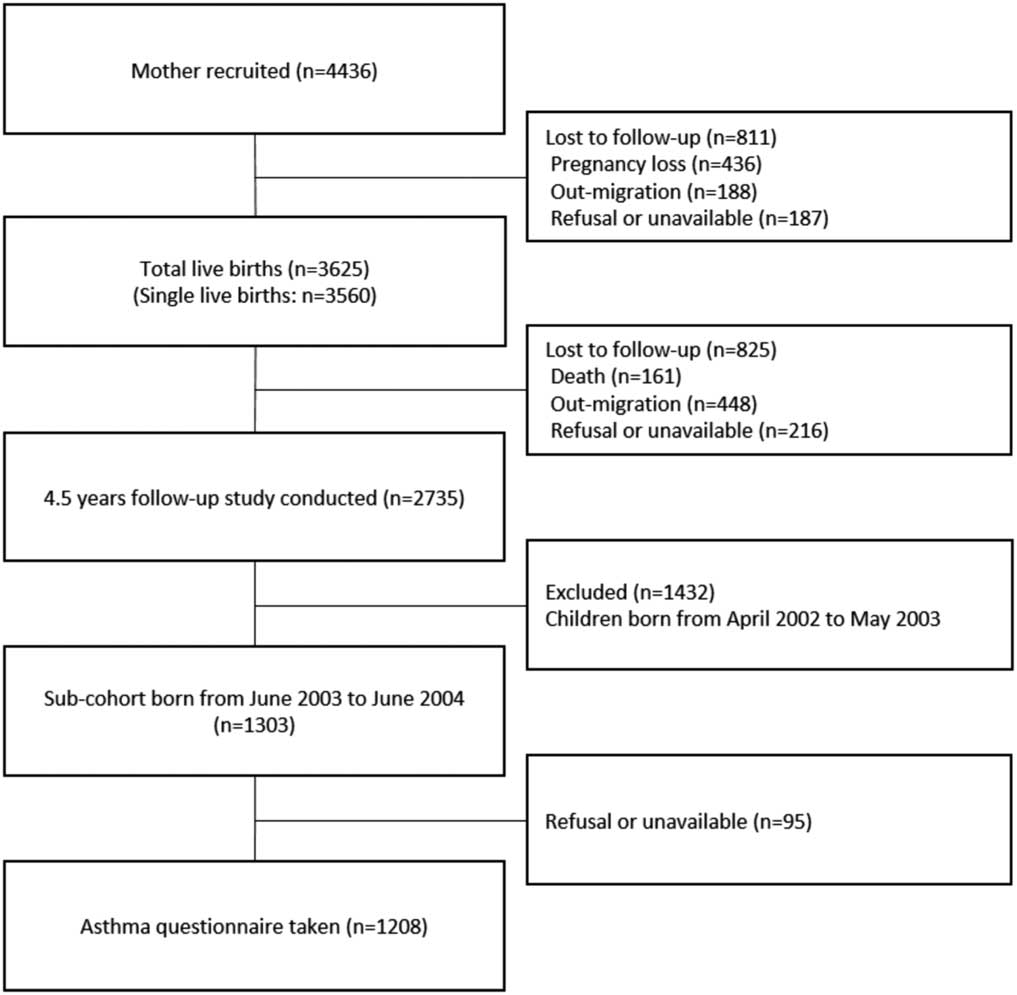
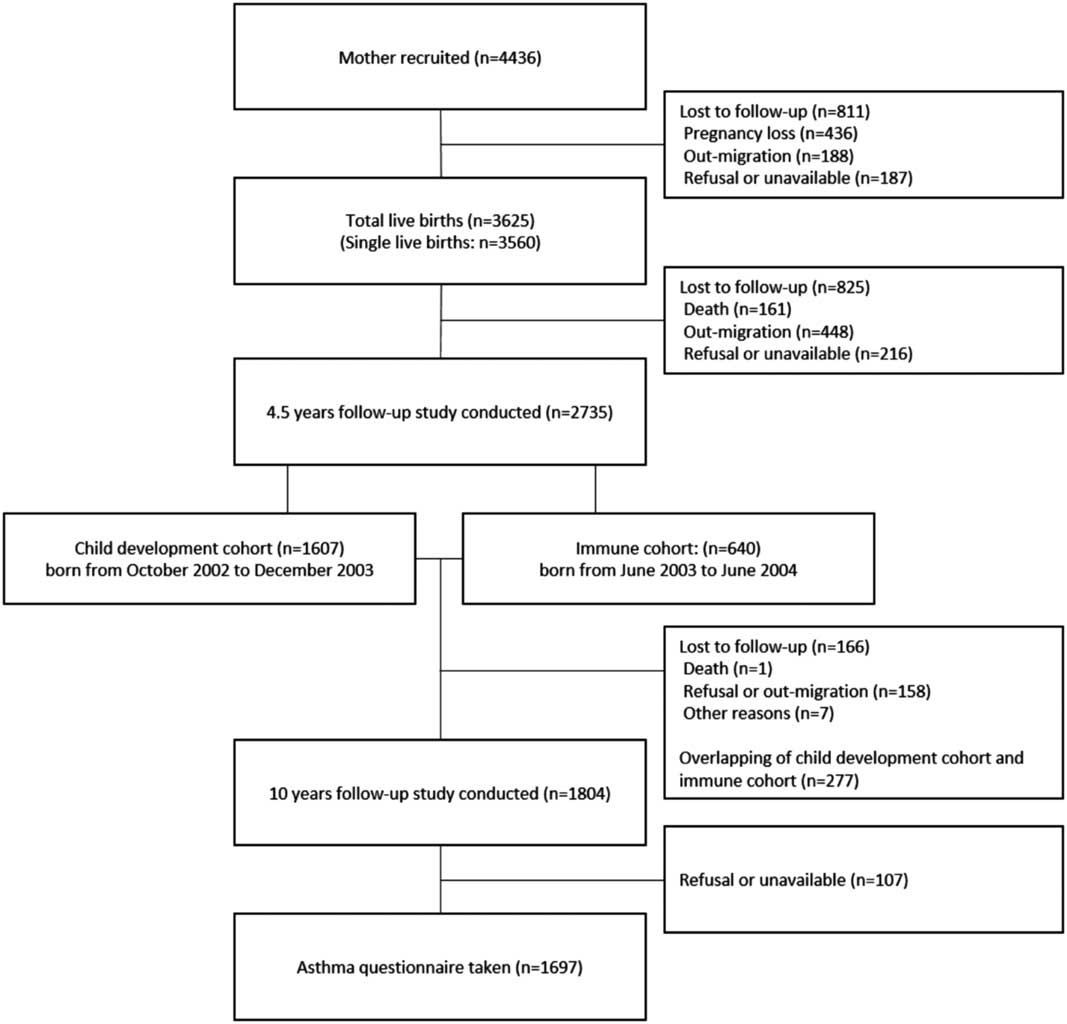
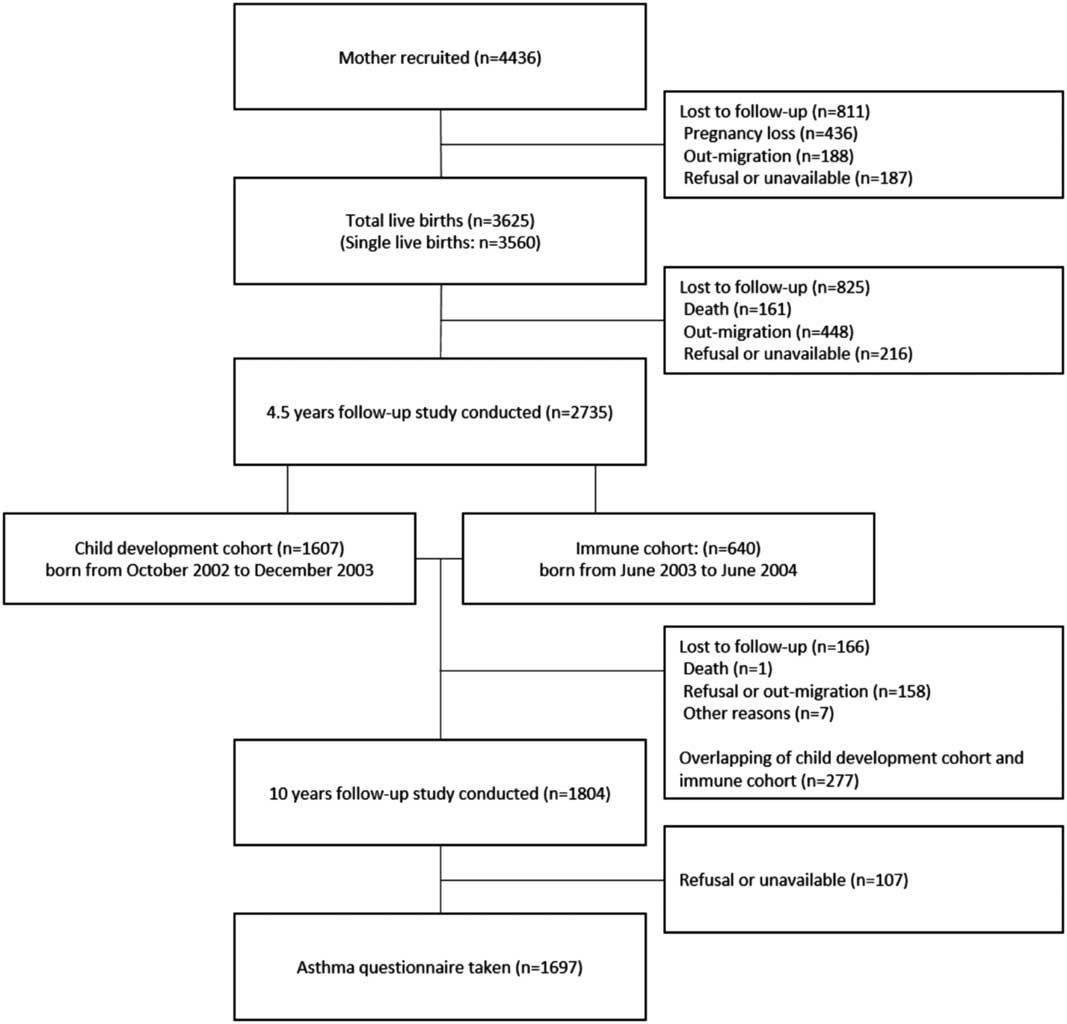
In total, 4436 pregnant women were enrolled early in pregnancy in the MINIMat study and were followed-up throughout their pregnancy, and data on their socioeconomic status (SES) were collected. The women who were enrolled were randomly assigned to take one of six (3×2 design) different food and micronutrient supplementations: (i) 30 mg of iron and 400 μg of folic acid (Fe30F), (ii) 60 mg of iron and 400 μg of folic acid (Fe60F) or (iii) the UNICEF preparation, which consists of 15 different micronutrients (MMS), including 30 mg of iron and 400 μg of folic acid,Reference Persson, Arifeen and Ekström22 which were combined with food supplementation (608 kcal/day, 6 days per week) and randomized to either the early (9 weeks gestation) or usual (20 weeks gestation) invitation. A total of 3625 babies were born during the MINIMat study. Among them, 2735 children were eligible for a follow-up assessment when reaching the age of 4.5 years. The reasons for lost to follow-up were out-migration (n=448), death (n=161) and refusal or unavailable (n=216). To reduce the burden of various examinations for one child in the multicomponent follow-up study, these children were classified into two groups according to their calendar year of birth (subgroup born from April 2002 to May 2003 and subgroup born from June 2003 to June 2004). Study components of immunity, asthma and allergic diseases were included in the protocol used in the subgroup born from June 2003 to June 2004 (n=1303).Reference Hawlader, Noguchi and Ei Arifeen21 Basic characteristics were not statistically different among groups in terms of age, sex and SES. A total of 1208 children were assessed for asthma questionnaire during the 4.5 years follow-up (Fig. 1). At 10 years of age, 1697 children were reassessed using the asthma questionnaire (Fig. 2). In the 10-year follow-up, the major reasons for loss to follow-up were refusal or out-migration. Regarding the SGA definition, the 2017 WHO fetal growth chartReference Hawlader, Noguchi and Ei Arifeen12 was used, and this information was only available for gestation age of <40 weeks. Thus, we excluded 132 and 172 children with ≤40 weeks of gestational age at birth for asthma analysis at 4 and 10 years of age, respectively.
Flowchart of children participating in the study at 4.5 years of age.

Flowchart of children participating in the study at 10 years of age.
SES was estimated using a wealth index based on the information about the household assets, housing structure, land occupation and income. Principal component analysis was used to produce a weighted score.24 Scores were categorized into quintiles, with one category representing the poorest and five categories the richest.
Anthropometric measurements
The weight and length or height of the children were measured by well-trained staffs at the clinics during the 2 and 6 months and 1, 2, 4.5 and 10 years follow-ups. Most anthropometric measurements were obtained within 72 h of birth. The birth weight measurements obtained between 24 h and 30 days after birth were adjusted using the standard deviation score (SDS) transformation, assuming that the infants were in the same relative position in the anthropometric distribution during this period.Reference Arifeen, Black and Caulfield25 The estimated birth weight was used for the purpose of assessing the adequacy of fetal growth. Length at birth and during infancy (at 2, 6 and 12 months) was measured with a locally manufactured, collapsible length board, with a precision of 0.1 cm. Birth weight was measured with a SECA electronic or beam scale (SECA GmbH & Co., Hamburg, Germany), with a precision of 0.01 kg. During follow-ups, height was measured to the nearest 0.1 cm with the Holtain stadiometer (Holtain, Birmingham, UK). Weight was measured with a TANITA digital scale (Tanita Corporation, Tokyo, Japan) while the children were wearing light clothes. Stunting, wasting and underweight were calculated using the WHO Anthro software version 3.1.0. for children aged below 5 years and the standards of the WHO Multicentre Growth Reference Study for children aged over 5 years.Reference de Onis, Onyango and Borghi26 Stunted growth was considered after birth and defined as a height-for-age Z-score <−2. Wasting was defined as a weight-for-height Z-score <−2, and underweight was defined as a weight-for-age Z-score <−2. Stunting, wasting and underweight were defined at 2 and 6 months and 1, 2, 4.5 and 10 years as an assessment of the nutrition status at that time. The weight and height of the mothers were measured while they were wearing light clothes using standardized scales and a stadiometer, and BMI was calculated during early pregnancy at 8–13 weeks of gestation.
The asthma questionnaire
Information about current wheezing, ever wheezing and ever asthma at 4.5 and 10 years was obtained using the International Study on Asthma in Childhood (ISAAC) questionnaire.Reference Leung, Wong and Lau27 The written ISAAC questionnaires were translated into Bangla, which is the national and local language of Bangladesh, according to the ISAAC protocol. A trained expert in both Bangla and English translated the original ISAAC questionnaire. Then, it was back-translated into English by another bilingual expert. The translated questionnaires were pretested and modified before data collection. The ISAAC questionnaires were administered by trained interviewers.
Current wheezing at the age of 4.5 years was defined as wheezing symptoms within the past 12 months, whereas current wheezing at the age of 10 years was defined as wheezing symptoms within the past 6 months. Time period was modified due to the note of the Ethical Review Committee in icddr,b. At the 4.5 years follow-up, in most of the cases the mothers answered the questionnaire. However, at the 10 years follow-up, it was expected that the children would answer the questionnaire by themselves. Although 12-month recall for asthma questionnaire is used globally, the Ethical Review Committee in icddr,b thought that it was difficult for a 10-year-old child to recall correctly over half a year ago. Ever wheezing was defined as wheezing symptoms at any time point in the past, and ever asthma was defined as asthma symptoms at any time point in the past.
Assessment of lung function
The lung function of children at the age of 10 years was assessed using an electronic spirometer (Chestgraph HI-101, CHEST Ltd., Tokyo, Japan) in accordance with the American Thoracic Society (ATS) recommendation (American Thoracic Society, 1995). Microsoft Windows TM-based spirometer software (Spiro 2000) was used to measure the forced vital capacity (FVC) and forced expiratory volume in 1 second (FEV1). The FVC and FEV1 of 540 children from the immune cohort were assessed (Supplementary Fig. S1).
The fractional exhaled nitric oxide (FeNO) concentration was measured using a portable handheld electrochemical device (Ninox Mino®, Aerocrine, Solna, Sweden) and was used as a marker of airway inflammation. FeNO tests were conducted according to the American Thoracic Society/European Respiratory Society Standardization guidelines (American Thoracic and European Respiratory 2005).28 The tests were repeated up to five times with 10 min rests between each test if the child could not complete the test successfully with one attempt. The FeNO of 540 children from the immune cohort was assessed (Supplementary Fig. S1).
Statistical analysis
Data were analyzed using the Statistical Package for the Social Sciences software version 22 (IBM, New York, USA). The differences in the distribution of exposure characteristics in relation to ever asthma at ages 4.5 and 10 years were analyzed using Mann–Whitney U-test (continuous variables) and the χ2-test (categorical variables). The association between stunting and SGA was analyzed using the χ2-test. The association between ever asthma and SGA was analyzed by multivariable adjusted logistic regression analyses. Basic adjustment was made using the following core covariates: sex, BMI, SES, family history of asthma, gestational age at birth, mother’s parity, mother’s age at birth and intervention trial arm. Additional adjustment was made for stunting at 2 years and at all ages. The covariates were selected a priori from the previous literature, including variables significantly associated with ever asthma. The association between ever asthma and stunting was analyzed using multivariable adjusted logistic regression analyses. The basic adjustment was made using the following core covariates: sex, BMI, SES, family history of asthma, gestational age at birth, mother’s parity, mother’s age at birth and intervention trial arm. Additional adjustment was made for SGA.
Children were included in the present analysis if information on ever asthma at ages of 4.5 or 10 years, SGA definition (gestational age of ≤40 weeks) and at least one anthropometric measurement obtained from age 2 months to 10 years were available.
The risks were estimated as odds ratios (ORs) along with 95% confidence intervals (CIs). Two-sided P-values <0.05 were statistically significant.
Results
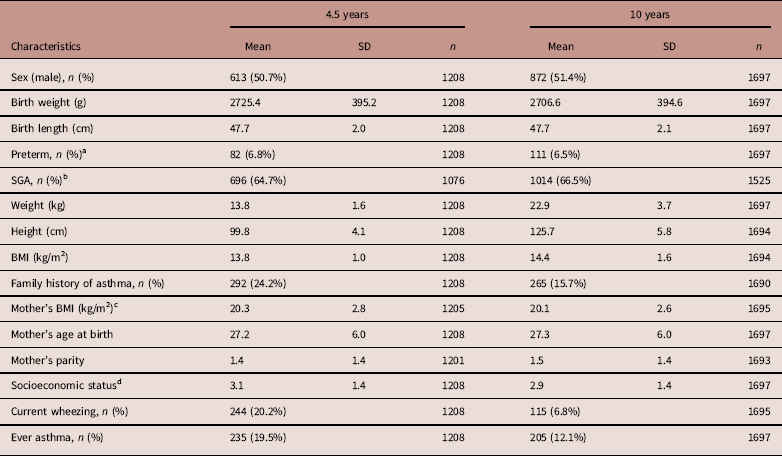
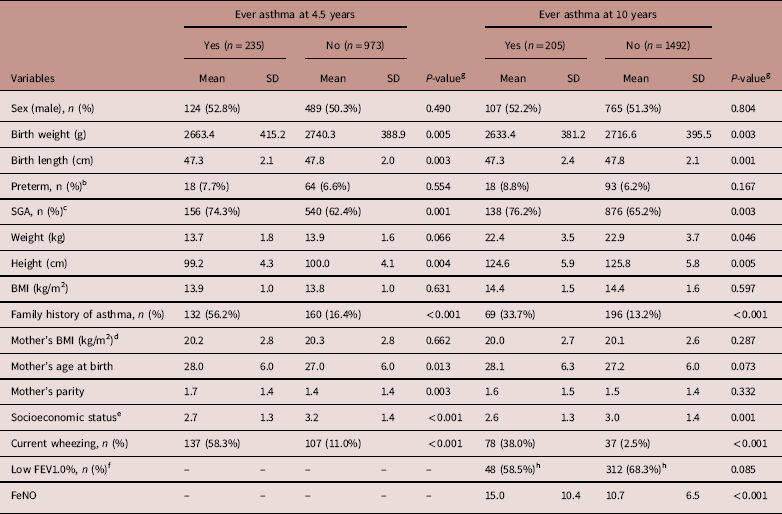
A total of 1208 and 1697 children with asthma at 4.5 and 10 years, respectively, were included in the analysis. The age of children during the follow-up for each study ranged from 4.5 to 5.3 and 8.0 to 10.6 years (median values, 4.5 and 9.8). The boys accounted for 50.7 and 51.4% of the 4.5- and 10-year-old study population, respectively. The prevalence of current wheezing, ever asthma and family history of asthma at 10 years (6.8, 12.1 and 15.7%, respectively) was lower than that at 4.5 years (20.2, 19.5 and 24.2%, respectively). The characteristic of the other variables at 10 years of age was similar to those at 4.5 years of age (Table 1).
Characteristics of study subjects participated in the cohort follow-ups at the age of 4.5 and 10 years

BMI, body mass index; SD, standard deviation.
a Defined as children with gestational age <37 weeks.
b Defined as birth weight below 10th percentile for gestational age of a reference standard.
c Measured at early pregnancy (8–10 weeks’ gestation).
d Estimated using a wealth index based on information about household assets and principal component analysis, producing weighted scores. Scores were categorized into quintiles with category 5 as the richest.
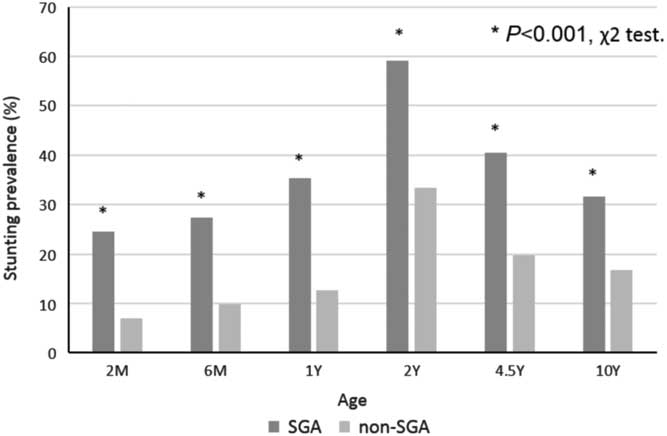
Figure 3 showed the stunting prevalence among SGA and non-SGA children observed at various timings of measurements. The prevalence of stunting at 2 months was 18.4%, and it increased to 50.4% at 2 years of age. By 4.5 years, the prevalence had decreased to 33.2%, and by 10 years, it declined to 26.7%. SGA children had a higher prevalence of stunting than non-SGA children at all ages (P<0.001) (Fig. 3).
Stunting prevalence among SGA and non-SGA children.

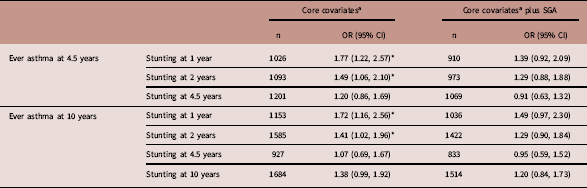
The SGA children were more likely to have asthma than the non-SGA children (P<0.05). Children with lower birth weight and length also had a higher risk of asthma than those with higher birth weight and length (P<0.01). Of the children with ever asthma, 58.3 and 38.0% presented with current wheezing at 4.5 and 10 years, respectively. At 10 years, children with ever asthma had a higher FeNO level (P<0.001), and ever asthma was significantly associated with lower lung function. In the 4.5- and 10-year follow-ups, children with short stature had a higher risk of developing asthma (P<0.01). Among the other variables, family history of asthma and SES were significantly associated with asthma in both 4.5 and 10-year follow-up (P<0.001) (Table 2). The association between ever asthma and stunting was examined during the 4.5- and 10-year follow-ups. After adjusting for sex, BMI, SES, family history of asthma, gestational age at birth, mother’s parity, mother’s age at birth and intervention trial arm in the multivariable logistic regression analysis, stunting at 1 and 2 years were significantly associated with ever asthma at both 4.5 and 10 years [stunting at 1 year: OR=1.77 (95% confidence interval (CI): 1.22–2.57) and OR=1.72 (95% CI: 1.16–2.56), stunting at 2 years: OR=1.49 (95% CI: 1.06–2.10) and OR=1.41 (95% CI: 1.02–1.96)]. Stunting at 2 and 6 months were nonsignificant in this model (P>0.05). However, they became nonsignificant after the additional adjustment for SGA [stunting at 1 year: OR=1.39 (95% CI: 0.92–2.09) and OR=1.49 (95% CI: 0.97–2.30), stunting at 2 years: OR=1.29 (95% CI: 0.88–1.88) and OR=1.29 (95% CI: 0.90–1.84)] (Table 3).
Association between ever asthma and various parameters among Bangladeshi children at age 4.5 and 10 yearsa

BMI, body mass index; SD, standard deviation.
a Information was missing for some variables.
b Defined as children with gestational age <37 weeks.
c Birth weight below 10th percentile for gestational age of a reference standard.
d Measured at the early in pregnancy (8–10 weeks’ gestation).
e Estimated using a wealth index based on information about household assets and principal component analysis, produced weighted scores. Scores were categorized into quintiles with category 5 as the richest.
f Defined as children with FEV1.0% is <70%.
g Mann–Whitney U-test (continuous variables) and χ2 test (categorical variables) were used to evaluate the differences between asthma statuses.
h Number of subjects measured for FEV1.0%, ever asthma yes: n=79, no: n=436.
Odds ratios (ORs) for children’s ever asthma at age 4.5 and 10 years by stunting during childhood

SGA, small for gestational age; OR, odds ratio; CI, confidence interval.
* P<0.05
a Adjusted by sex, BMI, socioeconomic status, family history of asthma, gestational age at birth, mother’s parity, mother’s age at birth and intervention trial arm.
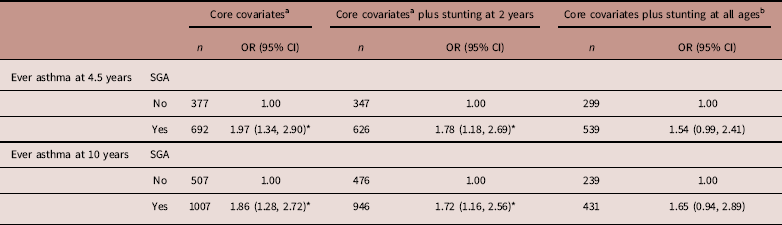
The association between ever asthma and SGA was examined. SGA was significantly associated with ever asthma at both 4.5 and 10 years after adjusting for sex, BMI, SES, family history of asthma, gestational age at birth, mother’s parity, mother’s age at birth and intervention trial arm [OR=1.97 (95% CI: 1.34–2.90) and 1.86 (95% CI: 1.18–2.72)] (Table 4). Further adjustment for stunting at 2 years slightly decreased the ORs [OR=1.78 (95% CI: 1.18–2.69) and 1.72 (95% CI: 1.16–2.56)], whereas they became nonsignificant after the additional adjustment for stunting at all ages [OR=1.54 (95% CI: 0.99–2.41) and OR=1.65 (95% CI: 0.94–2.89)] (Table 4).
Odds ratios (ORs) for children’s ever asthma at age 4.5 and 10 years by SGA

SGA, Small for gestational age; OR, Odds ratio; CI, confidence interval.
* P<0.05
a Adjusted by sex, BMI, socioeconomic status, family history of asthma, gestational age at birth, mother’s parity, mother’s age at birth and intervention trial arm.
b Adjusted by sex, BMI, socioeconomic status, family history of asthma, gestational age at birth, mother’s parity, mother’s age at birth, intervention trial arm, stunting at 1 year, stunting at 2 years, stunting at 4.5 years and stunting at 10 years (stunting at 10 years is used only in the model for asthma at 10 years).
We examined the effects of prenatal food and micronutrient supplementation during pregnancy on ever asthma. No difference was observed in the prevalence of ever asthma at 4.5 and 10 years of age between the early (9 weeks gestation) and usual (20 weeks gestation) food supplementation groups (P=0.64, 0.21) and among the micronutrient supplementation groups (P=0.88, 0.23).
Discussion
The findings of our study showed that both SGA and undernutrition during infancy were significantly related to asthma among children in rural Bangladesh. A previous study in the same area has suggested that wheezing is a significant cause of morbidity in children in rural Bangladesh. Moreover, underweight children had lower lung function, and lower body fat was associated with a higher occurrence of asthma symptoms.Reference Berntsen, Lødrup Carlsen and Hageberg29 The lung growth of malnourished children might be affected, leading to an increased likelihood of the occurrence of asthma symptoms.Reference Berntsen, Lødrup Carlsen and Hageberg29 In contrast, LBW (birth weight <2.5 kg), including preterm birth and SGA, was associated with childhood stunting and other indicators of nutritional status.Reference Christian, Lee and Angel14 According to a previous report, approximately 16% of LBW was observed in low-income countries, with rates higher in Asia than in Africa.Reference Black, Allen and Bhutta30 The result of the present study was in accordance with these findings, indicating that SGA might be related to childhood stunting and an important causal factor of childhood asthma among children in Bangladesh, with a high prevalence rate of SGA and undernutrition.
Regarding childhood stunting, a significant association between stunting at 1 and 2 years and ever asthma at 4.5 and 10 years was observed in the models including core covariates. Stunting is a chronic form of malnutrition and its causative factors are poorly understood. It may start from intrauterine life, and the peak incidence is before 2 years of life.Reference Ahmed, Ahmed, Roy, Alam and Hossain31 In this study, the prevalence of stunting was nearly the same as that reported in the previous MINIMat trial.Reference Svefors, Rahman and Ekström32 It decreased at 2 years, followed by an increase up to 10 years. A recent review has suggested that stunting in infancy is due to growth delay, which is associated with a decrease in the absorption of macronutrients and micronutrients caused by chronic enteric diseases within the first 2 years of life. The review has also found evidence that nutritional stunting due to enteric diseases early in life has long-term effects on the risk of developing diabetes and cardiovascular diseases.Reference Boer, Lima and Oría33 Another study has suggested that there was a defective T-cell response in malnourished children and that the proportions of total B cells, and those bearing the low-affinity IgE receptor (CD23+) were increased in the moderately malnourished children.Reference Hagel, Lynch and Puccio34 These high levels of total IgE may cause wheezing and asthma symptoms.
In addition, asthma is related to overweight, and growth during the first year of life may be important for lung development.Reference Casas, den Dekker and Kruithof35 A recent study has also shown that extreme changes in BMI, persistent underweight and overweight during childhood increased the risk of allergic asthma.Reference Chastang, Baiz and Parnet18 However, we could not examine the influence of overweight because of the limited number of children who are overweight (n=0–4) across all ages among this cohort in Bangladesh. Our results were in accordance with these findings, indicating that growth during the first 2 years of life might be the most critical period for lung and immune function development and the risk of acquiring childhood wheezing and asthma.
Furthermore, the logistic regression analysis including the core covariates revealed that ever asthma was significantly associated with stunting only at 1 and 2 years but not at 2 and 6 months. It has previously been reported that most SGA infants showed catch-up growth during the first years of life, and the actual length SDS at 6 months of age for full-term SGA infants was still below the third percentile among children in the Netherlands.Reference Hokken-Koelega, De Ridder and Lemmen36 In our study, the relationship between SGA and asthma remained significant after adjusting the stunting at 2 years. Moreover, stunting became nonsignificant after the additional adjustment for SGA. These results suggest that most of the effects on asthma was SGA and that SGA children without catch-up growth during the second year after birth might have the risk of developing childhood asthma. As a reference, the effects of SGA on asthma were analyzed after adjusting for core the covariates and stunting at all ages. However, the SGA became nonsignificant because of the strong correlations between SGA and stunting at all ages.
The results of the present study showed that ever asthma was not associated with preterm birth. A recent meta-analysis of pooled data on developed countries has shown that preterm birth was associated with an increased risk of wheezing disorders.Reference Been, Lugtenberg and Smets37 However, another study has reported an independent relationship between asthma and childhood stunting,Reference Hawlader, Noguchi and Ei Arifeen21 which have more significant effects on fetal growth restriction than preterm birth, among children in low- and middle-income countries.Reference Christian, Lee and Angel14 Our data suggest that SGA and postnatal stunting have a stronger impact on childhood asthma than preterm birth itself. It might be due to relatively small population of preterm (6.5%) in our study.
For the supplementation, this cohort was all derived from a population where mothers were supplemented throughout the pregnancy with folic acid. A previous study suggested that continued maternal folic acid supplementation into the late pregnancy is associated with increased rates of asthma and other allergies in the populations in developed countries.Reference Whitrow, Moore, Rumbold and Davies38 We acknowledge the need to consider current supplementation strategies in order to maximize the neuroprotective effects of folic acid while minimizing the potential adverse postnatal respiratory effects.
The major strengths of this study include its prospective design (from in utero life to 10 years of age) and relatively large sample size. The high-quality assessments over time made it possible to assess weight and height throughout childhood. Other strengths are the compact age group of the study participants and their unique demographic and socioeconomic characteristics. Some potential limitations require attention. For example, we used a questionnaire based on the ISAAC to diagnose current wheezing. The term wheezing is often misinterpreted by parents, and this may produce overestimation or underestimation of the symptoms. However, the ISAAC questionnaire has been used worldwide and has repeatedly provided a reliable estimation of the prevalence of asthma.Reference Leung, Wong and Lau27 Moreover, the association between ever asthma and FeNO values increases the questionnaire’s reliability. In addition, although the participants were from a population-based cohort, selection bias cannot be ruled out because there were some differences between the children who were included in the 4.5- and 10-year-old analyses. Finally, although we considered several previously identified confounders, the associations might have been influenced by residual or unmeasured confounders.
In conclusion, SGA and undernutrition during infancy may influence the development of childhood asthma among children in Bangladesh. Follow-up studies that include older children and longitudinal analysis must be conducted to elucidate whether these effects persist at later ages. Our analysis revealed that childhood undernutrition may have started during the fetal period, indicating the need for early-life interventions, particularly during pregnancy. Considering the significant impact of stunting at 1 and 2 years of age, approaches to improve breastfeeding and complementary feeding practice within the first 2 years of life might be also needed in specific populations, such as that in rural Bangladesh.
Supplementary material
To view supplementary material for this article, please visit https://doi.org/10.1017/S2040174419000096
Acknowledgments
The authors are grateful to the study participants for their involvement in the study. We thank the field and laboratory team members and data management staff of the icddr,b for their excellent work. Also thanks to Editage (www.editage.jp) for English language editing. Please note that the authors are entirely responsible for the scientific content of the paper.
Financial support
This work received financial support from UNICEF, DFID, SIDA, USAID, MRC and JSPS (JSPS kakenhi grant number: JP18256005).
Conflicts of interest
None.
Ethical standards
The study was conducted according to the guidelines laid down in the Declaration of Helsinki. All procedures involving human research participants were approved by the Ethics Review Committees of the icddr,b and Uppsala University. Written informed consent was obtained from the participants (for mothers) and the parents (for children) to participate in the study.