Introduction
The golden snub-nosed monkey (Rhinopithecus roxellana) is endemic to China and is ranked as a Class I protected species by both the national government of China and the Convention on International Trade in Endangered Species of Wild Fauna and Flora (CITES), and has been categorized as Endangered on the International Union for Conservation of Nature (IUCN) Red List of Threatened Species (Yongcheng & Richardson, Reference Yongcheng and Richardson2008; Ren et al., Reference Ren2012). The total population of R. roxellana in the wild is c. 10,000–16,000, mainly distributed in the western part of southern Gansu province, the Qinling Mountains (Shaanxi province), the Shennongjia forestry district (Hubei province), and the Sichuan province of China (Chang et al., Reference Chang2012). In addition to habitat challenges, infectious diseases caused by viruses and gastrointestinal nematodes are also responsible for a sharp decrease in the R. roxellana population (Li and Yang, Reference Li and Yang2015).
Trichuris (syn. Trichocephalus) species are common soil-transmitted helminths (STH), which parasitize the digestive tracts of golden monkeys and can cause typhlitis, colitis, chronic dysentery, serious malnutrition and even death. Five Trichuris species have been reported in golden monkeys (Li and Yang, Reference Li and Yang2015), and a Trichuris sp. isolated from R. roxellana has been named as a novel species, T. rhinopiptheroxella sp. nov., based on its distinct morphological features (Zhu et al., Reference Zhu2000). However, species nomenclature based on morphology lacks the ability to identify closely related species and larval parasites, is time-consuming and requires expert training (McManus and Bowles, Reference McManus and Bowles1996; Zhao et al., Reference Zhao2013).
In the last decade, molecular approaches have been widely used for characterization of parasite species (Gasser et al., Reference Gasser2008; Wang et al., Reference Wang2011; Zhao et al., Reference Zhao2012). Sequence analysis of mitochondrial DNA (mt DNA) has been used to study phylogenetic relationships of Trichuris spp. from humans, pigs, sheep, monkeys and other wild animals (Liu et al., Reference Liu2012, Reference Liu2013, Reference Liu2014a, Reference Liub; Hawash et al., Reference Hawash2015, Reference Hawash2016; Callejón et al., Reference Callejón, Halajian and Cutillas2017). In particular, sequence analysis of the entire mt genome has been widely used to distinguish closely related parasitic species and correctly identify their taxonomic relationships (Wang et al., Reference Wang2011; Liu et al., Reference Liu2012; Zhao et al., Reference Zhao2013, Reference Zhao2016). For example, based on mt genomic data, distinct genetic differences were observed in Trichuris spp. from humans and pigs (Liu et al., Reference Liu2012), and the phylogenetic position of Orientobilharzia turkestanicum belonging to the genus Schistosoma was clarified (Wang et al., Reference Wang2011; Aldhoun et al., Reference Aldhoun and Littlewood2012). In the present study, the phylogenetic position of T. rhinopiptheroxella, which had previously been characterized only morphologically, was analysed using both morphological and mt genomic data.
Materials and methods
Parasites and isolation of total genomic DNA
Adult specimens of Trichuris sp. were collected from the stomach of the dead monkey. The worms were rinsed thoroughly with physiological saline (PBS) to remove host tissue particles and preserved in 75% ethanol prior to DNA extraction. The posterior end of each male worm was excised and placed in lactophenol for further morphological observation. The total genomic DNA was extracted from the mid-body section of each worm using proteinase K treatment and purified directly using a column-purification kit (TIANamp Genomic DNA Kit, TIANGEN, Beijing, China), according to the manufacturer's instructions.
Polymerase chain reaction (PCR) amplification, sequencing of the mt genome
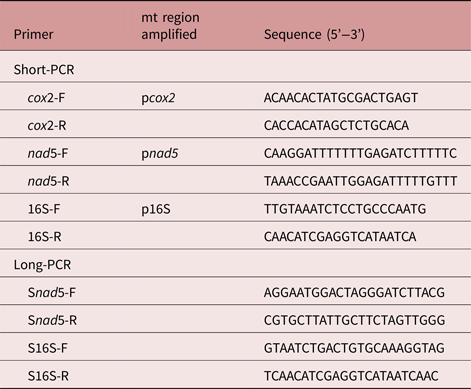
Initially, three partial fragments (pcox2, pnad5 and p16S) were amplified using the primers described in table 1, which were designed manually based on conserved regions of mt genes of closely related species. Subsequently, the sequences obtained (pnad5 and p16S) were used to design species-specific primer sets for the amplification of the entire mt genome of Trichuris spp. from golden monkeys, using three long overlapping PCR fragments (cox2-nad5, nad5-16S, 16S-cox2) (table 1). Long-range PCR was performed in a 25 μl mixture containing 2 mm MgCl2, 0.5 mm each of dNTP, 2.5 μl 10 × LA PCR Buffer (Mg2+ free), 0.4 μm each of primer, 0.25 μl LA Taq (5 U/μl) (TaKaRa, Dalian, China), and 1 μl of DNA, with the following cycling conditions: 92°C for 2 minutes (initial denaturation), then 92°C for 10 s (denaturation), 45°C for 30 s (annealing), and 60°C for 8 minutes (extension) for nine cycles, followed by 92°C for 10 s, 45°C for 30 s, and 60°C for 9 minutes for 25 cycles, and a final extension at 60°C for 10 minutes. A negative control (no DNA) was also included in each PCR reaction. PCR products (5 μl) were examined by electrophoresis in 1% agarose gel with ethidium bromide at 110 V for 30 minutes. Positive PCR amplicons were purified from the agarose gel using the Universal DNA Purification Kit (TIANGEN, Beijing, China). The purified products were ligated into pGEM-T Easy vector (Promega, Madison, WI, USA) and then transformed into Escherichia coli JM109 competent cells (TaKaRa, Dalian, China) as recommended by the manufacturer to obtain positive recombinant plasmids. At least three positive transformants were sequenced in both directions using a primer walking strategy by the Sangon Company (Shanghai, China).
Sequences of primers used to amplify PCR fragments from the mt genome of T. rhinopiptheroxella.

Sequence analyses and annotation of mitochondrial genome
Gene boundaries, protein-coding genes (PCGs) and two ribosomal RNA genes were annotated based on comparison and alignment with the complete mt genome sequences of Trichuris trichiura (Liu et al., Reference Liu2012; Hawash et al., Reference Hawash2015), Trichuris sp. GHL-2013 (Liu et al., Reference Liu2013) and Trichuris spp. TTB1 and TTB2 (Hawash et al., Reference Hawash2015) using Clustal X 1.83 (Thompson et al., Reference Thompson1997). Corresponding amino acid sequences were translated from the 12 PCGs using the invertebrate mitochondrial genetic codes in MEGA 5.0 (Tamura et al., Reference Tamura2011) with default settings. The majority of tRNA genes were identified using tRNAscan-SE (Lowe and Eddy, Reference Lowe and Eddy1997), together with ARWEN (Laslett and Canbäck, Reference Laslett and Canbäck2008), whereas the remaining tRNA genes were recognized manually based on their capability of folding into the tRNA-like secondary structures and anticodon sequences. The nucleotide composition and frequency of the codon usage were calculated using MEGA 5.0 (Tamura et al., Reference Tamura2011).
Phylogenetic analyses
In order to clarify the phylogenetic relations of Trichuris sp. from R. roxellana with closely related species, a genetic tree of selected nematodes was reconstructed using the Bayesian inference (BI) method within MrBayes 3.1.1 (Ronquist and Huelsenbeck, Reference Ronquist and Huelsenbeck2003) based on a concatenated dataset of deduced amino acid sequences of 12 mt genomic PCGs (without the atp8 gene), with Trichinella spiralis as the outgroup. The relatively conserved regions in each PCG were selected using Gblocks (http://molevol.cmima.csic.es/castresana/Gblocks_server.html) with the options for a less stringent selection (Talavera and Castresana, Reference Talavera and Castresana2007) and then subjected to subsequent phylogenetic analysis. The BI analyses consisted of 1,000,000 metropolis-coupled Markov chain Monte Carlo (MCMC) generations, with trees sampled every 1000 generations. Bayesian posterior probabilities (PP) were calculated in the remaining trees after discarding the initial 25% of trees as burn-in. Phylograms were shown using the program Tree View 1.65 (Page, Reference Page1996).
Results and discussion
Morphological characterization of Trichuris sp. from R. roxellana
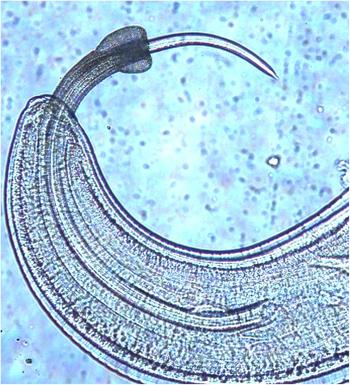
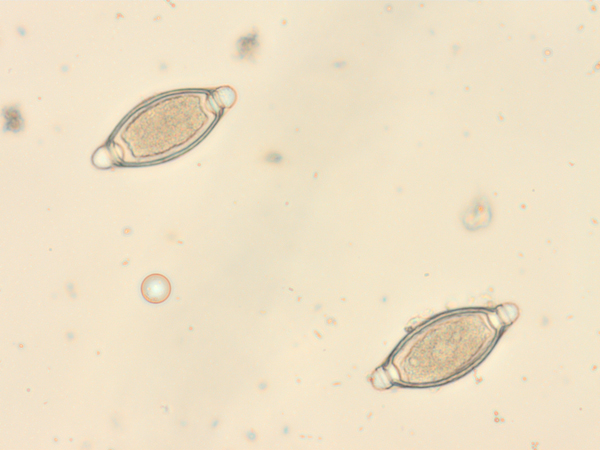
To morphologically identify the Trichuris sp. from R. roxellana, morphological features of 40 male and 40 female worms were carefully examined and measured, including the total body length, characters and lengths of the anterior and posterior bodies, inner structures, characters of the spicule and spicule sheath (fig. 1), and eggs (fig. 2). Morphological characterization indicated that the Trichuris sp. obtained from a snub-nosed monkey from the Qinling Mountains was similar in measurements to the previously reported T. rhinopiptheroxella sp. nov. (Zhu et al., Reference Zhu2000), suggesting that they were the same species of nematode. However, considering that the location of the monkeys differed, we only tentatively identified the nematodes obtained in the present study as T. rhinopiptheroxella.
Posterior end of T. rhinopiptheroxella (male), showing the shape of the spicule sheath (40×).

Trichuris rhinopiptheroxella egg (40×).

The mitochondrial genome of T. rhinopiptheroxella
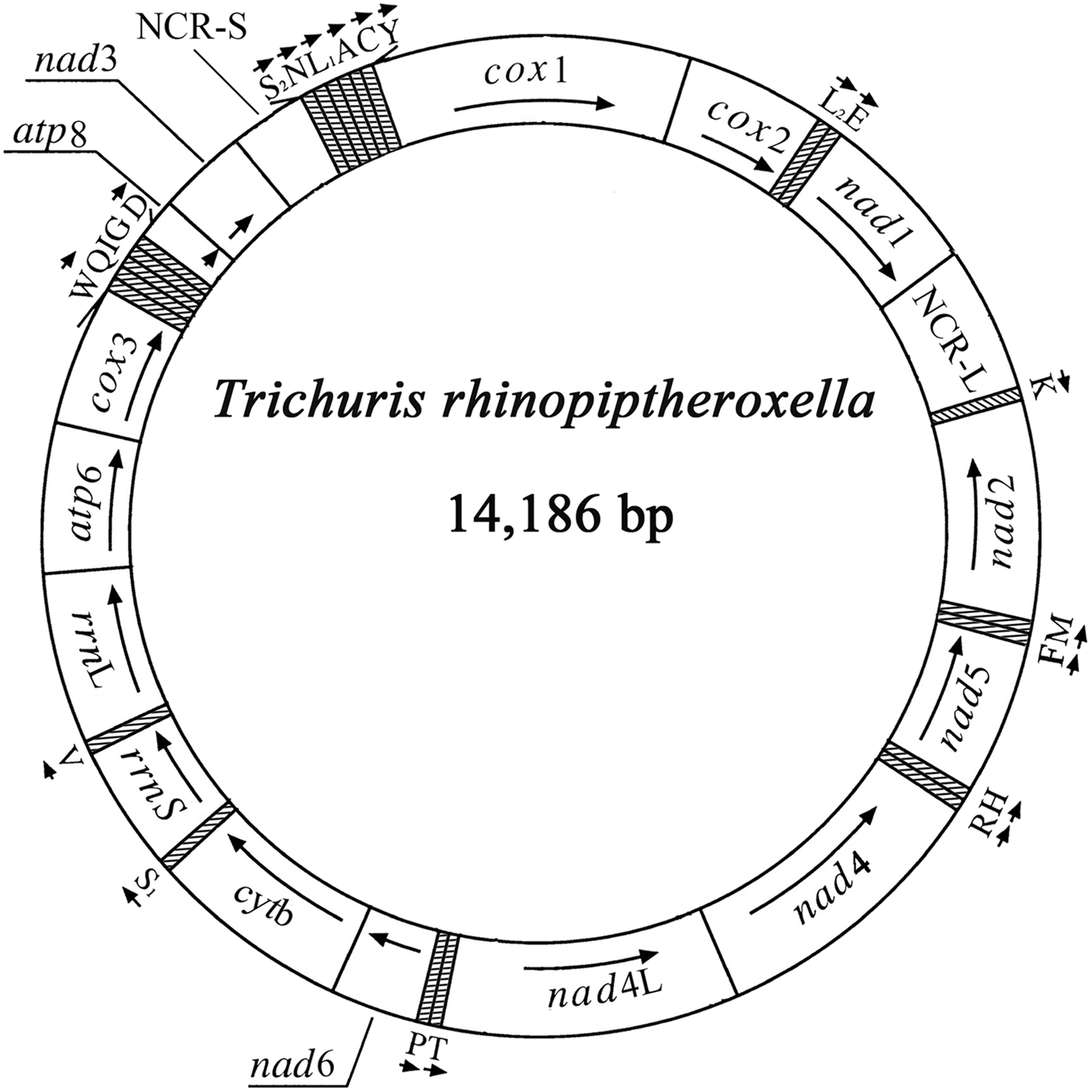
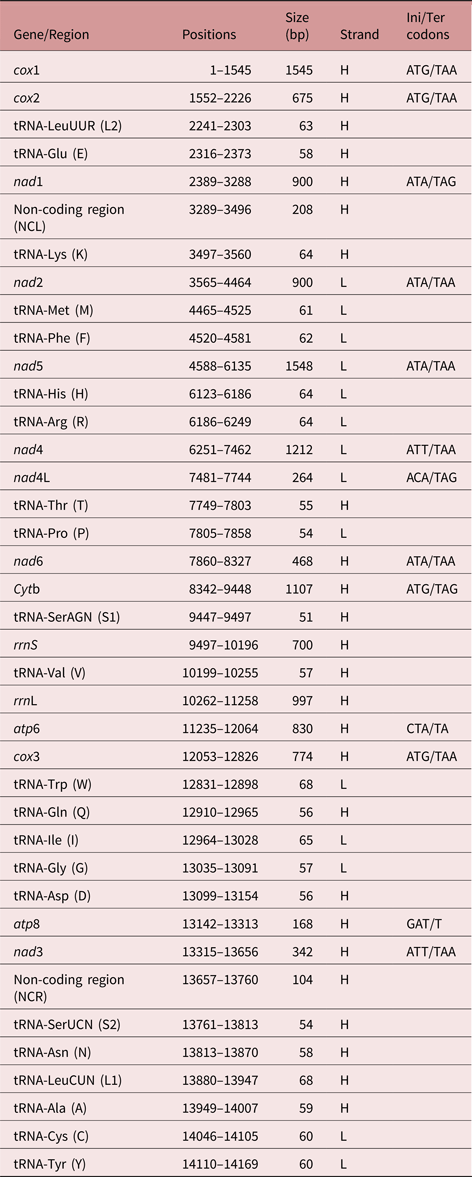
The complete mitochondrial genome of T. rhinopiptheroxella (GenBank accession number: MG189593) is a typical circular duplex DNA molecule, with a total length of 14,186 bp (fig. 3), which is 140 bp longer than T. trichiura from humans (14,046 bp, NC_017750 and GU385218), 39 bp longer than a Trichuris sp. GHL-2013 from Francois' leaf-monkey (Trachypithecus francoisi) (14,147 bp, KC461179), 202 bp longer than a Trichuris sp. TTB1 from the hamadryas baboon (Papio hamadryas) (13,984 bp, KT449824), and 177 bp longer than a Trichuris sp. TTB2 from an olive baboon (Papio anubis) (14,009 bp, KT449825). It contains 13 protein-coding genes (cox1-3, nad1-6, nad4L, atp6, atp8 and cytb), 22 transfer RNA genes, two ribosomal RNA genes and two non-coding regions (table 2). Moreover, four PCGs (nad2, nad5, nad4 and nad4L) and 10 tRNA genes (tRNA-Met, tRNA-Phe, tRNA-His, tRNA-Arg, tRNA-Pro, tRNA-Trp, tRNA-Ile, tRNA-Gly, tRNA-Cys and tRNA-Tyr) are transcribed on the L-strand, whereas the other genes are encoded on the H-strand, which is consistent with mt genomes of other Trichuris species previously reported (Liu et al., Reference Liu2012, Reference Liu2013; Hawash et al., Reference Hawash2015).
Circular mapping of the mitochondrial genome of T. rhinopiptheroxella. Gene scaling is approximate and all genes are coded by the same DNA strand. The arrow indicates the direction of transcription and all genes have standard nomenclature except for the 22 tRNA genes, which are designated by the one-letter code for the corresponding amino acid. Numerals differentiate each of the two leucine- and serine-specifying tRNA (L1 for codon families CUN and L2 for UUR, S1 for AGN and S2 for UCN) with small coding (NCR) and large non-coding (NCL) regions.

Mitochondrial genome organization in T. rhinopiptheroxella.

The mt genome sequence of T. rhinopiptheroxella has a marked A + T bias, with an overall A + T nucleotide composition of 69.5%, in which T is predominant and G is the least popular nucleotide, in line with the mt genomes of other whipworms (Liu et al., Reference Liu2012, Reference Liu2013; Hawash et al., Reference Hawash2015).
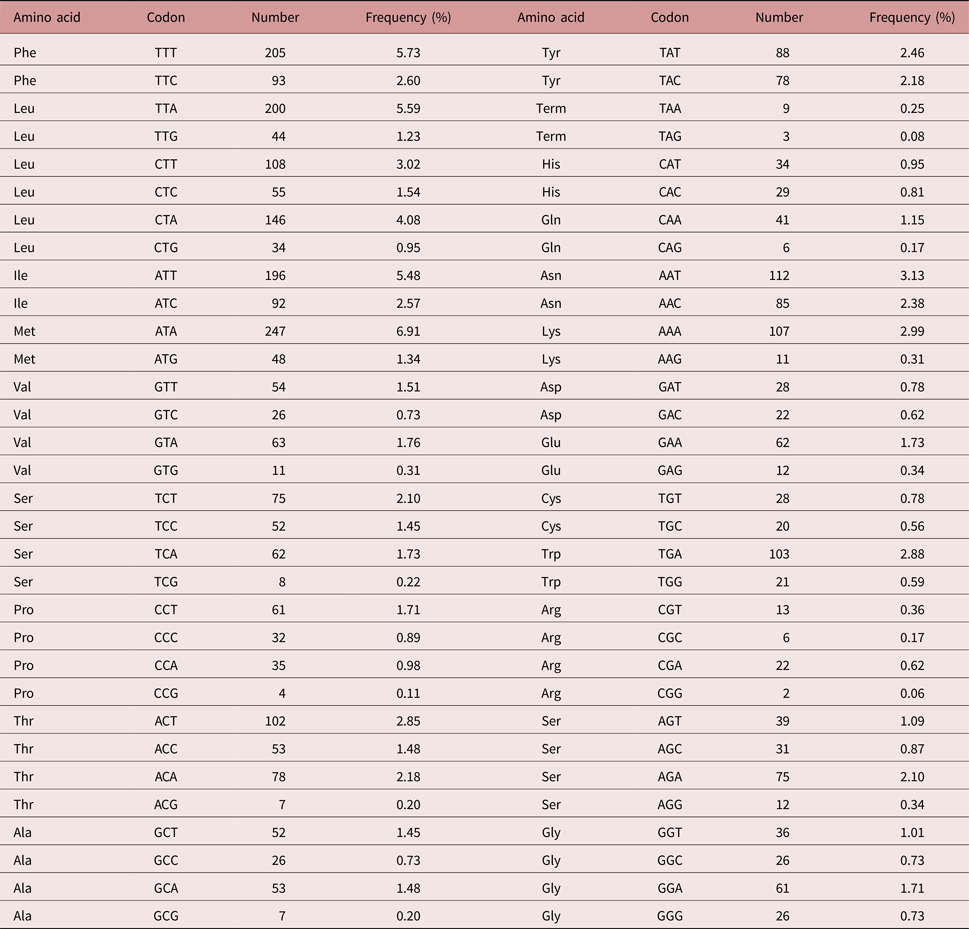
For all 13 PCGs of T. rhinopiptheroxella, the ATN codons are commonly used as the start codon, with four (cox1-3, cytb) using ATG, four (nad1, nad2, nad5 and nad6) employing ATA, and two (nad3 and nad4) employing ATT (table 2). Although most PCGs used TAA (cox1-3, nad2-6) as the termination codon, an incomplete TA and T were also found to encode termination codons for atp6 and atp8, respectively, which was not in accordance with studies of the other congeneric nematodes (Liu et al., Reference Liu2012; Hawash et al., Reference Hawash2015). Excluding the termination codons, a total of 3,577 amino acids (table 3) were encoded by the entire mt genomes of T. rhinopiptheroxella. The nucleotide bias towards AT also corresponded with a higher frequency of T-rich codons: ATA for methionine (6.91%), TTT for phenylalanine (5.73%), TTA for leucine (5.59%), and ATT for isoleucine (5.93%). The codons CGG (leucine) were utilized only twice.
Codon usage of T. rhinopiptheroxella mitochondrial DNA encoded proteins.

Total number of codons for T. rhinopiptheroxella is 3577, excluding the incomplete termination codons.
All 22 typical tRNA genes were detected in the mt genome of T. rhinopiptheroxella, ranging from 51 to 68 bp in size. The putative secondary structures of most tRNA genes (data not shown) shared common features, including an amino-acyl stem, a dihydrouridine (DHU) arm, and an anticodon stem, but lacking the TΨC arm which took the place of a TV replacement loop, with the exception of trnS1 and trnS2, which had a DHU arm that possessed a TΨC stem–loop structure. These structures were similar to those reported in other Trichuris spp. (Liu et al., Reference Liu2012, Reference Liu2013; Hawash et al., Reference Hawash2015).
The small- (rrnS) and large-subunit ribosomal RNA (rrnL) of T. rhinopiptheroxella were identified based on comparisons with sequences from T. trichuria (Liu et al., Reference Liu2012, Reference Liu2013; Hawash et al., Reference Hawash2015). rrnL and rrnS were 997 bp and 700 bp in length, with A + T contents of 74.2% and 74%, respectively, which were located between tRNA-Val and atp6, and between tRNA-SerAGN (S1) and tRNA-Val, respectively.
Additionally, two non-coding regions (NCRs) were identified in the mtDNA sequences of T. rhinopiptheroxella, including the large (NCL) and small non-coding (NCR) regions. The NCL (208 bp), located between nad1 and tRNA-Lys, contained 62 tandem repeats (AT), with the A + T content of 87.5%, while the NCR (109 bp) was situated between nad3 and tRNA-SerUCN (S2), with the A + T content of 75.23%. These regions, also referred to as control regions, are known to be likely candidates for replication and transcription (Wolstenholme et al., Reference Wolstenholme1992).
Comparative analyses among monkey- and human-derived Trichuris sp.
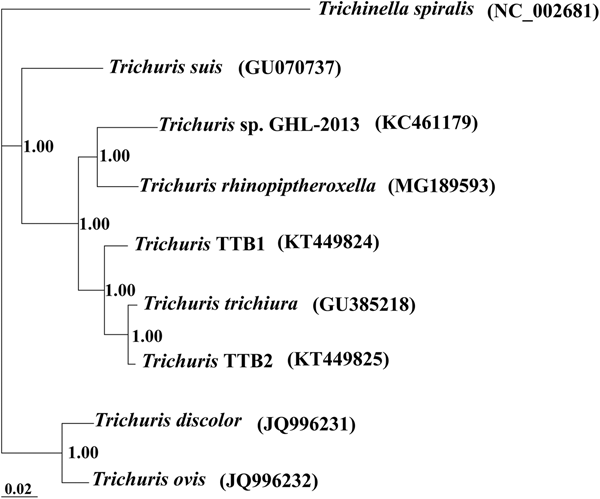
In the present study, the complete mt genome of T. rhinopiptheroxella was sequenced. Genetic distances between T. rhinopiptheroxella and other Trichuris from humans, Francois' leaf-monkey, the hamadryas baboon and the olive baboon were 27.5%, 27.7%, 27.8% and 27.8%, respectively. The mt gene arrangement of T. rhinopiptheroxella was completely identical to that of other congeneric whipworms available in GenBank. In the phylogenetic tree, T. rhinopiptheroxella was genetically distinct and clustered in a clade with Trichuris sp. GHL-2013 from Francois' leaf-monkey. Previous studies have reported that mt DNA sequence variation between individuals within a species could reach up to 2% on average, whilst between closely related species genetic distances were generally 10–20% (Blouin, Reference Blouin2002). In the present study, the genetic distance of 27.5–27.8% between T. rhinopiptheroxella and other Trichuris sp. provides further evidence that T. rhinopiptheroxella represents a separate species at the molecular level.
Phylogenetic analysis of Trichuris spp.
The BI tree based on the concatenated amino acid sequences of 12 PCGs (with the exception of atp8) (fig. 4) also confirmed the genetic distinctness of T. rhinopiptheroxella from the other Trichuris species, with absolute nodal support (pp = 1.00), confirming that T. rhinopiptheroxella is a valid species, which is most closely related to Trichuris sp. GHL-2013 from Francois' leaf-monkey.
Genetic relationship of T. rhinopiptheroxella with closely related nematode species based on mitochondrial sequence data. The concatenated amino acid sequences of 12 protein-coding genes (with the exception of atp8) were analysed using Bayesian inference, with Trichinella spiralis as the outgroup; posterior probability (scale bar).

Trichuris, an STH of medical and veterinary importance, can parasitize a broad range of hosts, such as ruminants, humans, non-human primates, pigs, dogs and rodents (Cafrune et al., Reference Cafrune, Aguirre and Rickard1999; Robles et al., Reference Robles Mdel2014). Trichuris trichiura has been reported to infect 600 million people globally (Hotez et al., Reference Hotez2009), especially children, resulting in considerable socio-economic losses and public health concerns. Trichuris derived from R. roxellana was initially reported in the stomach of golden snub-nosed monkeys and named as T. rhinopiptheroxella on the basis of morphology alone (Zhu et al., Reference Zhu2000). However, relying solely on conventional methods may cause taxonomic problems (synonyms) in morphologically similar species (Cutillas et al., Reference Cutillas1995; Oliveros et al., Reference Oliveros2000). With the advent of molecular biology, mtDNA has been proven as an alternative way to address taxonomic issues of parasites, especially using amino acid datasets inferred from the mt genomes, which have been shown to be robust genetic markers for elucidating phylogenetic relationships at different taxonomic levels (Lü et al., Reference Lü2010; Liu et al., Reference Liu2012; Zhao et al., Reference Zhao2012, Reference Zhao2016).
Previous studies reported that the prevalence of Trichuris sp. in golden snub-nosed monkeys in Shaanxi province was 83.3%, indicating that this is a common infection in these monkeys (Ravasi et al., Reference Ravasi2012). The present study sequenced and characterized the complete mitochondrial genome sequences of T. rhinopiptheroxella, further supporting that T. rhinopiptheroxella represents a valid Trichuris species, and provides a solid basis for further taxonomic, population genetic and molecular epidemiological studies of Trichuris.
Acknowledgments
We would like to thank Xiong-Feng Hu and Ge-Ru Tian for collecting samples, and Prof. Una Ryan from Murdoch University, Australia, for editing the language of this article.
Conflict of interest
None.
Ethical standards
This study was carried out strictly according to the recommendations of the Guide for the Care and Use of Laboratory Animals of the Ministry of Health, China, and the protocol was reviewed and approved by the Research Ethics Committee of Northwest A&F University. The golden snub-nosed monkey used in the study was rescued from the Qinling Mountains (34°04′6.29″N, 108°19′19.74″E), but unfortunately died two days later due to age and parasitic infections. Sampling of parasites from the dead monkey was permitted by the Shaanxi Rare Wildlife Rescue Breeding Research Center, with no specific permits being required by the authority for the collection of worms.