Introduction
Over the past few decades, socio-economic reforms in China have encouraged a huge amount of the rural labour force to migrate to cities in search of opportunities (Liang and Ma, Reference Liang and Ma2004; Lucas, Reference Lucas2004; Johnson and Woon, Reference Johnson and Woon2010; Lyu and Chen, Reference Lyu and Chen2019). In recent years, these rural-to-urban migrants, who have been significantly contributing to economic growth and urbanisation in China, are ageing at an unprecedented level (Chen and Powell, Reference Chen and Powell2012). However, rural-to-urban older migrants still participate more actively in the labour market than urban older residents. In 2016, the paid employment rates for rural-to-urban older migrants and urban older residents were 45 and 19 per cent, respectively.Footnote 1 Meanwhile, the effective health insurance and social security coverage for rural-to-urban older migrants is perilously lower than that for urban older residents.
As a crucial form of storing family wealth, housing can be served as precautionary/retirement savings for older people.Footnote 2 The literature has documented that the retirement decision of older people in developed countries is shaped by housing wealth (e.g. Farnham and Sevak, Reference Farnham and Sevak2015; Zhao and Burge, Reference Zhao and Burge2017). It is still not clear to what extent the labour market participation of older migrants in China depends on home ownership.Footnote 3 Furthermore, it remains to be studied whether or not home ownership could be used as compensation for the lack of financial security when older migrants in China make their retirement decision. This paper sheds light on the two questions referred to above, and is concerned with the wellbeing of older migrants.
In addition, the effectiveness for older migrants to use houses as precautionary/retirement savings may differ remarkably across properties with different liquidity levels. Since the liquidation value or redeployability of houses in China is highly correlated with the types of property rights, we use property ownership to approximate the liquidation value of houses. In particular, we investigate whether the labour market participation of older migrants would heterogeneously respond to houses with different liquidity levels. Our analysis provides some further discussions on the importance of improving the housing property rights system in China.
To alleviate the potential endogeneity between home ownership and older migrants’ labour market participation, we employ the propensity score matching method to construct comparable treatment and control groups. Our empirical findings are novel. First of all, older migrants who do not own houses more actively participate in the labour market than home owners. This negative effect of home ownership on older migrants’ labour market participation is more prominent when older migrants own houses with full property rights, that is, can be more easily liquidated in the market.Footnote 4 Second, the heterogeneous analysis reveals that older migrants with a greater lack of financial security would more heavily rely on home ownership in making retirement decisions. Our findings suggest that houses indeed can be used as a form of precautionary savings to compensate for the retirement insecurity of older migrants in China. The wellbeing of older migrants could also be improved by alleviating the urban–rural disparities in housing property and land use rights systems in China.
Literature review
A sizeable literature has stressed the importance of economic incentives on the labour force participation of older workers (e.g. Vickerstaff and Cox, Reference Vickerstaff and Cox2005; Coile and Levine, Reference Coile and Levine2006, Reference Coile and Levine2011; Schils, Reference Schils2008). Empirical studies generally show that the accumulation of private wealth leads to earlier retirement of older people. For example, Coronado and Perozek (Reference Coronado and Perozek2003) take advantage of the bull market in the United States of America (USA) in the 1990s as an exogenous positive shock to private wealth. They find that older workers who held corporate equities before the bull market retired earlier than they planned. van Ooijen et al. (Reference van Ooijen, Mastrogiacomo and Euwals2010) use the Dutch Central Bank Household Survey between 1994 and 2009, and find a small but significant impact of wealth on planned early retirement.
As a major component of private wealth, home ownership imposes a great influence on the labour market participation of older workers. Many studies are concentrated on providing empirical evidence from the USA. Sevak (Reference Sevak2002) and Farnham and Sevak (Reference Farnham and Sevak2015) show that increasing housing wealth leads to earlier retirement. Zhao and Burge (Reference Zhao and Burge2017) exploit the 2008 financial crisis as an exogenous negative shock to housing wealth and show that the labour supply of older people, especially females, was significantly increased after the bust of housing prices. Similarly, Begley and Chan (Reference Begley and Chan2018) find that older workers significantly postponed retirement and delayed their claims on Social Security after 2008, because housing wealth was significantly decreased by the subprime crisis.
In other developed countries, home ownership also contributes to a large share of retirement income for older people in Australia (Yates and Bradbury, Reference Yates and Bradbury2010), and facilitates early retirement in the European Union member states (Doling and Horsewood, Reference Doling and Horsewood2003). Morris (Reference Morris2016) demonstrates that older people who are home owners are generally in a better financial condition than older private renters in Australia. Yet, Disney et al. (Reference Disney, Ratcliffe and Smith2015) find little support for a statistically significant relationship between housing wealth and the timing of retirement for older people in Britain. Overall, the literature examining the effect of home ownership on labour market participation of older people focuses on developed countries. Our paper contributes to the existing literature by providing empirical evidence from the largest developing country in the world.
It is widely recognised that housing liquidity can be capitalised in housing prices (Head and Lloyd-Ellis, Reference Head and Lloyd-Ellis2012; Head et al., Reference Head, Lloyd-Ellis and Sun2014). The previous literature also shows that assets with a higher liquidity level are often more desirable, because they enable people to respond flexibly to retirement events, raise the marginal utility of consumption and improve the financial adequacy of retirees significantly (Carroll, Reference Carroll1997; Noviarini et al., Reference Noviarini, Coleman, Roberts and Whiting2019). To some extent, this study provides an understanding of housing liquidity in shaping the effect of home ownership on the labour market participation of older people. Instead of directly investigating the effect of housing wealth on older people's labour supply, we pay attention to how the labour market participation of older migrants in China is affected by home ownership with different types of property rights, which induce tremendous variations in housing liquidity.
Moreover, our paper is closely related to studies examining the economic consequences of property rights. In urban areas, securing property titles to households can significantly increase the labour supply of squatters and facilitate the substitution of adult for child labour (Field, Reference Field2007). Property rights can also foster the beliefs of free market (Di Tella et al., Reference Di Tella, Galiant and Schargrodsky2007), increase subject wellbeing (Cheng et al., Reference Cheng, King, Smyth and Wang2016), improve real wages and housing costs (Aragón, Reference Aragón2015), and encourage investment in housing and children's education but reduce family size (Galiani and Schargrodsky, Reference Galiani and Schargrodsky2010). Some studies further show that property titles could increase investment and productivity in agricultural sectors (Goldstein and Udry, Reference Goldstein and Udry2008; Hornbeck, Reference Hornbeck2010; Liscow, Reference Liscow2013), and lead to increased migrations from rural to urban areas (De Janvry et al., Reference De Janvry, Emerick, Gonzalez-Navarro and Sadoulet2012). Our paper incorporates property rights in studying the effect of home ownership on the labour market participation of older migrants. It also implies that improving housing property rights may foster the wellbeing of older migrants, especially the ones in great need of financial security after retirement.
Institutional background
Chinese pension system and retirement patterns of migrant workers
The Chinese government has established the household registration system known as hukou, which divided people into agricultural and non-agricultural residents, since the 1950s. The purpose of hukou is to restrict population migration between urban and rural areas. People registered as non-agricultural (urban) and agricultural (rural) residents are entitled to different economic and social benefits. This urban–rural dual system leads to tremendous disparities in socio-economic development between urban and rural areas in China (Adams and Gaetan, Reference Adams and Gaetano2010; Gunatilaka, Reference Gunatilaka2010).
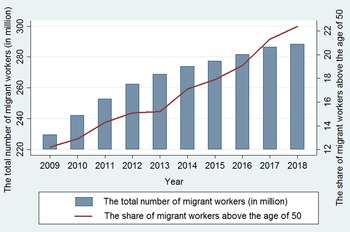
After the 1978 reform and opening-up, the hukou restrictions in China have been gradually deregulated (Chang, Reference Chang1996; Johnson and Woon, Reference Johnson and Woon2010). As a result, the surplus labour in rural China has been crowding into urban areas to seek job opportunities with higher returns (Shen, Reference Shen1996; Lucas, Reference Lucas2004). Figure 1 plots the total number of migrant workers and the share of migrant workers older than 50 from 2009 to 2018. The total number of migrant workers in China has significantly increased from around 230 million in 2009 to almost 290 million in 2018. In recent years, this enormous rural-to-urban migrant labour force has been ageing rapidly. The share of migrant workers older than 50 was 12.2 per cent in 2009. This number increased to 22.4 per cent in 2018, almost doubling in the past decade. Consequently, the labour market participation of older migrants has recently been increasing in China.
Migrant workers in China: the total number versus the share of elderly ones, 2009–2018.
Source: National Bureau of Statistics of China, Migrant Worker Survey Reports (2009–2018).

Despite the rapidly ageing migrant workers, the pension systemFootnote 5 in China discriminates against rural workers.Footnote 6 To narrow down disparities in pension plans for urban and rural workers, in 2009, the central government in China established the New Rural Social Pension System (NRSPS) to provide wide endowment insurance coverage for the rural population.Footnote 7 Although the NRSPS participation rate increased dramatically from less than 11 per cent in 2010 to over 78 per cent in 2014,Footnote 8 the amount of NRSPS pension benefits is far below the minimum cost of living (Lei et al., Reference Lei, Zhang and Zhao2013). According to the data provided by the 2014 wave of the China Longitudinal Ageing Social Survey (CLASS), the average pension received by rural residents is merely 137 RMB (around US $20) per month under the NRSPS, while the average pension collected by urban residents is 995 RMB (around US $145) per month under the Urban Social Pension System.Footnote 9
Since migrant workers receive much lower pension benefits than urban residents, the retirement pattern of older migrants differs tremendously from that of urban workers. In China, male and female urban workers generally retire at 60 and 50–55, respectively. To some extent, the retirement for urban workers is mandatory, especially for those employed in state sectors and government-affiliated institutions. Some urban workers may continue to stay in the labour market after retirement, even though they can live on pensions in later life. On the other hand, the retirement for migrant workers is voluntary, especially for the ones in informal sectors. Since older rural workers cannot receive adequate pension benefits to cover living expenses, they mainly rely on savings and financial support from children in later life. Hence, it is only when older rural workers have obtained enough savings to cover consumption and medical expenses in later life that retirement is an option.
The urban–rural dual land system: property rights and liquidity
The so-called socialist public land ownership is a critical component of the urban–rural dual system in China. This land ownership profoundly impacts urban and rural socio-economic development (Lai, Reference Lai2000), and induces fundamental differences in urban and rural land transactions from at least three aspects. First and foremost, the land ownership in urban and rural China is different. According to the Land Administration Law, urban land is completely state-owned, whilst rural land is generally collectively owned by local agricultural residents, whose hukou are registered in local administrative villages. Agricultural residents with hukou registered in these villages could apply for a parcel of land as a homestead. Furthermore, the re-application for such house sites shall not be granted if local agricultural residents sell or lease out their homesteads and houses.
Second, the real-estate development process for collectively owned (rural) land differs from that for state-owned (urban) land (Song, Reference Song2015). Specifically, the collectively owned land cannot be used for commercial real-estate development unless it is requisitioned by governments and transferred as state-owned (Li, Reference Li2012). The requisition process involves high costs, including compensation for rural residents, and various taxes and fees. However, this process is necessary so that real-estate developers can obtain permits from the Bureau of Land and Resources to build commercial real estate. If not, these houses could not be granted with property ownership certificates issued by the Housing Administration Bureau (HAB) and could not be traded on the open market. The property ownership of houses without HAB certificates is only endorsed by local township governments or village committees.
Third, transaction regulations for real estate on state-owned (urban) land are different from those for property built on collectively owned (rural) land. Commercial property which is built on state-owned land has full property rights and can be traded on the open market. However, the transaction of real estate on rural land does not follow the same rule. By law, rural land is exclusively reserved for villagers, who are registered as local agricultural residents. Both rural land and houses built on it should not be sold, transferred or leased out to people, especially non-agricultural residents, whose hukou are registered outside the village (Deng, Reference Deng2009). Thus, the property built on rural land cannot be classified as standard commercial real estate, since it only has limited property rights and cannot be traded on the open market. Therefore, compared to commercial real estate, houses on rural land have limited property rights, and thus have a lower level of liquidity.
In this paper, home ownership refers to houses owned by older migrants either from the official housing market (i.e. the standard commercial housing with full property rights) or from the unofficial housing market (i.e. housing with limited property rights), rather than those built on their own entitled village land.
Methods
Data
To investigate the effect of home ownership on the labour market participation of older migrants in China, we employ the 2016 wave of the China Migrants Dynamic Survey (CMDS) conducted by the National Health Commission. The National Health Commission sent formally trained investigators to conduct face-to-face data collection. During the process, smartphones or pads with computer-assisted personal interviewing systems were used. The CMDS is not a panel survey, and the questionnaires of the waves differ slightly from each other. We chose the 2016 wave, because it is the most recent one containing general information on locations of migrants’ houses. The sampling frame of the 2016 CMDS is based upon the 2015 annual report of migrant population. The survey adopts a stratified, multi-stage and probability proportional to size method for sampling. The 2016 CMDS has a national representativeness and covers 1,459 counties in 31 provinces. The sample size of each province was divided into five levels: 10,000, 8,000, 7,000, 5,000 and 4,000. The 2016 CMDS contains 169,000 respondents older than 15. All migrants have lived in the current place for more than one month but are not registered as local residents in hukou status. The survey contains rich information on migrants’ socio-economic characteristics, such as family structure, marriage status, employment, education, income and health conditions.
This study focuses on rural-to-urban older migrants who are put in a disadvantaged position under the current health-care and social security system in China (Chen et al., Reference Chen, Chen, Feng, Chen, Wang, Zhu, Jin, Yao, Xiang, Yao, Sun, Zhao, Fung, Wong and Dong2020). We restrict our sample to migrants registered as agricultural residents in hukou status. We further narrow the sample down to male migrants aged between 60 and 75, and female migrants aged between 55 and 75.Footnote 10 The final sample contains 3,217 observations. All continuous variables are winsorised at the 1 and 99 per cent levels in order to alleviate the influence of outliers.
Measures
Dependent variable
Our dependent variable Labour market participation is an indicator, which equals 1 if the older migrant participates in the labour market and equals 0 otherwise. We define the older migrant as a labour market participant if he or she chooses ‘yes’ as the answer to the following question: ‘Are you employed or looking for a job before participation in this survey?’
Explanatory variables
To measure home ownership, we use three alternative measures, i.e. Housing, Commercial housing and Local commercial housing. The indicator Housing equals 1 if the older migrant owns a house, regardless of whether the house has full property rights or not, and equals 0 otherwise. Commercial housing is an indicator of whether the older migrant owns a commercial house, which is endorsed with full property rights. Local commercial housing is an indicator of whether the older migrant owns a commercial house in the city in which he or she currently lives.
Broadly speaking, commercial housing can be more easily liquidated in the market than houses without HAB certificates. Houses with ownership only endorsed by township governments or village committees cannot be traded in the open market, so it is difficult to find buyers for resale. Additionally, a property resale transaction requires both buyer and seller to be physically present at the local HAB to sign the contract on the spot. It has been documented in the literature that the long distance brings obstacles for business transactions (Cai et al., Reference Cai, Tian and Xia2016; Ha et al., Reference Ha, Hilber and Schöni2021). Thus, it is reasonable to expect that, in general, local commercial housing is more easily liquidated in the market than non-local commercial housing, since the transaction would not severely suffer from the asymmetric information problem and the transaction costs are lower. It is worth noting that we mainly discuss the differences in liquidation driven by different types of property rights/home ownership in general.Footnote 11 In practice, the liquidity would significantly affect the effectiveness of a fixed asset to be used as precautionary savings.
Control variables
We also include various socio-demographic variables, such as age, gender (female or male) and education (measured by years of education), as control variables, which may significantly correlate with older people's participation in paid work after retirement (Larsen and Pedersen, Reference Larsen and Pedersen2012).
For married couples, one spouse will value retirement more once the other one has retired (Gustman and Steinmeier, Reference Gustman and Steinmeier2000). Hence, we include the marital status of the respondent (married or unmarried) in the regression. In addition, prior studies show that having more children is associated with later retirement for men, while the presence of young children may reduce women's labour force participation (Cebula and Coombs, Reference Cebula and Coombs2008; Hank and Korbmacher, Reference Hank and Korbmacher2013). The gender of children also matters. Older adults living with unmarried sons are more likely to participate in the labour market (Tong et al., Reference Tong, Chen and Su2019). Furthermore, older people who are economically responsible for other family members are more likely to stay in the labour market (Clark et al., Reference Clark, Johnson and McDermed1980; Szinovacz and Deviney, Reference Szinovacz and Deviney2000; Brosig et al., Reference Brosig, Glauben, Herzfeld, Rozelle and Wang2010). Thus, we control family size (the number of family members living within the current residential city) and an indicator of whether the older migrant has at least one son in our analysis.
Migration status may also correlate with home ownership and retirement decision. Therefore, the migration geographic distance, frequency and time length are all taken into account. We further add the older migrant's residence willingness, which is measured by an indicator of whether or not the migrant is willing to stay permanently in the current residential city, as an additional control variable. Older migrants’ financial status is also brought under control. We include three variables, i.e. household income per capita (the logarithm of household income per capita last year), household consumption per capita (the logarithm of household consumption per capita last year) and an indicator of whether the older migrant is covered by endowment insurance to capture older migrant family income, expenditure and social security status.
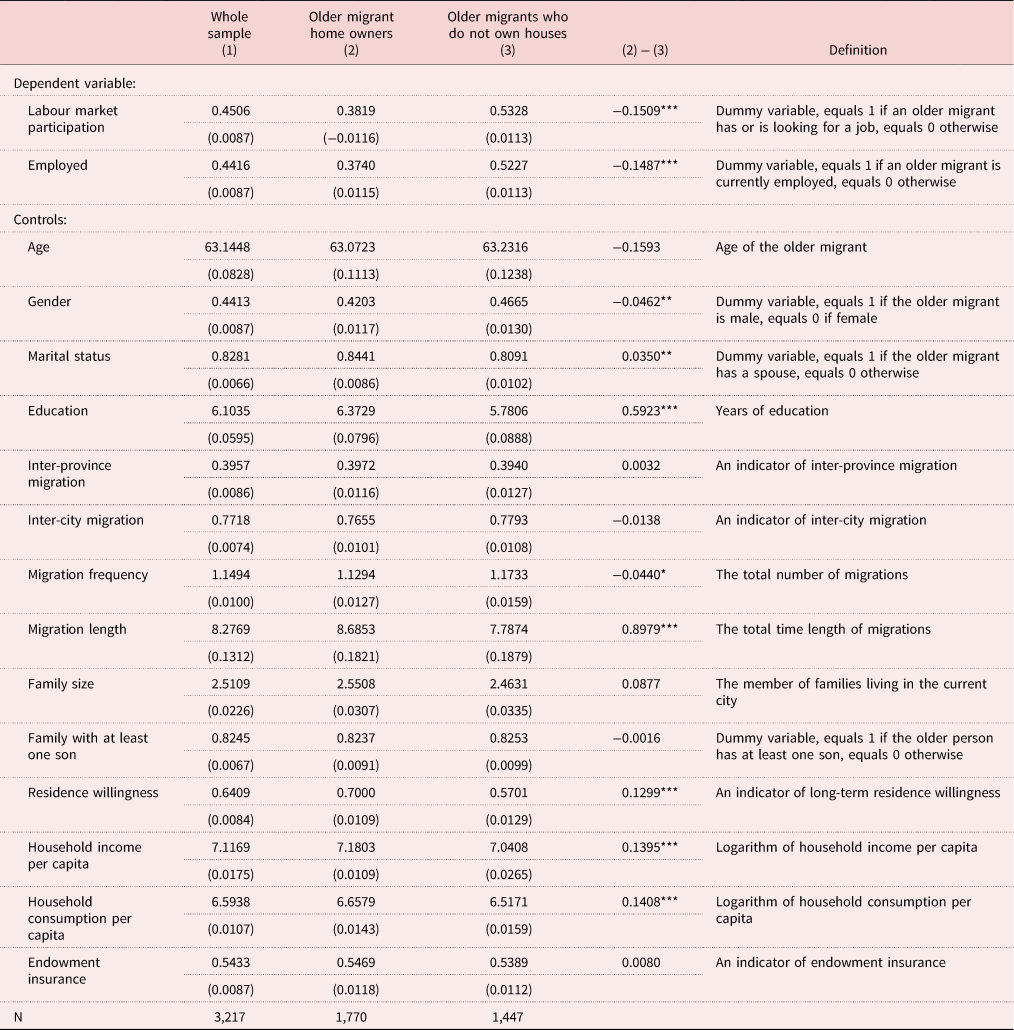
Table 1 summarises the statistics for the whole sample, for older migrants who own houses and for those who do not. The definitions of dependent and control variables are presented in the last column of Table 1. On average, the labour market participation rate of older migrants in our sample is around 45.06 per cent. This number in older migrants who do not own houses (i.e. 53.28%) is higher than that in home owners (i.e. 38.19%). We find a similar pattern regarding employment rate. For other control variables, we find that home owners tend to be female, married and have a higher level of education. Compared to older migrants who do not own houses, home owners have a lower level of migration frequency and a relatively longer migration time length. Moreover, in older migrants, home owners are more willing to stay permanently in the current city and have a higher level of household income and consumption per capita than those who do not own houses.
Summary statistics and definitions of key variables

Notes: The data are mean values of covariates with standard errors in parentheses. The last column provides the definitions of the key variables.
Significance levels: * 5%, ** 1%, *** 0.1%.
Model specification
We employ the logit model to examine the effect of home ownership on older migrants’ labour market participation. The baseline empirical model is specified as follows:

where i and j denote individual and city, respectively. Participationij is a dummy variable, which equals 1 if the older migrant i participates in the labour market of city j and equals 0 otherwise. In robustness checks, we replace Participationij with the dummy variable Employedij, which equals 1 if the older migrant i is employed in city j and equals 0 otherwise.
The regressor of our main interest, Home ownership, contains three measurements, i.e. Housing, Commercial housing and Local commercial housing, which are included into the regression one by one. A negative β 1 suggests that older migrants who do not own houses are more likely to participate in the labour market than home owners. In other words, when an older migrant becomes a home owner, he or she is inclined to retire. It implies that home ownership is used as precautionary savings for older migrants’ retirement. Meanwhile, a positive β 1 indicates the opposite effect.
Xi is a vector including various socio-economic characteristics such as education, financial status, family structure and migration status. μj indicates city fixed effects capturing unobservable time-invariant city factors such as culture and natural endowment, which may have influences on the local labour market.Footnote 12 The standard errors are clustered at the province level to deal with the potential heteroscedasticity and serial correlation problems induced by policy interventions regarding migrant workers (Bertrand et al., Reference Bertrand, Duflo and Mullainathan2004).
For older migrants, home owners (treatment group) may fundamentally differ from those who do not own houses (control group). The sample selection may lead to a biased estimator. To alleviate this concern, we first estimate Equation (2) via the logit model, and then use the propensity score matching method to construct the comparable treatment and control groups:

where the vector Xi contains the same set of control variables included in Equation (1). We use Housing, Commercial housing and Local commercial housing to replace Home ownership in Equation (2) one by one. The results indicate that older migrants who do not own houses indeed differ from home owners with respect to various socio-economic characteristics and migration status.Footnote 13
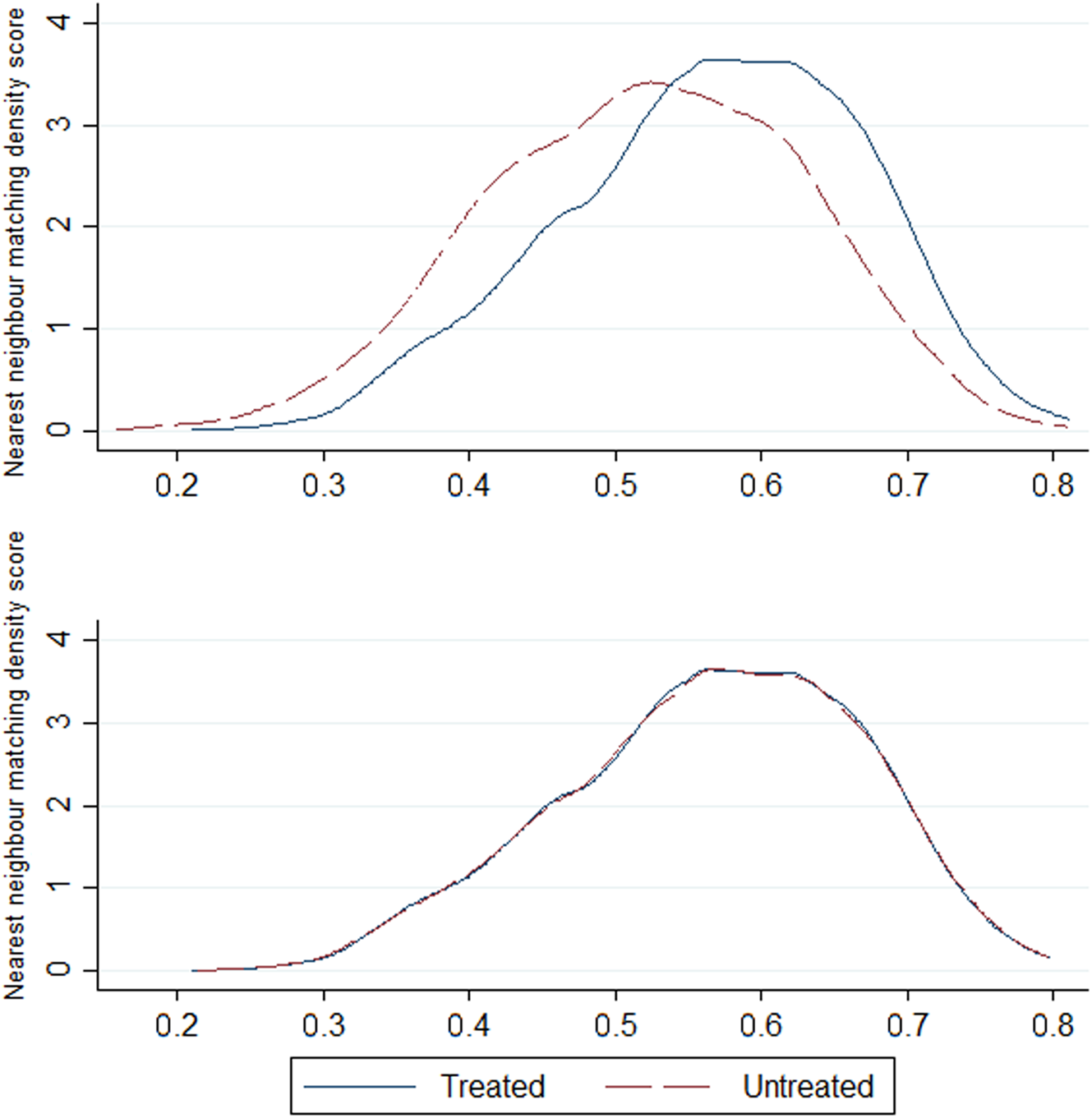
Next, we use the nearest neighbour matching (NNM) method to construct comparable treatment and control groups.Footnote 14 Figure 2 compares the pre- and post-matching density functions of home owners (treatment group) and older migrants who do not own houses (control group). The figure demonstrates that the difference between the density functions of home owners and older migrants who do not own houses disappears after matching. The balancing property of the matching method is satisfied.Footnote 15
Distribution of propensity scores, unmatched versus matched.
Source: Authors’ elaboration.

Empirical results
Main results
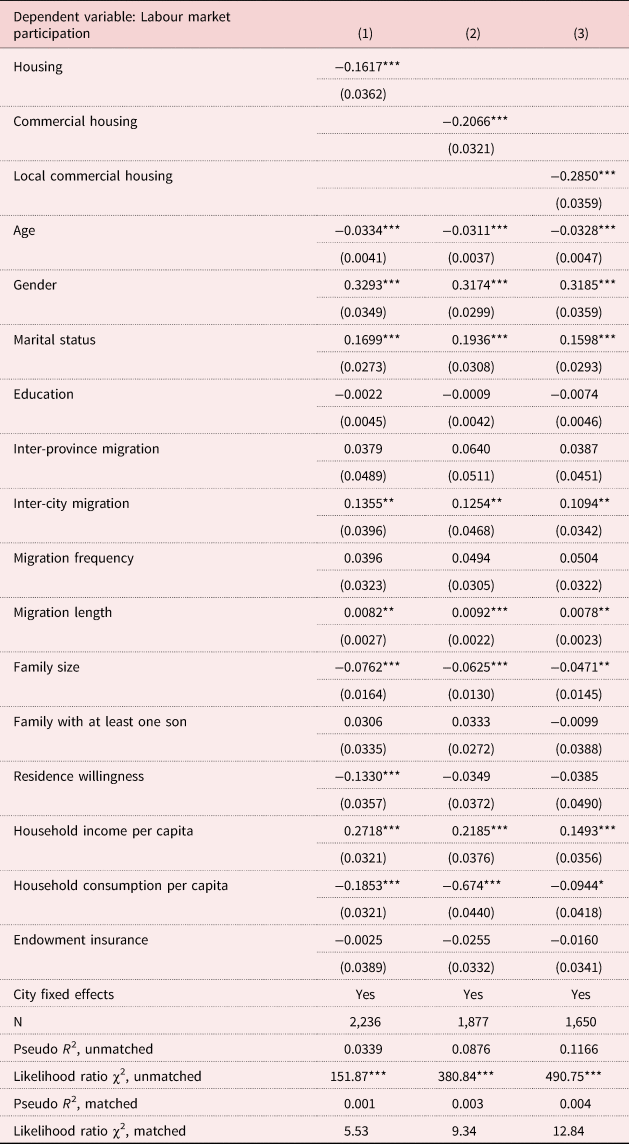
We report the marginal effects at mean values of covariates in all tables, since the logit model is adopted. In Table 2, we present the baseline results of estimating Equation (1) after implementation of the NNM. In column (1), we investigate the effect of home ownership on the labour market participation of older migrants. In columns (2) and (3), Housing is replaced by Commercial housing and Local commercial housing, respectively, in order to examine the effect driven by different types of home ownership.
Main results, marginal effects, logit model after nearest neighbour matching (caliper 0.01)

Note: The data are marginal effects at mean values of covariates with standard errors in parentheses.
Significance levels: * 5%, ** 1%, *** 0.1%.
The marginal effects of Housing, Commercial housing and Local commercial housing are all negative and statistically significant at the 0.1 per cent level. The estimates in Table 2 indicate that older migrants who do not own houses are more likely to participate in the labour market than home owners. That is, when older migrants become home owners, they are inclined to retire. It implies that home ownership can be used as a type of precautionary/retirement savings for older migrants.
Additionally, the marginal effects of Housing, Commercial housing and Local commercial housing are gradually enlarged in magnitude. Since Housing is an indicator of home ownership regardless of whether the house has full property rights or not, the larger marginal effect of Commercial housing suggests that the negative effect of houses with full property rights on labour market participation of older migrants is larger than that of houses only having limited property rights. We obtain a similar pattern from comparing marginal effects of Commercial housing and Local commercial housing. Therefore, older migrants are less likely to participate in the labour market when they own local commercial houses than those not in the current residential city. These findings imply that as a type of precautionary saving, home ownership with a higher liquidity level has a more prominent influence on the labour market participation of older migrants in China.
With respect to other control variables, we find that age, family size and household consumption per capita are negatively correlated with the labour market participation of older migrants. On the contrary, male and married older migrants more actively participate in the labour market than female and unmarried counterparts. Older migrants with inter-city (within the same province) migration, a longer length of migration period and a higher level of household income per capita are also more likely to participate in the labour market.
Following Sianesi (Reference Sianesi2004), for each regression, we compare the pseudo R 2 and the corresponding likelihood ratio χ2 values of the logit model before and after matching. Consistently, we find that the explanatory power of our regressors on the potential sample selection of treatment and control groups becomes statistically insignificant after matching. These results further confirm that the estimated marginal effects are unbiased.
Robustness checks
Alternative measure of the dependent variable
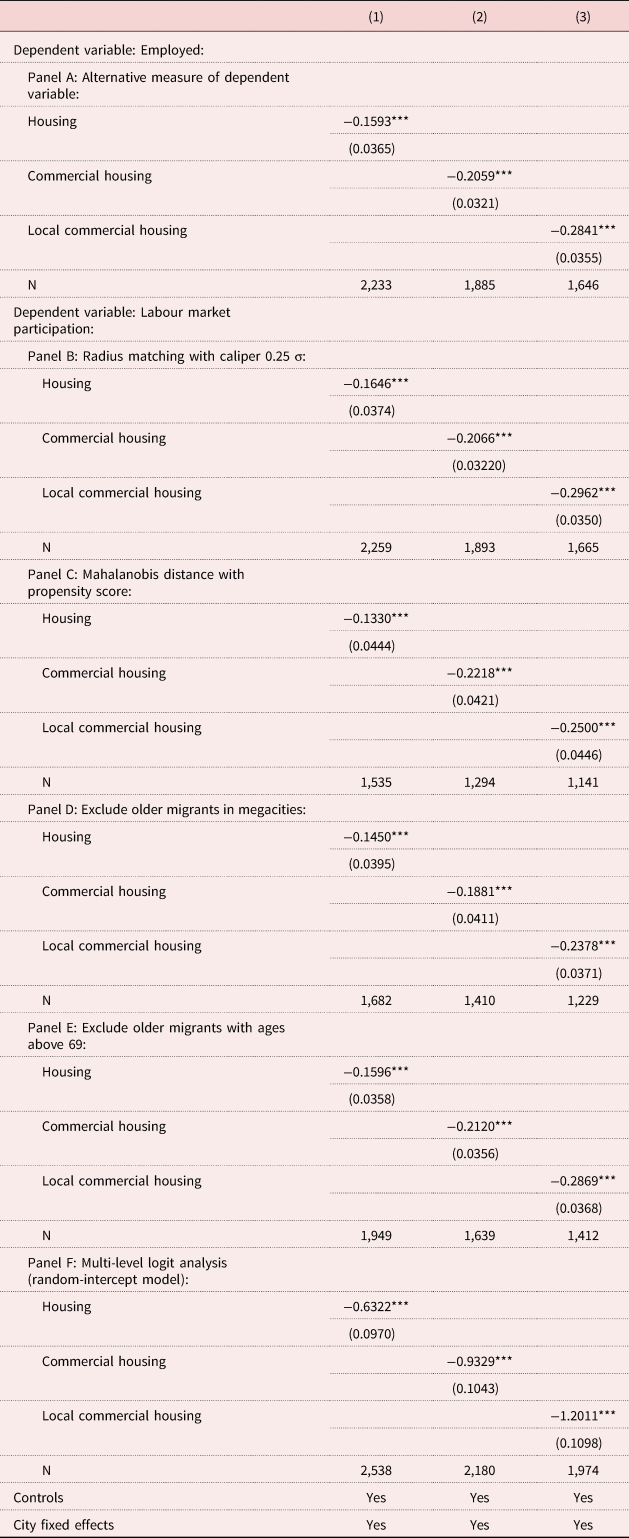
Our main dependent variable is Participation, defined as an indicator of older migrants who are employed or are currently looking for a job. As a robustness check, we replace Participation with Employed, which is an indicator of whether older migrants are employed or not, to investigate how home ownership affects the actual employment of older migrants. The results are summarised in Panel A of Table 3.
Robust, alternative specifications and subsample analysis

Notes: The data are marginal effects at mean values of covariates with standard errors in parentheses. In Panel F, coefficients and standard errors are reported.
Significance level: *** 0.1%.
The marginal effects of Housing, Commercial housing and Local commercial housing are similar to the corresponding baseline results regarding sign, magnitude and the significance level. Consistently, older migrants who do not own houses are more likely to work than home owners. Older migrants are less likely to get employed in the labour market, when they own houses having a higher level of liquidity, which is driven by the types of property rights/home ownership.
Alternative matching method
To check whether our findings are sensitive to the choice of matching method, we adopt alternative methods in the matching process. The results obtained from radius matching with caliper 0.25 σ and Mahalanobis distance with propensity score are displayed in Panels B and C of Table 3, respectively. The estimates are close to our baseline findings. Hence, our results would not be significantly altered by different matching methods. The results further boost our confidence on the validity of the identification strategy.
Exclude older migrants in megacities
In China, housing prices and living expenses are much higher in megacities, i.e. Beijing, Shanghai, Guangzhou and Shenzhen, than in other places (Gyourko et al., Reference Gyourko, Mayer and Sinai2013). As a result, it is more difficult for older migrants to own houses in megacities than in other urban areas. It is also possible that the migration status and labour market participation of older migrants in these megacities are systematically different from those in other cities, although city fixed effects are included to absorb the potential impacts induced by city-level macro-economic factors. If megacities provide better job opportunities to older migrants, our estimates may be upward biased.
To alleviate this concern, we exclude all older migrants in megacities and re-estimate Equation (1) after the NNM. The results are shown in Panel D of Table 3. The marginal effects remain negative and significant in all three columns, with magnitudes similar to the counterparts in the aforementioned findings. Thus, our results are not driven by older migrants in megacities.
Exclude older migrants with ages above 69
In previous sections, the age ranges for male and female older migrants are 60–75 and 55–75, respectively. In some provinces, older residents above 70 in both urban and rural areas are entitled to receive some allowances from local governments, although the amount of allowances is not enough to cover the minimum cost of living. Yet, such allowances may lead to different incentives in labour market participation for older migrants above and below 70. That is, our results may be sensitive to the upper age limit of older migrants.
To alleviate this concern, we exclude all migrants older than 69. The results are summarised in Panel E of Table 3. The marginal effects of Housing, Commercial housing and Local commercial housing continue to be negative and significant, and are almost unchanged in magnitude. Hence, our findings are robust to the alternative upper age limit of older migrants. Consistently, we find that older migrants who do not own houses are more likely to participate in the labour market than home owners. This negative relationship between home ownership and labour market participation of older migrants is more prominent when houses have a higher level of liquidity induced by property rights.
Alternative model specification
The CMDS adopts hierarchical multi-stage sampling, so that the data have nested attributes. We employ the multi-level logit model as an alternative model specification to examine whether our findings would be changed when we control for the nested attributes of data. The results are presented in Panel F of Table 3. Similarly, the coefficients of Housing, Commercial housing and Local commercial housing stay significantly negative, and are gradually enlarged in magnitude. Our findings are robust when the multi-level logit model is adopted.
Heterogeneous effects
In this subsection, we investigate the potential heterogeneity induced by older migrants’ socio-economic characteristics, and provide some insights into the pathways of home ownership to labour market participation of older migrants. We also provide further discussions on how the labour market participation of older migrants who own local commercial housing varies across cities with differential potential demand for real estate. The estimated results are summarised in Tables 4 and 5. We adopt the NNM method to construct comparable treatment and control groups in all regressions.
Heterogeneous effects

Note: The data are marginal effects at mean values of covariates with standard errors in parentheses.
Significance levels: * 5%, ** 1%, *** 0.1%.
Heterogeneous effects (city-level characteristics)

Note: The data are marginal effects at mean values of covariates with standard errors in parentheses.
Significance levels: † 10%, * 5%, ** 1%, *** 0.1%.
Gender
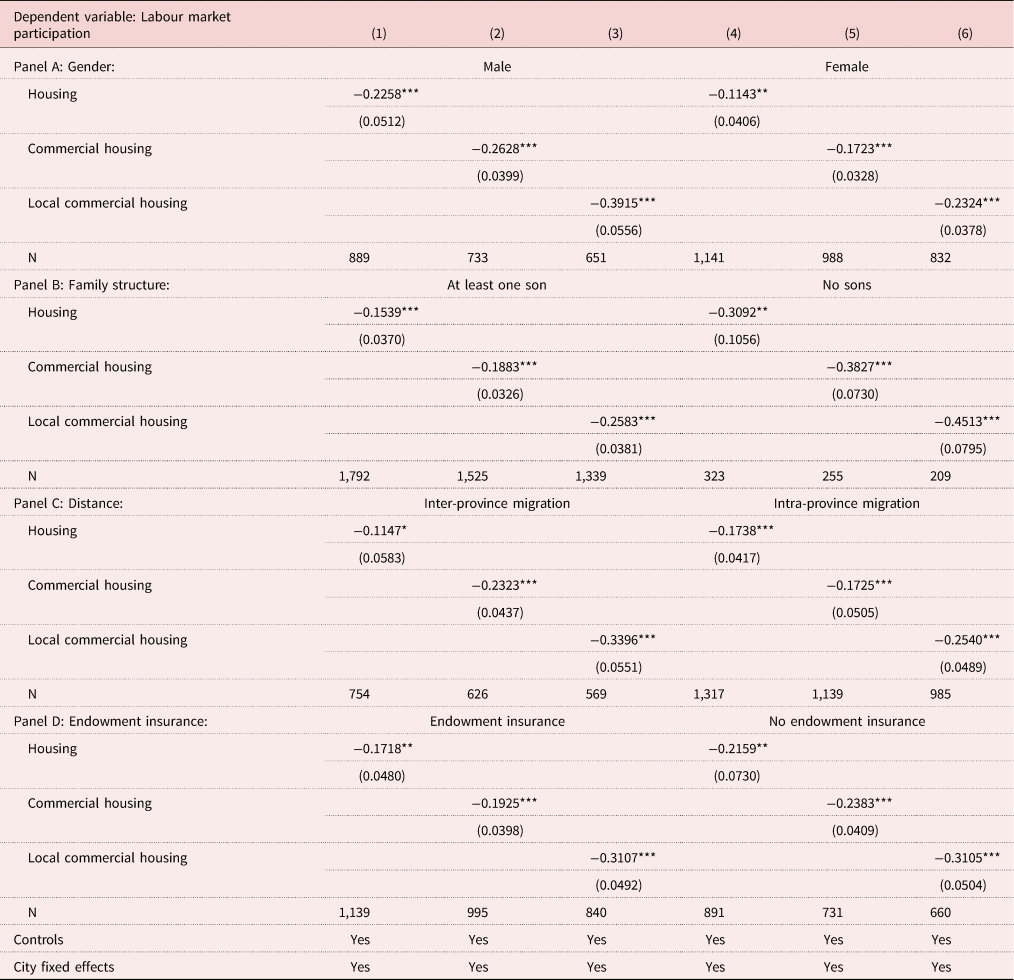
In China, social norms have different requirements for males and females (Glasser, Reference Glasser1997; Liu, Reference Liu2014). Men are considered as the main bread-winner in the family and take the primary responsibility for purchasing houses. Compared to female older migrants, male ones are expected to participate more actively in the labour market if they do not own houses. That is, it is reasonable to expect that male older migrants are less likely to retire, unless they have fulfilled the task that they have to provide enough precautionary savings to their families. To check whether the effect of home ownership on older migrants’ labour market participation exhibits gender differences, we split the sample according to gender. The results obtained from gender-specific models are summarised in Panel A of Table 4.
The marginal effects of Housing, Commercial housing and Local commercial housing remain negative and significant in all columns, indicating that older migrants who do not own houses are more likely to participate in the labour market. Within each gender-specific model, the magnitudes of marginal effects gradually increase along with the level of housing liquidity. These results are consistent with our aforementioned findings. We then compare the results to their counterparts across gender-specific models. As expected, the estimated marginal effects are larger in magnitude in the male subgroup than their counterparts in the female subgroup. This difference is persistent across houses with different liquidity levels. Our finding differs from Zhao and Burge (Reference Zhao and Burge2017), who showed that in the USA female labour supply is affected to a greater extent by changes in housing wealth than male labour supply. In China, male older migrants are more responsive to home ownership than female ones with respect to labour market participation.
Family structure
Son preference is prevailing in China and is especially deeply rooted in rural culture (Lei and Pals, Reference Lei and Pals2011; Murphy et al., Reference Murphy, Tao and Lu2011), because sons are generally considered as the primary providers for their aged parents. Older migrants having male offspring expect that they can receive intergenerational financial support as income after retirement, so it is possible that they are less dependent on housing wealth as precautionary/retirement savings. In other words, older migrants having no son may more heavily rely on home ownership as precautionary/retirement savings, so they are more likely to participate in the labour market if they do not own houses than those with at least one son. Therefore, we divide the sample into two subgroups, i.e. older migrants with at least one son and those having no son, to investigate whether home ownership heterogeneously affects the labour supply of older migrants with different family structures. The results are displayed in Panel B of Table 4.
The marginal effect estimates on three measures of home ownership continue to be significantly negative in all columns. The estimates obtained from older migrants having at least one son subsample are smaller in magnitude than their counterparts in the subsample containing older migrants with no son. In line with our prediction, older migrants having no son are more responsive to home ownership regarding labour market participation than those with at least one son. Our findings also imply that the retirement decision could be considered as a family decision rather than an individual decision (Becker, Reference Becker1988).
Migration distance
Migrants who are further away from their hometown generally encounter more difficulties in life. For instance, China's social health insurance system was segmented by provinces before 2017, so inter-provincial migrants could not get social health insurance reimbursement if they sought inpatient services in hospitals in the current residential province. Social health insurance provides affordable health care and financial protection to enrollees, so it is a crucial factor affecting older people's medical expenses. This segmentation significantly increased out-of-pocket medical expenses for inter-provincial migrants.Footnote 16 Therefore, inter-provincial older migrants may more heavily depend on home ownership as precautionary savings than intra-provincial older migrants. That is, inter-provincial older migrants who do not own houses may have stronger incentives to participate in the labour market than intra-provincial ones. To investigate such a possibility, the sample is divided into two subgroups, i.e. inter-provincial older migrants and intra-provincial older migrants. We redo the analysis for these two subsamples and the results are presented in Panel C of Table 4.
Similarly, we find that the estimates in each subsample stay significantly negative, and become larger in magnitude when housing liquidity is increasing. The marginal effect of Housing for inter-provincial older migrants is smaller in magnitude than that for intra-provincial older migrants. However, as predicted, the marginal effects of Commercial housing and Local commercial housing for inter-provincial older migrants are greater in magnitude than their counterparts for intra-provincial older migrants. These results suggest that commercial housing, especially local housing, which can be easily liquidated in the market, indeed can serve as precautionary/retirement savings to compensate for the potential loss of long-distance migration for older migrants.
Endowment insurance
The social security system in China discriminates against people registered as agricultural residents. Home ownership can be used by older migrants as a substitute for endowment insurance, since the two can be considered as different forms of precautionary/retirement savings. As a result, it is possible that older migrants with no endowment insurance would more actively engage in the labour market than the older migrants having endowment insurance, when they do not own houses. To examine whether older migrants with and without endowment insurance are heterogeneously affected by home ownership regarding labour market participation, we separate the sample according to whether older migrants are covered by endowment insurance or not. The results are shown in Panel D of Table 4.
We consistently find that the estimates in all columns are negative and significant. The marginal effects of our regressors of interest also become larger in magnitude when housing liquidity level is increasing. Furthermore, the estimated marginal effects of Housing, Commercial housing and Local commercial housing are larger in magnitude for older migrants with no endowment insurance than their counterparts for older migrants covered by endowment insurance. These results are in support of our prediction that compared to those having endowment insurance, older migrants with no endowment insurance are more responsive to home ownership regarding labour market participation. Our finding also implies that increasing the coverage of endowment insurance for older migrants can mitigate the effect of home ownership on their labour market participation.
City-level characteristics
Hereinbefore, we find that older migrants owning houses, which can be considered as a form of precautionary/retirement savings, are less likely to participate in the labour market than those who do not own houses. We further show that this negative effect of home ownership on labour market participation of older migrants is more prominent when older migrants own commercial houses, especially local ones, because broadly speaking, (local) commercial houses can be more easily liquidated in the market. Nonetheless, housing liquidity and values as well also depend highly on the locations of properties. Unfortunately, the CMDS does not contain the precise information on locations or values of houses. We can only obtain information on older migrants’ current working places at the city level. Then, we infer locations of local commercial houses at the city level, accordingly.
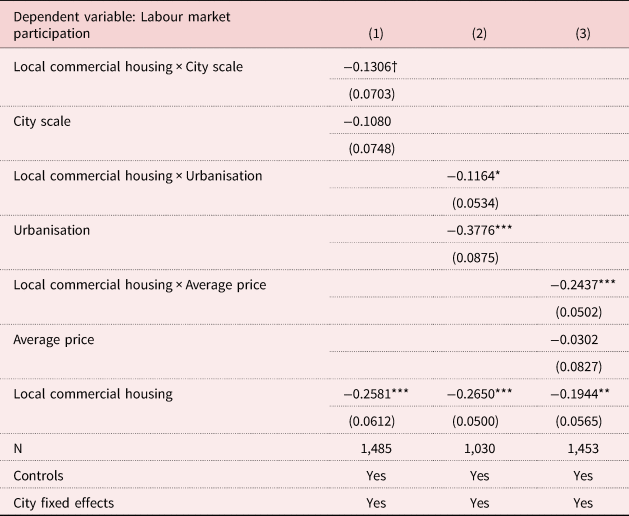
To provide further insights into how housing liquidity affects older migrants’ labour market participation, we use city-level characteristics correlated with the potential demand of local real estate to approximate the general liquidity of local commercial houses at the city level. Specifically, we estimate the empirical model as follows:

The NNM method is also adopted to construct comparable treatment and control groups before we estimate Equation (3). In practice, cities on a larger scale, with a higher level of urbanisation and higher average commercial housing price, are considered to be the ones where commercial houses are in greater demand, that is, can be more easily liquidated in the market. We expect that older migrants owing local commercial houses in cities with a higher housing liquidity level would be less likely to participate in the labour market.
Cityj contains three city-level characteristics capturing the general liquidity level of local commercial houses. City scale is an indicator of whether the city is classified as a large city.Footnote 17 Urbanisation is a dummy variable which equals 1 if the city is highly urbanised and equals 0 otherwise.Footnote 18 Average price is also a dummy variable, which equals 1 if the city has a relatively high average commercial housing price and equals 0 otherwise.Footnote 19 We introduce City scale, Urbanisation and Average price into Equation (3) one by one, and summarise the results in columns (1) to (3) of Table 5, respectively.
The estimated marginal effects of Local commercial housing remain negative and significant in all columns, indicating that older migrants who do not own local commercial houses are more likely to participate in the labour market than local commercial house owners. Meanwhile, the estimates for interaction terms are also negative and statistically significant in all columns. Hence, older migrants owning local commercial houses in larger-scale cities, with a higher degree of urbanisation, and those with a relatively higher level of average commercial housing price have much lower incentives to participate in the labour market. These results confirm our prediction.
Conclusion
In this paper, we show that the labour market participation of older migrants in China is significantly affected by home ownership. Older migrants who do not own houses participate more actively in the labour market than home owners. Hence, as a type of precautionary savings, home ownership imposes a great influence on the retirement decision of older migrants. We further show that home ownership plays a more important role in the labour market participation of older migrants suffering from greater financial responsibility and insecurity. Specifically, male older migrants, older migrants having no son, those moving inter-provincially and those uncovered by endowment insurance are more likely to use home ownership as a compensation for retirement insecurity than their counterparts.
In addition, we investigate how the labour market participation of older migrants is heterogeneously affected by home ownership with different levels of liquidity, mainly resulting from different types of property rights. The results indicate that houses with a higher level of liquidity can be used as precautionary/retirement savings more efficiently for older migrants. Particularly, older migrants who own local commercial housing in cities with potentially larger demand for real estate, i.e. local commercial houses having a higher level of liquidity, are also less likely to participate in the labour market. Since we pay attention to the housing liquidity differences essentially driven by the urban–rural land dual system in China, our results imply that the financial security of older migrants regarding retirement can be enhanced by alleviating trading barriers for rural land, and improving the property rights system for housing in China.
Financial support
This work was supported by the National Social Science Funds of China (CX, grant number 16CRK002); and the Social Science Planning Project of Shandong Province (LC, grant number 20CRK01).
Conflict of interest
The authors declare no conflicts of interest.
Ethical standards
Ethical approval was not required.