Introduction
The increase in the number and type of palliative care (PC) programs suggests an expanding demand for PC clinicians (Dumanovsky et al., Reference Dumanovsky, Augustin and Rogers2016). Accompanying this has been an expanded exploration of the effect of PC on its providers (Back et al., Reference Back, Steinhauser and Kamal2016; Kamal et al., Reference Kamal, Bull and Wolf2016; Kavalieratos et al., Reference Kavalieratos, Siconolfi and Steinhauser2017). Research suggests that 60% of PC clinicians report burnout and stress (Kamal et al., Reference Kamal, Bull and Wolf2016; Whitebird et al., Reference Whitebird, Asche and Thompson2013). Healthcare providers have acknowledged the harmful effects of burnout on clinical care (Prins et al., Reference Prin, van der Heijden and Hoekstra-Weebers2009; Tei et al., Reference Tei, Becker and Kawad2014; West et al. Reference West, Huschka and Novotny2006; Williams et al., Reference Williams, Manwell and Konrad2007) and the importance of self-care strategies (Back et al., Reference Back, Steinhauser and Kamal2016; Harrison et al., Reference Harrison, Dzeng and Ritchie2017). PC chaplains collaborate within a multidisciplinary environment and often create deep relationships with patients and families (Massey et al., Reference Massey, Barnes and Villines2015), putting them at risk for increased distress. The potential for decreased empathy within patient-clinician encounters as a result of an imbalance between stress and coping strategies may specifically concern professional PC chaplains. Existing research suggests potentially low levels of distress among chaplains (Flannelly et al., Reference Flannelly, Roberts and Weaver2005; Oliver et al., Reference Oliver, Hughes and Weiss2018; Taylor et al., Reference Taylor, Flannelly and Weaver2006; Yan & Beder, Reference Yan and Beder2013) and potentially a wider range of coping strategies employed by chaplains compared with nurses (Ekedahl & Wengstrom, Reference Ekedahl and Wengstrom2008); however, researchers have not specifically examined the distress levels of chaplains in PC or their self-care practices.
PC researchers continue to add to the literature on burnout. Younger age, working >50 hours per week, and fewer institutional colleagues predicted higher burnout rates among PC professionals (Kamal et al., Reference Kamal, Bull and Wolf2016; Pereira et al., Reference Pereira, Fonseca and Carvalho2011). Emotional exhaustion and depersonalization appear worse among non-physician PC clinicians (Kamal et al., Reference Kamal, Bull and Wolf2016). These variations in distress among clinical professionals could result from organizational level differences or from discipline-specific operational or self-care strategies (Back et al., Reference Back, Steinhauser and Kamal2016; Kavalieratos et al., Reference Kavalieratos, Siconolfi and Steinhauser2017; Sinsky et al., Reference Sinsky, Willard-Grace and Schutzbank2013). As researchers identify proactive strategies to increase resilience (Back et al., Reference Back, Steinhauser and Kamal2016; Harrison et al., Reference Harrison, Dzeng and Ritchie2017; Jonas & Bogetz, Reference Jonas and Bogetz2016), clinicians have also identified the importance of addressing emotions and integrating experiences associated with existential and spiritual suffering (Boston & Mount, Reference Boston and Mount2006). PC clinicians with greater self-care and self-awareness seem to have lower levels of burnout, especially among those with frequent exposure to death (Sansó et al., Reference Sansó, Galiana and Oliver2015).
Facilitating closure and providing care at the time of death are prominent activities for chaplains working in acute and PC care (Massey et al., Reference Massey, Barnes and Villines2015). Learning self-awareness and self-care are core components of chaplains’ education (Jankowski et al., Reference Jankowski, Vanderwerker and Murphy2008). As with other PC clinicians, predictors for distress among chaplains included less clinical integration, increased time providing trauma care, years in current position, and perceived institutional support (Galek et al., Reference Galek, Flannelly and Greene2011; Taylor et al., Reference Taylor, Flannelly and Weaver2006; Yan & Beder, Reference Yan and Beder2013). One small study suggested that chaplains who provide ritual care at the graveside may also experience greater stress than those who do not (Carter et al., Reference Carter, Trungale and Barnes2013). Limited research suggests nurses use functional coping strategies, whereas chaplains shift between professional and religious coping strategies (Ekedahl & Wengstrom, Reference Ekedahl and Wengstrom2008).
The present study was designed to provide an initial report of distress and self-care among chaplains working in PC. The study had three specific aims: (1) to describe the spiritual and work-related distress levels of chaplains who work at least part-time in PC; (2) to describe these chaplains’ self-care activities and the extent to which they debriefed clinical experiences with colleagues; and (3) to examine personal and work-related factors that might be associated with the chaplains’ distress and self-care activities.
Methods
Participants and procedures
Some of the study methods have been previously described (Jeuland et al., Reference Jeuland, Fitchett and Schulman-Green2017). Invitations to participate in the online survey (via Survey Monkey) were sent to members of four major associations of professional chaplains in the United States: Association of Professional Chaplains; National Association of Catholic Chaplains; National Association of Veterans Affairs Chaplains; and Neshama: the National Association of Jewish Chaplains. The survey was open between February and April 2015. Inclusion criteria were employment in a hospital and spending 15% or more of professional time in PC, including clinical, teaching, and administrative activities. This study was approved by the Yale University Human Investigation Committee and the Rush University Institutional Review Board.
This report describes findings from 322 chaplains of the 531 valid responses received. Of the 209 cases that were omitted, 149 worked less than full-time (the majority of whom worked half-time or less), 30 were respondents who reported minimal or no clinical activity, and 30 were cases that were missing information for the dependent variables (distress, self-care, and debriefing).
Survey development
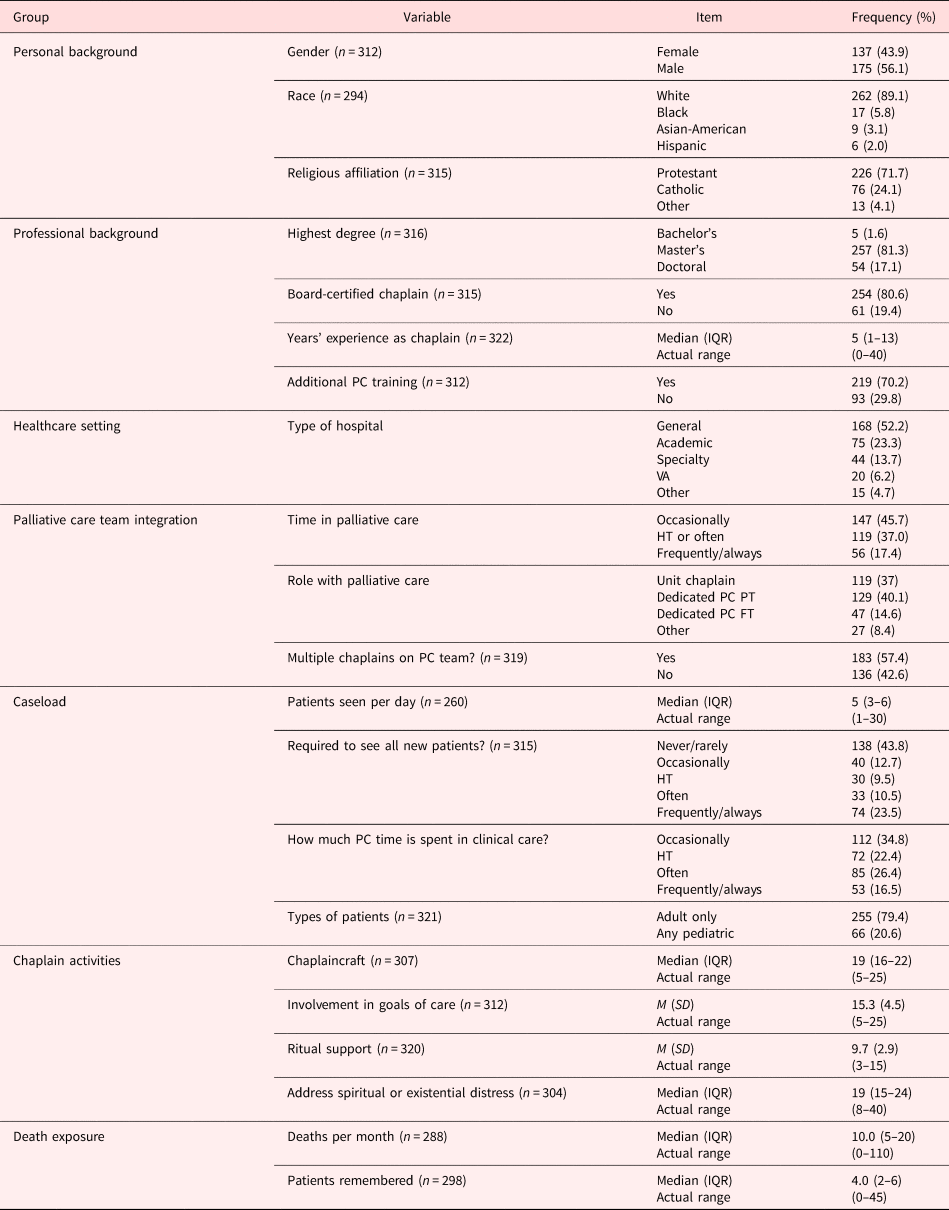
The survey measures were created by the investigators using published descriptions of chaplain activities (Handzo et al., Reference Handzo, Flannelly and Kudler2008) and professional expertise. For the present study, the main measures were items related to distress, self-care, and debriefing. Covariates used included factors that might be associated with distress and self-care, including chaplains’ personal and professional background, healthcare setting, PC team integration, caseload, chaplaincy activities, and death exposure (Table 1).
Chaplain characteristics

Unless specified, n = 322.
FT, full-time; HT, half-time; IQR, interquartile range; PT, part-time; VA, Veterans Administration.
Study measures
Distress
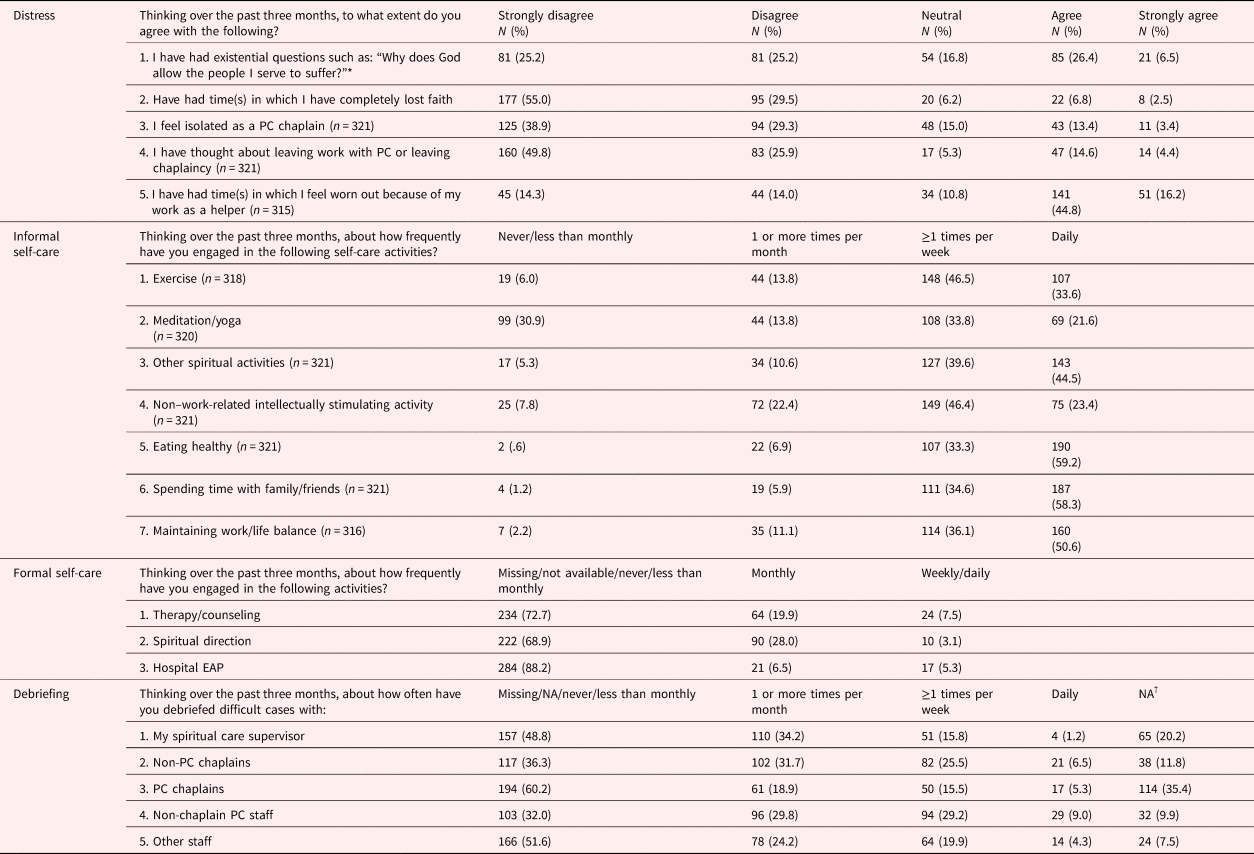
The study included five items that assessed distress associated with working as a chaplain in PC (Table 2). The items were scored from 1 (strongly disagree) to 5 (strongly agree). For the five items together, Cronbach's alpha was low (.646); dropping two of the items (“Had existential questions such as, why does God allow the people I serve to suffer?”; “Had times in which I completely lost my faith”) increased the alpha for the remaining three items to .696. The sum of the responses to these three items constituted our Professional Distress scale (items 3–5 in Table 2). We retained the other two items as important additional single-item measures of distress. Item 1, “Had existential questions such as, why does God allow the people I serve to suffer?” is related to the theological issue known as theodicy (attempts to integrate beliefs with experiences of suffering in the world) and is labeled Distress from Theodicy here.
Frequencies of distress, self-care, and debriefing among PC chaplains
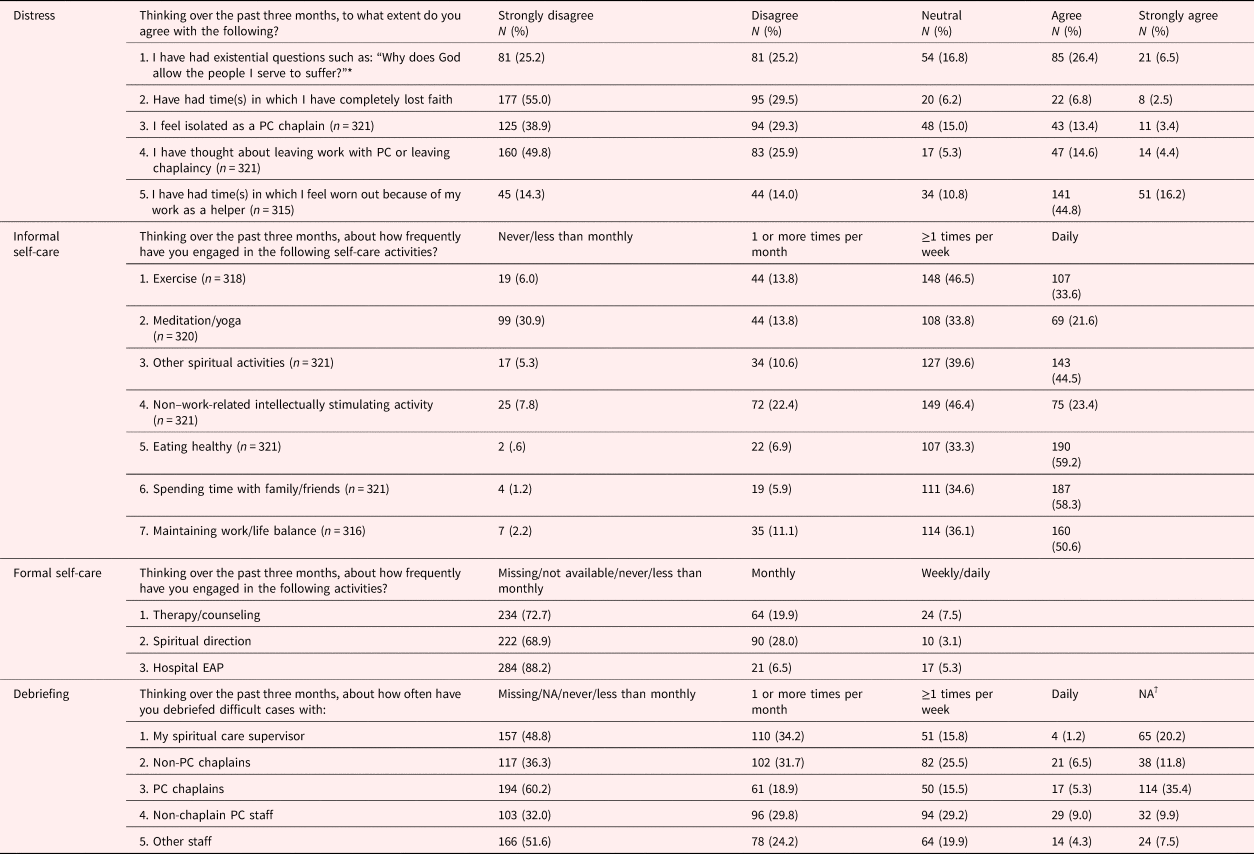
Unless specified, n = 322.
EAP, employee assistance program; NA, not available; PC, palliative care.
* Subsequently labeled Distress from Theodicy.
† Reported separately here but only counted in the first column of the table.
Self-care
We created two measures of self-care (Table 2): Informal Self-care (seven items) and Formal Self-care (three items). The Informal Self-care items were scored from 1 (never or less than monthly) to 4 (daily) and an Informal Self-care score was created by summing the item scores (Cronbach's alpha = 0.645). The Formal Self-care items were scored as 0 (missing, not available, never or less than monthly) or 1 (monthly or more).
Debriefing
The study included five items in which the participants reported the frequency of debriefing difficult cases with different chaplaincy and non-chaplaincy colleagues (Table 2). Each item was scored from 0 to 3 (0 = never, less than once a month, not available, or missing; 1 = once a month or more; 2 = once a week or more; 3 = daily). A sum of each of the five items created a debriefing score.
Covariates
Variables that follow include (1) items that were used to describe the study sample and (2) measures of the chaplains’ personal and professional background and work setting to examine their possible association with distress and self-care.
Chaplain personal and professional background
For descriptive purposes, chaplains’ personal and professional background and work setting included: gender, self-reported race, religious affiliation, and highest degree. The study included a question about years of experience as a board-certified chaplain. We used this item to create a measure of years of experience working as a chaplain. Where the response for years working as a board-certified chaplain was missing and the respondent reported not being board-certified (59 cases), we assigned one year of experience as a chaplain. Other measures of professional background included reports of any training in PC beyond initial chaplaincy training. Type of hospital where employed was coded in five categories and role in PC coded in four categories (Table 1). Chaplain age was not included in the survey.
Other work-related measures
Previous PC research has identified that the amount of clinical time predicts increased levels of burnout (Kamal et al., Reference Kamal, Bull and Wolf2016; Koh et al., Reference Koh, Chong and Neo2015), thus the following covariates add perspective for chaplains working in PC. The percent of the chaplains’ time spent in any type of PC activities in a typical week (e.g., clinical, educational, administrative) was coded in three categories (15–40% occasionally, 41–85% half-time or often, and 86–100% frequently or always). The respondents also reported if there were any other part-time or dedicated PC chaplains in their institution (yes/no). For caseload, respondents reported the number of PC patients they saw on average each day. The respondents reported if they were required to see all new PC patients; responses were coded in five categories (never or rarely to frequently or always). Respondents stated what percent of their PC time, in a typical week, was spent in clinical activities with four categories (occasionally to frequently or always). The type of PC patients cared for by the chaplain was coded in two categories (adults only, any pediatric cases).
Chaplain activities
The survey included 22 items about chaplain activities. Each item was scored from 1 to 5 (1 for never or rarely; 5 for frequently or always). Factor analysis was used to create four groups of chaplain activities: Chaplaincraft, Ritual Support, Involvement in Goals of Care, and Address Spiritual or Existential Distress. The group Chaplaincraft contained five items of regular chaplain tasks (e.g., visit patients to build a relationship, provide care for actively dying or deceased patients and their loved ones), Cronbach's alpha = .762. The group Provide Ritual Support contained four items (e.g., help patients pray, help patients connect with community of faith), Cronbach's alpha = .772. The group Involvement in Goals of Care contained five items (e.g., visit patients to discuss goals of care, visit patients to facilitate communication between patient, loved ones and team), Cronbach's alpha = .779. The group Address Spiritual or Existential Distress contained eight items (e.g., helped patients asking why me, helped patients asking about the meaning and purpose of suffering, helped patients asking what happens after death), Cronbach's alpha = .895. These categories were derived from a factor analysis and differ slightly from an earlier report (Jeuland et al., Reference Jeuland, Fitchett and Schulman-Green2017) in which the chaplain activity items were grouped based on their face validity.
Measures of death exposure included the average number of PC deaths per month and the number of deceased PC patients the chaplain reported thinking about from time to time over the past 3 months.
Analysis
Analysis included a description of the study participants, their background, work setting, and activities. The analysis included reporting the frequencies of distress, self-care, and debriefing. Next, to identify the relation between distress and self-care, we examined the correlation among the measures of distress, self-care, and debriefing. This was followed by examining the bivariate association (Spearman correlations) among chaplain background, work setting, and work activities and the measures of distress, self-care, and debriefing. The final step used separate multiple regression models to examine the independent association of all the covariates with the measures of distress, self-care, and debriefing. Because this was an exploratory study, we retained all the predictors from the bivariate analyses for these multivariable models.
There were missing data for many of the covariates in the study. We used the actual data for the descriptive and bivariate analyses. The bivariate analyses were also repeated with imputed data (n = 322) with results being essentially same as those using the actual data. Because of the missing data, the samples for the multiple regression analyses (using actual data) ranged from 181 to 191. Consequently, for these analyses, we used Multiple Imputation available in SPSS 24 using the variables in the analysis, yielding 322 complete cases, and report those results. Because this was an exploratory study, we did not adjust the p value for multiple tests of associations among variables.
Results
Table 1 reports the characteristics of the chaplains in the study; most were male (56.1%), white (89.1%), and identified as Protestant (71.7%). Professionally, the chaplains were primarily board-certified (80.6%) and had additional PC training (70.2%). Most of the participants worked at general hospitals (52.2%), provided PC for adults only (79.4%), and 23.5% reported being required to visit all new patients. The majority of the participants (>80%) were not involved full-time in PC.
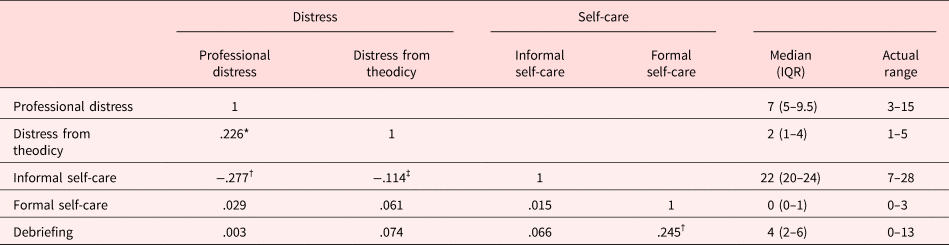
Table 2 reports the frequencies of our primary measures and shows that the proportion of chaplains who endorsed distress (“agreed” or “strongly agreed”) varied from 9.3% to 61% depending on the item. Loss of faith was somewhat rare (9.3%), but one-third of the chaplains (32.9%) reported experiencing some Distress from Theodicy in the past 3 months. At times, feeling worn out was the item with the highest endorsement (61%). With regard to self-care, participating chaplains identified high levels of Informal Self-care. A large majority of identified exercising (80.1%), using other spiritual activities (84.1%), eating healthy (92.5%), or spending time with family/friends (92.9%) once a week or more. The median of 0 (Table 3) indicates that one-half of the chaplains reported no involvement in Formal Self-care (e.g., counseling, spiritual direction); however, nearly one-third (31.1%) reported at least monthly spiritual direction, and more than one-quarter (27.4%) reported at least monthly counseling. Approximately one-third of the chaplains reported at least weekly debriefing with a non-chaplain PC colleague (38.2%) or a non-PC chaplaincy colleague (32%). Substantial proportions of the chaplains reported not having chaplaincy colleagues (35.4%) or a spiritual care supervisor (20.2%) available for debriefing. Table 3 shows the correlations among the key study measures and shows that Informal Self-care was inversely associated with Professional Distress and Distress from Theodicy. The item asking about loss of faith was not associated with the other key measures or covariates and was deleted from further analysis.
Spearman correlation coefficients of distress, self-care, and debriefing
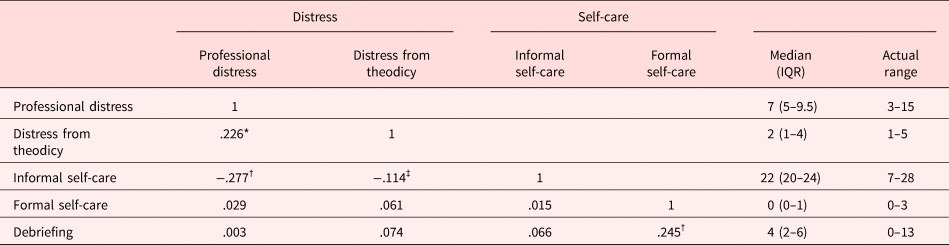
N = 300–322.
* p < 0.010.
† p < 0.001.
‡ p < 0.05.
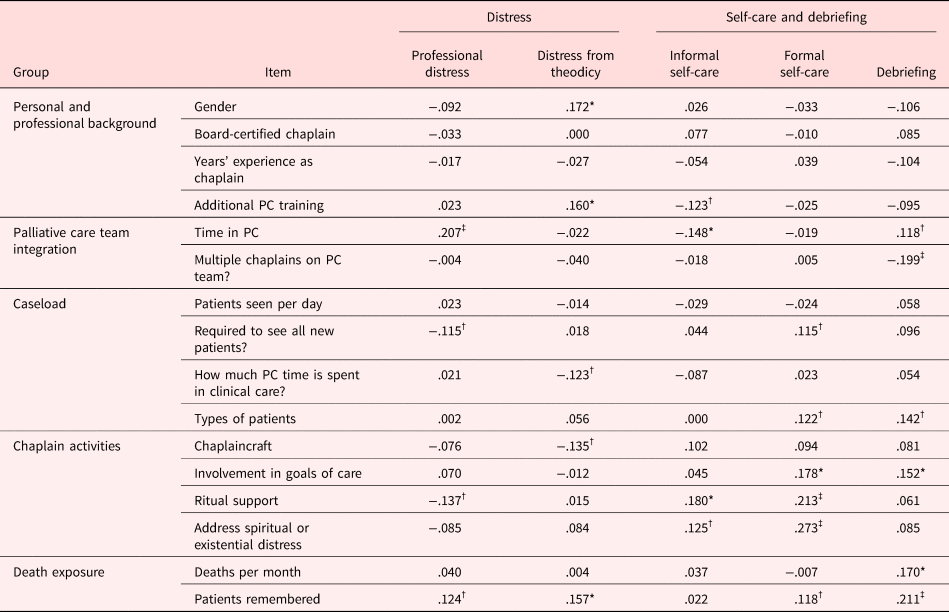
Analysis examined the bivariate association between chaplain personal and work covariates and the distress, self-care, and debriefing items. Professional Distress, as detailed in Table 4, shows a small (Portney & Watkins, Reference Portney and Watkins2015) association with the time spent in PC and a small association with remembering patients. Distress from Theodicy, also associated with patients remembered, showed little (Portney & Watkins, Reference Portney and Watkins2015) association with additional PC training and gender. We identified a relationship between Informal Self-care and providing ritual support and addressing spiritual and existential distress. Formal Self-care had a fair (Portney & Watkins, Reference Portney and Watkins2015) association with the frequency of addressing spiritual and existential distress and a small (Portney & Watkins, Reference Portney and Watkins2015) association with a requirement to see all new patients, the type of patients in a caseload, and involvement in goals of care conversations. Finally, debriefing showed a small (Portney & Watkins, Reference Portney and Watkins2015) relationship with the amount of time spend in PC, deaths per month, and patients remembered. It had a small (Portney & Watkins, Reference Portney and Watkins2015) negative relationship with multiple chaplains on the PC team.
Spearman correlation coefficients for chaplain characteristics and distress, self-care, and debriefing
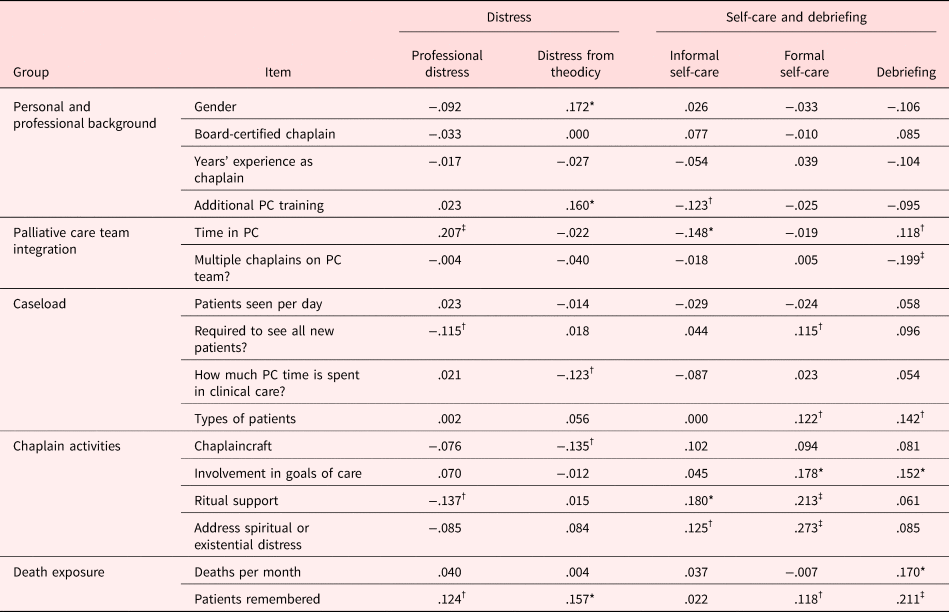
Gender: 1 = female, 2 = male2; other PC training: 1 = yes, no = 2; type patients: 1 = adult only,2 = some pediatrics; other PC chaplains: yes = 1, no = 2.
* p < 0.01.
† p < 0.05.
‡ p < 0.001.
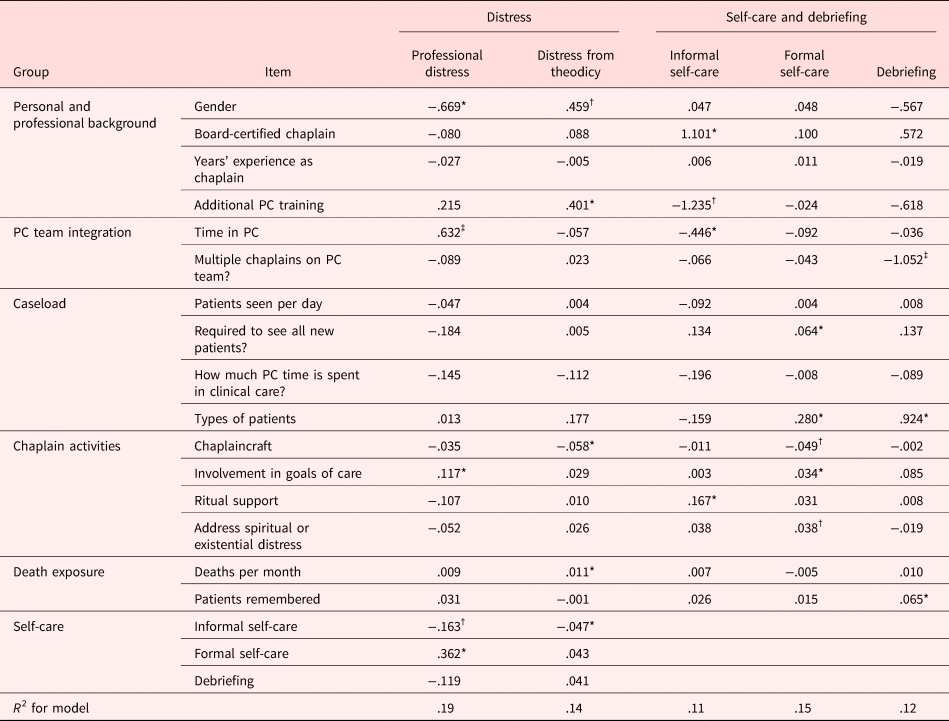
Table 5 reports the regression coefficients for chaplain characteristics and the distress and self-care items. Items predictive of Professional Distress included an increase in the percent of time spent in PC, more frequent goals of care conversations, and identifying as male. Items included in Chaplaincraft negatively predicted Distress from Theodicy, as did Informal Self-care. The use of Formal Self-care was predicted by an increased frequency in addressing spiritual or existential distress of patients and involvement in goals of care. Providing PC to both adults and some pediatric patients predicted an increased frequency of debriefing.
Regression coefficients for chaplain distress and self-care (with imputed data)
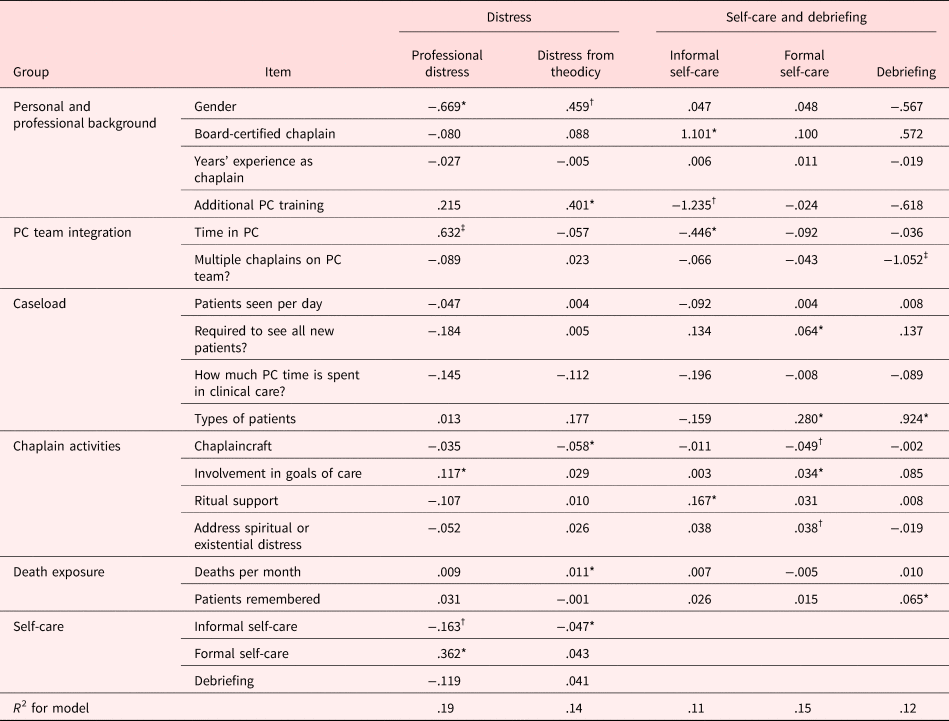
Gender: 1 = female, 2 = male2; other PC training: 1 = yes, no = 2; type patients: 1 = adult only,2 = some pediatrics; other PC chaplains: yes = 1, no = 2.
* p < 0.05.
† p < 0.01.
‡ p < 0.001.
Discussion
This study provides the first in-depth examination of distress, self-care, and debriefing activities of chaplains working in PC. Some chaplain distress seems prevalent in more than one-third of the sample. Chaplains working in PC frequently use Informal Self-care strategies and one-third engage in spiritual direction. Acute spiritual distress (loss of faith) was rare (9.3%), but one-third of the participants experienced Distress from Theodicy and a majority (61%) reported feeling worn out in the past 3 months. Other studies of healthcare chaplains suggest a low prevalence of burnout (Flannelly et al., Reference Flannelly, Roberts and Weaver2005; Oliver et al., Reference Oliver, Hughes and Weiss2018; Taylor et al., Reference Taylor, Flannelly and Weaver2006; Yan & Beder, Reference Yan and Beder2013). The higher proportion of chaplains reporting distress in the present study may be due to their work in PC; however, a chaplain's exposure to death did not predict increased Professional Distress or Distress from Theodicy. This could be explained by a chaplain's ability to cope with death or self-awareness, as suggested by earlier research (Sansó et al., Reference Sansó, Galiana and Oliver2015). Earlier research has also suggested chaplains may cope with such experiences differently than other healthcare professionals (Ekedahl & Wengstrom, Reference Ekedahl and Wengstrom2008).
Experience as a chaplain also did not predict distress, which is inconsistent with previous studies of chaplains (Galek et al., Reference Galek, Flannelly and Greene2011), but similar to studies of PC professionals (Kamal et al., Reference Kamal, Bull and Wolf2016; Koh et al., Reference Koh, Chong and Neo2015). Similar with findings that suggest PC clinicians experience greater burnout when working more hours (Kamal et al., Reference Kamal, Bull and Wolf2016; Koh et al., Reference Koh, Chong and Neo2015), greater time spent in PC was associated with greater distress. The associations between chaplain activities and distress are difficult to interpret, but suggest some relation with distress.
Chaplains seem attentive to Formal and Informal Self-care. As with other studies (Mills et al., Reference Mills, Wand and Fraser2017; Sansó et al., Reference Sansó, Galiana and Oliver2015), physical (informal) self-care seems widely prevalent. Substantial minorities engaged in spiritual direction and counseling, but very few use employee assistance program services. Informal Self-care was inversely associated with Professional Distress and Distress from Theodicy in both bivariate and multivariable analyses. The extent that practicing chaplains are involved in debriefing or clinical supervision has not been previously studied. Debriefing, identified elsewhere as a social component of self-care (Mills et al., Reference Mills, Wand and Fraser2017; Sansó et al., Reference Sansó, Galiana and Oliver2015) with chaplaincy supervisor, colleagues, or PC colleagues, is a potential way to address stress of PC chaplaincy. PC professionals perceive regular debriefing and staff processing opportunities as important in preventing burnout (Jonas & Bogetz, Reference Jonas and Bogetz2016). A unique finding identified that one in five chaplains reported not having a spiritual care supervisor available for debriefing. Factors associated with debriefing among professional chaplains deserve further study.
A limitation of this study, as with most studies that examine burnout or distress, is the potential for sampling bias. Specifically, those under significant stress at the time of the survey may have been less likely to respond. Unlike studies of other PC professionals (Kamal et al., Reference Kamal, Bull and Wolf2016), the majority of the chaplains who participated in this study were not involved in PC on a full-time basis. Although it is a limitation, it is not surprising because it is most common for a PC team to use a part-time chaplain or unit chaplain; chaplains are the professionals least likely to be included in the PC team (Spetz et al., Reference Spetz, Dudley and Trupin2016). The cross-sectional and exploratory nature of the study design is another limitation, precluding conclusions about the causal direction among study variables. An additional limitation is that we did not use validated measures of distress or self-care. This study also did not directly capture years of experience as a chaplain or chaplain age.
Future research needs to include the examination of whether clinical context is associated with distress among all healthcare chaplains, guided by a model or theory about distress among health professionals (Back et al., Reference Back, Steinhauser and Kamal2016), and use validated measures. Finally, the recent finding that theodicy is associated with chaplain well-being (Currier et al., Reference Currier, Drescher and Nieuwsma2017), reinforces, alongside our study, the need for further exploration about whether religious or spiritual beliefs or practices provide protection against the stressors associated with caring for people at the end of life.
Conflicts of interest
The authors have no conflicts of interest or competing financial interests.
Author ORCIDs
Kelsey B. White, 0000-0002-4806-1414.