Background
Disasters are high-stakes, low-frequency events that challenge health care workers and the systems in which they work.Reference Fendya 1 - Reference Frolic, Kata and Kraus 3 By definition, disasters and other mass-casualty events overwhelm available health care resources. It often is the responsibility of prehospital care providers, such as paramedics and emergency medical technicians, to begin the care of disaster victims.Reference Cowley, Myers and Gretes 4 , Reference Lowe 5
Care delivery in disasters differs from routine care in several key ways. First, patients are triaged based on their acuity and likelihood of survival.Reference Cross and Cicero 6 - Reference Zaslavsky 8 Indeed, when there are many critically ill or injured patients, those patients who are dead, or expected to die, should not be offered attempted resuscitation. Next, disasters intensify the need for quality communication between prehospital care providers and receiving facilities, namely emergency departments, operating rooms, and surge-capacity care venues.Reference Kanter 9 - Reference Kelen, McCarthy and Kraus 11 Also, disasters may generate large numbers of victims with minor injuries and uninjured bystanders. Finally, these mass-casualty events cause anxiety for family members of victims and the public, and attract media attention; these factors complicate care delivery.Reference McDermott, Cobham, Berry and Stallman 12 - Reference Chung and Shannon 14
Disaster planners have adopted strategies to decrease the gap between actual- and ideal-care delivery in multiple-casualty events. Prehospital care training for disaster triage and decision making includes didactic and simulation education.Reference Pelaccia, Delplancq and Triby 15 Across the world, there are numerous disaster-triage algorithms and guidelines, with varying degrees of practicality and evidence base to support them.Reference Cross and Cicero 6 , 16 - Reference Romig 19 Still, disasters happen infrequently, demand that prehospital care providers use triage and treatment skills that are not part of routine practice, and involve patients with unusual illnesses or injuries.
Although work has been done to compare triage strategies and to explore technology as a means for patient tracking during a disaster,Reference Chung and Shannon 14 , Reference Wallis and Carley 20 little is known about how technology can enhance the initial assessment of patients and the triage process. Telemedicine is the audio and video presence of health care specialists for real-time assistance with clinical decision making. Telemedicine has been suggested to enhance clinician decision making in disasters;Reference Xiong, Bair, Sandrock, Wang, Siddiqui and Hupert 21 although, the effect of telemedicine on triage in disasters has not been established. A small number of reports have discussed the educational and clinical utility of Google Glass (Google Inc; Mountain View, California USA), but no work exists about its use in telemedicine or in disaster response.Reference Muensterer, Lacher, Zoeller, Bronstein and Kübler 22 , Reference Parslow 23
The objective of this feasibility study was to explore whether a wearable visual-technology product is a practical, acceptable means for a prehospital care provider to communicate with a physician disaster expert for guidance during disaster triage. Secondary aims included comparing triage accuracy and time to triage for telemedicine triage and conventional triage when performed by paramedics.
Methods
Setting
The Federal Aviation Administration (Washington DC, USA) requires that every commercial airport in the United States conduct a triennial live-action disaster drill. The purpose of these drills is to test airport disaster-response capabilities, the interface between the airport and local Emergency Medical Services and fire agencies, and the interactions between emergency agencies when an airport disaster occurs.
The Tweed-New Haven Airport (New Haven, Connecticut USA) is a regional airport in southern Connecticut with multiple daily flights to Philadelphia (Pennsylvania USA) via a commercial carrier, as well as private and charter flights. On April 29, 2014, Tweed Airport conducted its triennial drill. The disaster scenario for the drill was the crash of a Bombardier Dash 8 airplane (Bombardier Aerospace, Bombardier Inc; Dorval, Quebec, Canada) upon landing, wherein the airplane struck a truck on the runway.
Local volunteers of high school students and airport staff portrayed the crash victims. The victims had preassigned injuries and vital signs. Each victim had moulage applied to portray injuries, and clothing was modified, as appropriate, to depict the injuries. A placard was hung around the neck of each victim providing the victim's identification number, age, and vital signs. Finally, each victim had a preassigned expected triage level based on the SMART Triage System (TSG Associates LLP; Halifax, England). The triage levels were: Red, the most critically ill and injured patients; Yellow, nonambulatory patients with no abnormal vital signs; Green, or ambulatory patients; and Black, those patients who were deceased or expected to die. The expected triage level was based on the patient's ambulatory status, vital signs, and mental status.
Participants
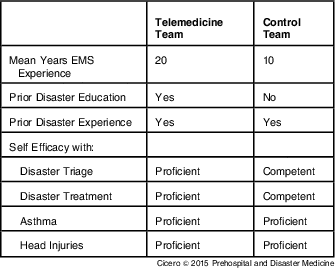
Study participants were two teams of two paramedics conducting primary disaster triage during the airport disaster drill. As the Tweed Airport is located on the border between two municipalities, one team represented one city and the other the second city. All participants were licensed paramedics. A comparison of the paramedics’ disaster training, disaster experience, general experience, and self-efficacy in disaster triage is shown in Table 1. The participants completed a post-drill survey, which included attitudes about the use of telemedicine in disaster triage.
Characteristics of Telemedicine and Control Teams Performing Disaster Triage. Self-efficacy was recorded on a five-point Likert scale: Novice, Advanced Beginner, Competent, Proficient, and Expert

Abbreviation: EMS, Emergency Medical Services.
The paramedics were voluntary participants in the study and provided an information sheet about the study prior to the disaster drill. The study was approved by the Human Investigations Committee of Yale University School of Medicine (New Haven, Connecticut USA). No signed consent form was required.
Technology
The state of Connecticut employs the SMART Triage System. The SMART Triage System employs four triage levels based on acuity and likelihood of survival (Red, Yellow, Green, and Black) via a standardized algorithm for the triage of adult disaster victims, and a length-based tape for the triage of children, with alterations to the adult algorithm based on patient size. Both teams of paramedics, the intervention team and the control team, performed primary triage using the SMART Triage System.
One of the teams, the intervention team, employed Google Glass. Google Glass is a wearable, consumer-grade, electronic device with head-up display.Reference Parslow 23 One member of the intervention team wore the Google Glass throughout the disaster triage, with a physician disaster expert available via telepresence. Google Glass was developed as a consumer electronic product and does not provide an adequate security level to comply with the Health Insurance Portability and Accountability Act (HIPAA; US Congress, 1996) requirements without additional customization with a third-party, HIPAA-compliant version of Android's (Google Inc.) operation systems (OS). The standard version of Android OS for Google Glass, designated version XE 17, was used during this study. Initially, communication between team members was evaluated via the video-chat function (“Hangout”) available in Glass OS XE 16. Unfortunately, a week before the study, Google released a new version of Glass OS XE 17, where video-chat capability was removed. Due to time constrains, the research team selected the only openly available, non-HIPAA-compliant, live-video broadcasting application from Livestream (Livestream; Brooklyn, New York USA). The Livestream beta version for Google Glass application is a pure-video broadcasting tool and does not provide two-way audio chat, which was required for patient triage. To provide audio communication between telemedicine physician and triage paramedic, the paramedic used a standard wireless cell phone connection with microphone mute on the paramedic side (to avoid sound duplication). Both members of the team were briefed about Google Glass and its use in the week prior to the airport disaster drill. The physician disaster expert was able to see what the paramedic saw, on the computer, via the paramedic's Google Glass camera. For connection to the internet, Google Glass used a WiFi hotspot through the Verizon (Verizon Communications; New York, New York USA) Long Term Evolution network.
Recording
Each of the teams had a member of the research team follow them and record their triage choices for each victim.
The intervention team had two additional recordings made. A third-person perspective video recording was made as the team triaged each of the victims. Additionally, a first-person video recording was made via Google Glass. The videos were used to confirm the number of instances the paramedic intended to use Google Glass to communicate with the telemedicine physician disaster expert, to confirm the triage decisions of the intervention team, and to determine the time of triage for each patient.
Analysis
Statistical analyses were performed using SPSS (v. 20.0, IBM Corp; Armonk, New York USA). Statistical analyses performed included comparisons of triage accuracy between the intervention and control groups, the time to triage the patients by expected triage level, and whether there was an association between communication of the intervention team with the telemedicine physician on time to triage and triage accuracy. Barnard's test was used for comparison of triage accuracy. This analysis included episodes of mistriage. Mistriage is either overtriage (triage of a patient to an inappropriately high triage level) or undertriage (triage of a patient to an inappropriately low triage level). One-way ANOVA was used for accuracy for patients triaged by the intervention group, and student's t test was used for comparison of time to triage. Variations in triage level between patients triaged with the telemedicine physician and those without the telemedicine physician were assessed.
Results
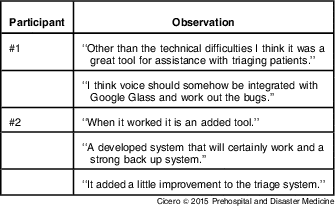
The results of the post-drill survey regarding telemedicine in triage included the free text assessments shown in Table 2. The participants in the intervention team made observations about the feasibility and utility of Google Glass for triage.
Paramedic's Assessment of Telemedicine in Disaster Triage

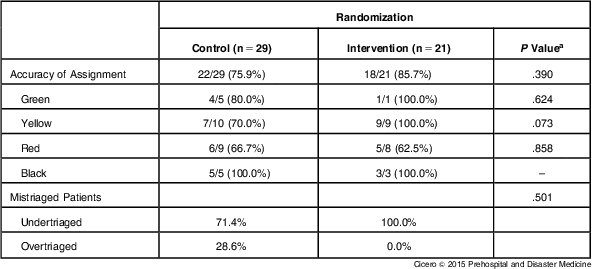
The intervention and control teams each triaged 20 crash victims, with the control team triaging an additional seven victims who were not triaged by the intervention team. There was no significant difference in triage accuracy between the intervention and control groups, as shown in Table 3. Of note, all patients mistriaged by the intervention group were undertriaged, and 28.6% of mistriage instances for the control group were overtriaged.
Accuracy of Triage Level Assignment for Study Teams (Accuracy of assignment based on simulated patients being classified in the correct triage group. Stratified by expected triage group.)

a P values calculated using Barnard's test due to extremely small sample size.
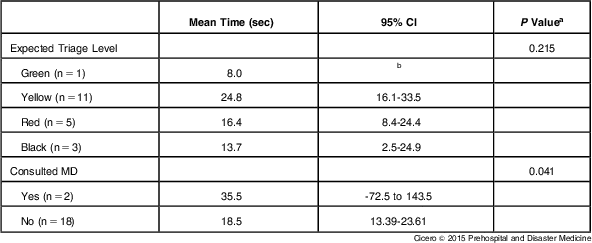
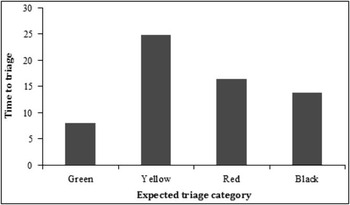
Regarding the time needed by the intervention group to triage patients based on expected triage level, there was no significant difference (Table 4; Figure 1). The Yellow triage group had the highest mean time to triage. However, the two patients who were triaged with input from the telemedicine physician required significantly more time to triage. For one of the 21 patients triaged by the intervention group, the time to triage could not be determined.
Mean Time to Triage for Intervention Group

Abbreviation: MD, medical doctor.
a P values calculated using one-way ANOVA.
b95% CI cannot be calculated because only one patient in the control group was expected as green level triage.
Time to Triage (in seconds) by Triage Level for Intervention Group (P value for group = .215; one-way ANOVA).

Discussion
The most important contribution of this work is the demonstration of obstacles to telemedicine-assisted triage given currently available technology. Google Glass is still an early product currently in the stage of public beta testing via “Glass Explorer Program” and, as a result, has several important limitations. To better address this limitation, it is important to distinguish between the internal limitations of the Google Glass device and those of the related software. The major hardware limitations encountered during the study included: the need for internet connectivity and dependence on either a WiFi network or Bluetooth (Bluetooth SIG; Kirkland, Washington USA) smartphone connection; short battery life, which further decreased during the video streaming; microphone position, which record a high level of background noise and was not always sensitive to verbal commands; and screen contrast, especially outdoors. At the same time, there were the following software problems: a significant lag in live-video broadcasting (there was more than a 20-second delay between the events at the disaster drill site and what the telemedicine physician observed on the computer screen; audio communication from the telemedicine physician to the paramedic was near instantaneous); no lock function, to prevent the possibility of inadvertently halting the streaming; and inability to opt-out of frequent Glass OS updates, which significantly complicates appropriate technology selection and research planning.
In the context of a disaster, which is itself an uncommon, unfamiliar event for paramedics and other health care workers, and in which there is a need to use infrequent triage algorithms, the addition of an unfamiliar technology, Google Glass, did not convey an improvement to triage accuracy. The variations and similarities between the two groups’ performances are likely not due to variations in training, years of experience, or prior disaster experience. The observations of the intervention team support the idea that Google Glass does not make a significant improvement in disaster triage. Further, the intervention group consulted the telemedicine physician only two times. This is important because it suggests that even when telemedicine consultation is available, frontline triage personnel might not use it extensively.
There may still be a role for telemedicine in disasters, as Latifi et al have suggested.Reference Latifi and Tilley 24 Primary triage is intended to be fast, and in current disaster-response systems, appending telemedicine to triage at the scene of a disaster does not seem the best approach. Further work with disaster triage training with established telemedicine systems might show greater utility for telemedicine triage. Other uses of telemedicine in disaster could be more promising than triage. For example, transport decisions regarding what hospital or other facility should receive a patient might be facilitated by telemedicine. Further, treatment decisions in the field and in critical access hospitals show promise for disaster telemedicine.Reference Dharmar, Kuppermann and Romano 25
Limitations
There are a number of limitations to the study itself; the limitations for Google Glass are discussed previously in the research. First, there is a small sample size, with two teams of two paramedics being compared. Replicating this work with more intervention and control teams would yield more robust conclusions about the utility of telemedicine triage. Next, the control team arrived on the scene first and began triaging the patients prior to the arrival of the intervention team; hence, the control team was able to triage more patients. Despite this, the two teams triaged the same 20 patients, whose triage is compared here. There were between five and 12 patients in each of the triage categories, limiting the power when comparing triage level accuracy. Also, as the intervention team interacted with the telemedicine physician only twice, the data about telemedicine's utility in disaster triage must be interpreted with caution. As a consumer-oriented product, Google Glass was not specifically built for emergency medical communication. Also, a relative lack of openly available and HIPAA-compliant software further complicates the device's utilization in emergency medicine. Finally, the work did not investigate other modes of telemedicine triage, including dedicated internet connected cameras or smartphones. It is possible that other, more mature technologies, especially those developed specifically for medical settings, would have greater utility in primary disaster triage.
Conclusion
This study demonstrated no increase in triage accuracy when paramedics evaluating disaster victims use telemedicine. There are a number of obstacles to available technology that, if overcome, might improve the utility of telemedicine in disaster response.