


Introduction
We know popular support frequently rises for leaders who bring their countries into war or whose lands are attacked (Levy Reference Levy1998; Mueller Reference Mueller1973). Such “rally effects” are important to understand not only because they can potentially sustain a leader in power but also because research finds they can create incentives to initiate international conflict (James and Oneal Reference James and Oneal1991; Jung Reference Jung2014). Yet it remains an open question who specifically joins a rally and why. This question is almost completely open in authoritarian settings because nearly all prior systematic research on rallying around the flag has been conducted in democratic settings.
Perhaps due to these origins in democratic contexts, where survey data on incumbent support have traditionally been considered a reasonably true indicator of actual preferences, extant theories generally proceed from an unstated assumption that rallies reflect changes in sincere expressions of preference. Accordingly, debate has centered mainly around whether this change results from conflict-triggered surges in patriotism that benefit incumbent state leaders or from a process of “opinion leadership” whereby opposition party leaders and media refrain from criticizing incumbent leaders and instead call for national unity in conflict (Berinsky Reference Berinsky2009; Brody and Shapiro Reference Brody, Shapiro and Brody1991; Hetherington and Nelson Reference Hetherington and Nelson2003; Jung Reference Jung2014; Kam and Ramos Reference Kam and Ramos2008; Mueller Reference Mueller1973).
There is strong cause to question this basic assumption of sincerity in rallying. Social desirability considerations routinely lead people to engage in behaviors not aligning with their actual views (Maass and Clark Reference Maass and Clark1983). Such “preference falsification” exists in all societies, but is especially important in nondemocratic settings, where social risks can be at their most severe (Kuran Reference Kuran1995, 85–91).
The present study builds on this research to argue authoritarian rallying around the flag can be fruitfully conceptualized (at least partly) as a “reputational cascade” (Kuran Reference Kuran1995). By this interpretation, “rallying” is a fast-moving, media-fueled process by which early and prominent (“available”) expressions of support for a country’s leader in the wake of conflict initiation start to create the impression that backing the leader is the most prevalent and thus socially desirable attitude to hold. The earliest public expressions, especially those widely visible in social media and on television, induce others who are sensitive to social pressures to publicly adopt the same supportive positions regardless of what they themselves actually think, prompting still more individuals to do likewise, and so on. What opinion polls and interpersonal conversations tend to reflect, then, is often the appearance of movement toward a social consensus that masks a significant measure of dissembling. The claim is not that all rallying is insincere but that rallying is nevertheless likely to involve a substantial reputational cascade component.
The identification strategy begins with a focus on the well-documented surge in domestic public support for Russian President Vladimir Putin triggered by Russia’s March 2014 annexation of Ukraine’s Crimean peninsula. This is arguably one of the substantively most important and long-lasting rally effects in recent memory, by some accounts benefiting Putin for over four years. Important leverage is provided by original, nationally representative panel survey data in Russia that span Putin’s Crimea rally and that record self-reported vote in the 2012 presidential election both immediately after the election (pre-Crimea) and again post-Crimea. These data yield direct individual-level measures of two quantities of interest: (a) “ralliers,” defined in the study as people who went from a position of nonsupport at time t 0 to public support at time t 1, where t 1 is defined as a moment after a rally event, and (b) a subcategory of ralliers operationally called “dissemblers,” defined here as people who were nonsupporters at t 0 but who at t 1 denied their t 0 nonsupport. Among other considerations, an item-count experiment, designed to shield respondents from social desirability pressures, helps confirm that the misrepresentation of past vote documented in the dataset is dissembling rather than poor recall. The study thereby establishes that as many as 75% of Putin’s “Crimea ralliers” were engaging in this form of dissembling. Econometric analysis further establishes that dissembling ralliers harbor combinations of pre-rally and post-rally dispositions that are associated with media-fueled reputational cascades (Kuran and Sunstein Reference Kuran and Sunstein1999). By contrast, conventional theories of rallying—all based on assumptions of sincerity—do a good (but much weaker) job predicting sincere rallying, but not dissembling rallying.
By establishing that rallying involves at least some significant component of dissembling in this substantively important case, the study supplies cause for future studies to direct attention to the insincere component of rallying. Important directions for research include investigating (a) to what extent the dissembling component of rallying extends beyond the self-reporting of past behavior (evidence presented here suggests it does) and (b) how important the dissembling component is relative to the sincere rallying component in different contexts. While these results focus on an authoritarian setting, the potential for social desirability pressures to play roles in all societies supplies reason to believe reputational cascading may be a largely overlooked factor driving rallying around the flag in democracies too. This study thus opens up fresh avenues for researching rally effects in all regime types and yields new insights into cascading phenomena and the sources of political dissembling more generally.
Sincere Rallying vs. Rallying as Reputational Cascade
Virtually all existing theory on rallying around the flag assumes that rallies are sincere, that individuals are changing their actual preferences regarding their leadership according to some kind of process catalyzed by a rally event, such as the initiation of international war or a major terrorist attack on the country in question. Accordingly, researchers often frame the literature as revolving around a debate between a “patriotism school” and an “opinion leadership school” (Hetherington and Nelson Reference Hetherington and Nelson2003). Broadly speaking, the patriotism school posits rally events like war trigger surges in patriotic sentiment or nationalism directed against an out-group. Since the country’s leader is well positioned to be symbolic of the country as a whole, the rise in good feeling toward the nation usually reflects positively on the leader, explaining the rise in popular support (Coser Reference Coser1956; Hetherington and Nelson Reference Hetherington and Nelson2003; Kam and Ramos Reference Kam and Ramos2008; Mueller Reference Mueller1973). The opinion leadership school also posits sincere preference change, but portrays preferences as highly malleable and strongly influenced by “authoritative voices” to whom they look for cues, including media and political parties. Rallying, therefore, tends to occur when an event triggers a reduction in the volume of voices critical of the leadership. This can occur either if these media refuse to report such voices or if opposition leaders themselves refrain from critical comments for the sake of national unity (Baker and Oneal Reference Baker and Oneal2001; Berinsky Reference Berinsky2009; Brody and Shapiro Reference Brody, Shapiro and Brody1991; Hetherington and Nelson Reference Hetherington and Nelson2003; Kam and Ramos Reference Kam and Ramos2008).
It is well established, however, that people often harbor what Kuran (Reference Kuran1995, 21) has called “dual preferences,” one set of “sincere” or “private” dispositions and a diverging set of “public” dispositions expressed in social settings. Responses to direct questions in public opinion surveys—the most common method for detecting rallying around the flag—are examples of public dispositions (Edwards Reference Edwards1957; Rosenfeld, Imai, and Shapiro Reference Rosenfeld, Imai and Shapiro2016). When individuals express public preferences different from their private preferences, they are engaging in what economists have called “preference falsification” (Kuran Reference Kuran1995, 17) and psychologists call “compliance” (Nail, MacDonald, and Levy Reference Nail, MacDonald and Levy2000). People typically do this when they sense their private views are not “socially desirable” and either (a) fear the repercussions or (b) derive positive utility from appearing to be in harmony with a reference group that matters (Edwards Reference Edwards1957). Potential repercussions from being publicly out of sync can take at least three forms: (i) discomfort that comes from suspecting an interlocutor may disapprove, (ii) actual social or economic sanctions such as rebuke or ostracism, and (iii) state responses that can range from prosecution (when the undesirable behavior is also illegal) to repression (Bursztyn, Egorov, and Fiorin Reference Bursztyn, Egorov and Fiorin2020; Kuran Reference Kuran1995, 85). Conversely, potential rewards from being publicly in sync might include (i) confidence of being in good social standing, (ii) social or economic rewards like praise or inclusion, or (iii) privileges supplied by the state (Brown Reference Brown1988, 90–102; Greene and Robertson Reference Greene and Robertson2017; Hogg and Mullin Reference Hogg, Mullin, Abrams and Hogg1999). All of these pressures (types i, ii, and iii) can be present in democratic as well as authoritarian polities, and even repression cannot be ruled out in democracies at all times for all preferences. But as Kuran (Reference Kuran1995, 85–91) observes, notwithstanding the possibility of outright repression, the risks of being out of the social mainstream tend to be highest in nondemocratic systems, without reliable institutions for protecting people with minority views.
Preference falsification has also been shown to spread or unravel in fast-moving cascades that could account for the rapidity of the popularity surges typically associated with rallying and that could lend insight into who joins the rally and who does not. In a process Kuran (Reference Kuran1991a) formally models and dubs a reputational cascade (Kuran Reference Kuran1995, 30), the first public expressions of a particular view (especially if visible and seemingly representative of others’ opinions) can lead new people to conclude this view is socially desirable and thus to express it themselves even if they privately disagree. This triggers still others who observe them to do likewise, and so on.
Mass media are particularly influential in forming initial impressions of what is socially desirable, propagating reputational cascades. Television is well known as a source of effective “representative” images of what is socially desirable (Kuran and Sunstein Reference Kuran and Sunstein1999), with state-run broadcasters being particularly important in nondemocratic contexts (Enikolopov, Petrova, and Zhuravskaya Reference Enikolopov, Petrova and Zhuravskaya2011). And social media constitute sites where large numbers of individuals consciously manipulate the impressions they make on each other through postings that instantly become accessible to large numbers in their personal networks (Gunitsky Reference Gunitsky2015; Oates Reference Oates2013; Reuter and Szakonyi Reference Reuter and Szakonyi2015).
Reputational cascades are widely associated with defection from nondemocratic regimes, including the 1989 fall of communism in Eastern Europe and the 2011 Arab uprisings (Kuran Reference Kuran1991b; Patel Reference Patel2013; Rubin Reference Rubin2014). What is proposed here is essentially that rallying around the flag can be thought of as a regime defection cascade in reverse. That is, conflict creates a shock that focuses public attention intensely on mass media (especially television and social media) to obtain information about how to respond. The public expressions of support for the leader they encounter there shape initial beliefs about (1) which interpretations are most prevalent and thus socially desirable; (2) what repercussions might be associated with failing to publicly adopt the socially desirable view such as discomfort, being rebuked, or perhaps even being branded unpatriotic or traitorous; and (3) what social rewards might accrue to those expressing the desirable position. As more people are observed publicly supporting the leader with respect to the conflict, additional individuals conclude this is the most socially desirable position and express it, prompting still others to adopt it, and so on. The nonsupporters who bear the least psychological discomfort from publicly expressing the desirable view can be expected to join the cascade first, which might come from previously harboring more positive views of the leader or lacking information about negative consequences of the rally-triggering event (Edwards and Swenson Reference Edwards and Swenson1997). The rally will continue until it reaches a “gap” in these individual thresholds for succumbing to social desirability pressures, a point at which the last person’s joining the rally will not be enough to trigger any new people to do likewise (Granovetter Reference Granovetter1978; Kuran Reference Kuran1995). Because threats of actual repression or promises of undue state privilege (type iii social desirability pressures) are not needed to fuel this dissembling, the study focuses on only type i and type ii pressures in what follows.
If this theoretical approach is fruitful in explaining rallying, certain patterns in political behavior should be observable. Most obviously, we would expect the set of ralliers at any given time to contain a significant subset of people who are dissembling about at least some aspect of their relationship to the leader, a category of people we call here “dissembling ralliers” as opposed to “sincere ralliers.” We thus arrive at the following hypothesis:
H1 Dissembling Hypothesis. A rally will include a significant share of dissembling ralliers.
Note also the mechanisms involved in the rally process just described: (a) beliefs about leadership popularity drive the cascade; (b) media are key conveyors of initial information shaping these beliefs; and (c) the cascade then travels through people’s personal thresholds for dissembling, which can reflect (c.1) people’s priors on the leader or (c.2) information about costs involved with the rally-triggering event. These yield testable expectations regarding what individual-level traits should correlate with being a dissembling rallier. Mechanism (a) expects individuals to be more likely to dissemble the more other people they perceive hold the socially desirable view. Mechanism (b) would lead us to expect a positive relationship between consumption of news through a country’s most influential mass media (especially television and social media) and the propensity to become a dissembling rallier. Mechanism (c.1) anticipates that dissembling ralliers are likely to have had the weakest politically opposing priors, and mechanism (c.2) implies a negative correlation between dissembling and awareness of the rally-triggering event’s costs. We thus arrive at the next hypothesis:
H2 Cascade Hypothesis. Dispositions known to be associated with reputational cascades will predict dissembling ralliers. These dispositions include:
a. believing a majority of the population supports the leader during the rally,
b. the consumption of higher levels of television news and social media,
c.1. weaker opposition dispositions prior to the rally, and
c.2 lower awareness of costs associated with the rally-triggering event.
Crimea Rally as Case Study: A 2012–2015 Panel Survey
Using Putin’s surge in support after the Crimea annexation to develop theory on authoritarian rallying makes sense for several reasons. For one thing, it clearly meets the definition of a rally given in the opening paragraph and it took place at a time when Russia was widely agreed to be nondemocratic. After pro-European Union protesters ousted Russian-backed Ukrainian President Viktor Yanukovych in February 2014, Russia executed the stunning annexation of Ukraine’s Crimean peninsula in March and covertly began backing a fierce insurgency that over the rest of that year gained control of significant parts of Ukraine’s industrial Donbas region. As these events unfolded, observers documented an impressive surge in Putin’s popular support. His approval ratings leapt from about 60% before the takeover of Crimea to above 80% afterwards (Arutunyan Reference Arutunyan2014) and remained at roughly this level for several years. While 60% support in democracies might seem high, this level and the downward trend it represented in late 2013 were widely regarded as a significant threat to Putin’s regime given the need for autocratic leaders to demonstrate strength to remain stable. In fact, an earlier stage of this ratings decline is widely associated in Russia with the outbreak of a major protest wave in 2011–12 (Volkov Reference Volkov2012). Indeed, the Crimea rally is substantively quite important, part of a momentous series of events that upturned Russian politics, raising Putin’s rule to something like epochal status and bringing Russian relations with Western countries to their lowest point since the Cold War (Greene and Robertson Reference Greene and Robertson2019). This rally continued for years despite human costs of war and a major economic slowdown that observers widely expected (in line with democracy-based research) would derail it (Balzer Reference Balzer2014), testifying to its potency and therefore importance to understand.
Russia also presents a special opportunity due to the availability of a nationally representative panel survey spanning the Crimea annexation.Footnote 1 The initial wave of the survey was not designed in anticipation of a rally and was instead part of the Russian Election Studies (RES) series intended to study political behavior in the March 2012 presidential election that brought Putin back to the presidency after a four-year stint as prime minister (Colton and Hale Reference Colton and Hale2014).Footnote 2 The first-wave questionnaire thus included a wide range of questions about politics, and these turn out to be very useful for testing rally-around-the-flag theories. This first wave interviewed a nationally representative sample of 1,682 adult Russian citizens during April 1–May 18, 2012. After the rally was observed and proved to be more than fleeting, funding was obtained to reinterview as many of the original respondents as could be located again during June 1–August 21, 2015, with the specific intention of studying the rally. Enumerators successfully reinterviewed 1,027 respondents, asking them some new questions along with the majority of the original questions to explore what had changed and why. The second wave (which for convenience may also be called the 2015 RES survey) also added 629 new respondents, chosen to obtain a fully nationally representative sample for 2015 (for example, adding respondents who had become adults only after the 2012 wave).Footnote 3 The pattern of panel attrition is found not to affect the overall conclusions of this study.Footnote 4
Contours of Rallying in Russia 2012–15
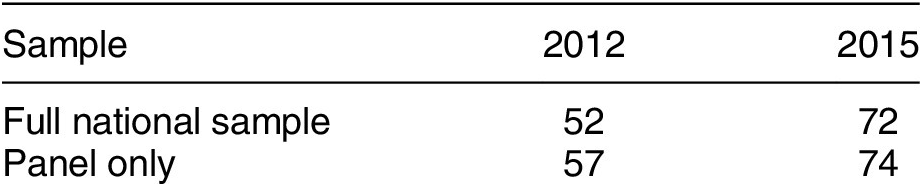
This study measures support for Putin, and thus rallying, through questions on voting behavior. This is appropriate because in authoritarian regimes with elections, the regime’s capacity to orchestrate an official ballot-box win is necessary for retaining power and therefore the willingness of citizens to vote for the regime most directly affects perceptions of its legitimacy and stability (Schedler Reference Schedler and Schedler2006, 12–3). Table 1 reports that the share of the population who said in April–May 2012 they had voted for Putin in the March 2012 presidential election was 52%, whereas by summer 2015, 72% said that they would vote for him if the election were held that same week and if the alternative candidates remained the same as in 2012.Footnote 5 The survey, then, confirms that (on aggregate) rallying took place on a scale of roughly 20 percentage points—essentially the same scale the surge was reported to be shortly after the Crimea annexation (Balzer Reference Balzer2014, 6–7). The table also reports figures calculated using only the subsample of 1,027 that was interviewed in both 2012 and 2015, “the panel,” and as can be seen, these estimates are very close to those using the fuller samples.
Percentage of the Population Saying They Voted for Putin in 2012 and Saying They Would Do So in 2015 as Assessed Using Full Sample and Using Only Panel Respondents

As Table 2 makes clear, however, the actual share of “ralliers” in the population is greater than one might think by looking only at Table 1’s aggregate numbers, which mask the full extent of individual-level change. Because the panel survey reveals 10% of Russian citizens were “defectors” and withdrew their support from Putin during this same period, the share of ralliers in the population turns out actually to be 27%. People who supported Putin in neither 2012 nor 2015 are called “oppositionists.” The latter combine with ralliers to comprise the 43% of the population who in 2012 were not self-reported Putin voters and are the baseline population for parts of this analysis.Footnote 6
Breakdown of Population by 2012–15 Patterns of Support

Note: Panel only, using voting as measure of support, percent.
Identifying Dissembling in Rallying (H1)
As expressed in the Dissembling Hypothesis (H1), the reputational cascade theory of rallying would lead us to expect a significant share of the ralliers to be engaging in at least some dissembling. While it is impossible to directly measure misrepresentation of what respondents were actually thinking at the moment of the interview, the panel design remarkably allows us to measure rather directly another form of dissembling that reputational cascade theory predicts should be involved in the rally: misrepresentation of past behavior. As Kuran (Reference Kuran1995, 256–7) notes, people concerned about social desirability are likely to misrepresent their past as well as their current positions. Misrepresenting one’s past attitudes to political leadership is a substantively important form of dissembling, distorting (thereby impoverishing) the informational landscape, creating false senses of political inevitability (“it seems everyone around me has always supported the leader”), and augmenting social pressures to conform—all of which work to authoritarians’ advantage, especially as new generations come of age (Kuran Reference Kuran1995, 184–6). We can confidently identify this form of rally dissembling because—thanks to the panel element of the survey—we have a direct record of respondents’ survey responses from 2012 that can be compared with a direct record of how they responded to the same question (about their 2012 behavior) later, in 2015.
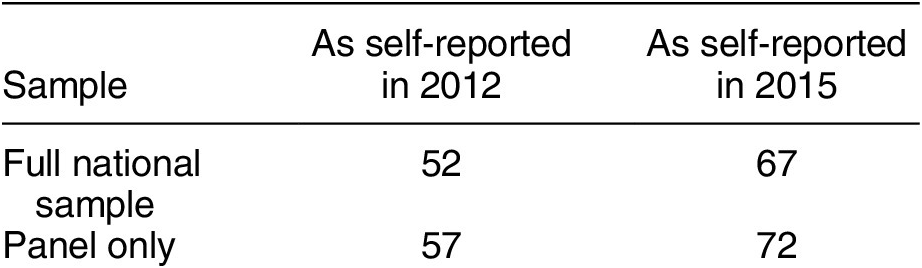
The panel survey’s findings here are remarkable, as summarized in Table 3. While 52% of all Russian citizens (not just voters) said right after the 2012 election that they had voted for Putin, by 2015 some 67% were now claiming to have voted for him. And because a large proportion of the original respondents were interviewed both in 2012 and 2015, we can actually document that many of the individuals who in 2015 were claiming to have voted for Putin in 2012 had said something different when asked the same question in 2012.
Percentage of Entire Population Reporting in 2012 and in 2015 That They Had Cast a Ballot for Putin in the 2012 Presidential Election
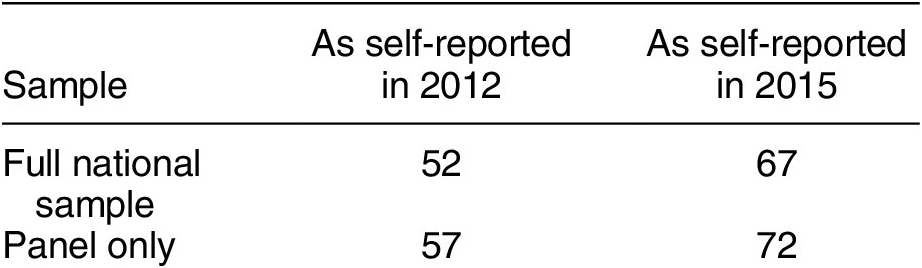
Table 4 underscores the scale of this phenomenon. Over half of the people who in 2012 gave a response other than voting for Putin misrepresented this in 2015. And this constitutes 27% of all people who said in 2015 that they would vote for Putin if elections were held that week and a stunning 75% of ralliers.Footnote 7
Among Different Parts of the Population, the Share Who Falsely Claimed in 2015 to Have Voted for Putin in the 2012 Election

Note: Estimated using panel only.
The study is naturally concerned that this documented inconsistency might not be capturing misrepresentation at all and might instead be reflecting individuals’ inability to remember for whom they voted over three years ago under the influence of hindsight bias (Kahneman Reference Kahneman2011, 202–3). Studies of vote recall have found that inaccuracy increases over time and that people who cannot remember tend to give answers biased in favor of their current preferences, which in this case could be Putin (Colton and McFaul Reference Colton and McFaul2003, 247–54; Himmelweit, Biberian, and Stockdale Reference Himmelweit, Biberian and Stockdale1978). While some recall problems are to be expected, three additional checks establish with high confidence that a significant part of the inconsistency reported in Tables 3 and 4 does in fact owe to actual misrepresentation rather than to poor recall.
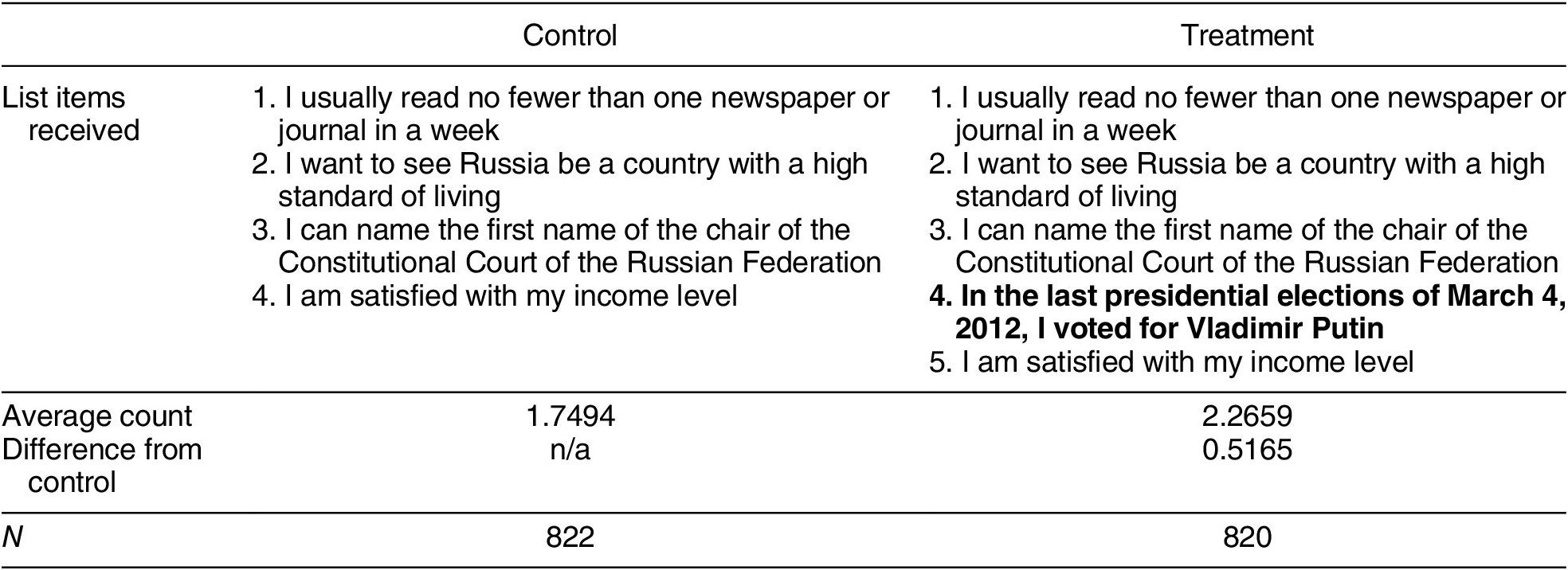
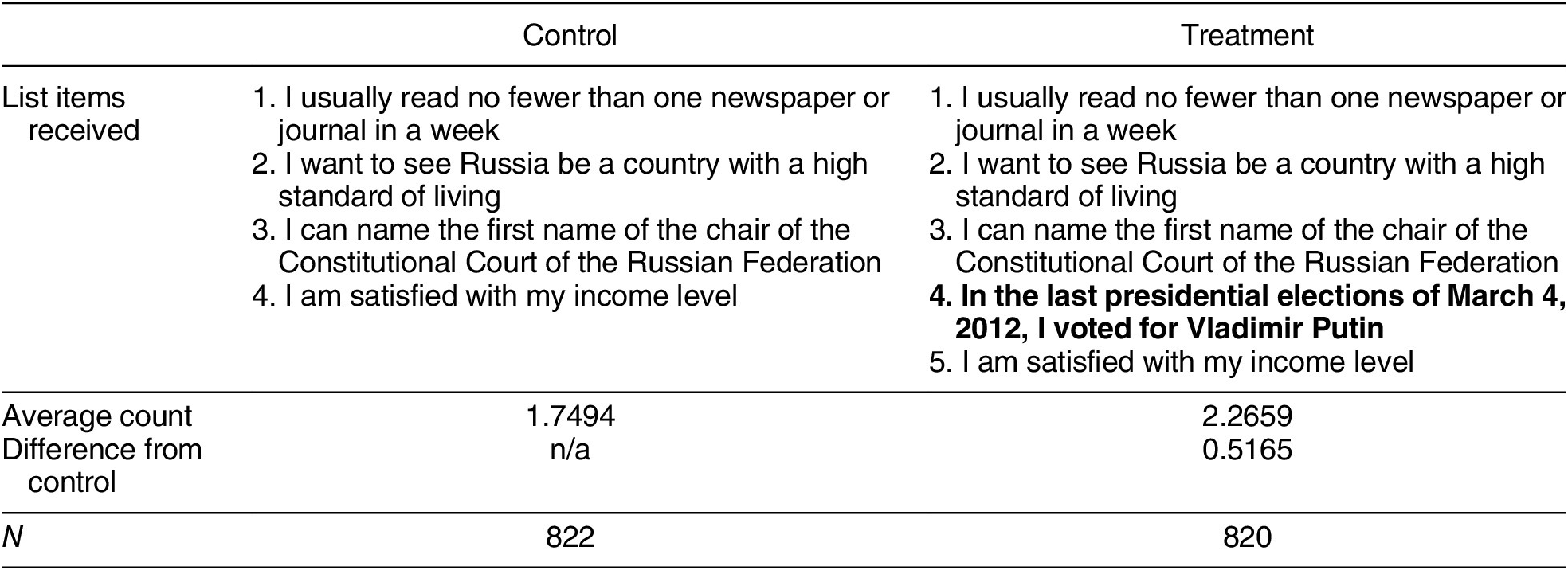
The first check is the use of a list experiment (item-count experiment), a technique designed specifically to measure public opinion on issues where social desirability considerations may yield biased results if a question is asked directly (Blair and Imai Reference Blair and Imai2012). Specifically, the 2015 survey wave gave respondents a list of four innocuous statements with which someone might agree or disagree while distributing a fifth (that the respondent voted for Putin in 2012) to a randomly selected half of the sample. By asking people only to give the overall number of these items with which they agree—pointedly not asking which items—this method gives respondents the opportunity to answer sincerely without ever having to reveal to the interviewer or anyone else whether one of the “agree” items was in fact voting for Putin. Yet by calculating the difference in the two subsamples’ average counts, researchers obtain a valid estimate of the share of the population that voted for Putin.Footnote 8
The 2015 list experiment and the basic results are reported in Table 5.Footnote 9 With 95% statistical confidence, the actual share of 2012 Putin voters in the population is assessed to be between 44% and 59%, with even the largest possibility within this band being well below the 67% reporting in the same 2015 survey having voted for Putin when asked directly. The point estimate of the real Putin vote generated by the list experiment is 52%, which intriguingly is almost exactly the share reporting in 2012 that they had voted for him. This is important evidence that the 2012–15 surge in the share of people saying they voted for Putin in the 2012 election cannot be dismissed as a matter of poor recall, but in fact represents a considerable amount of misrepresentation, backing the Dissembling Hypothesis (H1).
Results of 2015 List Experiment to Estimate the Share of the Population Who Voted for Putin in 2012
Note: Treatment item bolded.
Turning to the second strategy for testing whether poor recall can credibly account for the results in Table 4, this study leverages research telling us recall problems tend to rise quickly in the first few weeks after an event and then grow only gradually over time (Himmelweit, Biberian, and Stockdale Reference Himmelweit, Biberian and Stockdale1978). Survey research on voting in Russia has found that the initial spikes in poor recall (on the order of 10%) generally occur very soon after the vote itself among the politically disinterested, meaning that the initial sharp rise in memory failure is in fact already “baked in” to most surveys of election behavior that are not taken in the first days after an election (Colton and McFaul Reference Colton and McFaul2003, 247–54). Thus people who are misrecalling their vote in this way—the usual way—are not even part of the present analysis because they were already registered as Putin supporters in the 2012 wave of the survey (taken 4–7 weeks after the election) and thus cannot be ralliers by this study’s operational definition. Put more pointedly, the populations most prone to poor vote recall are not even part of the population of potential ralliers studied here. Moreover, a separate pair of surveys carried out by a separate survey agency documented a 20% surge in “remembered” 2012 votes for Putin—about the same size as the surge documented between 2012 and 2015 by the present survey—taking place during the window between May 2013 (well over a year after the election) and October 2014 (Alexseev and Hale Reference Alexseev, Hale, Kolstø and Blakkisrud2016, 198–9). This helps pin the timing of the “recall” surge to a narrow window spanning the Crimea rally.
Third, if people did in fact suffer an improbable sudden-onset memory lapse unrelated to Crimea midway between election cycles that can account for the denial of documented past nonsupport for Putin among ralliers, we would expect recall to be equally or more faulty for Russia’s less consequential and temporally more distant parliamentary vote, which took place in December 2011, three months before the presidential balloting. Yet in dramatic contrast with the pattern regarding the more sensitive question of past support for Putin, people’s aggregate recollection as to whether they had voted for the dominant United Russia Party in 2011 is strikingly unchanged between 2012 and 2015: In the 2012 survey wave, 40% of the population claimed to have voted for United Russia, whereas in the 2015 wave 39% claimed this—even though the 2015 question on current party vote intentions indicates a seven-point rise in United Russia’s support during the interval covered by the survey. Moreover, of the 88% of inaccurate self-reporters of the Putin vote who were not United Russia supporters in the 2012 survey, fewer than half (45%) inaccurately reported their 2012 United Russia nonsupport in 2015.
These three checks combined allow us to rule out with considerable confidence that the discrepancy between self-reporting of the 2012 Putin vote between 2012 and 2015 reflects poor recall (including the possibility of current preferences filling in for poor recall) rather than dissembling.
EMPIRICAL MARKERS OF CASCADING (H2)
Having now identified a set of ralliers whose rallying involves at least some dissembling and being able to separate them from a set of ralliers we are confident are fully sincere, this study is positioned to test whether factors associated with reputational cascading are good predictors of dissembling rallying in the way the Cascade Hypothesis (H2) posits and to explore the same predictors’ relationship to sincere rallying.
Dependent Variables and Model
Two binary dependent variables are created, one coded 1 for dissembling ralliers (0 for all others)Footnote 10 and the other coded 1 for sincere ralliers (0 for all others). Then, among the 445 people in the panel who did not already count among Putin’s self-reported voters in 2012, these dependent variables are regressed on a set of independent variables capturing the different elements of H2 (a–c) using a logit model. Models are first estimated using independent variables measured only in 2012, meaning we know the 2014 Crimea annexation could not influence them. This supplies our most confident identification of predictors of dissembling rallying and sincere rallying. Models are then estimated using not only the 2012 independent variables but also some that can only be measured in 2015 for reasons noted below.
Independent Variables for Testing Cascade Hypothesis
The independent variables are constructed as follows, with the precise formulations of the questions that generated them available in Appendix B of the SM and summary distributions of responses in Appendix D of the SM. They are listed here in order of the different elements of H2.
H2a. A binary variable (Majority backs Putin) is created to single out people who in 2015 answered at least “a majority” when asked “what do you think, how many people in our country approve of Vladimir Putin’s activity as president?” This variable must be measured in 2015, as the theory posits a connection between contemporaneous perceptions of what the majority view is and public statements of political support. To ensure this variable is capturing contemporary perceptions only, the study controls for 2012 perceptions that Putin has majority support. If the theory is correct, what should predict dissembling rallying is precisely the 2015 measure, not that from 2012.
H2b. Measures are created to reflect television news consumption and social media use. As with all variables capturing media habits here, one set measures them in 2012, prior to the rally, and another set assesses them in 2015. The measure of the frequency with which individuals watch television news (TV frequency) ranges from never (coded 0) to every day (coded 5). Controlled by the state, Russia’s dominant three channels featured intensely positive coverage of the Crimea annexation and Putin’s role in leading it, creating the impression of a positive nationwide “movement” that people should find it socially desirable to join (Hutchings and Tolz Reference Hutchings, Tolz, Kolstø and Blakkisrud2016; Sharafutdinova Reference Sharafutdinova2020). As for social media use, because prior research on Russia has found that different sites expose people to different kinds of communities with distinct political implications (Reuter and Szakonyi Reference Reuter and Szakonyi2015), separate binary variables are created for users of each of the three most frequented social media platforms in Russia at the time: VKontakte, Odnoklassniki, and Facebook.
H2c1. Three indices are constructed to capture the strength of people’s priors regarding Putin. Because it is important that these be priors, they are measured only in 2012, two years before the Crimea rally occurred. Two are economic, reflecting the known tight relationship between economic perceptions and support for Putin (Treisman Reference Treisman2011). The first is a five-point scale capturing whether respondents thought their families had won or lost materially since Putin came to power (pocketbook economic considerations, higher numbers reflecting more positive economic assessments) (Pocketbook up 2000s). The second is a binary variable measuring whether people believed the population as a whole had gained materially since Putin became president in 2000 (RF economy up 2000s).Footnote 11 And because Putin’s strongman leadership qualities are also known to shape support for him (Cassiday and Johnson Reference Cassiday, Johnson and Goscilo2013; Matovski Reference Matovski2018), the third variable capturing people’s priors on Putin is an index (ranging from 1 to 4) of the degree to which they think Putin possesses the leadership qualities of strength, intelligence, honesty, and empathy (Putin leader qualities).
H2c2. Four variables capture awareness of the negative economic and other consequences scholars have argued resulted from the Crimea annexation and should weaken support for Putin (Alexseev and Hale Reference Alexseev, Hale, Kolstø and Blakkisrud2016; Balzer Reference Balzer2014; Snegovaya Reference Snegovaya2020). Because it would have been impossible for people to be aware of the Crimea annexation’s negative consequences before this surprise event happened, these quantities can only be measured after the rally. These include two five-point scales reflecting how people say their own family’s material fortunes (Pocketbook up last yr) and those of the whole Russian economy (RF economy up last yr) had changed over the year prior to the 2015 survey (higher values capture more positive assessments). They also include two measures of information regarding the human costs of the war in eastern Ukraine sparked by the annexation: a binary measure of having direct information through personally communicating with war refugees (War refugee contact) and a binary variable coded 1 for people who indicate either that “Russian soldiers are fighting in Ukraine” or, if not, that it was “very likely” or “somewhat likely” that “Russian soldiers will be drawn into combat in the war in Ukraine in the next five years” (RF troops in Ukraine).
Independent Variables for Testing the Two Conventional Theories
To assess the relative power of the two conventional theories (both of which posit sincere rallying) and the reputational cascade theory of rallying, the analysis also includes measures capturing the mechanisms most emphasized by the patriotism and opinion leadership schools (Appendix B.3 in the SM contains precise definitions and discussion). Because the patriotism school posits that a surge in patriotism motivates ralliers, the study includes a post-rally measure of whether people thought pride in being a Russian citizen had increased in Russia since 2000 (Pride in Russia up) as well as four pre-rally variables meant to capture predispositions for experiencing such a surge: a binary measure of believing Russia’s influence in the world had risen since 2000 (RF influence up), a four-point scale of ethnocentric Russian nationalism (RF for Russians), and four-point scales of perceiving NATO and the USA as a threat (Fear West) and supporting hostile Russian treatment of the West (Hostile to West).
Because the opinion leadership school finds that rallies consist primarily of former opponents becoming more supportive under the influence of their party leaders or the media they follow, the study includes a binary measure of partisanship for Russia’s largest opposition party, the Communist Party of the Russian Federation (KPRF partisan), and variables capturing exposure to independent media where opposition viewpoints can reliably be found. The latter are binary variables indicating whether individuals had “listened to news broadcasts” in the past seven days on the freewheeling Ekho Moskvy radio station or said they relied primarily on the Internet for news (Internet main news).
Controls
The study includes control variables common in studies of Russian voting (discussed in Appendix B.4 in the SM).
Results
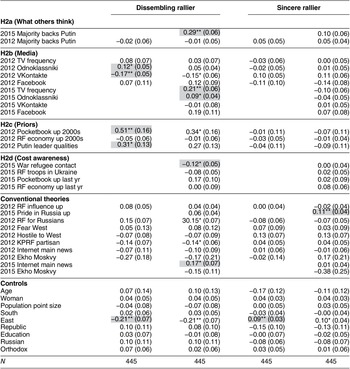
Table 6 reports the results with several considerations in mind. First, the analysis takes advantage of the data’s panel structure to address certain endogeneity concerns that might otherwise arise. In particular, wherever possible and logical, primary explanatory factors are measured in 2012, with information collected from respondents prior to the rally. This way, we know that the measures on these independent variables cannot be influenced by Crimea and subsequent events. When estimating the effects of variables measured in 2012 on different forms of rallying in 2015, only other 2012 variables (not 2015 variables) are included as controls. Some independent variables, as discussed above, must be measured in 2015. When estimating the effects of such measures, all 2012 variables are included as controls. Both sets of results (with and without independent variables measured in 2015) are reported, though the particular findings that “count” (being generated by the appropriate model specification for testing the hypothesis in question) and that are also statistically significant are shaded gray.
Factors’ Full Effects on the Probability of a 2012 Putin Nonsupporter Becoming a Dissembling Rallier or a Sincere Rallier in 2015

Note: Baseline all others, logit model, SEs in parentheses, *p < 0.05, **p < 0.01.
Second, a correlation is deemed statistically significant if zero effect can be ruled out with at least 95% statistical confidence. Third, as logit coefficients do not lend themselves to straightforward interpretation, the results are reported as “full effects.” Full effects are simply average marginal effects when all independent variables are scaled to 0–1, with 0 representing the minimum and 1 the maximum values on each variable observed in the data.Footnote 12 They are useful for comparing the overall magnitude of effects of variables in the equation as well as for avoiding the intractably small coefficients that can result from calculating the average marginal effects of finely gradated variables like age.
H2a. Believing Most Others Support the Incumbent
Supporting H2a, the belief that a majority of other people support Putin in 2015—treated by reputational cascade theory as a key source of social pressures to conform—is a very strong predictor of being a dissembling rallier just as we would expect. The full effect is large, 29 percentage points. Additional findings lend confidence this result is not spurious or the product of endogeneity. If this independent variable were in fact reflecting an omitted variable that happened to be related to dissembling rallying through a mechanism other than social desirability concerns, its measure in 2012 should also be significantly correlated with rallying, but it is not. Instead, H2a is supported, with dissembling rallying correlated with thinking Putin enjoys majority support only post-rally, not pre-rally.
H2b. Media Consumption
Patterns of media consumption are more complex, but also broadly consistent with reputational cascade theory. Consuming the powerful images and frames produced by state television in greater measure in 2015 is associated with a statistically significant 21-point increased chance of being a dissembling rallier. Interestingly, not only is frequent television news consumption not a significant predictor of sincere rallying, but if anything it is a negative predictor. This suggests television may be better at cueing people as to what they should think about Putin in the wake of Crimea than at shaping what they actually do think. This also rules out an endogeneity concern raised by the insignificance of 2012 patterns of TV viewership, the possibility that people might have chosen to watch more TV news in 2015 because they were ralliers and sought an outlet expressing similar views: if this were the case, televised news consumption should instead be primarily (or at least equally) associated with sincere rallying. As for social media, using Odnoklassniki (one of Russia’s two biggest online social networks at the timeFootnote 13) in either 2012 or 2015 predicts dissembling rallying but not sincere rallying, fully in line with reputational cascade theory. Associations with the other major Russian social network, however, are different: 2012 VKontakte usersFootnote 14 are 17 points less likely to be dissembling ralliers but are (in a nearly statistically significant relationship) on average 10 points more likely to be sincere ralliers. Because VKontakte at that time was more popular among people with opposition viewpoints (Urman Reference Urman2019) and until late 2014 strongly resisted state interference in content (Enikolopov, Makarin, and Petrova Reference Enikolopov, Makarin and Petrova2020, 1488), perhaps its users encountered more pushback against the idea that backing Putin was socially desirable than did users of the more mainstream Odnoklassniki, leading them to rally only when they sincerely supported Putin’s Crimea gambit. Regardless, this supports the importance of disaggregating social media effects in future research (Reuter and Szakonyi Reference Reuter and Szakonyi2015).
H2c1. Priors on Putin
Supporting H2c1, Table 6 reports that individuals who had the least anti-Putin positions in 2012 were the most likely to be among the ralliers in 2015. And they systematically became dissembling ralliers rather than sincere ralliers. This is what we would expect if having priors closer to the socially desirable position served primarily to lower the personal discomfort of insincerely claiming to hold this position (that is, to lower personal thresholds for joining the reputational cascade) rather than to make people more likely to sincerely shift to this position. The priors that mattered most are whether someone believed in 2012 (despite not having voted for Putin) that they had personally gained materially under him (associated with a full effect of 51 percentage points) and whether someone thought in 2012 (also despite not having voted for him) that Putin possessed strong leadership qualities (a full effect of 31 points).Footnote 15
H2c2. Awareness of Rally-Triggering Event’s Costs
The results of the econometric analysis are also consistent with H2c2, the expectation that people who are most aware of the rally event’s high costs will be less comfortable dissembling and thus less likely to be dissembling ralliers. Table 6 shows people who reported having come into personal contact with refugees from the Russia—Ukraine war in 2015 were 12 percentage points less likely to be among the dissembling ralliers. Believing Russian troops are or would soon be in Ukraine does not have a statistically significant effect, though the coefficient sign is as expected. Similarly, people suffering the most economically since the Crimea annexation began are on average less likely to be dissembling ralliers but the relationship is not statistically significant. None of these measures of cost awareness are statistically significant predictors of sincere rallying.
Conventional Theories
Also confirming this study’s overall argument is the finding that conventional theories, where supported in Table 6, are borne out where they should be: in predicting sincere rallying. This primarily pertains to the most central expectation of the patriotism school: sincere rallying should be linked to high levels of patriotism. Indeed, people believing national pride had increased under Putin in 2015 are 11 percentage points more likely to be sincere ralliers. This, along with the similar (but just barely insignificant) findings on the role of hostility to the West, reassures us that a set of fully sincere ralliers has been correctly identified.
No support, though, is found in Table 6 for the opinion-leadership theory of sincere rallying, the idea that opposition opinion leaders (partisan, media) create rallies by cueing followers to be less critical of the country’s leader. Neither KPRF partisanship nor consuming independent or opposition-minded media (Ekho Moskvy or the Internet generally) are statistically significant predictors of sincere rallying, and Internet news consumption in 2015 instead predicts dissembling. Such findings are arguably to be expected in an authoritarian environment, where opposition voices are often muted in the first place or reflect “in-system,” co-opted opposition that is small in numbers and not very critical. In this light, the otherwise puzzling finding on the Internet’s role makes sense when one considers research showing that the Internet in Russia is not so independent as one might think, and that state-run television news strongly influences what people look for (and therefore find) on the Internet (Cottiero et al. Reference Cottiero, Kucharski, Olimpieva and Orttung2015).
Discussion
This study has argued there is strong theoretical reason to believe rallying around the flag in authoritarian polities is likely to involve a substantial component of dissembling that is expected to spread through a reputational cascade.
Next, it has established through panel survey data that a large share of the rallying around the flag observed in Russia following Putin’s annexation of Crimea involves at least one form of dissembling, a phenomenon that has not been recognized in prior quantitative studies of rallying. Specifically, a whole 75% of all ralliers are revealed to have falsely claimed a more supportive overall relationship to Putin after the Crimea annexation than in fact was the case, misleadingly reporting that they had voted for him in the most recent presidential election. Multiple checks confirm this misrepresentation is mostly intentional rather than poor recall: (1) When the very same people were shielded from social desirability pressures after the rally by an item count experiment, their responses yielded an estimate of Putin’s vote share that is very close to pre-rally records and far off what they claimed post-rally; (2) the misrepresentation of 2012 votes spiked up precisely during 2013–14 (when the rally occurred, over a year after the election itself) rather than following typical patterns of fading memory of past vote, and the types of people most likely to display poor vote recall were likely already recorded as Putin supporters in the 2012 survey and thus were not among the ralliers identified in this study; (3) the majority of people who falsely claimed to have voted for Putin did accurately recall and report a highly similar but less sensitive behavior (not voting for the United Russia Party) even though the parliamentary election was further in the past and less consequential than the presidential election and even though support for United Russia also rose during the period studied; (4) factors linked to reputational cascades by previous research successfully predict which pre-rally nonsupporters of Putin become dissembling ralliers as opposed to steadfast oppositionists or sincere ralliers. The totality of evidence thus strongly identifies dissembling as a component of Putin’s Crimea rally, thereby supporting this study’s core Dissembling Hypothesis (H1).
By identifying this form of dissembling, the study is able to illuminate patterns in its distribution and show that these patterns are consistent with reputational cascading. In a reputational cascade, social desirability considerations induce incumbent leaders’ nonsupporters with successively higher personal thresholds to publicly express support in a rapid chain reaction fueled by social media and television outlets that are positioned to convey impressions of social desirability. The rally event triggers this process by focusing people’s attention on mass media and the central leadership for information, including information on what type of response is socially desirable. The first to join the cascade, ceteris paribus, are those with relatively pro-incumbent priors and those who are least aware of the rally event’s likely costs (their psychological discomfort from dissembling should be lower), with the cascade stopping when a gap in personal thresholds is reached (when the last rallier’s joining is not enough to cross the next-lowest personal threshold). The result is the appearance of a major addition of new supporters of the incumbent that is in fact highly dependent on people wanting to express publicly what they think other people likely expect them to express. Accordingly, the present study of Russia’s Crimea rally finds dissembling ralliers stand out systematically for believing contemporaneously that a majority of other people also back Putin (H2a), consuming media that convey impressions of social desirability (state television and certain social media as per H2b), having relatively pro-Putin priors (H2c1), and personal access to information about the human costs of the Crimea annexation (H2c2).
On the Extent of Dissembling
This study’s chief goals, documenting a role for cascading dissembling in rallying around the flag and identifying patterns in its distribution, have been accomplished by focusing on only one form of dissembling: self-reported voting in the most recent election. A natural next step for future studies will be to establish whether, and the extent to which, the dissembling predicted by reputational cascade theory extends to other aspects of rallying around the flag, most importantly post-rally attitudes toward leadership. The present study is not equipped to answer the latter question with great confidence. Someone skeptical of the extent of dissembling involved in rallying could argue that a person who did not vote for Putin in 2012 might have become a sincere Putin supporter by 2015 and then wished in retrospect that they had voted for him or been too embarrassed to admit that they had not done so. In this case, their very support for Putin post-Crimea might actually contribute to their motivation to dissemble about not having supported him pre-Crimea. This possibility would also be consistent with some of the patterns identified in Table 6: Because we know people can react to majority social pressures not only by complying (preference falsification) but also by converting (Nail, MacDonald, and Levy Reference Nail, MacDonald and Levy2000), it would make sense that some people who believe Putin has majority support, who consume media conveying majority social pressures, and who previously had the least negative perceptions of Putin might sincerely convert to “Putinism” and dissemble about not having voted for him. Such a pattern may even reflect an “informational cascade,” which posits a cascading updating of sincere beliefs (Lohmann Reference Lohmann1994). Something like this interpretation can be found in two important recent studies of Putin’s appeal after Crimea (Greene and Robertson Reference Greene and Robertson2019; Sharafutdinova Reference Sharafutdinova2020), though neither addresses past vote and both take their subjects’ responses at face value, not considering the possibility that some of the behavior they observe and report may not be entirely sincere. The two distinct interpretations laid out by the present study and these works should frame a fruitful agenda for future research into the extent of dissembling involved in rallying.
At this point, three grounds can be advanced for suspecting that the reputational cascade theory will eventually be borne out in predicting a much larger role for dissembling in rallying around the flag than what is established in the present study as a first step. Initially, the social science of human behavior is unequivocal that people respond to social pressures in different ways that can include both compliance and conversion and that compliance is very common (Maass and Clark Reference Maass and Clark1983; McCauley Reference McCauley1989; Nail, MacDonald, and Levy Reference Nail, MacDonald and Levy2000). For this reason, reputational cascading is frequently found intertwined with informational cascading (Kuran Reference Kuran1995, 176–94). In this light, given the strong social pressures to conform in Russia documented to have come along with the Crimea annexation (Greene and Robertson Reference Greene and Robertson2019; Sharafutdinova Reference Sharafutdinova2020), it would be surprising if people pursued conformity exclusively through conversion and not at all through compliance (preference falsification). Most likely, rallies involve both—some conversion, some compliance—and the present study provides a starting point for sorting these out by establishing that at least a quarter of Russia’s Crimea ralliers are likely to be fully sincere. At the same time, the fact that three quarters of Crimea ralliers are established to have reacted to social pressures by dissembling about one thing (their past vote) would seem a strong prima facie case for suspecting a large share of them are dissembling about other things too, such as their post-rally attitudes to Putin.
Second, some empirical signs this is the case can be found in Table 6. If the new Putin supporters brought in by the Crimea rally were primarily engaging in cascading conversion rather than cascading compliance, the markers of cascading responses to social pressures outlined in H2 should be at least as strong among the most clearly sincere ralliers as among other ralliers. But a look at Table 6 makes clear this is not the case.Footnote 16
Third, Appendix G in the SM reports results from a head-to-head test of the two competing possibilities conducted through an experiment in the 2015 RES survey. It is well established that priming people on a consideration tends to give that consideration greater weight in subsequent cognitive tasks, including the evaluation of politicians (Sherman, Mackie, and Driscoll Reference Sherman, Mackie and Driscoll1990; Taber and Lodge Reference Taber and Lodge2016). If the Crimea annexation did genuinely enhance support for Putin among the people this study has labeled “dissembling ralliers,” priming them on the annexation should lead them to express greater support for him. But this does not happen; in fact, the average response is negative. This contrasts with results among people classified in this study as sincere Putin supporters, among whom being primed on Crimea generates a pronounced increase in Putin’s support. Although definitive conclusions must await further research, cause is strong for believing that the dissembling involved in rallying around the flag is likely to extend far beyond past vote (the focus of this study), including to dissembling about post-rally attitudes to leadership.
Conclusion
Establishing a reputational cascade component of rallying around the flag is important because rallying is a consequential phenomenon, widely linked to the initiation and outcomes of deadly conflicts as well as to major shifts in domestic politics. Before the present study, theories of rallying have virtually all assumed rallying reflects changes in individuals’ sincerely held, private preferences, driven by surges in patriotism or the silencing of influential opposition voices in mass media. Moreover, standard theories have developed primarily with democratic polities in mind even though some of weightiest rallies in recent history have involved nondemocratic regimes initiating conflicts ranging from the relatively quick Falklands/Malvinas War to the unfathomably bloody World War II. The argument has not been that such studies are wrong, just that the mechanisms they identify are not the whole story. In fact, the present case study of a major authoritarian rally triggered by territorial conquest, Putin’s surge in popularity following Russia’s annexation of Crimea, suggests that the reputational cascade component of rallying may in fact be the dominant one when it comes to explaining the appearance of large numbers of new regime supporters who remain so for more than a year.
Although the primary goal of this research has been to develop a theory of rallying in previously understudied nondemocratic contexts like Russia’s, its findings likely have major implications for how we should understand rallying in general, including in democratic settings. For one thing, democracies can be rife with the same kinds of political social desirability pressures that are in focus here, those of type i and type ii, resulting in dissembling and reputational cascades (Kuran Reference Kuran1995; Kuran and Sunstein Reference Kuran and Sunstein1999). While one may question just how prevalent political preference falsification is in democracies (Tetlock Reference Tetlock1998) and while people in democratic systems are less likely to experience type iii pressures, it would seem natural for at least some rallying behavior in democracies to involve dissembling much as in dictatorships. At a bare minimum, this study identifies this as an important question.
In fact, there are strong grounds for future research to consider whether the reputational cascade theory of rallying might supply a more fundamental theory of rallying across democracies and autocracies, one capable of explaining observed patterns in both the primary dependent and independent variables on which the most prominent conventional theories are based. For one thing, reputational cascade theory can account for the appearance of surges in patriotism that most theories put at the heart of rallying but can do so without presuming everyone expressing such patriotism is (a) sincerely feeling it and (b) genuinely viewing the leader as the embodiment of the nation. That is, at least some of what public opinion research registers as patriotism may in fact be only a public expression of patriotism that diverges from privately held attitudes. Recent research indeed finds that much of Russians’ supposed patriotic fervor is feigned accommodation to authorities’ demands based on beliefs that a majority of “other people” were patriots in the state-led way and that there is accordingly a divergence between public and private patriotism (Goode Reference Goode2021, 12). Rally events, therefore, may produce not only dissembling rallying but also dissembling patriotism. And this may be leading researchers to assume patriotism is causing rallying when in fact social desirability concerns are a confounding, omitted underlying variable.
Reputational cascade theory might also explain why theorists have arrived at the opinion leadership theory of rallying. Opposition leaders—to the extent they seek public support in order to win power—are likely to be among the most sensitive bellwethers of social desirability trends. By adjusting their positions accordingly, they cue their followers to do the same.Footnote 17 Social desirability considerations, then, may well explain not only mass-level dissembling but also dissembling among party and media elites, thereby accounting for the correlation researchers frequently find between the behavior of elite opinion leaders and the behavior of their followers.
Reputational cascade theory also holds out potential for explaining additional patterns observed among rallies in democracies that other theories find challenging. For one, it helps explain why common types of “rally events” do not always trigger rallies and why it has proven difficult to predict the longevity or magnitude of rallies. This is because the speed and scale of cascades (and indeed whether one occurs at all) depend on the specific distribution of thresholds in society and very small variations in the thresholds of a very small number of individuals can make the difference between a cascade continuing or running into a breakpoint and stopping at any given level (Bikhchandani, Hirshleifer, and Welch Reference Bikhchandani, Hirshleifer and Welch1992; Granovetter Reference Granovetter1978; Kuran Reference Kuran1991a). Reputational cascade theory can also explain why rallies generally have short life spans in democracies (Parker Reference Parker1995): Cascades can easily be followed by reverse cascades with the onset of the right kind of shock (Bikhchandani, Hirshleifer, and Welch Reference Bikhchandani, Hirshleifer and Welch1992), and reversal is arguably more likely to occur when preference falsification is high (Kuran Reference Kuran1995; Kuran and Sunstein Reference Kuran and Sunstein1999).
In what ways would reputational cascade theory suggest authoritarian rallies differ? For one thing, nondemocratic leaders are likely to have more tools at their disposal for ensuring intended rally events actually do trigger the cascading dissembling necessary to constitute a sizable rally. With more direct control over mass media, authoritarians are better positioned to portray their own position as the socially desirable one during the first critical moments of postevent media consumption that are widely documented to get rallies going (Newman and Forcehimes Reference Newman and Forcehimes2010, 146–8; Schubert, Stewart, and Curran Reference Schubert, Stewart and Curran2002). Authoritarians’ political resources are also likely to make them better (but not perfectly) able to “shore up” a cascade equilibrium once one has been reached, potentially insulating the public from “shocks” in the form of new information or potent images that could catalyze a reverse, regime defection cascade (Rubin Reference Rubin2014). Finally, the much greater presence of type iii social desirability pressures (including possibilities of repression for dissent and promotion for loyalty) might suggest authoritarian rallying could tend to reach greater heights, with type iii pressures lowering thresholds for more people to join the cascade.
Finally and most generally, by isolating a form of dissembling and identifying patterns in its distribution, this study has much to tell us about influences on compliance as well as about how human behavior cascades. Studies of political dissembling have struggled to find direct measures (Rosenfeld, Imai, and Shapiro Reference Rosenfeld, Imai and Shapiro2016), so this study’s individual-level isolation of misrepresention of past vote is unusual and supplies important precision and leverage relative to indirect measures in the effort to identify influences on it. The main findings are that political dissembling in authoritarian regimes is likelier among people who are likelier to experience lower discomfort from cognitive dissonance (having priors more proximate to the socially desirable position) and it is less likely when people have private information about negative considerations linked to this position. It also confirms strong patterning by media consumption. Regarding cascading human behavior, this study establishes a role for cascading in a previously unrecognized realm, rallying around the flag. It also supplies a rare systematic empirical test of reputational cascade theory, introducing a novel empirical strategy (combining panel survey data with an experimental design) for identifying the presence of dissembling in a way that enables us arguably to observe and study a real-world reputational cascade in action at the individual level more directly and systematically than has before been possible.
Supplementary Materials
To view supplementary material for this article, please visit http://doi.org/10.1017/S0003055421001052.
Data Availability Statement
Research documentation and data that support the findings of this study are openly available at the American Political Science Review Dataverse: https://doi.org/10.7910/DVN/6XGUWQ.
Acknowledgments
The author thanks in particular Donna Bahry, Alexander Coppock, Stas Gorelik, Cynthia Kaplan, Peter Krause, Kelly McMann, Ora John Reuter, Regina Smyth, Julie Taylor, Joshua Tucker, the anonymous reviewers, and participants in workshops organized by PONARS Eurasia and the University of Helsinki’s Aleksanteri Institute, the Yale MacMillan Center, and George Washington University’s Comparative Politics Workshop for their feedback at different stages of the project. The views and findings presented here reflect only those of the author, who bears sole responsibility for any errors.
Funding Statement
The new research that was conducted for this article (the 2015 survey) was funded by the U.S. National Science Foundation (SES-1541738). The study also uses the previously published 2012 RES survey, for which funding information can be found in Hale and Colton (Reference Hale and Colton2017).
Conflict of Interest
The author declares no ethical issues or conflicts of interest in this research.
Ethical Standards
The author declares that the human-subjects research in this article was reviewed and approved by the Institutional Research Board of the George Washington University Committee on Human Research. The certificate number is provided in Appendix A of the SM. The author affirms that this article adheres to the APSA’s Principles and Guidance on Human Subject Research.






Comments
No Comments have been published for this article.