Although outcomes for patients with single-ventricle heart disease have improved over the last three decades,Reference Karamlou, Diggs, Ungerleider and Welke 1 – Reference Knott-Craig, Danielson, Schaff, Puga, Weaver and Driscoll 3 patients with significant systemic atrioventricular valve regurgitation at diagnosis are widely considered to be a high-risk sub-population for staged surgical palliation, and continue to present difficult management decisions. Both Norwood and Fontan discussed the importance of a competent atrioventricular valve in staged palliation for single-ventricle patientsReference Norwood, Lang, Casteneda and Campbell 4 , Reference Hancock Friesen, Sherwood and Gauvreau 5 and some centres consider significant atrioventricular valve regurgitation a contraindication to proceeding with staged surgical palliation.Reference Checchia, Larsen and Sehra 6 However, current data are conflicting with regard to the impact of atrioventricular valve regurgitation on outcomes in this population. In some series, atrioventricular valve regurgitation has been found to be an independent risk factor for mortality during staged palliation;Reference Azakie, Merklinger and McCrindle 2 , Reference Barber, Helton and Aglira 7 – Reference d'Udekem, Xu and Galati 13 however, this association has not been found in other series.Reference Knott-Craig, Danielson, Schaff, Puga, Weaver and Driscoll 3 , Reference Forbess, Cook, Roth, Serraf, Mayer and Jonas 14 – Reference Furck, Uebing and Hansen 17
In addition, these studies have largely evaluated the impact of atrioventricular valve regurgitation on short-term outcomes. As a result, longitudinal follow-up data in patients with significant atrioventricular valve regurgitation at diagnosis are limited, especially in the current era when surgical intervention on atrioventricular valves is an option for single-ventricle patients that may help mitigate the risk associated with atrioventricular valve regurgitation at diagnosis. Few prior studies have evaluated the effect of atrioventricular valve regurgitation at the time of diagnosis on outcomes, but have instead focused on atrioventricular valve regurgitation at later points during the staged palliation process. As a result, there are relatively little current data to guide management decisions in single-ventricle patients with significant atrioventricular valve regurgitation at the time of diagnosis. Predictors for atrioventricular valve intervention in this population have not been closely examined, and it is unclear whether atrioventricular valve regurgitation at diagnosis is associated with an increased likelihood of atrioventricular valve surgical intervention over time. Furthermore, most data on the impact of atrioventricular valve regurgitation have focused on patients with single right ventricular morphology, and there may be different implications for patients with single left ventricular morphology.
In this retrospective study, we sought to evaluate the impact of significant atrioventricular valve regurgitation at the time of diagnosis on mortality and morbidity in single-ventricle patients, and how this association may differ based on ventricular morphology. We also aimed to investigate predictors of atrioventricular valve intervention during follow-up.
Materials and methods
Study design
This retrospective study was approved by the Institutional Review Board of the University of Utah, and the requirement for patient consent was waived. All patients admitted to our institution with a new diagnosis of single-ventricle heart disease from January 1, 2005 to December 31, 2008 were reviewed. Patients were identified through the Enterprise Data Warehouse, a database of hospital discharge and procedure International Classification of Diseases 9 codes maintained by Intermountain Healthcare. Patients with any of the following discharge codes were evaluated: common ventricle, endocardial cushion defect, tricuspid stenosis/atresia, congenital stenosis of the aortic valve, congenital mitral stenosis, hypoplastic left heart syndrome, and malposition of the heart and cardiac apex. Patient records were then searched to identify those with single-ventricle anatomy and to evaluate for any exclusion criteria. Patients were excluded if they did not have a complete pre-operative echocardiogram available, or if they had biventricular physiology and a two-ventricle treatment pathway, pulmonary venous obstruction at diagnosis, pulmonary atresia with intact ventricular septum, or hypoplastic left heart syndrome with intact atrial septum. Data were collected from birth to 18 months of age for all patients through chart review. Demographic data collected included gestational age, birth weight, presence of associated genetic syndromes or heterotaxy syndrome, and listing for transplant, including age at listing and age at transplant. Peri-operative variables included type of surgical intervention and type of systemic to pulmonary artery shunt, any atrioventricular valve surgical intervention, as well as bypass and cross-clamp times. Details were collected for all hospitalisations and included total hospital days and days until chest tube removal. Echocardiogram reports at diagnosis and before and after each surgical intervention were reviewed for pre-operative anatomy, degree of systemic atrioventricular valve regurgitation, and presence of systemic ventricular dysfunction. At our institution, the degree of atrioventricular valve regurgitation is judged qualitatively from the colour Doppler signal because of a lack of validated quantitative methods for assessing atrioventricular valve regurgitation in children,Reference Lopez, Colan and Frommelt 18 especially those with single-ventricle anatomy. In order to evaluate variability in grading atrioventricular valve regurgitation, the initial echocardiograms of 10% of randomly selected patients were reviewed in a blinded manner by a single reviewer (N.P.), and results were compared with those in the echocardiogram reports.
The primary outcome of the study was cardiac mortality, which was defined as those patients receiving a cardiac transplant or with mortality for any reason during the study period. Secondary outcomes included listing for heart transplant, as well as the morbidity factors of total hospital days, duration of chest tube drainage, and whether a surgical atrioventricular valve intervention was performed. Evaluation of total hospital days included cumulative days admitted at our institution, the only regional children's hospital, for any reason from birth to 18 months of age. For those patients who died during the study period, hospital days were assigned a score in reverse order, such that those who died earliest received the worst score. This was done to prevent those who died – and therefore had fewer hospital days – from appearing to have a more favourable outcome.
Statistical analysis
Univariate associations between categorical variables were assessed with Fisher exact test or χ2 test, and continuous variables were assessed with Student's t-test or the Wilcoxon rank-sum test as appropriate. Multivariable logistic regression was used to determine independent variable associations with the end points of mortality, listing for heart transplant, and need for surgical atrioventricular valve intervention. Variables with a p value of <0.05 were included in the models. Analyses were also stratified by ventricular morphology – single right ventricle versus single left ventricle. Survival curves were generated and the association of risk factors with mortality was evaluated with a Cox proportional hazards model. Association between total hospital days and degree of atrioventricular valve regurgitation at diagnosis was evaluated with the non-parametric Wilcoxon rank-sum test. For those patients who died before 18 months of age, hospital days were scored in reverse order, such that those who died earliest – having the shortest length of stay – represented the worst scenario.
Results
Demographics
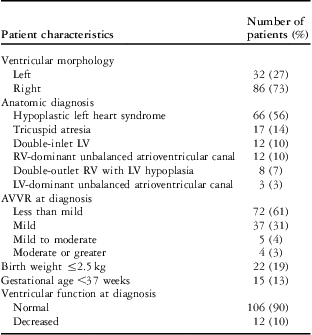
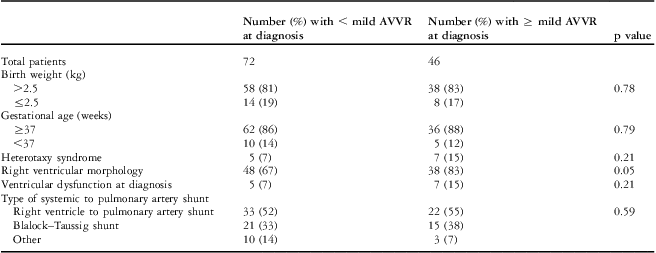
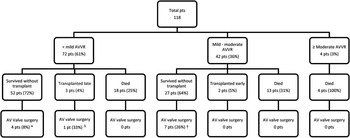
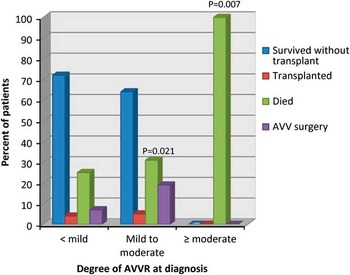
A total of 118 single-ventricle patients met the inclusion criteria and were evaluated, 73% of whom had single right ventricular morphology (Table 1). The mean gestational age was 38 weeks (range 30–41) and the mean birth weight was 2.99 kg (range 1.16–4.50). At the time of diagnosis, 37 patients (31%) had mild, 5 (4%) had mild to moderate, and 4 (3%) had ≥ moderate atrioventricular valve regurgitation. Table 2 compares demographics between those with less than mild atrioventricular valve regurgitation at diagnosis and those with mild or greater atrioventricular regurgitation. The proportion of patients with a single right ventricle with ≥ mild atrioventricular valve regurgitation at diagnosis (83%) was greater than in the group with less than mild atrioventricular regurgitation (67%), although this did not meet statistical significance (p = 0.058). In order to evaluate variability in the reported grading of atrioventricular valve regurgitation, 10 randomly selected echocardiograms were reviewed in a blinded manner by a single reviewer (N.P.). There was fairly good agreement in the assessment of the degree of atrioventricular valve regurgitation noted in the initial report and that determined on blinded review. There were only two discrepancies in which the category of atrioventricular valve regurgitation would have changed, both of which were rated as trace atrioventricular valve regurgitation in the report and mild atrioventricular valve regurgitation by the blinded reviewer. All other variables were similar between the two groups. Figures 1 and 2 depict a breakdown of longitudinal outcomes for all patients based on the degree of atrioventricular valve regurgitation at diagnosis.
Patient demographics for the entire cohort.

AVVR = atrioventricular valve regurgitation; LV = left ventricle; RV = right ventricle
Comparison of demographic variables by the degree of atrioventricular valve regurgitation at diagnosis.

AVVR = atrioventricular valve regurgitation
Flow diagram demonstrating patient outcomes based on the degree of AVVR. Those transplanted early were listed for transplant at the time of diagnosis, before undergoing any surgical palliation. Those transplanted late were listed for transplant following attempt at surgical palliation. *One with mild, one with mild-to-moderate, and two with moderate AVVR at the pre-stage II evaluation. ΔMild AVVR at the pre-stage II evaluation. †Three with mild-to-moderate and four with moderate AVVR at the pre-stage II evaluation. AVVR = atrioventricular valve regurgitation.

Graphical depiction of patient outcomes by the degree of AVVR demonstrates a statistically significant increase in mortality for those patients with mild to moderate and greater than moderate AVVR at diagnosis. Statistical significance is based on univariate analysis. AVVR = atrioventricular valve regurgitation.

Mortality
During the study period, 35 patients died, with an overall mortality of 30%. An additional five patients received a heart transplant before 18 months of age, with a total of 40 cardiac deaths (34%).
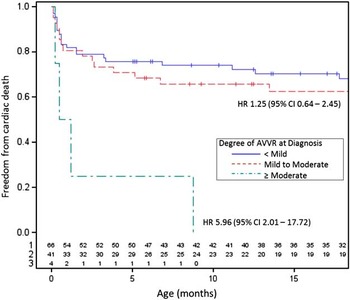
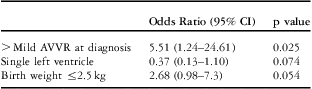
All four patients with ≥ moderate atrioventricular valve regurgitation at diagnosis died during the study period, with only one surviving to hospital discharge (mortality 100% versus 27%, p = 0.007). Survival curves based on the degree of atrioventricular valve regurgitation at diagnosis are shown in Figure 3. Greater than mild atrioventricular valve regurgitation at diagnosis was the only association with mortality found in multivariate logistic analysis for the entire cohort (OR 5.51, 95% CI 1.24–24.61, p = 0.025, Table 3). There was a trend towards increased mortality in those patients with birth weight ≤2.5 kg, although it did not reach statistical significance (OR 2.68, 95% CI 0.98–7.30, p = 0.054).
Kaplan–Meier curve of freedom from cardiac death by the degree of AVVR at diagnosis. Those with ≥ moderate AVVR at diagnosis have a nearly sixfold increased risk of death. Numbers along the horizontal axis represent the number of patients remaining in each cohort at each time point. AVVR = atrioventricular valve regurgitation.

Multivariate logistic regression model for mortality.

AVVR = atrioventricular valve regurgitation
Results were adjusted for ventricular morphology, birth weight, ventricular dysfunction at diagnosis, and type of systemic to pulmonary artery shunt (Blalock–Taussig shunt or right ventricle to pulmonary artery shunt)
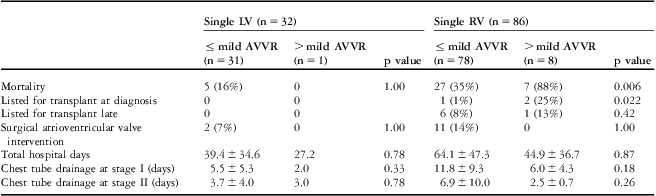
Analysis of the association of atrioventricular valve regurgitation with mortality was also stratified by ventricular morphology (Table 4). Single right ventricle patients with greater than mild atrioventricular valve regurgitation at diagnosis had increased mortality compared with those with less atrioventricular valve regurgitation (p = 0.006). However, there was no association between the degree of atrioventricular valve regurgitation at diagnosis and mortality for single left ventricle patients.
Association of mortality and morbidity with the degree of AVVR at diagnosis stratified by ventricular morphology.

AVVR = atrioventricular valve regurgitation; LV = left ventricle; RV = right ventricle
Listing for transplant
In all, eight patients (6%) were listed for heart transplant during the study period. Of these, three were listed for the primary treatment option, after undergoing a hybrid procedure as a bridge to transplant. The other five patients were listed for transplant late, after undergoing attempt at surgical staged palliation. While awaiting transplant, two patients died. There was one patient who was listed for transplant but had not received a transplant before 18 months of age. Greater than mild atrioventricular valve regurgitation at diagnosis was associated with listing for primary transplant, rather than undergoing surgery as part of planned staged palliation (p = 0.015). However, no association was found between the degree of atrioventricular valve regurgitation at diagnosis and listing for transplant following attempted staged surgical palliation. There were no single left ventricle patients listed for transplant.
Morbidity
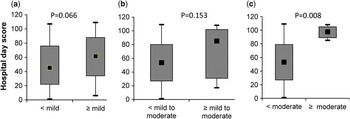
There was a significant increase in hospital day score for those patients with moderate or greater atrioventricular valve regurgitation at diagnosis (p = 0.008). However, there were only four patients in this group, all of whom died (Fig 4). There was a trend towards a worse score in patients with mild or greater atrioventricular valve regurgitation at diagnosis, but this did not reach statistical significance (p = 0.066). Total hospital days were also evaluated separately for those patients who died and those who survived. This demonstrated no significant association with ≥ mild atrioventricular valve regurgitation at diagnosis and total hospital days for surviving patients (Table 5). Birth weight ≤2.5 kg was associated with increased total hospital days (mean 66 versus 54 days, p = 0.023). Right ventricle patients had greater total hospital days compared with left ventricle patients (mean 63 versus 39 days, p = 0.0002), an association that remained significant on multivariate analysis.
Box plots demonstrating hospital day score for those with < mild versus ≥ mild ( a ), < mild to moderate versus ≥ mild to moderate ( b ), and < moderate versus ≥ moderate ( c ) atrioventricular valve regurgitation at diagnosis. Only c met statistical significance (p = 0.008).

Association of total hospital days with the degree of AVVR at diagnosis stratified by survival to 18 months of age.

AVVR = atrioventricular valve regurgitation; SD = standard deviation
There was no association of the degree of atrioventricular valve regurgitation at diagnosis with the length of chest tube drainage at either stage I or II for the cohort. However, relative to left ventricle patients, right ventricle patients had significantly longer duration of chest tube drainage after stage I (mean 11.45 versus 5.32 days, p = 0.0001) and stage II (mean 6.70 versus 3.69 days, p = 0.034).
The association of morbidity with degree of atrioventricular valve regurgitation at diagnosis was also stratified by ventricular morphology (Table 4). This demonstrated no association with > mild atrioventricular valve regurgitation and total hospital days or days of chest tube drainage for either single left or right ventricle patients.
Atrioventricular valve intervention
A total of 12 patients (10%) had a surgical intervention on their atrioventricular valve, all of which occurred at the time of stage II surgery – cavopulmonary anastomosis. There were no independent predictors of receiving a surgical atrioventricular valve intervention, including degree of initial atrioventricular valve regurgitation, ventricular morphology, ventricular dysfunction at diagnosis, or birth weight. Of the 12 patients who underwent surgical atrioventricular valve intervention, 5 (42%) had less than mild atrioventricular valve regurgitation at the time of diagnosis. However, when stratified by ventricular morphology, single left ventricle patients with mild atrioventricular valve regurgitation at diagnosis were more likely to have an intervention on their atrioventricular valve than those with less than mild atrioventricular regurgitation (p = 0.046). At the time of the pre-stage II evaluation, in those patients receiving an atrioventricular valve intervention, 2 (17%) had mild, 4 (33%) had mild to moderate, and 6 (50%) had moderate atrioventricular valve regurgitation. Only two left ventricle patients had an atrioventricular valve intervention, one with a diagnosis of double-inlet left ventricle and one with a left ventricle-dominant atrioventricular canal defect. Both patients had mild atrioventricular valve regurgitation at diagnosis. In all, 10 right ventricle patients required a valve intervention, 50% of whom had < mild atrioventricular valve regurgitation at diagnosis.
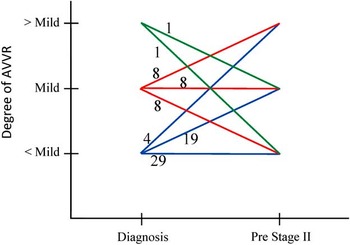
Atrioventricular valve regurgitation at diagnosis seemed persistent over time (Fig 5). Of the 28 patients with ≥ mild atrioventricular valve regurgitation at diagnosis who survived, 18 (61%) continued to have ≥ mild atrioventricular valve regurgitation before stage II. There was one patient who did not have pre-stage II echocardiogram data available for review. Of those patients who survived to stage II and had < mild atrioventricular valve regurgitation at diagnosis (53 patients), 30 (57%) continued to have < mild, 20 (38%) had ≥ mild, and 3 (6%) had moderate atrioventricular valve regurgitation before stage II. Progression of atrioventricular valve regurgitation was not associated with ventricular morphology. Atrioventricular valve regurgitation worsened in 46% of single left ventricle patients, and in 56% of single right ventricle patients (p = 0.423).
Change in the AVVR over time from diagnosis to the pre-stage II evaluation. Only patients surviving to stage II are included. Numbers listed are the number of patients in each group. AVVR = atrioventricular valve regurgitation.

Discussion
The most important finding of our study is that significant atrioventricular valve regurgitation at diagnosis in single ventricle patients continues to be an important risk factor for death or transplant. However, in those patients surviving to 18 months of age, it was not associated with atrioventricular valve surgical intervention, total hospital days, or duration of chest tube drainage. This study provides much needed longitudinal outcome data for this challenging patient population.
With interstage mortality being a significant concern in single ventricle patients, our results indicate that initial atrioventricular valve dysfunction carries significant implications for the management of single-ventricle patients, as well as for counselling for families. We similarly found that those patients with greater than mild atrioventricular valve regurgitation at diagnosis were more likely to be listed for primary transplant, rather than undergoing surgical palliation. A similar association with transplant was shown by Tweddell et alReference Tweddell, Sleeper and Ohye 19 recently, although it did not reach statistical significance. This association may represent a reaction on the part of clinicians to the perceived high-risk nature of surgical palliation in those patients with significant atrioventricular valve regurgitation at diagnosis. However, when stratified by ventricular morphology, greater than mild atrioventricular valve regurgitation at diagnosis continued to be a risk factor for mortality for single right ventricle patients, but not single left ventricle patients. To our knowledge, this has not been demonstrated previously. Although our power to detect differences in subgroups was limited, it is possible that atrioventricular valve dysfunction at diagnosis is better tolerated by single left ventricle patients, and perhaps should not factor as significantly in management decisions for these patients.
In contrast, we found no clear association between the degree of atrioventricular valve regurgitation at diagnosis and total hospital days or duration of chest tube drainage. This association with morbidity factors has not been closely investigated in other studies, and provides unique information on the longitudinal impact of initial atrioventricular valve regurgitation on these patients.
We found surgical atrioventricular valve interventions to be relatively common, with 10% of patients having an intervention within the first 18 months of age, all of which occurred at the time of stage II palliation. Nevertheless, we found no variables that predicted which patients would go on to have an atrioventricular valve intervention. In particular, the degree of atrioventricular valve regurgitation at diagnosis was not predictive of surgical atrioventricular valve intervention, with nearly half of the patients who underwent atrioventricular valve intervention having less than mild atrioventricular valve regurgitation at diagnosis. Elmi et alReference Elmi, Hickey, Williams, Van Arsdell, Caldarone and McCrindle 20 found that atrioventricular valve regurgitation following stage I surgery was associated with atrioventricular valve intervention, but did not report the initial degree of atrioventricular valve regurgitation. On the basis of their findings, atrioventricular valve function after initial surgical palliation, as well as ischaemic time or type of surgical repair, may be more closely associated with atrioventricular valve surgical intervention than initial atrioventricular valve regurgitation. It is worth noting that their cohort included only hypoplastic left heart syndrome patients, and whether these findings may be generalised to all single-ventricle patients remains to be seen.
Our data also support the observation found by othersReference d'Udekem, Xu and Galati 13 , Reference Nakata, Fujimoto and Hirose 21 that patients with single left ventricle morphology have better outcomes than those with single right ventricle morphology. Compared with left ventricle patients, we found single right ventricle patients to have an increased risk of cardiac death, longer hospital stays, and greater duration of chest tube drainage at stages I and II.
Limitations
This is a retrospective study, and is subject to the limitations inherent in such a study design. Despite a fairly large number of patients in our study, the number of patients with moderate or greater atrioventricular valve regurgitation at diagnosis was small, and this may have limited the analysis. This also limited our stratified analysis, especially for the single left ventricle group. Owing to the fact that we collected data only up to 18 months of age, we cannot comment on the effects of atrioventricular valve regurgitation on longer term mortality or morbidity. In addition, there are no widely validated techniques to quantify atrioventricular valve regurgitation in paediatric or single-ventricle patients.Reference Lopez, Colan and Frommelt 18 As a result, we relied on qualitative assessment of atrioventricular valve regurgitation by multiple readers, which has limitations, and likely introduced additional variability. However, the reported atrioventricular valve regurgitation was chosen as it was on the basis of this information that clinical management decisions were made. Although the echocardiograms were done in a similar manner, as per lab protocol, there may have been subtle differences in image acquisition between echocardiograms. In addition, decisions regarding which patients received a surgical atrioventricular valve intervention were made at the discretion of the patient's primary surgeon and cardiologist. As a result, the criteria for such intervention may have varied between patients.
Conclusion
We found greater than mild systemic atrioventricular valve regurgitation at the time of diagnosis to be a significant risk factor for mortality in single-ventricle patients, although it may be less significant in patients with left ventricular morphology. However, we found no clear association with the length of hospitalisation or duration of chest tube drainage. Although atrioventricular valve surgical intervention occurred in 10% of the patients, there were no independent predictors of intervention, including no association with the degree of atrioventricular valve regurgitation at diagnosis.