Introduction
The bone conduction of sounds has been known since the Renaissance when Girolamo Cardano described for the first time the possibility of transmitting sounds to the inner ear through a vibrating rod or the shaft of a spear held between the teeth.Reference Mudry and Tjellström1 This capacity is used by implantable bone conduction devices to transfer acoustic energy to the inner ear, by-passing the faulty conduction system of the middle ear.Reference Sprinzl and Wolf-Magele2 The indications for bone conduction devices are for conductive hearing loss, mixed hearing loss and single-sided deafness with a cochlear reserve of at least 45 dB.Reference Sprinzl and Wolf-Magele2–Reference Snik, Mylanus, Proops, Wolfaardt, Hodgetts and Somers4 The first osteo-integrated percutaneous bone conduction device was implanted in 1977.Reference Mudry and Tjellström1,Reference Tjellström, Lindström, Hallén, Albrektsson and Brånemark5,Reference Burton, Niparko, Johansson and Tjellström6 The original surgical technique involved the creation of a split-thickness skin graft free of hair follicles around the skin penetrating abutment.Reference Stalfors and Tjellström7 This first percutaneous bone conduction device was the workhorse for nearly 30 years. However, the approach was associated with significant soft tissue-related complications and required regular aftercare.Reference Stalfors and Tjellström7,Reference House and Kutz8 Newer soft tissue techniques like the Nijmegen linear incision techniqueReference de Wolf, Hol, Huygen, Mylanus and Cremers9 or the ‘Sheffield incision’ techniqueReference Ray, Addams-Williams and Baldwin10 and novel implant designs like the hydroxyapatite-coated percutaneous bone conduction devices have helped to reduce soft tissue problems, but the need for aftercare remained. Transcutaneous bone conduction devices that do not penetrate the skin have appeared in the last 10 years and were aimed at further minimising soft tissue issues.Reference Reinfeldt, Håkansson, Taghavi and Eeg-Olofsson11
Materials and methods
Objective
This project aimed to describe and compare surgical and functional outcomes in patients implanted with two different types of transcutaneous bone conduction devices: the active Bonebridge® device and the passive BAHA Attract® device.
Study design
Data were collected prospectively and analysed retrospectively. The number of patients considered was not large enough for a full statistical analysis. The study was approved after institutional review by the Sheffield Teaching Hospital NHS Foundation Trust clinical effectiveness unit (approval number: CEU5496/16).
Setting and patients
Consecutive patients who underwent surgery for the implantation of BAHA Attract or Bonebridge devices in a tertiary referral centre between November 2014 and September 2016 were included. The two patient groups were composed of eight patients each and were similar in demographic and audiological profile. Trademark (‘CE’) approval was obtained for the Bonebridge device in 2012Reference Zernotti, Di Gregorio, Galeazzi and Tabernero12 and the BAHA Attract device in 2013 (Table 1).Reference Briggs, Van Hasselt, Luntz, Goycoolea, Wigren and Weber13
Demographic and audiological profile

Intervention
The BAHA Attract is a passive transcutaneous bone conduction device composed of three parts: a titanium fixture inserted into the skull bone, an implant magnet connected to a titanium implant and an external processor which generates the vibration that is transmitted to the implant magnet through the intact scalp.Reference Kurz, Flynn, Caversaccio and Kompis14 The Bonebridge, on the other hand, is composed of an internal part comprising a receiver-stimulator package that is covered by intact scalp. This is driven by an external processor that is anchored magnetically. The sound-generating part is the floating mass transducer which is drilled into the skull bone and fixed with two screws.Reference Zernotti, Di Gregorio, Galeazzi and Tabernero12
All patients underwent a two-week trial of a bone conduction device on a soft band as per the National Health Service commissioning guidelines for bone conduction devices.15 The device choice was mainly driven by patients depending on their need and lifestyle (i.e. cosmetic, profession, wearing of hats).
Surgical outcomes were recorded in the patient notes, which contained information regarding surgery and follow-ups. All operations were performed under general anaesthetic by a single surgeon. The protocol for loading the implants with the processor (both for the BAHA Attract and the Bonebridge) was eight weeks from the day of the surgery.
The surgical technique for BAHA Attract involved a superiorly curved ‘C’ shaped incision (there is a detailed description in a paper by Orhan et al.).Reference Orhan, Ray, Polat, Carr, Deleito and Greenwood16 The periosteum was lifted in a cruciate fashion, and the BI300 fixture was placed in the skull. The bony clearance around the fixture was checked with the bone bed indicator before placing the magnet over the fixture and anchoring it with the pre-threaded screw that was tightened to 25 Nm.
The Bonebridge group underwent a preliminary computed tomography scan to assess the depth of the mastoid bone. A customised planning software provided by the manufacturer was used to plan the optimum position for the floating mass transducer and to avoid any inadvertent injury to vital structures like the dura or the sigmoid sinus. The surgery was undertaken using a standard post-aural incision with a superiorly based musculo-periosteal soft tissue flap that eventually covered the implant. The floating mass transducer was placed within the mastoid segment in six cases and the retro-sigmoid location in the remaining two.
The incisions were closed in two layers with interrupted stitches, and a head bandage was applied. Patients removed the head bandage on their own after appropriate instruction was given at the time of discharge. Sutures were removed on the seventh post-operative day and first surgical check-up was done after four weeks.
Main outcome measures
Audiological outcomes were measured with different inventories: the Glasgow Hearing Aid Benefit Profile, the Glasgow Hearing Aid Difference Profile, the Client Oriented Scale of ImprovementReference Arunachalam, Kilby, Meikle, Davison and Johnson17,Reference Dutt, McDermott, Jelbert, Reid and Proops18 and post-operative speech reception threshold, comparing patients in aided versus unaided situations. The Glasgow Hearing Aid Benefit Profile was used in patients who were previously fitted with conventional hearing aids. The Glasgow Hearing Aid Difference Profile was used in patients in whom the implant (BAHA Attract or Bonebridge) was the first type of hearing device ever used. Both questionnaires were given before and after surgery, and the global score was considered.
The Client Oriented Scale of Improvement tool was administered to each patient before the surgery.Reference Dillon, James and Ginis19 With this inventory, each patient nominates different hearing situations (up to five) that they want to improve with the new hearing implant. At the end of the rehabilitation, the patient scored how much they can hear compared with hearing prior to surgery on a scale from one to five (one is worse and five is much better) and gave a final score for hearing ability, choosing between 5 answers describing the ability to hear. This can range from ability to hear ‘hardly ever’ to ability to hear ‘almost always’. Each of the 5 answers is graded with a percentage (10 per cent, hardly ever; 25 per cent, occasionally; 50 per cent, half of the time; 75 per cent, most of the time; 95 per cent, almost always). Free field speech recognition threshold was performed in all patients apart from the ones with single-sided deafness.
Results
All patients had satisfactory post-operative wound healing, and no significant skin or soft tissue-related complication was reported. Each patient went home on the day of the surgery, and the devices were loaded at eight weeks for all. No device failures were recorded.
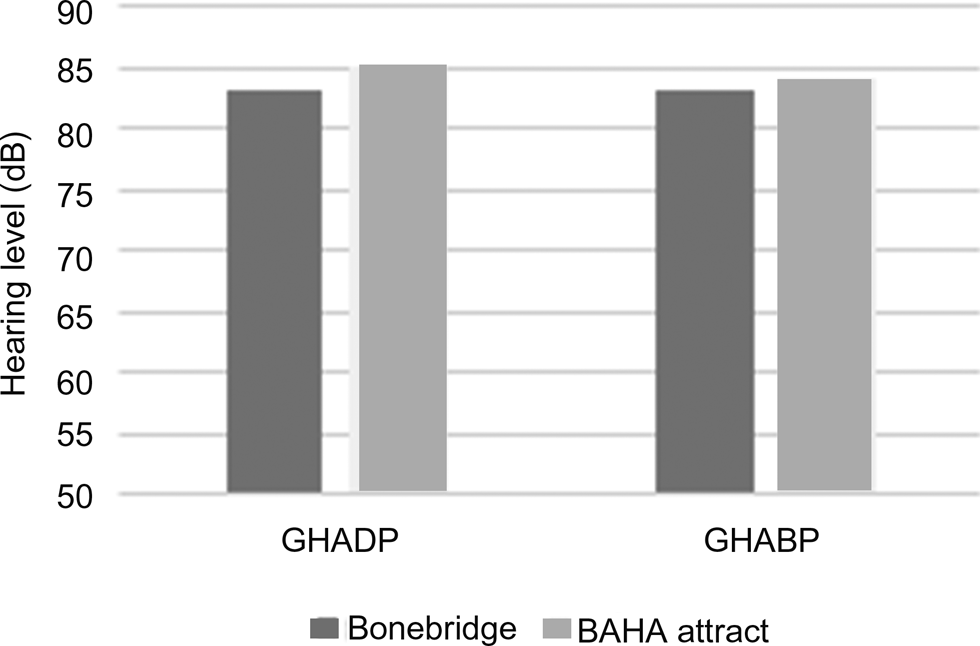
Audiological results were divided according to the test undertaken. Glasgow Hearing Aid Benefit Profile showed a mean global score of 83 (standard deviation (SD) ± 23.5) in the Bonebridge group and 84 (SD ± 15.3) in the BAHA Attract group. The Glasgow Hearing Aid Difference Profile showed a mean global score of 83 (SD ± 14.1) in the Bonebridge group and 85 (SD ± 8.6) in the BAHA Attract group.
All patients completed a Client Oriented Scale of Improvement questionnaire. Five categories were considered by both groups, and the perceived improvements in each domain are aggregated alongside: (1) listening to the television at a normal level, valued between 75 per cent and 95 per cent improvement (5 responders); (2) clarity of conversation in groups in quiet, valued between 75 per cent and 95 per cent (9 responders); (3) clarity of the conversation in groups with background noise, valued between 25 per cent and 95 per cent (10 responders); (4) directionality of the sounds, valued between 50 per cent and 95 per cent (4 responders); and 5) listening to music, valued between 75 per cent and 95 per cent (3 responders).
Post-operative speech reception threshold showed a mean threshold of 26.5 dB (SD ± 5.3) and 30.5 dB (SD ± 2.1) in Bonebridge and BAHA Attract groups, respectively, when aided, and a mean threshold of 45.7 dB (SD ± 3.7) and 47.7 dB (SD ± 4.3) in Bonebridge and BAHA Attract groups, respectively, when unaided.
Finally, in the speech reception threshold testing, Bonebridge patients reached 100 per cent of correct answers on an average threshold of 43.7 dB when aided and 66.2 dB when unaided, while BAHA Attract patients reached 100 per cent of the right answers on an average of 53.5 dB when aided and 71.2 dB when unaided (Figures 1 and 2).
Speech recognition threshold (SRT) and sound field testing (SFT).

Glasgow Hearing Aid Difference Profile (GHADP) and Glasgow Hearing Aid Benefit Profile (GHABP) global scores

There were no device failures reported in either group. The average surgical times for the Bonebridge group was 90 minutes (range, 84–126 minutes) whereas it was 42 minutes (range, 36–88 minutes) for the BAHA Attract group.
Discussion
The main aim of this study was to compare the surgical and functional outcomes of the Bonebridge and BAHA Attract devices. To our knowledge, this is the first study of this kind. When studied singularly, the two devices have been seen in the literature to be reliable and to guarantee good audiological outcomes in patients affected by conductive hearing loss, mixed hearing loss and single-sided deafness.Reference Snik, Mylanus, Proops, Wolfaardt, Hodgetts and Somers4–Reference House and Kutz8 However, a direct comparison between the two devices has not been carried out.
We have confirmed the surgical reliability and safety of these devices within our patient population. Surgical times are significantly longer in the Bonebridge group than the BAHA Attract group. This is because of the additional drilling required to accommodate the floating mass transducer, which is 9 mm deep. There was also the need for a pre-operative scan and radiological pre-planning for the optimum location of the floating mass transducer.Reference Plontke, Radetzki, Seiwerth, Herzog, Brandt and Delank20,Reference Kong, Park and Seo21 The BAHA Attract group did not require these additional steps.
Glasgow Hearing Aid Benefit Profile and Glasgow Hearing Aid Difference Profile global scores showed an improvement when compared with the pre-operative condition. Also, there are similar results in both groups between patients previously fitted with hearing aids when compared with the ones who were not fitted with hearing aids prior to the operation. As expected, the free-field speech reception threshold showed a significant improvement when the implants were in use. The increase was both in the mean thresholds recorded and in the average thresholds when the patients reached 100 per cent of the correct answers. This demonstrates that the improvement is not only limited to the pure tone audiometry thresholds but is also extended to speech discrimination, demonstrating the practical value of both the devices in a social setting.
The responses on the Client Oriented Scale of Improvement focus more on patient expectation while at the same time helping the clinician and the clinical audiologists to understand where the disability lies and where they can take some additional actions to improve the patient's quality of life.Reference de Wolf, Hol, Huygen, Mylanus and Cremers9 In our study, almost all the situations chosen by the patient showed a significant hearing improvement, and in most cases, the answers were ‘much better’ with satisfactory final hearing ability. The number of responders was small, but the spread between the two devices was roughly equal, with no noticeable difference in outcome between the two.
Given that the Bonebridge is an active transcutaneous bone conduction device, there is less possibility of feedback if covered by a scarf or clothing. However, the Bonebridge is a standalone device without any compatibility with other bone conduction devices. The BAHA Attract, on the other hand, has forward and backward compatibility to either the existing percutaneous versions of percutaneous bone conduction devices or the future generation of transcutaneous bone conduction devices because of the use of a single point of anchorage.Reference Carr, Bruce, Jones and Ray22,Reference Bere, Vass, Perenyi and Rovo23 This, coupled with the possibility of using power and superpower processors, gives the BAHA Attract significant audiometric headroom should the bone conduction thresholds deteriorate in future.Reference Bosman, Kruyt, Mylanus, Hol and Snik24 The BAHA Attract also provides a wide range of wireless accessories that make it a more versatile device in many different settings.Reference Wolfe25
The two devices are magnetic resonance imaging (MRI) compatible up to 1.5 Tesla magnet strength (as per manufacturer indications) and can be used in younger patients whose lifetime chance of having MRI scans is quite high. The problem with the imaging is the artefacts that are generated because of the presence of the devices. Signal voids can obscure areas directly underlying the devices, and this must be taken into consideration when offering these devices. This is especially important in patients with neurological conditions where the implant might overlie the area of radiological interest or where serial scanning may be required for monitoring. All the patients who underwent implantation with a BAHA Attract or a Bonebridge device in our department had routine MRI scans of the head and internal auditory meatus pre-operatively in order not to miss any abnormalities that may be hidden in signal voids from the implant in the future. However, if necessary, the BAHA Attract can be easily removed under a local anaesthetic via a small incision and easily replaced after the scan. This is not as easy with the Bonebridge device because a bigger surgical exposure is needed to remove the device and dissect it from the underlying dura or sigmoid sinus.
This study is limited by its small sample size and relatively short follow up duration. Nevertheless, it addresses several issues of relevance in the first direct comparison of the two transcutaneous bone conduction devices.
• Bone conduction implants provide a good quality of hearing when conventional hearing aids are not an option
• Similar functional and surgical outcomes give the patient more flexibility in choosing the device, which better fits their personal lifestyle
• Transcutaneous devices prevent skin complications, which can happen in percutaneous devices
• Counselling before surgery is essential to understand the patient's expectations and potential benefit
• This is the first study to compare functional and surgical outcomes of active and passive transcutaneous bone conduction devices
Conclusion
Both Bonebridge and BAHA Attract devices are reliable semi-implantable transcutaneous bone conduction devices with excellent surgical and functional outcomes and patient satisfaction. The overall surgical time was much less in the BAHA Attract group, with no necessity for pre-planning. The BAHA Attract is much easier to remove with the possibility of conversion to other bone conduction devices in the manufacturer's portfolio and enjoys wide-ranging wireless accessories. Further studies are needed to assess the longer-term results in a bigger population.
Competing interests
None declared