INTRODUCTION
More than 300 species of pea crabs (Pinnotheridae) are known to occur globally, of which 12 belong to the genus Nepinnotheres (Ahyong & Ng, Reference Ahyong and Ng2008; Ng et al., Reference Ng, Guinot and Davie2008; Davie, Reference Davie2015). They are ubiquitous symbionts, many of them living in the mantle cavities of bivalves such as oysters, clams and mussels, and they exhibit symbiotic relationships ranging from commensalism to parasitism with their hosts (Silas & Alagarswami, Reference Silas and Alagarswami1967; Dai et al., Reference Dai, Yang, Song and Chen1986; Ueda & Kohno, Reference Ueda and Kohno1987; Wang et al., Reference Wang, Sun and Song2002; Sun et al., Reference Sun, Sun, Yuqi, Baowen and Weibo2005; Asama & Yamaoka, Reference Asama and Yamaoka2009).
Species of the genus Nepinnotheres Manning, Reference Manning1993 infest many species of bivalves. For example, Nepinnotheres rathbunae (Schmitt, McCain & Davidson, 1973) has been reported from Donax sp. off Aibukit, Palau (Ahyong & Ng, Reference Ahyong and Ng2007) and Nepinnotheres novaezelandiae (Filhol, 1885) from Perna canaliculus (Gmelin) off New Zealand (Troitter & Jeffs, Reference Troitter and Jeffs2015). Three species of Nepinnotheres, Nepinnotheres cardii (Bürger, 1895), Nepinnotheres glaberrimus (Bürger, 1895) and Nepinnotheres pectinicola (Bürger, 1895) were found in Fragum unedo (Linnaeus), Arca sp., and Decatopecten radula (Linnaeus), respectively, whereas, Nepinnotheres villosulus (Guérin-Meneville, 1831) has been previously been reported from Pinna chemnitzii Hanley (=Atrina chinensis (Deshayes)) and Pinctada margaritifera (Linnaeus) from the Philippines (Ahyong & Ng, Reference Ahyong and Ng2007). The only report of a pinnotherid crab from a bivalve host in Pakistan is of Sindheres karachiensis Kazmi & Manning, Reference Kazmi and Manning2003 from an unidentified bivalve species (Kazmi & Manning, Reference Kazmi and Manning2003). The present study is the first record of Nepinnotheres villosulus from six species of clams and one species of cockle from Pakistan.
MATERIALS AND METHODS
Live clams and cockles were handpicked throughout May 2004–April 2005 from Sonmiani on the coast of Balochistan (Figure 1). The substrate at the sampling site was sandy/muddy. Extensive beds of cockles and clams occur in the area. Live clams and cockles were brought to the laboratory, washed, cleaned and identified (see Jahangir et al., Reference Jahangir, Siddiqui, Moazzam and Ayub2012). They were opened by cutting the anterior and posterior adductor muscles to determine the presence of pea crabs (Figure 2). The shell length of clams and cockles and carapace width (CW) of pea crabs was measured with a Vernier calliper to the nearest 0.01 mm. Crabs were counted and sorted into males, females and ovigerous females.
Map showing sampling sampling site.

Nepinnotheres villosulus: (A) inside host shell, (B) male crab, (C) female crab, (D) dorsal and (E) ventral views of ovigerous female.
Crabs were identified as belonging to Nepinnotheres using the key of Manning (Reference Manning1993) and identified to species by comparison with data in publications describing and figuring species of Nepinnotheres (e.g. Manning, Reference Manning1993; Ahyong & Brown, Reference Ahyong and Brown2003; Ahyong & Ng, Reference Ahyong and Ng2007). The preliminary identification of the specimens as Nepinnotheres villosulus was confirmed through comparison with the description and figures of Miers (Reference Miers1886: pl. 22, Figure 2). The subequal proportions of the walking leg dactyli and the shape and structure of the third maxillipeds match well with those described and illustrated by Miers (Reference Miers1886) and briefly described by Ahyong & Ng (Reference Ahyong and Ng2007).
Voucher specimens of N. villosulus were deposited in the Department of Invertebrates, National Museum of Natural History, Smithsonian Institution, Washington, D.C. (USNM): one adult non-ovigerous female crab, 10.4 CW × 5.7 CL mm (CL, carapace length), parasitized by Hypocepon enoeensis Nierstrasz & Brender à Brandis, Reference Nierstrasz, Brender and Brandis1930 (Isopoda: Epicaridea: Bopyridae), one female, 5.0 mm, one male, 5.0 mm (USNM 1191992); one adult ovigerous female crab, 7.0 CW × 5.4 CL mm (USNM 1191991). CW and CL are provided as an indicator of size for crabs. Isopod size is given as total body length (TL = anterior margin of head to posterior margin of pleotelson). Voucher crabs were extracted from their hosts, Meretrix casta (Gmelin) (Veneridae), collected from sandy-cum-muddy habitat, Sonmiani, Balochistan, Pakistan, 25°25′N 66°37′E, by S. Rashid in October 2008.
RESULT AND DISCUSSION
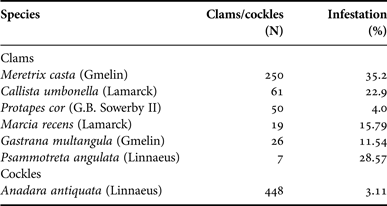
This is the first record of Nepinnotheres villosulus from Pakistan, found in six species of clams and in one species of blood cockle from Sonmiani, Pakistan (see Table 1). This crab was earlier reported as Pinotheres villosulus from the Philippines, Indonesia, New Guinea and Australia infesting various bivalve species (Ahyong & Brown, Reference Ahyong and Brown2003). Subsequently, due to the presence of subequel walking leg dactyli and articulation of the MXP3 dactylus near the midlength of the propodus, the species was transferred to Nepinnotheres (Ahyong & Ng, Reference Ahyong and Ng2007).
Prevalence of Nepinnotheres villosulus in six species of clams from Sonmiani.
All species of clams examined in the present study were found at the same tidal level and habitat. The highest prevalence (35.20%) of N. villosulus was recorded in Meretrix casta and the lowest was found in Anadara antiquata (3.11%) (Table 1). The mean sizes of the infested clams were 47.4 ± 8.92 to 51.93 ± 9.62 mm. The relationship between pea crabs and their host is dependent on a number of factors, such as the availability of food and the abundance of hosts (Haines et al., Reference Haines, Edmunds and Pewsey1994), salinity (Kruczynski, Reference Kruczynski1973), position of hosts on the beach (Houghton, Reference Houghton1963; Seed, Reference Seed1969) and the tidal level and currents (Kruczynski, Reference Kruczynski1973; Pregenzer, Reference Pregenzer1978). The abundance of hosts appears to be the major factor responsible for the greater prevalence of pea crabs in M. casta as it is the most abundant species of clam found in the intertidal region of Sonmiani.
Most of the crabs were soft-shelled with a maximum CW of 20 mm; the remaining crabs were hard-shelled at 5–7 mm in size (Figure 2). Both male and female crabs were found inside host clams. Among females, 62.82% females were ovigerous. The greater prevalence of soft-shelled ovigerous females indicates that they were perhaps seeking refuge inside the host to avoid predation. In species of Pinnotheridae, two types of mating behaviours have been reported: males and females leaving the host for copulatory swarming in open water, with only females returning to their hosts (Christensen & McDermott, Reference Christensen and McDermott1958; Soong, Reference Soong1997; Hsueh, Reference Hsueh2003) or males travelling from host-to-host to seek females for copulation (Pregenzer, Reference Pregenzer1978; Haines, et al., Reference Haines, Edmunds and Pewsey1994; Soong, Reference Soong1997; Weiming et al., Reference Weimimg, Shchun, Yuqi, Baowen and Weibo2005). It is unclear which strategy is occurring in this population of N. villosulus and further study of the mating behaviours is needed.