

We are comfort moths. Always flitting in the direction of the greatest promised solace. Instinct drawing us toward the light, but in our confusion, we mistake numbing comfort for true serenity. — Myosan
Relationship researchers have embarked on a path of investigating the many intricacies that contribute to the long-term health of intimate connections. An integral facet of relationship health lies within the intimacy system, which uses our histories, strengths, and present-moment reactions to keep us connected to, or ‘safely’ distanced from, another complicated human being. In this article we examine the association between partners’ relationship strengths and the intimacy system, and describe a theory positing that turning toward our partners, even in challenging and emotionally charged moments, may be a protective factor for relationship health; whereas turning away from our partners, toward less emotional complication, may lead to a decline in feelings of intimate safety and satisfaction.
While conducting Marriage Checkups (MC) as part of a recently reported randomised control trial (Cordova et al., Reference Cordova, Fleming, Morrill, Hawrilenko, Sollenberger, Harp and Wachs2014), MC clinicians reported observing a pattern in the types of relationship strengths nominated by more distressed versus less distressed couples. Specifically, clinicians noted that distressed couples seemed to more frequently report strengths that did not rely on having an emotionally intimate connection, such as: ‘We tend to agree more than disagree when it comes to money issues’ and ‘We're a good team when it comes to parenting’. This clinical observation was made consistently enough that we began to hypothesise that what couples consider their greatest relationship strengths may indeed differ by level of relationship distress. We found this hypothesis compelling, specifically because it is consistent with theory of intimacy and the related process of least emotional resistance. Informed by intimacy theory, the current study investigates whether distressed couples nominate strengths that are less indicative of intimacy than healthier couples. Intimacy was chosen as the potential differentiating factor for several reasons. First, intimacy is a central mechanism of change in the MC (Hawrilenko, Gray, & Cordova, Reference Hawrilenko, Gray and Córdova2016). Second, it has been argued that intimacy may be at the heart of relationship health (Barnes & Sternberg, Reference Barnes, Sternberg, Sternberg and Hojjat1997; Cordova, Gee, & Warren, Reference Cordova, Gee and Warren2005; Prager, Reference Prager1995; Schaefer & Olson, Reference Schaefer and Olson1981). Given this, we speculated that relationship strengths that indicated a high level of intimacy between partners would be more readily reported by satisfied partners, whereas partners who were more dissatisfied would be less likely to report intimacy-based strengths and more likely to nominate strengths that emphasise aspects of their partnership that do not require high levels of intimacy.
Intimacy Theory
In accordance with Reis and Shaver's (Reference Reis, Shaver, Duck, Hay, Hobfoll, Ickes and Montgomery1988) interpersonal process model of intimacy, the development of intimacy is a transactional and dynamic process, built from daily interactions that accumulate over time. This process is broadly captured as the interplay between self-disclosures and partner responsiveness (Laurenceau, Barrett, & Rovine, Reference Laurenceau, Barrett and Rovine2005; Reis, Clark, & Holmes, Reference Reis, Clark, Holmes, Mashek and Aron2004; Reis & Patrick, Reference Reis, Patrick, Higgins, Kruglanski, Higgins and Kruglanski1996; Reis & Shaver, Reference Reis, Shaver, Duck, Hay, Hobfoll, Ickes and Montgomery1988). The intimacy process is set in motion when expressions of vulnerability are met in ways that demonstrate that we are safe with our partners (Cordova & Scott, Reference Cordova and Scott2001; Reis & Shaver, Reference Reis, Shaver, Duck, Hay, Hobfoll, Ickes and Montgomery1988). Much of our experience in the social world of others teaches us that we are vulnerable to rejection (e.g., Panksepp, Herman, Conner, Bishop, & Scott, Reference Panksepp, Herman, Conner, Bishop and Scott1978). We learn to guard ourselves against rejection by hiding those parts of ourselves that have been met with rejection or the threat of rejection in the past. Shaped by consequences, we develop a social repertoire constructed of those behaviours that have been least subject to rejection and those that appear to be the most socially acceptable (Skinner, Reference Skinner1981, Reference Skinner1984).
However, behavioural suppression is effortful; it takes energy to suppress parts of ourselves, so we remain inclined to express our genuinely vulnerable selves (Baumeister & Leary, Reference Baumeister and Leary1995). Consistent with behavioural research on suppressed repertoires (Skinner, Reference Skinner1953), when we chance to express our vulnerabilities in a new relationship and the other person responds in a non-rejecting way, that effortfully suppressed repertoire tends to rapidly emerge. The more accepting the other person is, the more of our vulnerable social repertoire surfaces, catalysing an intimacy process in which further expressions of vulnerability emerge and are reinforced, cascading to even more frequent expressions of vulnerability — most often mutual and bidirectional (Cordova & Scott, Reference Cordova and Scott2001). This intimacy process is related to global marital satisfaction (Laurenceau et al., Reference Laurenceau, Barrett and Rovine2005) and may be at the heart of the experience of falling in love and developing adult attachment (Bowlby 1979/Reference Bowlby1994; Fraley & Shaver, Reference Fraley and Shaver2000).
However, what was once made vulnerable does not necessarily become invulnerable. Although we may learn that we are generally safe with our intimate partner, our vulnerabilities remain vulnerabilities, and we have uniquely high expectations for our intimate partner's responsiveness as compared to other interpersonal relationships (Reis et al., Reference Reis, Clark, Holmes, Mashek and Aron2004). The shadow side of intimacy is that we eventually reveal aspects of ourselves that are not easily acceptable by our partners and are not met by the warm responsiveness necessary for the experience of intimacy (Laurenceau et al., Reference Laurenceau, Barrett and Rovine2005). Further, partners inevitably step on each other's emotional toes, both accidentally and on purpose. Couples often fall into patterns, or mutual traps, where they reactively trigger one another (Christensen, Reference Christensen, Noller and Fitzpatrick1988). The discovery of the limits of acceptability within a developing intimate relationship slows the intimacy process and may eventually halt it entirely. Partners develop new relational repertoires designed to protect themselves from being emotionally hurt by each other. Couples who maintain healthy intimate relationships discover processes that allow them to remain open, vulnerable, and reciprocally kind to each other. Couples whose relationship health deteriorates over time acquire relational processes that continue to erode intimacy, furthering repertoire suppression, and increasing experiential distress.
The Path of Emotional Least Resistance
The path of least emotional resistance describes an intimacy erosion process in which partners start to turn away from the more vulnerable aspects of their relationship and instead turn toward those aspects that are less emotionally threatening. As an intimate relationship continues to accumulate experiences that either reinforce or punish vulnerable expression, that relationship history can be expressed as a ratio of positive to negative interactions akin to Gottman's (Reference Gottman1994) preliminary findings concerning the now classic (but so far unreplicated) 5-to-1 ratio of positive to negative events. As that ratio weakens towards fewer positive and more negative interactions, it is likely that the experience of intimate safety versus intimate threat shifts accordingly. As a partner's experience becomes increasingly mixed, such that any given moment of contact might be experienced as either safe or unsafe, then every moment of contact becomes a choice point between moving toward and moving away. At such points, a person's natural inclination is to take the path of least emotional resistance. If our experience of our partner in the moment is less emotionally comfortable than turning toward the television, we will most probably turn toward the television, though we may continue to report a mostly positive emotional experience of our partner. Whatever is more emotionally comforting tends to win these micro-moment choice points. Although the emotional experience may be below the threshold of awareness, the probability that we will choose turning toward something else and away from our partner increases. For example, a wife might find that she turns toward the children more frequently because her experience of interacting with them is less emotionally challenging, vulnerable and potentially hurtful than her experience of interacting with her partner. Similarly, a person may turn toward work, hobbies, friends or anything else that helps resolve that micro-moment experience of relational discomfort.
This subconscious experience of our partner as slightly more emotionally uncomfortable than other aspects of our life may be part of what implicit measures detect (e.g., Banse & Kowalik, Reference Banse and Kowalick2007; Murray et al., Reference Murray, Pinkus, Holmes, Harris, Gomillion, Aloni and Leder2011). In fact, Murray and colleagues conducted a series of studies investigating responses to one's automatic associations and expectations of his/her partner. They found that impulsive trust (automatic evaluation of the partner) predicted choices based on when it was safe or unsafe to approach one's partner, and therefore regulated one's self-protective responses to rejection. Specifically, those who had positive implicit associations of their partners were more likely to approach their partners, whereas those who had negative associations were more likely to cautiously avoid their partners (Murray et al., Reference Murray, Pinkus, Holmes, Harris, Gomillion, Aloni and Leder2011). While we do not necessarily notice or purposefully make these micro-judgments, they occur within our relationships every day. At any given moment we are, by nature, prone to subconsciously move in the direction of those experiences that are less emotionally complicated.
There is likely a moment in a relationship in which the accumulation of unrepaired hurts reaches a tipping point where turning away from our partners is easier than staying present. It is also probable that partners initially enter a period of time when these micro-moment moves to turn away are occurring below the level of awareness. As these experiences accumulate, partners may find that they are spending less and less time with each other. However, when couples are directly asked about this process they may not identify relationship distress as the reason; rather, they may naturally point to the demands of day-to-day living, because tacking away from emotional complication is not necessarily consciously palpable. Thus, even what couples identify as their relationship strengths may begin to subtly shift toward aspects that require less vulnerable exposure to each other, such as being a good team when it comes to parenting, or taking care of the house or finances. Therefore, one of the potential markers of an accumulated history of taking the path of least emotional resistance may be that couples begin to identify their main strengths as those aspects of their relationship that require the least emotional exposure.
Thus, in this article we will test the hypothesis that more distressed couples will self-identify strengths that are less emotionally vulnerable than more satisfied couples, who will themselves identify strengths that require greater emotional vulnerability.
The Marriage Checkup
The Marriage Checkup (MC; Córdova et al., Reference Cordova, Scott, Dorian, Mirgain, Yaeger and Groot2005; Cordova, Reference Cordova2013) is a brief, two-session, assessment and feedback relationship health checkup. Similar to regular physical or dental checkups, the MC is designed to be accessible to couples across all levels of marital health, regardless of whether they are identifying as distressed (see Cordova, Reference Cordova2014, for more details).
Multiple studies to date have shown that the MC is effective in increasing a wide array of factors related to relationship health both in the short term and at 2-year follow-up (Cordova, Warren, & Gee, Reference Cordova, Warren and Gee2001; Cordova et al., Reference Cordova, Fleming, Morrill, Hawrilenko, Sollenberger, Harp and Wachs2014).
Two components of the MC are particularly germane to the current study. First, the MC is designed to attract couples across the spectrum of relationship satisfaction, and evidence suggests that participants did indeed span the relationship health spectrum, from very satisfied to severely distressed (Morrill et al., Reference Morrill, Fleming, Harp, Sollenberger, Darling and Córdova2011). Second, the MC actively assesses couples’ strengths using both questionnaires and conjoint interview. Thus, the current study is in a unique position to examine the question of whether couples’ self-identified relationship strengths vary systematically by level of distress.
The Current Study
A key focus in the Assessment session of the MC is a discussion of each partner's self-identified relationship strengths. As part of the self-report questionnaires completed before the first session, each partner independently rates 32 potential relationship strengths, and then selects his/her top three strengths from this list. During the strengths assessment, the therapist reminds the first partner what she listed as her top three strengths, and asks her to select her primary relationship strength. The therapist would then solicit more detailed information about this strength and facilitate a discussion about the ways this strength benefits the health and happiness of the relationship. Finally, the other partner is asked to reflect on how he sees this strength functioning in the relationship. Then, the process is repeated with the second partner. The focus of the present study is on the top three relationship strengths that each partner nominated. We hypothesised that distressed couples would choose strengths that were qualitatively different than the strengths chosen by non-distressed couples. In particular, we hypothesised that distressed couples would nominate strengths less reliant on emotional intimacy. We further hypothesised that satisfied couples would nominate strengths characteristic of a greater intimate connection.
Methods
Participants
The current sample included 119 heterosexual, married individuals with children participating in the MC study in a northeastern metropolitan area.
The primary aim of this study was to examine how self-identified relationship strengths varied according to relationship distress. Studies indicate that relationship distress is taxonomic, meaning that distressed couples behave categorically differently from non-distressed couples (Whisman, Beach, & Snyder, Reference Whisman, Beach and Snyder2008). Because intimacy theory predicts categorical distinctions between couple behaviours (turning towards vs. turning away), we were interested in discrete categories of relationship distress rather than incremental differences. Consequently, we examined the reports of couples who clearly fell into one of these two groups. We determined distress levels of the participants at the pretreatment time-point using previously validated cutoff scores on the Marital Status Inventory-Revised Global Distress subscale (MSI-GDS) of 60 and 40, with scores above 60 indicating significant distress and scores below 40 indicating no distress (Snyder, Reference Snyder1997). Thirty-three women and 32 men fell into the significantly distressed range, and 28 women and 26 men fell into the non-distressed/satisfied range (119 participants in total).
Of the 119 participants, 64 were in the treatment group and 55 were in the control group. Only data from the preintervention time-point was examined so that treatment effects would not confound the results. Of the 119 participants, there were 61 women and 58 men. Participants ranged in age from 25 to 71 years, with an average age of 47.
The majority of participants were Caucasian (95%), followed by African American (3.5%), and 2.7% who identified as Latino/a. Overall, couples had been married on average for 16 years and had an average household income above $100,000. Only couples with children were selected from the larger sample for this particular study because the item assessing parenting as a strength was central to our conceptualisation of the path of least emotional resistance, and assessing non-parents could potentially skew the analysis of our hypothesised strength simply because it was not applicable to those couples. Thus, all couples in this study had children, with an average of two children per couple. Ninety-five percent of the sample had a high school degree and 36% had a bachelor's degree or higher.
Procedures
Couples were recruited for the original study (see Cordova et al., Reference Cordova, Fleming, Morrill, Hawrilenko, Sollenberger, Harp and Wachs2014) through the use of flyers, paper and electronic advertisements, print and broadcast media, and word of mouth. Three hundred and thirty-four married individuals initially contacted the study and were screened for eligibility. To be able to participate in the study, couples had to be both married and cohabitating, and could not currently be attending couples therapy. A total number of 215 couples (or 430 individuals) were enrolled in the study following return of the pretreatment questionnaires and informed of their study condition (treatment or control). In the current study, we were only examining partners who were: (1) parents; and (2) scored on either end of the marital distress spectrum, as measured by the MSI-GDS.
Measures
All enrolled participants were asked to fill out a packet of questionnaires assessing various aspects of relationship functioning at the pre-Checkup time point. However, for the purposes of the current study only self-nominated strengths and marital satisfaction variables were examined.
The Marital Satisfaction Inventory-Revised: Global Distress Scale (MSI-R GDS; Snyder, Reference Snyder1997)
The MSI-R GDS is a well-validated subscale measuring overall relationship distress. In this sample, Cronbach's alpha for the GDS was .80.
The Marriage Checkup Assessment Questionnaire (MCAQ; Cordova, 2008)
The MCAQ was developed specifically for the Marriage Checkup study and measures couples’ self-identified areas of strengths as well as areas of concern. The MCAQ consists of 32 items that describe areas that could be strengths or concerns in a couple's relationship. Couples were asked to nominate their top three strengths from the 32 items. For the current study, we were examining only the top three rated strengths. Some sample items from the MCAQ are ‘We're happy with our sex life’, ‘We're good at making up after a fight’, and ‘My partner really knows/accepts who I am as a person’. We included a wide array of potential areas of strength and concern, from communication and problem solving to forgiveness and acceptance.
Results
Categories of Strengths
Guided by intimacy theory and our hypotheses from the current study, we divided the items on the MCAQ into two categories based on the centrality of intimate safety to each particular strength. For the purposes of the current study we were primarily interested in the strengths that were most frequently reported by the participants, and presumably most reflective of the relational phenomenon that each person was experiencing. Therefore, we went through and created our ultimate categories of strengths by retaining the three most frequently nominated strengths within each category (consequently excluding many strengths that the authors determined as being both significantly intimate and lacking in intimacy because they were rarely or never reported by the participants in the sample).
The first category, ‘Intimate/Affectionate’, was comprised of items that theoretically require a warm, engaged connection between partners. These items include ‘We chat, touch base, or check-in regularly about what's going on in our separate day-to-day lives’, ‘We laugh or smile together’, and ‘We're good friends’. Each of these items assesses the couple's ability to engage in an emotionally positive way. These strengths require participation by both partners. For example, chatting, touching base, and checking in with one another is an active and mutual interaction. Similarly, laughing and smiling together suggests that the couple is mutually, concurrently, and pleasantly engaged with one another. Being good friends is unique in that it is the most frequently nominated strength among all of the participants in the sample. Friendship in general is often associated with feelings of caring, tenderness, warmth, honesty, sincerity, trust, intimacy, openness, and loyalty (Donelson & Gullahorn, Reference Donelson and Gullahorn1977). Of the most frequently nominated strengths, these three items best represented our conceptualisation of affectionate/intimate.
The second category, ‘Parallel Support’, was comprised of items that focused more on the couple's ability to work together on a common goal and do not necessarily require a warm or intimate connection between partners. Items from this category included: ‘We tend to agree more than disagree when it comes to money issues’, ‘We're a good team when it comes to parenting’, and ‘We actively support each other in the things we find most important as individuals’. These particular items are grounded in a sense of camaraderie, collaboration, or cooperation. While they are each positive and likely beneficial to the overall relationship, they differ from the intimate/affectionate items in that they can be accomplished independently or in parallel to one another. For example, being a good team when it comes to parenting may indicate that one partner is the primary caregiver and the other yields the decision making to him or her. Or it may denote an agreement between parents to function and interact with their children, based on predetermined roles. In addition, actively supporting one another as individuals highlights independent aspects peripheral to the core relationship. Lastly, agreeing on money issues, while certainly a robust strength, represents another asset exterior to intimate relationship functioning. The common thread among each of these strengths is a quality of parallel support, not necessarily reliant on direct interaction or engagement.
Data Analysis
Since each individual in the MC nominates his/her own top three strengths, all data analysis is at the individual and non-dyadic level. Further, due to couple-level non-independence, we analysed the men's and women's data separately and consequently excluded data from same-sex couples.
First, we examined frequencies of the top three nominated strengths for both satisfied and distressed individuals in the MC. The number of Intimate/Affectionate and Parallel Support items were summed separately and then contrasted with independent sample t tests to test the hypothesis that self-nominated strengths vary according to distress level, that is, between highly satisfied and highly distressed individuals.
Frequencies
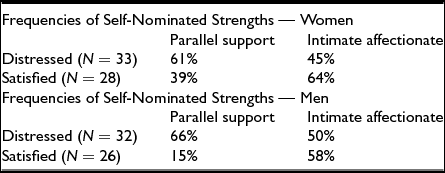
We found that 64% of satisfied women and 58% of satisfied men endorsed at least one item from the Intimate/Affectionate category as one of their top three strengths, whereas 39% of satisfied women and only 15% of satisfied men endorsed an item from the Parallel Support category. On the other hand, 61% of distressed women and 66% of distressed men endorsed an item from the Parallel Support category as one of their top three strengths as a couple, whereas 45% of distressed women and 50% of distressed men endorsed an item from the Intimate/Affectionate category. Results are presented in Table 1.
Frequencies of Nominated Strength Categories For Men and Women

Note: Percentages may be greater than 100% because participants could choose items for both categories.
In order to assess if this difference was statistically significant we performed a series of two-tailed independent sample t tests. For women, both t tests were significant. Distressed women were more likely to endorse items from the Parallel Support category (M = 0.85, SD = 0.80) compared to satisfied women (M = 0.43, SD = 0.57), t(59) = 2.32, p < .05. In addition, satisfied women trended toward more frequently endorsing items from the Intimate/Affectionate category (M = 0.86, SD = 0.80) compared to distressed women (M = 0.52, SD = 0.61), t (59) = -1.83, p = .07. These results supported our hypothesis that there is a qualitative difference between the strengths endorsed by happy and unhappy female partners, such that distressed women are nominating more side-by-side supportive strengths and satisfied women are nominating more intimacy-focused strengths.
For male partners, however, only one test was significant. Distressed men were more likely to endorse items from the Parallel Support category (M = 0.84, SD = 0.72), compared to satisfied men (M = 0.15, SD = 0.36), t(56) = 4.41, p < .001). However, satisfied men were not significantly more likely to endorse items from the Intimate/Affectionate category (M = 0.73, SD = 0.72) compared to distressed men (M = 0.62, SD = 0.71), t(56) = −0.56, p = .57.
Discussion
The results of the current study indicate that more distressed partners, both women and men, are significantly more likely to endorse Parallel Support relationship strengths that are theoretically less reliant on emotional intimacy, whereas more satisfied women (but not men) are more likely to endorse Intimate/Affectionate relationship strengths theoretically indicative of a stronger experience of intimacy. It may be that when more distressed partners are asked to choose their top three strengths from the list provided to them during the Checkup, they are more likely to look past those strengths that indicate a more loving, affectionate, and intimate relationship, instead choosing as strengths those facets of the relationship that they can engage without having to make themselves emotionally available or vulnerable. Partners who are distressed in their relationship can still manage money, parent, and support each other's individual lives without being particularly warmly engaged with each other.
On the other hand, more satisfied wives may still consider parenting, finances, and individual support genuine sources of strength within their relationship, but when offered the choice are significantly more likely on average to choose strengths that clearly indicate the quality of their emotional and intimate connection with their partners. In other words, they might look at the parenting item and think ‘we are really good at that’, but then when compared to laughing and smiling together, choose that as an even greater strength. This suggests that given a wide variety of strengths to choose from, relationally satisfied wives consider the real strength of their relationship to be the quality of their intimate connection as manifest in their friendship, daily connection, and expression of joy.
Our data were strictly cross-sectional in nature and cannot address change over time. Thus, it is possible that differences in chosen strengths may have been present in some of these relationships from their inception. Additionally, however, it is also conceivable that the type of strengths that characterise a couple's relationship may change over time as relationship health deteriorates. It could be that as partners stop perceiving each other as sources of emotional safety, they shift away from considering things like friendship, chatting, and laughter as strengths and toward those strengths that can be engaged from greater emotional distance. If future longitudinal research supports this speculation, then assessing for this shift in considered strengths may be an effective early indicator of relationship health deterioration.
Alternatively, the causal arrow may point in the opposite direction. It is conceivable that couples who from early on in their relationship emphasised parenting, finances, and support for individual activities as their principle strengths may be more susceptible to relationship health deterioration over time than those who emphasise more intimacy and affection-based strengths. If future research finds support for this speculation, then assessing for the dominance of Parallel Support strengths may be an important part of premarital education.
One possible implication of these results is that distressed partners appear to stop choosing strengths that involve real intimate, and therefore vulnerable-making, interactions and choose instead options that limit their vulnerable exposure. They choose those facets of the relationship that require the least intimate interaction, such as managing finances, being parents, and supporting each other's individuality. As the quality of the intimate relationship deteriorates and the partners spend less and less time interacting in a positive way, laugh and smile less together, and no longer feel like they are good friends, the strengths that hold them together as a couple shift in the direction of the least vulnerably exposed and perhaps emotionally safest facets of the marriage — money, parenting, and individual achievement.
This is consistent with intimacy theory and with our description of the path of least emotional resistance based on that theory. The theory draws a distinction between intimate events, characterised by expressions of vulnerability that are reinforced by the partner's response, versus suppressive events, characterised by expressions of vulnerability that are functionally punished by the partner's response. This theory posits that the rapid accumulation of intimate events in the early phases of a developing intimate relationship are responsible for the felt experience of falling in love and the developing sense of intimate safety (Cordova & Scott, Reference Cordova and Scott2001), or safety being authentic and vulnerable, with the partner. It also suggests that suppressive events are unavoidable and a natural part of the landscape of a deeply intimate relationship; we cannot help but hurt each other's feelings from time to time. A la Gottman's 5-to-1 ratio, however, intimacy theory posits that the ratio of intimate to suppressive events translates into the partner's felt sense of intimate safety, which in turn determines his or her experience of marital or relationship satisfaction. As that ratio begins to weaken in the direction of suppressive events, a person's emotional experience of the relationship begins to change from one of intimate safety to one of greater emotional discomfort and threat.
The results of the current study suggest that this process of intimacy deterioration may also affect what couples think of as the principal strengths at the foundation of their relationship, such that intimacy and the associated emotional vulnerability are minimised as much as possible. Theoretically, the shift away from intimate interactions and toward the other, less vulnerable-making facets of married life should happen gradually and cumulatively, in keeping with our description of the micro choice points resolved in the direction of least emotional resistance. For example, if the choice is between going into the kitchen to spend time talking to and making dinner with one's partner and going into the living room to spend time with the children, partners experiencing less intimate safety are more likely to choose time with the children. If the choice is between going home early to spend time with one's partner and staying late at work to meet with colleagues, those whose partners have become more emotionally discomforting may become more likely to choose staying at work.
It is also likely that the conscious decision to nominate parallel support strengths emerges following the tipping point in relationship deterioration associated with the more binary shift from a person rating her relationship as satisfying to dissatisfying, in keeping with Gottman's (Reference Gottman1994) description of ‘p-space and q-space’ change. That is, an accumulation of negative (or non-intimate) interactions must occur before a partner perceives his or her relationship as distressed. Thus, the theoretical implication of the results of the current study is that an increase in suppressive events shifts a person's conceptualisation of the strengths of his or her relationship from one characterised by intimacy and affection to one characterised by the provision of parallel support.
These findings have several practical implications. First, consistent with the early detection goal of the MC, it may be possible to detect the early stages of relationship deterioration through the shift in a couple's attention away from intimate and affection based strengths and toward strengths based on the provision of parallel support. Though the current data do not address the implied emergence directly, they are consistent with this possibility. Second, emphasising a couple's parallel support strengths in the MC, while validating, may not best serve the long-term health of the couple. MC therapists might be directed to acknowledge parallel support strengths but to query more deeply into and emphasise the available intimacy and affection-based strengths. If a couple can be guided toward a more positive reconsideration of their intimacy-based strengths, it may further serve to therapeutically foster the relationship's intimacy process.
Limitations/Future Directions
While this study examined a novel area of couple functioning, it has several limitations. First, this was a cross-sectional study, so we do not know if these category differences precede the onset of distress, follow the onset of distress, or are co-occurring with distress. Future longitudinal studies could answer questions such as: Are couples who begin their relationships on the foundation of parallel support at higher risk of experiencing distress later on or do couples begin to emphasise parallel supports strengths as a result of intimacy deterioration in general?
In addition, the results of this study require replication to ensure that they are not particular to this sample. This work is currently being conducted at the University of Tennessee on a study adapted from the MC (referred to as Relationship Rx) targeting low-income couples recruited from a community-based integrative healthcare facility (Gordon, Reference Gordon2014).
Other limitations include the format of the strengths questionnaire. Participants nominated strengths from a finite list of strengths presented to them by the questionnaire. This limited the study in a few ways. First, it did not allow for a thorough investigation of all of the strengths listed, as many strengths were never selected and therefore were unable to be categorised. Second, it is possible that under free-choice conditions, distressed couples would simply report that they have no strengths or would nominate strengths not currently listed on the questionnaire. Even if this were the case, the present study still makes plain that given the particular choices presented by the strengths questionnaire, distressed couples do nominate less positively engaged strengths than do happier couples.
Finally, the current study revealed some interesting gender differences, and future studies could explore the dimensions of those differences more thoroughly. For example, future researchers could look at partners who nominate strengths from different intimacy categories and investigate whether those differences are associated with even greater relationship distress.
Conclusion
Partners are all faced with multiple choice points throughout their relationships, and they can choose to either move towards their relationship and intimacy, or they can move in the direction of less vulnerable exposure. Choosing the latter may accumulate over time into dissipation or diversion of attention from intimacy and affection toward simple parallel support, which may ultimately be corrosive to intimate relationship health. Clinically, these findings suggest that encouraging partners to pay attention to their patterns, notice the subtle moments when they turn away, and begin to choose connection, presence and intimacy may be at the heart of the therapeutic work. In other words, even in the presence of darkness, complication and heartache, we must shine the light on the bright intimate connection between partners and embolden them to turn toward it again, and again, and again.
Disclosure Statement
Support for this project was provided by a grant (R01HD45281) from the Eunice Kennedy Shriver National Institute of Child Health and Human Development to the first author. Recruitment and interview data were published in a 2011 paper. The current project focuses on distinct data outcomes. Results of this study were presented at the 2012 Conference for the Association of Behavioral and Cognitive Therapies.
Conflict of Interest
None.
Ethical Standards
The authors assert that all procedures contributing to this work comply with the ethical standards of the relevant national and institutional committees on human experimentation and with the Helsinki Declaration of 1975, as revised in 2008.