Introduction
Chrysodeixis chalcites (Esper) and Chrysodeixis eriosoma (Doubleday) (Lepidoptera: Noctuidae) are polyphagous multivoltine species, larvae of which feed on a wide variety of leaves and fruits of vegetables, fruit, and ornamental plants. Morphological techniques cannot reliably distinguish between C. chalcites and C. eriosoma and they are possibly the same species. Although the taxonomy still requires clarification, DNA barcode data, including specimens from this study suggest that variation between C. chalcites and C. eriosoma is only about 1% (C. Schmidt; Canadian Food Inspection Agency, Ottawa, Canada; personal communication). Should they prove conspecific, C. chalcites would be the valid name.
Chrysodeixis chalcites (Golden twin spot moth) is distributed between 45°N and 35°S, from southern Europe, the Mediterranean, and the Middle East to Africa (Centre for Agriculture and Biosciences International 2012). Outdoor breeding populations occur in Europe as far north as northern Spain and northern Italy. No successful breeding is reported outdoors in northern Europe (Centre for Agriculture and Biosciences International 2012), although it has been recorded in Austria, Denmark, Germany, Sweden, Switzerland, and the United Kingdom in the late summer or autumn (Jor Reference Jor1973; Bretherton Reference Bretherton1983; Hachler et al. Reference Hachler, Jermini and Brunetti1998; Palmqvist Reference Palmqvist2002). Chrysodeixis chalcites is a major pest of tomato, lucerne, alfalfa and clover in Israel; it is one of the principal arthropod pests on soybean in northern Italy and Spain; on field fruit and vegetables in Egypt; and on potato in Mauritius (Avidov and Harpaz Reference Avidov and Harpaz1969; Zandigiacomo Reference Zandigiacomo1990; Broza and Sneh Reference Broza and Sneh1994; Amate et al. Reference Amate, Barranco and Cabello1998). Indoors, C. chalcites is reported as a main insect pest in Netherlands, Italy, Belgium, Bulgaria, and Turkey affecting tomato, cucumber, peppers, and ornamentals (Uygun and Ozgur Reference Uygun and Ozgur1980; Inserra and Calabretta Reference Inserra and Calabretta1985; Loginova Reference Loginova1992; Veire Reference van de Veire1993; Vos and Rutten Reference Vos and Rutten1995).
Chrysodeixis eriosoma has been reported throughout Asia, in Korea, China, Japan, India, Vietnam, Indonesia, Malaysia, and all over Australasia (Roberts Reference Roberts1979; Centre for Agriculture and Biosciences International 2012). The larva feeds mostly on Solanaceae and Asteraceae (Compositae) plants. It is one of the most serious horticultural pests in New Zealand, Australia, Indonesia, Japan, and Hawaii, feeding on a variety of crops such as tomato, soybeans, beans, pumpkin, capsicum, tobacco, and cabbage (Roberts Reference Roberts1979; Cameron et al. Reference Cameron, Allan and Walker1986; Talekar Reference Talekar1987, Luther et al. Reference Luther, Valenzuela and DeFrank1996).
In 1995, C. eriosoma was intercepted at United States of America ports on a species of Moringa Adanson (Moringaceae) and on water dropwort, Oenanthe javanica (Blume) Candolle (Apiaceae) from Hawaii (United States Department of Agriculture 2006, 2007), and a specimen of C. chalcites was found on Pelargonium L'Héritier de Brutelle ex Aiton (Geraniaceae) (geraniums) in a greenhouse in Ohio (Passoa and Gilligan Reference Passoa and Gilligan1995). Olsen (Reference Olsen2005) reported that C. chalcites was intercepted by Customs and Border Protection at Atlanta, Georgia, United States of America airport on Hydrangea Linnaeus (Hydrangeaceae) from the Netherlands. By the end of December 2005, a detection of either C. chalcites or C. eriosoma was made in two vegetable production greenhouses in Delta, British Columbia, Canada. The facilities were placed under quarantine and compliance agreements from the summer of 2006 to the spring of 2007 to prevent potential spread with agricultural products; facilities were also required to carry out eradication activities and because detections were not made after the quarantine-eradication process, the status of the pest in Canada is eradicated (North American Plant Protection Organization 2007; Lafontaine and Schmidt Reference Lafontaine and Schmidt2010).
In California, United States of America, specimens of C. chalcites and C. eriosoma have been detected or intercepted in the counties of San Mateo, Shasta, Contra Costa, Los Angeles, Orange, and San Luis Obispo from 1999 through 2007 (California Department of Food and Agriculture 1999, 2005, 2007). In 2006 the rating of C. eriosoma was changed from Q (Quarantine) to A (Actionable) status (California Department of Food and Agriculture 2007). United States Department of Agriculture-Animal and Plant Health Inspection Service-Plant Protection and Quarantine (2008) lists C. chalcites as a pest of national concern for fiscal year 2009 but C. eriosoma is not listed. The priority pest list for fiscal years 2010 and 2011 report C. chalcites though without ranking it into the top 50 pests that are expected to cause damage to agricultural or natural resources if introduced into the United States of America (United States Department of Agriculture-Animal and Plant Health Inspection Service-Plant Protection and Quarantine 2009, 2010). The pests on this list are the Animal and Plant Health Inspection Service's high priority pests that should be surveyed.
Sullivan et al. (Reference Sullivan, Flores, Salinas, Salas and Ramsey2007) reported that based on host availability, areas from North Dakota east to Ohio and south to Texas/Louisiana were at considerable risk of C. chalcites establishment and areas along the west coast such as Oregon, California were at moderate risk.
During September–October 2008 in a 4-ha multi-crop field plot of tomato, pepper (Capsicum annuum Linnaeus, Solanaceae), corn (Zea mays Linnaeus, Poaceae), cabbage (Brassica oleracea Linnaeus, Brassicaceae), green beans (Phaseolus vulgaris Linnaeus, Fabaceae), and onions (Allium cepa Linnaeus, Alliaceae) located in Leamington Ontario, Canada (42°02′36.45′′N, 82°38′05.60′′W), four universal moth traps (Great Lakes IPM Inc., Vestaburg Michigan, United States of America) with pheromone lures for Trichoplusia ni (Hübner) (Lepidoptera: Noctuidae) were placed in the plot corners and separated by about 300 m from each other. Weekly sampling of larvae of the subfamily Plusiinae (Lepidoptera: Noctuidae) was done during September–October 2008 in the multi-crop field plot and from May to October during 2009 and 2010 in processing tomato, cabbage, and broccoli fields in different localities of the Essex and Chatham-Kent counties in southwestern Ontario, Canada. During 2009, larvae were collected in 16 tomato, two cabbage, and one broccoli crops located in Kingsville–Leamington (eight tomato fields: 42°02′36.45′′N, 82°38′05.60′′W; 42°05′07.25′′N, 82°36′08.65′′W; 42°04′57.37′′N, 82°34′01.83′′W; 42°05′00.78′′N, 82°37′07.26′′W; 42°05′04.03′′N, 82°34′09.19′′W; 42°02′28.91′′N, 82°43′49.66′′W; 42°05′06.68′′N, 82°34′42.24′′W; 42°06′00.53′′N, 82°37′42.33′′W; one cabbage and one broccoli field: 42°02′36.45′′N, 82°38′05.60′′W), Harrow (five tomato fields, four individual plots: 42°02′00.82′′N, 82°53′58.49′′W; 42°02′11.54′′N, 82°57′03.78′′W), Blenheim (one tomato field, one visit on 31 August: 42°16′00.08′′N, 82°03′06.82′′W), and Ridgetown (one tomato and one cabbage fields visited on 31 August: 42°26′51.06′′N, 82°52′42.22′′W). During 2010, larvae were collected in 11 tomato crops located in Kingsville–Leamington (four fields: 42°02′36.45′′N, 82°38′05.60′′W; 42°05′07.25′′N, 82°36′08.65′′W; 42°04′59.21′′N, 82°34′10.93′′W; 42°05′07.95′′N, 82°38′19.02′′W), Harrow (one field: 42°02′11.54′′N, 82°57′03.78′′W), Wallaceburg (one field: 42°31′40.8′′N, 82°2029.32′′W), Chatham (four fields: 42°23′26.93′′N, 82°09′27.13′′W; 42°23′56.23′′N, 82°06′59.493′′W; 42°27′54.07′′N, 82°05′17.75′′W; 42°24′45.44′′N, 82°05′38.67′′W), and Blenheim (one field visited three times: 42°16′00.08′′N, 82°03′06.82′′W). A few scattered larval collections were done during 2011 in six processing tomato fields located in the Kingsville–Leamington area (42°02′36.45′′N, 82°38′05.60′′W; 42°02′11.48′′N, 82°42′01.16′′W; 42°04′57.37′′N, 82°34′01.83′′W; 42°05′07.25′′N, 82°36′08.65′′W; 42°05′00.78′′N, 82°37′07.26′′W; 42°05′04.03′′N, 82°34′09.19′′W). For each field, a total of 100 plants were sampled. Starting from a different corner of the field on each sampling date, five plants were selected and examined for larvae every 10 steps in a random zigzag pattern. Larvae were reared individually on a pinto bean diet (Shorey and Hale Reference Shorey and Hale1965) in a growth chamber at 24°C, 12:12 hours light:dark photoperiod and 60% relative humidity. Voucher specimens have been deposited in the Canadian National Collection of Insects, Arachnids, and Nematodes (Ottawa, Ontario, Canada).
During September–October of 2008, from Trichoplusia ni pheromone traps in the 4-ha multi-crop field plot located in the Leamington-Kingsville area, 25 adult males were collected and they were identified as C. chalcites or C. eriosoma making this the first record of this species for eastern Canada. Based on the statements above in the first paragraph, from now on this species will just be named as C. chalcites. During this year, the larvae sampling in the same plot, yielded 32 specimens of C. chalcites collected from the green bean crop and 21 from the tomato crop.
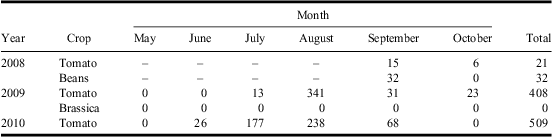
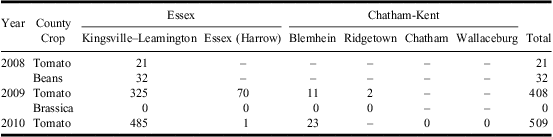
During 2009, 408 C. chalcites were collected from the 13 tomato fields but none were collected from brassica crops. During 2010, 509 C. chalcites were collected from the 11 tomato crops. The number of C. chalcites specimens collected can be observed by month in Table 1 and by location in Table 2. The larval collections made during 2011 in processing tomato fields located in the Kingsville–Leamington area all yielded C. chalcites specimens.
Number of Chrysodeixis chalcites larvae collected in field crops that turned into adult moths by month during 2009–2010.
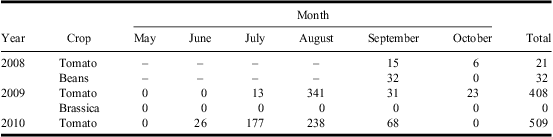
–, There was no sampling.
Number of Chrysodeixis chalcites larvae collected in field crops that turned into adult moths by localities in the Essex and Chatham-Kent counties, Ontario, Canada during 2009–2010.
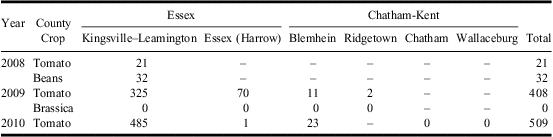
–, There was no sampling.
Based on the information provided above, we hypothesise that C. chalcites is probably an established insect pest in North America in processing tomato crops at least in the counties of Essex and Chatham-Kent, southwestern Ontario, Canada and that it could already be present in surrounding field tomato crop areas in the United States of America states of Michigan, Ohio, and New York. After four years of the presence of C. chalcites in southwestern Ontario, we believe that the species overwinters in North America. However, it is unclear if the overwintering occurs in southwestern Ontario, or if it occurs further south with a spring migration to Ontario. In Europe, breeding populations of C. chalcites are reported only up to northern Spain and Italy where weather conditions are much milder than southwestern Ontario (Centre for Agriculture and Biosciences International 2012). Chrysodeixis chalcites has the potential of becoming one of the main insect pests for the field tomato crops and other crops such as beans in eastern North America. Studies about the dispersal and overwintering of C. chalcites, on its interaction with other Noctuidae and about potential biocontrol agents are currently being performed by the authors.
Acknowledgements
The authors would like to thank all the growers in Essex and Chatham-Kent counties of Ontario, Canada who allowed us to take samples from their crops and to Dr. Christian Schmidt from the Canadian Food Inspection Agency for the taxonomic information.