Introduction
The list of ‘non-negotiables’ for every lesson is comprehensive, amongst them are evidence of planned seating, homework set in every lesson and literacy addressed in the lesson as well as in marking. Students are expected to know the National Curriculum level at which they are currently working and should be able to share their current target for improvement in that subject with anyone that asks. Formal lesson observations, informal learning walks, an annual department review and regular ‘Work Scrutiny’ exercises are in the school calendar. This year, for the first time as a teacher of a foundation subject in my mixed, mainstream secondary school of 1200 students, I have been given target levels for students reaching the end of the compulsory music curriculum (currently at age 14 in England). I am expected to implement intervention strategies for students who may fall short of these. According to discussions on a popular online music teaching forum,Footnote 1 I'm not alone. In a recent BBC News report it was found that music teachers are coming under increasing pressure to meet rigid targets as a means to measure school effectiveness in a climate of league tables and the aim to ‘add value’ throughout the secondary school experience.Footnote 2
For music practitioners wishing to use informal learning and non formal teaching approaches (here referring to whole-class workshopping)Footnote 3 to deliver innovative and engaging music teaching through practical authentic musical experiences, these can be significant barriers to taking on initiatives such as the Musical FuturesFootnote 4 Approaches (D'Amore, Reference D'AMORE2009).
‘The five characteristics of informal learning’ in practice
Emphasis on aural learning as a main starting point for informal approaches (Green, Reference GREEN2008) can lead to issues highlighted by one senior manager in my school. He feels that other staff view the informal approach as ‘too innovative: staff “walk through the school and see students banging on things and just what basically appears to be causing riots . . . they are not in a controlled environment. Then because they don't see the entire process, just a snapshot of it which doesn't reflect what is really going on, staff struggle to understand what it's all about”’ (Hallam et al., 2011).
There is normally a practical element to any curriculum music lesson, often leading to similar conclusions being drawn by staff, complaints about noise levels around the music department, are common, as groups huddle around plug sockets in corridors. This is in stark contrast to more ‘controlled’ circumstances found in the formal ambience of other subjects. However, the ‘innovation’ suggested has more to do with the role of the teacher in the informal approach and how this can be perceived by other staff.
Rather than choose the material to be studied, break it down then deliver the skills needed to achieve set attainment outcomes, informal learning practitioners support personalised learning objectives set by each individual learner themselves, and in the initial informal learning module (Green, Reference GREEN2008) learners even choose the material they wish to study. We facilitate the skills and understanding that learners identify they need to move forward, rather than impose a ‘one-size-fits-all’ set of skills for everyone. We recognise that progress occurs in peaks and troughs even within a single lesson and most importantly we allow space and time for learners to meet their objectives through the integration of listening, performing, composing and improvising within a single lesson whilst allowing self-selected friendship groups.Footnote 5 Therefore, rather than devising a plan for the learning that will take place in a lesson, teachers respond as learning unfolds.
In my school, weekly ‘teaching and learning’ resources are sent round to all staff; many don't really apply in the informal music lesson. For example, the ‘Structuring group work for peer learning’ idea (TES resource May 2011)Footnote 6 asks that pupils are ‘placed in groups’, a direct conflict with the concept of friendship groups that is key to informal approaches. It is interesting that one of the common outcomes of informal learning is students taking on the roles themselves that in this example are suggested by the teacher (Hallam et al., 2011). Requests to ‘adjust my seating plan’ to separate certain students in lessons seem irrelevant when they have chosen to work together and are achieving positive results, or haven't chosen to work together at all. Summarising tasks in bullet points for a student with Special Educational Needs is no replacement for a conversation guiding that student through the task while engaged in it.
Progress, haphazard learning and differentiation
As part of regular observation schedules, one of the main issues fed back has been that although it is recognised that the students are learning, there is some question about progress that can be seen within a single lesson given that learning takes place in a haphazard way, ‘without structure or guidance’ in informal learning (Green, Reference GREEN2008).
Without standard classroom strategies such as levelled objectives on the board, a defined three-part lesson, formal seating plan and a book full of marked written assignments, some observers find it difficult to tick boxes on the observation form and without following the teacher closely as they interact with individuals and groups, examples of differentiation and personalised support can be missed by observers. In a typical formal lesson observation, planning for differentiation is often evidenced by resource, with different worksheets distributed by ability, or different types of learners are grouped together by the teacher and these approaches are clearly evident to observers. In an informal music lesson, differentiation happens on the spot as teachers work with individuals and groups, standing back, diagnosing, modelling and facilitating the learning as appropriate and it is essential that teachers insist on observers being fully informed about the approach before the lesson to ensure their expectations are realistic. Asking for at least 10 minutes of the observation to be spent ‘shadowing’ the teacher has also helped address this in my lessons, although it is telling that the only observer to grade my teaching outstanding until recently was from OFSTED.
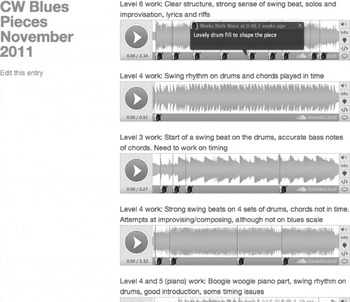
Giving access to recorded outcomes showing progression over a longer time has been successful and recently I have developed a new means of recording and storing recorded music helping to create a bank of exemplar work assessed in line with current National Curriculum requirements. For example, using the ‘soundcloud’Footnote 7 app on my smartphone, I record class work which uploads to the internet via 3G. It is then possible to add teacher comments as the track plays and using a simple free blogging website, I can create pages of feedback for students so my feedback on their practical work is accessible from their computers at homeFootnote 8 and easily shared with parents and other learners.

Informal approaches and written work
One of the main requirements of teachers in my school this year is to ensure there is the opportunity for students to demonstrate their understanding of the learning they have been experiencing. When work is scrutinised, it is expected that as part of reflection activities, they will identify progress they have made and ensure that they understand how to achieve the targets they have been set (AFL policy 2010). During ‘Learning Walks’ they are questioned about why they are doing the tasks set and how that will contribute to their progress in the subject.
The criteria for work scrutiny is geared towards what is found in student written work and providing evidence of this can be challenging for music teachers wishing to deliver content practically within (typically) a weekly lesson. Utilising, where schools allow, appropriate social media, is one way in which teachers are addressing this. With young people becoming increasingly competent with social media, the resulting effects of how certain technologies can affect how young people communicate with each other (Bryant et al., Reference BRYANT, SANDERS JACKSON and SMALLWOOD2006) could form an effective means of helping them to demonstrate understanding as an alternative to traditional written tasks. For example, in addressing an improvement target from a learning walk for the music department: to allow students to document their achievements in diary form at the end of lesson; in my classroom, reflection on learning takes place through a weekly blog on their NUMUFootnote 9 pages.
The following are from two students in the same class after lesson one of a classroom workshopping task (Musical Futures non-formal approach). After improvising then composing their own rhythms, they transferred these to instruments, initially using the chord of D minor with the option of adding an improvised melody using 5 notes. As I worked around the class, both said they were ‘fine’.
Student 1:
Today i was playing the keyboard when we all split up into groups. Altogether i thought we could play the notes we were given in time but i would have had something a bit more Challenging because all the keyboards are doing is playing the same note over and over again (sic).
Student 2:
In todays lesson we all got on to a instrument and did a tune, and then we put it all together and made a song/ tune. i thought the tune on the piano was a bit difficult (sic)
The learning needs of both, the first to understand how to compose a new melody to play in the piece and the second to learn an easier part were made much clearer in the blogs than had been expressed in the lesson.
The next blog from Student 1 suggested that subsequent intervention had been effective:
I thought today was really good. I have made up my own notes that fit in with the rest of the music and it sounds quite good.
Some music educators feel that allowing students to express themselves using their own language is an example of how informal approaches represent ‘dumbing down’ in the music classroom as exemplified by the following post in response to a blog giving examples of the positive feedback from Musical Futures Young Champions in their support of other young people using the NUMU website:
I don't see what is so wrong with helping students develop an appropriate vocabulary for our subject. Other subject areas see this is a responsibility to help them articulate a coherent argument – so why must we dumb down in music? “Awesome” and “Epic” certainly provide a feelgood (sic) factor and it is important that students encourage one another, but some students should be encouraged to go beyond this and provide more insightful commentary. There are many who will be capable of providing more detailed technical or descriptive analysis.
In response to this viewpoint, I decided to use online student blogs to support students with developing these essential skills. They are first asked to describe their experiences in lessons, then I use the ‘shout back’ box on the page, to encourage them to identify how they have made progress, guide them towards identifying their musical contribution and facilitate use of musical terminology as well as informal colloquialisms. Printing the blogs and feedback has enabled me to track how my online input and engagement with them outside the classroom has had an impact on practical outcomes, useful evidence to present to anyone ‘scrutinising’ the work.
Conclusion
Integration of informal approaches into the music classroom is one of the most significant initiatives in secondary music education in recent years and practitioners are accessing resources developed by teachers for teachers and adapting these to suit their particular circumstances.
As teachers, we have a responsibility to strive to deliver innovative and creative practice within the constraints of secondary schools in the 21st century and the current climate of uncertainty and change in music education as a whole.
However we must continue to work to understand how informal approaches are different from traditional music lessons and to develop ways to fulfil the demands of the increasingly target-driven priorities of schools in England. At the heart of informal approaches is the wish to satisfy the needs of all young people, as for many, their curriculum music experience will be their only musical experience.