Introduction
Communities worldwide face challenges in meeting basic needs, addressing economic and social issues and mitigating environmental problems (Sanoubar et al. Reference Sanoubar, Khalili and Saghafian2012, Kolahi & AzimiSeginSara Reference Kolahi and Rahmani2019). In response, the role of private and civil society institutions has become more prominent, necessitating their engagement in social responsibilities (Shafei & Azizi Reference Shafei and Azizi2013). Universities, as influential entities, play a pivotal part in this landscape.
Despite the importance of universities in societal progress, Iran faces challenges such as environmental crises, pollution and resource depletion (Rahmani Reference Rahmani2019). There is a need for improvement in the University of Tehran’s role in social responsibility (Shafaei et al. Reference Shafaei, Abili and Faramarzgheramoli2018). Although corporate social responsibility (CSR) has been studied, research specific to university environmental responsibility in Iran is lacking (e.g., Cauchick Miguel & Campos Reference Cauchick Miguel and Campos2013, Branowska et al. Reference Branowska, Spychała, Rybka, Matczak, Mazur, Golinska-Dawson and Spychała2019, Freitas et al. Reference Freitas, Caldeira-Oliveira, Teixeira, Stefanelli and Teixeira2020). This study bridges this gap, exploring university environmental responsibility in Iran.
Iran’s higher education system boasts a rich history, encompassing globally recognized institutions. The University of Tehran, for instance, stands as one of the oldest and most prestigious universities in the world (Universities QST 2022). While rankings highlight the University of Tehran’s stature, Iranian universities face environmental challenges that underscore the urgency of addressing university environmental responsibility.
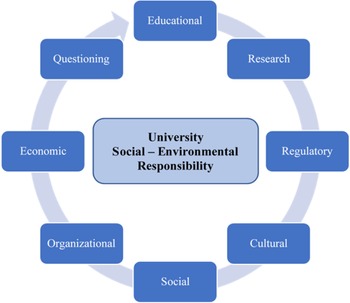
This study therefore aims to evaluate university socio-environmental responsibility in Iran, exploring dimensions and ranking universities based on their status. A conceptual model encompassing eight variables (economics, organizational, educational, research, regulatory, culture, social and questioning) guides this investigation (Figure 1; see also Table S1). These variables collectively inform university environmental responsibility, shaping strategies and approaches for addressing environmental issues in a community context.
Conceptual model of the research.

Universities and socio-environmental responsibility: the global context
Socio-environmental responsibility in universities refers to the commitment and actions taken by higher education institutions to address sustainability challenges and promote sustainable development. It is a complex and multifaceted concept that requires the development of key competencies, institutional change and collaborative efforts among stakeholders. Barth et al. (Reference Barth, Godemann, Rieckmann and Stoltenberg2007) argue that developing key competencies for sustainable development is crucial for universities to effectively address socio-environmental responsibility. These competencies include systems thinking, interdisciplinary collaboration and critical reflection. Wiek et al. (Reference Wiek, Withycombe and Redman2011) provide a reference framework for academic programme development, highlighting the importance of integrating sustainability into university curricula. Moreover, Corcoran and Wals (Reference Corcoran and Wals2004) highlight the challenges universities face in embracing socio-environmental responsibility, including the need for institutional change, overcoming disciplinary boundaries and fostering collaboration among stakeholders. Universities have a role to play in implementing the Sustainable Development Goals (SDGs) and in discussing the challenges they face in aligning their activities with the SDGs (Zhou et al. Reference Zhou, Rudhumbu, Shumba, Olumide, Nhamo and Mjimba2020). Universities have implemented various practices to promote sustainability, ranging from integrating sustainability into curricula to adopting comprehensive sustainability strategies. Several studies have explored the practices adopted by universities to promote socio-environmental responsibility. Thus, a worldwide survey found that commitment to sustainable development varied among institutions, with some implementing comprehensive sustainability strategies while others focused on specific initiatives (Lozano et al. Reference Lozano, Ceulemans, Alonso-Almeida, Huisingh, Lozano and Waas2015). Sterling (Reference Sterling, Corcoran and Wals2004) has argued for the importance of systemic learning in higher education, where students are encouraged to understand the interconnectedness of social, economic and environmental issues.
University social responsibility – a burgeoning concept – encompasses interactions between universities and communities as a driving force for sustainable development (Villasana et al. Reference Villasana, Cárdenas, Adriaenséns, Treviño and Lozano2016). Universities must actively engage in local and global challenges, contributing to societal progress across social, economic, ecological, environmental and technical dimensions (Chen et al. Reference Chen, Nasongkhla and Donaldso2015). Moreover, higher education’s influence on sustainable development and environmental awareness is substantial (Wright Reference Wright2010, Nejati et al. Reference Nejati, Shafaei, Salamzadeh and Daraei2011). Students must transcend individualism, recognizing their roles in addressing societal issues (Alimohammadlou et al. Reference Alimohammadlou, Akbari and Mahdavianpour2014).
Environmental responsibility, particularly amidst concerns such as global warming and biodiversity loss, has gained global significance (Rahmani Reference Rahmani2019). Higher education institutions, including universities, have a pivotal role to play in mitigating environmental challenges. Universities are obliged to operate in an ecologically responsible manner and, concurrently, to lead global efforts in promoting sustainability through education, research and community involvement (Ketlhoilwe Reference Ketlhoilwe2008).
Embedding environmental responsibility into the broader social responsibility context, models such as the ‘New DNA’ (Visser Reference Visser2011) and the expectation of CSR (Mandhachitara & Poolthong Reference Mandhachitara and Poolthong2011) recognize environmental dimensions. Universities, as integral parts of society, necessitate the adoption of social responsibility principles (Simha Reference Simha2005).
Columbia University and the University of Edinburgh are exemplary institutions showcasing strong commitments to environmental sustainability and social responsibility. In 2019, Columbia University initiated two taskforces addressing the climate crisis and the university’s role in societal needs (Cohen Reference Cohen2019). These taskforces aimed to analyse the university’s foundational aspects and its approach to research, education and public service. The University of Edinburgh is at the forefront of social responsibility and sustainability, providing diverse training courses, events, internships, funding and guidance for students to enhance their sustainability skills and contribute to positive change (University of Edinburgh 2023). The university excels across various areas such as research, teaching, biodiversity, climate action, energy, food, investment and community engagement, earning recognition as the leading UK institution for sustainability according to the QS World University Rankings (Universities QST 2022).
Universities play a vital role in cultivating sustainable development awareness among future generations by integrating social, economic and environmental perspectives. Equipping students with the knowledge, skills and values to become conscientious citizens is essential for a sustainable future (Læssøe & Mochizuki Reference Læssøe and Mochizuki2015). Universities must lead by example, reducing their environmental impacts through carbon footprint reduction, sustainable energy use and waste management (Wright Reference Wright2010). Additionally, interaction with communities – a part of universities’ social responsibility – emphasizes immediate and direct social impacts. Universities must align their missions with environmentalism by considering their social and eco-centric responsibilities (Des Jardins Reference Des Jardins2012).
This study builds upon Vallaeys’ (Reference Vallaeys2014) model of university social responsibility, adapting it for environmental considerations:
-
Organizational impacts: Similar to any organization, a university has various stakeholders, including staff, faculty members and students, who can be affected by the university or influence its decisions. The way a university organizes its activities can have environmental impacts, such as waste, deforestation and increased energy and transportation costs.
-
Educational impacts: Responsible universities should consider the kind of people and professionals they are educating, along with their duties towards them. They must structure their educational systems to produce citizens who value environmental sustainability, altruism and community well-being and accept responsibility for them.
-
Cognitive impacts: Universities are responsible for producing and fostering knowledge that influences social, cultural and economic issues. Responsible universities must question the knowledge they produce and its applications to overcoming challenges. For instance, they need to consider the type, purpose and audience of the knowledge they produce and how they can disseminate this knowledge to address cognitive shortcomings that prevent sustainable development and lead to environmental degradation.
-
Social impacts: The community is one of the university’s stakeholders. A responsible university continuously assesses its impacts on its surrounding community and how it can contribute to community development. It also considers how it can foster education and knowledge that lead to social responsibility, particularly at the local level. However, implementing this mission and strategy is not without challenges. Therefore, universities must identify the challenges that they face to achieve their social responsibility goals.
Methodology
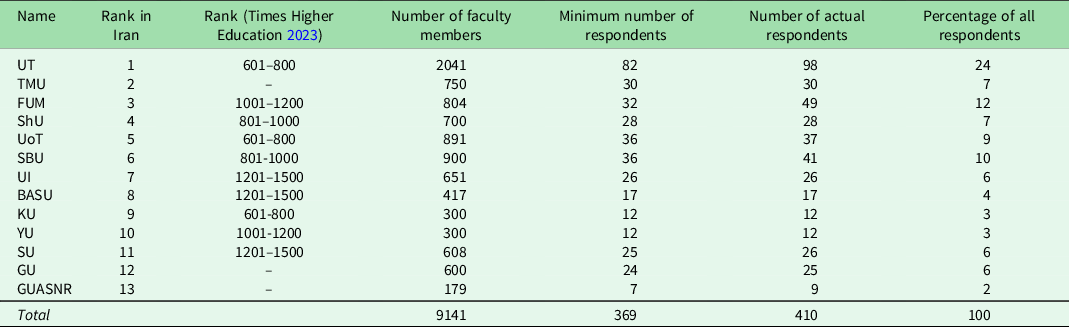
The sample for this study consisted of 13 comprehensive universities in Iran, selected based on their ranking by the Ministry of Science, Research and Technology of Iran. These universities cover a wide range of academic disciplines and have a focus on research and graduate programmes. They typically have faculties and departments across various disciplines, including the humanities, natural sciences, social sciences and engineering. The selected universities are the University of Tehran (UT), Tarbiat Modares University (TMU), Ferdowsi University of Mashhad (FUM), Shiraz University (ShU), University of Tabriz (UoT), Shahid Beheshti University (SBU), University of Isfahan (UI), Bu-Ali Sina University (BASU), Kashan University (KU), Yasouj University (YU), Semnan University (SU), University of Guilan (GU) and Gorgan University of Agricultural Sciences and Natural Resources (GUASNR; Table 1). The study’s population included all faculty members of these universities engaged in teaching, research and consulting activities.
The top 13 comprehensive universities of Iran ranked and the minimum number of respondents as indicated by the Cochran formula.

UT = University of Tehran; TMU = Tarbiat Modares University; FUM = Ferdowsi University of Mashhad; ShU = Shiraz University; UoT = University of Tabriz; SBU = Shahid Beheshti University; UI = University of Isfahan; BASU = Bu-Ali Sina University; KU = Kashan University; YU = Yasouj University; SU = Semnan University; GU = University of Guilan; GUASNR = Gorgan University of Agricultural Sciences and Natural Resources.
For data collection, an online survey method was utilized. The questionnaire (available from the corresponding author on request) contained two parts: questions related to university social-environmental responsibility (USER) and personal characteristics of respondents. A total of 62 questions related to USER were divided into the following eight indices:
-
Economic index (6 questions): this assessed the economic aspects of the university’s environmental practices. The questions covered topics such as the university’s utilization of solar panels to generate electricity, allocation of a budget for designing bicycle paths, allocation of a budget for addressing environmental issues, budget allocation for environmental workshops, financial support for green businesses and water recycling practices.
-
Organizational index (11 questions): this focused on the organizational aspects of the university’s environmental initiatives. The questions addressed the presence of an official unit or department supporting environmental activities, waste segregation practices, use of energy-saving lightbulbs, use of disposable plastic containers, implementation of designated bicycle paths, restrictions on personal motor vehicles, utilization of food waste for composting, promotion of bicycle use for transportation, collaborative meetings to address environmental issues, enforcement of environmental regulations and automation of administrative and educational processes to reduce paper consumption.
-
Educational index (7 questions): this assessed the university’s efforts in promoting environmental knowledge and training. The questions examined the organization of environmental training workshops, annual environmental conferences, publication of promotional newsletters, organization of voluntary and free environmental training camps, provision of energy efficiency and conservation courses, integration of environmental principles and behaviours in education and continuous information dissemination through automation.
-
Research index (6 questions): this focused on the university’s research activities related to environmental issues. The questions covered areas such as extensive research on environmental topics, preference for publishing research in Persian, formation of research teams with diverse expertise, involvement of expert faculty members in environmental research, presentation of research achievements in the media and selection of research topics based on societal environmental challenges.
-
Regulatory index (6 questions): this evaluated the presence of guidelines and policies for environmental protection. The questions addressed the existence of guidelines for environmental protection, penalization of environmental violations, annual evaluation of environmental standards, policies to reduce personal vehicle entry, guidelines to minimize paper usage and waste recycling guidelines.
-
Cultural index (6 questions): this assessed the university’s efforts in promoting environmental awareness and community engagement. The questions focused on organizing free environmental education workshops in the city, programmes connecting the university, families and nature, provision of free online environmental education programmes through the media, establishment of a free counselling centre for environmental issues, information dissemination about available environmental services and contribution to ethical responsibility towards current and future generations.
-
Social index (10 questions): this examined the university’s collaborations to and interactions with external entities in addressing environmental issues. The questions covered areas such as collaboration with the municipality in waste management, sharing scientific achievements with governmental and private institutions, joint meetings between university faculty and executive organizations, organization of annual conferences on environmental issues, incentives for participation in environmental civil organizations, relationships with grassroots environmental organizations, formation of student organizations in environmental conservation, provision of free consultancy services to green businesses, reaction to detrimental environmental decisions and active participation in environmental meetings and gatherings.
-
Questioning index (6 questions): this focused on the university’s approach towards student engagement and discussions on environmental issues. The questions examined the university’s openness to student criticism, cultivation of inquisitive students regarding environmental matters, raising awareness in society, fostering a friendly atmosphere for discussions, organization of open dialogues and discussions and accommodation of students’ perceptions and approaches towards environmental issues.
Additionally, personal characteristics of the participants were collected, including gender, age, family size, faculty and university affiliation, employment status, scientific ranking, academic foundation, marital status, scientific field, years as a faculty member, monthly income, membership in environmental non-governmental organizations (NGOs) and other characteristics of responsible individuals. Furthermore, the participants’ perspectives on their level of activity in scientific and research activities related to environmental issues, their level of concern about environmental issues, their engagement of students in environmental matters and their willingness to voluntarily collaborate to solving environmental problems were assessed.
Through random cluster sampling, 410 researcher-made questionnaires were collected from a total of 9141 faculty members based on the Cochran formula. The validity of the questionnaire was ensured through consultations with specialists, who reviewed the questionnaire for face and content validity. Face validity refers to the extent to which the questionnaire appears to measure what it is intended to measure. To assess face validity, experts in the field were asked to review the questionnaire and provide feedback on whether the questions seemed relevant and appropriate for measuring the intended construct. Content validity, on the other hand, refers to the extent to which the questionnaire adequately covers all aspects of the construct being measured. To assess content validity, specialists were asked to review the questionnaire and provide feedback on whether the questions covered all relevant aspects of the construct and whether any irrelevant questions were included. Therefore, specialists were consulted to help ensure that the questionnaire was valid by reviewing the questions and providing feedback on whether they seemed relevant and appropriate for measuring the intended construct and whether they covered all relevant aspects of the construct. Reliability was also confirmed using Cronbach’s α. Data collection involved an online survey sent to faculty members’ email addresses obtained from university websites and educational departments. Farazkish and Montazer (Reference Farazkish and Montazer2019) and Jiang et al. (Reference Jiang, Islam, Gu, Spector and Chen2022) have demonstrated the suitability of online surveys for data collection in educational research, highlighting their advantages of anonymity, efficiency and cost-effectiveness.
Respondents ranked each of the indices on a scale of 1–5. The scores of questions related to any variable were summed and used for analysis. Data analysis was performed using descriptive and inferential statistics in the SPSS software (IBM Corp., Armonk, NY, USA). Descriptive analysis included means, standard deviations, frequency tables and charts. Inferential analysis included parametric tests such as use of t-tests, one-way analysis of variance and Pearson correlations. However, to gain deeper insights into respondents’ evaluations, written responses to qualitative open-ended questions were used to explore the motivations, expectations, challenges and obstacles shaping their perceptions. Each response was analysed and categorized and relevant codes were assigned to them. The analysis aimed to provide insights into the participants’ perspectives on USER and related issues in Iranian universities.
Results
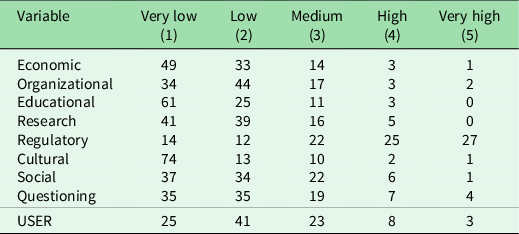
Perceptions of USER at the top 13 comprehensive universities in Iran tended to be generally low. Among the aspects assessed, regulatory considerations received intermediate levels of attention, while economic, organizational, educational, research, social and questioning aspects showed lower levels of consideration. Cultural aspects were identified as insufficiently addressed by the universities (Table 2).
Number of respondents indicating the response levels of each of the eight university social-environmental responsibility (USER) variables.

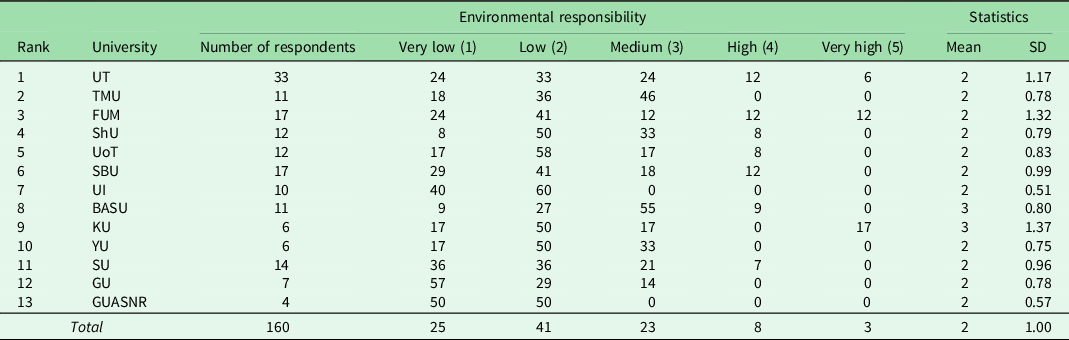
GUASNR displayed the lowest level of USER, while BASU demonstrated the highest level (Table 3 & Fig. S1). All 13 of the universities exhibited low levels of USER. There were also significant positive Pearson correlations among contextual and dependent variables (Table S2).
Mean (± SD) values of university social-environmental responsibility by university.

UT = University of Tehran; TMU = Tarbiat Modares University; FUM = Ferdowsi University of Mashhad; ShU = Shiraz University; UoT = University of Tabriz; SBU = Shahid Beheshti University; UI = University of Isfahan; BASU = Bu-Ali Sina University; KU = Kashan University; YU = Yasouj University; SU = Semnan University; GU = University of Guilan; GUASNR = Gorgan University of Agricultural Sciences and Natural Resources.
An exploration of gender in relation to USER revealed notable differences, whereas marital status did not yield significant differences (Table 4). It is notable, however, that the effect size of the t-test on gender differences was relatively small (0.01).
Results of t-tests of gender and marital status differences with respect to university social-environmental responsibility.

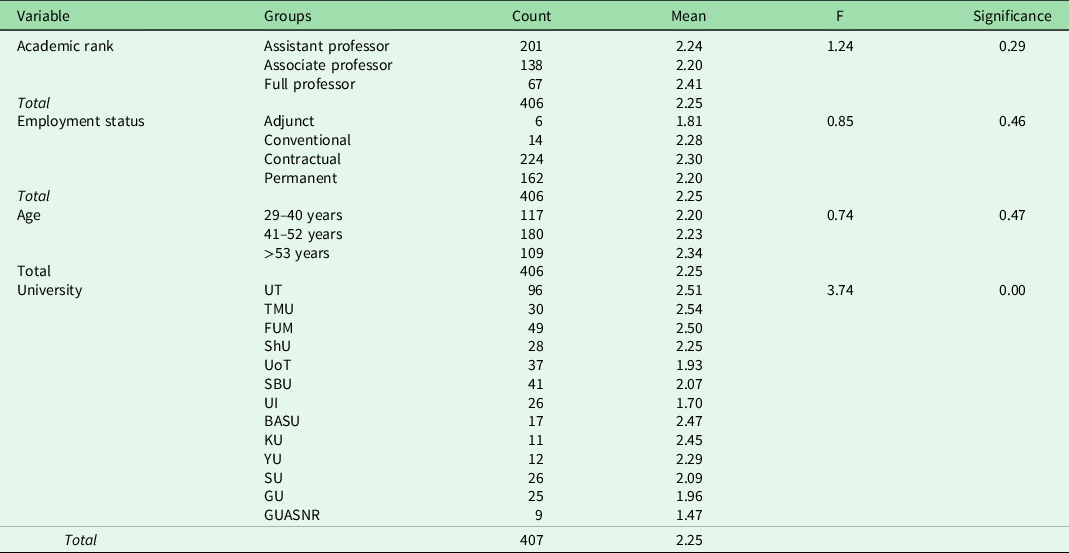
In contrast, USER did not exhibit significant variation based on professors’ academic rank, employment status or age (Table 5). However, considerable disparities in the levels of USER were observed across the participating universities.
Results of analysis of variance tests of differences among mean university social-environmental responsibility values by academic rank, employment status, age and university.

UT = University of Tehran; TMU = Tarbiat Modares University; FUM = Ferdowsi University of Mashhad; ShU = Shiraz University; UoT = University of Tabriz; SBU = Shahid Beheshti University; UI = University of Isfahan; BASU = Bu-Ali Sina University; KU = Kashan University; YU = Yasouj University; SU = Semnan University; GU = University of Guilan; GUASNR = Gorgan University of Agricultural Sciences and Natural Resources.
Qualitative analysis helped to elucidate the following 16 perceptions behind the respondents’ responses:
-
Lack of awareness and importance of environmental issues: some participants mentioned that environmental issues were not being adequately addressed in universities. Some participants highlighted the lack of emphasis on environmental concerns and the need for greater awareness and education. They emphasized that environmental issues should receive more attention at both individual and institutional levels.
-
Cultural education and academic community: several participants stressed the importance of cultural education and its positive reception within the academic community, believing that promoting a culture of environmental responsibility would be well received among university faculty and students.
-
Inadequate discussion and action: many participants mentioned that the options chosen for most of the questions were not being discussed or addressed within their universities; they expressed concerns about the lack of attention to environmental matters and suggested that more concrete actions should be taken.
-
Enforcement and regulations: some participants suggested that strict measures should be taken against those who violate environmental rights, similar to how crimes are handled through regulations and enforcement. They believed that legal measures would contribute to better environmental practices.
-
Practical impact and research: many participants expressed the hope that the research findings would lead to practical solutions and actual improvement in addressing environmental challenges. They emphasized the need for research to have a positive impact on solving complex environmental problems in the country.
-
Environmental activities and national determination: many participants highlighted the need for more genuine and consistent environmental activities. They stressed the importance of creating understanding and sensitivity to environmental issues throughout the education system, from kindergarten to university. National determination and social justice were also mentioned as prerequisites for success in environmental matters.
-
University roles and responsibilities: a few participants discussed the role of universities in environmental matters. They suggested that universities should play a significant role in environmental education, research and addressing environmental problems. Some participants mentioned that universities need to go beyond teaching and publishing articles to effectively address societal needs.
-
Challenges and financial constraints: several participants mentioned the financial constraints faced by universities, which limit their ability to implement environmental initiatives. They pointed out that while ambitions for environmental improvements exist, funding remains a challenge, especially when universities struggle with daily expenses.
-
Societal culture and mindset: participants discussed the impacts of the prevailing socio-political culture on individuals’ behaviour and actions. They noted that a deterministic and individualistic mindset affects participation, collaboration and social responsibility, leading to minimal collective engagement.
-
Media and education: some participants emphasized the role of the media, particularly television and radio, in raising awareness about environmental issues. They believed that the media could contribute significantly to universal education in this regard.
-
International examples and collaboration: a few participants referred to international examples of universities that prioritize environmental research and initiatives; collaborating with successful international models could guide improvements in Iranian universities.
-
Practical strategies and actions: several participants proposed practical strategies and actions for promoting environmental responsibility, such as a bicycle riding culture, comprehensive education, strengthening faculty engagement and adding environmental law courses.
-
Barriers and challenges: some participants identified various barriers to environmental responsibility, including cultural issues, lack of awareness, financial constraints and a focus on individual disciplines rather than interdisciplinary approaches.
-
Hope and possibility for change: despite the challenges, some participants expressed hope and belief that efforts can be undertaken to make a difference in promoting USER. They believed that with the right strategies and actions, positive change is achievable.
-
Lack of engagement and responses: a few participants suggested that some questions may not have received responses due to the absence of clear answers or engagement with those specific issues.
-
Suggestion for future research and impact: one participant recommended that the research findings should be published in the media to address the misconception that universities are solely about teaching and publishing articles. They emphasized the importance of impactful research and contributions to societal knowledge.
The participants’ responses collectively reflect a range of perspectives on environmental responsibility and the challenges and potential strategies for improvement in Iranian universities. The analysis highlights the importance of cultural education, practical actions and collaboration to address environmental issues effectively within the academic community and society at large.
Discussion
Our study illuminates a prevailing low overall score for USER among the top 13 comprehensive universities in Iran. This outcome resonates with Shafaei et al. (Reference Shafaei, Abili and Faramarzgheramoli2016, Reference Shafaei, Abili and Faramarzgheramoli2018), who exposed inadequate levels of socio-environmental responsibility at UT. The results indicate a substantial gap in environmental engagement and sustainable practices within higher education institutions. Despite their considerable resources, these universities seem to have struggled to adequately address social environmental concerns.
If these top universities, which have substantial budgets and personnel, are unable to act pro-environmentally, it is likely that the other 2566 universities in Iran are also failing in this area. Given that Iran’s environmental concerns are widespread and serious, with depleted natural resources, degraded ecosystems and an alarming water crisis (Mianabadi et al. Reference Mianabadi, Davary, Kolahi and Fisher2022), among other issues, Iranian universities’ inability to respond adequately could undermine their legitimacy in the long term. It is essential for Iran’s universities to redefine their vision, mission and strategies to prioritize their social-environmental responsibilities. This will require a significant effort on the part of universities to take steps towards sustainable practices and contribute to a more environmentally conscious society.
The themes emerging from the participants’ responses align with the identified codes. The lack of awareness of the importance of environmental issues is reflected in participants’ observations about the limited focus on environmental matters and the need for collective participation through awareness and education. This echoes the sentiment expressed by some participants regarding cultural education, which they believe is highly important and welcomed by the academic community. On the other hand, the lack of discussion and action is evident because participants emphasized the inadequate discussion of and action on environmental matters within their universities.
The limited focus on regulatory aspects demonstrates a moderately higher consideration compared to other dimensions, such as economic, organizational, educational, research, social and questioning aspects. Cultural dimensions, however, appear to be insufficiently addressed (Table 2). This pattern suggests that while universities may have some awareness of regulatory requirements, more comprehensive approaches to integrating sustainability across various facets of their operations are necessary.
Regarding regulatory aspects, its slightly higher consideration compared to other dimensions is in line with the observations from participants who suggest taking strict measures and enforcing regulations to ensure environmental rights are upheld. Additionally, the desire for practical impact and research resonates with participants’ hopes that the research findings lead to practical solutions and improvements in addressing environmental challenges in the country.
The ranking of universities in terms of the perceptions of their social-environmental responsibility from the lowest (GUASNR) to the highest (BASU) reveals variations in their approaches. The distinctions among universities signify the potential for diverse strategies and practices across institutions. Notably, FUM and UT score relatively highly in dimensions related to economic, organizational, educational and cultural aspects.
The variations in universities’ rankings are consistent with participants’ opinions about the diverse strategies and practices across institutions. The suggestion for universities to foster sustainability-orientated academic programmes and collaborate with environmental organizations aligns with participants’ recommendations for strengthening student engagement, adding environmental law courses and instilling appreciation of the environment through education.
Our analysis revealed notable distinctions in perceptions of USER based on gender. To better understand the influence of these, it is essential to consider a range of factors, including societal norms, cultural expectations and varying attitudes towards sustainability and environmental issues. Moreover, we acknowledge the potential presence of circularity in university perceptions. While our intention was to capture a diverse range of perspectives among universities, we recognize that inherent biases in self-assessment could contribute to varying perceptions among different institutions. Consequently, we must acknowledge the possibility of limitations and alternative explanations for the observed variations in perceptions among universities. In light of these considerations, our study aims to provide a comprehensive and nuanced analysis of the complexities surrounding USER.
Comparative analysis with international studies further underscores the complex interplay of socio-environmental challenges and institutional approaches. For instance, Muñoz-Rodríguez et al. (Reference Muñoz-Rodríguez, Sánchez-Carracedo, Barrón-Ruiz and Serrate-González2020) have emphasized the integration of sustainability across various degree programmes in Spanish universities, which parallels our participants’ calls for comprehensive education in this area from an elementary school level. Shin et al. (Reference Shin, Kim, Kim and Lim2018) highlighted the significance of socio-environmental factors in educational experiences, akin to our participants’ focus on fostering understanding and sensitivity to environmental issues.
The urgency for Iranian universities to enhance their environmental commitments is supported by the participants’ observations about the critical need for universities to prioritize environmental responsibility and re-evaluate their missions and strategies. Albareda-Tiana et al. (Reference Albareda-Tiana, Ruíz-Morales, Azcárate, Valderrama-Hernández, Múñoz, Filho, Salvia, Pretorius, Brandli, Manolas and Alves2020) emphasized the role of higher education institutions in implementing sustainable development goals, aligning with participants’ recommendations for universities to establish environmental programmes and guidelines.
Conclusion
There is a concerning gap in the social-environmental responsibility of Iran’s top comprehensive universities. There is a need for a significant transformation in university strategies and policies to integrate environmental considerations across various dimensions. The context-specific approaches align with the observed variations among universities and the insights from comparative research. While Iranian universities face distinctive socio-environmental challenges, international experiences provide valuable lessons.
The recommendations for universities are supported by participants’ suggestions to establish environmental programmes, involve multiple stakeholders and emphasize green practices within university environments. Implementing these changes could contribute to integrating environmental issues within universities and fostering a positive environmental impact in Iran.
The observed variations among universities and the insights from comparative research underscore the need for context-specific approaches. While Iranian universities face distinctive socio-environmental challenges, there are valuable lessons to be learned from international experiences. By prioritizing social-environmental responsibility, universities can contribute to sustainable development and inspire positive change within society.
Based on the findings of this study, we propose several recommendations to enhance USER in Iran. These recommendations should include the establishment of programmes focused on environmental sociology at various academic levels and the integration of environmental philosophy into interdisciplinary studies. There might also extend to support for environmental advocacy groups and initiatives promoting ‘green universities’, the active involvement of diverse stakeholders in decision-making processes, the creation of green spaces on campuses, the organization of nature-related camps for students and the promotion of ecotourism. Additionally, we suggest developing comprehensive environmental guidelines to optimize the usage of resources, including paper, water and energy, and to improve indoor air quality. By implementing these changes, universities could effectively contribute to the incorporation of environmental issues on campus and to the improvement of the environmental situation more widely in Iran. These recommendations underscore the importance of enhancing USER within Iranian universities, allowing them to fulfil their pivotal role as key social institutions and positively influence their surrounding communities.
Supplementary material
To view supplementary material for this article, please visit https://doi.org/10.1017/S0376892923000206.
Data availability
The datasets used and/or analysed during the current study are available from the corresponding author on request.
Acknowledgements
None.
Author contributions
The authors contributed equally to this work.
Financial support
We extend our heartfelt gratitude to the Iran National Science Foundation (INSF) for their invaluable support and funding (reference number 98006880), which has been crucial to the successful execution of this study.
Competing interests
The authors declare none.
Code availability
Available on request.
Ethical standard
None.