Introduction
It is often contended that social isolation, loneliness and the absence of a social support network are common problems of later life. Indeed, the impression is often conveyed that such problems are almost, if not entirely, exclusive to old age. A recent survey by the United States National Council on the Aging (2000) revealed that 38 per cent of those aged less than 65 years thought that loneliness was a very severe problem for older people, many more than the nine per cent of those aged 65 or more years who had this view. There are several competing theoretical perspectives on loneliness and approaches to its definition and measurement (Victor and Bond Reference Victor and Bond2007). From a sociological perspective, loneliness can be simply defined as a deficit between actual and desired levels of social contact (Victor et al. Reference Victor, Scambler, Bowling and Bond2005a), which is an inherently ‘subjective’ conceptualisation that reflects the lived experience of individuals in their social world. There are, however, many other interpretations of loneliness and no single approach to measurement can establish its objective reality. Rather, we must accept the multiple realities of the state and that there is no alternative to relativism. The meaning of loneliness lives in the individual's mind: seeking their individual, personal accounts may be the only way to its understanding. Rather than trying to determine ‘the truth’ about social relationships, researchers should therefore embrace the pluralism intrinsic to the task of understanding the social world of older people in their diverse cultural contexts.
Loneliness is widely perceived as one of the major problems of later life and an extensive literature describes its extent and risk factors (for reviews see Anderson Reference Anderson1998; De Jong Gieveld Reference De Jong Gieveld1998; Gibson Reference Gibson2001; Victor et al. Reference Victor, Scambler, Bond and Bowling2000, Reference Victor, Scambler, Bond, Bowling, Walker and Hennesey2004; Weeks Reference Weeks1994). Given its relativist nature, it is unsurprising that the reported levels vary among societies. For example, the evinced rates of loneliness in northern Europe cluster around 10 per cent, but in Greece double that rate has been reported (Walker and Maltby Reference Walker and Maltby1997). Most of the literature on loneliness in later life considers contemporary western industrial societies such as Australia, North America and Europe, and much less attention has been given to this issue in Asian countries. In a cross-national study of those aged 60 or more years in Indonesia, Sri Lanka and Thailand, Andrews and Hennink (Reference Andrews and Hennink1992) reported that respectively eight, 12 and nine per cent stated that they often felt lonely, a similar prevalence to northern Europe. This study also identified several risk factors for loneliness, such as marital status, socio-economic status, living arrangements and physical health, which also mirrored European findings. From a study of Abha City, Saudi Arabia, Abolfotouh et al. (Reference Abolfotouh, Daffallah, Khan, Khattab and Abdulmoneim2001) reported that 4.5 per cent of those aged 65 or more years were lonely, but did not distinguish between ‘loneliness’ and ‘living alone’.
Older people in China and loneliness
In 2005, the estimated population of the People's Republic of China aged 60 or more years was 140 million, 11 per cent of the total (Li Reference Li2005). Research on the components of the quality of life in old age in China is emerging, as on psychological wellbeing (Chen and Silverstein Reference Chen and Silverstein2000; Chen, Copeland and Wei Reference Chen, Copeland and Wei1999; Wu and Schimmele Reference Wu and Schimmele2006), social security (Du and Tu Reference Du, Tu and Peng2000), income (Raymo and Xie Reference Raymo and Xie2000), socio-political status (Sher Reference Sher1984), and inter-generational relations (Whyte Reference Whyte2003). Loneliness, however, has not yet attracted the attention of researchers, perhaps because it has been assumed that this negative affective state – and even social exclusion more broadly – is not problematic among older people in Asian countries. Where loneliness has been studied, it is often taken as a condition linked to depression. Chou and Chi (Reference Chou and Chi2005) studied the prevalence of depression among people aged 60 or more years in Hong Kong, and found loneliness to be a significant and independent risk factor, but did not specifically analyse loneliness. The same authors also examined the relationships between childlessness, depression and loneliness, taking the last two factors to be synonymous (Chou and Chi Reference Chou and Chi2002). Researchers in Taiwan have also studied the prevalence of depression among older people, accepting that loneliness was one ‘depressive manifestation’ (Chong et al. Reference Chong, Chen, Tsang, Yeh, Chen, Lee, Tang and Lo2001). Although it has been reported in both Chinese communities and contemporary western societies that loneliness and depression are highly correlated, the nature of the link remains unclear (Harris et al. Reference Harris, Cook, Victor, Rink, Mann, Shah, DeWilde and Beighton2003).
This paper focuses on the experience of loneliness rather than the prevalence of depression, because our interest is in the ways by which the changing social life of Chinese elders has affected their psychological wellbeing, not just their mental condition. The study of loneliness among older people in China is especially important not only because the country has the largest older population in the world but also because Chinese society has undergone dramatic social and economic changes since the late 1970s. According to the 1990 census, ‘there were 1.13 billion people living in China’, of which 63.3 million (5.6%) were aged 65 or more years (Li and Peng Reference Li, Peng, Peng and Guo2000: 64). To put this in context, in 2001 the older population of China exceeded the all-age population of the United Kingdom. Researchers of China's older people have expressed concerns about the implications of changing living arrangements (Bian, Logan and Bian Reference Bian, Logan and Bian1998; Davis-Friedman Reference Davis-Friedman1991; Whyte Reference Whyte1995; Yan Reference Yan1997). With more and more of the younger generation being able to afford separate housing, economic growth has produced an increasing number of nuclear households, as predicted four decades ago by William Goode (Reference Goode1963). There is, however, no consensus as to whether the new living arrangements will inevitably lead to the decline of support from adult children. The prevalence of the sense of loneliness among older people in China in the past can never be known, but recent surveys have made it possible to estimate the recent temporal trend – although not rigorously because successive inquiries have had different coverage and data collection methodologies (as detailed below). It is possible, however, to explore the hypothesis that socio-economic changes since the end of the 1970s have increased the prevalence of loneliness among older people in China. Furthermore, we can also investigate which risk factors are associated with loneliness among older people. Before the empirical analyses are described and reported, however, the meanings of ‘loneliness’ in Chinese society are first discussed.
The social context of loneliness in China
Soon after it came to power in 1949, the Chinese Communist Party established a high level of control in almost every domain of social and economic life. One effective mechanism was hu kou, the household registration system that assigned each person and household a residential status, either urban or rural (Kirkby Reference Kirkby and Kirby1985). The distinction was of enormous importance for most people because it determined their eligibility for a wide range of welfare provisions, including housing, childcare, subsidised food, schooling, medical services, and retirement income benefits. Furthermore, these benefits were realised and administered in urban areas by dan wei [work units], such as state enterprises, collective co-operative enterprises and government agencies. In rural areas, life was highly collectivised from the early 1960s until the economic reforms of the late 1970s, although welfare provision by no means matched that in the cities. Communes, brigades and teams were responsible not only for agricultural production but also for many other important community affairs.
Tight control and long-term employment had an unintended consequence, a high intensity of social interaction among those working in the same unit or community. Whether sitting in prolonged meetings that discussed the distribution of welfare, chatting during long lunch hours, participating in organised social activities, visiting each other during holidays, or helping each other sort out personal problems, people saw one another much more than work colleagues in normal circumstances do. The unusually stable working relations did not necessarily lead to a collegial environment, of course, but they did increase the level of social engagement among employees. The effect extended to retirees because of the long-term relationships at work and the social activities organised by local communities. It is not clear, however, whether the high intensity of social interaction acted as a shield against loneliness, because it is the meaning ascribed to interactions, not just their intensity, that influences whether loneliness is felt.
In the Han language (han yu), two characters or words are used for ‘lonely’, namely gu and du. The former has a clear negative tone, and means ‘neglected, deserted or isolated’. It is often used with another character, gua [widowed]. In the broadcast media one often hears the phrase gu gua lao ren, meaning ‘neglected and widowed old people’. The word du, however, is neutral and means ‘being alone, single and independent, or solitude’. When gu and du are collocated, the resulting phrase describes the undesirable feeling of loneliness. Because there are words that describe ‘being alone’, such as du zi [alone], du chu [living alone], and du shen [single], there is little doubt that gu du refers to a negative feeling, not an observable living situation, even though the two are closely connected.
In China until the late 1980s, loneliness was rarely reported even among people of advanced old age. Because of stable and strong family ties, it was not perceived as a problem and, in practice, the custom of mutual help and exchange among family members was reinforced by the shortage of housing and a high prevalence of three-generation households. Even after the one-child policy was implemented, most regions could not cope with the increasing number of married couples. Culturally and legally, all children are expected to provide support to their parents (Ikels Reference Ikels, Maddox and Lawton1993; Sher Reference Sher1984). Culturally, adult children were under enormous pressure among relatives and friends if they failed to show xiao [filial piety] by supporting their parents (Zhan and Montgomery Reference Zhan and Montgomery2003). The norm is that the responsibility is fulfilled financially, physically and emotionally. Legally, parents have the right to demand financial and physical support from their children (Gu and Liang Reference Gu, Liang, Bengtson, Kim, Myers and Eun2000). The cultural practices and assumptions meant that most old people had a high level of social engagement and interactions, and so were not expected to feel lonely. The older people most likely to feel lonely were those who believed that their adult children had failed to fulfil their responsibilities. The expectation of children's filial concern, especially from sons, is deeply embedded in Chinese families and society, and fear of loneliness has been a strong motive for having sons (Peng Reference Peng1989). In this context, the sense of loneliness partly expresses a fear of destitution and abandonment in old age.
The late 20th-century economic reforms and the one-child policy have fundamentally reshaped the social context in which old age is experienced. In rural areas since the late 1970s, the widely welcomed ‘household responsibility system’ quickly replaced the collectivised system, and has made each household an independent production unit. In urban areas, ‘jobs for life’ have been much reduced although they persist in a few giant state enterprises. Increased production capacity and technology have pushed millions of ‘surplus labourers’ from villages to big cities, and hundreds of thousands of young people born in urban areas have been impelled to move from one city to another to find work and money-making opportunities; all leaving their older parents in homes sometimes characterised as ‘empty nests’ (Marquand Reference Marquand2004). Many of the younger migrants have been the only child of the parents, and have no siblings who stay with them. They may send money back to improve their parents' living conditions, but this does little to ameliorate the parents' sense of loneliness. Zhenqiu Peng, a Shanghai Representative in the People's Congress, urged that ‘what the old people need, more than money, is more emotional support from their children. More calls and visits are necessary to resolve old people's loneliness’ (Wang Reference Wang2006).
It is not at present clear whether it is correct to infer from this anecdotal evidence that one by-product of China's economic development has been an increase in loneliness among older people. There has been insufficient academic research to resolve the question. Some studies have analysed depression or overall psychological wellbeing but, unlike in Taiwan and Hong Kong, none have directly examined loneliness in mainland China, and although there has been research on inter-generational support, mostly financial and material, older parents' perceptions have not been studied. The analysis reported in this paper cannot definitively conclude whether there is a rising temporal trend, but has been able to examine the forms and prevalence of loneliness among older people in mainland China, and certain associations with the country's dramatic economic growth. Our ambition is to open up an aspect of ageing and later life in China for further study.
Data on loneliness
The empirical analyses are of data from two national surveys of older people in China, the Survey of the Support System for the Elderly in China (SSSE) of 1992, and the Survey of the Aged Population in China (SAP) of 2000. There were differences in the two surveys' sampling designs and instruments for measuring loneliness, which makes direct comparisons potentially misleading and strictly false. As we shall show, however, there was considerable overlap between the two samples. The SSSE survey was conducted in February 1992 of people aged 60 or more years.Footnote 1 Multi-stage representative samples were drawn separately for rural and urban areas. The urban sample comprised 9,889 respondents and the rural sample 10,194. At the first stage, 12 provincial areas were selected: Beijing, Tianjin, Shanghai, Zhejiang, Jiangsu, Hubei, Sichuan, Guizhou, Shaanxi, Heilongjiang, Guangxi and Shanxi. In each of the first five areas, the older population (60+ years) exceeded 10 per cent of the total. Other areas were selected because they represented varying stages of economic development. Except for the first three, which are metropolitan areas, cities in the provinces were categorised by size as ‘big’, ‘medium’ and ‘small’, and one city in each category was randomly selected. Finally, in each selected area, a quota for the number of older people was based on the area's proportion of the provincial older population. Social scientists at China's Research Centre on the Aged Population (RCAP) produce the questionnaire, drew the samples and processed the results. They also provided training for the interviewers, most of whom were recruited from local agencies that provide services for older people.
Conducted in December 2000, SAP was also designed and administered by RCAP with funding provided by China's National Committee on Ageing. Not only were both surveys conducted by the same research institutions, they shared the same target population – people aged 60 or more years – and used the same stratified sampling procedure with separate urban and rural samples. The SAP sampled 10,171 in urban areas and 10,084 in rural areas, both very close to the SSSE samples. The SAP data unfortunately are not available for public use but aggregate analyses have been published (RCAP 2003). A major difference between the two surveys is that a larger number of geographical areas were surveyed in 2000 than in 1992 with almost the same sample size – the number of sampled provincial areas was increased from 12 to 20. In SAP, 10 of the 12 provincial areas covered in SSSE were retained, with Guizhou and Guangxi being dropped, while the following provinces were added: Hebei, Jilin, Anhui, Fujian, Shandong, Henan, Guangdong, Yunan, Gansu and Xinjiang. Note that Guangxi, not selected in SAP, is dominated by the Zhuang ethnic minority. The loss, however, was made up by the addition of Xinjiang, an area populated by the Uyghur ethnic minority.
Comparison of the age structures of the two samples
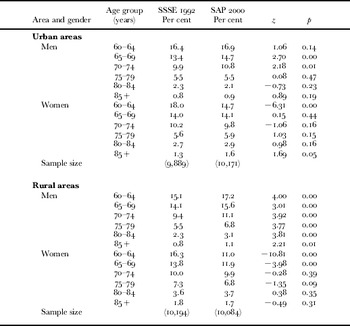
As age, gender and area of residence are all associated with loneliness, and a difference in prevalence between the two samples might be an artefact of the sample differences, the age structures by gender and in rural and urban areas have been compared for the two samples. This was done by testing a null hypothesis, that the proportions in each age-gender-area group were the same in the 1992 and 2000, by examining the significance of the z scores at the 95 per cent confidence level. The results reveal that the urban samples were more stable than those in rural areas (Table 1). In the urban samples, the proportions of males aged 65 to 74 years were significantly higher in 2000 while, in contrast, the proportions of females aged 60–64 years declined significantly; the proportions of all other sub-groups showed no significant change. The stability of the urban samples is not surprising given that Beijing, Shanghai and Tianjin were included in both surveys and constituted almost 30 per cent of the urban samples. In the rural samples, by contrast, many more of the age-group proportions changed significantly, principally through a relative increase of males and relative decrease of females in the two youngest age groups (60–69 years). The many transformations and changes in China, such as the growth of rural industries, improved medical services throughout the country, and labour migration from rural to urban areas, could easily have changed the rural-urban distribution of successive cohorts, but it would be very difficult to identify which were the most influential processes. The changed age distribution that we have observed could be a reflection of such changes or of sampling variations.
The age structures of older respondents to the SSSE and SAP, China 1992 and 2000

Notes: SSSE: Survey of the Support System for the Elderly in China 1992. SAP: Survey of the Aged Population in China 2000.
Sources: Data for 1992 were calculated from SSSE results; that for 2000 are from Research Centre on the Aged Population (2003).
Concepts and measures
Indicators of loneliness
Both SSSE and SAP were ‘portmanteau’ surveys designed to provide an overview of different aspects of the experience of population ageing in China. Whilst they were not undertaken specifically to examine loneliness, they included some indicators that enable its prevalence to be gauged and to assess the risk factors. To evaluate the appropriateness of these indicators, it is useful to understand how the concept of loneliness among older people has been operationalised in other studies. Although it is widely accepted that loneliness is conceptually ‘the deficit between the actual and desired level of social engagement’ (Victor et al. Reference Victor, Scambler, Bowling and Bond2005a: 215), beyond this broad consensus, both the theoretical meaning of ‘loneliness’ and the derived approach to measurement are contested. There have been two approaches: on the one hand, the conception of loneliness as a single phenomenon that varies in intensity and, on the other hand, its conception as having multiple social and emotional dimensions.Footnote 2
Measures of the one-dimensional concept of loneliness use single questions to establish its presence or absence, and assess intensity using Likert scales, with the required responses varying in levels of sophistication or ordinal differentiation. A key objection to the use of self-rating scales is that they require an ‘admission’ of loneliness, which among respondents may induce a moderated response that avoids compromising the sense of self-worth. Partly for this reason, most loneliness scales are ‘indirect’ in that they do not explicitly mention the condition but seek to identify the underlying constructs. The proponents of indirect scales argue that self-assessment questions result in under-estimates of the ‘true’ extent of loneliness, and that indirect measures are more appropriate because they do not require the ‘public’ declaration. The issue is not however settled. Victor et al. (Reference Victor, Grenade and Boldy2005b) argued that there is little difference in the estimated prevalence of ‘severe’ loneliness by either the method or the mode of question administration, i.e. direct interview or postal survey, although estimates of the ‘intermediate’ categories of loneliness diverge for several reasons, including the insensitivity of intermediate categories in self-rating scales and inconsistent boundaries for the ordinal categories. Survey questions about loneliness in western countries usually pre-specify the frequency response categories as ‘always’, ‘often’, ‘sometimes’ and ‘never’ (Victor et al. Reference Victor, Scambler, Bond, Bowling, Walker and Hennesey2004).
In comparison, the measures of loneliness used in the two Chinese surveys were unsophisticated. First, there was no question about the frequency of the experience. In SSSE, respondents were asked ni gan dao gu du ma? [Do you feel lonely?] and could choose ‘yes’, ‘no’ or shou bu hao [hard to say]. The loneliness question in SAP was indirect and used the same three response categories. Specifically, the respondents were asked, ‘What do you think of the following statements?’, one of which was wo chang chang gan dao gu du [I often feel lonely]. Whilst the responses ‘yes’ and ‘no’ are unambiguous, the option ‘hard to say’ is unclear. It may be interpreted by a respondent as a medium frequency of loneliness, equivalent to ‘sometimes’ in established loneliness rating scales, or interpreted as a medium strength of the sense of loneliness. Yet again, it could also indicate that the respondent did not understand what was meant by ‘loneliness’ (which in strict survey practice is a missing answer), or did not have a clear memory of any experience of loneliness (which is close to ‘not lonely’). Given these ambiguities, our analysis focuses on the clearer ‘yes’ or ‘no’ responses.
Risk factors for loneliness
As mentioned, there have been few studies of loneliness among older people in China. The analysis reported here was informed principally by the authors' understanding from previous empirical research of loneliness in Great Britain and other western countries. One British study, for example, found that besides age, gender and educational qualifications, six other independent factors made older people more vulnerable to feelings of loneliness. Of these, three described social resources, including ‘marital status’, ‘time spent alone’ and ‘increase in loneliness over the previous decade’, and three were aspects of health resources, including a high score on the General Health Questionnaire (an internationally used measure of general psychiatric morbidity), and agreement with the statements that my health is ‘worse than expected in later life’ and currently ‘poor’ (Victor et al. Reference Victor, Grenade and Boldy2005b).
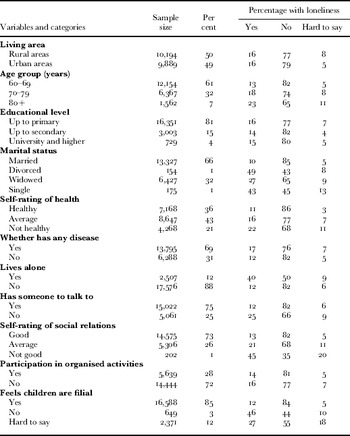
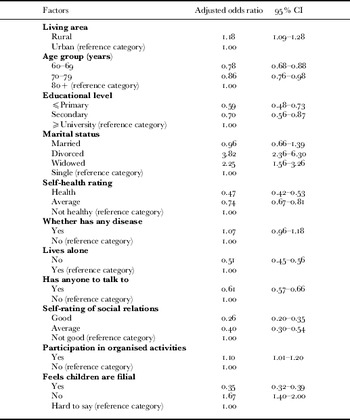
For the analysis, the two data sets for rural and urban areas were merged and a dummy variable for ‘living area’ was created (1=rural, 0=urban). Age was originally measured in single years. To make the analysis comparable with previous analyses on European countries, three age groups were coded (60–69, 70–79 and 80 or more years). The ‘level of education’ variable originally had seven categories (illiterate, primary school, middle school, high school, vocational school, college, university undergraduate and above) and was regrouped into three (primary or below, secondary, and university or above). The health variables derived from the question sequence, ‘Do you have any disease?’ and if ‘yes’, please tick any of 10 listed diseases, but there was no information about severity. As the analysis is not concerned with the effect of any specific disease on loneliness, here we consider only the effect of the presence of a disease. Living arrangements are not good indicators of loneliness but are risk factors (Victor et al. Reference Victor, Scambler, Bowling and Bond2005), so we focused on ‘living alone’ and explored its effect on loneliness. A few cultural variables in SSSE pertained to the vulnerability to a feeling of loneliness. One on social relations derived from the question, ‘Do you think you are getting along well with others? that we believe would have been interpreted as referring mainly to non-family members such as neighbours. Respondents were also asked whether they participated in any ‘organised activities’, i.e. the programmes offered by local communities and organisations (e.g. older people's activity centres and associations). Finally and of great interest, the respondents reported their feelings about ‘whether [their] children are filial’. The codes, descriptive statistics of the risk factors, and percentages of loneliness for the sub-groups are shown in Table 2.
Variable codes, descriptive statistics and percentages of loneliness

Results
Prevalence of loneliness among older people in China
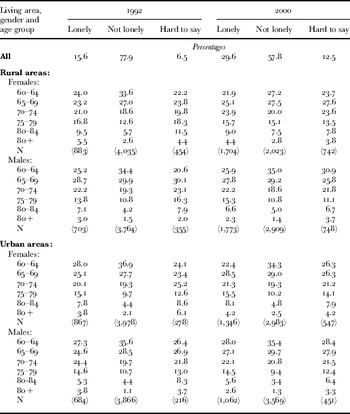
We begin by examining the prevalence of loneliness among older people in China. To reiterate, although estimates from the two surveys are presented, it is not assumed that they are comparable. Table 3 shows that 15.6 per cent of elders in 1992 and 29.6 per cent in 2000 replied ‘yes’ to the question about loneliness, whilst the percentage that answered ‘no’ was 77.9 per cent in 1992 and 57.8 per cent in 2000. This suggests that over the eight years between the surveys the percentage of older people in China that felt lonely increased substantially.Footnote 3 To establish whether the change was real or an artefact, better designed studies are needed to verify this preliminary but intriguing observation. Even if there was an increase in overall rates of loneliness between 1992 and 2000, it did not apply to all subgroups. The reported level increased among both females and males aged 65–69 years in urban areas, among females in this age group in rural areas, and also in rural areas among females aged 70–74 years and males aged 75–79 years. By contrast, among females aged 60–64 years in both rural and urban areas, the percentage reporting loneliness declined from 1992 (24% and 28% respectively) to 2000 (around 22%).
Prevalence of loneliness among older people in China, 1992 and 2000, by gender, living area and age group

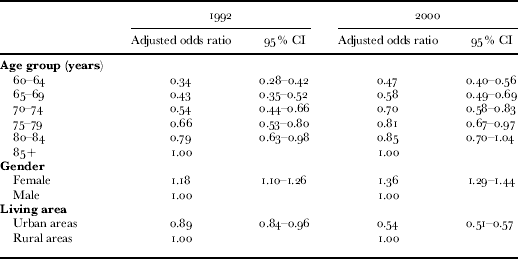
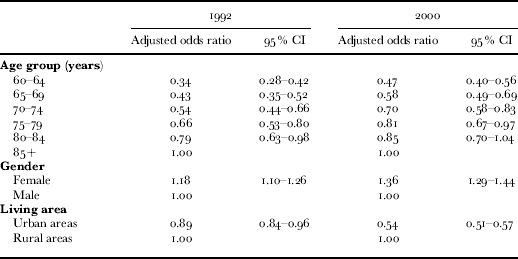
To examine the relationships of loneliness with gender, age and living area, adjusted odds ratios were calculated for 1992 and 2000 (Table 4). These odds ratios measure the correlation between each of the three independent variables and loneliness when controlling for the effects of the other two variables.Footnote 4 The results show that the likelihood of reported feelings of loneliness increased with age at both dates, that in all age groups the likelihood was higher in 2000 than in 1992, that females were more likely to report loneliness than males, and that the gender differential widened between the two dates. The odds ratio for feeling lonely among women controlling for age and living area increased from 1.18 in 1992 to 1.36 in 2000. Finally, older people living in urban areas were less likely to suffer from loneliness, especially in 2000, for the adjusted odds ratio declined from 0.89 to 0.54 over the eight years.
Relationships of loneliness with age, gender and living area, China 1992 and 2000
Note: CI confidence interval.
Prevalence of loneliness across sub-groups of the older population in China (1992)
As individual-level data from SAP were not available, further analysis was restricted to the 1992 SSSE data. Table 2 shows that the reported feelings of loneliness varied by subgroup. The most vulnerable to loneliness were: the divorced (49%), the never married (43%), those living alone (40%), those who thought their relations with others were poor (45%), and those who did not think their children were filial (46%). All point to the importance of social relations, particularly within the family, in explaining variations in the sense of loneliness among older people in China.
Risk factors for loneliness in 1992
The relationships between each of the risk factors and a feeling of loneliness are more clearly indicated by the adjusted odds ratios (i.e. with the effects of other factors being controlled), as shown in Table 5. These figures confirm that living in rural areas, an advanced age, self-reported poor health, living alone, having nobody to talk with, poor social relations, and thinking that children are not filial were all independent contributors to the reported experience of loneliness. Having a chronic disease was not statistically significant, but the respondent's self-perception of his or her poor health raised the prevalence of a feeling of loneliness. The lower an older person's educational level, the less likely that he or she reported loneliness – it is of particular interest that the odds ratio for those with no more than primary school education was originally 1.16 but decreased to 0.59 after the effects of other factors were taken into account – although the mechanisms underlying such a relationship require further investigation. The findings also provide support for an association between marital status and loneliness – those who had been married before but had lost their spouses through either divorce or widowhood were much more likely to suffer from loneliness than those who were married. Participation in any activity organised by local communities and associations had only a marginal effect on the likelihood of not feeling lonely, suggesting that these formal institutions, although welcomed and appreciated by older residents, were much less effective than good family relations in reducing the likelihood of loneliness.
Ordinal logistic regression model on loneliness among older people, China 1992

Note: CI: confidence interval.
Discussion
Limitations of the comparisons
Few studies have focused on the prevalence and risk factors of loneliness among older people in China. The SSSE, although collected more than 12 years ago, is among the very few sources of individual-level data that enable analysis of loneliness among older people in the country. There were important differences in coverage and methodology of the SSSE and SAP. The 2000 SAP measured the frequency of loneliness by using the word ‘often’, whereas the 1992 SSSE survey investigated simply the presence of loneliness. Clearly, the 1992 question referred to the feeling at the time of the interview, while the 2000 question inquired about the state over a period. The revealed differences in the prevalence of loneliness in 1992 and 2000 must be regarded as hypotheses not findings, and further study is required to establish whether the differentials are real or a function of the different survey methodologies.
The same caution should also be applied when making comparisons between the findings from China and results from Britain and elsewhere. Whilst the Chinese respondents were invited to confirm the presence (or absence) of feelings of loneliness, western country surveys have asked respondents to rate feelings of loneliness in terms of its frequency (as in Great Britain, Australia and Scandinavia), and to answer questions that make up composite scales (as in Australia and The Netherlands) (Victor et al. Reference Victor, Grenade and Boldy2005b). The absence of a time frame in the items of the Chinese surveys meant that the respondents would have concentrated on their recent experience, particularly in 1992. In other words, they reported feelings of loneliness at or close to the time of the survey.
The prevalence of loneliness
The raw estimates suggest that the prevalence of loneliness among older people in China was 15.6 per cent in 1992 and 29.6 per cent in 2000. A recent study lends some support to the hypothesis that there has been an upward trend. Using data from the third wave in 2002 of the Chinese Longitudinal Healthy Longevity Survey (CLHLS), Zhang and Liu (Reference Zhang and Liu2007) examined the effect of childlessness on older people's psychological wellbeing. The survey targeted those aged 65 or more years in 22 provinces and had a sample size of 13,447. Most relevant to our study was the inclusion of a question on loneliness, which was similar to that used in the SAP, ‘Do you often feel lonely and isolated?Footnote 5 The instrument was better designed than the SAP's because it offered four categories of responses: ‘always and often’, ‘sometimes’, ‘seldom’ and ‘never’. The percentages of the respondents that chose these categories were respectively 8.4, 24.2, 30.3 and 37.1. If the first two categories are aggregated as an approximation of positive answers in SAP, then the estimated prevalence of loneliness was 32.6 per cent in 2002, a level consistent with the estimate (29.6%) from the SAP in 2000 and with a rising trend (given that the respondents in CLHLS were aged 65 or more, rather than 60 or more years, and interviewed two years later).
Putting the possibility of a rising temporal trend to one side, the available evidence suggests that variations in loneliness among older people were broadly similar in Britain, Australia and China at the turn of the millennium: in all three countries approximately 60 per cent said that they were not lonely. It has been found that the prevalence of severe (‘always’ or ‘often’) loneliness in the UK, North America, Australia and Saudi Arabia is around seven per cent and that this has been quite stable for several decades (Victor et al. Reference Victor, Scambler, Shah, Cook, Harris, Rink and de Wilde2002). It is the intermediate categories of loneliness that vary over time and by whether self-rating or composite indicators are used. In this sense, the survey instrument used in the 2000 SAP that included the qualifier ‘often’ has ‘face level’ comparability with the measures used in Great Britain and Australia, but the revealed prevalence of severe loneliness among older people in China was much higher than in the economically more advanced countries.
Variation in the prevalence of loneliness by sub-groups
In western societies, loneliness is not equally distributed across the older population, and at the univariate level of analysis it has statistically significant relationships with several demographic, health and social factors (Victor et al. Reference Victor, Scambler, Bowling and Bond2005; De Jong Gierveld 2003), including gender (female), age (above 75 years), marital status (widowed), and living arrangement (living alone). These associations have been consistently shown over time and in different settings (e.g. Iredell et al. Reference Iredell, Grenade, Boldy, Shaw, Howat and Morrow2003). More recent multivariate statistical analyses have contested many of these relationships, however, especially the links with age, gender, household size and health factors. Both Victor et al. (Reference Victor, Scambler, Bowling and Bond2005a) and Wenger et al. (Reference Wenger, Davies, Shahtahmesebi and Scott1996) have developed multivariate statistical models of loneliness that confirmed the link with marital status and health ratings but found no support for associations with increased age, living alone and gender.
Some findings of the analysis reported here are consistent with the above findings. Among older people in China, females, those of an advanced age (85 or more years), and those without a spouse suffer from the highest levels of feeling lonely, but there are two important differences from western patterns. First, the likelihood of feeling lonely among older people in rural areas is significantly higher than among urban residents. Secondly, in western countries the relationships between loneliness among older people and socio-demographic characteristics have been found quite stable, but in China these associations appeared to intensify between 1992 and 2000.
Loneliness and social relations
By definition, loneliness is an evaluation of a shortage of desirable social relations with others. Studies of loneliness with an empirical focus in Europe, Australia and North America have usually identified the ‘social sources’ of loneliness as an unprotective marital status, the lack of confiding relationships, and much time spent alone (Victor et al. Reference Victor, Scambler, Bowling and Bond2005; Wenger et al. Reference Wenger, Davies, Shahtahmesebi and Scott1996). As the surveys in China did not include the amount of time alone, here we focus on the first two factors. It is worth pointing out that the percentage of people aged 60 or more years who lived alone in China was 0.12 per cent in 1992 and 6.6 per cent in 2000, much lower than the approximately one-in-three reported for contemporary western countries (Victor et al. Reference Victor, Scambler, Bowling and Bond2005).
A link between loneliness and widowhood has long been established in most countries. For older people in China, widowhood does have a statistically significant and independent effect in raising the likelihood of loneliness, but unlike in western countries, divorce has a much greater effect. For Chinese elders, the termination of a marriage through an untenable relationship seems to be a more powerful trigger of loneliness than the death of one's spouse. Note, however, that the prevalence of divorce among older people in China is very low: among those aged 60 or more years, in 1992 only 0.76 per cent were divorced, and in 2000 only 0.90 per cent. Being widowed is much more common (32.0% in 1992 and 35.5% in 2000). Because both divorce and widowhood are triggers of loneliness and because more than one-third of older people in China are either divorced or widowed, it is not surprising that loneliness has become common, and affects at least one-third of the Chinese older population. In short, marital status is a powerful predictor of loneliness in China.
In addition, older people's relations with their children, which have not been given much attention in western studies of loneliness, have been shown to be of great importance. The difference comes partly from the Chinese notion of filial piety. As Whyte and colleagues (2003) reported for the City of Baoding, the requirement of being filial to their parents seems to have survived the torrent of economic reforms in China. The implication for understanding the bases of loneliness in China is that, if older parents expect their children to be filial and for this to be expressed through various forms of care and respect, and if the expectation is not satisfied adequately or at all, then a sense of loneliness develops. At both univariate and multivariate levels of analysis, the belief that their children were not being filial was a statistically significant risk factor of loneliness. The SAP respondents were asked to rank their children's filiality using four ordinal categories (‘very filial’, ‘filial’, ‘fair’ and ‘not filial’). The SSSE respondents were offered only two categories (‘filial’ or ‘not filial’). It should be clear that the ‘not filial’ responses are comparable because neither survey established the degree of a negative answer. The two surveys found that the percentage of older people who thought that their children were not filial was 3.2 per cent in 1992 and 1.6 per cent in 2000. If this indicates a real trend, the figures support the conclusion of the Baoding study that filial responsibility is robust despite China's rapid economic development.
In the UK, Victor et al. (Reference Victor, Scambler, Bowling and Bond2005a) found no statistical association between loneliness and levels of social contact or proximity to children, family or friends, and suggested that the availability of a confiding relationship is more important for health and social outcomes across the lifecourse – in other words, that it is the quality rather than the quantity of social relations that shapes the chance of feeling lonely. Both SSSE and SAP were not designed to measure either the frequency of contacts between older parents and their children or their proximity to children, although both surveys asked respondents whether they had someone to talk to and, if ‘yes’, who it was. In our view, these items can be used as approximate measures of a confiding relationship. The results show that the percentage of older people in China having someone to talk to was 73.3 per cent in 1992 and 68.4 per cent in 2000, which may indicate a deterioration of the quality of older people's social relations. In addition, having such a confiding relationship significantly predicted a lower likelihood of loneliness in China in 1992 (see Table 5). That fewer older people had confiding relationships in 2000 could help explain the increase in the percentage of older people feeling lonely in that year, although further studies would be needed to confirm this hypothesis. Finally, in 1992, respondents were asked to whom they talked if they had at least one confiding relationship (the question was omitted from the 2000 survey). It turns out that the spouse was most frequently identified (47.7%) by older respondents, followed by a daughter (26.3%), a son (19.6%), and friends and neighbours (10.2%). Note that only 6.8 per cent of respondents in SSSE reported a confiding relationship with their daughter-in-law (a son's wife) and 3.1 per cent with their son-in-law (a daughter's husband). Consistent with a previous finding, this suggests a process for the effect of marital status on loneliness – divorce or the loss of spouse takes away a confiding relationship, which is crucial in reducing the vulnerability of older people to loneliness.
Conclusions
Studies of loneliness in later life and, more broadly, of social exclusion and social relationships, rarely have an explicit cross-national dimension. When such studies have been undertaken, they typically have compared western societies (Victor et al. Reference Victor, Grenade and Boldy2005b). This analysis has examined the extent of loneliness and the risk factors amongst Chinese elders using a combination of secondary analyses of existing data and evidence from published studies. It has drawn tentative comparisons with recently published data from Great Britain, Europe and Australia; these should strictly be regarded as hypotheses requiring further investigation. The results suggest that rates of loneliness, as defined inclusively, may be increasing in China in response to social and economic changes. The consistent importance of marriage across societies as a protection against loneliness has been shown. The results are intriguing and raise various topics for further research that will require, among other things, longitudinal studies of social relationships in China, the development of ‘lifecourse’ perspectives on loneliness, and measures of concepts of loneliness that are methodologically robust and meaningful in diverse social and cultural contexts.
Acknowledgements
First and foremost, we are grateful for the very helpful comments and suggestions made by the editor, Tony Warnes, and by two anonymous reviewers. Also, we would like to thank University Service Centre for China Studies at The Chinese University of Hong Kong for supplying the data collected in Survey on the Support System for the Elderly in China (1992). Keming Yang thanks the University of Reading for providing a small research fund for purchasing the dataset when he was working there.