Are all Islamic law states equally likely to use certain methods of peaceful resolution as they attempt to settle their territorial disputes?Footnote 1 Since its beginnings, international law has leaned heavily on Western, mainly European conceptions of law.Footnote 2 International forums for peaceful resolution of disputes, such as negotiations, mediation, or adjudication have been no exception. Islamic law states, for the most part, did not participate in the creation of rules underlying international settlement venues. Consequently, these venues' institutional features differ considerably from faith-based Islamic law. In fact, some scholars argue that public international law and Islamic international law constitute completely divergent legal systems.Footnote 3 As a result, the argument goes, Islamic law states are unlikely to support Westernized international institutions, turning instead to Islam-based venues for resolution, such as the Organisation of Islamic Cooperation.Footnote 4
Such a grim outlook on the relationship between international law and Islamic law states could arguably constitute an important impediment in the settlement of territorial disputes—the most salient of all interstate disputes.Footnote 5 Peacefully resolving disputes over territory constitutes an important goal for the international community as issues of sovereignty continue to cause friction between states, and many of these conflicts remain unresolved.Footnote 6 Territorial disputes involving Islamic law states have been no exception.
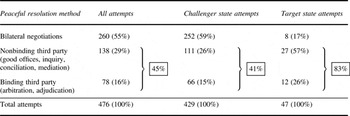
Although there is some evidence that the differences between Westernized international law and Islamic law may drive Islamic law states away from international settlement venues, the descriptive evidence reveals interesting patterns. According to data displayed in Table 1, 45 percent of Islamic law states' attempts at peaceful resolution of territorial disputes in the postwar era (1945–2006) have involved a third party. Moreover, in almost one-third of the cases (29 percent), an Islamic law state resorted to nonbinding third-party methods—such as mediation or conciliation, and 16 percent of cases are attempts at most legalized resolution venues—arbitration and adjudication. Similar patterns hold for Islamic law challenger states, and become even more conspicuous for target states.Footnote 7 Importantly, contrary to some accounts, Islamic law states seek third-party-mediated resolution of territorial disputes more frequently than states representing Western legal traditions.Footnote 8 Thus, Islamic law states' preferences lean toward international nonbinding resolution venues at a higher rate than that prevailing among the Western legal tradition states. It seems puzzling, however, that a considerable number of Islamic law states' attempts at peaceful resolution involve binding approaches thought to be more amenable to Western legal tradition states. Additionally, several Islamic law states that have attempted nonbinding third-party methods, such as Yemen, embrace traditional Islamic precepts, which at first glance may seem contrary to international law. Similarly, although used less frequently, binding third-party methods are repeatedly proposed by relatively traditional Islamic law states, such as Pakistan or Qatar.
Islamic law states' peaceful resolution attempts in territorial disputes, 1945–2006

This article seeks to both demonstrate and explain these patterns by analyzing variation in domestic laws among Islamic law states. I argue that specific characteristics of Islamic domestic legal institutions shape these states' choices of peaceful resolution venues in territorial disputes. What factors can explain why some Islamic law states, despite the differences between international and Islamic law, choose resolution methods that heavily rely on international law, such as arbitration and adjudication? Why are other Islamic law states drawn to nonbinding third-party methods? After providing original data on the characteristics of Islamic legal structures, I systematically compare pertinent rules of international dispute resolution methods and Islamic law, focusing on similarities and differences between them. I demonstrate empirically that secular legal features embedded into an Islamic domestic legal system have the power to attract these states to arbitration and adjudication. On the other hand, Islamic law states that embed holy oaths in their constitutions, which signifies their commitment to sharia, prefer negotiations and nonbinding third-party methods.
Given the scope and intensity of conflict in the Islamic world, the issue of the relationship between Islamic law states and peaceful resolution of territorial disputes is timely and important. Understanding these states' attitudes toward international settlement venues is crucial in light of the proliferation of international courts, and the fact that international institutions have been criticized as being unreceptive to Islamic legal principles.Footnote 9 This article constitutes, to my knowledge, the first attempt in the English language to investigate empirically whether the similarities and differences between Islamic and international law play a significant role in shaping Islamic law states' attitudes toward international settlement venues. In the international relations scholarship, there is a deficiency of empirical studies focusing specifically on Islamic law states' view of settlement venues. Most of the existing literature addresses Islamic law in the context of its historical development or its implementation in specific countries, focusing on normative description.Footnote 10 There is also abundant research on peaceful settlement venues in general and on specific international courts.Footnote 11 Yet there is a gap between the general international dispute settlement literature and the scholarship on Islamic law states. Even the few studies that include Islamic law states in quantitative analyses disregard important differences that exist within the Islamic legal family, such as the degree of interconnectivity between law and religion.Footnote 12 Failure to look within the Islamic legal tradition may have skewed scholars' understanding of these states' choices of peaceful resolution venues. The purpose of this study is to introduce variation within the Islamic law tradition, and to demonstrate empirically that depending on domestic legal institutions, Islamic law states are drawn to different settlement venues when attempting to resolve their territorial disputes.
Islamic Law and Peaceful Resolution Methods
The principle of peaceful settlement of international disputes, as outlined in the United Nations Charter, has been established to prohibit self-help in interstate dispute resolution, and constitutes a pinnacle of international relations.Footnote 13 All means of peaceful settlement, including negotiations, good offices, inquiry, conciliation, mediation, arbitration, and adjudication, are fully embraced by international law and organizations. In particular, the international community has placed a heavy emphasis on peaceful resolution in the context of territorial disputes, known for their gravity, duration, and likelihood of escalation.Footnote 14 International relations scholars have followed suit by recognizing that focusing on territorial dispute resolution is indeed crucial.
Peaceful settlement rests fundamentally on states' consent, and disputants are at liberty to choose any method of settlement. In negotiations, states attempt to settle their grievances without third-party involvement and retain the highest level of control over the dispute. Resolution venues involving third parties entail many more rules/procedures. There are two broad types of third-party settlement—nonbinding and binding. In nonbinding methods such as conciliation or mediation, after a decision is rendered, the parties have the option to reject the settlement proposal. Additionally, states may select the third party, which allows them to retain some share of control over the dispute.Footnote 15 Arbitration and adjudication constitute the most formal, binding third-party methods. Both entail binding decisions rendered in accordance with international law, with disputants agreeing in advance to accept the award or judgment.Footnote 16 These formal methods generate an expectation on the part of the international community that the disputants will abide by the third party's decision.Footnote 17
The literature shows that the potential costs of territorial dispute settlement encourage states to be strategic in their venue selection.Footnote 18 The delegation of disputes to an outside agent, inherent in third-party methods, is tainted by uncertainty about international norms and about the behavior of other states. Several scholars argue that to increase the predictability of final settlement, states use resolution venues that resemble their domestic legal institutions.Footnote 19 Arguably, the Western-based design of settlement venues considerably increases Islamic law states' uncertainty when they attempt to settle their territorial disputes. Since these states have not participated in the creation of peaceful resolution venues, they have been unable to embed elements of Islamic law into these international legal mechanisms.
Uncertainty no doubt plays an important role in the context of interstate peaceful resolution. However, in the particular case of Islamic law states, there is another factor that fundamentally shapes these states' venue choices: the nature of social interaction in dispute resolution. To Islamic law states, the most preferred form of social interaction in the international sphere is characterized by two distinct features: nonconfrontational modes of dispute settlement and Islamic religious principles in the resolution process. International nonbinding third-party venues such as mediation and conciliation allow Islamic law states to fulfil their preferences regarding the nature of social interaction by engaging in a brotherly solution approach to settlement and by enabling direct reference to sharia in dispute resolution.Footnote 20
Nonconfrontational Dispute Settlement
Islam “emphasizes that moral relations between nations ought to be the rule” and calls for peaceful resolution of interstate disputes.Footnote 21 At the same time, however, Islamic law replaces Western-style formal approaches to conflict resolution with apology and reconciliation. Reminiscent of nonbinding third-party methods, sulh—a simple, nonformal settlement between the disputants with help from a third party—was the Prophet Muhammad's favored method of dispute resolution.Footnote 22 In fact, schools of Islamic jurisprudence teach that amicable settlement without the use of formal adjudication constitutes an ethically and religiously superior method of seeking justice.Footnote 23 Generally speaking, “the preferred ‘third party’ in the Arab-Islamic approach is an unbiased insider with ongoing connections to the major disputants as well as a strong sense of the common good and standing within the community.”Footnote 24 Traditional Islamic law incorporates brotherly settlement into arbitration and adjudication. Islamic scholarship typically interprets arbitration as a form of conciliation—a nonbinding settlement venue.Footnote 25 This stands in contrast with international law, where decisions of arbitral panels have a binding force, similar to that of a court's judgment. As one international scholar noted, “international arbitration is like going to the court, but a different court.”Footnote 26 Adjudication is relatively informal in traditional Islamic law. The major role of a qadi, a judge, is to guide the parties in the process of finding common ground. During in-court proceedings, reconciliation is given utmost priority to eradicate any source of disagreements between the Muslim brethren. According to Islamic faith, formal adjudication may “breed hatred between parties while reconciliation brings them together.”Footnote 27
Characteristics of international nonbinding third-party methods, especially their informal character and the disputants' ability to choose the third party, make them attractive to Islamic law states. These methods, reminiscent of Islamic sulh, promote reconciliation through flexible out-of-court procedures, and enable Islamic law states to fulfill their preferences regarding the nature of social interaction.Footnote 28 The disputants may phrase a just solution in less-legalized terms, such as reparations or the restoration of friendly interstate relationships.Footnote 29 Additionally, the Islamic community may be engaged in the resolution process via the appointment of an Islamic mediator or conciliator.Footnote 30 Arbitration and adjudication, on the other hand, reflect the more confrontational Western approach to conflict resolution. A just outcome in these venues is equated with legal rights, and a winner-loser dichotomy.
Incorporation of Islamic Religious Precepts in Dispute Settlement
Islamic faith is intrinsic to Islamic law, and the two cannot be separated.Footnote 31 This relationship is also present in Islamic international law, or siyar: “Muslim jurists view the Islamic law of nations as derived from the eternal truth and justice that God had bequeathed to humanity through His messenger.”Footnote 32 All sources of Islamic law, including the Koran and the Sunna, are closely connected to the Islamic faith.Footnote 33 Under strict Islamic principles, a Muslim may not be judged by non-Muslim judges.Footnote 34 Closely linked to this issue is the status of women in the judiciary. Several Islamic scholars are of the view that a woman cannot serve as a qadi, an Islamic judge. The basis for such exclusion, although disputed by some Islamic schools, comes from hadiths that forbid women from being in charge of Muslim public affairs.Footnote 35 This stands in sharp contrast to Western-based international law, which relies on a clear distinction between law and religion.Footnote 36 International adjudicators are not to judge based on morals or religion. Sources of international law, such as international conventions or custom, are secular in nature. The law contains no provisions regarding the religious affiliation or gender of judges, arbiters, or mediators.
Among peaceful resolution venues, negotiations and nonbinding third-party methods provide venues where Islamic religious norms could be incorporated. They allow Islamic law states to mitigate, if not altogether avoid, the unwanted influence of “Westernized” international law. Binding third-party methods, on the other hand, adhere closely to international law, are the most formal, and are unlikely to consider Islamic faith as a basis for settlement. For example, only in a marginal number of cases has the International Court of Justice (ICJ) included a meaningful discussion of Islamic law in its judgment.Footnote 37 Additionally, when international adjudicators refer to Islamic law, they face “vehement criticism” on the part of international legal scholarship.Footnote 38 This fact may be troublesome to Islamic law states which, upon attempting to settle their territorial disputes via the ICJ, must accept the court's existing nonnegotiable procedures.Footnote 39
The clash between Islamic and international law is particularly apparent in the context of territorial disputes because Islamic notions of land ownership and sovereignty are religious in nature.Footnote 40 According to Islamic law, God owns the land, whereas the state is supposed to administer it “efficiently and fairly, in accordance with God's laws and ethical and moral principles.”Footnote 41 Territory constitutes a sacred trust for states, tribes, and individuals. Sovereignty is not absolute but conditional.Footnote 42 Islamic religious notions of partial sovereignty and land stewardship deeply modify the Western zero-sum framework used to understand states' motivations in territorial disputes. For example, according to Islamic law all fertile land that falls within Islamic control via conquest constitutes “communal property owned by all Muslims.”Footnote 43 Natural resources, closely connected to territorial disputes, are to be used for the advantage of the Islamic community as well. Both these principles soften the winner/loser dichotomy present in international courts addressing issues of sovereignty. The direct contradiction between Islamic and Western interpretations of sovereignty became apparent when the ICJ issued the Western Sahara Advisory Opinion. Footnote 44 In its argumentation, Morocco argued that the Western Sahara peoples' religious allegiance to the Moroccan Sultan equated with territorial sovereignty. The ICJ in its opinion adhered to territorial ties-based Western understanding of sovereignty by declaring that an allegiance to a ruler, if it is to be equated to sovereignty, “must clearly be real and manifested in acts evidencing acceptance of his political authority.”Footnote 45
While theorizing about Islamic law states' preferences regarding international settlement venues, an important caveat warrants further discussion. How does the Islamic philosophy of reconciliation and brotherly settlement “scale up” to the state level? In other words, is there a theoretical link between individual-level Islamic rules and state-level rules of behavior? Generally, Islam and Islamic law continue to play a crucial role “in the cultural, political and legal affairs of many Muslim states and societies.”Footnote 46 Islamic international law, syiar, and domestic law draw from the same legal sources—the Koran and the Sunna, and there is no separation between these two legal domains.Footnote 47 Such an approach, inherent in Islam's foundational sources as well as Islamic scholarship, effectively causes individual-level rules to be applied to collectivities such as tribes or states.Footnote 48 Rules regarding peace, justice, and the resolution of disputes “should dictate relationships between human beings in general, whether individually or collectively.”Footnote 49 Another example of the application of individual-level rules to states' actions deals with a jurisprudential rule stemming from the Koran: “And Allah will by no means give the unbelievers a way against the believers.”Footnote 50 According to Muslim jurists, based on this verse the domination of infidels over Muslims in any area, including adjudication, is prohibited. Since a judge holds authority over the disputants, a Muslim person or legal entity (such as an Islamic law state) should not refer to a non-Muslim judge. This Koranic rule “can be considered as the reason that Islamic governments often refuse to go to the international courts, whose judges are usually not Muslim.”Footnote 51
Furthermore, the Koran and the Sunna directly regulate dispute resolution among collectivities such as tribes or states. For example, the Koran states that “If two groups of believers come to fight one another, promote peace between them.”Footnote 52 In the context of territorial disputes, Islamic law states have repeatedly used Koranic rules of land ownership to establish their sovereignty over territory. The ICJ Western Sahara and the Libya-Chad dispute constitute the most vivid examples. In these cases, the disputants resorted not only to collectivity-level Koranic verses referring to tribes, but also individual-level rules regarding land possession.Footnote 53
The level of direct incorporation of sharia in the official legal system varies across Islamic law states as well as over time. Some states, such as Morocco, limit the influence of sharia to laws of personal status, such as family and inheritance laws. In other countries, including Saudi Arabia or Iran, sharia is applied directly to state law, such as criminal or commercial law, making the influence of traditional Islamic legal principles much deeper. I argue that Islamic law states whose legal system remains closely tied to the Islamic faith are drawn to nonbinding third-party methods. These venues enable Islamic law states to fulfill their preferences regarding the nature of social interaction by engaging in a brotherly solution approach to settlement and by permitting direct reliance on Islamic religious norms in the resolution process. At the same time, such states are uncomfortable with arbitration/adjudication, which rely heavily on international law and are unlikely to use sharia as a basis for settlement. On the other hand, Islamic law states whose legal systems embrace rules comparable with these of international law should be more accepting of binding third-party methods. Based on my theory, I propose the following hypotheses:
H1
Islamic law states whose domestic laws embrace traditional sharia principles are more likely than other Islamic law states to resort to nonbinding third-party methods in attempting to settle their territorial disputes.
H2
Islamic law states whose domestic laws incorporate principles similar to international law are more likely than other Islamic law states to resort to binding third-party methods in attempting to settle their territorial disputes.
Research Design
To evaluate these hypotheses empirically, I analyze data from 1945 to 2006 on Islamic law states' attempts at peaceful resolution in territorial disputes. The unit of analysis is an attempt made by an Islamic challenger or target state to peacefully resolve a territorial dispute in any given dyad year. Footnote 54 Attempts at peaceful settlement include calls for bilateral negotiations, good offices, conciliation, mediation by a third party, or an attempt at arbitration or adjudication by an international court or an arbitration panel. These data capture attempts or proposals to resolve a territorial dispute, and not whether the attempt was successful in ending a dispute. As such, I am able to capture the dynamics of the target's or challenger's preferences over time, and provide a much larger number of observations compared with actual dispute settlements.Footnote 55
Usually within one dispute, disputants subsequently propose various venues. For example, during the Bahrain-Qatar dispute, over the time span of thirty years each state attempted different methods: Qatar (the challenger), proposed negotiations, nonbinding third-party methods, and finally adjudication. Bahrain (the target) attempted negotiations, and also several third-party venues. The disputants eventually resorted to ICJ adjudication. My data capture all of these attempts instead of coding just the final settlement (adjudication), and reflect the distinct preferences of each party in any given year. Measuring changes in states' preferences over time is particularly important in long-lasting territorial disputes, as well as when disputants' domestic laws change. During 1945–2006, there were a total of 476 attempts by Islamic law states at peaceful resolution, with 429 challenger attempts, and 47 target attempts (Table 1). Negotiations were proposed most often (260), followed by nonbinding third-party methods (138), and binding methods (78). Challengers prefer negotiations (59 percent), whereas targets prefer nonbinding third-party venues (57 percent).
The dependent variable, the method of peaceful resolution attempted by the challenger or the target, has the following categories: (1) bilateral negotiations, (2) nonbinding third-party methods (inquiry, good offices, conciliation, mediation) and (3) binding third-party methods (arbitration, adjudication).Footnote 56 However, because this project deals exclusively with Islamic law states, I use only attempts made by Islamic law challenger or target states, regardless of the legal system of the other disputant.Footnote 57 Thus, attempts made by both parties in the Bahrain-Qatar dispute as well as attempts by Morocco in the Morocco-France dispute appear in the data.
I define an Islamic law state as one with a substantial part of their official legal system directly based on the Koran.Footnote 58 In other words, states that officially and directly apply sharia to a substantial part of personal, civil, commercial, or criminal law are considered Islamic law states. In a few countries, such as Turkey, the official legal system is not considered Islamic despite the fact that Muslims make up a substantial portion of the population. My categorization of Islamic law states is based on the substantive content of the official legal system, not on the composition of the population.Footnote 59 I base my coding on Powell and Mitchell's categorization of Islamic law states, as well as other subsidiary sources.Footnote 60 As a result, twenty-six Islamic law states are included in the data.Footnote 61
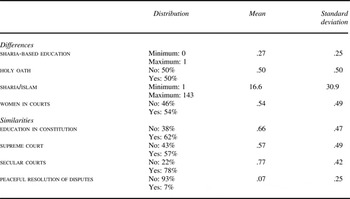
To capture past and contemporaneous characteristics of Islamic law states' domestic legal systems, I gathered my own data using the following sources: Jan Otto's Sharia Incorporated, the 2010 Central Intelligence Agency (CIA) World Factbook, official Islamic law states' constitutions, constitutional amendments, codes, statutes, other legal documents, and news articles about Islamic law states from Lexis-Nexis, JSTOR, the Telegraph, and other periodicals.Footnote 62 I also conducted several in-depth interviews with scholars and practitioners of Islamic law and international law.Footnote 63 Existing scholarship has thus far overlooked the variation within the Islamic legal tradition, treating all Islamic law states as belonging to one, homogeneous category.Footnote 64 My new data set, which captures the diversity of Islamic legal institutions (cross-sectional and temporal), remedies this empirical shortcoming. To test my hypotheses dealing with the similarities and differences between international and Islamic legal systems, I coded two sets of independent variables—the first deals with differences, and the second with similarities. Table 2 presents descriptive statistics regarding Islamic legal characteristics.
Characteristics of Islamic law, descriptive statistics

Note: These statistics pertain to state-years in the data set.
The first set includes sharia-based education, holy oath, sharia/islam, and women in courts—variables that measure the depth of commitment to traditional sharia principles. The first three variables capture the presence of certain provisions in Islamic law states' constitutions. In constructing these variables, I coded information from seventy-two constitutional acts, and ninety-five major amendments. Entries for these variables in state-years when there was no constitution are coded 0. The sharia-based education variable is constructed by dividing the number of Islamic/sharia education constitutional mentions by the number of all constitutional education mentions (education, secular education, religious education, etc.). Thus, this variable constitutes a 0 to 1 scale with higher scores indicating the relative frequency of Islamic/sharia education references in comparison with other education references.Footnote 65 In my data, Islamic/sharia education mentions constitute 40 percent of all education constitutional provisions. For example, the Qatari 1972 constitution mentioned the word “education” five times, “religious education” three times, and “Islamic/sharia” education twice.Footnote 66
Incorporation of sharia-based principles into the educational system constitutes an expression of a state's profound commitment to traditional Islamic precepts, and its determination to pass Islamic principles to the next generation.Footnote 67 Historically, it was a commonplace for Islamic law states to officially base their education on Islamic principles. For example, article 22 of Afghanistan's 1931 constitution stipulated: “In order to make sure that all educational institutions conduct their programs in accordance with Islamic principles, all educational institutions shall be monitored and inspected by the Afghanistan Islamic government.” Saudi Arabia's 1992 Basic Law of Governance mentions Islamic education directly in article 13: “The aim of education is to implant the Islamic Creed in the hearts of all youths.” Adherence to Islamic religious principles and the preservation of the kingdom constitute the most important pillars of education.Footnote 68
The dichotomous variable holy oath captures whether a state's constitution mentions a religious oath that is to be taken by public officials. Several constitutions require such oaths from the executive (the Algerian president, Tunisian advisors and deputies), the judiciary (Afghan Supreme Court judges), or the legislature (the Yemeni House of Representatives). The sharia/islam count variable codes the number of times that sharia and/or Islam are mentioned in a constitution, and ranges from 1 (1958 Iraqi constitution, 1963 Malaysian constitution) to 208 (1979 Iranian constitution). I expect that states with constitutions that incorporate holy oaths, repeatedly mention sharia/Islam and Islamic education, or states where women cannot serve as judges are attracted to nonbinding third-party methods. At the same time, such states should be unlikely to attempt adjudication/arbitration. The women in courts dichotomous variable captures whether women are allowed to serve as judges in either sharia courts or secular courts. In some states, such as Syria, women may be appointed to only secular courts that hear criminal and civil matters. At the same time, judicial positions in personal status courts or special courts that apply religious law are reserved for men only.Footnote 69 In slightly more than one-half of my observations, women can serve as judges (Table 2).
The second set of variables, designed to capture similarities between international and Islamic law, includes: education in constitution, supreme court, secular courts, and peaceful resolution of disputes. In my data, a total of 62 percent of constitution-years directly mention education/schools at least one time. Not surprisingly, the percentage of Islamic law states' constitutions that mention education has increased over time rising from 21 percent in the 1950s to 100 percent in the 2000s, reflecting the general trend in the West to include the right to education in constitutions.Footnote 70 The supreme court dichotomous variable captures whether a constitution mentions a supreme/high/cassation court. Examples include the Higher Council of Justice in the 1992 Saudi Arabian constitution, or the Supreme Court described in the 1963 or 2004 constitutions of Afghanistan. In my data, the majority of constitutions contain such provisions (57 percent). The secular courts variable is coded 1 if a mainstream secular court system exists during a particular state-year, and 0 otherwise (if it does not exist, its role is marginal, or it is limited to very specialized jurisdiction). In some states, religious courts function side by side a secular court system. For example, during 1964–79 in Afghanistan a dual court system was established, consisting of separate secular and religious courts with clearly delineated jurisdictions. On the other end of spectrum is, for example, Libya where the 1973 Act on the Unification of the Courts explicitly reestablished the unitary system functioning earlier in its history. A definite majority of Islamic law states have a secular court system (78 percent). Finally, the peaceful resolution of disputes variable codes whether a constitution refers to the peaceful settlement of international disputes. Only a small minority of Islamic constitutions contain such provisions (7 percent), such as article 24 of the 1956 constitution of Afghanistan: “The State shall endeavour to strengthen the bonds of unity among Muslim countries, to promote international peace and security, to foster goodwill and friendly relations among all nations, and to encourage the settlement of international disputes by peaceful means.”
In addition to these variables of interest, I considered several control variables. The treaty commitments variable accounts for the number of pacific settlement treaties, of which both disputants are members in the same year. I obtained this variable from the Multilateral Treaties of Pacific Settlement Data Set—Issue Correlates of War (ICOW) Project.Footnote 71 Scholarship suggests that membership in such organizations/treaties increases a state's support for international courts.Footnote 72 I control for specific characteristics of the disputed territory: ethnic value, economic value, and strategic value, since salience of the contested land affects states' choices of resolution venues.Footnote 73 Disputed territory has strategic value if it is located at or near military bases, major shipping lanes, or choke points for ships. Economically valuable territory is located at or near a significant amount of natural resources such as fishing grounds, oil, iron, copper, or diamonds, and ethnic value exists if there are ethnic minorities living on the other side of the border. These dichotomous variables are coded 1 if the land has a particular value for both disputants, and 0 otherwise. Findings regarding the value of disputed territory are somewhat mixed. For example, Gent and Shannon demonstrate that as the territory's salience increases, nonbinding third-party resolution methods are less likely to occur.Footnote 74 On the other hand, Mitchell, Kadera, and Crescenzi find that higher salience levels make third-party resolution methods more likely.Footnote 75
The variable capabilities accounts for the expectation in the literature that states equal in power should be more likely to choose third-party methods.Footnote 76 This variable is measured using the Correlates of War's National Capabilities Index, dividing the larger of the two military capabilities' scores by the sum of the two.Footnote 77 A resulting score of .5 indicates perfect parity whereas a value of 1.0 indicates asymmetry. The democratic dyad variable captures whether the disputants share Polity IV democracy scores in any given dyad-year, coded 1 if both states score 6 or higher.Footnote 78 This variable controls for the influence of regime type on states' choices of resolution venues. Some scholars argue that democracies should be more supportive of international courts,Footnote 79 whereas others present contrary evidence.Footnote 80 Finally, the past fight dichotomous variable, constructed using the Correlates of War data set, captures whether a dyad has fought an armed conflict related to the dispute in the past fifty years.Footnote 81
Empirical Analysis
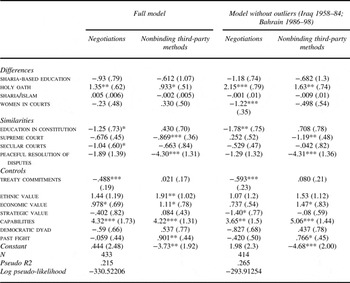
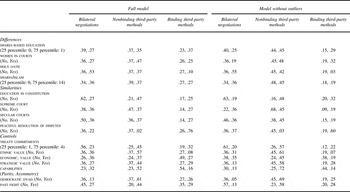
To test my hypotheses, I estimate two multinomial logit models. Recall that the dependent variable, a disputant's attempt at a settlement venue, consists of three categories: bilateral negotiations, nonbinding third-party methods, and binding third-party methods. The models' estimates presented in Table 3 are followed by substantive effects in Table 4.Footnote 82 Binding third-party methods constitute the base outcome, thus the estimates in Table 3 are a comparison between negotiations (columns 1 and 3) or nonbinding third-party methods (columns 2 and 4) with arbitration/adjudication. I cluster all analyses on country to account for the lack of independence among observations. Both tables present two models: a full model, estimated on all observations, and a model without outliers. Iraq (1958–84) and Bahrain (1986–98) constitute the most important outliers in the model.
Multinomial regression—methods of peaceful resolution of territorial disputes

Notes: Binding third-party methods is the base outcome. Clustered standard errors in parentheses. * p < .10; ** p < .05; *** p < .01.
Substantive effects: Methods of peaceful resolution of territorial disputes

Note: Values are calculated using Clarify Version 2.0 (King, Tomz, and Wittenberg Reference King, Tomz and Wittenberg2000).
In the case of Iraq, the model predicts nonbinding third-party venues as the expected course of action, but in reality attempts at negotiations took place. This discrepancy can be explained by important political changes in Iraq during this period. In 1958, the monarchy was overthrown by a military coup d’état and Iraq was proclaimed a republic. In 1968 the Ba'ath government assumed power, which eventually led to Saddam Hussein's reign and Iraq's attempts to become the dominant Persian Gulf state. Iraq's 1964 and 1970 interim constitutions were deeply ingrained with Islamic principles, repeatedly referring to sharia/Islam. Public officials were required to take holy oaths.Footnote 83 Although Iraq attempted negotiations in its dispute with Kuwait, there were also several attempts at nonbinding third-party methods, especially mediation by Islamic parties including the Arab League, or the King of Jordan. Interestingly, attempts at nonbinding third-party venues were often invoked during Iraq's dispute with Iran. In this case, Islamic third parties, such as the Islamic Conference Organization, were also called upon. It seems that Iraq's intermittent preference for negotiations during the dispute with Kuwait reflects the country's concurrent aim to become the dominant Persian Gulf state. This periodic desire to become a regional power prevented Iraq from engaging consistently in nonbinding third-party methods and instead turning to direct negotiations, contrary to the model's expectations. In sum, throughout this period, Iraq was vacillating between pursuing regional hegemony and incorporating a traditional Islamic, third-party-led approach to dispute resolution.
In the context of Bahrain (1986–98) and its dispute with Qatar,Footnote 84 the model predicts attempts at nonbinding third-party methods and negotiations, although in reality disputants resorted to adjudication. It is worth noting that this is the only Islamic law dyad that ever attempted to use adjudication in a territorial dispute. This case lasted eleven years, making it the longest case in the ICJ's history. Interestingly, several Islamic law states, especially Saudi Arabia, were skeptical about Qatar's decision to use the ICJ in the 1990s, preferring mediation by Saudi Arabia or the Gulf Cooperation Council. Sheikh Khalifah bin Salman al-Khalifah, Bahrain's cabinet chairman, also favored Saudi mediation, suggesting that “a brotherly solution was best, particularly between brothers,”Footnote 85 though Bahrain eventually agreed to use the ICJ. However, the disputants jointly agreed to adjudication only after informal reconciliation efforts in the late 1980s and the 1990s failed to provide a solution. Actually, in the words of one international advocate, the most contentious territorial dispute where the ICJ was called on precisely because earlier attempts at mediation had failed was the Bahrain-Qatar dispute.Footnote 86 Even after the ICJ's jurisdiction for the case was settled, Bahrain continued to insist that “the Saudi mediation still stands, and we hope that it will secure a solution to the problem.”Footnote 87 This case also illustrates how disputants who hope to reduce uncertainty and tip the scales of justice their way sometimes resort to questionable methods. During the dispute, Qatar introduced into the case “a number of documents that were found to be forgeries.”Footnote 88
In contrast to these outliers, the dispute between Saudi Arabia and Jordan seems to best fit the empirical model. During this border conflict, Saudi Arabia continued to attempt negotiations, which eventually resulted in agreement in 1965 with both sides conceding some territory. Attempts at negotiations squarely fit the model's predictions and reflect Saudi Arabia's general preference of resolution venues. In fact, the only time that this country has ever participated in any aspect of the ICJ's proceedings was when the Saudi ambassador gave a speech at the court in 2004 regarding the construction of a security wall by Israel.Footnote 89 Additionally, during a 2013 meeting with the ICJ president, Prince Bandar bin Salman bin Mohammed mentioned training courses in Islamic law intended for judges inside and outside the kingdom as offered by the Saudi Custodian of the Two Holy Mosques, should the court be interested.Footnote 90 This is a definite indication of Saudi apprehension toward any international court, whose judges either do not understand or choose to repeatedly ignore Islamic law.
The empirical results indicate that the similarities between Islamic and international law seem to matter more than the differences. In support of H2, secular features embedded into an Islamic legal system have the power to attract these states to arbitration/adjudication. Reflective of Western design, constitutional mentions of education are positively associated with the likelihood of binding methods when compared with negotiations. Increase in predicted probability of binding venues (from .17 to .25) is accompanied by a substantial decrease in the likelihood of bilateral talks. Similarly, Islamic law states whose constitutions mention a highest/supreme court are drawn toward binding methods. In fact, the predicted probability of resorting to arbitration/adjudication is relatively high for such states (.27), almost twice as high as for states whose constitutions lack such reference. The increase in the probability of binding methods is associated with a decrease in the likelihood of the other venues.
The secular courts variable is statistically significant only in the context of comparing negotiations with the binding methods (full model), suggesting that Islamic law states with a secular court system are more likely to attempt adjudication/arbitration. As was the case with the supreme court variable, we see a considerable increase in the predicted probability of binding methods (.14 to .27) and a concurrent decrease in the likelihood of negotiations. A constitutional commitment to the peaceful settlement seems to demonstrate Islamic law states' willingness to resolve their territorial disputes via binding methods. Coefficients for this variable in Table 3 are negative and statistically significant in the context of comparing the two types of third-party venues: nonbinding and binding. In fact, the predicted probability of attempting arbitration/adjudication is very high for such states (.76), much higher than for any other independent variables. Increase in the likelihood of arbitration/adjudication is associated with a considerable decrease in the probability of nonbinding third-party methods (.37 to .02). We observe similar patterns in the model without outliers. The constitutional presence of the peaceful settlement provision has an unmatched dampening effect on the probability of nonbinding third-party methods. It seems that a constitutionally embedded commitment to peaceful resolution, inherent to international law, forms a natural bridge only to legalized international forums such as courts and arbitration panels, rather than the nonbinding third-party methods. These results support an earlier finding that the presence of constitutional articles devoted to peaceful resolution increases the likelihood of recognizing the ICJ's jurisdiction.Footnote 91
Turning to the differences between Islamic law and international law, my general expectation, as expressed in H1, was that deep commitment to traditional sharia principles increases the likelihood of nonbinding third-party methods. As I discussed earlier, although the presence of constitutional mentions of education increases the likelihood of international binding venues, I am unable to statistically decipher the exact effect of the sharia-based education variable. This variable is statistically insignificant across all four columns in Table 3. However, a cursory look at some states that mention sharia-based education in their constitution reveals some interesting patterns. For example, several Islamic education systems have gone through an intense process of modernization while maintaining the Islamic spirit of education. In Qatar in 1999, the English language was introduced in the first grade, and new concepts were incorporated in the curricula such as “voluntary work, peace, condemnation of violence, globalization.”Footnote 92 These changes were accompanied by the removal of any religious/sharia education mentions in the 2003 Qatari constitution. However, at the same time the government continues to emphasize Islam in the educational curriculum.Footnote 93 The case of Saudi Arabia is also interesting because its 1992 Basic Law of Governance directly refers to Islamic education. At the same time, however, the government pressed for developing instructional syllabi in a way to reinforce “contemporary international trends according to the Islamic values.”Footnote 94
Capturing a state's legal commitment to sharia, the holy oath variable is statistically significant and positive across all four columns in Table 3. Thus, states that embed holy oath in their constitutions are unlikely to attempt resolution via adjudication/arbitration, preferring instead less formalized venues. The predicted probability of binding methods is at very low levels (.10), much lower than for any other variables from the “differences” group. Traditional Islamic law states feel uncomfortable with international courts because of their unwillingness to refer to sharia.Footnote 95 Embedding a holy oath requirement in a constitution captures the state's will to incorporate Islamic faith into political affairs. Conversely, some international judges and lawyers see international law as being a completely divergent legal system from religion-based Islamic law. In the words of one international advocate, “International law is international law. Islamic law is Islamic law.”Footnote 96 Nonlegalized venues such as negotiations or mediation allow Islamic law states to “customize” settlement venues to reflect their preferences over the nature of social interaction. To this end, via nonbinding third-party methods Islamic law states can rely on reconciliation and acknowledgment, as well as employing Islamic third parties. My data demonstrate that 78 percent of all Islamic law states' attempts at peaceful resolution in territorial disputes involved an Islamic third party, and typical mediators were the Arab League, the Islamic Conference Organisation, the Gulf Cooperation Council, and presidents/envoys from Saudi Arabia, Egypt, or Jordan. Results regarding this variable provide additional insights into Islamic law states' preference not only for the nonbinding third-party venues, but also for bilateral negotiations. Traditional Islamic law states may first try bilateral talks, and then “if they fail to reach an agreement through a direct negotiation, bilateral negotiation, they will resort to a third party in order to mediate and try to solve the problem.”Footnote 97
The women in courts variable is negative and significant when we compare negotiations with binding third-party methods in the model without outliers. This implies that states that allow women to serve as judges are more open toward arbitration/adjudication. Table 4 shows that predicted probability of binding methods (.32) is considerably higher than the likelihood of negotiations (.19). Simply put, Islamic law states that allow women to serve as judges are more accepting of binding settlement venues because they will not object to a woman judge presiding over a case. Such an approach signals openness to Western legal doctrines. Finally, I am unable to statistically discern the impact of the sharia/islam count variable in either model. This result is surprising because constitutions are certainly aspirational documents that in a large sense represent states' preferences whether legal, political, or ideological. As the literature argues, constitutions are “social devices that structure the creation of rules,”Footnote 98 and constitutional text can provide a “focal point.”Footnote 99 In the specific case of Islamic law states, scholars have recognized that the domestic role of Islamic faith is “formally reflected in the constitutions.”Footnote 100 At the same time, however, these results provide interesting insights into the constitutional design literature. As some scholars point out, constitutional provisions may sometimes not reflect states' true preferences or practices, especially at times when the practical force of constitutions is compromised by an arbitrary political system.Footnote 101
Among control variables, membership in peace-promoting organizations increases the likelihood of adjudication/arbitration when compared with negotiations, in support of the literature. For example, one study finds that Islamic law states are prone to accept the ICJ's compulsory jurisdiction when part of global IOs.Footnote 102 When disputed territory has ethnic value, the disputants are most likely to propose nonbinding third-party methods, which corroborates earlier findings.Footnote 103 In such cases, the predicted probability of attempting international adjudication/arbitration is very slim (.08). If the territory is economically valuable, Islamic law states are less likely to seek binding third-party methods when compared with all the other venues, a finding that's consistent with Huth.Footnote 104 Power asymmetry encourages less legalized settlement methods. These results sit well with patterns discovered by Allee and Huth, and also HenselFootnote 105 who find that recourse to binding methods is likely if the disputants are equal in power.
The coefficient for the democratic dyad variable is statistically insignificant across all columns in Table 3. Thus, in the context of Islamic law states' territorial disputes, I am unable to discern whether joint democracy makes these states more or less likely to choose legal venues over other methods. These results differ from the democratic peace literature but dovetail nicely with other studies in which democratic dyads are shown not to be automatically more likely to choose third-party venues.Footnote 106 Finally, in support of earlier findings, dyads characterized by a conflict-ridden past are drawn to nonbinding third-party methods.Footnote 107
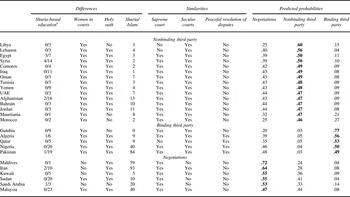
Although the empirical models provide useful insights into the general patterns of peaceful resolution, it is also important to discuss the implication of these findings for policy-makers. In Table 5, I use the multinomial logit model (full model) to forecast settlement venue choices based on the characteristics of Islamic law states as of January 2006. In each category, the states are arranged according to the levels of predicted probability of a venue. Fifteen states are most likely to choose nonbinding third-party methods in the future. Jordan's King Abdullah II in his 2006 speech at the ICJ commented on the inherent link between domestic and international principles of peaceful resolution: “Islamic civilisation upheld the primacy of settling disputes by law, not force—among nations as among people.” Remarkably, the king also noted that “In these commitments, we are guided by our Arab-Islamic legal heritage”Footnote 108 It seems that the “Arab-Islamic legal heritage” constituted by specific configurations of Islamic domestic legal characteristics encourages states like Bahrain, Oman, or Yemen to use nonbinding third-party methods. Among this group are traditional Islamic law states such as Bahrain, as well as more secular countries such as Lebanon and Tunisia. Nevertheless, all these countries share several unifying characteristics. First, all of them allow women to serve as judges, do not mention peaceful resolution of disputes in their constitutions, and have a secular court system. Furthermore, an overwhelming majority have constitutions with holy oath (twelve), and supreme/high court provisions (thirteen). Some of the outliers are Libya, Mauritania, and Morocco (no holy oath in any, and no supreme court mention in Libya's and Lebanon's constitutions).
Predicting settlement venue preferences, 2006

a. In 2006, all of Islamic law states' constitutions mention education.
Among all states in this category, Mauritania and Morocco, in addition to having relatively low predicted probability of nonbinding third-party venues (.46 and .47, respectively), have the highest probability of attempting binding third-party methods (.21 and .27, respectively). Further explaining Mauritania's categorization is the fact that major revision to the Mauritanian constitution later in 2006 actually introduced the holy oath provision. In Morocco, on the other hand, holy oath continues to be used in practice in the court system, despite its absence in the constitution.Footnote 109 Libya's 2011 Constitutional Declaration adopted by the revolutionary government actually requires the president of the Interim Transitional National Council to take a holy oath. In an overwhelming majority of these states, traditional Islamic domestic institutions constitute an important part of the legal landscape.Footnote 110 Additionally, in 2006 some states in this group were on the brink of increasing the impact of sharia on their legal systems.Footnote 111
Further explaining the preference for mediation, conciliation, etc., a panoramic comparison of these states' domestic laws reveals that informal third-party procedures are granted an important role in all these societies. Some examples include informal conflict resolution procedures such as jirga and shura in Afghanistan,Footnote 112 sulh in Jordan,Footnote 113 or a traditional justice system and community-sponsored conciliation in rural Morocco.Footnote 114 In some of these countries, mediation between disputants is also encouraged officially by the courts.Footnote 115 Lebanon and Tunisia, despite their less comprehensive official commitment to Islamic law, still incorporate sharia and informal third-party procedures in familial and other types of civil disputes.Footnote 116
The model also forecasts that five states will attempt binding venues. What is unique to this group is that predicted probabilities associated with arbitration/adjudication are high, ranging from .49 (Pakistan) to .77 (Gambia), indicating these states' relatively strong preference for these venues. Remarkably, the predicted probabilities of the nonbinding third-party venues are at their lowest levels for this group. It seems that just because an Islamic state is willing to try a particular court or arbitral tribunal, this does not mean that this state will also be willing to resort to other third-party venues, such as mediation. Among this group is Qatar, which strongly advocated ICJ adjudication in the dispute with Bahrain.Footnote 117 Included is also Pakistan, which in 2010 instituted arbitral proceedings against India regarding the Indus Waters Treaty of 1960.Footnote 118 In general, states in this group share several unifying legal features: all of them allow women to serve as judges and have secular court systems. Additionally, all but one have constitutional clauses regarding holy oath, supreme/high court, and the peaceful resolution of disputes. In fact, all states that have constitutional peaceful resolution provisions prefer adjudication/arbitration, further confirming my expectation that such provisions demonstrate a state's commitment to binding venues. Interestingly, in several of these countries, supreme adjudicators have also effectively tamed religion in the legal system. For example, the Supreme Court of Pakistan has succeeded in ensuring its “overarching review authority vis-à-vis the pro-religious jurisprudence of the Shari'at Appellate Bench.”Footnote 119 Likewise, the Supreme Court of Nigeria has repeatedly been able to curtail the spread of religious laws in Nigerian northern states. Despite the fact that a high court is not mentioned in the Qatari constitution, its Court of Cassation and recently established Supreme Constitutional Court both constitute highly important and vibrant adjudicators.
Finally, the model predicts that six states will most likely choose negotiations. This group is somewhat of a residual category because my theoretical expectations do not deal directly with negotiations. Nevertheless, we can observe several interesting patterns regarding this group. First, every state that does not allow women in courts and does not have secular courts falls in this category. This regularity is particularly interesting, since all third-party venues have the potential of including a female judge, mediator, arbiter, etc. Constitutions of these states do not mention peaceful resolution of disputes, but have provisions regarding supreme/high court. Overall, these are interesting cases, where politics seem to play an important role in explaining the preference for negotiations. Saudi Arabia, Kuwait, and Iran, founding members of the Organization of Petroleum Exporting Countries (OPEC), have the capacity to choose other resolution venues but choose not to, preferring instead bilateral talks.Footnote 120 Saudi Arabia, for example, has consistently expressed its preference for negotiations: “As the big sister to which the other Gulf states defer to various extents, Saudi Arabia does not want to see itself defending its borders at the ICJ, and would rather reach solutions by mutual consent through direct and candid negotiations.”Footnote 121 Maldives and Malaysia have historically been closely tied to the West, especially via the Commonwealth—an organization that fosters conflict resolution among its members via negotiations.Footnote 122 Last, Sudan is a war-torn country that simply does not have the capacity to engage in third-party-based international resolution venues.
As a further application of these predictions to actual territorial disputes, the model correctly predicts that Bahrain would prefer nonbinding third-party methods, such as mediation, which was indeed the case prior to its final acquiescence to the ICJ's adjudication. Qatar, on the other hand, has been placed in the group of states that prefer adjudication. Throughout the duration of the dispute, it was clear that Bahrain preferred that a “brotherly solution” be reached, and Qatar insisted that the parties resort to the ICJ.Footnote 123 Table 5 also provides important insights into ongoing territorial disputes, such as the dispute between the United Arab Emirates (UAE) and Iran over Abu Musa and Greater and Lesser Tunbs, which continues to produce tensions near the strategic Strait of Hormuz at the entrance to the Persian Gulf. The model predicts that the UAE will continue to propose nonbinding third-party solutions and Iran will prefer negotiations. Indeed, although the UAE showed an initial preference for bilateral talks with Iran, Abu Dhabi since 2006 “has changed its strategy by seeking to internationalise the dispute,” including “third party mediation by countries that are on good terms with the Iranian regime.”Footnote 124 Iran has continued to reject these proposals, which could potentially endanger the regime's position and “enflame the Iranian public and opposition who will certainly accuse it of endangering Iran's territorial integrity, and so will seek to challenge its legitimacy to rule.”Footnote 125 Thus, my empirical model's prediction of state behavior appears to be largely borne out by the historical record.
Conclusion
Scholars and practitioners of international law have repeatedly expressed their concern regarding the relationship between Islamic law states and international peaceful resolution forums. Some have argued that sharia-based law and the international legal order constitute two separate legal domains, without much in common.Footnote 126 Arguably, this disparity could constitute a real hindrance to the international community's efforts to settle existing territorial disputes in a peaceful manner. The proliferation of international dispute resolution methods, including inter-Islamic third-party forums, has created the possibility for Islamic leaders to strategically choose among available settlement methods.
The nature of social interaction matters greatly to Islamic law states attempting to settle their disputes in a peaceful way. In general, international nonbinding third-party venues such as mediation and conciliation allow traditional Islamic law states to fulfill their preferences by engaging in a brotherly solution approach to settlement and by enabling direct reference to sharia in dispute resolution. As I demonstrate empirically, not all Islamic law states view international settlement venues in the same way. In fact, the specific configuration of domestic Islamic laws can explain these states' preference for certain international venues. Secular legal features, such as constitutional mentions of a supreme court, education outside an explicitly religious framework, or peaceful settlement of disputes have the power to attract Islamic law states to the most formal international venues—arbitration and adjudication. On the other hand, states that embed holy oath in their constitution are unlikely to attempt resolution via international courts or arbitral tribunals, preferring instead less-formalized venues. In the context of the peaceful resolution of territorial disputes, it seems that the similarities between Islamic and international law matter more than the differences.
My data capture not only the cross-sectional variation within the Islamic legal family, but also patterns of change over time by providing a more detailed coding of the degree of interconnectivity between Islamic law, Islamic faith, and international law. I use the findings of my analyses to identify Islamic law states' specific settlement venue preferences. This is in no way a conclusive statement regarding this issue—more data on Islamic domestic legal institutions would perhaps allow a more comprehensive empirical model of the factors shaping states' choices of dispute resolution venues—but I believe this study constitutes a worthwhile initial step to understand Islamic law states' view of international settlement.
Supplementary Material
Supplementary material for this article is available at http://dx.doi.org/10.1017/S0020818315000156.