INTRODUCTION
Fishery and research survey collections made along the Aleutian Island Archipelago of Alaska during the 1990s indicated that this high-latitude region supported an unusually diverse and abundant coral and sponge fauna (Heifetz et al., Reference Heifetz, Wing, Stone, Malecha and Courtney2005). In 2002 a research programme was initiated to study seafloor habitat and biodiversity along the oceanic ridge that supports the volcanic archipelago (Stone, Reference Stone2014). The research included the collection of sponge specimens with submersibles and remotely operated vehicles and as by-catch during fishery surveys. Examination of specimens collected during the first decade has resulted in the description of 29 novel species of demosponges from the region (Lehnert et al. Reference Lehnert, Stone and Heimler2005a, Reference Lehnert, Stone and Heimlerb, Reference Lehnert, Watling and Stonec, Reference Lehnert, Stone and Heimler2006a, Reference Lehnert, Stone and Heimlerb, Reference Lehnert, Stone and Heimlerc, Reference Lehnert, Stone and Heimler2012, Reference Lehnert, Stone and Drumm2013; Lehnert & Stone, Reference Lehnert and Stone2010, Reference Lehnert and Stone2014; Stone et al., Reference Stone, Lehnert and Reiswig2011).
Examination of sponges collected in the Aleutian Island region in 2012 and 2013 continues to reveal new species of Demospongiae, including one in the order Poecilosclerida and others belonging to the Haplosclerida. Here we describe two new species from that collection, Megaciella pituitosa sp. nov. and Cladocroce toxifera sp. nov. Interestingly, while both new species belong to orders and families that are speciose and have a worldwide distribution (De Weerdt, Reference De Weerdt, Hooper and Van Soest2002; Hooper, Reference Hooper, Hooper and van Soest2002), both belong to genera with relatively few species. The World Porifera Database (Van Soest et al., Reference Van Soest, Boury-Esnault, Hooper, Rützler, de Voogd, Alvarez de Glasby, Hajdu, Pisera, Manconi, Schoenberg, Janussen, Tabachnick, Klautau, Picton, Kelly, Vacelet, Dohrmann, Cristina Díaz and Cárdenas2014) currently recognizes 12 species of Megaciella and 15 species of Cladocroce worldwide. Seven species of Megaciella, accounting for 54% of the known species and five Cladocroce (31%), are now documented from the Pacific Ocean with the description of the two new species here. The remainder of the species known for both genera principally occur in the southern hemisphere.
MATERIALS AND METHODS
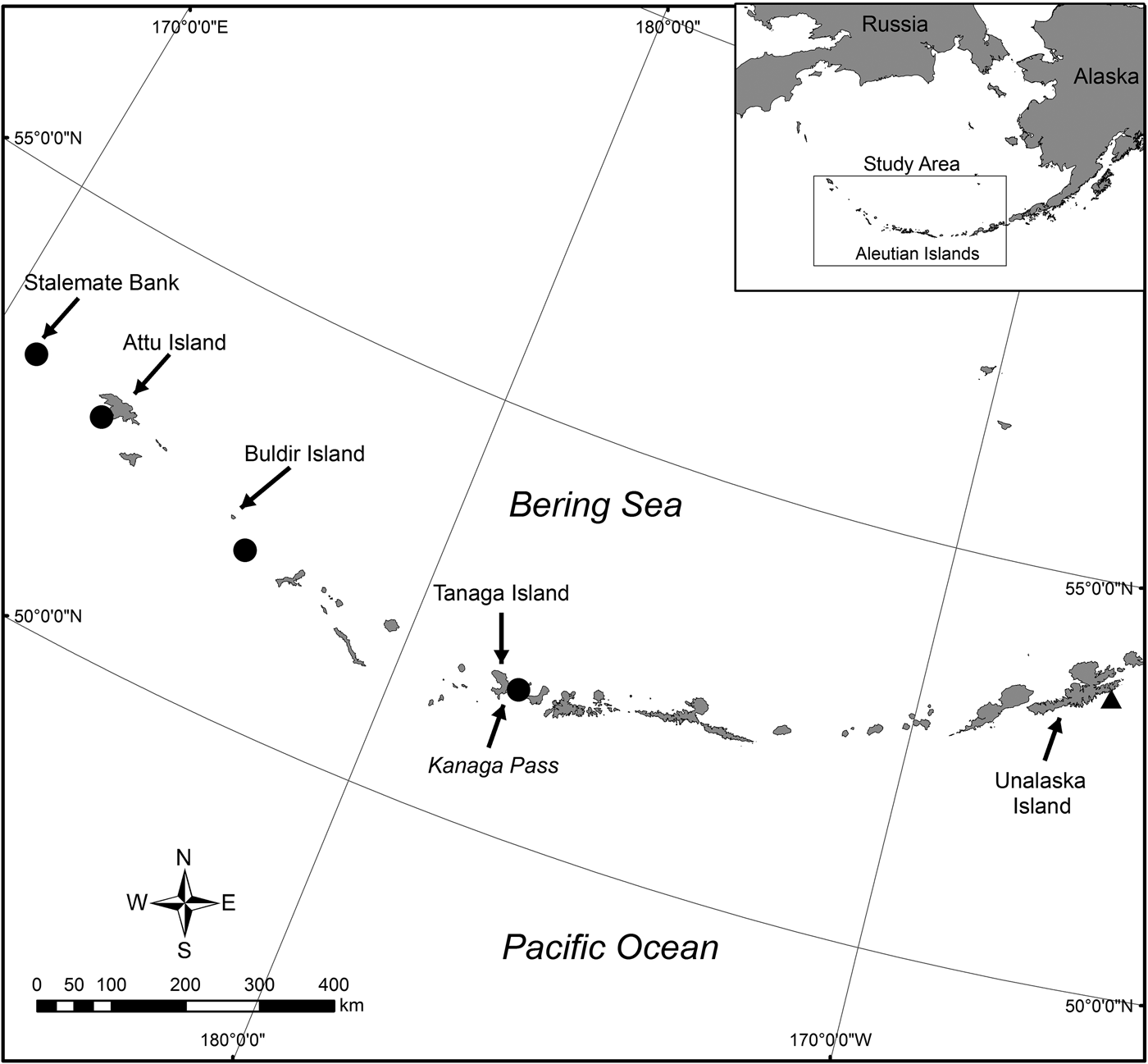
Specimens were collected in the summers of 2012 and 2013 with a bottom trawl during biennial fish stock assessment surveys conducted by the FV ‘Ocean Explorer’ or with a towed camera array by the FV ‘Sea Storm’ in the Aleutian Islands (Figure 1). Sponges were kept frozen at −10°C until a small section was transferred to 90% ethanol for further investigation. Sections were obtained with a razor blade, and spicules were obtained by boiling a sponge fragment in nitric acid. Cleaning of the spicules occurred in distilled water and subsequently in ethanol by the use of a centrifuge (Lehnert & Stone, Reference Lehnert and Stone2010). Finally spicules were embedded in Canada balsam and examined with light microscopy. For examination with scanning electron microscopy (SEM), spicules were mounted on a stub and sputtered with gold. SEM examinations were made with a Leo 1430 VP. Light microscopic observations were made with a Leitz Laborlux 11 microscope equipped with a LM Scope Tust 38 adapter and a Canon EOS600D camera. For each spicule category some initial measurements were made for length and breadth and then several slides were searched for larger and smaller spicules. Following this procedure we examined a minimum of 25 spicules to obtain minimum and maximum dimensions and provide size ranges rather than averages. Systematic hierarchy follows Hooper & van Soest (Reference Hooper and van Soest2002).
Collection locations for Megaciella pituitosa sp. nov. (▴) and Cladocroce toxifera sp. nov. (•) in the Aleutian Islands of Alaska.

RESULTS
SYSTEMATICS
Phylum PORIFERA
Class DEMOSPONGIAE
Order POECILOSCLERIDA Topsent, Reference Topsent1928
Suborder MICROCIONINA Hajdu et al., Reference Hajdu, van Soest, Hooper, Van Soest, van Kempen and Braekman1994
Family ACARNIDAE Dendy, Reference Dendy1922
Genus Megaciella Hallmann, Reference Hallmann1920
Megaciella pituitosa sp. nov.
TYPE MATERIAL
All type material is deposited in the National Museum of Natural History, Washington, DC, USA, indicated by the prefix USNM. Fragments in ethanol are deposited at the Zoologische Staatssammlung München, Germany, indicated by ZSM. Additional material is deposited at the Auke Bay Laboratory, Juneau, Alaska, USA, indicated by the prefix AB.
Holotype (USNM 1231427, ZSM 20140182) stored in ethanol, collected by Jim Stark with a research survey bottom trawl from the FV ‘Ocean Explorer’; 2 August 2012, 131 m depth, Stalemate Bank, western Aleutian Islands, North Pacific Ocean (52°58.6206′N 170°57.4524′E). Water temperature 3.7°C.
Paratype (USNM 1231424, ZSM 20140183), stored in ethanol, collected by Jim Stark with a research survey bottom trawl from the FV ‘Ocean Explorer’; 29 June 2012, 176 m depth, 9.7 km south–south-west of Chuniksak Point, Attu Island, western Aleutian Islands, North Pacific Ocean (52°42.1074′N 172°42.2760′E). Water temperature 3.6°C. Attached to a pebble.
Paratype (USNM 1231425, ZSM 20140184), stored in ethanol, collected by Jim Stark with a research survey bottom trawl from the FV ‘Ocean Explorer’; 24 July 2012, 141 m depth, Buldir Reef, 44.8 km south-east of Southeast Point, Buldir Island, western Aleutian Islands, North Pacific Ocean (52°03.4128′N 176°25.0806′E). Water temperature 4.1°C.
Paratype (USNM 1231426, ZSM 20140185), collected by Jay Orr with a research survey bottom trawl from the FV ‘Ocean Explorer’; 5 July 2012, 137 m depth, Kanaga Pass 4.5 km south-south-east of Pendant Point, Tanaga Island, central Aleutian Islands, Bering Sea (51°47.4264′N 177°36.7728′W). Water temperature 4.3°C.
ADDITIONAL MATERIAL
AB12-0067, dry with a fragment stored in ethanol, (ZSM 20140186) collected by Jim Stark with a research survey bottom trawl from the FV ‘Ocean Explorer’; 2 August 2012, 127 m depth, Stalemate Bank, western Aleutian Islands, North Pacific Ocean (52°59.0730′N 170°55.5756′E). Water temperature 3.7°C.
DESCRIPTION
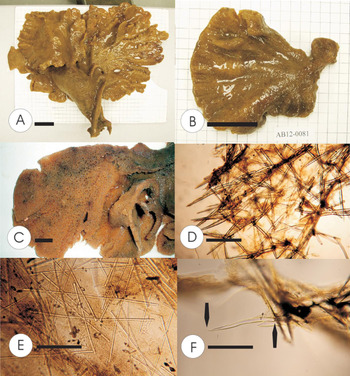
All specimens are stalked, fan-shaped, light brown to golden-brown in colour (Figure 2A, B), extremely slimy with no obvious odour, with a soft consistency, elastic, highly porous (Figure 2C), and easy to tear along the length.
Megaciella pituitosa sp. nov.: (A) holotype, largest type specimen collected, scale is 5 cm; (B) paratype, smallest specimen collected; scale is 5 cm; (C) close-up view of sponge showing porous surface; scale is 2 cm; (D) section perpendicular to surface. Surface of the sponge is on the left with ascending tracts from upper right to lower left; scale bar is 500 µm; (E) ectosomal membrane with tylotes tangential to the surface and isochelae in between; scale bar is 100 µm; (F) finely acanthose small style, indicated by the black arrows, echinating tract; scale bar is 100 µm.

Holotype (Figure 2A): dimensions are up to 31 cm high and 31 cm in width, thinnest areas of the blade are 3 mm but central, branch-like areas are considerably thicker (5–10 mm). Thickening of the blade may stabilize the sponge in strong currents. The fan consists of three major blades, partly perforated, and divided into several lobes. The stalk is 45–53 mm thick, 50 mm long and twisted.
Specimen USNM 1231424 consists of three major lobes and is attached to a small highly worn cobble (78 mm long and 29 mm wide). The stalk is 55 mm long and tapers at both ends. Holdfast is 35 × 35 mm. The maximum thickness of the lobes is about 7.5 mm and the widest blade is 80 mm.
Specimen USNM 1231425 (Figure 2B) is stalked and was probably attached to a pebble. It has slight lobe processes that are weakly divided. The stalk base is roughly oval and widest at 24.5 mm. The stalk is 30 mm long. Specimen is 15 cm tall, 13 cm wide and has a maximum thickness of 12.5 mm.
Specimen USNM 1231426 has three major lobes with smaller processes. The stalk is 25–45 mm long tapering to the lobes and the base is approximately circular with a diameter of 22.5 mm. The specimen has a maximum height of 30 cm, maximum width of 26 cm, and a maximum thickness of 7.5 mm.
Specimen AB12-0067 is obviously fan-shaped with a few minor lobes and a slightly palmate margin. The sponge is slightly concave and the concave surface has two minor lobes or processes. The fan is 45 cm at the widest and has a 52 cm maximum height. The fan is 10–12 mm in width. The very stout stalk has a firm, obvious holdfast; 10–12 mm long and 32 × 42 mm in diameter.
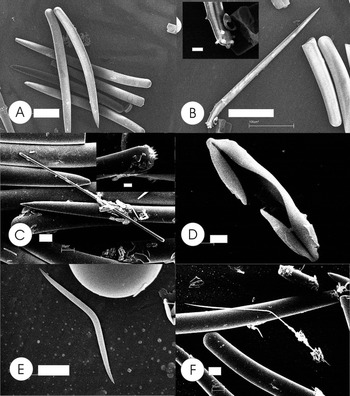
The ectosome consists of a thin membrane where tylotes with slightly acanthose heads are distributed singly or in bundles (Figure 2D, E) and numerous microscleres occur without recognizable order. The choanosome consists of ascending tracts of mainly smooth, large styles, which break through the ectosomal membrane and cause a microhispid surface (Figure 2D). The same large styles connect the vague tracts and also echinate tracts together with a second category of small, very finely acanthose styles, the blunt end cemented with spongin and with the points facing away from the tracts (Figure 2F). Numerous microscleres are distributed throughout the sponge. Megascleres are large, mainly smooth styles, only occasionally with a few spines near the blunt end, 425–644 × 27–36 µm (Figure 3A); small, sometimes wavy acanthostyles, 135–205 × 9–14 µm (Figure 3B); and anisotylotes with acanthose ends, 144–310 × 4–6 µm (Figure 3C). Microscleres are palmate isochelae, 17–23 µm (Figure 3D); small, thick toxa, 40–86 × 2–3 µm (Figure 3E); and long, very thin toxa, 120–300 µm (Figure 3F).
Megaciella pituitosa sp. nov.: (A) large styles of the choanosomal skeleton; scale bar is 100 µm; (B) small styles, echinating the tracts of large styles; scale bar is 100 µm. In upper left, enlarged acanthose blunt end of small style; scale bar is 10 µm; (C) ectosomal tylote with acanthose ends from upper left to lower right; scale bar is 20 µm. In upper right, enlarged acanthose end of tylote; scale bar is 2 µm; (D) isochela; scale bar is 2 µm; (E) small, thick toxon; scale bar is 10 µm; (F) long, thin toxon; scale bar is 20 µm.

DISTRIBUTION
Aleutian Islands from Stalemate Bank to Kanaga Pass at depths between 127–176 m. This species appears to be locally abundant and attaches to pebbles in low-relief habitat, possibly in areas of high current. The temperature in the areas where the specimens were collected ranged from 3.6 to 4.3°C.
ETYMOLOGY
From Latin: pituitosus—slimy.
DISCUSSION
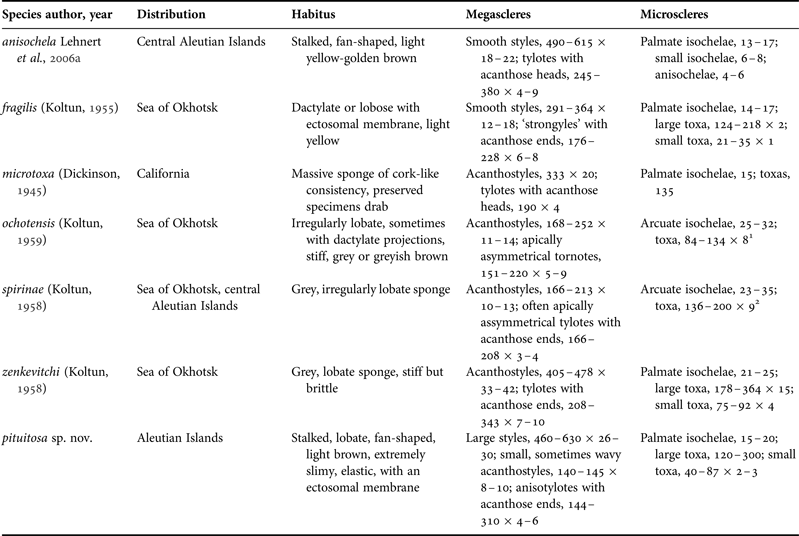
We compare the new species with all known Megaciella in the North Pacific Ocean (Table 1). Megaciella are unknown from the Bering Sea, the seas of the Arctic Ocean and the North Atlantic Ocean. Megaciella anisochela (Lehnert et al., Reference Lehnert, Stone and Heimler2006a) also stalked and known from the Aleutian Islands, occurs in considerably deeper water (702–750 m), has no category of small styles nor toxas, but does have anisochelae and a second category of isochelae. Megaciella fragilis (Koltun, Reference Koltun1955) from the Sea of Okhotsk differs in colour and growth form and has no second category of styles. The remaining four species, M. microtoxa (Dickinson, Reference Dickinson1945) from California, M. ochotensis (Koltun, Reference Koltun1959) from the Sea of Okhotsk, M. spirinae (Koltun, Reference Koltun1958) from the Sea of Okhotsk and central Aleutian Islands (Stone et al., Reference Stone, Lehnert and Reiswig2011), and M. zenkevitchi (Koltun, Reference Koltun1958) from the Sea of Okhotsk all have acanthostyles instead of smooth styles, lack a second category of styles, and differ in growth form. Megaciella zenkevitchi also has two categories of toxa but they are considerably thicker than those of M. pituitosa sp. nov.
Characteristics of Megaciella of the North Pacific Ocean. All measurements are in μm.

1Koltun (Reference Koltun1959) writes in the species description that the ‘chelae are typically arcuate and are not transitional to palmate chelae, as is the case in M. spirinae.’ In our opinion the chelae of both M. ochotensis and M. spirinae, as presented in his figures, are palmate. Also, see note in (2); 2Koltun (Reference Koltun1958) writes in the species description that the ‘cheloids … are very similar to palmate chelae, even though they have been classified by us as arcuate chelae.’ We assume that they are indeed palmate isochelae; otherwise this species would have to be removed from Megaciella and Microcionina and transferred to Myxillina.
An anonymous referee suggested that we compare this new species with Megaciella pilosa (Ridley & Dendy, Reference Ridley and Dendy1886) known from the Kerguelen Island region in the southern Indian Ocean (approximately 18,000 km from the Aleutian Islands). Megaciella pilosa is indeed similar in shape to the new species but differs considerably in colour and spiculation. Megaciella pilosa is chocolate-brown, has two categories of oxeas, lacks acanthostyles, has larger smooth styles (up to 2000 × 25 µm) and larger isochelae (65 µm) compared to M. pituitosa which is light brown, lacks oxeas, has acanthostyles, has smaller isochelae (15–20 µm) and additionally has two categories of toxa. The two are clearly different species.
Order HAPLOSCLERIDA Topsent, Reference Topsent1928
Suborder HAPLOSCLERINA Topsent, Reference Topsent1928
Family CHALINIDAE Gray, Reference Gray1867
Genus Cladocroce Topsent, Reference Topsent1892
Cladocroce toxifera sp. nov.
TYPE MATERIAL
The holotype (USNM 1231428) is deposited in the National Museum of Natural History. Washington, DC, USA. Additionally, a fragment of the holotype (ZSM 20140187) is deposited at the Zoologische Staatssammlung in Munich, Germany. Both are stored in ethanol. The holotype was collected by Dave Somerton with a research survey bottom trawl from the FV ‘Alaska Provider’; 1 June 2013, 93 m depth, 10.7 km south of Sedanka Island, east end of Unalaska Island, eastern Aleutian Islands, Gulf of Alaska (53°36.6378′N 166°12.4800′W). Water temperature 4.5°C.
DESCRIPTION
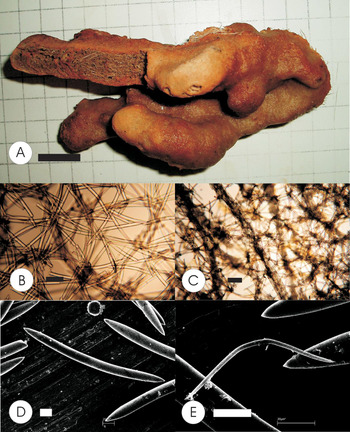
The holotype (Figure 4A) consists of a large fragment; probably the top 2/3rds of the sponge. It is a lobate sponge, reddish-light brown in colour, with bulbous lobes creeping over the surface, branching, coalescing, or growing one lobe over the other with the appearance of four partially fused fingers (Figure 4A). Large circular oscules all over the surface and separated by irregular intervals of about 1–2 cm, slightly elevated with distinct rims about 1 to 3 mm in diameter (Figure 4A). Consistency is hard and stiff, only slightly compressible, surface optically smooth but rough to the touch. Dimensions are 10.8 × 5.3 × 2 cm.
Cladocroce toxifera sp. nov.: (A) holotype, polyspicular tracts are visible at the left margin of the specimen, grid marks are 1 cm; (B) ectosomal reticulation of spicules, polyspicular tracts are visible below; scale bar is 100 µm; (C) choanosome, polyspicular tracts run as darker bands through the somewhat irregular unispicular reticulation; scale bar is 200 µm; (D) oxea; scale bar is 20 µm; (E) toxon at centre; scale bar is 20 µm.

The ectosome is a somewhat irregular tangential arrangement of oxeas, single or in vague paucispicular tracts (Figure 4B). The choanosome consists of a subisotropic unispicular reticulation of oxeas which is traversed by polyspicular tracts of the same category of oxeas (Figure 4C), running through the lobes of the sponge in longitudinal direction. Polyspicular tracts near the surface run parallel below the surface and do not break through the ectosome. These polyspicular tracts are of variable thickness, 50–230 µm in diameter, can be several cm long and are visible to the unaided eye in areas where the sponge has been torn (Figure 4A). These tracts provide the stiff consistency of the sponge. Spicules are oxeas, 241–297 × 12–23 µm (Figure 4D), toxas are distributed throughout the sponge in a wide size range and different widths, 36–139 × 3–7 µm (Figure 4E).
DISTRIBUTION
Known only from a single specimen at the type locality on the island arc slope south of Unalaska Island at a depth of 93 m. We suspect that the specimen was in rough, rocky habitat, possibly attached to cobble or low-relief bedrock.
ETYMOLOGY
Toxifera from the Latin, toxon—the spicule type—and ferre: ‘to carry’.
DISCUSSION
Within the genus, Cladocroce toxifera is the only species in the North Pacific Ocean with toxas. The oxeas of C. toxifera are of similar length to those in C. attu and C. kiska Lehnert & Stone, Reference Lehnert and Stone2013, but C. toxifera has an additional category of toxa, a special ectosomal region with tangential oxeas, and it differs in colour and growth form. For additional data on the spicule measurements of North Pacific species of Cladocroce we refer to Lehnert & Stone (Reference Lehnert and Stone2013a) where all species of the genus Cladocroce from the North Pacific Ocean, the Bering Sea, and the Arctic Ocean are discussed in detail. Cladocroce gaussiana (Hentschel, Reference Hentschel1914) from the Antarctic region also has toxas but differs in growth form (tube-shaped), colour (yellowish-white), has larger toxas (80–152 µm), and somewhat smaller oxeas (232–264 µm).
A remote possibility for placement of the new species described here would be assignment in the genus Pachypellina. Pachypellina occur in similar massive lobose growth forms, have a thick ectosomal layer of tangential oxeas, and the choanosomal skeleton has polyspicular tracts within a ‘pulpy’ mass of oxeas. We excluded assignment of the new species to Pachypellina, however, due to the presence of the toxa, which are known for Cladocroce but not for Pachypellina. Additionally, the ectosomal layer is not thick, as in Pachypellina, but relatively thin, and the polyspicular tracts are not arranged perpendicular to the surface but are rather irregular. Assignment to Pachypellina is also highly unlikely from a biogeographical standpoint as the genus is represented by only a single species from Antarctica.
ACKNOWLEDGEMENTS
We thank the Resource Assessment and Conservation Engineering Division of NOAA's Alaska Fisheries Science Center, especially Jim Stark, Jay Orr, and Dave Somerton and the captains and crews of the FV ‘Ocean Explorer’ and FV ‘Alaska Provider’ for their assistance collecting biological specimens for this study. Thanks also to the Zoologische Staatssammlung, München for providing access to the SEM, and especially to Enrico Schwabe for help operating the SEM. We thank Michele Masuda (Alaska Fisheries Science Center, Auke Bay Laboratory) for providing Figure 1. The findings and conclusions in this paper are those of the authors and do not necessarily represent the views of the National Marine Fisheries Service.
FINANCIAL SUPPORT
Helmut Lehnert was supported by a contract from the Alaska Fisheries Science Center of NOAA/NMFS.