Two types of democratization
There is a difference between (1) the democratization of states and international organizations; and (2) democratizing globalization. This distinction between spreading democracy as an organizational principle across more and more states and other agencies, and the democratization of their mutual relations, is crucial but seldom acknowledged in the literature.
In both cases democratization is about creating checks and balances in power politics. There is a difference between rulers and ruled, between state and society. Who is entitled to control who? Who is entitled to represent who? This distinction is familiar in the literature, albeit that democratization is mainly associated with problems of defining society: who are the people (demos) in global democracy? The question, ‘who are ruling (cratos)?’, receives much less attention.
Literally, demos and cratos are the same; democracy means rule by the people. In practice, however, democracy is about subordinating the rulers to control mechanisms of the people. Ideally, in a representative democracy, the government has no subjects, but serves its subjects. But as the very terminology reveals, the ontological divide between rulers and subjects is undisturbed even in the most sophisticated functioning democracies. Cratos by the demos becomes public control over those who rule, plus legitimizing ‘those who rule’ by their subsequent representative nature of the people. Democracy is about striking a satisfactory balance between rulers and ruled.
There are two types of globalizing democracy, and both types are about balancing (mis)use of power. Type 1 democracy (distributional democracy) runs into the problem that criteria for democracy are rather diverse, which is an understatement. They are hard to objectify, and therefore in the end power decides. Type 2 democracy (democratizing world politics) runs into a more fundamental problem, i.e. the absence of both a demos and a cratos. Both rulers and ruled need to be defined clearly in order to make the idea of democracy work. Democracy without cratos turns into an anarchy; democracy without demos becomes an autocracy. Only old-fashioned world federalists explicitly try to upscale the domestic logic to global proportions: humankind as its people, represented by a world government. Most of the literature on global democracy is unaware of its implicit support for such a plea.
Demos & cratos in Type 1: the state/society nexus
What is the domestic story of democracy in the modern state system? It starts with basic questions about political authority and the acceptance of rule in general. Related to why people accept sovereignty, there are two lines of argument, which do not exclude each other: social contract theory, and organized crime theory. In social contract theory, as rooted in the works of Thomas Hobbes and Jean Jacques Rousseau, hierarchical relations in a state are accepted as a positive survival mechanism of a population on a given territory. In spite of all the criticism concerning the rulers, the principle of hierarchy as such goes unchallenged. Leadership is needed to survive. The next question is how to tame the Leviathan that has been called into being for the general good. Democracy is the whip to keep the powerful from getting corrupted.
However, in organized crime theory, as rooted in the work of Charles Tilly, and also present in studies on war lords and inner city warfare, the basic logic of hierarchical relations is repression.Reference Tilly1 The accumulation of coercive means and capital allow war lords or gangs to establish their authority on a given territory. These then become states. Even in extreme repressive circumstances, willing compliance occurs. Following the advice of Machiavelli, the best guarantee for rulers to survive is not to be hated, nor to be loved, but to be feared. Fear is a powerful counterpart of uncertainty avoidance; obedience and social hospitalization are the result.
Machiavelli’s middle position between love and hatred is only achieved if a sufficient number of subjects will be rewarded for their loyalty. Here, more is at stake than sticks and carrots. Identity formation, through the building of (national) myths, ideologies and religion, is an independent variable in its own right. The monopolization of the mind is as important as the monopolization of capital and coercive power.Reference Anderson2
Democracy plays a role in both social contract and organized crime theory. Democracy can be valued as a taming force in the hands of society if one sees the state/society-nexus essentially as a social contract. Or it can be valued as a taming force in the hands of the state if one sees the state/society-nexus essentially as exploitative and repressive. In both cases, however, it is an instrument to turn a society into a community (from Gesellschaft to Gemeinschaft): democracy binds rulers and ruled into a common myth about shared responsibility for the future of the national state.
The varying national circumstances in which each democracy has developed explain the wide variety of its appearances. Crucial in its development has been the 19th century. During the development of national democracies, the sovereign state was already established; cratos was given. Sovereign states were a fact. The subjects, however, were not yet a people; the demos-identity was missing. Probably this explains why, up to the present, authors about democracy are unaware of the cratos-problem.
Decolonization meant a formidable shift in the balance between state and society in favour of society: colonial rule was closer to the organized crime theory about state-formation than to social contract theory. Ending colonial rule opened a way to a new balance, but in many cases the new rulers and groups in society failed to establish a binding national myth. Many attempts at democratization failed due to the absence of a demos. Civil wars reveal and strengthen a deadly struggle between competing ethnic, religious, and ideological identities. Frequently, dictatorial and repressive regimes are both cause and result, reaffirming organized crime theory of state formation.Reference Bayart, Ellis and Hibou3 The distribution of democracy fails in states that lack a society with sufficient cohesion, societies that lack a demos. This is well illustrated in Afghanistan and Iraq, where local identity groups distrust all forms of central government. Enforced distribution of democracy proved successful only in cases where the societal preconditions were met. After 1945, West Germany and Japan provide strong examples. In the 1990s, democratization proved a success in Central and Eastern Europe too.
Meanwhile, India has become the world’s largest democracy. Africa’s image of a torn continent is wrong in the face of stable democracies such as Mauritius, Ghana and Botswana. Out of 193 sovereign states in 2009, 121 have electoral democratic regimes.4 So there are success stories. But what they reflect needs to be assessed in each separate case. In contrast to the 121 formal democracies, Freedom House lists only 89 countries as free, including countries like Mexico, where in 2009 some 7600 people were killed in gang warfare, also involving corrupted police forces.5 World Audit lists merely 37 states in their first two divisions of democratic quality.6
What does the label ‘democracy’ mean? In today’s television democracy, in which arguments are beaten by sound bites and slogans, the concept of democracy has been hollowed out. According to Guéhenno, people have forgotten the meaning of notions such as democracy, freedom and politics.Reference Guéhenno7 It should be questioned whether politicians are still discussing democracy in rational terms. Western media and leading politicians frequently question, for example, the democratic qualities of the Russian Federation. The tendency in the reports is to interpret Russia’s struggle with democratic principles as a proof of its autocratic nature: the cratos, symbolized by Kremlin and Gazprom, apparently misleads the people by talking democracy. But evaluations of the self-proclaimed world champion of democracy, the United States of America, are likewise critical: election campaigns, run by two elitist parties which are at least as dependent on campaign money donors as on votes, bring a government to power that claims to represent the people of America, while almost half of the population shows no interest in voting.Reference Chomsky8
The inability within the ‘democratic’ world to agree about form and content of democracy contributes to its mystification. It is not too difficult to recognize dictatorships and failed states – repression and chaos are clear indicators – but the call for democracy to replace them is mainly waving a flag. Anarchy, failed states, autocracy, dictatorships are concepts to judge existing situations. Democracy, however, refers to a promised land behind the horizon. It is telling that the ‘Map of Freedom’ of Freedom House is based on an operationalization of the Universal Declaration on Human Rights. That document provides better support than democratic ideals, which have no universal blueprint. Everyone knows that Saddam Hussein’s regime in Iraq was pernicious. No one knows what Iraqi democracy looks like. Everyone knows that Liberia is a failed state. No one knows what Liberian democracy looks like. Will it be more like Belgium or more like South Africa? Do the president’s competences equal those of the Russian president or will s/he function like a kind of Dutch prime minister, a prima inter pares? The road to democracy is paved by organizing elections, preferably critically followed by international observers. When more is done, this does not primarily require the flag of democratization.
An excellent example is governmental transformation in Central and Eastern Europe. Here, democratization in a direct sense referred to a merely institutional reform: the introduction of a division of powers and of strong parliaments, anchored in a constitution. More important was the acceptance and implementation of the European Union’s acquis communautaire, supplemented with human rights requirements. There were ‘negotiations’ about this, but these were not based on democratic principles of equality or equal terms. International political and economic relations were decisive. Apparently, democracy only shows after several preconditions are fulfilled, and these preconditions can be enforced undemocratically. Spreading democracy itself has little to do with democratic practice. In countries such as Afghanistan and Iraq the ‘international community’ imposes its rule, which comes closer to colonial traditions than democratic ones.
The difference is obviously the objective: to establish independent stable democracies. The first stage is to build up a cratos that can win the ‘hearts and minds’ of the local authorities/society-nexus. Rather than elections, this requires concrete preconditioning measures, such as the training of police forces, an adequate penitentiary system, and a reliable judiciary.Reference Holm and Eide9 More important than a democratically elected government is a well-equipped, transparent and reliable public bureaucracy that delivers collective goods appreciated by the subjects (read: the local rulers and their subjects). Only after installing public authority with sufficient coercive power and capital, does it makes sense to discuss a democratic identity. In Development Studies this problem is well-known: some juntas have been more stable, and less corrupt than some elected civil governments.Reference Huinder10
The ‘international community’ can exert a beneficial influence on these practices. This, indeed, is happening already: developing countries generally have to provide a certain measure of transparency and accountability towards donor organizations. Aid and cooperation often depend on criteria for ‘good governance’, a concept as yet far more concrete than democracy. Some governments rely even more on their ‘external’ power base (non-governmental donor organizations, the World Bank, the IMF, the WHO, etc) than on their ‘internal’, domestic power base (the electorate and loyal tax payers). An electoral democracy in such circumstances is a joke, because the true powers that need to be checked and balanced are outside of the state’s jurisdiction.
In conclusion, spreading democracy among states runs into the following problems:
• The required demos (a myth that binds a population on a given territory together) is often absent. Creating it depends on non-democratic processes involving the accumulation and use of coercion and capital, i.e. a struggle for power.
• Many democratizing regimes are highly dependent on outside support, often more so than on domestic support. Hence the state/society-nexus is disturbed by multilevel governance phenomena, which weaken the basic ideas of ‘government by the people’, and ‘representative government’.
Multilevel governance
In the face of globalization and its multilevel governance patterns, it seems evident to export the basic logic of democratization to the international layers of government and governance. If democracy is about taming the ruling elite, then scaling up the scope of its control mechanisms is both obvious and paramount. Historically, democracy scaled up from city-states to nation-states. European integration suggests that it is only a matter of time for democracy to scale up to continental proportions, as has already been achieved in the North Americas, Australia and India. Globalization cries for control: Who audits multinational corporations, the financial world, the international press agencies, the NGOs, the providers of cyberspace? Who checks and who balances the intergovernmental organizations, the World Trade Organisation (WTO), ASEAN, the G-8, the G-20, or the UN Security Council? In the context of the European Union, a ‘democratic deficit’ has been discovered, and many scholars point at similar deficits in the global context.Reference Weiler11
‘Multilevel’ criticizes the logic of separate levels of analysis. It is futile to locate sources of explanation and outcomes of political processes at specific substructures in world politics, for the very reason that these substructures are too interdependent to allow for ontological differentiation. ‘Multilevel’ is a discursive tool to falsify the applicability of ‘levels of analysis’ as an ontology: sources and outcomes are multi-level; the differentiation between levels needs to be questioned.
For a positivist, within this logic, the traditional chess board structures (those of international system, geopolitical functional subsystems, state units, and sub-state structures; or those of world economy, regional economy, etc) are either undermined or overarched by newly developed structures across the original levels; i.e. the world has changed. For a post-positivist, talking ‘multilevel’ is an attempt to build a new understanding of the world by challenging the original deconstruction of it. In both cases the traditional worldview is too strong to render the old way of perceiving political structures obsolete: reference to levels is needed to qualify or even deny its relevance.
‘Governance’ refers to the intertwinement of public and private spheres, pulling attention to a new division of labour between them. As a consequence of the neoliberal privatization agenda in the West, and in line with the practices in weak states, the private sector delivers crucial collective goods. Public political control mechanisms are often powerless towards these private actors. The term governance is also used to point at government-like arrangements within the formally anarchic structure of international politics: governance without government.Reference Czempiel and Rosenau12 Combined, governance is government in the absence of hierarchy and/or the performance of public functions by private or semi-private institutions.
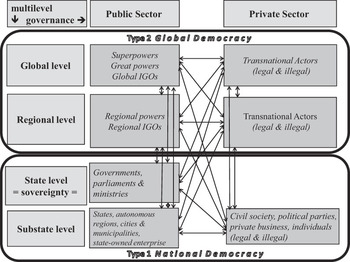
Figure 1 illustrates the resulting structure of multilevel governance. Yes, there are different chess boards on which politics and economics are played, requiring different levels of analysis; and yes, there is a difference between the public and the private sectors at all of these levels. But the thicker the arrows between them, the less they can be analysed in their own right. In International Relations theory, academics are familiar with this when it comes to great power politics: great powers play their own games (unaffected by lower level influences) and practice their power at lower levels. But in today’s world, small scale terrorist networks have shown the ability to play at the great powers’ chess board; and firms like Microsoft have changed the rules and practices for communication worldwide.
Multilevel governance and types of democracy

Crucial for the discussion about global democracy is to recognize that the private sphere includes both legal and illegal powers. The public sphere excludes crime by definition, since it is the authorities who define what is legal or illegal. Crime in the public realm (such as corruption, extortion, random arrests or nepotism) belongs to the private sphere: private interests are pursued through public channels. Judged by universal standards, however, criminal states do exist just like gangs. Recall the power of organized crime to form the basis of state formation. Since power corrupts, the entire public realm constantly runs the risk of being corrupted. In addition, the notion of democracy can be corrupted. This is why checks and balances need to be manifest to both participants and observers. Reversely, these checks and balances need to be expanded to the private sphere to guarantee proper delivery of its public services.
Type 1 democracy is about the state and sub-state levels. Government in general is subject to democratic yardsticks. It is evaluated for both its input legitimacy (transparency of decision-making processes and accountability for the implementation) and output legitimacy (public services and their appreciation). Governance refers to similar public functions but performed by private actors (civil society, firms, NGOs). Here, mere output legitimacy counts, and where it fails, governments are expected to correct their performance.
However, the thicker the arrows from higher levels, the lesser checks and balances are focused on the actual centres of power, and the more it is difficult to make national rulers accountable for what is happening. Just an example: if mismanagement of the banking sector in the USA causes a global financial crises (as in 2008–2009), it makes little sense to blame governments in other states for their failure to protect their citizens from bankruptcy (as, for example, in Iceland). Conversely, in a booming world economy, national governments overestimate themselves when they take the credit for it. In the face of global developments, the individual margins for manoeuvre are very limited.
In spite of this, however, one of the criteria for democracy still is ‘autonomy’ of the elected government. Robert Dahl calls this ‘exercising final control over the agenda’.Reference Dahl13 The government needs to represent the interests of its subjects – and in theory of its subjects only – and therefore the agenda needs to be determined by (representatives of) the subjects, not by the interests of other governments, transnational corporations (TNCs), foreign donor organizations, or a Commission in Brussels. In the face of globalization and Europeanization, this criterion gets lost. When autonomy is in jeopardy, transparency, openness and thus accountability are lost too. But when the ‘international community’ is spreading Type 1 democracy, it is neglecting this. Access to the ‘true’ centres of power is limited. Hence, a quest for the globalization of democracy seems a reasonable answer.
Demos and cratos in Type 2: taming MLG?
Type 2 democracy is non-existent, but aims at the global and regional levels. There is a wide literature on ‘the search for alternatives to the mode of global governance dominated by states and multi-national corporations’.Reference Omelicheva14 Mariya Omelicheva takes stock of the literature tracing the role of Global Civil Society in democratizing world politics. She concludes that the empirical quality of existing research is too low to allow for conclusions. In the end, normative preferences appear too strong in both the studies that highlight or downplay successful balancing by Global Civil Society. But balancing of what? She compares domestic practices with global practices. But in doing so, she avoids the problem of defining the demos by focusing on procedural aspects, and she lets cratos simply disappear: on the domestic level, democratization is defined as ‘A series of socio-political changes that transform the state …’, and on the global level ‘A series of socio-political changes that alter global politics in a democratic direction.’Reference Omelicheva15 This move from structure (the state) to process (politics) is crucial for understanding what is wrong with Type 2 thinking. The error is made in many studies.
Literature about the globalization of democracy neglects that all theories on democracy assume existing government. Democracy has always been about taming a Leviathan. International politics, however, is about taming anarchy. If democracy is supposed to prevent the abuse of power, the existence of a power is a precondition. Democracy speaks to centres of power. In international relations, power itself is too diffuse to be tamed like a national government or the board of an organization can be tamed. Even in a unipolar world the dominant discourse cannot be about democracy.
There is much ado about the question of whether global democracy can meet the precondition of a demos – a society tight enough to allow for democracy. This issue is raised in particular in the debate about the EU’s ‘democratic deficit,’ and it is also at stake in Type 1 concerns about torn countries like Iraq and Afghanistan. At a planetary scale, it is highly questionable to consider ‘humanity’ or ‘mankind’ a demos. In the English School, various authors are puzzling with this problem in the context of theorizing ‘world society’. Robert Jackson mentions the options of (1) An emerging ‘cosmopolitan community of humankind’; (2) An international community of national citizenries; or (3) A community of states.Reference Jackson16 He is in line here with Barry Buzan, who argues that an evolutionary development from international society to world society is feasible.Reference Buzan17 The concept of sovereignty can indeed be expected to be flexible enough to allow for growing concerns about individual needs from a global perspective, in line with the development of human rights law.Reference Werner and de Wilde18 Andrew Linklater and Hidemi Suganami, however, expect a more revolutionary development.Reference Linklater and Suganami19 Implicitly, their account of international society is closer to the organized crime theory of state formation: the system of states has to be replaced in order to give proper expression to people’s interests. In Buzan’s and Jackson’s reading, the social contract theory of state formation weighs more strongly: ruling elites are necessary, and can be forced to serve their subjects.
Along these lines, David Ellis is investigating the question of whether an international community exists. Unfortunately, he formulates an empirical benchmark for its existence that is not very helpful: ‘… an International Community must by necessity represent all mankind and must, therefore, include all states if it is to achieve a universal, solidarist order’.Reference Ellis20 The point he misses here is that more important than the actual existence of an international community are the claims made on its behalf. By claiming to act in the name of mankind, and by convincing a critical audience that this is indeed the case, an actor increases his power, both in terms of his position and his policies. The proper parallel to the notions of international community and humankind is the notion of God: whether God actually exists is less relevant than the mobilization of people in his name. If a religious discourse leads to architectural record performances (cathedrals, mosques) and to self-sacrifice and conquest (crusades, suicide-bombers), the power of God is in the words preached to these ends. Similarly, international community exists already as a discursive tool to silence opposition: if you act on behalf of the international community or humankind, your opponents by definition must be selfish opportunistic bastards; barbarians.
This discriminating quality of the quest for unity is also present in the search for a global demos. Since Identity strongly depends on distinctions between the Self and the Other, an identity that lacks an Other is problematic. One possible distinction would be time-related: We-today versus We-in-the-past. But even then the articulation of the global identity will always serve polemical purposes: it is only necessary to spell out a common identity when there are people who disagree. To claim that ‘we are one’ is a way to silence opposition: ‘I will act on behalf of Us’. The remaining opposition who does not buy this, automatically becomes the Other, whose behaviour has to be corrected. Hence, searching for, or building a global myth about a common identity of humankind is not necessarily a positive development.
In the literature, a discussion about an emerging global demos can be recognized, but there is surprisingly little attention for the question of whether government or governance – cratos – is pronounced enough to enable democracy. Joseph Weiler addresses this problem in the context of the EU. He calls it a problem of translation:
the very language of modern democracy, its grammar, syntax and vocabulary, revolve around the state, the nation and the people – its demos. The Union, it is generally accepted, is not a state. The result is a description of oranges with a botanical vocabulary developed for apples.Reference Weiler21
How can we translate the anchors of democracy, ‘peoplehood’ and ‘polity’, in a democratic theory about European governance? He admits, he can’t: a ‘mundane lack of grey matter and intellectual ability’.Reference Weiler22 I see a different cause: the translation simply can’t be made. Democracy presupposes hierarchy.
Despite globalization, world politics has the structure of a failed state and a failed society: anarchy prevails. A failed state can never be democratic. In theory, the warring factions on its territory could be democratic, because they are hierarchical, but their interactions both shape and reflect an anarchical structure. Irrespective of the impact of anarchy on the population, there is no way of democratizing these interactions. This is only feasible after a third party has literally overruled the warlords – which means when anarchy has ended. In the meantime, the prevailing anarchy does not imply chaos. There are all kinds of stabilizing cooperative structures, as well as stabilizing coercive structures. The first are mainly associated with international regimes and organizations, the latter with the type of polarity in the international system and in its regional subsystems.
The debate about Type 2 international democracy mainly focuses on the cooperative structures, as if this were the cradle of a new social contract. According to most IR theories, however, the distribution of political, military and economic power across the dominant units (whether state or non-state) of the system is still decisive for the system’s functioning. The implied catch-as-catch-can structure reminds us that the organized crime theory is fully alive here. The dominant discourse on anarchy even legitimizes the (pre-emptive) fight against this.
For understanding the role of power obstructing the ideal of Type 2 democratization, it is revealing to compare two elections: the American presidential elections and the elections of the European Parliament (EP). Given the strong hegemonic position of the USA in Europe, it is self-evident that the results of the American elections are of far more importance to EU politics than the results of the EP elections. The USA is a military superpower, a cultural superpower and an economic great power. It plays a crucial role in the chances to further develop or to further subvert an international legal order. The EP is much more an expression of a democratized international order, but it has rather limited powers to control the policies of the European Commission, and even fewer powers to influence decision-making in the European Council. Brussels has no choice but to listen to Washington first, to its dominant member-states second, and to its people’s representation, the EP, third. Whether the Netherlands – or the EU for that matter – is at war is decided in Washington, not in Brussels. And whether that decision was right – democratic accountability – is decided by the American Senate, not by the European Parliament or the Dutch parliament.
The American presidential election is a global affair. Add this to the pleas for global democracy, and the logical consequence must be that world society as a whole should take part in that election. If democracy means civilian checks and balances on those who rule them, perhaps we should organize global elections for the governments of all super- and great powers, or apply for worldwide membership of the Chinese communist party. This is nonsense of course, but it illustrates to which power-political structures the democratization of global governance is subjected. As long as international control of power politics is impossible, it is futile to expect global democratization by Global Civil Society fighting for democratic control of the WTO or the World Bank. One may have Type 1 considerations for taming these organizations, but taming them for Type 2 reasons is fighting windmills.
Global democracy presupposes a Leviathan that can be tamed, but the only candidate at present, the United States, cannot possibly qualify. To the extent that US hegemony can be tamed, short of mobilizing competing powers like China or the EU, is by mobilizing international organizations – both governmental and non-governmental. The UN Security Council and the G-8 come to mind, as well as the G-20, but in principle every forum for multilateral consultation in which the USA participates is counterbalancing its power. Similarly, global civil society organizations, like the World Watch Institute, Amnesty International and Privacy International, contribute to a global political climate in which the responsibility of individual actors, including great powers, is called upon. That, however, is not a democracy, perhaps an IO-cracy. It is not about taming a cratos but about taming anarchos. Democracy is the wrong flag for this struggle.
In conclusion
The first conclusion, related to Type 1 democracy, is that the balance between state and society needs to be judged in its own right, per case. The more a regime needs to rely on fear backed by coercion and repression for its continuation, the less it is ‘democratic’. Crucial in this balance is not the type of constitution, but the balance between reliance upon civil servants versus police, military and intelligence. The Global Militarization Index (GMI) of the Bonn International Centre for Conversion (BICC) is a good attempt to show this.23 Here we find a democracy like Israel (ranked 31st by World Audit and labelled ‘free’ by Freedom House) in the third position of most militarized states on earth (following Eritrea and Syria). Greece is ranked as no. 17, hence higher than autocratic states such as Belarus, Algeria or Iran. Figures like these need to be added to figures about human rights violations and organized crime to provide more useful indicators to reflect the present global concerns about the state/society-nexus in the world’s 193 sovereign states.
The second conclusion, also related to Type 1 democracy, is that due to practices of multilevel governance, national assessments are of limited value to establish the balance between rulers and ruled. A low Human Development Index, for example, may read as government failure, but can also be a symptom of asymmetries within the world economy. Therefore, and this is the third conclusion, for each sovereign state the powers that rule, and thus have to be checked, need to be defined. This involves analysis of how transnational and international actors play an enduring role in the state/society-nexus.
This MLG-context is the argument that legitimizes pleas for Type 2 democracy. Yet, the fourth conclusion is that the arguments about Type 2 are conceptually caught in state-centric thinking by using democracy as their ideal type and benchmark. Typical is Omelicheva’s conclusion that ‘the scholarship on democracy and democratization of domestic politics contains many valuable insights for building empirical theory of democratization of politics in the global realm’.Reference Omelicheva24 Despite her warning that the analogy with the national level should be used heuristically, the empirical prerequisite of a cratos that can be held responsible in the first place, is not discussed.
Thomas Weiss rightly defines global governance as ‘the patchwork of formal and informal arrangements among states, international organizations, and various public-private partnerships’.Reference Weiss25 It is telling that he concludes his plea for a third generation of international organizations with a call to the new US government to make this happen.Reference Weiss26 Apparently it still takes conventional power politics to create the necessary conditions for a ‘new grand bargain’.
Thinking in terms of global democracy by definition entails a search for a global demos and a world cratos. With the uneasy historical record in mind of state formation oscillating between social contract and organized crime, it is questionable whether the effective global governance that results from scaling up state formation practices will be democratically tamed before it is exerting its power. The final conclusion, therefore, is that both Types 1 and 2 democracy are better served by demystifying the word ‘democracy’ and by looking for empirical records of factual checks and balances, transparency, accountability and respect for human rights in local, national, regional and global polities.
Jaap de Wilde is Professor of International Relations and World Politics at the University of Groningen. From 2001 to 2007 he was Professor of European Security Studies at the Vrije Universiteit Amsterdam.