1. Introduction
Uncertainties are an ever-present feature of runological studies. These uncertainties apply to rune names as well. The s-rune, however, stands out among these. Old English (OE) rune names, as far as the runica manuscripta informs us, show that the s-rune followed the acrophonic principle like the others, and possessed a name meaning ‘sun’, in line with what is known of other runic traditions (Barnes Reference Barnes2012:21–22). What is puzzling, however, is that instead of OE sunne, the typical OE word for ‘sun’, most runica manuscripta show the word as either sigel or sigil.Footnote 1 One manuscript, Codex Vindobonensis 795, which forms the focal point of this article, shows both sigil and sygil. Whereas OE sigel does mean ‘sun’, it also can mean ‘jewel’ or ‘brooch’ and is restricted primarily to poetic usage.Footnote 2 Furthermore, the meanings of ‘jewel’ and ‘brooch’ are remnants of the word's etymology, likely a loan word from Latin (Lat) sigillum. This article seeks to address this mystery of OE sygil and to offer an explanation as to why this curiosity came into being. Part of this explanation requires that one consider the existence of Old High German (OHG) sugil in the Hrabanic runic abecedaria as a previously unrecognized word meaning ‘sun’.
In short, the position taken here is that OE sygil ‘sun’ is not a native OE term derived from the Proto-Indo-European (PIE) word for ‘sun’ or even Proto-Germanic (PGmc), nor is it cognate with either Gothic (Go) sauil or sugil. Rather, I would like to suggest that OE sygil has been wrongly interpreted. The spelling <sygil> is a unique and interpolated spelling for sigil ‘sun, brooch, jewel’, from Lat sigillum; however, sigil does not derive from sygil via unrounding. OHG had a word, sugil ‘sun’, now found preserved only in runic abecedaria, which could have led an OHG-speaking scribe to interpolate a <y> onto a pre-existing <sigil>, thus producing the lone occurrence of OE <sygil>, found on folio 20r of Codex Vindobonensis 795.Footnote 3 Pre-OE, if it had a cognate of OHG sugil < PGmc + suïl ‘sun’, perhaps saw the substitution of more common OE sigil for the peripheral and archaic word for ‘sun’ in the name of the s-rune.Footnote 4 After reviewing the philological and paleographic problems of OE sygil and Go sugil, this article turns its attention to the etymological development of OHG sugil from PIE to West Germanic (WGmc).
2. OE Sygil, Sigel, Go Sugil, OHG Sugil
At some point shortly after the year 798 c.e., a monk in Salzburg, working for the newly appointed Archbishop Arno, wrote two simple pen strokes into a manuscript. A letter y has made determining the etymology of the word ‘sun’ in Germanic (Gmc) more difficult than it would have perhaps been otherwise. OE sygil and Go sugil, often cited in etymological studies as evidence supporting the interpretation of the other, are problematic, not only from an etymological standpoint, but also from a philological one. Each form is a hapax legomenon with significant complications: OE <sygil> is an isolated spelling of the name of the s-rune, and Go <sugil> is a unique spelling of Go sauil.Footnote 5 That these words are found on opposite sides of a folio sheet in the same manuscript, Codex Vindobonensis 795, folio 20, does not make this problem any easier. The spellings <sygil> and <sugil> are paralleled by the appearance of the word sugil (spelled variously also as <suhil, siugil>, and <suigil>) in a series of related letter names in runic abecedaria from the 9th to 17th centuries. Collectively these alphabets have been erroneously referred to as the Hrabanic runic alphabet. Although sygil might be an OHG speaker's attempt to record an OE word, one must also consider the possibility that it represents an interpolation influenced by a native OHG lexeme.
2.1. Codex Vindobonensis 795, Folio 20
Codex Vindobonensis 795 (hereafter CV 795), formerly Codex Salisburgensis 140, first discussed by W. Grimm (Reference Grimm1828, especially pp. 1–15), and also known as the Alcuin Manuscript, is home to two critical pieces of data in this study. This is an essential manuscript among the runica manuscripta. Yet the information regarding OE rune names and Go letter names is obscured by a complex interaction between various factors. Different scribes worked on the manuscript; they made corrections and interpolations, and followed different spelling traditions. The manuscript is unique among the OE runica manuscripta in several ways: It is the oldest, having been copied and compiled at the end of the 8th century, most likely in or shortly after the year 798; the additions to the codex were made shortly after the main compilation (Unterkircher Reference Unterkirchner1969:10; Bischoff Reference Bischoff1980; Rotsaert Reference Rotsaert1983a, Reference Rotsaert, Lendinara and Melazzo1983b; Bischoff Reference Bischoff and Bischoff1984; Wagner Reference Wagner1993:262; Diesenberger & Wolfram Reference Diesenberger, Wolfram, Niederkorn-Bruck and Scharer2004:89–92).Footnote 6 It is the only manuscript to preserve names for Go letters, and it is the sole manuscript with the spelling <sygil> for the OE s-rune.
Folio 20 of this manuscript appears after a copy of Alcuin's De Orthographia Brevis and a presentation of the Greek (Gk) alphabet. These initial folios were added to the main body of the codex secondarily. On folio 20r one finds a list of OE runes, their names, and their equivalents in the Lat script. A copy of the Go alphabet from A to P (.a. to .p.) in the original Go ordering accompanies the runes as does a J (.j.) on the upper right corner. These Go letters, in a hand and ink different from the rest of the page, are presented fully on folio 20v, where two full versions of the Go alphabet were copied, along with their equivalents in Lat script, letter names, and variant shapes. The upper right-hand corner of folio 20v contains translation of some Go text, as well as an explanation of the pronunciation of diphthongs and the letters J (.j.) and G (.g.) along with the numerical usage of the letters. It seems that these folios were added to the codex in preparation for Archbishop Arno's mission to the Avars, who in the Frankish perspective were associated with Scythians, Goths, and Huns (Diesenberger & Wolfram Reference Diesenberger, Wolfram, Niederkorn-Bruck and Scharer2004:95). In order to fully evaluate what information OE sygil and Go sugil provide, one must examine them in context of one another.
The OE rune names are clearly in an Anglian dialect of OE and represent an early stage of the dialect (as suggested by the preservation of final -il in the words hægil, sygil, and oedil, and the form ti for later tiw).Footnote 7 Although the dating of the manuscript itself seems certain (see note on Derolez’ dating above), whether these runes were copied from a text coming from Alcuin himself must remain pure speculation.Footnote 8 Below the second column of the OE runes one can also find a copy of the Notae Bonifatii. In addition to the miscopied lug, a c is lacking in aes for æsc.Footnote 9 The spelling <oedil> without <ð> is not necessarily due to scribal error, as such spellings are also found in early English manuscripts (Campbell Reference Campbell1959:23, note 3).
Only CV 795 spells the name of the s-rune <sygil>. Other runica manuscripta (MS Cotton Domitian A.ix, Oxford St. John's College MS 17, and Brussels, Koninklijke Bibliotheek, MS 9311–9319, as well as the now lost MSs Cotton Galba A.ii and Cotton Otho B.x) have either <sigel> or <sigil>.Footnote 10 Because the spelling <sygil> occurs only once, its interpretation is uncertain. In darker ink one can clearly see an within the descender of the <y>. One possible explanation is to view the fainter ink of the <y> as an attempt to erase the <y> and correct it to Footnote 11 However, I do not see this to be the likelier scenario.
Rather, it seems more probable that the scribe who made a number of interpolations on folio 20r—fe ‘livestock’ to the upper right of the f-rune and alteration of rad ‘journey’ to ræda—also wrote the <y> atop earlier. Rotsaert (Reference Rotsaert1983a:139) has suggested that the changes, fe and the <a> of ræda, were made in order to bring the OE rune names more in line with those of Go, possibly by the same scribe responsible for the gotica of folio 20v.Footnote 12 I would add that the <æ> seems modified from earlier <a>, again to stand more in line with Go reda ‘journey’ on the opposite side.Footnote 13 When compared to the <y> present in uyn and yr on folio 20r, the <y> of sygil has a steeper descender. It does, however, bear more similarity to the <y> of tyz and thyth of the gotica. The near verticality of the descender could also be an attempt to cover up the . By ascribing the <y> of sygil to a correction one may solve the problem of its unique spelling; however, in doing so one must explain the alteration of <sigil> to <sygil>.
If one views <sygil> on folio 20r as a spelling influenced by sugil on folio 20v, then the use of the grapheme <y> seems to indicate that the corrector held sugil and sigil as cognates. This would require the corrector to understand the phoneme/grapheme correlations between the <u> of sugil and OE <y>. The addition of fe above fech and -a to rad on folio 20r shows that the corrector associated cognates with one another, but suggests that preference was given to Go forms.Footnote 14
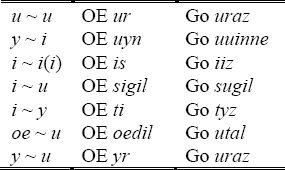
I restrict my analysis to OE and Go letter names in CV 795 that resemble one another enough to be considered cognates. I further limit myself to those letter names that have the graphs <u>, and <y> in their root syllables. Based on this, the possible correspondence sets available to the scribe appear in table 1.
Letter correspondence sets.

Among these pairings, sigil ∼ sugil stands out. Whereas identical correspondences (i=i, u=u) are unproblematic, and the correspondence of oe=u is not relevant to the alteration of OE sigil, the pairing of i and u presents a challenge for the sound ∼ symbol relationship. The ambiguous nature of <y> creates no difficulties when paired with either i or u because y can correspond to i (OE uyn ∼ Go uuinne, OE ti ∼ Go tyz) and u (OE yr ∼ Go uraz).
Rotsaert (Reference Rotsaert1983a:140) has argued that sugil on folio 20v is an attempt to represent a late Go form of Wulfilan Go (wulf.) sauil in a manner consistent with Gallo-Romance (Gallo-Rom) scribal practice. Along with utal (< wulf. oþal-) there is an apparent shift from ō to ū. The <g> serves to mark a glide in the hiatus, characteristic of Gallo-Rom as well as OHG spelling practices (see also von Grienberger Reference Grienberger1896:217, Wagner Reference Wagner1993:267). An origin in the Gallo-Rom region for the orthography, for example, at the Abby of Saint-Amande, is consistent with Archbishop Arno's connection between the two locations, as he had been Abbot of Saint-Amande prior to assuming the see in Salzburg. Furthermore, Arno was present in Saint-Amande in late 798 (Diesenberger & Wolfram Reference Diesenberger, Wolfram, Niederkorn-Bruck and Scharer2004:85) and could have brought the exemplar back to Salzburg, or might have requested that the codex be sent after his arrival. Falluomini's (Reference Falluomini2010) examination of the Go script, furthermore, leads her to align the gotica Vindobonensia with Visigothic rather than Ostrogothic origins.
The hand that wrote the rune names and transliterations on folio 20r, as well as the material of folio 20v, with the exception of the far-left column of Go letters and f(rauj)a þo x(rist)aus, seems to belong to the Salzburg scribe and magister, Baldo. Forstner's (Reference Forstner1974) examination of Baldo's writings in the Salzburg Verbrüderungsbuch (H8 in Forstner's facsimile edition) identifies the salient features of his hand as irregularities in some word forms, but mostly in the shakiness of his ascenders. Other features are to be found both there and in CV 795. Diagnostic features are the double stroke for making the clubbed ascenders, open <a> with high right stroke, predominant use of straight <d>, <e> with off-set top stroke, and the <g> with closed lower bow (Forstner Reference Forstner1974:26). In CV 795, the two-stroke clubbed ascender is most visible in the <đ> of đorn, <d> of ræda, and <l> of sigil on folio 20r, and the <l> of utal, <h> of his, and <d> of dicitur and gahlibeda on folio 20v. One can also note the parallel ascender strokes of the <d> in daaz, which are similar to Baldo's <d> in the name adalp(er)ht in the top line of the right corner on page 7 in the Verbrüderungsbuch. Moreover, CV 795, folio 20, contains exclusively the <g> with closed bow.
Bischoff (Reference Bischoff1980:118–119) supports Forstner's identification of Baldo's hand in CV 795. He points out that Baldo would have to have been in his earlier years, if his contributions to the runica and gotica are contemporaneous with the rest of the manuscript. Given that Baldo was still active in the early 850's under Archbishop Liuphramm and wrote in the Verbrüderungsbuch ca. 821, it is possible that he could have been in his early twenties at the time of the compilation of CV 795, assuming he died in his seventies. After an examination of the Hrabanic runica abecedaria, the problem of sygil ∼ sigil is addressed and an explanation is offered.
2.2. The Hrabanic Runica Abecadaria and OHG Sugil
What seems to have been overlooked while attempting to solve this problem is the manuscript's native linguistic context. The explanation for the correction of sigil to sygil lies in the homographic relationship between sugil of the gotica and an OHG lexeme formerly presumed to be of Anglo-Saxon origin (see, for example, Seebold Reference Seebold1991:541 in relation to the runica abecedaria in CV 751; Derolez Reference Derolez1954:205, Reference Derolez1959:16, Krause Reference Krause1968:63–66 in relation to the Hrabanic abecedaria; see also Grimm Reference Grimm1821:93, von Grienberger Reference Grienberger1899:35, Arntz Reference Arntz1944:215). The word sugil, and its orthographic variants suigil, siugil, and suhil, are found outside CV 795 in a number of collections of runic letters arranged in alphabetic sequence. As many of these appear in texts adjacent to Hrabanus Maurus’ De inventione litterarum, these alphabets were falsely attributed to him, which gave rise to the term Hrabanic runes (Derolez Reference Derolez1954:279–282, 1959:2–3).
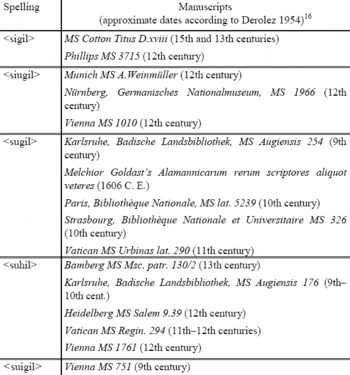
Of the Hrabanic runic alphabets, 16 contain a name for the s-rune.Footnote 15 Table 2 shows groupings arranged according to spelling.
Spelling variants of <sugil> in Hrabanic abecedaria.

The outlier here, <sigil>, from MS Cotton Titus D.xviii, differs from the others primarily because it appears in an English manuscript, whereas the others—in Continental, hence the spelling is more in line with the spelling of OE runes in manuscripts. Similarly, Philips MS 3715 has runic alphabets “closely related to similar entries in Exeter MS 3507 and Cotton MS Vitellius A.XII” (Derolez Reference Derolez1991:91).
2.3. CV 795 Sygil ∼ Sugil
If OHG had preserved a cognate orthographically similar to Go sugil, one might find an explanation for the correction of sigil to sygil in CV 795. Arguments regarding the presence or absence of secondary i-umlaut in OHG are as of yet unresolved.Footnote 17 Fertig (Reference Fertig, Lippi-Green and Salmons1996:178–180) points out, however, that much of the impasse is caused by the possible underspecified nature of OHG orthography in relation to the language's phonology. Folios 19 and 20 of CV 795 by their very nature allow one to mitigate, if not transcend, the traditional problems of native German orthography. One may compare the problematic y ∼ i ∼ u set with a similar set of sounds and graphemes on the preceding folio.
The table of roman-script equivalents for Gk diphthongs in CV 795 presents the Gk <αι>, <ει>, <οι>, and <ου> diphthongs, arranged in four columns of 15 rows in combination with consonants. Within this four-by-fifteen matrix, the equivalents of the Gk vowels are given in Lat script as <e>, <i>, <y>, and <u>, respectively. This is also true for the column of vowel correspondences between the matrix and the examples of Gk numeral equivalents at the top center of folio 19v. Gk pronunciation of <οι> by the Middle Ages had moved from original [oi] to [y], which is reflected in their equivalents in Lat script. One should note that these are not transliterations, but an attempt to represent the same sound with a familiar grapheme.Footnote 18 There would be little sense to convey the sound value of Gk <οι> as <y> unless it was meaningful to the one who had provided the equivalents and their intended readers.
A parallel to the Go ∼ Gk ∼ Lat script interaction in CV 795 is found in a contemporary manuscript from the Abby of Saint-Denis, whose main content was produced around the year 800. Codex Parisiensis, MS lat. 528 contains, on folio 71v, Gk diphthongs, their equivalent sounds in Lat script, as well as Biblical names from the Generatio of the Gospel of Luke in Go and Lat letters. At the bottom of the page are eight letters of the Go alphabet, with equivalents written above each. Bischoff's (Reference Bischoff and Bischoff1984:256–258) analysis leads him to identify the hand of the Parisian gotica as different from the main hand of the codex, but the same as the hand that entered the name Abbot Abbo of Massay into Bourges Abbey's necrologue, in the year 861 (see also Seebold Reference Seebold, Haubrichs, Hellgardt, Hildebrandt, Müller and Ridder2000:25).
Unlike the graeca and gotica of Salzburg, the equivalents given in the Codex Parisiensis betray speakers of Gallo-Rom. Equivalents are given as “Aι p(ro) e Ει p(ro) e Οι p(ro) i ΟΥ p(ro) u,” where the front rounded sound value of Gk <οι> is absent. Similarly in the gotica, in addition to the equivalent of Go þ (.þ.) as t, the two sounds represented by V (.w.) are given as u (=[w]) and as i, where the letter usually transliterates upsilon. The comparison between CV 795, folios 19 and 20 and MS lat. 528 suggests a language community around Salzburg with a three-fold distinction between [i], [u], and [y]. MS lat. 528, however, suggests no presence of [y], since Gallo-Rom had not developed the high front rounded [y] of Old French at this point (Pope Reference Pope1973:79, 90, §§166, 183).
Sugil and its variants in the Hrabanic alphabets cannot be explained as copies of the gotica of CV 795; nor can one assume that these words are loans from OE, because other than sygil of CV 795, there is no textual support for the existence of any such lexeme in OE. One should entertain the possibility that they reflect a native OHG word that is orthographically and semantically similar to sugil of CV 795's gotica. The variation between medial <g> and medial <h> in the runica abecedaria also suggests that the word was disyllabic with hiatus, just like Muspilli 59a uugir ‘fire’ of MS Cod. monac. lat. 14098 (Simms Reference Simms2009:321). One suggested phonetic value of OHG sugil would be [sY.Il].
An explanation for the writing of <y> upon sigil of CV 795, folio 20r may lie in the following: The corrector, likely Baldo, after having reviewed the gotica and having noted the similarities between the runic names on the preceding side of the folio, took it upon himself to alter the OE runic names to more closely match their Go cognates. OE fech ‘livestock’ was joined with (late) Go fe ‘livestock’, and OE rad ‘riding’ was given the ending -a to match Go reda ‘journey’. Furthermore, a was altered to æ in order to bring a more sensible correspondence to the variation between OE <a> and Go <e>, as <æ>, <ę>, and <e> can stand in free allographic distribution. Correspondingly, OE sigil, which differs from Go sugil by only one letter, was also assumed to be sugil's cognate. The corrector's perception of Go sugil, however, was not as [su:Il] or [su:Il], the two likeliest reflexes of wulf. sauil; rather it was colored by his native language, where sugil would have been pronounced [sY.Il] ‘sun’. In the absence of OHG orthographic constraints, and with the false assumption that OE sigil is cognate with Go sugil, the corrector added an <y> on top of the first of sigil to accord better with his native pronunciation. His intuition was strengthened perhaps further by the possible connection between Go uraz and OE yr. Given that the runic names ur and yr could reflect the same lexeme as Go uraz, the corrector might well have assumed that an <i> in sigil was introduced by a speaker whose own native language (like the language of the Gallo-Rom speakers of Saint-Amande) lacked front rounded y and who, therefore, often represented y with.
In section 3.3, I present etymological arguments for the development of OHG sugil. Why this OHG lexeme was preserved only in the runica abecedaria remains to be explained. In sum, one should no longer look to either OE sigil or the sygil of CV 795 in pursuing etymologies for ‘sun’ in Gmc.
3. Etymology of OHG Sugil
The OE form cited as sygil and Go sugil does not support the reconstruction of PGmc + sugil (< Pre-Gmc + suwel-).Footnote 19 However, OHG sugil (with spelling variants <suigil, siugil> and <suhil>) found in runica abecedaria could reflect PGmc + suïl ‘sun’.Footnote 20 At first, one ought to consider the <g> in the gotica Vindobonensia and OHG sugil as a hiatus marker rather than an actual consonant. One cannot rely on a change from PIE + -w- > Gmc + -g- based on examples such as OE nigon ‘nine’ < +PIE +neu̯ṇ (Lehmann Reference Lehmann1955:49), since the -g- in OE nigon could have likely resulted from serial analogy with PGmc + teγunð-a- ‘tenth’ (PIE + dek´ṃ-tó-) or PGmc + newun-teγunz ‘90.acc.pl’ > + neγun-teγunz.
The PIE word for ‘sun’, which is the only l-/n-stem heteroclite, poses extensive etymological challenges, given the wide variety of stem forms reflected.Footnote 21 Gmc stems in -l are found in Go sauil (< PIE + seh 2u̯el-o-) and Old Norse (ON) sól (see discussion below). The PGmc etymon of Go sauil is + sō(w)ila-. It traces back to the same etymon as Gk ἥλιος, though with different derivational stems (both from PIE + seh 2 u̯el-).
Newer suggestions on the source of PIE ‘sun’ have viewed the plethora of forms as derivatives of the root + seh 2- ‘heat, warmth’. The connection between this root and ‘sun’, however, is not new (see Huld Reference Huld1986; Lehmann Reference Lehmann1986:330, who cites Scherer Reference Scherer1953:50; Wodtko et al. Reference Wodtko, Irslinger and Schneider2008:607–608).Footnote 22 Nikolaev (Reference Nikolaev2009) discusses the derivation of Cuneiform Luvian (CLuv) ši(h?)u̯al ‘dagger, that is, that which is sharp’ (< athematic preform + sēh 2/3 u̯ōl) and its relation to CLuv ši(h?)u̯a/i ‘bitter, sour, that is, sharp/bitter (to the tongue)’.Footnote 23 He suggests the existence of an acrostatic u-stem + sēh 2/3 u- ‘sharpness’, where Anatolian exhibits semantic development of HOT > SHARP.Footnote 24 Had this acrostatic noun arisen semantically from a PIE root that originally meant ‘hot’, then one could ostensibly posit derivatives whose locatival form could have taken a variety of athematic stems. These could include, for example, -en, -er, or -el: + s(e)h 2 u̯en, + s(e)h 2 u̯er, + s(e)h 2 u̯el, or stems with Schwebeablaut (where the full-grade vowel can appear on either other side of a consonant), as in + sh 2 eu̯(i) (pp. 471–472). Many of the varying forms of ‘sun’ in the Indo-European (IE) daughter languages could stem from an originally delocatival series of derivatives, PIE + seh 2 u̯el- (pp. 477–481).Footnote 25
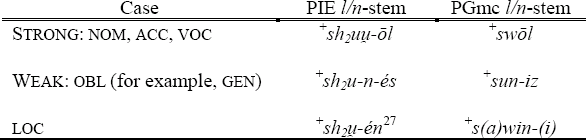
The starting point for this etymology, then, will be a heteroclitic l/n-stem with a holokinetic accent-ablaut declension, PIE + sh 2 uu̯-ōl.Footnote 26 ON sól need not be a reflex of either PGmc + sōwil-ō, or + sōwul-ō < PIE + seh 2 u̯el- or + seh 2 u̯l?- (for example, Pokorny Reference Pokorny1959:881; Lehmann Reference Lehmann1986:297; Bammesberger Reference Bammesberger1990:206; Bjorvand & Lindeman Reference Bjorvand and Lindeman2000:831; Gerasimov Reference Gerasimov2002:141, Reference Gerasimov and Kasanskij2005:176; Ringe Reference Ringe2006:277; Wodtko et al. Reference Wodtko, Irslinger and Schneider2008:606; Nikolaev Reference Nikolaev2010:50). Rather, I would suggest that ON sól reflects the PIE nominative accusative neutral holokinetic collective + sh 2 uu̯-ōl, to which one should add, as cognates, OE swōl ‘heat, warmth (of the sun)’ and Middle High German (MHG) swuol, swüele ‘heat, warmth’.
The holokinetic PIE paradigm of + sh 2 uu̯-ōl as it would have been inherited into PGmc is presented in table 3.
The holokinetic PIE paradigm of + sh 2 uu̯-ōl.

Loss of prevocalic laryngeal and reduction of the Lindeman's Law variant changes + sh 2 uu̯-ōl into PGmc + swōl (see, for example, Ringe Reference Ringe2006:121–122 and Simms Reference Simms2009:308).
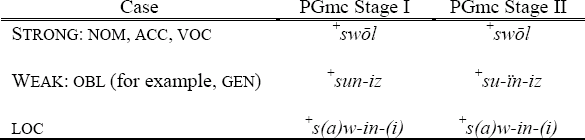
The inherited paradigm possessed opaque allomorphy, alternating between strong + sw- and weak + su-. Similarly, the oblique stems possess both zero- and e-grade forms. At first one may suppose a change within the oblique stems. Since other heteroclites, such as ‘fire’ (Go fon), remained heteroclitic within PGmc (Euler Reference Euler2000, Simms Reference Simms2009), changes affecting the obliques need not have affected the nominative form. Whereas it is clear that the zero-grade n-stems survived in Gmc forms beginning with sunn-, there may have been a stage when the more regular e-grade of the n-stem was leveled through the obliques. Pressure to level came either from the n-stems in general, or from the inherited locative form with e-grade of the stem (which leaves no visible trace in Gmc).
Paradigmatic changes in ‘sun’ in PGmc.

Alongside the n-stem forms, which are not treated here, a paradigm with the l-stem leveled throughout—as one sees in the r-stem forms of ‘fire’ in North-West Germanic (Simms Reference Simms2009)—and reduced the complexity of the allomorphy. This is shown in table 5.
Leveling of stem consonant in PGmc.

Paradigmatic changes such as these need not exclude the continued existence of earlier forms (such as + sun-, which continues on its own route). However, other than OHG sugil, there is no remaining trace of the intermediary PGmc + su-ïn. Moreover, given the opaque relationship between + swōl and + suïl-, these two split from each other as well. PGmc + swōl continued on as ON sól ‘sun’, whereas OE swōl and MHG swuol both came to mean ‘heat/warmth (of the sun)’. As PGmc develops, + suïl- survives into WGmc as OHG sugil, a noun grown independent of + swōl via analogy with root-nouns, as shown in table 6.Footnote 28
Analogical restructuring in WGmc + suïl.

In OHG, one would expect + suïl to remain disyllabic, as fuir ‘fire’ had done up until the 9th century. Typical orthographic representations of OHG suïl (with i-umlaut [sY.Il]) would be any of the variants one encounters in the Hrabanic runic abecedaria: sugil, siugil, suigil, or suhil.Footnote 29
In OE, however, one needs to account for the switch in the name of the s-rune to sigil (why the reflex of PGmc + suïl was chosen among all others is unclear). One possibility lies in the near homophony of OE sigil ‘brooch, jewel, sun’ [sIʝIl] < Lat sigillum and an OE [sYjIl], a reflex of PGmc + suïl with possible medial glide in the former hiatus. Assuming this near homophony existed until the effects of i-umlaut were present, the two differ mostly in the rounding of the first syllable's vowel and the medial voiced palatal fricative or palatal glide: [sIʝIl], on the one hand, and [sYjIl] < PGmc + suïl, on the other. Moreover, the evidence seen in OHG would suggest that PGmc + suïl had become marginalized in the lexicon. A more widely known lexeme would have easily replaced a rarer word.
A second, although less likely, possibility presents itself: [sY(j)Il] could have eliminated hiatus between syllables to produce [sy:l]. Homophony with OE sy¯l ‘column’ < PGmc + sūliz ‘column’ could have presented a semantic mismatch with the mnemonic tradition in which the s-rune's name was ‘sun’. However, given that sunne adheres to the acrophonic principle and is semantically identical to ‘sun’, it is odd that sigil would have been the preferred choice for an acrophonic representative of the s-rune (perhaps it was preferable because it begins and ends with the same sound as its PGmc predecessor). Poetic diction may have also played a role in this shift, as elsewhere one finds the sun referred to as heofenes gim ‘the gem of the sky’ (Beowulf 2072b). Because the metaphor for the sun as a jewel in the sky was present within that culture, it is not too far a leap for one to begin to use a term for ‘brooch’ as a word for ‘sun.’ As the older reflex of PGmc + suïl ‘sun’ grew less common, a term with wider familiarity, sigil, could have replaced it within the runic letter names.Footnote 30
5. Conclusion
Often etymology works in tandem with philology. As I have argued in the first part of this article, one must read a text carefully before drawing etymological conclusions. The interpretation of the word <sygil> or <sigil> in CV 795 requires attention to the scribal hand, the orthographies at play, and the complicating factors of scribal interpolation. For <sygil>/<sigil>, one must recognize that the <g> marks hiatus between syllables, that the <y> is likely a later interpolation, and that evidence for an OHG lexeme sugil is attested elsewhere. Recognition of these philological aspects creates a better source of information for etymological conclusions. In the case of <sygil>, one may turn away from etymologies proposing a PGmc etymon + sugil-.
Etymology, in turn, provides insights into what one might read within a given text or texts. By finding an etymology for both OHG sugil and Go sugil in the gotica Vindobonensia, one can also consider new etymologies for the words for ‘sun’ in Germanic as a whole. Some key points in this article are that the l-/n-stem heteroclite may have had an l-stem WGmc reflex in OHG sugil and that ON sól may derive from the same etymon as OE swōl ‘heat, warmth (of the sun)’ and MHG swuol, swüele ‘heat, warmth.’ Furthermore, the development in this heteroclite may parallel developments seen in the r-/n-stem heteroclite in the Gmc words for ‘fire’ (see Simms Reference Simms2009). Turning back to philology again, the etymological problems seen in the words for ‘sun’ in Gmc may give one reason to reassess the textual data and previous etymologies built on the problematic data.