Introduction
The unprecedented magnitude of the coronavirus disease (COVID-19) infection led to the closure of educational institutions, including schools, with no adequate framework to ensure continuity of services and procedures to reopen, when the situation subsides. Reference Dibner, Schweingruber and Christakis1 As of April 16, 2021, India is the second most affected country globally, with a total of 13 358 805 cases and 180 530 deaths, the case fatality rate being 1.3%. 2
The adverse effects of school closures in terms of social and economic aspects Reference Esposito and Principal3 may outweigh, in the long run, the potential benefits that are being intended to achieve due to reduced virus transmission at present. Experts opine that school closures could have adverse medical, social, and economic effects. Reference Esposito and Principal3 It is feared that the children might lose essential benefits of schooling until they physically return to the school, especially in developing countries like India, where the social and economic differences will further be strained. Children returning to schools could also improve the participation of parents in the economy by partially freeing them up from their caregiving responsibilities. In conditions of moderate transmission (< 10 cases per 100 000 people), it is opined that the school services should be recognized as an essential service. Reference Levinson, Cevik and Lipsitch4
Developed nations assumed that schooling instructions can continue through distance learning, but it was soon learned that children struggle with it if an adult is not available for supervision. In poorer settings, the adult cannot afford or is unaware of the usage of technology. Reference Dibner, Schweingruber and Christakis1 Even in high-income countries such as Italy, it was found that almost 41% of the households had no access to digital tablets or personal computers in poorer parts of the country. Another report states that only 14.3% of families in Italy with 1 or more children could afford distance learning. Reference Esposito and Principal3 A similar condition or even a more frightful scenario could be experienced in developing countries like India. 5,Reference Mishra6
Modeling studies indicate that the closure of schools can be significantly effective for infection control when the outbreaks are caused by viruses with transmissibility similar to the influenza virus 7 (the serial interval of the influenza virus is 3 days, while it is around 5-6 days for COVID-19), but this decision may not be well grounded for the severe acute respiratory syndrome coronavirus 2 (SARS-CoV-2) infection, for evidences indicate that children are less affected by this virus and the transmission dynamics point toward an increased transmission among adults and elderly. Reference Esposito and Principal3,7 Studies across the globe reveal that most children between 1 and 18 years of age experience no illness or only a mild infection from COVID-19 and are very unlikely to face severe consequences compared with an adult or elderly. However, from a clinical perspective, a small number of children has been reported to have multi-system inflammatory syndrome (MIS-C) after SARS-CoV-2 infection, though it appears to be a rare phenomenon (2 per 100 000 people under 21 years of age between March and May, 2020). The clinical outcome in the children is shown to be better than the adults, with early recognition and treatment. Reference Levinson, Cevik and Lipsitch4 As of date, the role of children as asymptomatic spreaders in the community is not established by strong evidences. The possibilities cannot be ruled out yet, contemplating the changing facets in the natural history of the novel disease.
Evidence from the countries that have reopened their schools (Taiwan, Finland, Germany, New Zealand, Israel) has shown limited COVID-19 transmission in the school settings and low community transmission rates. However, modifications in the procedural functioning, such as reducing the size of the class to half, exempting high-risk children and teachers, and adopting a hybrid model of functioning, were observed from various countries such as the Netherlands and Denmark. Reference Levinson, Cevik and Lipsitch4,Reference Couzin-Frankel, Vogel and Weiland8,Reference Wang, Ng and Brook9 Also, in Taiwan, the schools were kept open throughout the pandemic, yet successfully maintained negligible levels of transmission among children. This, however, could also be attributed to an early and aggressive outbreak response in Taiwan prior to the recognition of COVID-19 as a Public Health Emergency of International Concern (PHEIC). On the other hand, a resurgence of cases was observed in Israel in May 2020, which was presumably linked to the opening of high schools.
In India, the state of Andhra Pradesh reopened the schools in November, following a Standard Operating Procedure (SOP) released by the Ministry of Health and Family Welfare, Government of India (September 8, 2020), for the voluntary reopening of schools for higher classes. 10 Despite strict implementation of preventive measures, a cluster of about 575 students and 829 teachers was found to test positive for COVID-19 after reopening. However, owing to the small percentage (0.1% of the total number of students attending school in the state, which is around 975 000), policy-makers and administrators did not feel that such clusters contribute to community transmission of COVID-19. Also, it should be noted that other states in India, such as Karnataka, look up to the model of graded reopening implemented in Andhra Pradesh. 11
In this study, a field experience from a village in the state of Rajasthan is highlighted, in relation to the reopening of schools, after options for alternative arrangements were ruled out as impossible. Also, the study brings into focus the importance of assessing the readiness of schools to reopen in order to accept students in a promising atmosphere. In the process, an indigenous readiness checklist to achieve this purpose has also been developed.
The Experience From the Field
In the village of Dhawa, Jodhpur, there is one government senior higher secondary school catering to a population of about 5500, with an enrolled strength of around 750 students and an average attendance of more than 90% throughout the academic year. During the pandemic, the school had also served as one of the “COVID Care Centres” to quarantine the migrant population and served those who couldn’t afford to isolate themselves in their own shelters.
A health-need assessment conducted in the village, following the nationwide lockdown, exposed diverse problems from various participants. One commonly cited problem by a majority of the participants was limited access to education during this lockdown due to their non-affordability of electronic devices. This problem was asserted in a “Swacchh Bharat Meeting – Grameen” held in the village and also held up by the school principal and senior teachers, who confirmed, based on attendance records, that only about 50% of the students now were able to take advantage of the online classes conducted by the school.
An effort was taken from our side, along with the village development officer and the school principal to make alternative arrangements (setting up of computers with Internet connection in a community hall, with maintenance of social distancing norms and preparation of time-based schedules for different classes of students) for the students to continue the education in a safe atmosphere. Considering the requirement of a written permission from government officials and thereby ruling it out, the only option left was to reopen schools if we were not to face any adversities related to the education of children as pointed out in the literature (drop-outs, loss of in-person benefits such as mid-day meal schemes, pull back of labor force to take care of children at home).
In view of this, there was a normative need to assess the readiness of the school to reopen in a conducive and safe atmosphere to accept students. An SOP for the voluntary reopening of schools was released by the Ministry of Health and Family Welfare and the Government of India, at the same time (September 8, 2020), which came in as a reinforcement to the line of thought. In a brainstorming session with the school principal and teachers, suggestions were gathered from their side to implement measures that could lead to a safe environment in the school. These included the following:
-
Re-arrangement of infrastructure to maintain social distancing norms.
-
Schedules for classes (time-based for different classes).
-
Hybrid mode of classes (continue online classes along with offline classes).
-
Utilization of open spaces under shade for conduct of proceedings.
-
Establishment of multiple checkpoints with handwashing and sanitization portals.
-
Obtaining willingness of parents to send students back to school.
-
Reinforcement of preventive measures by IEC (Information, Education, Communication) material displayed in the school.
-
Awareness and training sessions for students and staff.
The Centers for Disease Control and Prevention Readiness and Planning Tool 12 for the reopening of schools was taken as a guidance document to perform the assessment, though all the points in the document were not directly applicable to the Indian schools, such as arrangement of accommodations, plan for serving meals in wrapped boxes or plates, or broadcasting of announcements.
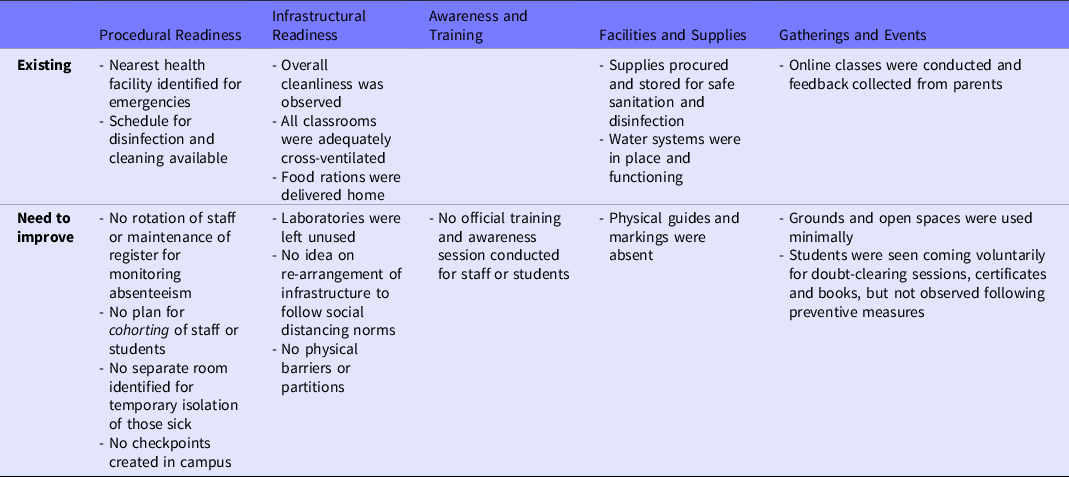
The findings from the assessment of the school are enumerated below in the following domains (Table 1).
-
Procedural Readiness
-
Infrastructural Readiness
-
Awareness and Training of Staff
-
Facilities and Supplies
-
Gatherings and Events
Findings from the assessment of readiness in the school

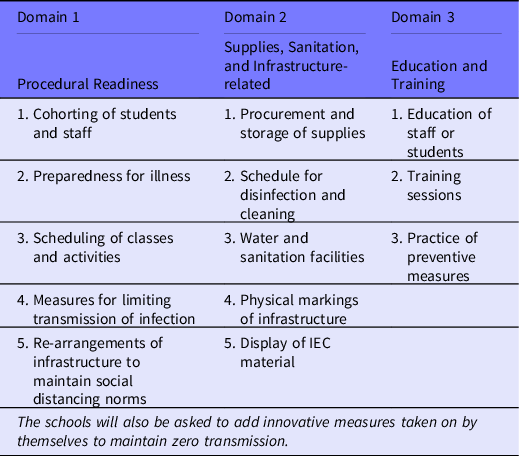
From the above activities, a need was evident to have an indigenous checklist that could serve as a guiding document for both assessment and implementation of mitigation measures, if deficits are recognized. Hence, an indigenous readiness checklist was prepared with 3 domains, keeping in mind the suggestions provided by the teachers and the findings from the assessment, to fit the Indian schools, which shall help prevent transmission of the virus in the schools (Table 2). The entire checklist is available as supplementary material.
Checklist for assessment of readiness in Indian schools

How Was the Problem Approached?
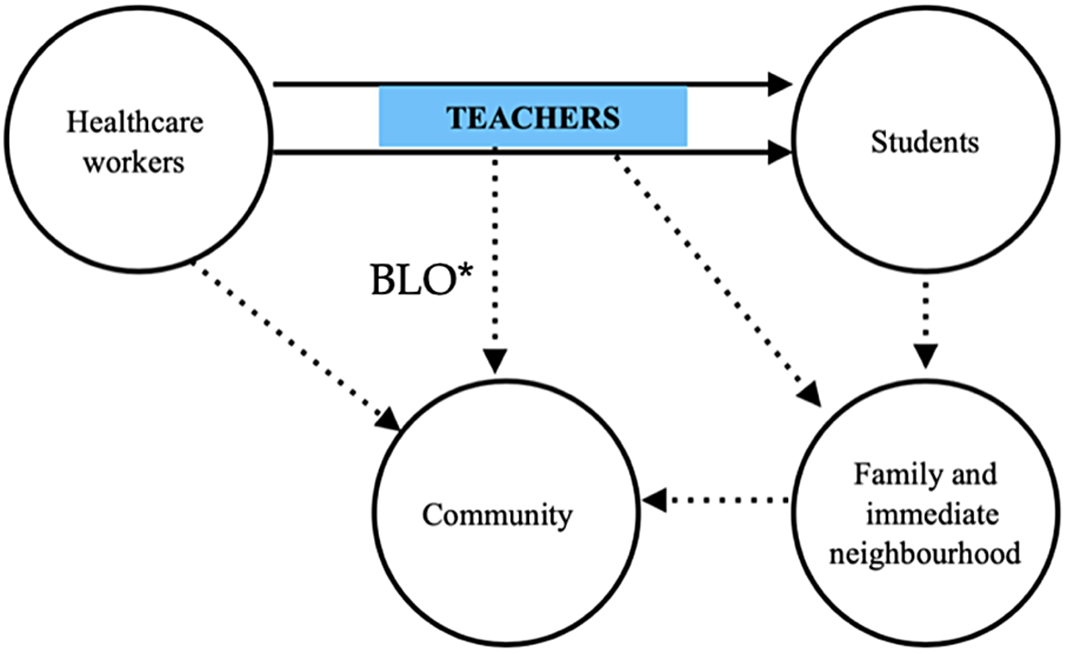
The deficits identified through the assessment were highlighted during a training and awareness session conducted for the teachers, which is also considered a domain in the readiness. The idea behind choosing teachers as the bridging link in dissemination of proper and adequate information for awareness was emphasized in the session (Figure 1).
Teachers as bridging link in disseminating the right information to generate awareness in the community. BLO = Both level officers.

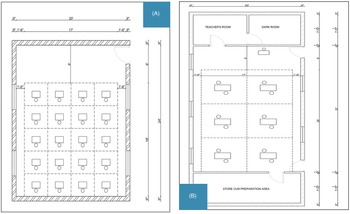
Illustrations for revised arrangements of classrooms (A) and laboratories (B) to maintain social distancing norms. Source: Revised based on Indian Standard Recommendations for School Buildings.

The training session for 15 teachers, which lasted for about 2 hours in the chosen Senior Secondary school, involved discussion on the implementation of mitigation measures in the school campus, to disseminate the information and training of students as ambassadors, to practice the preventive measures, and to promote healthy life choices to maintain positive health (yoga, good nutrition). The session involved utilization of virtual medium (Google Meet) for enabling discussions with experts.
Key points of the training and awareness session for teachers included:
-
Implementation of mitigation measures in school.
-
Dissemination of information and training of students as ambassadors for awareness generation.
-
Removing misconceptions and myths around COVID-19.
-
Re-arrangement of infrastructure by demonstration (Figure 2).
-
Promoting healthy life choices to maintain positive health (yoga, nutrition).
-
Preparation of time-based schedules for classes and other activities.
Outcomes of the Activity
The implementation of the mitigation measures in the school was overviewed and was found that the teachers were skilled and confident in better handling the work. The information discussed in the session and the IEC material provided were shared among students of the school (around 500 students) through electronic media (WhatsApp or e-mails), and prints were given to the teachers who were present during the training session. IEC materials related to prevention of COVID-19 were displayed at various places in the school. Re-arrangements of infrastructure with physical distancing norms were discussed but were not immediately implemented as the arrangements were being made in the school for conducting local ward elections.
Conclusion
Given the transmission dynamics of COVID-19 and the low infectivity observed in children, Reference Couzin-Frankel, Vogel and Weiland8,Reference Wu and McGoogan13 it could be considered safe to reopen schools, if the schools are “ready” by implementing appropriate rectifying measures. Considering the clusters of cases in states of Andhra Pradesh and Himachal Pradesh, which are presumably linked to reopening of schools, it is emphasized to implement a readiness assessment in every school prior to reopening. The readiness checklist that we have developed can be conveniently used to achieve the purpose for our Indian schools. The reopening of schools during the pandemic will prevent the nation from facing other adversities related to loss of schooling by children and also enable the full return of the human resource (including people in the health care sector) to work, thereby reducing the negative impact on economy and productivity.
The experience gained in the field can be comprehensively summarized into 3 operational steps, which will help in the implementation of the same practice in any Indian school, making them conducive and safe for reopening:
-
1. Identify the problem using the “Readiness Checklist.”
-
2. Obtain baseline information and innovative measures (if any).
-
3. Implement rectifying measures by supportive supervision.
Supplementary material
To view supplementary material for this article, please visit https://doi.org/10.1017/dmp.2021.239