INTRODUCTION
The genus Jassa Leach, 1814 includes approximately 36 species (Lowry, Reference Lowry, Horton, Lowry and De Broyer2014) distributed from tropical to polar marine environments (Conlan, Reference Conlan1990; Jażdżewski et al., Reference Jażdżewski, Broyer, Teodorczyk and Konopacka1991). These organisms are the main food source for many animals and generally constitute one of the most important components in peracarid assemblages (Jeong et al., Reference Jeong, Yu and Suh2007; Beermann & Franke, Reference Beermann and Franke2012). The great similarity between species and the enormous intraspecific variation (i.e. strong sexual dimorphism and intra-male polymorphism) makes it difficult to characterize the taxonomy of the group (Conlan, Reference Conlan1990; Lim & Park, Reference Lim and Park2006; LeCroy, Reference LeCroy2007), so many species have been erroneously determined. Up to this moment, three species of Jassa have been previously recorded along the coasts of Argentina: Jassa alonsoae Conlan, Reference Conlan1990, Jassa marmorata Holmes, 1905 and Jassa falcata (Montago, 1808) (López-Gappa et al., Reference López-Gappa, Alonso and Landoni2006; Alonso, Reference Alonso2012).
Jassa slatteryi Conlan, Reference Conlan1990 is a small benthic amphipod that lives in self-constructed tubes and feeds principally on detritus and diatoms (Howard, Reference Howard1982; Jeong et al., Reference Jeong, Yu and Suh2007; Beermann & Franke, Reference Beermann and Franke2012). Its iteroparous life cycle, high fecundity, earlier maturity and presence in ballast water and ship fouling has favoured its invasion in numerous regions of the world; harbours constitute the initial area of settlement for this invasive species (Robinson et al., Reference Robinson, Griffiths, McQuaid and Rius2005; Lim & Park, Reference Lim and Park2006; Jeong et al., Reference Jeong, Yu and Suh2007; Flynn & Valério-Berardo, Reference Flynn and Valério-Berardo2009; Ahyong & Wilkens, Reference Ahyong, Wilkens, Galil, Clark and Carlton2011).
As part of an ongoing project for the monitoring and biological identification of native and exotic benthonic invertebrates in Mar del Plata harbour, Argentina, using DNA barcoding, in this paper we report, for the first time, the occurrence of Jassa slatteryi using morphological and genetic analysis.
MATERIALS AND METHODS
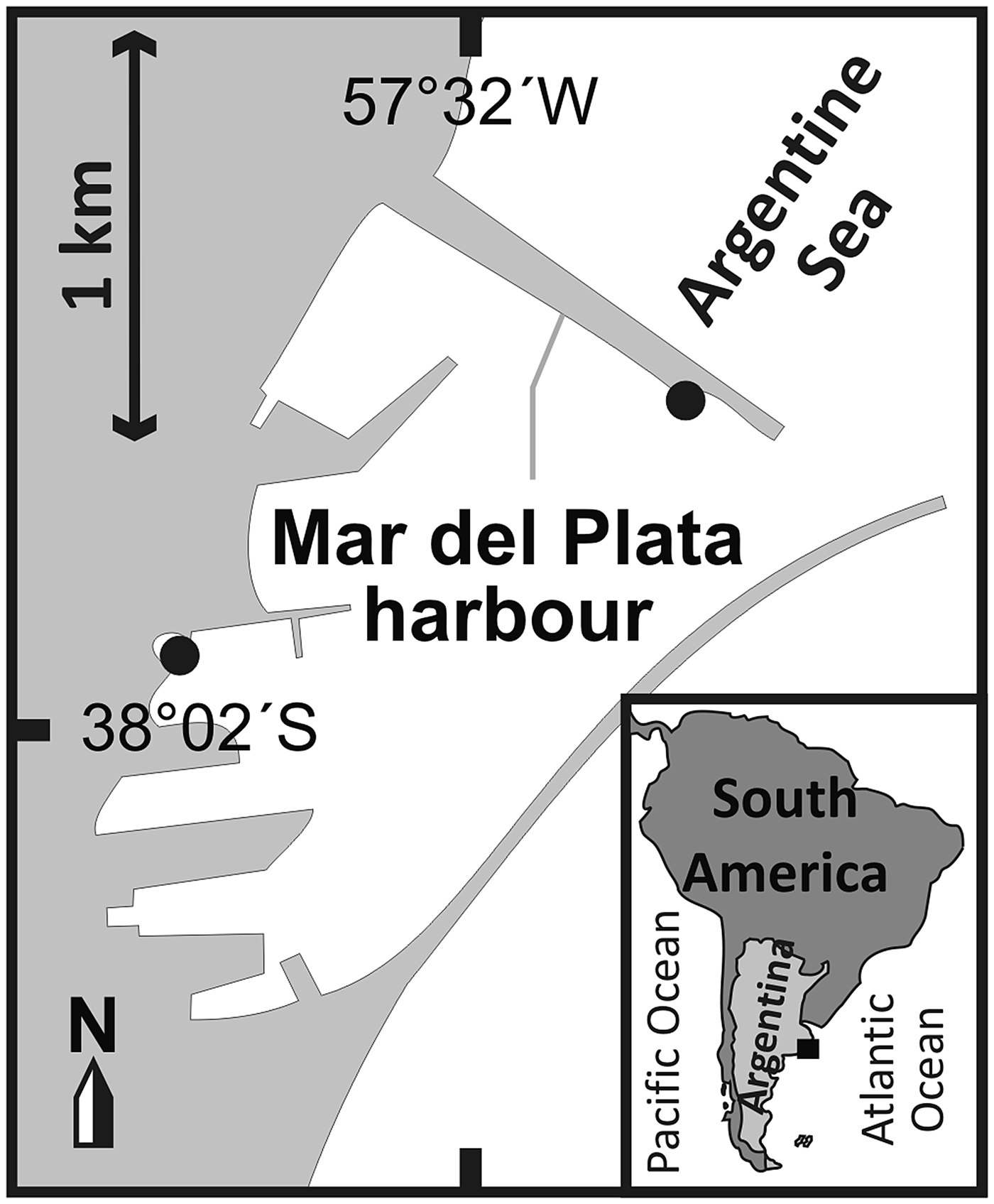
The specimens of Jassa slatteryi were collected in December 2010, November 2011 and August 2012 in Mar del Plata harbour (Figure 1), one of the most important harbours in the country due to naval traffic, commercial trade and size (Rivero et al., Reference Rivero, Elías and Vallarino2005; Albano et al., Reference Albano, Lana, Bremec, Elías, Martins, Venturini, Muniz, Rivero, Vallarino and Obenat2013). The harbour presents the typical characteristics of a polluted environment: high levels of organic matter from sewage and biogenic sources, hydrocarbons from ships and factories, low salinity and pH and anoxic conditions due to low turbulence (Rivero et al., Reference Rivero, Elías and Vallarino2005; Albano et al., Reference Albano, Lana, Bremec, Elías, Martins, Venturini, Muniz, Rivero, Vallarino and Obenat2013). Despite these conditions, the docks serve as settlement sites for ascidians, algae and polychaete tubes that generate refuges for a great variety of fishes, molluscs, crustaceans, nematodes and annelids (Albano & Obenat, Reference Albano and Obenat2009; Albano et al., Reference Albano, Lana, Bremec, Elías, Martins, Venturini, Muniz, Rivero, Vallarino and Obenat2013).
Geographical localization of the study area and general view of Mar del Plata harbour, including the position of sampling sites where the species was found in the present study (•).

Polychaete tubes of Phyllochaetopterus socialis (Claparède, 1869) were scraped up with spatulas and samples were fixed in 98% alcohol. In the laboratory, amphipods were separated from the extracted material using a stereoscopic microscope and determined with taxonomic guides (Conlan, Reference Conlan1990; Lim & Park, Reference Lim and Park2006; Chapman, Reference Chapman and Carlton2007). Jassa slatteryi specimens were measured, dissected and photographed. In order to confirm the species identification through genetic analysis, a tissue sample was obtained from two specimens and used for the molecular analysis of a partial fragment of the barcode gene cytochrome oxidase I (COI). DNA was extracted using an automated Glass Fibre protocol (Ivanova et al., Reference Ivanova, Dewaard and Hebert2006). Amplification of the 5′ barcode region of COI was first attempted using the primer pair LCO1490 (5′-GGTCAACAAATCATAAAGATATTGG-3′) and HCO2198 (5′-TAAACTTCAGGGTGACCAAAAAATCA-3′) (Folmer et al., Reference Folmer, Black, Hoeh, Lutz and Vrijenhoek1994), primers were appended with the M13F (5′-TTGTAAAACGACGGCCAGT-3′) and M13R tails (5′-CAGGAAACAGCTATGACC-3′) to facilitate sequencing. The polymerase chain reaction (PCR) was performed in 12.5 µL volume containing 2 µL H2O, 6.25 µL 10% trehalose, 1.25 µL 10× PCR buffer, 0.625 µL MgCl2 (50 mm), 0.0625 µL dNTPs (10 mm), 0.06 µL Platinum Taq polymerase (Invitrogen), 0.125 µL of each primer (10 µm) and 2 µL DNA template. The PCR reaction profile consisted of 1 min at 95°C and 35 cycles of 30 s at 94°C, 40 s at 50°C and 1 min at 72°C, with a final extension at 72°C for 10 min. Additional details about laboratory protocols for each step are available from the Canadian Centre for DNA Barcoding (CCDB) website (http://ccdb.ca/docs/). The obtained COI sequences were compared against both the Barcode of Life (BOLD, http://www.barcodelife.org) and the GenBank (http://www.ncbi.nlm.nih.gov/GenBank) databases using BLAST. The BLAST algorithm finds regions of local similarity between the query sequence and the sequences found in the above databases. BLAST provides a statistical value for each sequence, called the E-value, which describes the number of hits one can ‘expect’ to see by chance when searching a database. E-values closer to zero indicate a significant match.
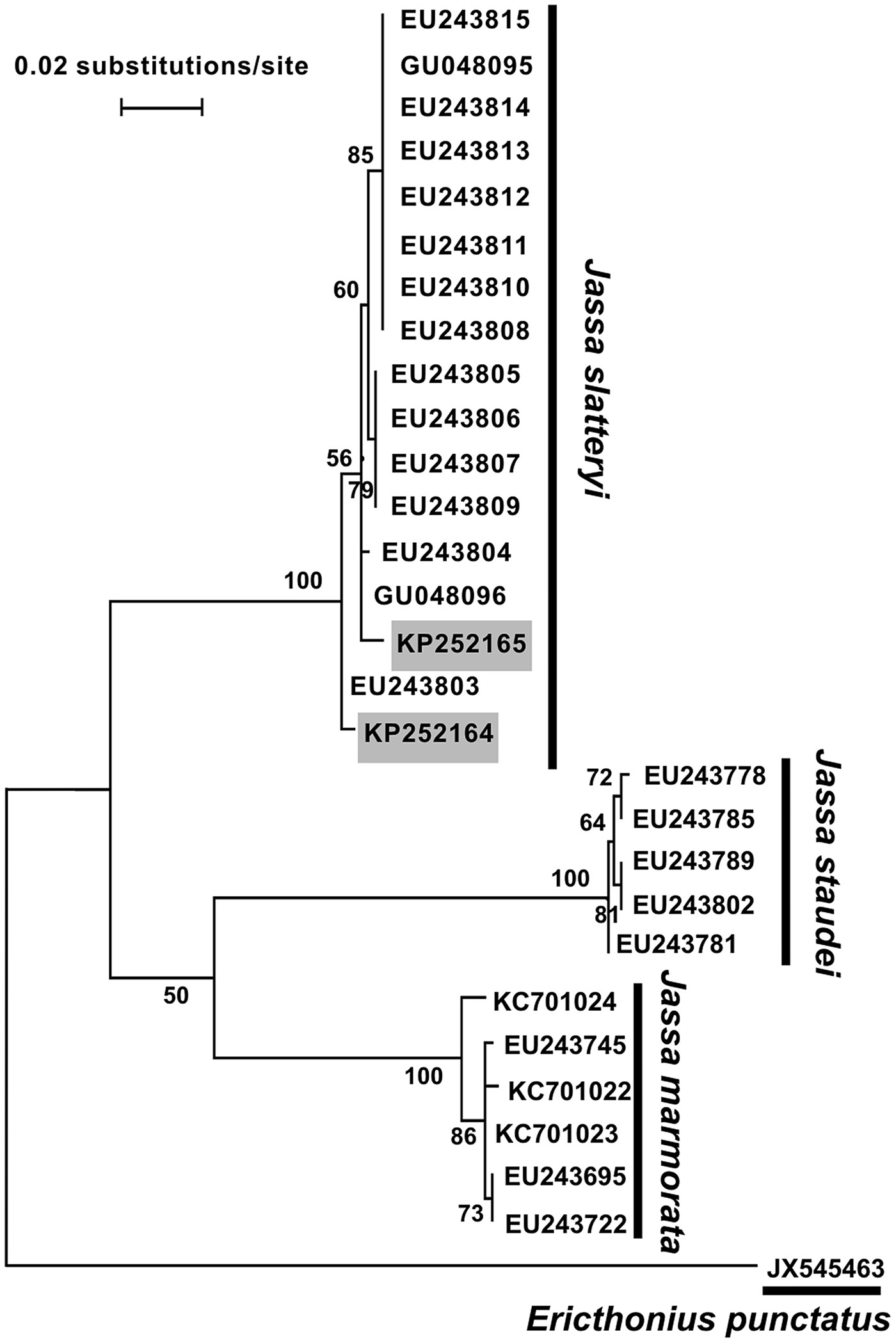
A phylogenetic analysis based on the construction of a maximum-likelihood tree was conducted to validate the identity of our material and the Jassa spp. from GenBank. For this phylogenetic analysis, additional COI sequences of Jassa spp. were retrieved from GenBank (for species name and accession numbers, see Figure 3). The COI sequence of Ericthonius punctatus (=Ericthonius brasiliensis) (Bate, 1857) was used as an outgroup. The COI sequences were aligned using BioEdit v.7.08.0 software (Hall, Reference Hall1999) through the Clustal W method (Thompson et al., Reference Thompson, Higgins and Gibson1994) and were verified by sight. A phylogenetic tree was inferred in MEGA v6 (Tamura et al., Reference Tamura, Stecher, Peterson, Filipski and Kumar2013; http://www.megasoftware.net/) and was evaluated with a bootstrap test with 1000 replications.
The COI sequences generated in the present study were deposited in GenBank (Accession numbers: KP252164, KP252165) as well as in the ‘Native and exotic invertebrate of Mar del Plata harbour’ project (code INVMP) on BOLD. Voucher specimens were deposited at the Estación Costera J.J. Nágera, Universidad Nacional de Mar del Plata, Argentina (catalogue number pending).
RESULTS
SYSTEMATICS
Order AMPHIPODA Latreille, 1816
Suborder SENTICAUDATA Lowry & Myers, Reference Lowry, Horton, Lowry and De Broyer2013
Infraorder COROPHIIDA Leach, 1814
Family ISCHYROCERIDAE Stebbing, 1899
Subfamily ISCHYROCERINAE Stebbing, 1899
Genus Jassa Leach, 1814
Jassa slatteryi Conlan, Reference Conlan1990
(Figures 2 & 3)
Jassa slatteryi Conlan, Reference Conlan1990: 2038, Figures 8, 9, 10 & 20; Lim & Park, Reference Lim and Park2006: 300, Figures 1, 2 & 3; Chapman, Reference Chapman and Carlton2007: 569, plate 268.
Jassa slatteryi Conlan, Reference Conlan1990. Lateral view of adult male (total length: 6.45 mm) from Mar del Plata harbour, Argentina.
Jassa slatteryi Conlan, Reference Conlan1990. (A) Antenna 2; (B) detail of plumose setae of flagellum of antenna 2; (C) gnathopod 1; (D) detail of dorsal setae in anterodistal edge of propodus; (E) detail of setae confined to anterodistal edge of basis; (F) gnathopod 2; (G) detail of scattered and simple setae of basis; (H) detail of small teeth next to origin of dactylus; (I) mandible; and (J) uropod 1. Scale bars: (A) and (F), 0.5 mm; (C), (I) and (J), 0.15 mm.
Morphological analysis
MATERIAL EXAMINED
Mar del Plata harbour, Mar del Plata, Buenos Aires, Argentina, South-west Atlantic: eight males and ten females (four ovigerous), 38°02.48′S 57°32.27′W, water depth <1 m, December 2010.
Mar del Plata harbour, Mar del Plata, Buenos Aires, Argentina, South-west Atlantic: one male, 38°02.48′S 57°32.27′W, water depth <1 m, November 2011.
Mar del Plata harbour, Mar del Plata, Buenos Aires, Argentina, South-west Atlantic: one male, 38°02.18′S 57°32.5′W, water depth 3 m, August 2012.
DIAGNOSIS
Antenna 2: posterodistal margin of flagellum segment 1 and peduncular segment 5 in males with plumose setae. Mandible: segment 2 without setae on dorsal edge. Gnathopod 1: palm slightly concave, carpus with dorsal setae in anterodistal junction of the propodus and basis with setae confined to the anterodistal edge. Gnathopod 2: palm concave without spines, propodus in males with small tooth next to origin of dactylus, basis and propodus with anterior marginal setae scattered and simple. Uropod 1: small spines occupying 50% the length of segment 2. Diagnosis from Conlan (Reference Conlan1990), Lim & Park (Reference Lim and Park2006) and Chapman (Reference Chapman and Carlton2007).
RECENT RECORDS
Jassa slatteryi has a wide distribution throughout the world: in Europe it is known in Spain (Mediterranean coast) (Beermann, Reference Beermann2013), Ireland (Conlan, Reference Conlan1990), France (Mediterranean and Atlantic) and Croatia (Conlan, Reference Conlan1990); western Pacific coasts in Japan (Conlan, Reference Conlan1990; Sano et al., Reference Sano, Omori and Taniguchi2003) and Korea (Conlan, Reference Conlan1990; Lim & Park, Reference Lim and Park2006; Jeong et al., Reference Jeong, Yu and Suh2007); South Africa (Conlan, Reference Conlan1990; Robinson et al., Reference Robinson, Griffiths, McQuaid and Rius2005) and southern coasts of Australia, Tasmania and New Zealand (Conlan, Reference Conlan1990; Ahyong & Wilkens, Reference Ahyong, Wilkens, Galil, Clark and Carlton2011). In the west coast of America it occurs from Alaska to Mexico (Conlan, Reference Conlan1990; Pilgrim & Darling, Reference Pilgrim and Darling2010), the Galapagos Islands and Chile (Conlan, Reference Conlan1990; González et al., Reference González, Haye, Balanda and Thiel2008), and on the east coast of America it was only reported in Brazil (São Paulo) (Conlan, Reference Conlan1990; Flynn & Valério-Berardo, Reference Flynn and Valério-Berardo2009). This is the first record of J. slatteryi in Argentina.
REMARKS
Body length ranged between 3.5 and 4.35 mm in females and between 3.35 and 6.45 mm in males. Some juveniles were recorded during surveys, but we could not determine if these specimens corresponded to Jassa slatteryi or Jassa marmorata. This new record is the most southerly for this species in South America.
Genetic analysis
The 658 bp COI sequences obtained from the two specimens showed 98–99% similarity with a mitochondrial COI sequence of Jassa slatteryi in GenBank (accession numbers: EU243803, EU243804, EU243805, EU243806, EU243807, EU243808, EU243809, EU243810, EU243811, EU243812, EU243813, EU243814, EU243815, GU048095, GU048096) and 98.32–99.68% similarity with 14 specimens in BOLD from the Pacific coast of the United States, confirming the species identity (in all cases, E-value = 0).
The maximum-likelihood tree showed that specimens from Mar del Plata harbour were clustered with J. slatteryi specimens from the United States (Figure 4).
Maximum likelihood phylogenetic tree of Jassa spp. cytochrome oxidase I (COI). Specimens of Jassa slatteryi collected in Mar del Plata harbour are marked with grey bars.
DISCUSSION
Harbours are important areas for the entrance, settlement and spread of exotic species. Monitoring projects that allow for the identification of potential invasive species are necessary for the prediction of possible sites of invasion and for determining their impact on the benthic community, such as a decrease in the density of native species, changes in biodiversity and alterations in interspecific interaction (Grabowski et al., Reference Grabowski, Bacela and Konopacka2007; Piscart et al., Reference Piscart, Bergerot, Laffaille and Marmonier2010; Galil et al., Reference Galil, Clark and Carlton2011).
Here, we report the occurrence of Jassa slatteryi on the coast of Argentina for the first time and extend its range 1900 km southwards in the South-western Atlantic. The high reproductive potential of J. slatteryi and their tolerance to polluted habitats, such as harbours, make this organism a successful invasive species (Jeong et al., Reference Jeong, Yu and Suh2007; Flynn & Valério-Berardo, Reference Flynn and Valério-Berardo2009). Previous studies suggest that J. slatteryi is native from the western coast of North America (Pilgrim & Darling, Reference Pilgrim and Darling2010), invading different countries around the world through commercial vessels and recreational boats (Robinson et al., Reference Robinson, Griffiths, McQuaid and Rius2005; Lim & Park, Reference Lim and Park2006; Flynn & Valério-Berardo, Reference Flynn and Valério-Berardo2009; Ahyong & Wilkens, Reference Ahyong, Wilkens, Galil, Clark and Carlton2011), which is the most likely explanation for understanding their presence in Mar del Plata harbour. On the other hand, it has recently been shown that one of the effects of global warming is the change in the geographical distribution of amphipods, related to the increase in seawater temperature and to species favouring the invasion of areas in which previously they could not survive or reproduce, so this hypothesis should not be discarded (Beermann & Franke, Reference Beermann and Franke2012).
The presence of adult males and ovigerous females in Mar del Plata harbour indicates that the population of J. slatteryi is well established. Further studies are necessary to analyse their current status and to assess their impact on the benthic community structure.
ACKNOWLEDGEMENTS
The authors would like to thank Club Naútico de Mar del Plata for facilitating access to the docks, E. Ocampo for his assistance with the phylogenic analysis and Ana Faigón, of Fondo iBOL Argentina, for her help with the BOLD system. We are grateful for the support provided by the Government of Canada through Genome Canada and the Ontario Genomics Institute's International Barcode of Life Project. This funding enabled the Canadian Centre for DNA Barcoding (University of Guelph) to carry out the sequence analysis on our specimens. We also thank the Ontario Ministry of Economic Development and Innovation for funding the ongoing development of BOLD. Finally, we appreciate the important comments made by John Chapman and two anonymous referees.