Dysfunctional or maladaptive patterns of emotion regulation (including excessive emotional reactivity, or an inability to modulate the intensity or duration of emotional expressions) are well-established risk factors for a wide range of childhood adjustment problems (Beauchaine, Reference Beauchaine2015; Cicchetti, Ackerman, & Izard, Reference Cicchetti, Ackerman and Izard1995; Cole, Hall, & Hajal, Reference Cole, Hall, Hajal, Beauchaine and Hinshaw2013; Eisenberg, Spinrad, & Eggum, Reference Eisenberg, Spinrad and Eggum2010; Kim & Cicchetti, Reference Kim and Cicchetti2010). Individual differences in emotion regulation are measurable in infancy (Keenan, Reference Keenan2000), show moderate continuity across development (Brand, Engel, Canfield, & Yehuda, Reference Brand, Engel, Canfield and Yehuda2006; Lang, Gartstein, Rodgers, & Lebeck, Reference Lang, Gartstein, Rodgers and Lebeck2010; Tees et al., Reference Tees, Harville, Xiong, Buekens, Pridjian and Elkind-Hirsch2010) and have also been shown to signal vulnerability later in childhood (Calkins, Dedmon, Gill, Lomax, & Johnson, Reference Calkins, Dedmon, Gill, Lomax and Johnson2002). Whereas the ability to self-regulate (involving the management of emotional reactivity) is largely theorized to arise out of interactions with primary caregivers across the first years of life (Eisenberg et al., Reference Eisenberg, Spinrad and Eggum2010), emotional reactivity in the context of stress more likely reflects underlying biological influences (Cole, Zahn-Waxler, Fox, Usher, & Welsh, Reference Cole, Zahn-Waxler, Fox, Usher and Welsh1996). Thus, characterizing individual differences in infant emotional stress reactivity may provide important clues about the transmission of stress response and health outcomes across generations that could inform early and specific targets for prevention.
One of the most widely used laboratory-based measures of infant emotional reactivity to stress is the face-to-face still-face paradigm (FFSF; Tronick, Als, Adamson, Wise, & Brazelton, Reference Tronick, Als, Adamson, Wise and Brazelton1978). The FFSF paradigm comprises three brief episodes in which the infant's caregiver first engages in typical play (baseline), then adopts a neutral facial expression (still-face), and finally resumes normal social interaction (reunion; Adamson & Frick, Reference Adamson and Frick2003; Mesman, van IJzendoorn, & Bakermans-Kranenburg, Reference Mesman, van IJzendoorn and Bakermans-Kranenburg2009; Sravish, Tronick, Hollenstein, & Beeghly, Reference Sravish, Tronick, Hollenstein and Beeghly2013). Results from studies using the FFSF support a “typical” still-face response (SFR) characterized by increased infant negative emotion (e.g., fussiness, protest, and facial expressions of anger), and decreased positive emotion (Cole, Martin, & Dennis, Reference Cole, Martin and Dennis2004; Ekas, Haltigan, & Messinger, Reference Ekas, Haltigan and Messinger2013; Mesman et al., Reference Mesman, van IJzendoorn and Bakermans-Kranenburg2009; Provenzi, Borgatti, Menozzi, & Montirosso, Reference Provenzi, Borgatti, Menozzi and Montirosso2015; Toda & Fogel, Reference Toda and Fogel1993; Tronick et al., Reference Tronick, Als, Adamson, Wise and Brazelton1978; Weinberg, Tronick, Cohn, & Olson, Reference Weinberg, Tronick, Cohn and Olson1999). These changes in affect are interpreted as infant distress in response to the violation in expected social reciprocity (Tronick et al., Reference Tronick, Als, Adamson, Wise and Brazelton1978; Tronick & Cohn, Reference Tronick and Cohn1989), and physiological indicators of stress, such as changes in heart rate, skin conductance, and cortisol response lend support to this notion (Haley & Stansbury, Reference Haley and Stansbury2003; Ham & Tronick, Reference Ham and Tronick2009; Lewis & Ramsay, Reference Lewis and Ramsay2005; Ramsay & Lewis, Reference Ramsay and Lewis2003). A review of research using the FFSF has shown that the typical SFR of increased negative and decreased positive emotion is robust across studies despite differences in sample characteristics and modifications to the paradigm (Provenzi, Giusti, & Montirosso, Reference Provenzi, Giusti and Montirosso2016). Results from longitudinal studies have shown prospective associations between the intensity of infants’ emotional expressions during the FFSF and later emotion dysregulation (Braungart-Rieker, Garwood, Powers, & Wang, Reference Braungart-Rieker, Garwood, Powers and Wang2001; Cohn, Campbell, & Ross, Reference Cohn, Campbell and Ross1991; Ekas et al., Reference Ekas, Haltigan and Messinger2013; Mesman et al., Reference Mesman, van IJzendoorn and Bakermans-Kranenburg2009), as well as subsequent behavioral and emotional problems (Moore, Cohn, & Campbell, Reference Moore, Cohn and Campbell2001; Willoughby, Waschbusch, Moore, & Propper, Reference Willoughby, Waschbusch, Moore and Propper2011).
There is also, however, heterogeneity in response to the FFSF. Sociodemographic (e.g., infant age and sex) and temperamental factors appear to be associated with infant reactivity to the FFSF, but not with any consistent pattern. For example, a meta-analysis revealed that some studies find higher levels of negative emotional response among male infants, others report more negative and less positive emotions among female infants, and still others find no effect of infant sex (Mesman et al., Reference Mesman, van IJzendoorn and Bakermans-Kranenburg2009). Similarly, equivocal results have been found in relation to infant fussy temperament, leading Mesman et al. to conclude that “temperament may be an important factor but has not been studied in relation to the still-face paradigm often enough to draw conclusions” (p. 11). Furthermore, even though postpartum depression tends to be associated with maternal behavior during the still-face paradigm (Field et al., Reference Field, Hernandez-Reif, Diego, Feijo, Vera, Gil and Sanders2007; Mantis, Mercuri, Stack, & Field, Reference Mantis, Mercuri, Stack and Field2018; Weinberg, Olson, Beeghly, & Tronick, Reference Weinberg, Olson, Beeghly and Tronick2006), it remains unclear whether infant emotional response also varies according to maternal depression severity (Field, Diego, & Hernandez-Reif, Reference Field, Diego and Hernandez-Reif2009; Graham, Blissett, Antoniou, Zeegers, & McCleery, Reference Graham, Blissett, Antoniou, Zeegers and McCleery2018).
A major strength of the FFSF paradigm is that it provides an opportunity to examine two key aspects of emotion regulation: (a) initial levels of infant negative and positive emotionality and (b) change in these emotions in response to a social stressor (i.e., reactivity). Despite the paradigm's potential to capture these aspects of emotionality, however, most studies employing the FFSF define infant stress reactivity by mean levels of positive and negative emotion during the still-face episode (without acknowledgment of baseline levels of emotion), or by sample mean differences in emotional expressions between the baseline and still-face episodes of the FFSF. With few exceptions, the proportion of infants showing the expected changes in negative and positive affect that reflect the still-face effect is rarely described, and other profiles of infant emotional reactivity that differ in terms of intensity (high vs. low) and emotional valence (e.g., predominantly negative, negative and positive, or positive) have been largely ignored. Yet given that both heightened and blunted negative emotionality are known to confer risk for psychopathology in children (e.g., Frick & Morris, Reference Frick and Morris2004; Lethbridge & Allen, Reference Lethbridge and Allen2008; Rottenberg, Kasch, Gross, & Gotlib, Reference Rottenberg, Kasch, Gross and Gotlib2002; Willoughby et al., Reference Willoughby, Waschbusch, Moore and Propper2011), capturing the variability in these dimensions may lead to more valid and specific characterizations of optimal and suboptimal responses, as they relate to developmental outcomes. Thus, one goal of the current study is to parse interindividual variability in emotional valence, intensity, and reactivity in the infant SFR using a person-centered rather than a variable-centered analytic approach.
Transgenerational Predictors of Emotional Reactivity
Research conducted across several different developmental periods supports the notion that there is transgenerational continuity in stress reactivity between mothers and children. For example, offspring of stress- or trauma-exposed parents exhibit greater risk for a broad range of adverse neurodevelopmental outcomes in childhood including alterations in the stress response system (Leen-Feldner et al., Reference Leen-Feldner, Feldner, Knapp, Bunaciu, Blumenthal and Amstadter2013). Parallel effects have been observed in the early months of life, with infants of mothers who had been exposed to trauma expressing more intense negative emotions during the FFSF (i.e., hard-crying during the still-face episode; Bosquet Enlow et al., Reference Bosquet Enlow, Kitts, Blood, Bizarro, Hofmeister and Wright2011). These studies are consistent with growing research reporting links between childhood maltreatment (e.g., emotional and physical abuse and neglect) and a broad range of adverse outcomes in the next generation, including emotional and behavioral problems in childhood (Anda et al., Reference Anda, Felitti, Bremner, Walker, Whitfield, Perry and Giles2006; Bosquet Enlow, Englund, & Egeland, Reference Bosquet Enlow, Englund and Egeland2018; Heim, Shugart, Craighead, & Nemeroff, Reference Heim, Shugart, Craighead and Nemeroff2010; Myhre, Dyb, Wentzel-Larsen, Grøgaard, & Thoresen, Reference Myhre, Dyb, Wentzel-Larsen, Grøgaard and Thoresen2014; Rijlaarsdam et al., Reference Rijlaarsdam, Stevens, Jansen, Ringoot, Jaddoe, Hofman and Tiemeier2014; Roberts, Lyall, Rich-Edwards, Ascherio, & Weisskopf, Reference Roberts, Lyall, Rich-Edwards, Ascherio and Weisskopf2013). Particularly during developmental periods of heightened neuroplasticity, severe or chronic stress can alter neurobiological and physiological systems involved in stress reactivity (e.g., hypothalamic–pituitary–adrenal [HPA] axis functioning and amygdala functional connectivity; Cicchetti & Banny, Reference Cicchetti, Banny, Lewis and Rudolph2014; Rogosch, Oshri, & Cicchetti, Reference Rogosch, Oshri and Cicchetti2010). These enduring changes in stress reactivity are likely transmitted to the next generation through a combination of biological factors such as placental-fetal stress physiology and epigenetics (Franklin et al., Reference Franklin, Russig, Weiss, Gräff, Linder, Michalon and Mansuy2010; Moog et al., Reference Moog, Entringer, Rasmussen, Styner, Gilmore, Kathmann and Buss2018; Sandman, Davis, Buss, & Glynn, Reference Sandman, Davis, Buss and Glynn2011), and postnatal impairments in maternal mental health and caregiving behaviors (Bowers & Yehuda, Reference Bowers and Yehuda2016; Noll, Trickett, Harris, & Putnam, Reference Noll, Trickett, Harris and Putnam2009; Rouse & Goodman, Reference Rouse and Goodman2014).
Expanding the window of maternal stress exposure to include the preconception period, including the mother's exposure to stress during childhood, has further increased the variability in transmission risk (Monk, Spicer, & Champagne, Reference Monk, Spicer and Champagne2012). One potential contributor is the lack of specificity about the type of childhood stress exposures, which can range from emotional and physical abuse and neglect to chronic environmental adversity, such as household poverty and family conflict. Differences in operational definitions of domains of stress exposures and a tendency to combine stress domains into a single composite variable have also led to results that lack consistency and specificity (Schwartz, Bellinger, & Glass, Reference Schwartz, Bellinger and Glass2011). For example, broadly defined stress exposure early in development has been associated with both blunted and heighted responsiveness of the HPA axis later in life. Some evidence suggests that different types of stressors may activate different aspects of an individual's stress response (Humphreys & Zeanah, Reference Humphreys and Zeanah2015; McLaughlin & Sheridan, Reference McLaughlin and Sheridan2016). Whereas threat-based stressors (e.g., physical abuse and violence exposure) may upregulate neurobiological responses to stress (McLaughlin & Sheridan, Reference McLaughlin and Sheridan2016), severe deprivation (e.g., neglect) has been linked to a blunted and downregulated stress profile in some studies (McLaughlin et al., Reference McLaughlin, Sheridan, Tibu, Fox, Zeanah and Nelson2015) although this has not been shown consistently (e.g., Boyce & Ellis, Reference Boyce and Ellis2005; Delahanty & Nugent, Reference Delahanty and Nugent2006; DeSantis et al., Reference DeSantis, Baker, Back, Spratt, Ciolino, Moran-Santa Maria and Brady2011). Thus, there is emerging evidence supporting the need to differentiate the impact of types of stressors on individuals, as well as the transgenerational impact of stressor types on emotional reactivity in young children (Ursache, Noble, & Blair, Reference Ursache, Noble and Blair2015), and it is plausible that infant stress reactivity may be impacted differentially by the type of maternal childhood stress exposure. Elucidating the unique effects of childhood emotional and physical abuse, emotional neglect, environmental adversity, and exposure to family conflict in the form of domestic violence on different profiles of infant emotional reactivity would inform more targeted interventions for high-risk families that could optimize infant developmental trajectories.
Present Study
Extant work suggests that maternal stress exposure experienced during childhood is associated with stress response in offspring, but specificity between the exposures and effects remains unclear. To address these limitations, the current study had three primary aims. First, we employed a person-centered approach to identify latent profiles of infant emotional reactivity informed by emotional expression during both baseline and still-face episodes of the FFSF. Second, we characterized these groups by examining potential differences in emotional reactivity as a function of sociodemographic factors (e.g., infant age and sex) and infant temperament. Third, we examined the strength of prospective associations between various forms of maternal preconception (i.e., childhood) stress exposure and different profiles of infant emotional reactivity to stress. We hypothesized that most infants would respond to the still-face with decreasing positive affect and increasing negative affect, but that individual differences in emotional reactivity would cluster in subgroups distinguished by type of emotional valence and intensity of response. Given some evidence for sex differences in emotion regulation, we expected that male infants as well as temperamentally fussy infants would be represented in groups characterized by higher levels of negative reactivity. Finally, we expected that subgroups of infant emotional reactivity would be associated with different types of maternal childhood stress exposure.
Method
Sample
Participants were 268 young mothers and their infants recruited from the Pittsburgh Girls Study (PGS). The PGS is a longitudinal population-based study, with the original aim of characterizing the ontogeny of conduct disorder in females. The PGS sample (N = 2,450) was formed following enumeration of 103,238 City of Pittsburgh households in 1999–2000. A stratified, random household sampling method with oversampling of households in low-income neighborhoods was used to identify girls between the ages of 5 and 8 years (see details in Hipwell et al., Reference Hipwell, Loeber, Stouthamer-Loeber, Keenan, White and Kroneman2002; Keenan et al., Reference Keenan, Hipwell, Chung, Stepp, Stouthamer-Loeber, Loeber and McTigue2010). In Wave 1, approximately half of the PGS sample was African American (52%), 41% European American, and the remaining girls were described as multiracial or representing another race. A large minority (39%) of households received public assistance (e.g., food stamps and Medicaid) and 17% of caregivers had completed fewer than 12 years of education. In-home, annual face-to-face interviews were conducted with the primary caregiver (>90% biological mother) until the girl participants were age 18 (PGS Waves 10–13). Separate interviews with the girls began at age 7 and are continuing in early adulthood. Sample retention across PGS assessment waves included in the current paper ranged from 97.2% (Wave 2) to 86.4% (Wave 15).
The PGS interview tracked pregnancies and birth outcomes beginning when the girls were 11 years of age, and in two separate substudies recruited participants for identical lab-based observational assessments in the postpartum period. The first substudy, conducted between 2006 and 2013 (PGS Waves 5–12), included 122 primiparous adolescent mothers (ages 12–20 years) who were assessed with their infants in the first postpartum year. The second substudy was conducted between 2011 and 2016 (PGS Waves 10–15) and included 185 primiparous mothers aged 18 and older, and their infants. Of this combined sample of 307, observational data were missing for 7 dyads for the following reasons: assessment was not conducted in the lab (n = 3); assessment incomplete due to infant distress (n = 2); or technical failure (n = 2). To reduce heterogeneity due to infant developmental factors, dyads were only included in the current analyses if the infant was between 3 and 9 months of age at the first lab visit (32 subjects were excluded: 19 infants <3 months and 13 infants ≥10 months). In addition, to ensure temporal ordering of childhood stress exposure (measured from age 8 through 13) and motherhood, 4 young mothers (1 12-year-old and 3 13-year-olds) were excluded. The final sample therefore included 268 mothers–infant dyads (87.3% of the enrolled samples).
Procedure
Approval for all study procedures was obtained from the University of Pittsburgh Human Research Protection Office. Written informed consent from the caregiver and verbal assent from the girl were obtained through age 17. Adolescent mothers younger than 18 years provided written consent for their infants’ participation. All participants aged 18 and older provided written informed consent for themselves and for their infants.
Between 3 and 9 months postpartum, the mother visited the research suite with her infant to complete interview measures and to be filmed during mother–infant interactions. When the infant was alert and not distressed, each mother–infant dyad was filmed in face-to-face interaction for 5 min (baseline): the mother was first asked to talk to her infant in any way she wanted to without the use of toys for 2 min and then to help her child get interested in a specific toy for 3 min. Mothers were then prompted to adopt a neutral, motionless face (still-face), which lasted for 3 min unless the infant engaged in hard crying for 20 s, in which case the episode was curtailed. Finally, mothers resumed interaction with infants for a 3-min period (reunion). Infants were seated in a high chair and the mother sat directly opposite for the duration of the filmed interaction. Families were compensated for their participation.
Measures
Demographic data
Mothers reported on their age at delivery, infant age at the time of the lab visit, and infant sex (female = 1, male = 2). Maternal race was assessed from caregiver report in the PGS interview. Infant weight in kilograms was measured at the time of the lab visit using a digital medical baby scale, and weight-for-age was calculated as an indicator of infant general health.
Infant temperament
Mothers completed the Infant Characteristics Questionnaire (ICQ; Bates, Freeland, & Lounsbury, Reference Bates, Freeland and Lounsbury1979) to measure their perceptions of their infants’ temperament. The 6 items of the fussy/difficult subscale were rated on 7-point scales (1 = most easy/optimal temperament to 7 = most difficult temperament) and combined to create a composite score. The ICQ has demonstrated adequate convergent validity with other parent-report measures of infant temperament as well as the independent impressions of trained observers (Bates et al., Reference Bates, Freeland and Lounsbury1979).
Postpartum depressed mood
The 10-item Edinburgh Postnatal Depression Scale (Cox, Holden, & Sagovsky, Reference Cox, Holden and Sagovsky1987) was used to assess maternal depressed mood. Mothers reported on the severity of depressed mood, anhedonia, guilt, anxiety, and suicidal ideation experienced in the past week using 4-point scales (0–3). The Edinburgh Postnatal Depression Scale has good psychometric properties (Cox et al., Reference Cox, Holden and Sagovsky1987; Murray & Carothers, Reference Murray and Carothers1990). In the current sample, 10.8% scored above 10, indicating possible clinical impairment (Cox et al., Reference Cox, Holden and Sagovsky1987). The distribution of scores was significantly positively skewed and were log-10 transformed for analyses.
Maternal childhood exposure to stress
Based on a combination of parent report and self-report, maternal childhood exposure to stress was assessed prospectively in the course of PGS annual interviews. Five types of childhood stressors were coded as present (1) or absent (0) each year when the current mothers were 8–13 years of age: parent–child aggression, parent domestic violence, emotional abuse, emotional neglect, and chronic poverty. Parent–child aggression was assessed using the Parent–Child Conflict Tactics Scale (Straus, Hamby, Boney-McCoy, & Sugarman, Reference Straus, Hamby, Boney-McCoy and Sugarman1996), including 1 parent-rated item and 2 self-reported items regarding the frequency that any caregivers in the home “hit or spanked” the child. Participants who were “often” exposed to hitting or spanking for 1 or more years (according to parent or child report) were coded as positive for parent–child aggression. The Parent–Child Conflict Tactics Scale also assessed for childhood exposure to emotional abuse, including 5 parent-reported items and 10 child-reported items about the frequency that the primary or secondary caregiver in the home engaged in five emotionally abusive behaviors (i.e., threatening to hit, shouting, swearing at the child, calling the child names, and threatening to kick the child out of the home). Participants were coded as positive for emotional abuse history if either the parent or the child endorsed three or more emotionally abusive behaviors as occurring “often” in the same year consistent with the adverse childhood experiences framework (Centers for Disease Control and Prevention, 2016). Emotional neglect was assessed by the low warmth subscale of the Parent–Child Relationship Scale (Loeber, Farrington, Stouthamer-Loeber, & Van Kammen, Reference Loeber, Farrington, Stouthamer-Loeber and Van Kammen1998), including 6 parent-rated items regarding parental warmth or engagement with the child (e.g., “How often have you enjoyed time together with your child?”). Participants were coded as positive for emotional neglect if their caregiver endorsed “almost never” for one or more items on this subscale. Parent domestic violence was assessed by the Conflict Tactics Scale-2 (Straus et al., Reference Straus, Hamby, Boney-McCoy and Sugarman1996), including 3 self-reported and 4 parent-reported items about the frequency that either caregiver engaged in physical aggression toward their partner (e.g., hit, kicked, or slapped). Participants were coded as positive for domestic violence exposure if any items were endorsed by parent or child as occurring “more than five times” in the past year. Finally, past-year receipt of public assistance (e.g., WIC or Medicaid), an index of household poverty, was reported annually by caregivers when the current mother was between 8 and 13 years old. A variable was created to reflect chronic poverty (receipt of public assistance for 2 or fewer years = 0, public assistance for 3 or more years = 1).
Infant emotional reactivity
Infant behaviors during the baseline and still-face episodes of the FFSF were coded by two independent observers using time-sampled global ratings. The trained coders were unaware of all other information about the mother–infant dyads, and observations during baseline were coded independently from those during the still-face episode. The frequency and intensity of infant positive and negative emotional expressions were coded based on affective displays of smiling and laughter or distress and fussiness, respectively, on 4-point scales (1 = none to 4 = frequent/severe). Observations from the warm-up and toy play interactions were averaged to create baseline intensity scores for displays of positive and negative emotionality. The positive and negative emotion dimensions were moderately correlated in expected directions at baseline, during the still-face and across the FFSF episodes (positive and negative emotion at baseline: Spearman's r = –.29, p < .01; positive and negative emotion during the still-face: r = –.39, p < .01; positive emotion during baseline and still-face: r = .31, p < .001; and negative emotion during baseline and still-face: r = .44, p < .01). Interrater reliability on the emotion dimensions was determined by intraclass coefficients (ICCs) on a random sample of 28 mother–infant pairs for the baseline episode (infant positive emotion ICC = 0.91, infant negative emotion ICC = 0.94) and 27 randomly selected pairs for the still-face episode (infant positive emotion ICC = 0.92; infant negative emotion ICC = 0.94).
Data analytic plan
Infant positive and negative emotion during baseline and during the still-face episodes were included as indicators in a latent class analysis (Vermunt & Magidson, Reference Vermunt, Magidson, Lewis-Beck and Liao2004), conducted using Mplus, version 8 (Muthén & Muthén, Reference Muthén and Muthén1998–2017). Model solutions were evaluated based on statistical measures of model fit, for example, Akaike and/or Bayesian information criterion, (AIC and/or BIC); Lo–Mendell–Rubin (LMR) adjusted likelihood ratio test, precision of assigning individuals into latent classes (e.g., entropy), and model parsimony (Collins & Lanza, Reference Collins and Lanza2010). Information criteria with smaller values indicate better model fit (BIC typically outperforming AIC in terms of the number of classes; Nylund, Asparouhov, & Muthén, Reference Nylund, Asparouhov and Muthén2007); higher entropy values indicate greater certainty of subgroup membership. Following extraction of the latent classes, infants were assigned to the subgroup for which they had the highest posterior probability. Mean scores were plotted for each latent class to visualize and guide interpretation of qualitative differences.
To characterize the subgroups of infant emotional reactivity, the latent classes were compared on sociodemographic characteristics (i.e., age and sex) and infant fussy temperament. Group comparisons were conducted using univariate one-way analyses of variance and post hoc least significance difference tests for continuous variables. Chi-square tests were used to examine group differences for categorical independent variables with post hoc comparisons of adjusted standardized residuals to determine significant differences (z score > 1.96) among observed estimated frequencies (Agresti, Reference Agresti2007). Finally, a multinomial logistic regression was conducted to test associations between mothers’ experiences of childhood stress (i.e., chronic poverty, parent–child aggression, interparental aggression, emotional abuse, and emotional neglect) and infant membership in the latent classes. To increase specificity of predictive effects, the model controlled for maternal and infant age, infant sex, weight-for-age percentile, infant fussiness, and severity of postpartum depressed mood as covariates.
Results
Sample characteristics
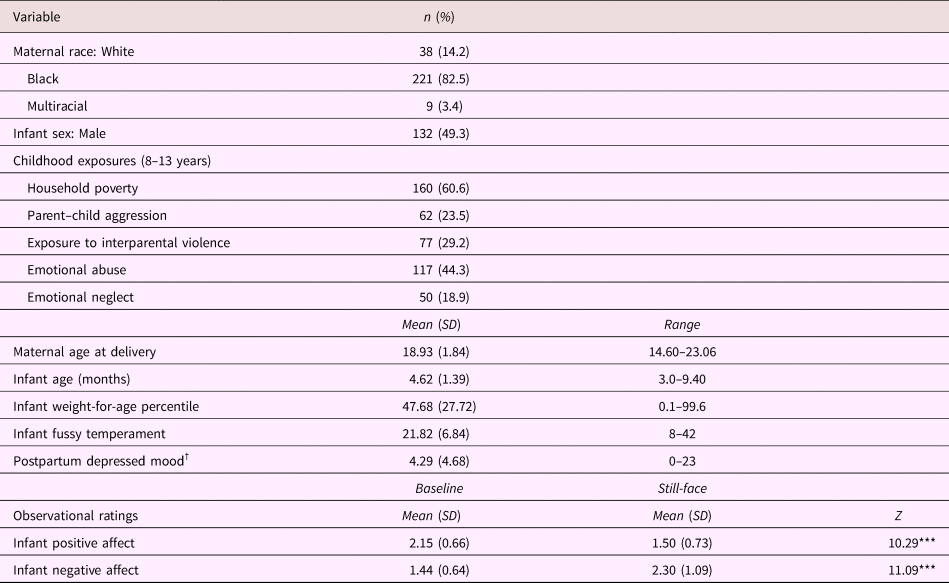
Descriptive statistics are shown in Table 1. Most of the sample comprised Black or multiracial mothers (85.8%), and the mean age at delivery was 18.93 years (SD = 1.84, range = 14.60–23.06). The infants (49% male) were aged 4.62 months (SD = 1.39, range = 3.0–9.40) at the time of the lab visit and were of average weight-for-age relative to the general population. More than half of the mothers had been exposed to multiple years of household poverty as children (60.6%), and substantial minorities experienced parent–child aggression (23.5%), interparental violence (29.2%), emotional abuse (44.3%), and emotional neglect (18.9%).
Descriptive statistics (N = 268)

Note: †Untransformed Edinburgh Postnatal Depression Scale scores are displayed for ease of interpretation. Z, standardized test statistic from Wilcoxon signed-ranks test. ***p < .001.
For the sample as a whole, infants displayed moderate levels of positive emotion and low levels of negative emotion during the baseline period (M = 2.15, SD = 0.66, skewness = 1.13, and M = 1.44, SD = 0.64, skewness = 1.74, respectively). Conversely, during the still-face episode, mean levels of positive emotion were low (M = 1.50, SD = 0.73, skewness = 1.34), and levels of negative emotion were moderate (M = 2.30, SD = 1.09, skewness = 0.22). Overall, infants showed less intense positive emotion (Wilcoxon signed-ranks Z = –10.29, p < .001, d = 0.63) and more intense negative emotion (Wilcoxon signed-ranks Z = 11.09, p < .001, d = 0.68) in the still-face, relative to the baseline episode.
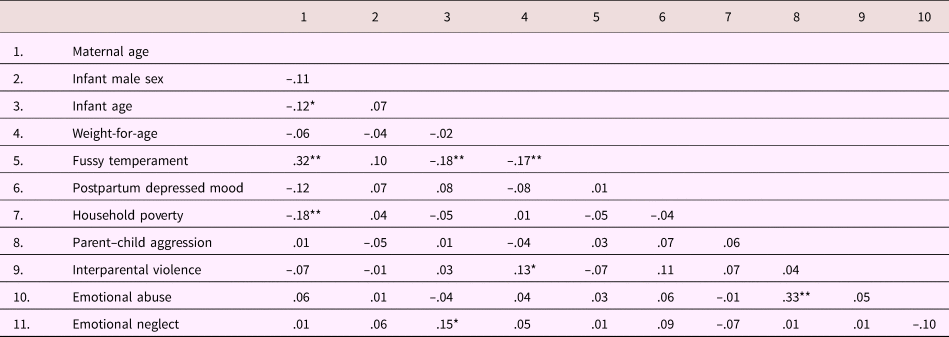
Zero-order correlations among the study variables are depicted in Table 2. Older maternal age was associated with having a younger infant at the time of the lab visit (r = –.12, p < .05), as well as higher reported infant fussiness on the ICQ (r = .32, p < .01) and lower rates of exposure to household poverty during childhood (r = –.18, p < .01). Reported levels of infant fussiness were higher for younger infants (r = –.18, p < .01) and for infants at a lower weight-for-age percentile (r = –.17, p < .01). Maternal exposure to parent–child aggression and emotional abuse in childhood were moderately correlated (r = .33, p < .01), but otherwise there was little overlap between the childhood exposure variables.
Zero-order correlations among study variables

*p < .05. ** p < .01.
Extraction of latent classes
Latent class models were estimated by iteratively specifying two to six classes (see Table 3). Consideration of model fit, precision, and parsimony determined selection of a five-class model. Although BIC and entropy statistics were similar for the five- and six-class models, respectively, the LMR adjusted likelihood ratio test revealed no significant improvement in fit from five to six latent classes, and the six-class solution also generated a group corresponding to approximately 5.60% of the sample (15 individuals). The average posterior probabilities of the five classes comprised 0.93, 1.0, 1.0, 0.92, and 0.98 for classes one to five, respectively, indicating a high certainty of the classification. The five-class solution was also compared on conceptual grounds to alternative solutions and appeared parsimonious and defensible.
Results of the latent class analysis

Note: AIC, Akaike information criterion. BIC, Bayesian information criterion. LMR adjusted LRT test, Lo–Mendell–Rubin adjusted likelihood ratio test. **p < .01. ***p < .001.
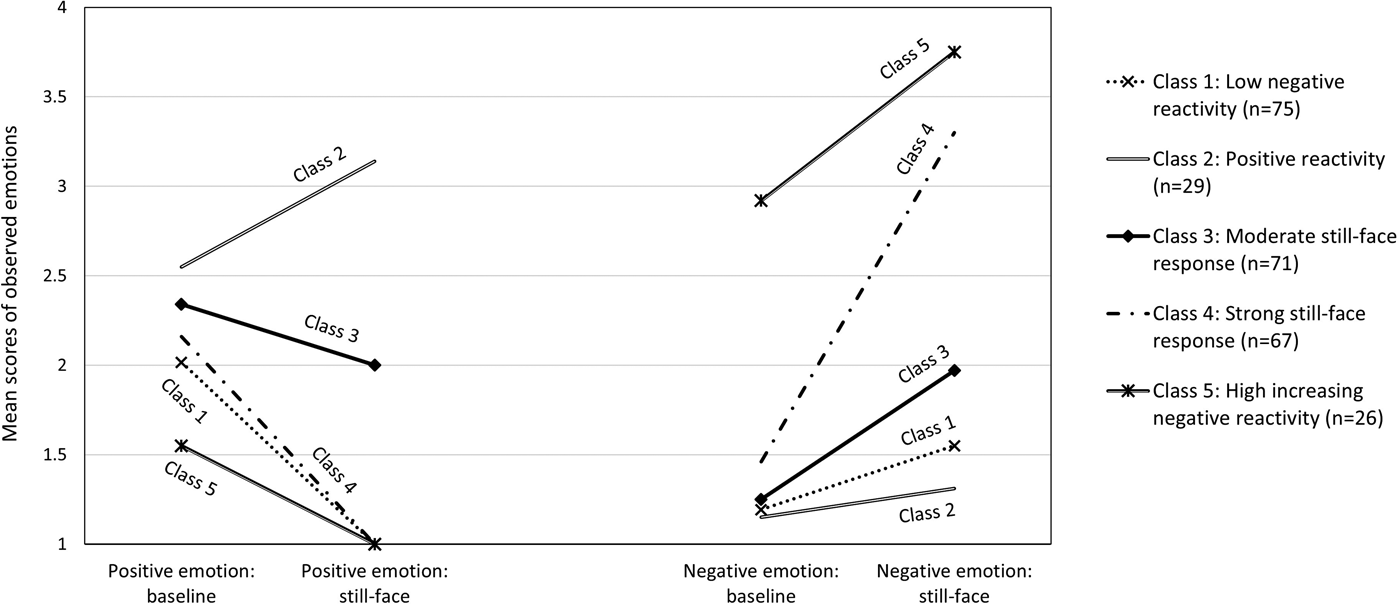
Figure 1 shows a profile plot of mean scores for observed infant emotions in the baseline and still-face episodes of the FFSF in the five latent classes. Class 1 is characterized by moderate levels of positive emotion at baseline that are absent in the still-face episode, combined with low negative emotion across baseline and still-face (labeled “low negative reactivity”; n = 75). Class 2 is characterized by high levels of baseline positive emotion that increase in the still-face episode, combined with minimal expressions of negative emotion across baseline and still-face (“positive reactivity”; n = 29). Class 3 comprised infants displaying moderate to high levels of baseline positive emotion that show a modest decrease in the still-face episode, combined with low levels of negative emotion at baseline that increase moderately during the still face (“moderate still-face response”; n = 71); a combination of behaviors that were most closely aligned with a typical SFR. Like Class 1, Class 4 is characterized by moderate levels of baseline positive emotion that are absent in the still-face episode, but these infants also display a large increase in negative emotion from baseline to still-face (“strong still-face response”; n = 67). Class 5 is characterized by low levels of baseline positive emotion that are absent in the still-face episode, combined with high levels of baseline negative emotion that further increase in the still-face (“high-increasing negative reactivity”; n = 26). Thus, two classes reflected the “typical” SFR of reduced positive and increased negative emotion: one manifesting a moderate intensity SFR and the other a strong, more intense SFR. Together, the “moderate still-face” and “strong still-face” classes represented 51.5% of the sample, whereas the other three classes exhibited patterns of emotional reactivity that deviated in terms of intensity and valence from the typical SFR.
Mean scores for infant positive and negative affect during baseline and still-face episodes for the five latent classes.

Characterizing the latent classes
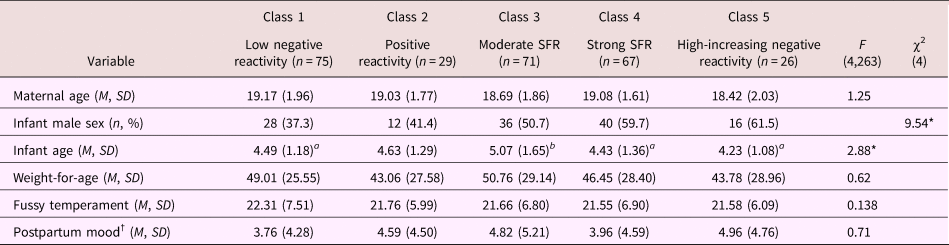
The results of the univariate comparisons of study variables by latent class are shown in Table 4. The proportion of male infants varied across the subgroups, χ2 (4) = 9.54, p < .05. Post hoc comparisons of observed and estimated frequencies revealed adjusted standardized residuals of –2.43 for the low negative reactivity class indicating that male infants were underrepresented in this group (i.e., the percentage of 37.3% male infants is statistically lower than the null hypothesis rate of 50%). In contrast, a significantly higher rate of male infants was represented in the strong SFR group (59.7%, adjusted standardized residual = 1.98). None of the remaining latent classes differed on proportion of male sex. The results also revealed a group difference in terms of infant age, F (4, 263) = 2.88, p < .05. Post hoc comparisons demonstrated that infants in the moderate SFR group were significantly older than infants classed as low negative reactivity, strong SFR and high-increasing negative reactivity. Analyses of variance revealed no group differences in terms of maternal report of fussy infant temperament, or for the covariates of maternal age at delivery, infant weight-for-age percentile, or maternal postpartum depressed mood.
Univariate comparisons between the latent classes

Note: SFR, still-face response. Different superscripts indicate that the mean scores were significantly different at p < .01. †Untransformed Edinburgh Postnatal Depression Scale scores are displayed for ease of interpretation. *p < .05.
Association between maternal stress exposure and infant response groups
Based on conceptual grounds, group size, and univariate comparisons, Class 3 (moderate SFR) was selected as the reference group in the multinomial logistic regression analyses. The multinomial logistic regression model fit the data well, –2 log likelihood = 726.11, χ2 (44) = 69.84, p < .01. After controlling for all covariates, maternal childhood emotional abuse exhibited a unique effect on odds of membership in the low negative reactivity class compared to the reference group (Table 5). Specifically, exposure to maternal childhood emotional abuse was associated with a 2.4-fold increase in the odds of infants showing low negative reactivity to the FFSF (adjusted odds ratio = 2.44; 95% confidence interval [1.15, 5.16]). In addition, maternal childhood emotional neglect was associated with a more than 4-fold increase in the odds of infants responding with high, increasing negative emotions to the still-face (Class 5) compared to the regulated still-face response (adjusted odds ratio = 4.65; 95% confidence interval [1.45,14.91]). Maternal history of chronic poverty, parent–child aggression, and interparental aggression did not predict offspring membership in the emotional reactivity classes.
Multinomial regression predicting infant still-face classes from maternal childhood stress domains

Note: SFR, still-face response. AOR, adjusted odds ratio. 95% CI, 95% confidence interval. Model controls for maternal age, infant sex, infant age, weight-for-age percentile, infant fussiness, and postpartum depressed mood. *p < .05. **p < .01.
Discussion
The current study advances knowledge on transgenerational effects of childhood stress exposure. Although a wealth of extant research supports a link between maternal stress exposure, broadly defined, and adverse offspring neurodevelopmental outcomes such as vulnerability to stress, the lack of specificity in both exposure and outcome has led to inconsistent results, which have likely hampered prevention and intervention efforts. We sought to increase specificity in exposure with a focus on five established domains of childhood stress (i.e., chronic poverty, emotional abuse, emotional neglect, parent–child aggression, and exposure to domestic violence) that were relatively independent of each other. Using a person-centered analytic approach, we also sought to increase specificity in offspring outcome, by parsing interindividual variability in infant emotion regulation in the context of a potent stressor. We hypothesized that infants’ responses to the FFSF could be empirically clustered in subgroups in terms of emotional valence and intensity of response. Furthermore, we expected that these subgroups would be associated with different types of maternal exposure to childhood stress. The results of the analyses supported both sets of hypotheses.
Patterns of infant stress reactivity
As far as we are aware, the current study is the first to employ latent class analysis of observed infant positive and negative emotional expressions during the baseline and still-face episodes of the widely used FFSF to identify distinct clusters of infants in terms of emotional reactivity to stress. This was possible with the use of a large combined sample of young mothers drawn from the same parent sample and participating in one of two identical lab-based observational assessments in the postpartum period. The validity of the paradigm and observational coding scheme and comparability with prior work was supported by the finding that mean levels of infant positive emotion decreased and mean levels of negative emotion increased from the baseline to the still-face episode. In terms of individual differences, the focus of the current analyses, the results lent some support to the notion of a “typical still-face response” given that four out of five of the latent classes were characterized by at least some increase in negative emotion and decrease in positive emotion from the baseline to the still-face episodes. However, the person-centered approach also revealed substantial variability in infant baseline emotional valence and intensity of response to the still face, highlighting the importance of taking these multiple factors into account when considering infant SFR.
Of the four groups displaying the expected changes in emotional valence from baseline to still-face, three groups were distinguished largely by the intensity of emotional change. Thus, the “moderate SFR” was characterized by modest to moderate levels of positive and negative emotion change in the expected directions, whereas change in the “strong SFR” group was characterized by a pronounced decrease in positive emotion (from average levels at baseline to none in the still-face episode), and by a large increase in negative emotion (more than 1 SD) in response to the still-face. The largest group (n = 75) comprised infants who showed the same pronounced decease in positive affect from baseline to still-face but were relatively unresponsive to the still-face in terms of the expression of negative emotions (“low negative reactivity”). Thus, although the direction of change in emotional valence was similar, reactivity intensity varied across these three profiles. In contrast, the “high increasing negativity” group appeared similar to the “moderate SFR” group in terms of intensity of change in emotional valence from baseline to still-face but was distinguished from all other groups by markedly low levels of positive affect and high levels of negative affect during the baseline interaction period. Infants in this class displayed negative emotions at levels that were >2 SD above the mean during baseline and then responded to the mother's neutral face with further increases in negative emotions to almost maximal levels.
The final group (“positive emotional reactivity”; Class 2) was the only class not to show the typical change in affect expected from baseline to still-face. Specifically, this group was characterized by high levels of positive affect during baseline and a yet further increase from baseline to the still-face episode, whereas displays of negative emotions were minimal and stable across the episodes. Such a pattern may indicate a high capacity for emotion regulation (e.g., engagement in self-soothing), consistent with the notion of resilience in the face of stress. The increase in positive affect from baseline to still-face could reflect that infants in this group used positive strategies to attempt to reengage and make bids to the mother during the still-face episode. An important avenue for future research will involve the collection of physiological indicators of HPA activation (e.g., changes in heart rate, skin conductance, and cortisol response) in tandem with observed emotions in order to clarify whether the FFSF was an effective stressor for these infants.
Results of univariate comparisons of the five groups based on demographic variables revealed differences in infant age and sex. Specifically, infants in the “moderate SFR” group were older than infants in the “strong SFR,” “low negative reactivity,” and “high-increasing negative reactivity” groups. This is consistent with previous work suggesting more pronounced still-face effects at younger than at older ages (Striano, Liszkowski, & Group, Reference Striano, Liszkowski and Group2005; Toda & Fogel, Reference Toda and Fogel1993). Self-regulation skills increase rapidly across the first year of life; thus as infants get older, they may be less reactive to social stressors in part due to the elaboration of self-soothing and coping strategies. In addition, male infants were more likely to be classified in the “strong SFR” group and less likely to be classified in the “low negative reactivity” group. This finding aligns with some prior research suggesting that male infants show more negative emotional dysregulation (Davis & Emory, Reference Davis and Emory1995; Weinberg et al., Reference Weinberg, Tronick, Cohn and Olson1999) and tend to be more reliant on the caregiver providing an optimal level of stimulation that encourages infant positive engagement and minimizes negative engagement (Field, Reference Field1994; Stoller & Field, Reference Stoller, Field, Field and Fogel1982). As noted previously, extant research examining infant sex as a correlate of the SFR has been mixed (Mesman et al., Reference Mesman, van IJzendoorn and Bakermans-Kranenburg2009); our findings suggest that sex effects may emerge if variability in the intensity of infant emotional reactivity from baseline to still-face is considered. Maternal perception of fussy-difficult infant temperament was similar across all the latent classes, indicating that the groups could not be distinguished in terms of this dispositional characteristic as reported by the mother.
Transgenerational associations with maternal preconception stress
Regarding the final study aim, our findings support the hypothesis that different types of maternal childhood stress exposure have unique associations with infant emotional reactivity profiles. Whereas previous studies examining this association have relied on combined measures of general stressful events (e.g., Bosquet Enlow et al., Reference Bosquet Enlow, Englund and Egeland2018; Brand et al., Reference Brand, Brennan, Newport, Smith, Weiss and Stowe2010), our study differentiated between five common domains of childhood adversity, ranging from chronic stressors such as living in poverty to more acute measures of emotional abuse and family violence. After accounting for sociodemographic factors, infant temperament, and postpartum depression, the multinomial regression model revealed two unique associations between types of maternal stress exposure in childhood and profiles of infant emotional reactivity. First, relative to infants displaying a moderate SFR, infants showing low negative reactivity were more likely to have mothers exposed to childhood emotional abuse. Low negative reactivity may be an indicator of a transgenerational blunting effect; high levels of maternal exposure to childhood emotional abuse contribute to the development of a blunted physiological stress response that is subsequently transmitted to the offspring. Second, infants showing high and increasing levels of negative emotions in response to the FFSF relative to the moderate SFR group were more likely to have mothers who were exposed to emotional neglect as a child. Overall, the pattern of these two findings is somewhat inconsistent with single-generation studies of childhood adversity, which have found stronger associations between threat (vs. deprivation) and an upregulated neurobiological stress response (Gunnar & Vazquez, Reference Gunnar, Vazquez, Cicchetti and Cohen2006; Heim & Nemeroff, Reference Heim and Nemeroff2001; McLaughlin & Sheridan, Reference McLaughlin and Sheridan2016). In contrast, maternal history of emotional neglect emerged as the best predictor of heightened infant negative reactivity in our study, whereas maternal history of emotional abuse was associated with the infant profile most closely aligned with a blunted response. However, our findings are consistent with one other study that documented an association between retrospectively reported maternal child abuse and lower baseline cortisol levels in offspring (Brand et al., Reference Brand, Brennan, Newport, Smith, Weiss and Stowe2010). Given that most studies measuring infant emotional reactivity rely on mean levels of positive and negative affect, more studies that employ a person-centered approach are needed to replicate the profiles of reactivity observed in this study.
Although the mechanisms involved are unclear, transmission from the preconception period to offspring may occur via stress-induced alterations in the mothers’ neural, neuroendocrine, and immune systems (Heim & Binder, Reference Heim and Binder2012), which have been shown to be especially susceptible to early life environments (Danese & Lewis, Reference Danese and Lewis2017; Zhang, Labonté, Wen, Turecki, & Meaney, Reference Zhang, Labonté, Wen, Turecki and Meaney2013). For example, victims of childhood maltreatment commonly exhibit structural and functional changes in a network of brain regions implicated in vigilance and emotional regulation (Graham et al., Reference Graham, Pfeifer, Fisher, Lin, Gao and Fair2015), which may impact later caregiving quality. Chronic exposure to maternal emotion dysregulation or suboptimal caregiving may, in turn, prompt persistent activation of the infants’ stress response systems and a reduction in the capacity for emotion regulation across development (Moore, Reference Moore2009). Transgenerational transmission may also occur along genetic or epigenetic pathways. For example, exposure to stress in childhood may directly impact the offspring via changes in the health of gametes (Dias & Ressler, Reference Dias and Ressler2014; Franklin et al., Reference Franklin, Russig, Weiss, Gräff, Linder, Michalon and Mansuy2010; Gapp et al., Reference Gapp, Jawaid, Sarkies, Bohacek, Pelczar, Prados and Mansuy2014) or may result in epigenetic changes in DNA leading to alterations in the HPA axis consistent with fetal “programming” (Glover, O'Connor, & O'Donnell, Reference Glover, O'Connor and O'Donnell2010; Sandman et al., Reference Sandman, Davis, Buss and Glynn2011). An important avenue for future research will be to probe mechanisms of transmission including altered HPA, epigenetics, and behavioral indices such as emotional dysregulation emerging in childhood and influencing the caregiving environment.
Despite these intriguing findings, maternal childhood emotional abuse and neglect did not distinguish other infant groups from moderate SFR. In addition, the results of the multinomial regression revealed no unique effects of chronic poverty, parent–child aggression, or interparental aggression on next-generation infant emotional reactivity profiles after accounting for emotional abuse and neglect. Thus, on balance, these results suggest that the relatively high prevalence of these five domains of childhood stress exposures and the challenges of parenting that are often faced by young mothers living in low-income environments (Parkes, Sweeting, & Wight, Reference Parkes, Sweeting and Wight2015; Rafferty, Griffin, & Lodise, Reference Rafferty, Griffin and Lodise2011) do not necessarily translate into heightened or blunted infant emotional reactivity to stress, and some infants may be resilient or adapt positively in the context of adversity (Luthar, Reference Luthar2003). Achieving greater rigor in characterizing heterogeneity in infant emotional reactivity to stress and the influence of specific stress exposure types on different developmental outcomes will provide opportunities for probing mechanisms that can be more usefully and accurately translated into prevention and early intervention.
Limitations
The current findings should be interpreted in the context of several study limitations. Although our sample size was larger than many studies that employ the observational FFSF paradigm to measure infant emotional stress reactivity, two of the latent classes were relatively small (n < 30), potentially limiting our power to detect differences between the groups. We selected moderate SFR as the reference group on conceptual grounds, but it is possible that the strong SFR profile represented infants for whom the FFSF was an especially potent stressor and against whom other groups should have been compared. Our interpretations of the SFR groups were also somewhat limited by our macro approach of measuring emotional reactivity, which did not allow us to examine sequential behaviors. For example, infants in the moderate SFR group may have been using different strategies to regulate emotion and cope with the stressor than other groups. It is also important to note that latent class analysis is an exploratory method that may be prone to overextraction of classes, especially if input variables are skewed. In our data, infant negative affect was skewed in the baseline period whereas positive affect was skewed in the still-face episode. This nonnormality may have increased the identification of spurious groups (Bauer & Curran, Reference Bauer and Curran2003) such as a group characterized by negative affect at baseline (a defining feature of the high increasing negative group) and a group characterized by positive affect during the still-face episode (i.e., the positive reactivity group). Although several precautions were taken to avoid the overextraction of classes (use of BIC and LMR; Nylund et al., Reference Nylund, Asparouhov and Muthén2007), replication and characterization of these latent classes in other large and diverse samples is clearly warranted.
Finally, although the study participants were oversampled from low-income neighborhoods and included relatively high rates of adversity compared to the general population, our findings were based on a community sample rather than a selected clinical sample of mothers with documented history of maltreatment or other forms of extreme stress. Thus, the strength of the association between patterns of stress reactivity in offspring and maternal childhood stress exposures delineated here may not be as strong as associations with more severe maltreatment. In the current analyses, frequent spanking and extreme forms of physical abuse were combined, which may have masked important variability in the experience and implications of parent–child aggression. Nevertheless, the ubiquity of moderately severe exposures does not diminish the importance of specifying types of stressors in order to determine early markers of stress vulnerability within the general population.
Acknowledgments
Special thanks go to the families of the Pittsburgh Girls Study for their participation in this research, to Robert Krafty for his expert advice, and to our dedicated research team.
Financial support
This project was supported by grants funded through the National Institute of Health (OD023244), the National Institute of Mental Health (MH071790, MH056630), and the Eunice Kennedy Shriver Institute of Child Health and Human Development (HD067185). During the preparation of this manuscript, I.T. and J. N. received support from training grants from the National Institute on Alcohol Abuse and Alcoholism (T32AA00745) and the National Institute of Mental Health (T32MH018269), respectively. The content is solely the responsibility of the authors and does not necessarily represent the official views the funding organization.