Introduction
Fish parasites can have a negative impact on the commercial fisheries industry (Mehl, Reference Mehl1970; Grabda, Reference Grabda1977; Palm & Overstreet, Reference Palm and Overstreet2000a). Although only a few cases of accidental human infections by trypanorhynchs have been reported (Palm, Reference Palm2004), these worms may cause allergic reactions (Pelayo et al., Reference Pelayo, García-Hernández, Puente, Rodero and Cuéllar2009). As a consequence of the highly developed large-scale fishing industry in the northern part of the Persian Gulf (Taghavi Motlagh et al., Reference Taghavi Motlagh, Akhoundi and Shiri2006), thorough studies on the marine fish parasite fauna are of major importance for the region.
Trypanorhynch cestodes mature in elasmobranchs and mainly use teleost fishes as intermediate or paratenic hosts (e.g. Palm, Reference Palm1997, Reference Palm2000). Because of the possibility of identifying adults as well as their larval stages based on the oncotaxy of unique hook arrangements along tentacles (Campbell & Beveridge, Reference Campbell, Beveridge, Khalil, Jones and Bray1994; Palm, Reference Palm2004), these marine tapeworms have been considered an interesting group for taxonomic and ecological investigations (Palm & Klimpel, Reference Palm and Klimpel2007). Of special interest is information concerning the host specificity within the taxon (Palm & Caira, Reference Palm and Caira2008), providing better insight into the zoogeographical species distribution (Jakob & Palm, Reference Jakob and Palm2006; Palm et al., Reference Palm, Waeschenbach and Littlewood2007, Reference Palm, Waeschenbach, Olson and Littlewood2009). Extensive fish parasitological surveys on the trypanorhynch cestode fauna in the Indian Ocean have been carried out by Palm (Reference Palm2000, Reference Palm2004) and Palm & Overstreet (Reference Palm and Overstreet2000b) off the Indonesian coast and by Southwell (Reference Southwell1929, Reference Southwell1930) off Ceylon. These authors revealed a species-rich fauna, suggesting that the former region, especially, is one of the centres of trypanorhynch species distribution. An observed level of low host specificity (Palm & Caira, Reference Palm and Caira2008) questions how far these species extend into the western or north-western part of the Indian Ocean.
The Persian Gulf is a semi-closed water body that is connected to the Gulf of Oman through the narrow Hormuz Strait. The Gulf of Oman is the most north-westerly part of the Indian Ocean that opens into the Arabian Sea. Studies on the trypanorhynch fauna of fishes from the Persian Gulf are non-comprehensive (Mirzayans, Reference Mirzayans1970; Tirgari et al., Reference Tirgari, Radhakrishnan and Howard1975; Ghiasi, Reference Ghiasi1988; El-Naffar et al., Reference El-Naffar, Gobashy, El-Etreby and Kardousha1992; Saif et al., Reference Saif, Al-Ghais and Kardousha1994; Sheini mandani, Reference Sheini mandani1994; Sazandegi, Reference Sazandegi1996; Kardousha, Reference Kardousha1999; Hassan et al., Reference Hassan, Palm, Mahmoud and Jama2002; Peighan et al., Reference Peighan, Hoghoghi Rad and Yousef Dezfouli2004; Haseli, Reference Haseli2005), and focused on the most eastern region. Most recently, Haseli et al. (Reference Haseli, Malek and Palm2010) studied elasmobranchs along the Iranian coast of the Persian Gulf and identified 22 taxa. These studies demonstrate that trypanorhynch cestodes are common fish parasites in the Persian Gulf, corresponding with a diverse fish fauna in the region (Blegvad & Lopenthin, Reference Blegvad and Lopenthin1944; Kuronuma & Abe, Reference Kuronuma and Abe1972; Randall et al., Reference Randall, Allen and Smith-Vaniz1978; Fischer & Bianchi, Reference Fischer and Bianchi1984; Kuronuma & Abe, Reference Kuronuma and Abe1986; Assadi & Dehghani, Reference Assadi and Dehghani1997; Carpenter et al., Reference Carpenter, Krupp, Jones and Zajonz1997).
The purpose of the present study is an examination of the trypanorhynch fauna of ten commercially important teleosts from the Iranian coast of the Persian Gulf. In combination with a study of trypanorhynch cestodes from elasmobranchs from the same region (Haseli et al., Reference Haseli, Malek and Palm2010), the present investigation compiles the known trypanorhynch fauna from the region. New host and locality records extend the known range of distribution for trypanorhynchs formerly known from the eastern part of the Indian Ocean into the Persian Gulf. For the first time, the dominance index was used in order to evaluate the infection pattern, and the Sorenson qualitative and quantitative indices to evaluate the similarity of trypanorhynch infections. To date, none of these ecological metrics have been applied to analyse the trypanorhynch infection pattern within teleost intermediate hosts.
Materials and methods
Collection and examination of fish
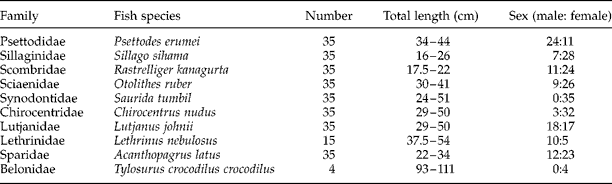
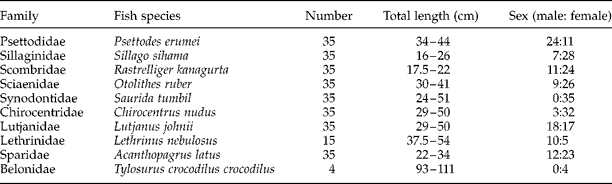
A total of 299 fish, comprising Psettodes erumei (N = 35, Psettodidae); Silver sillago, Sillago sihama (N = 35, Sillaginidae); Indian mackerel, Rastrelliger kanagurta (N = 35, Scombridae); Tigertooth croaker, Otolithes ruber (N = 35, Sciaenidae); Greater lizardfish, Saurida tumbil (N = 35, Synodontidae); Whitefin wolf-herring, Chirocentrus nudus (N = 35, Chirocentridae); John's snapper, Lutjanus johnii (N = 35, Lutjanidae); Spangled emperor, Lethrinus nebulosus (N = 15, Lethrinidae); Yellowfin seabream, Acanthopagrus latus (N = 35, Sparidae) and Hound needlefish, Tylosurus crocodilus crocodilus (N = 4, Belonidae) were bought in the fish market of Bandar Abbas, on the north-eastern coast of the Persian Gulf, Iran (27°11′N, 56°16′E) in April 2008. Identification was carried out according to published keys for the Persian Gulf (Assadi & Dehghani, Reference Assadi and Dehghani1997; Carpenter et al., Reference Carpenter, Krupp, Jones and Zajonz1997). Following biometry (table 1), the fish were examined macroscopically with the help of a stereo-microscope under 6.3 × magnification for larval trypanorhynch cestodes in the body cavity, the viscera and the musculature. Encapsulated trypanorhynch larvae were freed from the blastocyst and treated according to Palm (Reference Palm2004). The worms were fixed in 70% ethanol and stained in acetic carmine, dehydrated in an ethanol series, cleared in methyl salicylate and mounted on to slides in Canada balsam. Trypanorhynch species identification followed Palm (Reference Palm2004).
Number, total length and sex of examined teleost species.
Data analyses
Data analyses of the parasites and hosts were done using SPSS Package, version 13 (SPSS Inc., Chicago, Illinois, USA). According to Magurran (Reference Magurran1988), the dominance index of the most dominant parasite species in each host (dominance index = number of individuals of the most abundant species/total number of individuals in the community) and the Sorenson qualitative (C S = twice the number of species found in common/the total number of species that are present in two communities) and quantitative (C N = twice the sum of the lower of the two abundances for the recorded species/the total number of individuals that are present in two communities) indices were calculated. Unlike the Sorenson qualitative index, which counts all recorded species equally irrespective of whether they are abundant or rare, the Sorenson quantitative index takes into account abundances of respective species. Thus, a better idea of the trypanorhynch cestode infection pattern can be presented by using both similarity indices. Prevalence, mean abundance, intensity and mean intensity were calculated according to Bush et al. (Reference Bush, Lafferty, Lotz and Shostak1997). The specificity index (H S) of Caira et al. (Reference Caira, Jensen, Holsinger, Combes and Jordan2003) was used to assess host specificity. Voucher specimens have been deposited in the ZUTC, collection of the Zoological Museum, University of Tehran, Tehran, Iran (ZUTC Platy 1223–5, Callitetrarhynchus gracilis; ZUTC Platy 1214–7, Pseudogilquinia thomasi; ZUTC Platy 1218–22, Pterobothrium lesteri; ZUTC Platy 1226, Pseudolacistorhynchus shipleyi) and the Museum Berlin, Germany (ZMB).
Results
Identification of cestodes and levels of infection
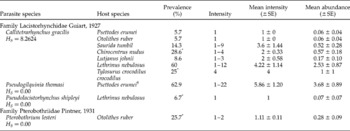
Four species of trypanorhynch cestodes, Callitetrarhynchus gracilis, Pseudogilquinia thomasi, Pseudolacistorhynchus shipleyi and Pterobothrium lesteri, were found in 7 out of 10 studied fish species. Pterobothrium lesteri and P. shipleyi represent new locality records from the Persian Gulf, and four new host records are established (table 2). All trypanorhynch species were isolated from the body cavity, except for P. thomasi which was recorded from the musculature of Psettodes erumei.
Prevalence, intensity, mean intensity, mean abundance and infection site of trypanorhynch cestodes from ten teleost species from the Persian Gulf. New host records are marked by an asterisk after prevalence values. H S according to Caira et al. (Reference Caira, Jensen, Holsinger, Combes and Jordan2003).

† All trypanorhynch species were isolated from the body cavity, except for P. thomasi which was recorded from the musculature of P. erumei.
The most common parasite was C. gracilis, recovered from seven different teleost species. The highest prevalence (62.9%) was seen for P. thomasi with a maximum intensity of 22 in P. erumei. The Kolmogorov–Smirnov test demonstrated that the parasite infection was not normally distributed; therefore non-parametric tests, Mann–Whitney test (U) and Kruskal–Wallis test, were applied to determine whether significant differences in mean abundances of parasites exist. Prevalence, intensity, mean intensity and mean abundance of the trypanorhynch cestodes from ten teleost species from the Persian Gulf are given in table 2.
Statistical analyses revealed that the prevalence and mean abundance of C. gracilis in C. nudus were significantly higher than in P. erumei (χ2 = 6.437, P = 0.011, U = 466.50, P = 0.009), O. ruber (χ2 = 6.437, P = 0.011, U = 466.50, P = 0.09) and Lutjanus johnii (χ2 = 4.629, P = 0.031, U = 490.50, P = 0.035). Prevalence and mean abundance of C. gracilis in L. nebulosus were significantly higher than in P. erumei (χ2 = 18.032, P < 0.005, U = 112, P < 0.005), O. ruber (χ2 = 18.032, P < 0.005, U = 112, P < 0.005), S. tumbil (χ2 = 10.884, P = 0.001, U = 139, P = 0.001), C. nudus (χ2 = 4.402, P = 0.036, U = 159, P = 0.012) and L. johnii (χ2 = 15.226, P < 0.005, U = 121.50, P < 0.005).
Cestode species richness
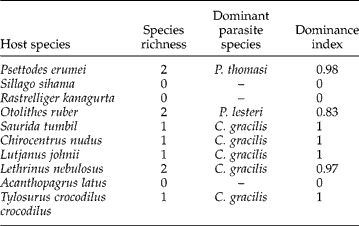
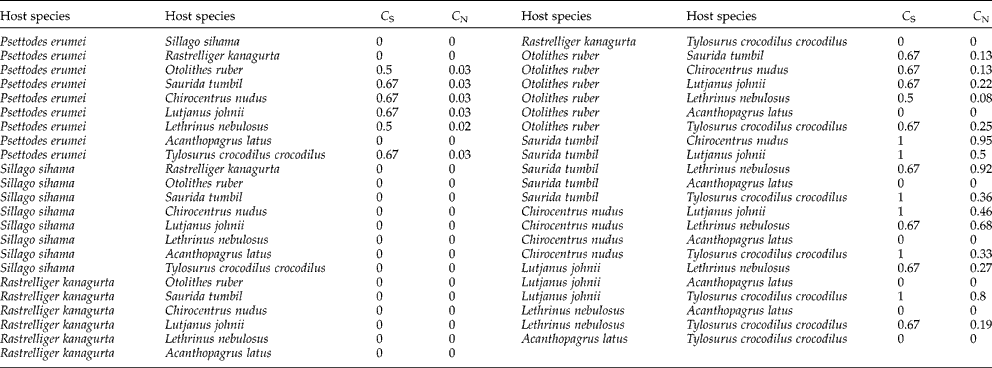
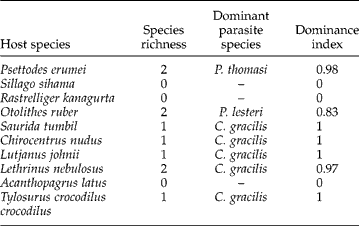
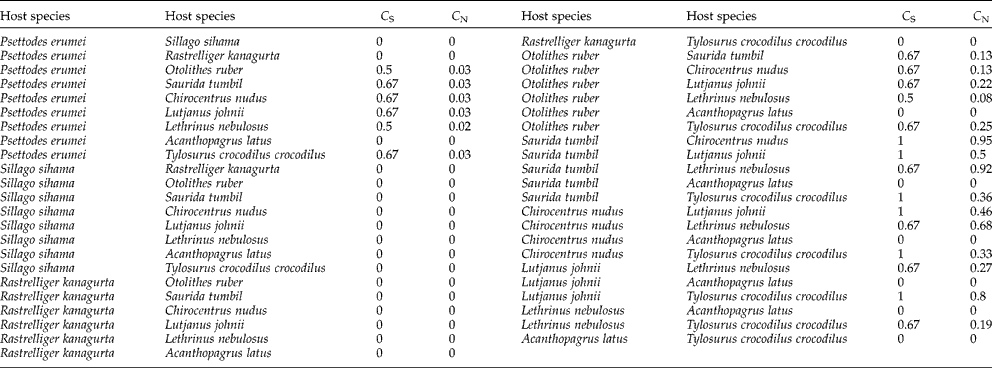
The species richness and dominance indices are summarized in table 3. Apart from P. erumei, O. ruber and L. nebulosus, which had a species richness of two parasite species, this value was 1 for other infected hosts. The Sorenson qualitative similarity index showed the highest value (1) for all inter-specific comparisons of hosts that were infested with C. gracilis. Values were comparatively intermediate between other infested hosts. Among inter-specific comparisons of hosts in which qualitative similarity indices were the highest (1), interestingly, high, low and intermediate values of Sorenson quantitative similarity were observed. Low values of Sorenson quantitative similarity were mostly calculated for inter-specific comparisons of hosts with intermediate values of Sorenson qualitative similarity (table 4).
Species richness and dominance index of trypanorhynch species in ten teleost hosts.
Sorenson qualitative similarity index (C S) and Sorenson quantitative similarity index (C N) between helminth communities of different teleost species.
Discussion
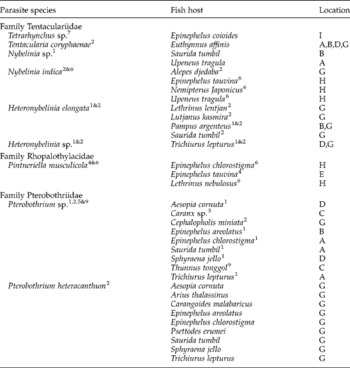
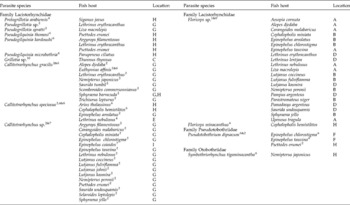
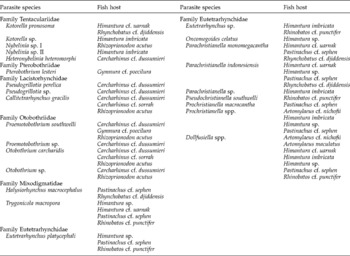
The present study provides the first information on a spectrum of trypanorhynch infections of ten teleost species from the Iranian waters of the north-eastern Persian Gulf. Until now the larval trypanorhynch fauna had been studied mainly from the southern part of the Persian Gulf (El-Naffar et al., Reference El-Naffar, Gobashy, El-Etreby and Kardousha1992; Saif et al., Reference Saif, Al-Ghais and Kardousha1994; Kardousha, Reference Kardousha1999; Hassan et al., Reference Hassan, Palm, Mahmoud and Jama2002). Summaries of reported larval and adult trypanorhynchs from the Persian Gulf are given in tables 5–7 (see also Palm, Reference Palm2004; Haseli et al., Reference Haseli, Malek and Palm2010).
Reported larval trypanorhynchs belonging to families Tentaculariidae, Rhopalothylacidae and Pterobothriidae in teleost species from the Persian Gulf.

1. El-Naffar et al. (Reference El-Naffar, Gobashy, El-Etreby and Kardousha1992); 2. Kardousha (Reference Kardousha1999); 3. Haseli (Reference Haseli2005); 4. Hassan et al. (Reference Hassan, Palm, Mahmoud and Jama2002); 5. Mirzayans (Reference Mirzayans1970); 6. Palm (Reference Palm2004); 7. Peighan et al. (Reference Peighan, Hoghoghi Rad and Yousef Dezfouli2004); 8. Saif et al. (Reference Saif, Al-Ghais and Kardousha1994); 9. Sazandegi (Reference Sazandegi1996); 10. Tirgari et al. (Reference Tirgari, Radhakrishnan and Howard1975). A. Abu Dhabi; B. Dubai and Sharjah; C. Iranian waters; D. Ras al Khaimah; E. The coasts of Bahrain, Oman, Qatar and the United Arab Emirates; F. The coast of Qatar; G. The coast of UAE; H. The Persian Gulf; I. Western part of the Persian Gulf, Iran.
Reported larval trypanorhynchs belonging to families Lacistorhynchidae, Pseudotobothriidae and Otobothriidae in teleost species from the Persian Gulf. See table 5 for abbreviations.

Reported adult trypanorhynchs from the Persian Gulf.

Of the recorded four trypanorhynch species, three species of the superfamily Lacistorhynchoidea Guiart, 1927, namely, P. lesteri, P. thomasi and P. shipleyi, demonstrated restricted host range. They were found in O. ruber, P. erumei and L. nebulosus, respectively, indicating higher specificity within the sampled subset of predatory fish. This is in contrast to the occurrence of the cosmopolitan C. gracilis (see Palm, Reference Palm2004) which infected 7 of 10 fish species. This situation is similar to an earlier investigation along the north-east Brazilian coast by Palm (Reference Palm1997). Within that study, C. gracilis was the trypanorhynch cestode with the widest host range, which could be isolated from 10 fish species out of the 57 sampled fish species from 30 families. The co-infection with another pseudolacistorhynchid, Pseudolacistorhynchus noodti, from Pseudupeneus maculatus and Scomberomorus maculatus, and another pterobothriid Pterobothrium sp. from Citharichthys spilopterus, showed a similar narrow host range as was observed within the present study. It seems as if the recorded combination of representatives from these three lacistorhynchoid families and the established host range are similar along the tropical north-eastern coast of Brazil and the Persian Gulf.
The record of C. gracilis from a range of different hosts in the Persian Gulf supports earlier investigations (e.g. Palm, Reference Palm1997), and the low host specificity (Palm & Caira, Reference Palm and Caira2008) and cosmopolitan distribution (Palm, Reference Palm2004) of the species. Similarly, Abdou & Palm (Reference Abdou and Palm2008) recorded C. gracilis in a range of different intermediate hosts in the Red Sea. Such a distribution pattern is promoted by the omnipresence of a variety of carcharhinid elasmobranchs as definitive hosts in coastal tropical regions, combined with restricted host specificity in both second intermediate and definitive hosts. Palm et al. (Reference Palm, Obiekezie and Möller1994) and Palm (Reference Palm1997) proposed a four-host cycle for C. gracilis, including small pelagic Carangidae and Clupeidae for the first stage, and larger predatory fish, mostly Carangidae and Scombridae, for the second stage of the plerocerci. Palm & Caira (Reference Palm and Caira2008) showed that the average value of host specificity (H S) for final larval stages of 63 trypanorhynch species was 6.29 (euryxenous), and the value for C. gracilis was 8.61 (euryxenous). The H S recorded herewith for C. gracilis from teleosts in the Persian Gulf was 8.26, also euryxenous. Two new host records from C. nudus and T. crocodilus crocodilus also suggest that more studies can further extend the already known wide host range for C. gracilis.
The trypanorhynch cestode fauna recorded so far from the Persian Gulf demonstrates a predominance of eutetrarhynchoid and lacistorhynchoid species, with only few tentacularioids or gymnorhynchoids. This might be explained with missing faunistic components in the Gulf, such as big pelagic sharks that are common hosts for gymnorhynchoids. Another possible explanation is the lack of potential first intermediate hosts, the most important stage in the completion of the life cycle of trypanorhynchs (Palm et al., Reference Palm, Obiekezie and Möller1994). Although El-Naffar et al. (Reference El-Naffar, Gobashy, El-Etreby and Kardousha1992) and Kardousha (Reference Kardousha1999) reported some tentaculariid species from the south of the Persian Gulf, not a single specimen belonging to the superfamily Tentacularioidea Poche, 1926 has been reported from the sampled teleosts in the northern part of the Persian Gulf. According to Palm (Reference Palm2004), the life cycle includes four or even more hosts, with copepods as first, euphausiids or schooling fish as second intermediate hosts and fish as third or more intermediate or paratenic hosts. Food resources, depth, salinity and temperature might influence the distribution and species composition of required copepod first intermediate hosts (Islam et al., Reference Islam, Ueda and Tanaka2005; Gaard et al., Reference Gaard, Gislason, Falkenhaug, Soiland, Musaeva, Vereshchaka and Vinogradov2008). Euphausiids as second intermediate hosts for tentaculariids might also be unevenly distributed. Zhaoli (Reference Zhaoli2007) and Yoon et al. (Reference Yoon, Cho, Lim, Choi and Lee2000) demonstrated that temperature, salinity and chlorophyll a concentration are important ecological factors that determine spatial distribution of euphausiids. Hunter (Reference Hunter, Gade, Edwards and Svendsen1983) and Reynolds (Reference Reynolds1993) stated that the salinity of the counterclockwise water current in the Persian Gulf can be influenced by rivers in the north (e.g. Tigris, Euphrates) leading to less saline waters in the Strait of Hormuz at the surface. Emery (Reference Emery1956) demonstrated that the bottom of the Persian Gulf is mostly muddy in the north and mostly sandy in the south, and Ebrahimi et al. (Reference Ebrahimi, Mohebi Nouzar, Ajlali Khaneghah and Sanjani2008) showed that salinity increased horizontally toward the west of the Persian Gulf. These ecological differences in the north and south of the Persian Gulf might play a role in the uneven distribution of the recorded trypanorhynchs.
The highest value (1) of the Sorenson qualitative similarity and low values of Sorenson quantitative similarity indices can be explained by the low diversity and high dominance of the trypanorhynch component community in the sampled fish. The high Sorenson qualitative similarity (1) combined with the high quantitative similarity (0.95) that was observed for S. tumbil and C. nudus can be explained by a high prevalence and mean abundance of C. gracilis in both hosts. It is worth mentioning that there was no significant difference of the prevalence and mean abundance in these hosts, though representing different fish families. This can only be explained by a similar size and feeding ecology of these species (Fischer et al., Reference Fischer, Sousa, Silva, de Freitas, Poutiers, Schneider, Borges, Feral and Massinga1990; Sommer et al., Reference Sommer, Schneider and Poutiers1996), demonstrating that the feeding ecology of the fish must have a major important role for infection with C. gracilis in the Persian Gulf.
Regarding the high diversity of trypanorhynchs in the Persian Gulf (Haseli et al., Reference Haseli, Malek and Palm2010), this semi-enclosed marine ecosystem has the capacity for the completion of a variety of life cycles. According to Palm (Reference Palm2004) and Southwell (Reference Southwell1929, Reference Southwell1930), it seems that the east of the Indian Ocean, the Indonesian archipelago and Sri Lanka share the same species, resulting from connected water bodies. The Persian Gulf can be invaded by trypanorhynchs due to their low host specificity (Palm & Caira, Reference Palm and Caira2008) and wide zoogeographical distribution of many of their host fish species (Fischer & Whitehead, Reference Fischer and Whitehead1974; Compagno, Reference Compagno1984; Fischer & Bianchi, Reference Fischer and Bianchi1984; Carpenter et al., Reference Carpenter, Krupp, Jones and Zajonz1997).
Among the ten studied commercially important teleosts in the Iranian waters of the Persian Gulf, musculature infection was restricted to P. erumei at a prevalence of 62.9% and a range of intensity of 1–22. This relatively high infection of muscles with the large plerocerci of P. thomasi may cause concern for marketing and public health (see Pelayo et al., Reference Pelayo, García-Hernández, Puente, Rodero and Cuéllar2009). It is recommended that P. erumei be well cooked and freed from the most obvious trypanorhynch larvae before the fish is sold and considered for human consumption.
Acknowledgements
We wish to thank Professor Dr H. Mehlhorn who facilitated the six-month stay of M.H. at Heinrich-Heine-University, Düsseldorf. Financial support was provided through the German Research Council (DFG PA 664/4-1 and 4-2) (H.W.P.) and the Iran Ministry of Science, Research and Technology together with the Centre of Research Affairs of the University of Tehran (M.H.). This study has been carried out within the framework of the NSF Planetary Biodiversity and Inventory Project (PB&I) awards Nos. 0818696 and 0818823.