Dentists prescribe 10% of outpatient antibiotics; a significant portion of these are for infection prophylaxis following dental procedures. Reference King, Bartoces, Fleming-Dutra, Roberts and Hicks1,Reference Suda, Calip and Zhou2 Current guidelines primarily recommend antibiotic prophylaxis prior to dental procedures that manipulate the gingival tissue or the periapical region of teeth or that perforate the oral mucosa in patients at high risk of an adverse outcome should they develop infective endocarditis. Reference Wilson, Taubert and Gewitz3 Recent data show that 80.9% of antibiotic prophylaxis was unnecessary prior to dental procedures. Reference Suda, Calip and Zhou2 The objective of this study was to assess the harms of unnecessary antibiotic prophylaxis prior to dental procedures.
Methods
We conducted a retrospective cohort study of patients prescribed unnecessary antibiotic prophylaxis for a dental visit between 2011 and 2015 using the IBM Watson Health Marketscan Commercial Claims/Encounters, Medicare Supplemental, Coordination of Benefits Research databases. Reference Suda, Calip and Zhou2 Patients were included if they were enrolled in commercial dental insurance and received unnecessary antibiotic prophylaxis. Antibiotic prophylaxis was defined as a ≤2 day supply of antibiotics dispensed within 7 days prior to a dental visit. Patients with a hospitalization or extra-oral infection 14 days prior to antibiotic prophylaxis were excluded. Unnecessary antibiotic prophylaxis was defined as prophylaxis in patients who did not undergo a procedure that manipulated the gingiva or tooth periapex and did not have an appropriate cardiac diagnosis. Patients with prosthetic joints were categorized as unnecessary (without a cardiac condition). Reference Suda, Calip and Zhou2 Patients with multiple eligible visits were allowed to re-enter the cohort if visits were >7 days apart.
The primary end point was any antibiotic adverse effect (AAE) within 14 days after prescription: composite of allergy, anaphylaxis, C. difficile infection (CDI), or emergency department (ED) visit. Allergies and CDI were defined based on previously validated International Classification of Disease, Ninth Revision (ICD-9) and ICD-10 codes and ED visits were identified by provider and place of service codes (Supplemental Table 1 online). Patients were censored at the occurrence of event, loss-to-follow-up, and end of enrollment.
Statistical analysis
The primary end point of composite AAE incidence rate was measured as events per 1,000 patient days (PD) in the overall cohort and stratified by amoxicillin and clindamycin; corresponding 95% confidence intervals were calculated. Secondary end points included the risk difference of the primary end point between amoxicillin and clindamycin per 1,000 PD, the incidence of CDI 30 days after the antibiotic, and the corresponding 95% CI for each. All analyses were performed using SAS version 9.4 software (SAS Institute, Cary, NC) and R version 3.3.1 (fmsb package) version 0.7.0 software (R Foundation for Statistical Computing, Vienna, Austria).
Results
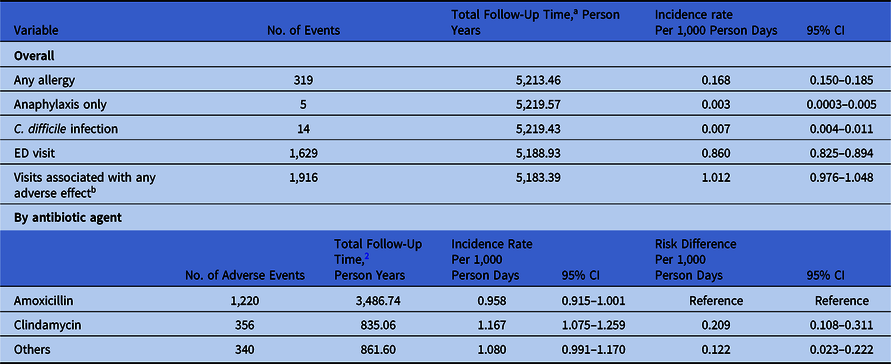
Of the 168,420 dental visits with antibiotic prophylaxis, 136,177 (80.9%) were unnecessary and were included for analysis (median patient age, 62 years; interquartile range [IQR], 55–71; 58% women). Antibiotics prescribed included amoxicillin (67.9%), clindamycin (15.5%), cephalexin (8.6%), azithromycin (2.8%), penicillin (1.5%), and others (3%). For the primary endpoint, 1.4% of unnecessary prescriptions were associated with an AAE within 14 days; the incidence of AAE was 1.01 per 1,000 PD, and ED visits (83%) and allergies (16%) were the most frequent AAEs (Table 1). Clostridioides difficile infection (CDI) incidence was 0.009 per 1,000 PD (95% CI, 0.006–0.012). Overall, AAEs were more common with clindamycin (1.167 per 1,000 PD) than amoxicillin (0.958 per 1,000 PD; risk difference, 0.209 per 1,000 PD; 95% CI, 0.108–0.33), including a higher risk of ED visit and allergy (Table 1 and Supplemental Table 2 online).
Occurrence of Adverse Effects Within 14 Days of Unnecessary Antibiotic Prophylaxis

Note. CI, confidence interval; ED, emergency department.
a Subjects were censored at the occurrence of event of interest, loss-to-follow-up and at end of enrollment.
b Primary end point defined as 14 days after prescription (composite endpoint of allergy, anaphylaxis, C. difficile infection, or ED visit).
Discussion
This study is the first to characterize adverse effects related to unnecessary dental prophylaxis. Although the occurrence of an AAE was rare (1.4%), serious AAEs (anaphylaxis, CDI) did occur. A limited number of studies and case reports describe the adverse effects of dental prophylaxis regardless of appropriateness. Reference Cloitre, Duval and Tubiana4-Reference Bombassaro, Wetmore and John8 A French database of voluntarily reported adverse effects contained 17 reports of anaphylaxis due to amoxicillin prophylaxis prior to dental procedures. Reference Cloitre, Duval and Tubiana4 Another study using a UK database assessed adverse reactions following single doses of amoxicillin or clindamycin. Reference Thornhill, Dayer, Prendergast, Baddour, Jones and Lockhart5 Of 2.7 million amoxicillin prescriptions, 67 adverse reactions were reported: 16 anaphylaxis and 38 other allergies. Of 1.2 million clindamycin prescriptions, 193 adverse reactions were reported: 15 were fatal (12 due to CDI) and the remainder were primarily gastrointestinal or allergy-related skin disorders. The only study in the United States, outside the current report, was an evaluation of community-acquired CDI cases in Minnesota which reported that 136 of 1,626 CDI cases (8%) were related to antibiotic prophylaxis for dental procedures. Reference Bye6 Consistent with the study by Thornhill et al, Reference Thornhill, Dayer, Prendergast, Baddour, Jones and Lockhart5 we observed a significantly greater rate of AAEs with clindamycin than with amoxicillin. Also consistent with our findings, a previous study found that clindamycin was associated with a greater rate of ED visits than amoxicillin. Reference Shehab, Patel, Srinivasan and Budnitz9 Collectively, these studies show that even short courses used for antibiotic prophylaxis, regardless of appropriateness of use, are associated with patient harm.
Our study has some limitations. Comparisons were not performed with patients unexposed to antibiotics; thus, the risk associated with inappropriate antibiotic prophylaxis could not be ascertained. Only patients with commercial dental insurance were included. ED visits could not be definitively attributed to AAEs. Patients with adverse reactions but who did not seek medical care were not captured in this study because our end point was based on medical coding. However, our study did not rely on voluntary reporting by medical professionals to ascertain outcomes. Therefore, we may have been able to identify and more comprehensively characterize AAE rates than previous investigations.
In conclusion, the risk of harm with unnecessary antibiotic prophylaxis is not trivial. Because most AAEs are diagnosed in medical settings, dentists may not be aware of these adverse effects. These data provide further impetus to optimize prescribing of antibiotic prophylaxis prior to dental procedures, and improved prescribing may be facilitated via comprehensive, multidisciplinary antimicrobial stewardship programs in dental clinics. Reference Gross, Hanna, Rowan, Bleasdale and Suda10
Supplementary material
To view supplementary material for this article, please visit https://doi.org/10.1017/ice.2020.1261
Acknowledgments
The opinions expressed are those of the authors and do not represent those of AHRQ, the Department of Veterans’ Affairs or the US government.
Financial support
Research was funded by Agency for Healthcare Research and Quality (AHRQ no. R01 HS025177; principal investigator, Suda).
Conflicts of interest
No authors report potential conflicts of interest relevant to this article.