Common waterhemp (CW) is a small-seeded, summer annual broadleaf weed that is a member of the Amaranthus genus and is closely related to many commonly found pigweed species in Ontario. Common waterhemp can be distinguished from other Amaranthus species by the entirely hairless leaves and stems and its dioecious nature with separate male and female plants, which are visually discernable later in the growing season (Costea et al. Reference Costea, Weaver and Tardif2005). Vyn et al. (Reference Vyn, Swanton, Weaver and Sikkema2007) reported that CW interference can reduce soybean yields by up to 73%, and Schryver et al. (Reference Schryver, Soltani, Hooker, Tranel, Robinson and Sikkema2017b) found up to 98% yield loss in extremely competitive glyphosate-resistant (GR) CW environments with densities of greater than 1,200 plants m−2. Although related to many commonly found Amaranthus species, CW has several traits that make this species difficult to control, including prolonged emergence pattern, rapid growth habit, and genetic diversity.
Common waterhemp has an extended emergence pattern resulting in ineffective control with many soil-applied herbicides. In Ontario, CW begins emergence in early May and continues to emerge until September (Vyn et al. Reference Vyn, Swanton, Weaver and Sikkema2007) or October (Schryver et al. Reference Schryver, Soltani, Hooker, Tranel, Robinson and Sikkema2017b). Seed can remain viable in the soil for up to seventeen years with a germination rate of 3% (Burnside et al. Reference Burnside, Wilson, Weisberg and Hubbard1996). Common waterhemp plants that survive are able to contribute to the soil seedbank and thus ensure CW persistence in a crop production system for many years (Sellers et al. Reference Sellers, Smeda, Johnson, Kenig and Ellersieck2003). Later-emerged CW have reduced seed production and dry weight by up to 90% and contribute less to the soil seedbank (Grundy Reference Grundy2003; Uscanga-Mortera et al. Reference Uscanga-Mortera, Clay, Forcella and Gunsolus2007), but recent work has found later emerging plants to contribute more to the soil seedbank than previously thought (Wu and Owen Reference Wu and Owen2014). The prolonged emergence pattern and long viability of the seed in the soil make CW a very persistent weed once it has been established in a given area.
Common waterhemp has substantial phenotypic plasticity, which allows it to thrive in a wide range of environments (Costea et al. Reference Costea, Weaver and Tardif2005; OMAF 2004). Common waterhemp is a C4 plant with the ability to grow 1.6 mm per growing degree day and reach heights of up to 3 m (Horak and Loughin Reference Horak and Loughin2000). This plant can be described as a thermophyte, mesophyte to hygrophyte, heliophyte, and nitrophyte, allowing for rapid growth in many environments (Costea et al. Reference Costea, Weaver and Tardif2005). In addition to environment, growth of CW is influenced by intra- and interspecific competition (Uscanga-Mortera et al. Reference Uscanga-Mortera, Clay, Forcella and Gunsolus2007; Wu and Owen Reference Wu and Owen2014). Common waterhemp vegetative dry matter accumulation was reduced 10-fold when grown in the presence of soybean (Uscanga-Mortera et al. Reference Uscanga-Mortera, Clay, Forcella and Gunsolus2007). The length of time CW remains in the vegetative stage depends on photosensitivity of individual plants within a population, with individuals reaching the reproductive stage at different times (Wu and Owen Reference Wu and Owen2014). The phenotypic plasticity of CW and its rapid growth rate contribute to the competiveness of this weed in diverse environments.
Common waterhemp is a dioecious species with separate male and female plants. This method of reproduction allows for more efficient resource allocation in female plants resulting in up to 4.8 million seeds per plant under ideal conditions, contributing to the rapid increase in CW densities in crop production areas (Hartzler et al. Reference Hartzler, Battles and Nordby2004). Due to its dioecious reproduction, CW has the ability to acquire new traits rapidly through pollen transfer with nearby plants (Costea et al. Reference Costea, Weaver and Tardif2005). Consequently, this species has high genetic diversity, contributing to rapid evolution of herbicide resistance (Wu and Owen Reference Wu and Owen2014).
The species Amaranthus tuberculatus (moq.) Sauer, or tall waterhemp, is native to Ontario and western Quebec, while Amaranthus rudis, or common waterhemp, is thought to have been introduced to Ontario via a demonstration combine near Petrolia in Lambton County in 2002 (Costea et al. Reference Costea, Weaver and Tardif2005). In 2015, common waterhemp had been observed in a number of Ontario counties (Schryver et al. Reference Schryver, Soltani, Hooker, Tranel, Robinson and Sikkema2017a). In a survey conducted by Schryver et al. (Reference Schryver, Soltani, Hooker, Tranel, Robinson and Sikkema2017a) in southwestern Ontario, 81% of fields where CW seed was collected had individuals that were resistant to glyphosate (Group 9), 76% had individuals resistant to atrazine (Group 5), and 100% had individuals resistant to imazethapyr (Group 2). Of the 49 samples collected, Schryver et al. (Reference Schryver, Soltani, Hooker, Tranel, Robinson and Sikkema2017a) reported that 61% of the sites had individuals that were resistant to each of the three herbicides tested. This greatly reduces the number of herbicide options for the control of this weed in corn and soybean production in affected fields.
The spread of multiple-resistant herbicide populations of CW in Ontario is similar to what has occurred in the midwestern United States. Glyphosate-resistant CW was first confirmed in 2005 in Missouri, and now has been confirmed in 19 US states (Heap Reference Heap2017). Common waterhemp has evolved resistance to herbicides from six groups: 2, 4, 5, 9, 14, and 27 (Heap Reference Heap2017). In addition to GR populations, multiple resistance also occurs. For example, an Illinois population has resistance to herbicide groups 2, 4, 5, 14, and 27 (Heap Reference Heap2017); another population in Illinois was found to be resistant to four groups including 2, 5, 9, and 14 (Bell et al. Reference Bell, Hager and Tranel2013); and a population in Missouri is resistant to groups 2, 9, and 14 (Legleiter and Bradley Reference Legleiter and Bradley2008). The above results highlight the importance of resistance management through the use of integrated weed management and the use of alternative technologies.
New technologies show promise for the control of multiple-resistant CW. Soybean cultivars with traits conferring resistance to combinations of glufosinate (LibertyLink); 2,4-D and glyphosate (Enlist); and isoxaflutole, mesotrione, and glufosinate [4-hydroxyphenylpyruvate dioxygenase (HPPD)-resistant] are in development. In addition to the near-term advantages for control of multiple resistant CW, these technologies present options for a more sustainable weed management strategy with diversity in the modes of action used (Norsworthy et al. Reference Norsworthy, Ward, Shaw, Llewellyn, Nichols, Webster, Bradley, Frisvold, Powles, Burgos and Witt2012). In a study across six US states, CW control was better with the use of some of the new technologies than it was with current technologies (Meyer et al. Reference Meyer, Norsworthy, Young, Steckel, Bradley, Johnson, Loux, Davis, Kruger, Bararpour and Ikley2015). Assessments showed that CW densities were reduced to 0% to 13% of the weedy control when pyroxasulfone plus flumioxazin (70+89 gaiha−1) was applied PRE followed by glufosinate (594 gaiha−1) or 2,4-D (1,065 g ae ha−1) applied POST (Meyer et al. Reference Meyer, Norsworthy, Young, Steckel, Bradley, Johnson, Loux, Davis, Kruger, Bararpour and Ikley2015). These findings are consistent with other studies that found excellent control of GR CW with 2,4-D or glufosinate applied POST (Chanhal and Johnson Reference Chahal and Johnson2012; Craigmyle et al. Reference Craigmyle, Ellis and Bradley2013a, Reference Craigmyle, Ellis and Bradleyb). In greenhouse experiments, glufosinate at 450, 590, and 730 g ha−1 applied POST when CW was up to 15 cm in height controlled CW 75%, 76%, and 92% 15 days after application, respectively (Craigmyle et al. Reference Craigmyle, Ellis and Bradley2013a). In the same experiment, 2,4-D at 560, 840, and 1,120 g ha−1 provided 78%, 95%, and 95% CW control, respectively (Craigmyle et al. Reference Craigmyle, Ellis and Bradley2013a). In a study with isoxaflutole, mesotrione, and glufosinate–resistant soybean cultivars, CW density was reduced by 96% to 100% with S-metolachlor (1,068 to 1,872 gaiha−1) plus isoxaflutole (105 gaiha−1) plus metribuzin (420 to 630 gaiha−1) applied PRE or S-metolachlor (1,068 to 1,872 gaiha−1) plus mesotrione (185 gaiha−1) plus metribuzin (420 to 630 gaiha−1) PRE followed by fomesafen (263 gaiha−1) applied POST (Meyer et al. Reference Meyer, Norsworthy, Young, Steckel, Bradley, Johnson, Loux, Davis, Kruger, Bararpour and Ikley2015). Management strategies that included three or more modes of action in a two-pass weed control program with a soil-applied residual herbicide followed by a POST herbicide have been found to be most effective (Craigmyle et al. Reference Craigmyle, Ellis and Bradley2013b; Meyer et al. Reference Meyer, Norsworthy, Young, Steckel, Bradley, Johnson, Loux, Davis, Kruger, Bararpour and Ikley2015).
The use of new soybean technologies provides not only an effective strategy for the control of existing herbicide-resistant weeds, but also a more sustainable management strategy moving forward if used in an integrated weed management program. The purpose of this study was to investigate control of GR CW in LibertyLink, Enlist, and HPPD-resistant soybean. This is the first study on the control of GR CW using three new soybean herbicide technologies in Ontario.
Materials and Methods
Three separate studies were conducted using three types of soybean technologies. Each study consisted of four experiments, or site–years, in 2015 and 2016. The technologies tested included LibertyLink, Enlist, and HPPD-resistant soybean. The HPPD-resistant soybean studies were conducted in the absence of the soybean because the seed was not available when the study was initiated. Research was conducted on Walpole Island, Lambton County, Ontario in 2015 on the first confirmed case of GR CW in Canada (Schryver et al. Reference Schryver, Soltani, Hooker, Tranel, Robinson and Sikkema2017b) Although planting dates were identical in 2015, application dates for treatments were applied approximately 1 week apart from the other trial. In 2016, research was conducted on the previously described site in addition to a field found during a GR CW survey of Ontario (Schryver et al. Reference Schryver, Soltani, Hooker, Tranel, Robinson and Sikkema2017b) near Cottam in Essex County. These differences in timing and location resulted in four different environments for statistical analysis, which will be described later. Treatments were arranged in a completely randomized block design with four replications. Plots were 2.25 m wide (three soybean rows spaced 0.75 m apart) and 8 m long. Following a cover spray of glyphosate (1,800 gaiha−1) to kill emerged weeds, seedbed preparation consisted of two passes with an s-tine cultivator with rolling basket harrows. Common waterhemp plants had not yet emerged at the time of planting. Soybean was seeded to a depth of 4 cm using a no-till planter at approximately 400,000 seeds ha−1 for the LibertyLink (Pride 2295 LL) and 300,000 seed ha−1 for the Enlist soybean. Differences in seeding population were due to limited availability of seed for the Enlist experiments.
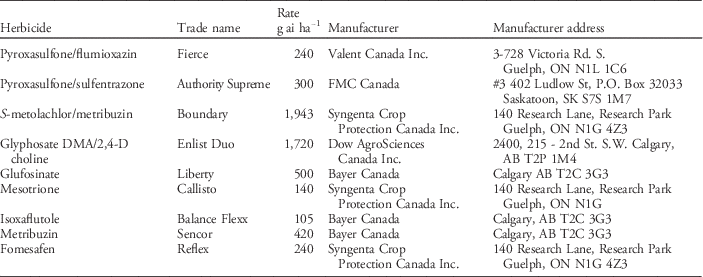
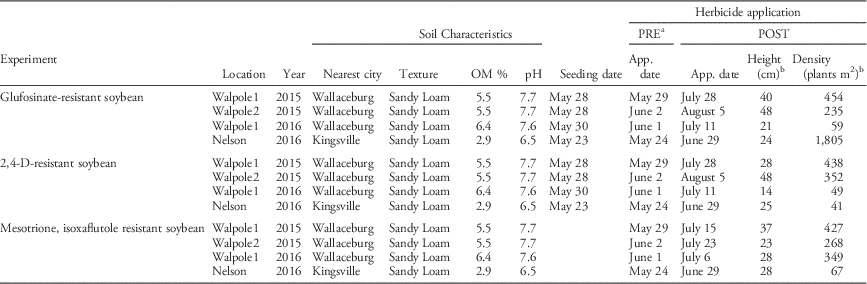
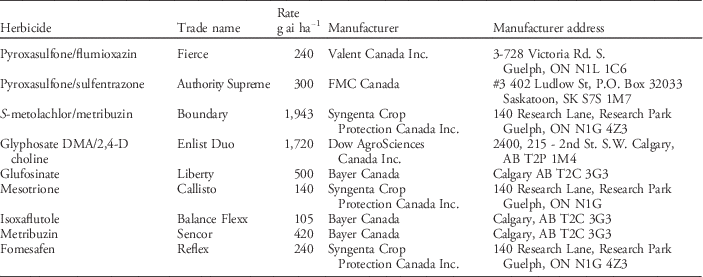
The PRE herbicides were applied within 5 days after soybean seeding. The POST herbicides were applied when escaped CW plants reached an average height of 10 cm in plots treated with PRE herbicides. This determination made for a late POST herbicide application timing as PRE treatments performed well, particularly in 2015. Herbicides were applied with a compressed CO2 backpack sprayer equipped with a handheld 1.5 m boom with four ULD 120-02 nozzles (Hypro, New Brighton, MN) spaced 50 cm apart. Herbicides were applied using a carrier volume of 200 L h−1 at 280 kPa. Experimental site locations, soil characteristics, seeding dates, herbicide information, herbicide application dates, and CW height and density at the POST application are presented in Tables 1 and 2.
Herbicides used as well as their trade name, rate, manufacturer, and manufacturer address for experiments.
Field site and herbicide application information for glyphosate-resistant common waterhemp studies in 2015 and 2016 in Ontario.
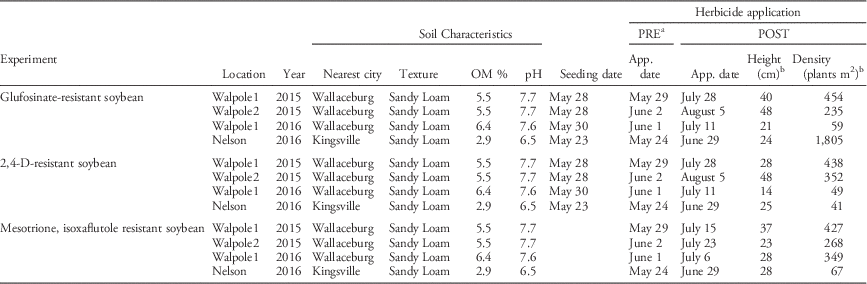
a Abbreviations: PRE, preemergence; POST, postemergence; OM, organic matter; App, application.
b Size and density from nontreated control at the time of POST application.
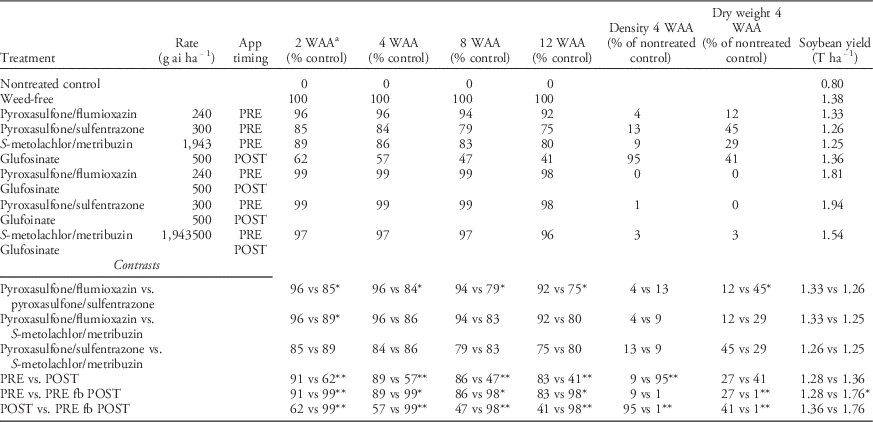
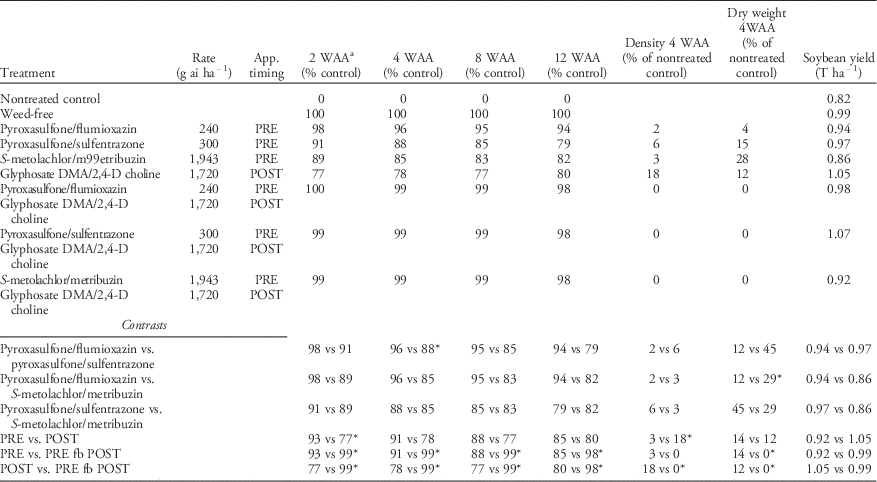
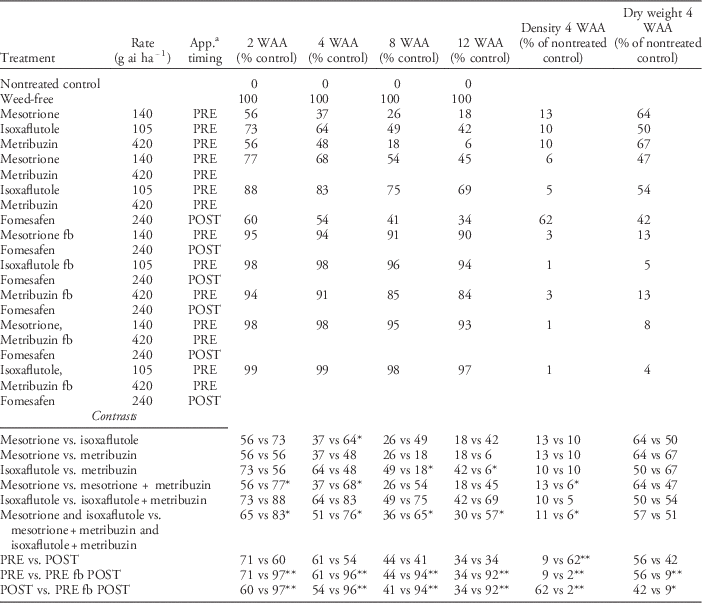
In each replicate untreated weedy and weed-free controls were included. The weed-free control was maintained weed-free with S-metolachlor/metribuzin (1,943 gaiha−1) applied PRE followed by hand-hoeing as required. The LibertyLink experiment consisted of pyroxasulfone/flumioxazin (240 gaiha−1) with a composition of 80.4/102 gaiha−1 respectively of each, pyroxasulfone/sulfentrazone (300 gaiha−1) containing 150 gaiha−1 of each, or S-metolachlor/metribuzin (1943 gaiha−1) with 1,570 and 372.5 gaiha−1 respectively of each active ingredient, applied PRE. Glufosinate (500 gaiha−1) was applied POST, and the two-pass programs of the PRE herbicides followed by glufosinate applied POST (Table 3). The Enlist experiment had the same three PRE herbicide treatments, glyphosate dimethylamine (DMA)/2,4-D choline (1,720 gaiha−1) applied POST, and the sequential program of the PRE herbicides followed by glyphosate DMA/2,4-D choline applied POST (Table 4). The HPPD-resistant soybean experiment consisted of mesotrione (140 gaiha−1), isoxaflutole (105 gaiha−1), metribuzin (420 gaiha−1), mesotrione plus metribuzin or isoxaflutole plus metribuzin applied PRE, fomesafen (240 gaiha−1) plus Turbocharge® 0.5% (v/v) applied POST, and the two-pass programs of a PRE residual herbicide followed by fomesafen applied POST (Table 5). Turbocharge is a mineral oil–surfactant blend (50% and 39.5%, respectively) used as a spray-tank adjuvant.
Means and nonorthogonal contrasts for glyphosate-resistant common waterhemp control using the glufosinate-resistant soybean system in Ontario in 2015 and 2016.
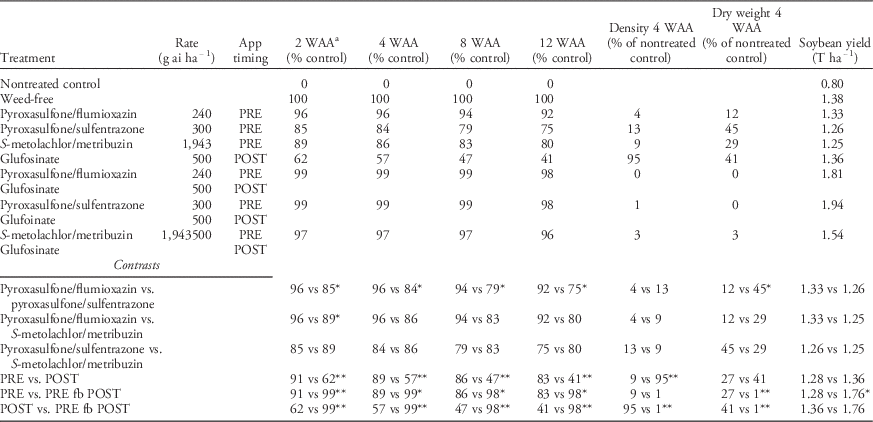
a Abbreviations: WAA, weeks after application; fb, followed by; vs, versus; PRE, preemergence; POST, postemergence; *, P<0.05; **, P<0.001.
Means and nonorthogonal contrasts for glyphosate-resistant common waterhemp control using the 2,4-D resistant soybean system in Ontario in 2015 and 2016.
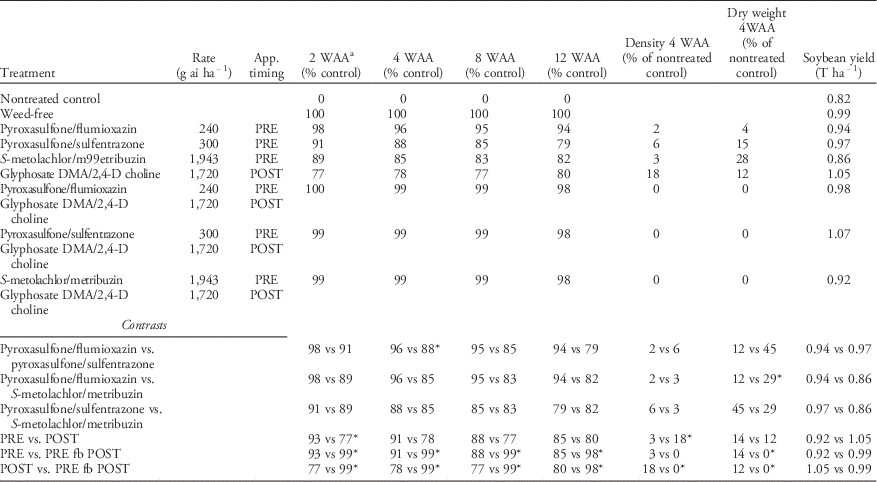
a Abbreviations: WAA, weeks after application; fb, followed by; vs, versus; PRE, preemergence; POST, postemergence; *, P<0.05; **, P<0.001.
Means and nonorthogonal contrasts for glyphosate-resistant common waterhemp control using the mesotrione, glufosinate, and isoxaflutole–resistant soybean system in Ontario in 2015 and 2016.
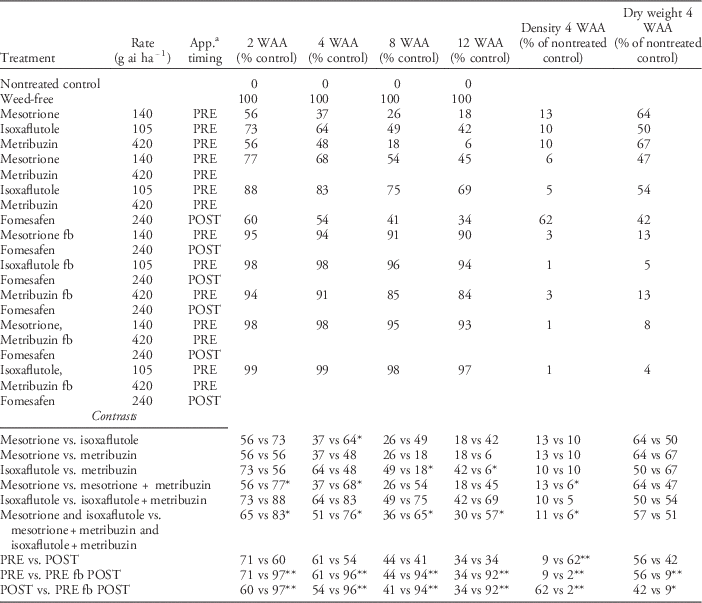
a Abbreviations: App., Application; WAA, weeks after application; fb, followed by; vs, versus; PRE, preemergence; POST, postemergence; *, P<0.05; **, P<0.001.
Soybean injury was visually estimated on a scale of 0% (no injury) to 100% (complete plant death) in 1% increments at 2 and 4 weeks after crop emergence and 1, 2, and 4 weeks after the POST application (WAA). Common waterhemp control was estimated on the day of the POST application and 2, 4, 8, and 12 WAA, and was ranked from 0% (no control) to 100% (complete control). Evaluations accounted for any newly emerged CW or CW that had survived the herbicide treatment. In addition to qualitative assessments, a random subsample of common waterhemp plants was taken from the middle 0.5 m2 of each plot at 4 WAA for a quantitative evaluation of density and dry weight. Common waterhemp plants were counted, cut at the soil surface, placed in a paper bag, and dried in a kiln at 60 C for approximately 3 weeks, followed by a measurement of weight. Soybean was harvested by hand from the middle 2 m of the center row of each plot. The harvested plants were threshed in a stationary threshing machine and weighed. The seed weight and moisture content were measured and weights were adjusted to 13% moisture for calculation of yield.
Statistical analysis was performed using PROC MIXED in SAS (version 9.4, SAS Institute Inc., Cary, NC). Variance was partitioned into the fixed effect of the herbicide treatment, and random effects included block, environment, and block by environment and environment by treatment interactions. Environment was defined as differences in location and year of the experiment. Data were pooled across all four environments for each trait. Residuals were plotted by predicted, treatment, and block for each variable to confirm assumptions of variance, including that errors were independent, homogeneous, and normally distributed. Normality was tested using PROC UNIVARIATE and Shaprio-Wilk’s test, and data transformations included arcsine square-root transformation, square-root transformation, and log transformation to meet the above assumptions. All research was compared using PROC MIXED COVTEST for nonorthogonal contrasts and estimates to compare PRE herbicides and herbicide combinations in addition to herbicide timing of PRE, POST, and PRE followed by POST. Tukey’s test was used with significance of P=0.05.
Results and Discussion
LibertyLink
There was excellent soybean tolerance to the herbicides evaluated, with less than 2% crop injury (data not shown). Pyroxasulfone/flumioxazin provided greater control of GR CW (92% to 96%) than did pyroxasulfone/sulfentrazone (75% to 85%) at 2, 4, 8, and 12 WAA, and there was a greater reduction in GR CW dry weight, but there was no difference in GR CW density and soybean yield (Table 3). With the exception of 2 WAA, pyroxasulfone/flumioxazin and S-metolachlor/metribuzin provided equivalent control of GR CW. Pyroxasulfone/sulfentrazone and S-metolachlor/metribuzin provided equivalent control of GR CW for all parameters assessed and equivalent soybean yield. At 2, 4, 8, and 12 WAA, glufosinate controlled GR CW 41% to 62%. At 2, 4, 8, and 12 WAA (Table 3), a PRE herbicide followed by glufosinate POST controlled GR CW >96%. With respect to herbicide timing, the PRE herbicides provided better GR CW control (83% to 91%) than did a single application of glufosinate applied POST (41% to 62%) with the exception of dry weight 4 WAA. Because of the contact nature of glufosinate, coverage was critical; glufosinate will only control emerged CW plants because it has no residual activity in the soil. In general, the control of GR CW was improved when glufosinate was applied POST after a PRE herbicide, and the control of GR CW was improved when a PRE herbicide was applied prior to glufosinate applied POST. The only significant difference in soybean yield was observed when glufosinate was applied after a PRE herbicide, which increased yield from 1.28 to 1.76 T ha−1. There was a 23% difference between the yield of POST and PRE followed by POST timings, but this was not significant (P=0.066). Soybean yield among the four experiments ranged from 0 to 4.34 T ha−1, partly because of CW interference (data not shown).
Enlist Soybean
There was excellent soybean tolerance to the herbicides evaluated, with less than 2% crop injury (data not shown). GR CW control in this study (Enlist soybean) was similar to that observed in the LibertyLink study. There was a striking difference in the control of GR CW with glyphosate DMA/2,4-D choline, which was observed to be more effective than glufosinate. This reflects previous work in greenhouses showing improved CW control with 2,4-D (Craigmyle et al. Reference Craigmyle, Ellis and Bradley2013a). In general, there were very few differences in GR CW control among the three PRE herbicides (pyroxasulfone/flumioxazin, pyroxasulfone/sulfentrazone, and S-metolachlor/metribuzin) evaluated. At 2, 4, 8, and 12 WAA, glyphosate DMA/2,4-D choline controlled GR CW 77% to 80%. At 2, 4, 8, and 12 WAA, there was numerically higher control of GR CW and a greater reduction in density and dry weight with the PRE herbicides than there was with glyphosate DMA/2,4-D choline POST, although differences were not always statistically significant. The herbicide glyphosate DMA/2,4-D POST following a PRE herbicide, or the application of a PRE herbicide prior to glyphosate DMA/2,4-D POST resulted in improved control of GR CW and a greater reduction in GR CW density and dry weight, although differences were not always statistically significant. Across treatments, there were no differences in soybean yield. This particular variety did not thrive in the soil at Walpole Island, Lambton County, and performed better near Cottam, Essex County. The reduction in seeding population may have also played a role in poor yields.
HPPD-Resistant Soybean
In general, mesotrione, isoxaflutole, metribuzin, mesotrione plus metribuzin, and isoxaflutole plus metribuzin provided similar control of GR CW, although there were a few statistical differences (Table 5). At 2 and 4 WAA, the addition of metribuzin to mesotrione resulted in improved control of GR CW, and there was a greater reduction in GR CW density. At 2, 4, 8, and 12 WAA, the control of GR CW was improved when metribuzin was added to either mesotrione or isoxaflutole, and there was a greater reduction in GR CW density but there was no difference in dry weight. In general, the PRE herbicides and fomesafen applied POST provided equivalent control of GR CW with the exception of GR CW density. For all parameters, there was improved GR CW control when fomesafen was applied POST following a PRE herbicide; control of GR CW was improved when a PRE herbicide was applied prior to fomesafen applied POST. This research was conducted on bare ground and it would be hypothesized that control of GR CW reported would be improved due to competition with a soybean crop.
In conclusion, among all of the herbicide-resistant soybean technologies evaluated, a two-pass weed control program was more efficacious for full-season control of GR CW, with ≥90% control 12 WAA. The use of these new herbicide-resistant soybean cultivars in conjunction with the appropriate herbicides will provide Ontario producers with new tools to manage GR CW. Use of diverse herbicide modes of action will reduce the selection intensity for other herbicide-resistant weeds, and hopefully reduce the geographic spread of this competitive weed. These technologies play a role in the rotation of practices and technologies to ensure that CW populations are manageable for years to come. Although recently developed herbicide technologies have a place in modern practices, good agronomic principles such as a diverse crop rotation, cover crops, narrow row spacing, strategic tillage, and high planting densities can all contribute to a sustainable common waterhemp management strategy moving forward.