The maturity of perceptual-motor organization is associated with a range of cognitive functions and psycho-neurological aspects, since it involves visual perception, manual motor skill, time and space concepts, and organization and representation. It is observed that it is unresponsive to culture, though it is also the result of environmental stimulation, including schooling (Labin, Taborda, & Carrizo, Reference Lacerda, Freire, Raposo, da Sá, de Silva and Lacerda2015).
Visual-motor or perceptual-motor development is usually measured through the Bender Visual-Motor Gestalt Test and have, as recent studies on standardization show, little or no cultural influence (Noronha, Santos, & Rueda, Reference Noronha, Santos and Rueda2013). Lauretta Bender, in 1938, created the test to provide a perceptual-motor maturity index. Bender (Reference Bender1955) observed an absence of errors in the test performed among individuals in their early adolescence, with or without developmental problems. She then suggested that the visual-motor skill is fully developed around 11 years. Ever since then, the Bender test has been used primarily for children. Several studies generally use the Bender test on adults when neurological or psychiatric problems are identified and even on adolescents (Brito & Santos, Reference Brito and Santos1996; Issac, Chandra, Rajeswaran, Christopher, & Philip, Reference Issac, Chandra, Rajeswaran, Christopher and Philip2016; Noronha et al., Reference Noronha, Santos and Rueda2013; Pacanaro, dos Santos, & Suehiro, Reference Pacanaro, dos Santos and Suehiro2008; dos Santos & de Jorge, Reference Dos Santos and de Jorge2007; Tremblay, Chebbi, Bouchard, Cimon-Lambert, & Carmichael, Reference Tremblay, Chebbi, Bouchard, Cimon-Lambert and Carmichael2014; Vendemiatto, Santos, & Suehiro, Reference Vendemiatto, dos Santos and Suehiro2008).
Several researchers have expressed doubts about the parameters of the Koppitz system when applied to the Brazilian population. Hence, the Bender Gestalt Test, according to the criteria of Sisto, Noronha and dos Santos (2006) – Bender-Gradual Scoring System (B-GSS), was validated in Brazil, showing a greater sensitivity to identifying the quality of the errors in the copy of the test figures. Beyond assessing the presence or absence of errors as in the Koppitz system, the B-GSS system also evaluates the intensity of errors (Noronha & Mattos, Reference Noronha and Mattos2006).
Analyzing visual-motor skill in relation to sex, Rajabi (Reference Rajabi2009) observed, in a sample of children aged 6 to 10 years, a greater number of mistakes among boys than girls. In a study by Ferreira, Feil, and Nunes (Reference Ferreira, Feil and Nunes2009), sex showed significant correlation only in some figures and in the rotation item. A study by Pinto and Noronha (Reference Pinto and Noronha2010) with children showed no association between sexes and the Bender test results. So far, controversial results regarding the relationship between visual-motor skill and sexes have been observed.
It is common to find greater visual-motor ability as age increases in a sample of children (Ferreira et al., Reference Ferreira, Feil and Nunes2009; Pinto & Noronha, Reference Pinto and Noronha2010; Rajabi, Reference Rajabi2009). This may be the reason why most studies with the Bender test are conducted on children or early adolescents (10, 11 or 12 years). However, some researchers observed increased visual-motor maturation beyond the age of 11 years. Decker (Reference Decker2008), developing a scale sensitive to lifelong changes in visual-motor development, observed rapid maturation lasts till middle adolescence, steadily decreases through adulthood, and rapidly declines in later age ranges. Bolen (Reference Bolen2003), with a sample of participants aged from 4 to 21 years, using the Bender test based on the Koppitz system, and Shapiro and Simpson (Reference Shapiro and Simpson1995), also using the Koppitz system in a study with 87 adolescents with emotional and behavioral disorders, obtained similar results.
Evidence of continued visual-motor maturation throughout life makes sense, as neuroscience studies have found continuous brain development to approximately 25 years (Lenroot & Giedd, Reference Lenroot and Giedd2006). Westlye et al. (Reference Westlye, Walhovd, Dale, Bjørnerud, Due-Tønnessen, Engvig and Fjell2010) found the maturational changes in the occipital lobe as reaching the maximum development around 20 years of age, and the frontal lobe until the third decade of life.
As the perceptual-motor skill involve cognitive and psycho-neurological processes, it is essential for learning in school. Lacerda, et al. (2015), conducting a neuropsychological assessment of children with difficulties in reading and comprehension, found impairments in visual-motor skill, besides attention problems. Tremblay et al. (Reference Tremblay, Chebbi, Bouchard, Cimon-Lambert and Carmichael2014) also found that adults with learning disabilities copied the Bender test figures more slowly and with a greater number of errors. Previous studies have also shown that the learning of mathematics and proficiency in both reading and writing depend on the development and interrelationship of cognitive and psychomotor skill (Carvalho, Noronha, Pinto, & Luca, Reference Carvalho, Noronha, Pinto and Luca2012; Suehiro & dos Santos, Reference Suehiro and dos Santos2005).
A study by Suehiro and dos Santos (Reference Suehiro and dos Santos2005) found performance in the Bender test worsened as the degree of learning difficulty of the participants increased. Other studies have found low visual-motor performance in adolescent school dropouts (Romi & Marom, Reference Romi and Marom2005) and in children and adolescents with school competence problems (da Silva, Feil, de Souza, & Paniagua, 2009).
Studies that measured visual-motor skill through the Bender test and measured intelligence with various tools, observed better performance in intelligence tests for participants with higher visual-motor maturation (Böhm, Lundequist, & Smedler, Reference Böhm, Lundequist and Smedler2010; Keppeke, Cintra, & Schoen, Reference Keppeke, Cintra and Schoen2013; Labin et al., Reference Lacerda, Freire, Raposo, da Sá, de Silva and Lacerda2015; Pacanaro et al., 2008; Romi & Marom, Reference Romi and Marom2005; Sisto, Bartholomeu, Rueda, dos Santos, & Noronha, Reference Sisto, Bartholomeu, Rueda, dos Santos and Noronha2008).
The results of Ferreira et al. (Reference Ferreira, Feil and Nunes2009) suggest that the Bender test is a sensitive tool to identify neurological problems at the maturational level. In the Oros et al. (Reference Oros, Altermir, Elia, Tuquet, Pablo, Fabre and Pueyo2014) study, children aged between 6 and 13 years and born small-for-gestational age, showed lower results in Bender test compared to control. Therefore, prematurity can lead to anatomical and structural changes in the brain due to the interruption of the stages of prenatal development, making individuals more susceptible to cognitive and motor problems, affecting daily and school activities even during adolescence and adulthood. Several other studies using the Bender test found that prematurity or low birth weight may interfere with visual-motor performance in later life (Böhm et al., Reference Böhm, Lundequist and Smedler2010; Chaudhari, Otiv, Chitale, Pandit, & Hoge, Reference Chaudhari, Otiv, Chitale, Pandit and Hoge2004).
Children with a high functioning autism spectrum disorder (Volker et al., Reference Volker, Lopata, Vujnovic, Smerbeck, Toomey, Rodgers and Thomeer2009), Attention Deficiency Hyperactivity Disorder (Allen & Decker, Reference Allen and Decker2008) or dyslexia (dos Santos & de Jorge, Reference Dos Santos and de Jorge2007) had worse scores in the Bender test compared to the control group. Similar results were found by Keppeke et al. (Reference Keppeke, Cintra and Schoen2013), where adolescents with various developmental problems had significantly lower visual-motor performance compared to healthy adolescents. Noronha et al. (Reference Noronha, Santos and Rueda2013), also observed the same in a sample of children, adolescents, and adults with intellectual disabilities.
Since the Bender test has been part of standard test sets for neuropsychological evaluation and remains popular in a variety of clinical settings of all ages for the past 60 years, it seems important to conduct studies to assess its sensitivity measurement at older ages of individuals than those used in the test standardization.
As mentioned earlier, there is evidence of visual-motor skill changes after childhood (Bolen, Reference Bolen2003; Decker, Reference Decker2008; Shapiro & Simpson, Reference Shapiro and Simpson1995), in contrast to Lauretta Bender’s (1955) suggestion.
According to the World Health Organization (WHO, 2014), the adolescence phase is marked by hormonal changes from puberty that generate drastic anthropometric changes involving an acceleration and a deceleration period. We can hypothesize that, among these biological changes, adolescents possibly go through a period of visual-motor changes until the body develops fully and the brain assimilates and maps these changes.
Adolescence begins in the second decade of life (between 10 and 19 years of age), its initiation is marked by puberty. These changes involve the development of secondary sexual characteristics, body members in general, and a growth spurt (WHO, 2014). Health professional experts constantly evaluate the phenomena of puberty during adolescence to correlate with other physical phenomena and make recommendations (Vitalle & Medeiros, Reference Vitalle, Medeiros, Morais, Campos and Hilário2013).
Around 1960, the English physician J. M. Tanner, standardized a staging method of sexual maturation that is most commonly used nowadays. Tanner`s method is a five-stage classification of breast maturation (M1–M5), in girls, external genitalia (G1–G5), in boys, and pubic hair (P1–P5) in both sexes (Vitalle & Medeiros, Reference Vitalle, Medeiros, Morais, Campos and Hilário2013).
The growth spurt (rapid growth in height and weight, and changes in body proportions) precedes sexual maturity with the entire maturation process lasting about four years, while beginning about three years earlier in girls. Health professionals, in their assessment of adolescence, usually consider, in case of girls, the growth spurt in the P2–P4 and M2–M4 stages, with a maximum growth rate being seen in M3, and slowing down in M4, when, usually, menarche occurs. In boys, the growth spurt occurs in P2–P4 and G2–G4 stages, accelerating in G3, and peaking in G4, after which it begins to slow down. For both sexes, sexual maturation is complete in the P5, M5, and G5 stages (Vitalle & Medeiros, Reference Vitalle, Medeiros, Morais, Campos and Hilário2013).
In a previous study using the Bender Test according to the Koppitz (Reference Koppitz1989) system, we did not observe any association between visual-motor skill and age variables or maturation related to puberty (Tanner`s stages and growth spurt) in a sample of Brazilian adolescents, although we found a correlation between visual-motor skill and the repetition of a school year and developmental problems (Keppeke et al., 2013). In the current study, to further explore the correlation between visual-motor development and pubertal stages in those adolescents, we re-evaluated visual-motor development through the Bender-Gradual Scoring System (B-GSS) of Sisto et al. (Reference Sisto, Noronha and dos Santos2006).
We explored by comparing the number of errors committed in the Bender Visual-Motor Gestalt test, according to the B-GSS assessment criteria, with the Tanner pubertal stages and growth-spurt. We also investigated the relation between the Bender scoring and demographic variables (sex, age and schooling), cognitive assessment measured through Raven’s Progressive Matrices Test, and developmental problems that may affect the Bender test results.
Method
Participants
The study included 134 patients, both male and female, assisted in the Adolescent Sector of the Department of Pediatrics at the Federal University of Sao Paulo (Brazil), aged 10 to 15 years.
Measures
Bender Visual-Motor Gestalt Test, Gradual Scoring System (B-GSS): Evaluates the perceptual-motor maturation through the analysis of distortion in the reproduction shapes of nine figures copied freehand. Correction assigns score from 0 to 3 for the graphic reproduction of each figure, giving total score values between 0 and 21. The score varies according to the quality of the drawings, where only errors are scored. So high scores mean more errors, indicating greater difficulty with visual-motor coordination. The standardization of B-GSS involved 1,052 male and female children, aged 6 to 10 years. The nine figures were applied collectively and individually (sometimes presented by transparency, sometimes by cards). All children were from public schools, enrolled from Kindergarten to Grade 5. The indices obtained from the correlation between age and scoring and Rasch measured were r = –.58 and r = –.60, respectively, both with significance (p < .001), showing that the distortion of copies progressively decrease with increasing age and that there is a consequent improvement in reproduction through the ages (Sisto et al., Reference Sisto, Noronha and dos Santos2006).
Raven’s Progressive Matrices Test: A test of abstract reasoning for measuring general intelligence, intellectual ability and general mental ability, designed for individuals aged 13 years and older (Raven, Reference Raven2000). It consists of visually presented, geometric-analogy-like problems in which a matrix of geometric figures is presented with one entry missing, and the correct missing entry to be selected from a set of answer options. The test consists of 60 problems, arranged in five sets (A, B, C, D, and E) of 12 problems each, arranged in the order of how difficult they are to answer. Each correct answer is noted. A simple sum of the scores on each set adds up to the total score ranging from 0 to 60 points. Raven (Reference Raven2000) established a saturation of .82 on factor g. The test-retest reliability ranges from .83 to .93, depending on age. The correlation with the Terman-Merril scale was .86.
Demographic chart: Data on variables affecting visual development were recovered from the participants’ medical charts following the literature: a) Developmental conditions; b) age; c) gender; d) schooling, including the repetition of a school year; and e) the Tanner stage. Determination of the sexual maturation stage was routine for medical appointments at the clinic according to literature (Vitalle & Medeiros, Reference Vitalle, Medeiros, Morais, Campos and Hilário2013).
Procedure
The study was approved by the Ethics Committee (process number 842/10). The study was explained while the adolescents waited for the medical appointment. The adolescents and parents/guardians who agreed to participate signed a statement of informed consent. The clinic offered a quiet room with tables and chairs where adolescents individually copied the figures on the Bender test and took Raven’s Progressive Matrices. After that, they went to the scheduled appointment with a specialist pediatrician for adolescents.
Statistical analysis
The Kolmogorov-Smirnov Test was employed to assess the normality of quantitative and semi-quantitative parameters and determine parametric/non-parametric distribution. To compare the B-GSS scoring test of two groups were at least one presented non-parametric distribution, the Mann-Whitney test was employed, and the derived Cohen’s d effect size (ES) was estimated. When three or more groups were compared were also at least one presented non-parametric distribution, we used the Kruskal-Wallis test, and estimate the effect size (ES) by calculating the epsilon square of the comparison. When statistical significance was observed, the groups were compared in pairs among themselves to identify those differences. The correlation between the results of the B-GSS and Raven tests was assessed with Pearson’s test since both shows normal distribution. Values of p ≤ .05 were considered statistically significant. All data were analyzed using SPSS 17.0 and are presented as mean (M) and standard deviation (SD).
Results
Among adolescents who agreed to participate, 56.7% were male. Regarding schooling predominated grades from 6 to 9 (69.7%). There were no females at the M1 and M2 stages. Those who repeated a school grade made up 22.4%, and those showing developmental disorders (mental retardation, dyslexia, global learning disability, attention deficit disorder and hyperactivity, global developmental disability, arthrogryposis multiplex congenita, epilepsy, etc.) comprised 15.8%. The mean age of the overall sample was 12.7 years. (SD = 1.6).
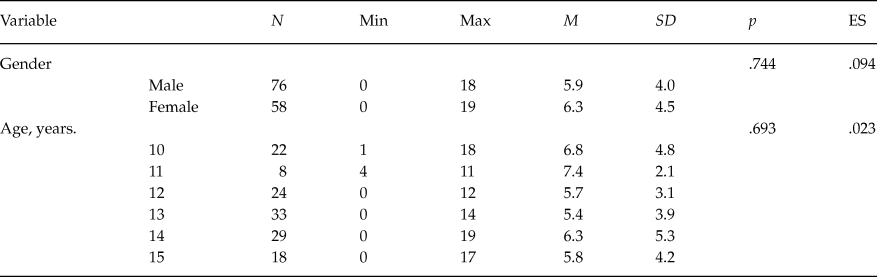
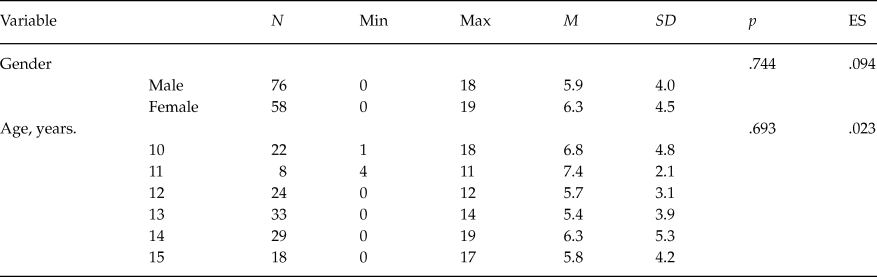
No significant differences between the sexes or age grouping were observed in relation to the Bender test score (Table 1).
Bender Test Scores According to Gender and Age
The results show a significant difference in the Bender test performance in relation to education classified as in grades or as in stages (Elementary, Middle, and High School) (Table 2). By analyzing the visual-motor performance difference in school grades, we observed swing changes and worst performance among the third grade participants, better performance among the fourth and fifth grade participants, decrease in the sixth and seventh grade participants, and renewed good performance in the eighth and ninth grades, and high school participants. Regarding results related to schooling stages, an improvement was observed in visual-motor skill the higher the stage, the lower the Bender score. The analysis of repeated school grade also showed significant differences between the groups that repeated and those that did not, being the first group to show significantly bad performance.
Bender Test Scores According to Academic Level

Note: 1 = 1st to 5th years; 2 = 6th to 9th years; 3 = high school (HS).
Analyzing the relation between visual-motor ability and intelligence g factor through Pearson’s correlation, we observed a statistically significant negative correlation (–57%; p < .001) between the Bender and Raven test results in gross rating points, showing that visual-motor skill and intelligence are related.
Adolescents with developmental disorders obtained a mean score significantly higher in the Bender test than those who had no diagnosis of developmental disorders, showing poorer performance (Table 3). Puberty-related changes were linked to visual-motor skill only among males adolescent. A significant difference was observed in the Bender test score in the growth spurt with worse visual-motor performance at the G3 stage and better performance at post-spurt (G5 stage) (Table 3). In the entire sample, we did not observe any relation between visual-motor skill and pubic hair changes.
Bender Test Scores According to Developmental Disorders and Sexual Maturation Stage

Discussion
In this study we analyzed the correlation between visual-motor skill measured through the B-GSS and the pubertal stages in adolescents. Pubertal changes, schooling, repetition of a school grade, developmental disorders and intelligence g factor, according to the Raven test, were related to the Bender test results. However, age and gender were not related to visual-motor skill.
Regarding pubertal development, we observed significant difference in score in the Bender test related to Tanner stages and growth spurt in males. The same was not true of females, probably because the sample had no girls in the pre-pubertal and stage 2 of Tanner, thus not allowing any associative analysis, which is a limiting factor in this study. As this study was conducted in a medical clinic for adolescents, only girls aged from 10 years were included in the sample. It is known that puberty starts earlier in girls than in boys (Vitalle & Medeiros, Reference Vitalle, Medeiros, Morais, Campos and Hilário2013), in many cases, from eight years.
Notably, the worst performers in the Bender test were at stage G3, the period when growth accelerates (spurt), and the best performances at stage G5, the post-spurt period coinciding with the end of pubertal development (Vitalle & Medeiros, Reference Vitalle, Medeiros, Morais, Campos and Hilário2013). It seems that hormonal and anthropometric changes in puberty are phenomena that interfere with visual-motor skill and consequently in the performance of the participants in the Bender test. Our finding may be due to the fact that the speed at which adolescent body changes occur is faster than the brain can map, resulting in temporary incoordination (Kolb & Whishaw, Reference Kolb and Whishaw2002; Vitalle & Medeiros, Reference Vitalle, Medeiros, Morais, Campos and Hilário2013).
These results are consistent with the suggestion of Kolb and Whishaw (Reference Kolb and Whishaw2002) and Machado et al. (Reference Machado, Bastos, Silva, Andrade, Silva, Furtado and Ribeiro2005) that gonadal hormones act on cognitive abilities. However, one should bear in mind that the present study only investigated visual-motor skill, inferring the action of hormones through secondary sexual characteristics. Our results are also consistent with the studies of Decker (Reference Decker2008), Bolen (Reference Bolen2003) and Shapiro and Simpson (Reference Shapiro and Simpson1995) that observed evidence of visual-motor development beyond childhood.
It is important to inquire into our finding of an association of visual-motor skill in relation to puberty and not with respect to age. Experts in adolescence find that the pubertal changes are more reliable for making correlations with other phenomena in adolescence than chronological changes, since biopsychosocial development is peculiar to each adolescent (Vitalle & Medeiros, Reference Vitalle, Medeiros, Morais, Campos and Hilário2013). So results have, expectedly, pointed to an association of visual-motor skill with pubertal changes and not with age, since the former do not follow the chronological age. The fact that pubic hair stages are not associated with Bender test results may be due to the influences of mixing. Brazil is a country where intermixing of various ethnic groups is quite common, which may explain a lack of association in P stages.
Similarly, to our previous observation reported at Keppeke et al. (Reference Keppeke, Cintra and Schoen2013) and more recently by Labin et al. (Reference Lacerda, Freire, Raposo, da Sá, de Silva and Lacerda2015), a negative correlation was seen between perceptual-motor development and intelligence g factor measured by the Raven test. On the other hand, a study by Vendemiatto et al. (Reference Vendemiatto, dos Santos and Suehiro2008), where adolescents at risk presented results far below expectations based on the standard sample of the Bender test, there was no correlation between visual-motor skill and intelligence measured by the R1–B Form test, also showing low results. However, these results indicate that the identification of poor visual-motor performance is not restricted to childhood, and may have several reasons. Therefore, in adolescent psychodiagnosis, it is interesting to evaluate the different areas of development. Even though the Bender Gestalt Test may show complete absence of errors among adolescents, the clinical view is expanded to detect possible neurological impairments, which can be related to learning disabilities and developmental problems or even precariousness of stimulatory exposure.
In the present study, the Bender test was sensitive to different levels of grade. Pinto and Noronha (Reference Pinto and Noronha2010) found similar results among children. This indicates that education seems to stimulate visual-motor skill also during adolescence. Adolescents with developmental disorder and those that have repeated a school year had worse results in the Bender test. In our previous study, we obtained the same result using the Bender test based on the Koppitz System (Keppeke et al., Reference Keppeke, Cintra and Schoen2013). It can also be inferred from the results that poor visual-motor condition is related to pathologies, which, in turn, hamper learning in school. In our previous study, it was found that there was a higher proportion (85.7%) of adolescents with some developmental disabilities among those who repeated a school year (Keppeke et al., Reference Keppeke, Cintra and Schoen2013). Several previous studies had found a relationship between developmental problems and poor Bender test results (Allen & Decker, Reference Allen and Decker2008; Ferreira et al., Reference Ferreira, Feil and Nunes2009; Pacanaro et al., Reference Pacanaro, dos Santos and Suehiro2008; dos Santos & de Jorge, Reference Dos Santos and de Jorge2007; Volker et al., Reference Volker, Lopata, Vujnovic, Smerbeck, Toomey, Rodgers and Thomeer2009).
Compared to the Koppitz System (1989) used in a previous study (Keppeke et al., Reference Keppeke, Cintra and Schoen2013), the B-GSS (Sisto et al., Reference Sisto, Noronha and dos Santos2006) in this study was more sensitive in identifying the association between the visual-motor skill and puberty and schooling. Both systems have identified associations between the Bender test and intelligence g factor and developmental problems in adolescence. These results may be related to different types of correction, as the B-GSS, besides assessing the presence or absence of errors as in the Koppitz system also evaluates the intensity of errors (Noronha & Mattos, Reference Noronha and Mattos2006). Since B-GSS is valid in Brazil, it may prove to be more sensitive in identifying changes in visual-motor ability of Brazilian adolescents as a result of pubertal changes. As this is a pioneer study, and more studies are needed to investigate the usefulness of the Bender Test in adolescents’ cognitive evaluation, is essential the use of more than one assessment instrument to make reliable diagnostics. Therefore, we encourage diagnosticians to use the Bender Test as one part of a diagnostic battery of assessment instruments. Tests are auxiliary tools in data collection. Together with other information organized by the professional, tests help to understand the problem studied in order to facilitate the decision making.
The Bender Test, though aimed at the age group of up to 11 years, was in this study associated with pubertal changes, schooling, intelligence g factor, and proved to be reliable in identifying developmental problems also during adolescence. These results suggest greater usefulness of the Bender Test at older ages than those used in the test standardization.