Early school achievement lays the groundwork for subsequent trajectories of academic, social, and economic success (Entwhisle, Alexander, & Olson, 2005; Kerckhoff, Reference Kerckhoff2007), yet there are still many unanswered questions regarding its predictors. Most extant research has focused on the cognitive and academic precursors to success in the classroom, such as qualities of the home environment that are believed to stimulate cognitive growth and promote academic achievement (Griffin & Morrison, Reference Griffin and Morrison1997; Stipek & Ryan, Reference Stipek and Ryan1997), as well as on intrinsic abilities linked to executive functioning (i.e., paying attention, following instructions, inhibiting inappropriate actions; DiPerna, Lei, & Reid, Reference DiPerna, Lei and Reid2007; Ladd, Birch, & Buhs, Reference Ladd, Birch and Buhs1999; Lin, Lawrence, & Gorrell, Reference Lin, Lawrence and Gorrell2003; McClelland et al., Reference McClelland, Cameron, Connor, Farris, Jewkes and Morrison2007).
An emerging line of research focuses on children's social–emotional behavior in the classroom as another crucial component of academic performance and achievement (e.g., Graziano, Reavis, Keane, & Calkins, Reference Graziano, Reavis, Keane and Calkins2007). Children and adolescents who have difficulty regulating emotion (i.e., negativity, frustration) in the classroom or who exhibit high levels of externalizing and internalizing behaviors (see Masten et al., Reference Masten, Roisman, Long, Burt, Obradović and Riley2005, for review) are at increased risk for poor adjustment to the classroom context, which may lead to future difficulties with social and academic competence (Blair & Peters, Reference Blair and Peters2003). Although many of these studies focus on the classroom behavior and performance of students in the later grades of elementary school and through high school, the critical skills that contribute to functioning in this context begin to develop early in the life course. Forty-six percent of a large, national sample of teachers reported that more than half of the children entering kindergarten classes did not possess the basic regulatory competencies needed to do well in school (Rimm-Kaufman, Pianta, & Cox, Reference Rimm-Kaufman, Pianta and Cox2000).
Little is known about the origins of these competencies in the first years of school. The present study examines early predictors of academic achievement and performance in first grade, with a focus on one possible source of variability: a gene–environment correlation involving mother and child genotype and maternal caregiving over the first 3 years of life. We hypothesize that these correlations are associated with psychosocial behavior and functioning (i.e., emotion regulation, externalizing behavior, internalizing behavior) that are integral to success in the classroom.
We focus on two dopamine receptor polymorphisms associated with receptor Types 2 (DRD2) and 4 (DRD4), because of the evidence linking them to impulsive behaviors and diminished capacity to learn from mistakes (Type 2; e.g., Eisenberg et al., Reference Eisenberg, Mackillop, Modi, Beauchemin, Dang and Lisman2007; Frank, Moustafa, Haughey, Curran, & Hutchinson, Reference Frank, Moustafa, Haughey, Curran and Hutchison2007) and symptoms of attention-deficit/hyperactivity disorder (Type 4; for a recent meta-analysis, see Smith, Reference Smith2010). Dopamine receptors may be related to processes that are associated with behavioral control, learning, and motivation (e.g., Benjamin et al., Reference Benjamin, Li, Patterson, Greenberg, Murphy and Hamer1996; Wise, Reference Wise2004), and one study, drawing on a nationally representative sample, reports that DRD2 TaqIA is associated with educational continuation in late adolescence (Shanahan, Vaisey, Erickson, & Smolen, Reference Shanahan, Vaisey, Erickson and Smolen2008).
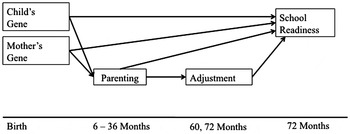
As shown in Figure 1, we examine whether these polymorphisms evoke less positive, sensitive parenting across the first 3 years of life, whether such parenting then eventuates in psychosocial skills that are less conducive to the social setting of the classroom, whether teachers evaluate these children in the classroom as less capable students, and whether these students have lowered standardized test scores. These were assessed via the reading and math subscales of the Woodcock–Johnson Test of Achievement, Third Edition (WJ-III, First Grade; Woodcock, McGrew, & Mather, Reference Woodcock, McGrew and Mather2001).
The pathways that the dopamine receptors take: whether these polymorphisms evoke less positive, sensitive parenting across the first 3 years of life, whether such parenting then eventuates in psychosocial skills that are less conducive to the social setting of the classroom, whether teachers evaluate these children in the classroom as less capable students, and whether these students have lowered standardized test scores.

Psychosocial Skills and Success in the Classroom
Although cognitive skills clearly matter for academic performance, most learning takes place in the complex social setting of the school and thus reflects the child's psychosocial skills as well, including emotion regulation, externalizing behavior, and internalizing behavior.
Emotion regulation is increasingly viewed as critical for a successful transition to school and academic achievement in early childhood and beyond (Bull & Sherif, Reference Bull and Scherif2001; Fuchs et al., Reference Fuchs, Fuchs, Prentice, Burch, Hamlett and Owen2003; McClelland et al., Reference McClelland, Cameron, Connor, Farris, Jewkes and Morrison2007). Findings suggest that children who have difficulty regulating emotions have trouble learning in the classroom and are less productive and accurate when completing assignments (Graziano et al., Reference Graziano, Reavis, Keane and Calkins2007). Evidence also suggests that children who are better at dealing with frustration during the school day may be more likely to stay on task and focus attention on learning (Martin et al., Reference Martin, Nagle and Paget1983; Newman, Reference Newman1998). Other findings reveal that the ability to handle frustration and negative emotions appropriately may be an important protective factor leading to better academic performance in children from low socioeconomic status backgrounds (Bramlett, Rowell, & Mandenberg, Reference Bramlett, Rowell and Mandenberg2000; Dobbs, Doctoroff, Fisher, & Arnolds Reference Dobbs, Doctoroff, Fisher and Arnold2006). Furthermore, intense emotions may affect the student–teacher relationship; children who are less emotionally intense are rated by teachers as being more teachable, and these children achieve at higher levels than children without these emotions (Keogh, Reference Keogh, Carey and McDevitt1992; Palinsin, Reference Palinsin1986).
There is also considerable evidence linking externalizing behavior to academic achievement (Bardone, Moffitt, Caspi, Dickson, & Silva, Reference Bardone, Moffitt, Caspi, Dickson and Silva1996; Chen, Rubin, & Li, Reference Chen, Rubin and Li1997; Dodge & Pettit, Reference Dodge and Pettit2003; Hinshaw, Reference Hinshaw1992; Maguin & Loeber, Reference Maguin and Loeber1996; Masten et al., Reference Masten, Roisman, Long, Burt, Obradović and Riley2005; Normandeau & Guay, Reference Normandeau and Guay1998; Risi, Gerhardstein, & Kistner, Reference Risi, Gerhardstein and Kistner2003; Williams & McGee, Reference Williams and McGee1994). Moreover, internalizing symptoms such as anxiety, depression, fearfulness, and withdrawn behavior have also been linked to academic problems, although the evidence is more limited and less consistent than for externalizing behavior (Masten et al., Reference Masten, Roisman, Long, Burt, Obradović and Riley2005). Moderate to strong correlations between internalizing behavior problems in children and daily classroom performance have been reported in clinical and community samples (Brumback, Dietz-Schmidt, & Weinberg, Reference Brumback, Dietz-Schmidt and Weinberg1977; Edelsohn, Ialongo, Werthamer-Larsson, Crockett, & Kellam, Reference Edelsohn, Ialongo, Werthamer-Larsson, Crockett and Kellam1992; Hodges & Plow, Reference Hodges and Plow1990; Ialongo, Edelsohn, Werthamer-Larsson, Crockett, & Kellam, Reference Ialongo, Edelsohn, Werthamer-Larsson, Crockett and Kellam1995; Ollendick, Weist, Borden, & Greene, Reference Ollendick, Weist, Borden and Greene1992).
Many studies of the factors that predict childhood psychopathology focus on externalizing behaviors (e.g., Fleming, Harachi, Cortes, Abbott, & Catalano, Reference Fleming, Harachi, Cortes, Abbott and Catalano2004; Hill, Degnan, Calkins, & Keane, Reference Hill, Degnan, Calkins and Keane2006), although childhood internalizing problems are also a serious concern (Masten et al., Reference Masten, Roisman, Long, Burt, Obradović and Riley2005). In addition, extant studies have typically focused on a single level of analysis (i.e., physiological, cognitive, or behavioral), a single context (i.e., lab, home, or school), or a single time point, and thus do not permit a comprehensive investigation of how these behaviors develop across different levels. The present study, therefore, examines development of the aforementioned behaviors (emotion regulation, externalizing and internalizing) in the classroom, and subsequent academic performance, from a multilevel perspective that takes into account the interplay between child genotype and the early caregiving environment over the first 3 years of life.
Dopamine Receptor Polymorphisms and Psychosocial Adjustment
Dopamine has been suggested as an underlying neurotransmitter influencing the behavioral system of approach in adults, including active exploration and approach toward novel stimuli as well as activation and intensity of response in reward situations (Cloninger, Reference Cloninger1987; Gray, Reference Gray1982; Panskepp, Reference Panskepp1986; Zukerman, Reference Zukerman, Bates and Wachs1994). Two dopamine receptor genes (associated with DRD4 and DRD2) have been extensively examined in the literature as correlates of adult, adolescent, and, more recently, child behavior and functioning.
DRD4 is primarily expressed in the limbic areas of the brain that are involved in cognition and emotion. The DRD4 gene contains a repeated sequence polymorphism within its coding sequences that changes the length of the receptor protein that has been shown to have a moderate functional significance (Asghari et al., 1994). Individuals with longer versions of the polymorphism (L-DRD4; 6–8 repeats) have shown significantly higher novelty-seeking (including risk taking) behaviors than those with the shorter version (S-DRD4; 2–5 repeats); the shorter the allele, the more efficient it is in binding dopamine (Plomin & Rutter, Reference Plomin and Rutter1998), suggesting that the L-DRD4 allele is a “risk” allele.
Variations in DRD4 have been related to dimensions of adult personality such as excitability, impulsiveness, and high exploratory behavior (Benjamin et al., Reference Benjamin, Li, Patterson, Greenberg, Murphy and Hamer1996; Ebstein, Nemanov, Klotz, Gritsenko, & Belmaker, Reference Ebstein, Nemanov, Klotz, Gritsenko and Belmaker1997; Noble et al., Reference Noble, Ozkaragoz, Ritchie, Zhang, Belin and Sparkes1998), pathological gambling (Pérez de Castro, Ibáñez, Torres, Sáiz-Ruiz, & Fernández-Piqueras, Reference Pérez de Castro, Ibáñez, Torres, Sáiz-Ruiz and Fernández-Piqueras1997), and addictive behaviors such as cigarette smoking (Shields et al., Reference Shields, Lerman, Audrain, Main, Boyd and Caporaso1998) and alcoholism (George, Cheng, Nguyen, Israel, & O'Dowd, Reference George, Cheng, Nguyen, Israel and O'Dowd1993). The emerging body of research examining associations between DRD4 and child behavior has revealed similar findings. L-DRD4 has been related to externalizing problems such as hyperactive–impulsive–inattention (LaHoste et al., Reference LaHoste, Swanson, Wigal, Glabe, Wigal and King1996; Sunohara et al., Reference Sunohara, Roberts, Malone, Schachar, Tannock and Basile2000), oppositional defiant behaviors (Kirley et al., Reference Kirley, Lowe, Mullins, McCarron, Daly and Waldman2004), and aggressive behaviors (Benjamin, Ebstein, & Belmaker, Reference Benjamin, Ebstein and Belmaker2002; Schmidt, Fox, Rubin, Hu, & Hamer, Reference Schmidt, Fox, Rubin, Hu and Hamer2002) in children and adolescence. Many studies, however, have failed to replicate such associations (e.g., Birkas et al., Reference Birkas, Lakatos, Nemoda, Ney, Toth and Novak2005). Consequently, although there is reason to believe that DRD4 may play a role in the development of behavioral problems, more work is needed to clearly understand the mechanisms involved, including a closer study of how pathways may differ for different demographic groups (e.g., race, socioeconomic status, sex) and how the interplay between genes and environment may lead to multiple outcomes.
The risk allele of DRD2 (i.e., minor Taq1 A1 allele) has been related to several similar dimensions of adult and adolescent personality, including high novelty-seeking behavior (Cloninger, Adolfsson, & Svrakic, Reference Cloninger, Adolfsson and Svrakic1996; Noble et al., Reference Noble, Ozkaragoz, Ritchie, Zhang, Belin and Sparkes1998; Suhara et al., Reference Suhara, Yasuno, Sudo, Yamamoto, Inoue and Okubo2001), conduct disorder (Comings et al., Reference Comings, Rosenthal, Lesieur, Rugle, Muhleman and Chiu1996; Lu, Lee, Ko, & Lin, Reference Lu, Lee, Ko and Lin2001), impulsivity (Wiers, Sergeant, & Gunning, Reference Wiers, Sergeant and Gunning1994), and disinhibition (McGue, Slutske, Taylor, & Iacono, Reference McGue, Slutske, Taylor and Iacono1997).Footnote 1 Furthermore, this allele of DRD2 has also been associated with addictive behaviors such as pathological gambling (e.g., Comings et al., Reference Comings, Rosenthal, Lesieur, Rugle, Muhleman and Chiu1996), alcoholism (Blum et al., Reference Blum, Noble, Sheridan, Finley, Montgomery and Ritchie1991; Noble et al., Reference Noble, Syndulko, Fitch, Ritchie, Bohlman and Guth1994), nicotine dependence (Comings et al., Reference Comings, Rosenthal, Lesieur, Rugle, Muhleman and Chiu1996; Noble et al., Reference Noble, Syndulko, Fitch, Ritchie, Bohlman and Guth1994), and opiate dependence (Lawford et al., Reference Lawford, Young, Noble, Sargent, Rowell and Shadforth2000). These results are consistent with expectations, as the Taq1 A1 allele of DRD2 has been reported to be associated with a decrease in D2 dopamine receptor availability (Pohjalainen et al., Reference Pohjalainen, Rinne, Nagren, Lehikoinen, Anttila and Syvalahti1998), and the number of receptor binding sites is lowest in A1 homozygotes. Therefore, given that D2 dopamine receptors have an inhibitory function in the dopaminergic system, a lower availability of these receptors may translate into less behavioral control. In addition to behavioral associations, a previous study of the current sample found that the risk allele of DRD2 was associated with less effective parasympathetic regulation (i.e., respiratory sinus arrhythmia), a purported physiological index of behavioral and emotional regulation, over the first year of life (Propper et al., Reference Propper, Moore, Mills-Koonce, Calkins, Carbone and Cox2008).
In summary, the DRD2 and DRD4 dopamine receptor genes are associated with personality characteristics and clinical disorders that are impulsive, reward seeking, and addictive in nature. The present study focuses on these two genes because these characteristics, overall, appear to be related to a lack of regulatory ability and behavioral control, which are critical skills for successful performance in the classroom.
The Mediating Link: Gene–Parenting Correlations and Adjustment
Our conceptual model (Figure 1) posits that parenting is a critical mediator between genetic propensities and adjustment and academic performance. A multitude of findings reveal that the first years of life are a fundamental time for the emergence of regulatory processes that underlie healthy social–emotional and cognitive development (e.g., Moore et al., Reference Moore, Hill-Soderlund, Propper, Calkins, Mills-Koonce and Cox2009). Although infants have rudimentary self-regulatory abilities, they initially rely on their parents for support in regulating behavior and internal physiological homeostasis (Spangler & Grossman, Reference Spangler and Grossmann1993; Spangler, Schiechle, Ilg, Maier, & Ackerman, Reference Spangler, Schiechle, Ilg, Maier and Ackerman1994), and as they grow and develop, they may progressively internalize the regulation strategies used within the dyad during the earlier months (Calkins, Smith, Gill, & Johnson, Reference Calkins, Smith, Gill and Johnson1998; Thompson, Reference Thompson1994). The way in which caregivers respond to the needs of their children may influence the independent ability to modulate stress and lead to more adaptive methods of regulation over time (Derryberry & Rothbart, Reference Derryberry, Rothbart, Izard, Kagan and Zajonc1984). Through repeated, day-to-day caregiving, early interactions influence the trajectory of young children's behavioral and physiological regulatory abilities (e.g., Haley & Stansbury, Reference Haley and Stansbury2003; Moore and Calkins, Reference Moore and Calkins2004; Propper & Moore, Reference Propper and Moore2006; Propper, Willoughby, Halper, Carbone, & Cox, 2007).
Similarly, some of the most robust predictors of childhood externalizing behaviors are harsh or insensitive parenting (Booth, Rose-Krasnor, McKinnon, & Rubin, Reference Booth, Rose-Krasnor, McKinnon and Rubin1994), maternal depression and interaction style (Leadbeater, Bishop, & Raver, Reference Leadbeater, Bishop and Raver1996), and parent–child relationships that are relatively low in warmth (Olson, Bates, Sandy, & Lanthier, Reference Olson, Bates, Sandy and Lanthier2000). The early years of life are of particular importance; caregiving as early as infancy has been significantly associated with externalizing problems, such as conduct and oppositional disorders, at school entry (Shaw, Owens, Giovannelli, & Winslow, Reference Shaw, Owens, Giovannelli and Winslow2001). Similarly, internalizing problems in children have been associated with early maternal parenting behavior such as negativity toward the child, hostility, low warmth, and inconsistent availability (Cicchetti & Toth, Reference Cicchetti and Toth1995; Hammen & Rudolph, Reference Hammen and Rudolph1996). The current study investigates maternal sensitivity from 3 to 36 months of age as a potential contributor to externalizing and internalizing outcomes in early childhood.
Although critical, parenting does not work independently, nor is it a unidirectional process. Family systems theory highlights the nature of parenting as a social behavior, directed toward and influenced by characteristics of the child (Belsky, Reference Belsky1984; Cox & Paley, Reference Cox and Paley2003). In this sense, the developmental origins of variations in parenting behaviors must focus not only on the parent but also on the role of the child and the broader environment in which they live. Prior to genetically informed studies of parenting and child development, there was evidence that child characteristics may evoke variations in maternal caregiving. For example, Crockenberg (Reference Crockenberg1981) and van den Boom (Reference van den Boom1994) reported that highly irritable infants tend to receive less sensitive care and are at greater risk for developing insecure relationships. Furthermore, whereas sensitive parenting can be challenged and reduced by child negativity, it can be enhanced when the child positively stimulates the parent and responds to her bids for interaction (see also Atkinson et al., Reference Atkinson, Chisholm, Scott, Goldberg, Vaughn and Blackwell1999; Cox, Owen, Henderson, & Margand, Reference Cox, Owen, Henderson and Margand1992; Kochanska, Reference Kochanska2001; Thompson, Reference Thompson1997; van den Boom, Reference van den Boom1997). Attentive children who respond positively to their mothers tend to elicit more sensitive caring, warmth, and attention from them than children who are highly reactive and not easily soothed (Thompson, Reference Thompson1997; van den Boom, Reference van den Boom1997; Shamir-Essakow, Ungerer, Rapee, & Safier, Reference Shamir-Essakow, Ungerer, Rapee and Safier2004).
Given the consolidating effect of child temperament and behavior on parenting, it is important to understand the role, if any, that genetic polymorphisms associated with specific temperamental and personality traits play in this process and whether their presence in the child, the mother, or both parties affects parenting behaviors. The current paper investigates the contribution of two such processes to the development of behavior in the classroom and subsequent performance, “evocative” and “passive” gene–environment correlations (rGE; Rutter & Silberg, Reference Rutter and Silberg2002). An evocative rGE refers to the way in which the child genotype may evoke or elicit reactions from others, including caregivers (Plomin, DeFries, & Loelin, Reference Plomin, DeFries and Loehlin1977; Scarr & McCartney, Reference Scarr and McCartney1983). A passive correlation (Rutter, Moffitt, & Caspi, Reference Rutter2006) refers to an association between the genotype inherited from the parent and the child-rearing environment as influenced by the parent. Jaffee and Price's (Reference Jaffee and Price2007) review notes that dimensions of parenting are moderately heritable, although the specific molecular basis for these associations is not well studied.
Two prospective studies, however, have reported correlations between polymorphic variants in the child and the caregiving of the parent. First, Propper et al. (Reference Propper, Willoughby, Halpern, Carbone and Cox2007) found that children with the long variant of a DRD4 gene received less sensitive caregiving (although not more harsh caregiving) than did children with the short variant of the same gene. However, this study did not have the data to conclude whether this correlation between child gene and parenting behavior was the result of evocative or passive genetic effects. However, variations in this gene have been associated with individual differences in infant engagement and activity levels (Cloniger, 1987; Ebstein et al., Reference Ebstein, Levine, Geller, Auerbach, Gritsenko and Belmaker1998), characteristics that may evoke differential responding from mothers.
Second, another study found that children with the A1+ allelic variant of the DRD2 gene received significantly less sensitive caregiving than children with the A1− variant (Mills-Koonce et al., Reference Mills-Koonce, Propper, Gariépy, Blair, Garrett-Peters and Cox2008). In this study, the effect of child gene was independent of the effects of maternal gene, suggesting that the association was evocative and not passive in nature. Dick, Rose, and Kaprio (Reference Dick, Rose and Kaprio2006) identified a mediator of a potentially evocative gene–environment correlation between child genotype (a DRD2 receptor variant) and retrospective report of their receipt of care from mothers and fathers. Specifically, those with the exon 8-A DRD2 allele reported receipt of significantly more paternal rejection and maternal and paternal overprotectiveness, effects partially mediated by their self-report of temperament. Unfortunately, this study did not include parental genotype controls and relied on retrospective self-report (which is prone to perceptual biases) as opposed to more objective (and prospective) observations of behavior (see also Lucht et al., Reference Lucht, Barnow, Schroeder, Grabe, Finckh and John2006, which reports gene–environment correlations involving DRD2 and parenting).
Finally, there is some evidence for sex differences in dopamine release and behavioral response (Martin-Soelch et al., Reference Martin-Soelch, Szczepanik, Nugent, Barhaghi, Rallis and Herscovitch2011). Behavioral correlates of dopamine activity have been found to be more pronounced in males compared to females, perhaps reflecting differences in the biological substrate as well as socialization. For example, men exhibited greater dopamine release then women following the administration of amphetamine and rated the effects of the drug as more pleasurable (Munro et al., Reference Munro, McCaul, Oswald, Wong, Zhou and Brasic2006). Similarly, women also have lower D2 receptor affinity than men, which suggests a further mechanism to explain why men's addictive-related disorders are far more common than women's (Pohjalainen, et al. Reference Pohjalainen, Rinne, Nagren, Lehikoinen, Anttila and Syvalahti1998). Thus, an examination of the model shown in Figure 1 by sex may be revealing.
The Current Study
The current study examines the interplay between child and mother dopamine genes and early maternal parenting behaviors as a predictor of psychosocial functioning in the kindergarten and first-grade classrooms (as rated by teachers). Understanding this gene–parenting correlation will provide insight into the critical mechanisms and pathways involved in the development of behaviors known to be essential for adjusting to the classroom context at school entry. This gene–environment correlation, as well as resulting child behaviors in the classroom, may be key a mediator of academic success or failure in early elementary school and beyond.
The current study thus tests the meditational model shown in Figure 1. We examine (a) possible gene–environment correlations involving the dopamine receptor polymorphisms and parenting; (b) whether these correlations predict central indicators of adjustment, including externalizing behavior, internalizing behavior, and emotion regulation; and (c) whether parenting and/or these indicators of adjustment are associated with behaviors and cognitive abilities observed in the classroom in first grade. Thus, this longitudinal study will draw upon genotype, observational measures of maternal parenting behavior, teacher report of behavior and performance in the classroom, and a standardized laboratory assessment of academic achievement from 3 months to 8 years of age in order to better understand the multiple levels and pathways that lead to early school success at first grade.
Methods
Participants
Participants were drawn from the Durham Child Health and Development Study, a longitudinal sample consisting of 206 healthy, full-term infants who were followed from 3 months to 8 years of age. Families were recruited from a largely urban community via fliers and postings at birth and parenting classes, as well as through phone contact via birth records. Approximately equal numbers of European American (EA) and African American (AA) families were sampled from low- and high-income groups. Infant's race was determined by the mother (or primary caregiver); income status was assessed based on the size of the family in relation to their household income in accordance with the 2002 Federal Poverty Guidelines. Demographic information was collected during the first visit at 3 months of infant age and was updated at each subsequent visit. Parents also consented for study staff to contact their child's kindergarten and first-grade classroom teachers. Teachers completed consent forms and questionnaires by mail.
The present study uses data from laboratory visits that occurred when infants were 6, 12, 24, and 36 months of age and in their kindergarten and first-grade years. The current analyses include child and mother genetic data (DRD2/DRD4), maternal parenting data from 6 to 36 months, teacher report of child behavior in kindergarten and first grade, and academic outcomes measured via teacher report and the WJ-III at first grade. The final sample (N = 166) is made up of 81 females and 85 males, of which 93 were AA and 73 were EA. Eighty-five families reported incomes that were classified as below poverty and 81 as above. At recruitment, the mean age of mothers was 27.8 (SD = 5.63, range = 18–40 years), and 51% of mothers reported having some college education, 49% had a high school education or some vocational training, and 44% of mothers were currently employed.
Of the 166 dyads with complete genetic and race data, all had parenting data for at least 1 of the visits across 6 to 36 months, 117 completed the WJ-III in first grade, and 95 had teacher report at either kindergarten or first grade. Girls and boys with and without teacher ratings were compared on all variables, and only one mean level difference was observed (among boys, those missing teacher ratings were more likely to be low income when compared to boys with teacher ratings). There were several apparently random reasons for missingness on teacher ratings, suggesting that missingness on teacher ratings is not systematically biased.
Procedure
At the 6-, 12-, 24-, and 36-month visits, infants and their mothers participated in several joint and individual tasks followed by a standardized interview and completion of demographic questionnaires by mothers. Infant and maternal genetic data was obtained at the 12-month visit, and maternal parenting behavior was coded during free-play interactions at each of these visits. At kindergarten and first grade, classroom teachers were contacted and asked to report on child behavior in the classroom. Finally, the letter–word and applied problems subscales of the WJ-III were administered in the lab at first grade.
Measures
Parenting
Mother–infant free play (6-, 12-, 24-, and 36-month lab visits)
To evaluate maternal behavior during interactions with infants, mothers were provided a standard set of toys and instructed to interact with their children as they normally would if playing during some free time on a typical day. The task lasted 10 min and was videotaped for later coding.
Free-play interactions were coded by two independent coders who were unaware of the study's hypotheses. From these observations, seven subscales of maternal behavior were coded (sensitive responsiveness, intrusiveness, detachment, positive regard, negative regard, stimulation of cognitive development, and animation). Coders were trained to reliability until interclass correlation coefficients of 0.80 or greater were established and maintained with criterion coders (and for each individual pair of coders). All interactions were double coded, and final scores were agreed upon by conferencing. An overall maternal sensitivity composite was created (guided by factor analyses) by aggregating the scores for five of the subscales, including sensitivity/responsiveness, positive regard stimulation of development, animation, and detachment/disengagement (reverse scored). Similar composite scores for maternal sensitivity have been used by the National Institute of Child Health and Human Development Study of Early Child Care (1997), the Family Life Project (Blair, Granger, Willoughby, Kivlighan, & The Family Life Project Key Investigators, in press), and other reports based on the current Durham Child Health and Development Study sample.
Sensitive parenting was modeled using a latent variable approach in which the measure of sensitive parenting for each time point (6, 12, 24, and 36 months) was loaded onto a latent factor for sensitive parenting. The factor loading for 6 months was set at 1 to set the metric of the latent variable, and the factor loadings for 12, 24, and 36 months were then estimated.
Child behavior in classroom
Teachers were mailed questionnaires with items related to child's behavioral, emotional, and academic performance in the classroom in kindergarten and first grade. The following questionnaires were included in the current analyses.
Child Behavior Checklist Teacher's Report Form (CBCL-TRF; kindergarten and first grade)
Teachers reported on child behavior using the CBCL-TRF (Achenbach & Rescorla, Reference Achenbach and Rescorla2001), a standardized 120-item questionnaire that obtains ratings of children's behavioral/emotional problems. The reliability and validity of the CBCL-TRF has been widely established for assessing psychopathological symptoms in youths (e.g., Bérubé & Achenbach, Reference Bérubé and Achenbach2001; Grigorenko, Geiser, Slobodskaya, & Francis, Reference Grigorenko, Geiser, Slobodskaya and Francis2010). For each item, the respondent was asked to determine how well that item describes their student currently or within the last 6 months using a scale of not true to very often true. Final scores used in analyses were the mean of the kindergarten and first grade subscales of the CBCL-TRF.
Because of our interest in identifying specific behaviors that may mediate the relationship between rGE and academic performance, scores on the following five subscales (that contribute to externalizing and internalizing behavior) were included in preliminary analyses: withdrawn behavior, somatic complaints, anxious/depressed, delinquent behavior, and aggressive behavior. Although we run the risk of capitalizing on chance by including each of these five subscales in our analyses, it is important to note that all mean level differences between groups defined by DRD2 and DRD4 allele status were of considerable size (and standard deviations were large, likely reflecting the small sample size). Preliminary analyses revealed that significant differences by genetic risk were found only in withdrawn behavior; therefore, this subscale is the only one included in the models described below. Moreover, a recent study provides evidence for this same pattern, further supporting our focus on withdrawal (Marino et al., 2004).
Emotion Regulation Checklist (ERC; kindergarten and first grade)
Teachers completed the ERC (Shields & Cicchetti, Reference Shields and Cicchetti1997, Reference Shields and Cicchetti2001), which assesses teachers' perceptions of child emotionality and regulation. This measure includes 24 items that are rated on a 4-point Likert scale indicating how frequently the behaviors occur (1 = almost always to 4 = never). The ERC contains items examining both positive and negative aspects of emotion regulation (e.g., “is easily frustrated,” “transitions well from one activity to another,” and “doesn't become angry, anxious, distressed, or overall excited”). Six items were reverse scored such that a higher score was always indicative of more positive behavior.
The results of previously reported factor analyses (see Shields & Cicchetti, Reference Shields and Cicchetti1998) indicate that two factors emerge: lability/negativity and emotion regulation. Shields and Cicchetti (Reference Shields and Cicchetti1997) reported high internal consistency (Cronbach α for liability/negativity = 0.96, emotion regulation = 0.83) and validity of the ERC using correlations with observers' ratings of children's regulatory abilities. The current study focused on the emotion regulation factor, which assesses appropriate display of emotion, identification with the feelings of others, and awareness of one's own emotional state (i.e., is a cheerful child, is empathic toward others, shows concern when others are upset or distressed). For the current study, scores were calculated as the mean of teacher responses (including reverse scored items) to the 8 items that load onto the emotion regulation factor. Final scores used in analyses were the mean of the kindergarten and first grade scores on the emotion regulation subscale.
Academic achievement and performance
Academic Achievement and Performance Rating Scale (APRS, First Grade)
The APRS (DuPaul, Rapport, & Perriello, Reference DuPaul, Rapport and Perriello1991) is a 19-item scale that was developed to reflect teachers' perceptions of children's academic performance and abilities in classroom settings. It includes items assessing work performance in various subject areas (e.g., “Estimate the percentage of written math work completed relative to classmates”), academic success (e.g., “What is the quality of this child's reading skills?”), behavioral control in academic situations (e.g., “How often does the child begin written work prior to understanding the directions?”), and attention to assignments (e.g., “How often is the child able to pay attention without you prompting him/her?”). Teachers answered each item using a 1 (bottom 0%–49%, or very slowly/consistently poor) to 5 (top 90%–100%, quickly/consistently successful) Likert-scale format.
Previous studies (DuPaul et al., Reference DuPaul, Rapport and Perriello1991) have reported that the 19 items load onto three statistically unique student abilities/factors: (a) academic success (i.e., quality of students classroom work), (b) impulse control (i.e., ability to control behaviors in academic situations), and (c) academic productivity (i.e., ability to complete work regardless of quality). DuPaul et al. (Reference DuPaul, Rapport and Perriello1991) found that congruent coefficients within factor items ranged from 0.84 to 0.98 with a mean of 0.92, and strong intercorrelations existed between subscales (range = 0.69–0.88). Due to these high intercorrelations, the present study used the APRS total score (sum of all items) as the teacher rating of academic performance and achievement.
WJ-III
The WJ-III (Woodcock et al., Reference Woodcock, McGrew and Mather2001) is a nationally normed test that has been widely used in studies of early education and achievement, including studies with racially and socioeconomically mixed samples. All children completed two standardized subtests from the WJ-III as an assessment of intellectual ability: math (applied problems [WJ-AP]) and reading (letter–word [WJ-LW]). The LW identification subtest measures prereading and reading skills. It requires children to identify letters that appear in large type and to pronounce words correctly (the child is not required to know the meaning of any particular word). In previous research, scores from this measure have shown internal reliability of 0.98 for 4- and 6-year-olds (Mather & Woodcock, Reference Mather and Woodcock2001). The AP subtest requires the child to analyze and solve math problems, performing relatively simple calculations, as a measure of early math reasoning and problem-solving abilities. This test includes orally administered word problems accompanied by pictures. Children are provided with a paper and pencil, and they must listen to the item, recognize the procedure to be followed, and perform the appropriate calculations before responding. All subtests include items increasing in difficulty and were administered until children reached a ceiling level (e.g., six items incorrect in a row). Scores from this measure have shown internal reliability of 0.92 among 5- and 6-year-olds (Mather & Woodcock, Reference Mather and Woodcock2001). Raw scores (i.e., the sum of correct answers within a subtest) were converted to grade-based standard scores for each subtest using WJ-III computerized scoring technology (Mather & Woodcock, Reference Mather and Woodcock2001).
Genotyping (12 months)
DNA was obtained through the collection of infant and mother buccal cells (i.e., cheek cells). The experimenter put on latex gloves before handling any supplies and rubbed the inside of the infants' inner cheek and gums for 20 s with a Q-tip. The Q-tip was then immediately placed into a pint-sized Zip-loc bag, sealed, and put into a storage freezer where it remained until sent to the laboratory for processing. Cheek cells for DNA isolation and analysis were sent to a genetics laboratory at North Carolina State University, Raleigh, North Carolina. In order to assure quality control, samples were analyzed twice per genotype and results were double entered into the database. All of the genotyping was done blind to the study's hypotheses and outcomes.
Genomic DNA was extracted from each salivary sample using the Puregene DNA extraction kit by following the manufacturer's protocol for DNA isolation from 1 ml of body fluid. Saliva samples yielded DNA in adequate quantities for genotyping (~200 µg/ml). Genotyping of the 48 base pair repeat in exon III of the DRD4 gene was performed as previously described. The genotypes short/short (s/s), s/long (s/l), or l/l were assigned to each individual. Based on previous results (Anchordoquy, McGeary, Liu, Krauter, & Smolen, Reference Anchordoquy, McGeary, Liu, Krauter and Smolen2003; Benjamin et al., Reference Benjamin, Li, Patterson, Greenberg, Murphy and Hamer1996; Schmidt et al., Reference Schmidt, Fox, Rubin, Hu and Hamer2002), polymorphisms made up of homogeneous short alleles (s/s) were classified as short (S-DRD4) and heterogeneous polymorphisms (s/l and l/l) were classified as long (L-DRD4). DRD4 genotyping for mothers and children was in Hardy–Weinberg equilibrium.
Genotyping of the DRD2 gene was performed by polymer chain reaction amplification using the forward and reverse primers: 5′-ccgtcgacggctggccaagttgtcta (D2F1) and 5′-ccgtcgacccttcctgagtgtcatca (D2R1; Miyake et al., Reference Miyake, Nagashima, Onigata, Nagashima, Takano and Morikawa1999). The amplicon was subsequently digested with the restriction enzyme, Taq1 (New England Biolabs, MA). This results in digestion products of the A1 allele (310 base pairs) and the A2 allele (180 + 130 base pairs). The allele status of DRD2 A1+ (A1/A1 and A1/A2 genotypes) and A1− (A2/A2 genotype) were assigned to each individual based on previous studies (see Noble, Reference Noble2003). DRD2 genotyping for mothers and children was in Hardy–Weinberg equilibrium.
Analytic strategy
Structural equation models were estimated to examine the conceptual model shown in Figure 1. The analytic strategy was designed to identify specific measures of parenting, adjustment, and school performance/achievement for this model, and then to estimate the model shown in Figure 1, incorporating these specific genetic, behavioral, and environmental candidates. Preliminary analyses examined patterns of missing data and distributional properties of candidates. Prior research suggested the importance of DRD2 and DRD4 for parenting and, in the case of DRD2, for educational processes among boys (Shanahan et al., Reference Shanahan, Vaisey, Erickson and Smolen2008). We thus focused on these two candidates, examining mean level differences between groups defined by DRD2 and DRD4 allele status on variables reflecting parenting, adjustment, and school performance/achievement. These analyses suggested unique, specific candidates for boys and girls. Path models were thus estimated separately for boys and girls with MPlus (version 6.12) using full-information maximum-likelihood estimation to address bias resulting from missing data.
Results
Distributions of the dopamine receptor polymorphisms
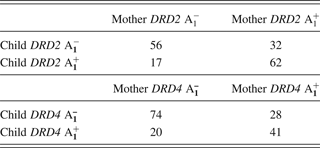
Table 1 reports the distribution of the DRD2 and DRD4 alleles. Mothers with the DRD2 A1+ allele were about twice as likely to have children with A1+ than with A1− (χ2 = 30.01, p < .001). Mothers with the A1− allele were almost three times more likely to have children with the A1− than with A1+. A comparison of this distribution of alleles with that observed in the National Longitudinal Study of Adolescent Health (Add Health, Wave III) reveals a similar mix of A1+ and A1− (calculations available on request). The allele distributions for DRD2 also differ by race (not shown), with AAs being somewhat more likely to carry A1+, which was also observed in Add Health. Females are also somewhat more likely to carry the nonrisk variant than males, which is also observed in Add Health.
Distribution of mother and child dopamine receptor D2 (DRD2) and D4 (DRD4) polymorphisms
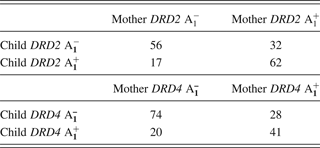
Note: Mothers with DRD2 A+1 are more likely to have children with DRD2 A+1 (χ2 = 30.01, p < .001), and mothers with DRD4 A+1 are more likely to have children with DRD4 A+1 (χ2 = 24.72, p < .001).
Table 1 also shows the distribution of the DRD4 alleles and reveals that the mothers with the DRD4 A1− allele were over three times more likely to have children with A1− than with A1+ (χ2 = 27.72, df = 1, p < .001). A comparison of this distribution of alleles with that observed in Add Health reveals that the two are very comparable. The allele distributions for DRD4 do not differ markedly by race, although females are more likely to carry the risk variant.
Descriptive statistics and correlations among the covariates
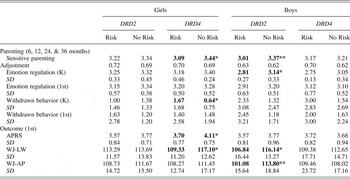
Table 2 reports descriptive statistics and mean level differences by allele status for the variables of central interest. For the girls, mean levels of sensitive parenting differ significantly by DRD4 status; by comparison, parenting differs for boys by DRD2 status. All significant mean level differences for the girls are observed for DRD4 allele status, and all such differences for the boys reflect DRD2 status. Girls' withdrawn behavior at kindergarten differs significantly, and the magnitude of the difference is considerable. Thus, teachers evaluate girls with DRD4 risk as more shy, less interactive, and lonelier when compared to girls without DRD4 risk. For the boys, mean level differences are observed for emotion regulation at kindergarten, suggesting that boys with DRD2 risk are more easily frustrated and prone to anger and excitement, for example, than their DRD2 nonrisk counterparts. The difference in emotion regulation at first grade also appears large, but the standard errors are also large. (Several of the other indicators of adjustment show apparently large mean level differences, but they do not differ significantly because of large standard deviations.)
Means and standard deviations of covariates by gender and dopamine receptor D2/D4 (DRD2/DRD4) risk
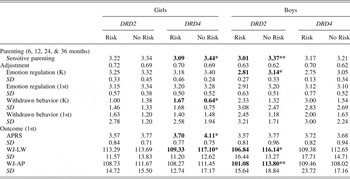
Note: K, kindergarten; 1st, first grade; APRS, Academic Achievement and Performance Rating Scale; WJ-LW, Woodcock–Johnson letter word subscale; WJ-AP, Woodcock–Johnson applied problems subscale.
*p ≤ .05. **p ≤ .01.
Among the indicators of school performance, the APRS and WJ-LW differ by DRD4 status for the girls, and the differences are notable in magnitude. Among the boys, both WJ subscales (WJ-LW and WJ-AP) differ significantly. These results thus show a clear pattern: DRD4 allele status distinguishes girls and DRD2 distinguishes boys with respect to parenting, an indicator of adjustment, and two indicators of school performance. We thus focused on withdrawn behavior for girls and emotion regulation for boys, and examined models for all three indicators of school performance.
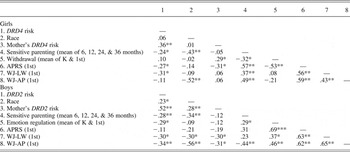
Table 3 reports bivariate associations among the variables chosen for inclusion in the structural equation models for the girls. The girls' DRD4 status is negatively associated with sensitive parenting from 6 to 36 months (r = –.24, p < .05), and the APRS (r = –.27, p < .05) and the WJ-LW (r = –.31, p < .05) in first grade, but not with social withdrawal. There is an appreciable positive correlation between the mother's and daughter's DRD4 status (r = .36, p < .01), raising the possibility of an active gene–environment correlation. Sensitive parenting is highly related to the daughter's withdrawal (r = –.32, p < .05), the APRS (r = .57, p < .01), and the WJ-LW and WJ-AP (r = .37 and .49, respectively, both p < .01). The daughter's social withdrawal is strongly, negatively associated with the APRS (r = –.53, p < .01), but it is unrelated to either scale of the WJ-III. This pattern suggests that first-grade teachers view withdrawn girls as less successful and academically productive. Finally, the APRS and the WJ-III scales are highly intercorrelated, but the magnitudes of the correlations nevertheless suggest that they are tapping unique dimensions of school performance. In sum, the pattern of correlations raises the possibility that girls' DRD4 status is associated directly and indirectly with indicators of school readiness, indirectly through parenting (for APRS, WJ-LW, and WJ-AP) and perhaps through parenting and adjustment (APRS).
Bivariate correlations for boys and girls

Note: DRD4, dopamine receptor D4; K, kindergarten; 1st, first grade; APRS, Academic Achievement and Performance Rating Scale; WJ-LW, Woodcock–Johnson letter word subscale; WJ-AP, Woodcock–Johnson applied problems subscale; DRD2, dopamine receptor D2.
*p ≤ .05. **p ≤ .01. ***p ≤ .001.
Table 3 also reports the bivariate associations for the boys. In contrast to the pattern observed among the girls, DRD2 status is negatively associated with the two subscales of the WJ, but not the APRS. As observed among the girls, genetic risk is likewise negatively associated with sensitive parenting (r = –.28, p < .01) and emotion regulation (r = –.29, p < .01). The correlation between the son's and mother's DRD2 status is substantial (r = .52, p < .01), once again suggesting a possible active gene–environment correlation and the importance of statistical control. Mother's sensitive parenting is associated with emotion regulation (r = .29, p < .05) and the WJ-AP (r = .44, p < .01). In turn, emotion regulation is substantially correlated with the APRS (r = .69, p < .001), the WJ-LW (r = .37, p < .01), and the WJ-AP (r = .46, p < .01). As observed among the girls, the correlations indicate that although the APRS, WJ-LW, and WJ-AP are highly intercorrelated, they are also tapping unique features of school performance. This overall pattern raises the possibility that DRD2 status is directly and indirectly associated with indicators of school performance, indirectly through parenting (for WJ-AP) and possibly through parenting and emotion regulation (for APRS, WJ-LW, and WJ-AP).
The bivariate patterns again clearly suggest the importance of DRD4 and DRD2 for females and males, respectively, for parenting, indicators of adjustment, and school performance in the first grade. Given these bivariate patterns, we examined the structural equation model suggested by Figure 1 focusing on DRD4 and social withdrawal for females and DRD2 and emotion regulation for males.
DRD4 and school performance: Females
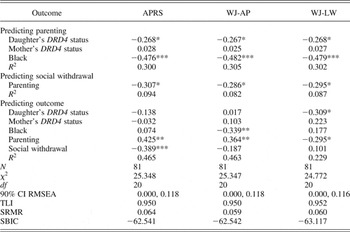
In interpreting the model's path parameters, we report standardized estimates and one-tailed p values; the latter decision reflects the directionality of the hypotheses and considerations of power. Nevertheless, t values are reported, and most substantively important paths are significant at nondirectional, two-tailed criteria. Table 4 reports the structural equation results for females for the three outcomes, the APRS, the WJ-AP, and the WJ-LW.
Structural equation results (standardized estimates) DRD4 and school performance in the first grade for females
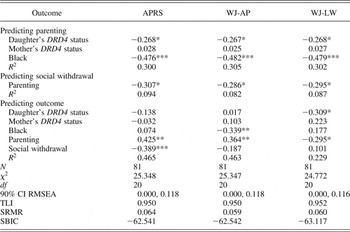
Note: APRS, Academic Achievement and Performance Rating Scale; WJ-AP, Woodcock–Johnson applied problems subscale; WJ-LW, Woodcock–Johnson letter word subscale; DRD4, dopamine receptor D4; CI RMSEA, confidence interval root mean square error of approximation; TLI, Tucker–Lewis index; SRMR, standardized root mean square residual; SBIC, Schwarz Bayesian information criterion.
*p ≤ .05. **p ≤ .01. ***p ≤ .001.
The fit statistics (absolute fit and adjusting for the model's complexity) for the APRS model suggest that the observed data correspond to the model well. The χ2 value is 25.3 with 20 degrees of freedom (p = .19) and the standardized root mean square residual (SRMR) is 0.06, although the latter may be somewhat biased by the small sample size and low degrees of freedom. The 90% confidence interval for the root mean square error of approximation (90% CI RMSEA) ranges from 0.00 to 0.12, suggesting a good fit (MacCallum, Browne, & Sugawara, Reference MacCallum, Browne and Sugawara1996). Finally, the Tucker–Lewis index (TLI) is 0.97, similarly suggesting an acceptable fit (e.g., Hu & Bentler, Reference Hu and Bentler1999).
The path coefficients reveal several noteworthy findings. First, the child's DRD4 polymorphism predicts parenting (standardized regression coefficient = –.27, t = –2.49, p = .01), controlling mother's DRD4 status (which is insignificant). This pattern of results is consistent with prior research and suggests an evocative correlation between the young girls' DRD4 status and the parenting behaviors that they evoke from their mothers. Race is also controlled and highly significant, suggesting that AA parents in this sample are showing less maternal sensitivity. Poverty status was entered into the model to examine whether the AA effect attenuated, but all of the model's parameters were essentially unchanged. Second, parenting is substantially, positively associated with the APRS (standardized regression coefficient = 0.43, t = 2.94, p = .00) and also with social withdrawal (standardized regression coefficient = –0.31, t = –2.26, p = .01). The daughters of mothers who are sensitive and responsive and who show them positive regard are judged as more academically successful and productive by their teachers in the first grade, and also viewed as less withdrawn. Third, the APRS is in turn predicted by social withdrawal (standardized regression coefficient = –0.39, t = –3.32, p = .00).
The R 2 associated with the APRS is 0.47 (t = 4.29, p = .00), with significant total (–0.28, t = –2.29, p = .01) and total indirect (–0.15, t = –2.12, p = .02) effects originating from the child's DRD4 status. An examination of the standard errors associated with the indirect effects provides evidence for mediation extending from child's DRD4 to parenting to the APRS (standardized indirect effect = –0.11, t = –1.89, p = .03). Thus, the model suggests that DRD4 risk evokes less positive, sensitive parenting from the mother, which in turn is associated with teacher's assessment of academic success in the first grade. Although all of the individual paths extending from DRD4 to parenting to social withdrawal to the APRS are significant, this more complex pathway is only marginally statistically significant (standardized indirect effect = –0.03, t = –1.53, p = .06). Still, given the low power to detect such a complex chain of mediation, these results warrant further study with larger samples.
The same model was reestimated, replacing the APRS with the WJ-AP. The model fit statistics for the WJ-AP suggest a good fit between the observed data and the model. Once again, results suggest an evocative gene correlation. The model's new feature is the WJ-AP, and the findings show that parenting significantly predicts it (standardized regression coefficient = 0.36, t = 2.71, p = .00), but social withdrawal does not. The R 2 for the WJ-AP is 0.46 (t = 4.30, p = .00), with significant total indirect effects (standardized = –3.47, t = –1.95, p = .03). An examination of the indirect paths again reveals that the girls' DRD4 status is associated with the WJ-AP by way of parenting (standardized indirect effect = –3.02, t = –1.80, p = .03).
Finally, the model fits the data well for the WJ-LW, with a χ2 of 24.77 with 20 degrees of freedom (p = .21) and an SMSR of 0.06. The 90% CI RMSEA ranges from 0.00 to 0.11, also suggesting a good fit, and the TLI is 0.95. The results are quite comparable to those observed in the prediction of the APRS. It was not surprising that the results suggest an evocative gene–environment correlation (standardized regression coefficient = –0.27, t = –2.49, p = .01) and parenting predicts social withdrawal (standardized regression coefficient = –0.29, t = –2.13, p = .02). Of central interest, the model also reveals a significant path from parenting to the WJ-LW (standardized regression coefficient = 0.36, t = 2.30, p = .01).
The R 2 for the WJ-LW is 0.23 (t = 2.34, p = .01), with significant total (–9.67, t = –3.01, p = .00) and total indirect (–2.14, t = –1.63, p = .05) effects extending from the girls' DRD4 status. An examination of the specific indirect paths reveals that this mediation is extending from DRD4 to parenting to the WJ-LW (standardized indirect effect = –2.34, t = –1.61, p = .05), although this pattern is marginally significant.
DRD2 and school performance: Males
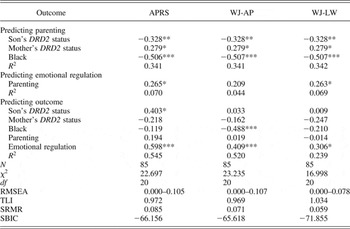
Table 5 reports the structural equation results for boys. The models are quite similar to those estimated for girls, except that they now include DRD2 and emotion regulation. Turning to the APRS model, the fit statistics suggest that the observed data fit the model well. The χ2 is 22.70 with 20 degrees of freedom (p = .30) and the SRMSR is 0.08. The 90% CI RMSEA ranges from 0.00 to 0.10, suggesting a very good fit, and the TLI is 0.97.
Structural equation results (standardized estimates) DRD2 and school performance in the first grade for males

Note: APRS, Academic Achievement and Performance Rating Scale; WJ-AP, Woodcock–Johnson applied problems subscale; WJ-LW, Woodcock–Johnson letter word subscale; DRD2, dopamine receptor D2; RMSEA, root mean square error of approximation; TLI, Tucker–Lewis index; SRMR, standardized root mean square residual; SBIC, Schwarz Bayesian information criterion.
*p ≤ .05. **p ≤ .01. ***p ≤ .001.
The pattern of path coefficients is not consistent with the meditational pattern observed among the girls. DRD2 status is associated with parenting (standardized regression coefficient = –0.33, t = –3.01, p = .00), controlling for mother's DRD2 status, consistent with an evocative correlation. Parenting is not, however, significantly associated with the APRS. Thus, the path from DRD2 to parenting to the APRS is not observed for the boys. The mother's DRD2 status is associated with parenting, although the direction of the effect is unexpected (standardized regression coefficient = 0.28, t = 2.44, p = .01). Given that the bivariate correlation is insignificant, this pattern is unlikely to be substantively important. As with girls, AA mothers appear to engage in less sensitive parenting (standardized regression coefficient = –0.51, t = –5.72, p = .00). Once again, poverty status was entered into the model, but the parameters remained largely unchanged. Although the girls' meditational pattern is not observed among the boys, several interesting, unique patterns emerge. First, parenting predicts emotion regulation (standardized regression coefficient = 0.27, t = 1.96, p = .03), which in turn has a very substantial association with the APRS (standardized regression coefficient = 0.60, t = 5.80, p = .00). The indirect path extending from DRD2 to parenting to emotion regulation to the APRS is marginally significant (standardized regression coefficient = –0.05, t = –1.57, p = .06). Given considerations of sample size (and thus power for such a complex meditational hypothesis) and the use of a one-tailed test, this pattern merits further study with a larger sample. The pattern suggests that young boys with DRD2 risk evoke less positive, sensitive parenting, which leads to diminished emotion regulation and then lowered the APRS.
Second, controlling for these direct and indirect effects, DRD2 has a direct effect on the APRS, although the direction of the effect is unexpected (standardized regression coefficient = 0.40, t = 2.32, p = .01). Given that the bivariate correlation is negative and insignificant, however, this finding is likely not substantively meaningful. Third, we reestimated the model to see whether there was a significant indirect effect extending from boys' DRD2 status to emotion regulation to the APRS. No direct effect from DRD2 to emotion regulation was observed, however. These results provide marginal support for the possibility that boys' DRD2 status evokes parenting that is associated with the APRS by way of their emotion regulation.
In the model that predicts the WJ-AP scores, the results show that the model fits the data well, with a χ2 of 23.24 with 20 degrees of freedom (p = .28) and a SRMR of 0.07. The 90% CI RMSEA ranges from 0.00 to 0.11 and the TLI is 0.97. The results once again reveal the evocative gene–environment correlation, although parenting is only marginally associated with emotion regulation in this specification (standardized regression coefficient = 0.21, t = 1.54, p = .06). Emotion regulation is strongly associated with the WJ-AP (standardized regression coefficient = 0.41, t = 4.17, p = .00). Although the paths from DRD2 to parenting, from parenting to emotion regulation, and from emotion regulation to the WJ-AP are all significant, the indirect effect associated with this complex meditational chain is not (standardized estimate = –0.03, t = –1.32, p = .09).
Finally, the WJ-LW results suggest a very good fit between the observed data and the model. The χ2 = 17.0 with 20 degrees of freedom (p = .65) and SRMSR = 0.06. The 90% CI RMSEA ranges from 0.00 to 0.08, suggesting an excellent fit, and the TLI = 1.0.
As was observed with the APRS, an evocative correlation is observed, but parenting is not associated with the WJ-LW. Parenting is, however, associated with emotional regulation, which is associated with the WJ-LW (standardized regression coefficient = 0.31, t = 2.26, p = .01). The R 2 for the WJ-LW is 0.24, but no significant direct or indirect effects are observed extending from DRD2 to the WJ-LW. Thus, boys' DRD2 risk status evokes less sensitive parenting, which in turn is associated with emotion regulation, which is significantly associated with the WJ-LW. The standard error associated with this indirect mediating pathway is insignificant, however.
Discussion
Are evocative gene–environment correlations involving young children and their mothers associated with school performance in the first grade? Our conceptual model (shown in Figure 1) suggests that genetic risk (defined in terms of dopamine receptors Types 2 and 4) evokes less sensitive parenting that in turn creates behavioral patterns that are less conducive to success in the classroom. The present study addressed this research question, drawing on rich longitudinal data from the Durham Child Health and Development Study. This data resource is strategically informative because of its extensive longitudinal assessments, which are a mix of observational data (with respect to parenting), teacher reports (with respect to adjustment and performance), and standardized tests of intellectual skills (involving reading and math). To our knowledge, no studies have examined connections between gene–parenting correlations and school performance, although there is ample theoretical support for such connections.
Nevertheless, these results should be regarded as exploratory and suggestive, primarily because they reflect a small sample and the findings have not been replicated. The small sample size increases the likelihood of false discoveries (particularly in the case of “novel findings” such as those reported here; Duncan & Keller, Reference Duncan and Keller2011), decreases the power to detect meditational patterns, and does not allow for the inclusion of extensive controls in the models. In the present case, the results have not been replicated (which would otherwise mitigate the possibility of false discovery). However, data from the nationally representative Add Health sample suggest that DRD2 Taq1 1A (among boys) and DRD4 (among black girls) are associated with school continuation (Shanahan, Erickson, Vaisey, & Smollen, Reference Shanahan, Erickson, Vaisey and Smollen2007; and analyses available on request). Further, despite the lack of power, meditational chains are observed. The smaller sample size may be counterbalanced to some degree by the richness of longitudinal, observational assessments. However, this small sample does call for replication with larger samples. Moreover, although our measures of adjustment have excellent psychometric properties, they are based on teachers' reports, which are also the basis of the APRS. This overlap warrants caution when interpreting the results, which suggest a meditational pattern extending from teachers' reports of emotion regulation to the APRS (for boys, r = .69) and withdrawn behavior to the APRS (for girls, r = –.53). Whether it is because of these behaviors or actual performance in the classroom, or a combination of the two factors, teachers do view children with genetic risk and less sensitive parenting in less positive terms than children without that risk. Furthermore, in order to obtain a comprehensive assessment of children's academic performance and achievement, the current study examined both the teacher rating of academic success and standardized achievement tests, which do not reflect a common source.
rGE, withdrawn behavior, and academic outcomes in girls
The basic conceptual model informing our study was supported in several respects and suggests new avenues of research that explore family–school connections very early in life. For the girls, the findings suggest a significant meditational process by which young girls' DRD4 status evokes less sensitive parenting from their mothers, which in turn is associated with the APRS, WJ-LW, and WJ-AP. In the APRS, there is weak evidence for a further meditational path extending from DRD4 to parenting to social withdrawal to the APRS, which is noteworthy given the substantial power needed to reliably detect such a complex meditational chain. In any event, all of the association between the girls' DRD4 status and the APRS is mediated. Thus, the child–parent relationship between 6 and 36 months “carries over” to teachers' assessment of academic productivity, success, and behavioral control in the classroom and standardized intellectual measures in first grade.
Although previous studies have reported links between dopamine genes (e.g., DAT1, DRD2, DRD4) and academic achievement in middle and high school (Beaver, Vaughn, Wright, DeLisi, & Howard) and educational attainment in late adolescence (Shanahan et al., Reference Shanahan, Vaisey, Erickson and Smolen2008), none have looked at this relationship as early as kindergarten nor have they looked at early caregiving as a mediating link. Our examination of the path leading from dopaminergic genes to academic outcomes revealed a significant link for girls between DRD4 and parenting through 3 years of age, extending previous findings from this sample of an association between DRD4 risk (L-DRD4) and less sensitive maternal caregiving observed through 1 year of age (Propper et al., Reference Propper, Willoughby, Halpern, Carbone and Cox2007). Furthermore, we were able to rule out the possibility of a passive rGE by including maternal genotype in the model, which was not associated with mothers' sensitive caregiving behavior. Although we did not examine the specific child behaviors that may elicit less sensitive caregiving from mothers, previous studies have found DRD4 to be associated with more aggression, more sensation seeking, and more defiant behaviors in toddlers and young children (Benjamin et al., Reference Benjamin, Ebstein and Belmaker2002; Kirley et al., Reference Kirley, Lowe, Mullins, McCarron, Daly and Waldman2004; Schmidt et al., Reference Schmidt, Fox, Rubin, Hu and Hamer2002), which could lead to a less positive parenting experiences and less sensitive responses to the child. It is especially troubling that this effect is found so early in life, because the positive and supportive interactions that occur between mother and child during this time are important for development of important regulatory strategies and processes. It is through these interactions with parents that emotion socialization occurs and self-regulatory skills necessary for social and academic success are developed (Cassidy, Parke, Butkovsky, & Braungart, Reference Cassidy, Parke, Butkovsky and Braungart1992; Denham, Reference Denham1993; Denham, McKinley, Couchoud, & Holt, Reference Denham, McKinley, Couchoud and Holt1990; Eisenberg & Fabes, Reference Eisenberg, Fabes and Clark1992; Parke, Burks, Carson, Neville, & Boyum, Reference Parke, Burks, Carson, Neville, Boyum, Parke and Kellam1994).
The subsequent significant path between parenting behavior and academic achievement, as assessed by each of three measures (APRS, WJ-AP, WJ-LW) is not surprising, given the multitude of findings predicting better academic outcomes from early elementary school through eighth grade for those children who experienced high-quality parent–child interactions (Denham, Reference Denham1993; Estrada, Arsenio, Hess, & Holloway, Reference Estrada, Arsenio, Hess and Holloway1987; Morrison, Rimm-Kauffman, & Pianta, Reference Morrison, Rimm-Kauffman and Pianta2003; Parke, Ornstein, Rieser, & Zahn-Waxler, Reference Parke, Ornstein, Rieser and Zahn-Waxler1994; Pianta & Harbers, Reference Pianta and Harbers1996; Pianta et al., Reference Pianta, Smith and Reeve1991; Welsh, Parke, Widaman, & O'Neil, Reference Welsh, Parke, Widaman and O'Neil2001). A recent longitudinal study of over 1,000 children entering school found that the strongest predictor of academic outcomes in the early school context was sensitive parenting (NICHD, 2002). Again, the early skills that are established prior to school entry may kick off a trajectory toward academic success that begins in the home and continues to grow as peers and teachers and classroom contexts build upon this foundation. Therefore, early parenting may have lasting effects on future achievement.
A novel contribution of the current study is the identification of a potential mediating path between early parenting (elicited by child genotype) and academic outcomes (as assessed by teacher report on APRS). Although we examined five subscales (related to internalizing and externalizing behaviors) of the CBCL-TRF as potential mediators, withdrawn behavior was the only one that significantly differed by DRD4 status, and only for girls. In other words, teachers evaluate girls with DRD4 risk as more shy, less interactive, and lonelier compared to girls without DRD4 risk. Although this link was not hypothesized, a recent study examined relations between DRD4 and each subscale of the CBCL (parent report) and found, as the present analyses did, that the only significant relationship was between DRD4 and withdrawn behavior (Marino et al., 2004).
This mediational path was only found to predict teacher report of academic performance and not standardized achievement testing. Although the method of using teacher ratings of children's academic success has limitations, there are unique benefits to including assessments of academic success via teacher reports. These reports provide information about the student's academic behavior in the classroom, above and beyond scores on standardized tests. For example, teachers can report on behaviors that support productive and high-quality work (i.e., the ability to independently attend to and complete assignments, follow instructions, independently grasp new information, and complete classroom assignments accurately). Therefore, girls' withdrawn behavior is perceived by teachers to influence their academic behaviors in a negative direction, when, in actuality, their achievement scores do not appear to be affected by this behavior. This pattern has important implications for the way in which the teacher–child relationship may develop and affect future performance; a teacher who does not believe a child is productive, bright, or competent may fail to provide him or her with a stimulating or challenging learning environment, leading to diminished self-esteem, performance, and motivation in the classroom that may carry forward to future grades and academic problems.
rGE, emotion regulation, and academic outcomes in boys
The results for boys are not consistent with the path observed for the girls. There is weak evidence for a more complex pathway, however, extending from DRD2 through parenting and emotional regulation to school performance and achievement. This pattern suggests that boys with DRD2 risk (A1+) evoke less sensitive parenting, which is associated with diminished emotion regulation (e.g., more prone to frustration and less emotional control), which is (a) associated with teachers' reports on the APRS (that these boys are less productive, have lower quality work, and are less able to control behavior in first grade), (b) associated with the WJ-III reading subscale (WJ-LW), and (c) marginally associated with the WJ-III math subscale (WJ-AP). The latter two relationships reflect significant pathways but not significant indirect effects.
Similar to the finding of an evocative effect of L-DRD4 on less sensitive parenting as described above, we found an rGE correlation for boys between the risk allele of DRD2 (A1+) and less maternal sensitivity through 3 years of age that extends previous findings from the current sample that examined parenting through the first year of life (Mills-Koonce et al, Reference Mills-Koonce, Gariépy, Propper, Sutton, Calkins and Moore2007). Unlike the findings for DRD4, in this case maternal caregiving was significantly associated with mothers' genotype (indicating a potential passive rGE); however, after controlling for this in the model child genotype was still a significant predictor of maternal sensitivity. Again, we did not examine the specific child behaviors that elicited less sensitivity from mothers in the current analyses, although previous studies have linked DRD2 to difficult behaviors and less regulation in infants, children, and adolescents (e.g., Comings et al., Reference Comings, Rosenthal, Lesieur, Rugle, Muhleman and Chiu1996; Lu, Lee, Ko, & Lin, Reference Lu, Lee, Ko and Lin2001; McGue et al., Reference McGue, Slutske, Taylor and Iacono1997; Propper et al., Reference Propper, Moore, Mills-Koonce, Calkins, Carbone and Cox2008; Wiers et al., Reference Wiers, Sergeant and Gunning1994).
Unlike the results described above for girls, the link between maternal sensitivity and academic achievement was fully mediated by ratings of emotion regulation for boys. Emotion regulation has also been found to be a strong predictor of performance in the classroom in older children and adolescence, and this association has been observed in studies of preschool and kindergarten children as well (Graziano et al., Reference Graziano, Reavis, Keane and Calkins2007; Howse et al., Reference Howse, Calkins, Anastopoulos, Keane and Shelton2003).
Several possible mechanisms have been posited for how emotion regulation may influence cognitive performance. First, the ability to control emotional arousal allows children to engage in more challenging tasks, which subsequently provide opportunities for using and practicing executive function skills (Calkins & Dedmon, Reference Calkins and Dedmon2000). Second, it is hard to teach disruptive kids, so these children may get less feedback and instruction in the classroom, and their overall experience may be less rewarding, which may lead to lower motivation or interest in achievement (Raver, Reference Raver2004). Third, if intense emotions are not regulated appropriately and the child reacts to his or her emotional state in less effective ways (i.e., acting out in response to frustration, vigilance in response to anxiety), the resources and energy expended may interfere with the those necessary for the higher order cognitive demands of the classroom setting (Blair, Reference Blair2002). Alternatively, when arousal is maintained at optimal levels, through regulatory processes, and affective experience does not compete with or interfere with cognitive demands, children are then able to utilize higher order processes important for problem solving (Campos & Barrett, Reference Campos, Barrett, Izard, Kagan, Zajonc, Izard, Kagan and Zajonc1984; Carver & Scheier, Reference Carver and Scheier2000). Therefore, the importance of emotion regulation in the classroom for academic success is well established.
Future directions
Given the exploratory nature of the analyses, further study of the conceptual model is needed with larger samples. Beyond this need for replication, several refinements may also be probative. First, DRD4 and DRD2 evoke less sensitive parenting, but the data do not allow us to examine the types of behaviors, on the part of the children, that elicit these reactions from mothers. Moreover, little is known about the mothers themselves and possible sources of resilience that promote sensitive parenting for children with genetic risk. Second, although animal models and other sources of evidence suggest that DRD4 and DRD2 have functional significance that bolster the plausibility of the models and findings, the research design does not warrant any definite causal statements. Other designs, with greater internal validity, are needed in the study of the conceptual model. Third, our genetic candidates and forms of psychosocial adjustment could be expanded considerably. For example, monoamine oxidase A is very likely related to aggression or antisocial symptoms. Perhaps monoamine oxidase A also evokes less sensitive parenting, which in turn is associated with antisocial acts and lowered school performance. Epistatic patterns are also plausible. For example, consistent with the differential susceptibility hypothesis, perhaps the present results would be stronger for carriers of s/s alleles of the serotonin transporter linked polymorphic region gene. Some evidence suggests that the DRD4 polymorphism studied here is actually a susceptibility gene (e.g., Bakermans-Kranenburg & van IJzendoorn, Reference Bakermans-Kranenburg and van IJzendoorn2011), in which case Figure 1 would be tested as a moderational model. In any event, the available data provide a limited empirical examination of the conceptual model shown in Figure 1, with many other genes and indicators of adjustment likely contributing to school performance.
Despite these limitations, however, this is the first study suggesting that an evocative gene–environment correlation involving parenting has repercussions beyond the family, possibly influencing the first moments of the academic trajectory. Although the results call for replication and refinement, our findings provide a first step toward understanding how the role of genetics in family functioning, and the child as an organizer of parenting behavior, may influence behavior in the classroom context and future academic achievement.