Introduction
Early adolescence is characterized by profound cognitive, emotional, and social changes, and the challenge of adapting to these changes often coincides with increased rates of internalizing and externalizing problems (Georgiou & Symeou, Reference Georgiou and Symeou2018). At the same time, peer relationships gain increasing importance during this developmental stage (Steinberg & Monahan, Reference Steinberg and Monahan2007). Theoretical frameworks, such as the interpersonal risk model (Kochel et al., Reference Kochel, Ladd and Rudolph2012), and empirical research (Bernasco et al., Reference Bernasco, Van der Graaff, Meeus and Branje2022; Murray et al., Reference Murray, Obsuth, Speyer, Murray, McKenzie, Eisner and Ribeaud2021) suggest robust unidirectional or bidirectional associations between negative peer experiences, particularly peer victimization, and internalizing and externalizing problems. However, not all adolescents who experience peer victimization develop internalizing and externalizing problems, indicating that genetic susceptibility may moderate these associations. Prior studies have shown that interactions between peer victimization and genetic variants associated with hypothalamic–pituitary–adrenal (HPA) axis dysregulation, such as the FKBP5 gene, may explain individual differences in vulnerability to internalizing and externalizing symptoms (Vaillancourt et al., Reference Vaillancourt, Hymel and McDougall2013). Most existing studies, however, have focused on gene-environment (G × E) interactions at the between-person level, making it difficult to isolate within-person effects, which are of primary interest to developmental theory. Therefore, the present study examined whether between-person differences in the FKBP5 gene moderated the within-person developmental cascades from peer victimization to internalizing and externalizing problems using a randomized intercept cross-lagged model (RI-CLPM), thereby illustrating between × within interactions using a time-invariant moderator.
Peer victimization and internalizing and externalizing problems
The interpersonal risk model posits that negative peer relationships serve as significant stressors that can lead to maladaptive outcomes, such as internalizing and externalizing problems (Kochel et al., Reference Kochel, Ladd and Rudolph2012). In contrast, the symptom-driven model suggests that internalizing and externalizing problems may precede and contribute to poor peer relationships by impairing children’s development of adaptive social skills, thereby increasing the risk of peer relationship problems (Rudolph, Reference Rudolph, Nolen-Hoeksema and Hilt2009). Additionally, the transactional model emphasizes reciprocal associations that occur over time between peer victimization and psychopathological symptoms, indicating a mutually reinforcing process (Kochel et al., Reference Kochel, Ladd and Rudolph2012). Consistent with the transactional perspective, the interpersonal theory of depression further illustrates the reciprocal nature of these associations, particularly highlighting how depressive symptoms and problematic interpersonal interactions, such as peer victimization, reinforce one another over time (Coyne, Reference Coyne1976; Hames et al., Reference Hames, Hagan and Joiner2013). Specifically, depressive symptoms may elicit rejection and victimization from peers, which in turn exacerbate depressive symptoms, creating a self-perpetuating cycle (Coyne, Reference Coyne1976). In conclusion, these theoretical models underscore the complexity of relations between peer victimization and internalizing and externalizing problems and illustrate multiple possible directions of influence.
Empirical studies employing traditional regression analysis and cross-lagged panel model (CLPM) have demonstrated bidirectional associations between peer victimization and psychopathological symptoms over time (e.g., Casper & Card, Reference Casper and Card.2017; Christina et al., Reference Christina, Magson, Kakar and Rapee2021). Furthermore, several studies have provided support for both the symptom-driven (Holfeld & Mishna, Reference Holfeld and Mishna2019; Kochel et al., Reference Kochel, Ladd and Rudolph2012) and interpersonal risk (Reijntjes et al., Reference Reijntjes, Kamphuis, Prinzie and Telch2010, Reference Reijntjes, Kamphuis, Prinzie, Boelen, van der Schoot and Telch2011) models. However, traditional CLPM conflates within-person and between-person effects (e.g., Hamaker et al., Reference Hamaker, Kuiper and Grasman2015), making it insufficient to fully capture the reciprocal influences between peer victimization and internalizing and externalizing problems as described by the symptom-driven and interpersonal risk models. Most psychopathology theories emphasize within-person processes, meaning that for a given individual, an increase in their own level of peer victimization should correspond to greater internalizing and externalizing problems, and vice versa. Therefore, applying traditional CLPM to examine bidirectional associations between internalizing and externalizing problems and peer victimization may lead to a mismatch between theoretical models and statistical methods, potentially resulting in ecological fallacy (Nelemans et al., Reference Nelemans, Keijsers, Colpin, van Leeuwen, Bijttebier, Verschueren and Goossens2020). An extension to the CLPM that overcomes this limitation has been proposed—the random intercept CLPM (RI-CLPM; Hamaker et al., Reference Hamaker, Kuiper and Grasman2015). If at least three waves of data are available, the RI-CLPM allows for the decomposition of observed data into within- and between-person components, thus ensuring that the cross-lagged effects, under certain assumptions, provide unbiased estimates of within-person effects (Hamaker et al., Reference Hamaker, Kuiper and Grasman2015). Studies have used the RI-CLPM to explore the within-person processes linking peer victimization and internalizing and externalizing problems. For example, Bernasco et al. (Reference Bernasco, Van der Graaff, Meeus and Branje2022) and Murray et al. (Reference Murray, Obsuth, Speyer, Murray, McKenzie, Eisner and Ribeaud2021) found that peer victimization predicted internalizing symptoms at the within-person level, though the reverse pathway was not supported. Zhou et al., (Reference Zhou, Gong, Lu, Xu, Zhao and Yang2023, Reference Zhou, Li, Zou and Gong2024) and Gong et al. (Reference Gong, Zhou, Huebner and Tian2024) used RI-CLPMs and reported bidirectional within-person associations between peer victimization and internalizing symptoms, but found no significant associations between peer victimization and externalizing symptoms among Chinese elementary school students.
Although prior studies have made substantial progress in clarifying the directional associations between peer victimization and internalizing and externalizing problems at the within-person level, one critical gap remains unaddressed—the potential moderating role of genetic factors. Research on G × E interactions suggests that individual differences in genetic predisposition may influence susceptibility to peer victimization and its psychological consequences (VanZomeren-Dohm et al., Reference VanZomeren-Dohm, Pitula, Koss, Thomas and Gunnar2015). However, existing studies have predominantly focused on environmental and psychological mechanisms, overlooking the potential contribution of genetic factors (Bernasco et al., Reference Bernasco, Van der Graaff, Meeus and Branje2022; Murray et al., Reference Murray, Obsuth, Speyer, Murray, McKenzie, Eisner and Ribeaud2021). Given that the impact of peer victimization may vary depending on genetic vulnerabilities—particularly in stress-related pathways such as the HPA axis—there is a pressing need to examine whether genetic variations moderate these within-person associations.
The moderating role of the FKBP5 gene
The theory of biological sensitivity to context proposes that heightened stress reactivity may reflect increased biological sensitivity, which arises from an individual’s temperamental, physiological, and genetic makeup (Ellis & Boyce, Reference Ellis and Boyce2008). This heightened biological sensitivity can contribute to adaptation difficulties, including internalizing and externalizing problems (Ellis & Boyce, Reference Ellis and Boyce2008). Among the biological systems involved in how the body responds to stress, the HPA axis plays a key role. Dysregulation of this system has been consistently linked to the development and persistence of emotional and behavioral problems, such as anxiety, depression, aggression, and impulsivity (Cao & Rijlaarsdam, Reference Cao and Rijlaarsdam2022; Mulder et al., Reference Mulder, Rijlaarsdam, Luijk, Verhulst, Felix, Timeier, Bakermans-Kranenburg and van IJzendoorn2017). Within this framework, the FKBP5 gene has emerged as a key modulator of HPA axis activity. FKBP5 encodes a co-chaperone protein that regulates the sensitivity of glucocorticoid receptors (GRs) to cortisol. Specifically, the FKBP5 protein binds to GRs and inhibits their ability to bind with cortisol, reducing the efficiency of the negative feedback loop that governs HPA axis regulation (Tyrka et al., Reference Tyrka, Ridout, Parade, Paquette, Marsit and Seifer2015). When FKBP5 expression is elevated, it leads to prolonged cortisol release, resulting in stress-response dysregulation, which has been implicated in both internalizing (e.g., anxiety, depression) and externalizing (e.g., aggression, impulsivity) problems (Tyrka et al., Reference Tyrka, Ridout, Parade, Paquette, Marsit and Seifer2015; Frodl & O’Keane, Reference Frodl and O’Keane2013). Given its regulatory role in the HPA axis, common FKBP5 gene variants may influence individual differences in susceptibility to stress-related psychopathology.
A substantial body of research has explored interactions of FKBP5 single nucleotide polymorphisms (SNPs) and adverse environmental factors, such as childhood trauma and negative parenting, in relation to adolescent internalizing and externalizing symptoms (see Normann & Buttenschøn, Reference Normann and Buttenschøn2019; Zannas et al., Reference Zannas, Wiechmann, Gassen and Binder2016, for reviews). In this study, four FKBP5 SNPs—rs4713916, rs1360780, rs3800373, and rs9296158—were selected, based on their frequent examination in prior investigations (e.g., Piechaczek et al., Reference Piechaczek, Greimel, Feldmann, Pehl, Allgaier, Frey and Schulte-Koerne2019; Wang et al., Reference Wang, Shelton and Dwivedi2018). Existing findings suggest that the minor allele of FKBP5 rs1360780 (i.e., the T allele) is associated with an increased risk of developing internalizing and externalizing symptoms, particularly when interacting with adverse environmental experiences (e.g., Bevilacqua et al., Reference Bevilacqua, Carli, Sarchiapone, George, Goldman, Roy and Enoch2012; Kang et al., Reference Kang, Shi, Gong, Wei, Zhang, Ding and Han2020; VanZomeren-Dohm et al., Reference VanZomeren-Dohm, Pitula, Koss, Thomas and Gunnar2015). Similarly, other risk alleles—including the A allele of rs4713916, the C allele of rs3800373, and the A allele of rs9296158—have also been linked to heightened susceptibility to internalizing and externalizing problems (e.g., Bevilacqua et al., Reference Bevilacqua, Carli, Sarchiapone, George, Goldman, Roy and Enoch2012; Bryushkova et al., Reference Bryushkova, Zai, Chen, Pappa, Mileva, Tiemeier, Bakermans-Kranenburg, Kennedy and Beitchman2016; Kang et al., Reference Kang, Shi, Gong, Wei, Zhang, Ding and Han2020; Keijser et al., Reference Keijser, Olofsdotter, Nilsson and Åslund2021).
Peer victimization represents a chronic social stressor that can activate the HPA axis and in susceptible individuals lead to prolonged stress exposure and emotional dysregulation (Vaillancourt et al., Reference Vaillancourt, Hymel and McDougall2013). Adolescents carrying risk-associated FKBP5 variants may exhibit heightened biological sensitivity to peer victimization, making them more likely to develop internalizing and externalizing problems in response to peer-related stress (VanZomeren-Dohm et al., Reference VanZomeren-Dohm, Pitula, Koss, Thomas and Gunnar2015). This perspective aligns with the biological sensitivity to context framework (Ellis & Boyce, Reference Ellis and Boyce2008), which suggests that genetic factors not only confer risk but also amplify sensitivity to both negative and positive environmental influences. Investigating FKBP5 in the context of peer victimization can provide deeper insights into why some adolescents are more affected by peer victimization than others, ultimately contributing to the development of personalized intervention strategies that are tailored to genetically susceptible individuals.
Moreover, many existing studies have analyzed only a single FKBP5 SNP, which may limit statistical power and yield inconsistent findings (Border et al., Reference Border, Johnson, Evans, Smolen, Berley, Sullivan and Keller2019). To address this issue, this study employs a cumulative genetic score (CGS) approach, which aggregates multiple FKBP5 SNPs based on their biological relevance (Keers et al., Reference Keers, Coleman, Lester, Roberts, Breen, Thastum and Eley2016). The polygenic risk score is calculated by summing risk alleles from multiple genetic SNPs, allowing for a more comprehensive examination of the interaction between cumulative genetic risk and environmental factors. This method provides a novel analytical approach for investigating the genetic mechanisms underlying psychopathology and increases the power of G × E interactions (Starr & Huang, Reference Starr and Huang2019; Vrshek-Schallhorn et al., Reference Vrshek-Schallhorn, Stroud, Mineka, Zinbarg, Adam, Redei, Hammen and Craske2015).
Although previous research has examined G × E in the relation between peer victimization and internalizing and externalizing problems, most studies have primarily focused on between × between interactions—that is, investigating whether adolescents who experience peer victimization and carry FKBP5 genetic variations are more likely to develop psychological maladjustment compared to those who neither experience peer victimization nor carry FKBP5 risk variants (e.g., Bryushkova et al., Reference Bryushkova, Zai, Chen, Pappa, Mileva, Tiemeier, Bakermans-Kranenburg, Kennedy and Beitchman2016; Kang et al., Reference Kang, Shi, Gong, Wei, Zhang, Ding and Han2020; Vrshek-Schallhorn et al., Reference Vrshek-Schallhorn, Stroud, Mineka, Zinbarg, Adam, Redei, Hammen and Craske2015). While this approach has provided valuable insights into how genetic predispositions moderate environmental influences at the between-person level, it does not fully align with psychopathological theories emphasizing within-person processes. The “between × within interaction” refers to the interplay between stable between-person differences (e.g., genetic predispositions) and dynamic within-person fluctuations (e.g., changes in peer victimization experiences over time) in predicting psychological outcomes (Speyer et al., Reference Speyer, Ushakova, Blakemore, Murray and Kievit2022). Specifically, this framework examines whether adolescents carrying FKBP5 risk variants, compared to those without risk variants, exhibit a greater increase in internalizing problems when experiencing higher-than-usual levels of peer victimization relative to their own baseline exposure. In other words, genetic vulnerability may heighten an individual’s sensitivity to fluctuations in peer victimization, making changes in peer victimization experiences more predictive of corresponding fluctuations in psychological symptoms. This distinction is critical because traditional between × between analyses only capture stable, between-person differences, assuming that genetic predispositions function as a general diathesis that remains constant across time. However, G × E interactions may also operate dynamically within individuals, influencing how they react to daily variations in environmental stressors. Despite its strong theoretical significance, no prior studies have applied a between × within approach to examine G × E interactions in adolescent development. This gap is particularly important because traditional models may overlook the dynamic nature of stress responses and fail to distinguish whether genetic influences shape stable, trait-like susceptibility or state-dependent reactivity to environmental fluctuations. By incorporating a between × within framework, this study extends prior G × E research beyond static comparisons and moves toward a developmentally sensitive, process-oriented approach. This shift is essential for understanding how genetic factors interact with environmental stressors not just at the individual level but also within the individual’s daily lived experience.
Previous research has shown that socioeconomic status (SES) and age influence adolescents’ internalizing and externalizing problems, as well as their experiences of peer victimization (e.g., Anderson et al., Reference Anderson, Siciliano, Henry, Watson, Gruhn, Kuhn, Ebert, Vreeland, Ciriegio, Guthrie and Compas2022; Gong et al., Reference Gong, Zhou, Huebner and Tian2024; Pouwels et al., Reference Pouwels, Souren, Lansu and Cillessen2016; Tippett & Wolke, Reference Tippett and Wolke2014). Studies have also revealed sex differences in these associations. Specifically, the association between peer victimization and internalizing problems tends to be stronger among girls than boys, whereas the association between peer victimization and externalizing problems is generally stronger among boys than girls (Kowalski & Limber, Reference Kowalski and Limber2013; Cuevas et al., Reference Cuevas, Finkelhor, Shattuck, Turner and Hamby2013). Considering these findings, in the present study, we controlled for the effects of these demographic covariates.
The present study
This study has two hypotheses. First, we hypothesized that youth who experienced more peer victimization would also experience more internalizing and externalizing problems and vice versa. Second, we hypothesized that the within-person link between peer victimization and internalizing and externalizing problems would be moderated by the FKBP5 gene. To improve the predictive validity and power of the G × E effects, a CGS was calculated based on the number of alleles showing previously established associations with the heightened stress reactivity FKBP5 gene (i.e., the minor alleles of rs4713916, rs1360780, rs3800373, and rs9296158). The effect of peer victimization on internalizing and externalizing problems is expected to be stronger for youth with higher CGS scores and weaker for youth with lower CGS scores.
Method
Participants
Participants came from public elementary schools in a mid-sized city located in northeast China. Participation was open to all third- through fifth-grade students and their parents at these schools. Students participated in measurements at three time points with a six-month interval. At the Time 1 assessment, participants included 915 students with an age range of 9 to 13 years old (43.9% girls; M age = 10.34 years, SD = 0.94). Participants included 899 (98.3%) students at Time 2 (T2), and 857 (93.7%) students at Time 3 (T3). Little’s Missing Completely at Random test based on all of the data across the three measurements produced a normed χ 2 /df of 1.11, indicating that any missing data were likely missing at random (Nicholson et al., Reference Nicholson, Deboeck and Howard2017).
Measures
Internalizing and externalizing problems
Internalizing and externalizing problems were assessed using the Chinese version of the Youth Self-Report form (Achenbach, Reference Achenbach1991; Wang et al., Reference Wang, Wang and Yao2013), which includes 16 items from the Anxious/Depression subscale assessing internalizing problems (e.g., “unhappy, sad, or depressed” and “nervous or tense”) and 12 items from the Delinquency subscale assessing externalizing problems (e.g., “cruelty, bullying, or meanness to others”). Responses ranged from “0” (not true) to “2” (very true or often true). The mean scores were calculated, with higher scores indicating higher levels of internalizing and externalizing problems. This scale has demonstrated good reliability and validity with Chinese students (Wang et al., Reference Wang, Wang and Yao2013). In this study, the Cronbach’s α coefficients for internalizing problems were 0.89 (T1), 0.92 (T2), 0.93 (T3), and the Cronbach’s α coefficients for externalizing problems were 0.79 (T1), 0.85 (T2), 0.87 (T3).
Peer victimization
Peer victimization was measured using the Chinese version of the Multidimensional Peer Victimization Scale (MPVS; Zhang et al., Reference Zhang, Chen, Ji, Zhang, Chen and Wang2009). The peer victimization scale consisted of ten items, such as “Other kids hurt me physically in some way” and “Some kids tried to get me into trouble with my friends.” Participants reported how many times an event occurred using a 4-point Likert scale ranging from “0” (never) to “3” (always). The mean scores were calculated, with higher scores indicating higher frequencies of peer victimization. In this study, the Cronbach’s α coefficients for peer victimization were 0.92 (T1), 0.94 (T2), and 0.94 (T3).
Covariates
Several demographic covariates were reported by students at T1, including age and socioeconomic status (SES). Parental education levels were reported by the participants, including the education levels of their fathers and mothers. There were eight response categories ranging from 1 (never attended school) to 8 (doctoral degree). Father’s and mother’s education levels and income scores were standardized, converted into z-scores and averages were calculated based on the standardized variables to index the SES.
Genotyping
DNA was extracted from buccal cell samples. The SNaPshot method was used to detect rs4713916, rs1360780, rs3800373, and rs9296158 polymorphisms by fluorescence capillary electrophoresis using the ABI 3730xl instrument (CE platform/next-generation sequencing platform). The genotyping results were read and analyzed by the GeneMaker software system.
The genotypes of the four FKBP5 SNPs were distributed as follows: rs4713916: GG = 61.1% (N = 559), GA = 34.0% (N = 311), AA = 4.9% (N = 45); rs1360780: CC = 55.8% (N = 511), CT = 38.3% (N = 350), TT = 5.9% (N = 54), rs3800373: AA = 56.7% (N = 519), CA = 36.9% (N = 338), CC = 6.3% (N = 58); rs9296158 GG = 47.4% (N = 434), AG = 43.0% (N = 393), AA = 9.6% (N = 88). None of the SNPs showed significant deviations from the Hardy-Weinberg equilibrium (rs4713916: χ2 = 0.04, df = 2, p = 0.98; rs1360780: χ2 = 0.34, df = 2, p = 0.84; rs3800373: χ2 = 0.09, df = 2, p = 0.96; rs9296158: χ2 = 0.01, df = 2, p = 0.99).
Based on the practices of previous studies (e.g., Cao & Rijlaarsdam, Reference Cao and Rijlaarsdam2022; Piechaczek et al., Reference Piechaczek, Greimel, Feldmann, Pehl, Allgaier, Frey and Schulte-Koerne2019; Tian et al., Reference Tian, Cao and Zhang2020), we coded the FKBP5 gene according to the number of minor alleles of four SNPs: rs4713916: AA = 2, GA = 1, GG = 0; rs1360780: TT = 2, CT = 1, CC = 0; rs3800373: CC = 2, CA = 1, AA = 0; rs9296158: AA = 2, GA = 1, GG = 0. Then, the cumulative genetic score was aggregated, in which a higher score indicated a greater number of minor alleles of these four loci and a higher environmental sensitivity of the individual to carry the genotype. The FKBP5-related cumulative genetic score ranged from 0 to 8. The frequencies of this CGS were as follows: 0 (N = 412, 45.0%), 1 (N = 92, 10.1%), 2 (N = 13, 1.4%), 3 (N = 63, 6.9%), 4 (N = 246, 26.9%), 5 (N = 33, 3.6%), 6 (N = 4, 0.4%), 7 (N = 14, 1.5%), and 8 (N = 38, 4.2%). Due to the small sample sizes for scores of 2 and 5 – 8, we scored 0 as 0; 1 as 1; 2 and 3 aggregated as 2; 4 as 3; 5, 6, 7, and 8 aggregated as 4, referring to existing studies (Cicchetti & Rogosch, Reference Cicchetti and Rogosch2012; Wade et al., Reference Wade, Moore, Astington, Frampton and Jenkins2015).
Procedure
The School of Psychology Research Ethics Committee of Northwest Normal University granted approval for this study. All procedures performed in this study involving human participants were in accordance with the ethical standards of the institutional and/or national research committees on human experimentation and with the Helsinki Declaration of 1975, as revised in 2008. Written informed consent was obtained from all students and their parents prior to data collection. The study measures were administered to students by a trained graduate assistant in their regular classroom setting. The assistant provided instructions both verbally and in writing to all students. Students were given as much time as needed to complete the measures, and they could stop at any time if they wanted. The parents filled out questionnaires online, as they were instructed to by the head teachers in each class. Researchers conducted the study with the strict assurance that the collected data would remain confidential and that only research staff were allowed access to the completed questionnaires for analysis purposes.
Statistical analyses
Preliminary analyses
All analyses, including descriptive statistics and bivariate correlations, of the study variables were performed using MPLUS version 8.0 after the FIML estimation of missing data.
Random intercepts cross-lagged panel model (RI-CLPM)
Random intercept cross-lagged panel models (RI-CLPMs) were employed in this study. Specifically, RI-CLPMs were conducted following the procedures of Hamaker et al. (Reference Hamaker, Kuiper and Grasman2015). For the sake of parsimony, as there were no specific hypotheses regarding the non-stationarity of the underlying within-person processes examined in this study, autoregressive paths and/or cross-lagged paths were constrained to be equal over time in a stepwise manner and compared with unconstrained baseline models (Orth et al., Reference Orth, Clark, Donnellan and Robins2021). The comparative fit of models was tested using Satorra-Bentler scaled chi-square difference tests (S-BΔχ2; Satorra & Bentler, Reference Satorra and Bentler2001). A between × within moderation analysis using random intercept cross-lagged panel models (Speyer et al., Reference Speyer, Ushakova, Blakemore, Murray and Kievit2022) was performed to analyze the between-person differences in a CGS-moderated within-person developmental cascade from peer victimization to behavioral problems, and CGS were added to the final model. As CGS are time-invariant variables, no decomposition into within- and between-person components was performed. In this model, estimated sex, age, and SES were simultaneously modeled to predict the random intercepts in Table S1.
Results
Preliminary analyses
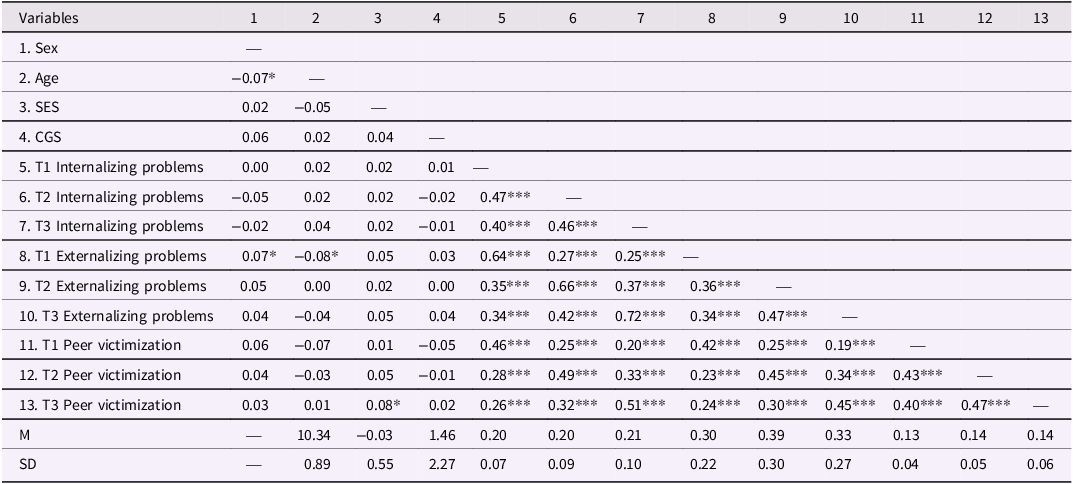
The means, standard deviations, and bivariate correlations of the study variables for the total sample are shown in Table 1.
Descriptive characteristics and correlation coefficients

Note. SES = Socioeconomic status; CGS = cumulative genetic score of FKBP5; T1 = First time of data collection; T2 = Second time of data collection; T3 = Third time of data collection.
*p<0.05; ***p<0.001.
Model comparisons
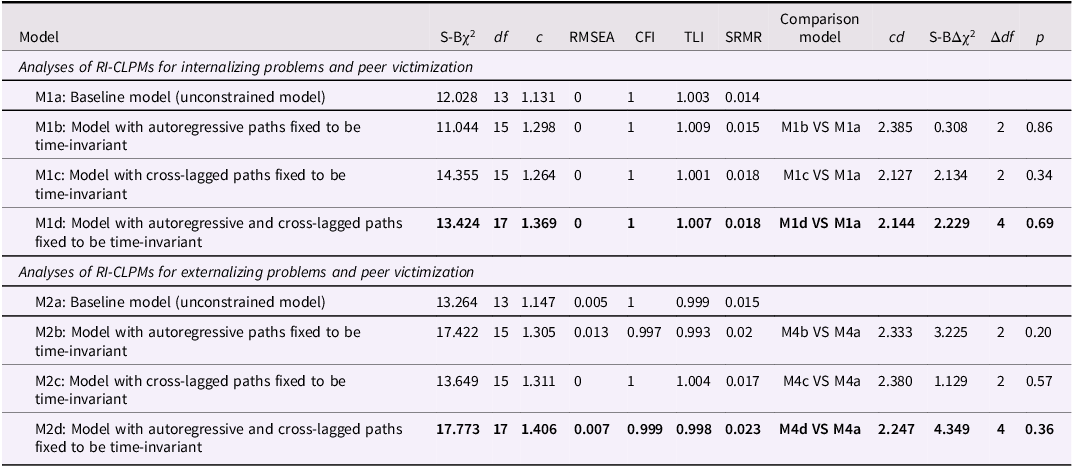
The fit and model comparison results for the constrained and unconstrained RI-CLPMs are presented in Table 2. Setting the autoregressive paths (i.e., Models 1b, 2b) or both the autoregressive and cross-lagged paths (i.e., Models 1d, 2d) as equal over time significantly decreased the fit of the unconstrained model (Models 1a, 2a). Setting the autoregressive paths (i.e., Models 1b, 2b), cross-lagged paths (i.e., Models 1c, 2c), and both the autoregressive and cross-lagged paths (i.e., Models 1d, 2d) as equal over time. This did not significantly decrease the fit of the unconstrained model (Models 1a, 2a). Therefore, considering parsimony, models 1d and 2d were chosen as the final RI-CLPMs for peer victimization and internalizing and externalizing problems, respectively.
Fit statistics and model comparisons

Note. S-Bχ2= Satorra-Bentler scaled chi-square; df = degrees of freedom; c/cd = scaling correction factor for chi-square test using MLR; CFI = comparative fit index; TLI = Tucker-Lewis index; RMSEA = root mean square error of approximation; SRMR = standardized root mean square residual.
RI-CLPM for peer victimization and internalizing and externalizing problems
The results of the final RI-CLPMs for peer victimization and internalizing and externalizing problems are summarized in Figure S1 and Figure S2, respectively. The random intercepts of peer victimization and internalizing or externalizing problems were significantly correlated (rs = 0.66 to 0.80; ps <0.001), indicating that the between-person effects linked the stable variances between peer victimization and internalizing and externalizing problems. The within-person effects from peer victimization at time T to internalizing problems at time T + 1 were all statistically significant (βs = 0.12 – 0.15, ps <0.05), as well as vice versa (βs = 0.10 – 0.14, ps <0.05) (see Figure S1). The within-person effects from peer victimization at time T to externalizing problems at time T + 1 were all statistically significant (βs = 0.14 – 0.18, ps <0.05), as well as vice versa (βs = 0.08 – 0.09, ps <0.05) (see Figure S2). Furthermore, the within-person concurrent associations between peer victimization and internalizing and externalizing problems at each time point and the autoregressive paths of each variable were all statistically significant (see Figure S1, Figure S2).
G×E interactions
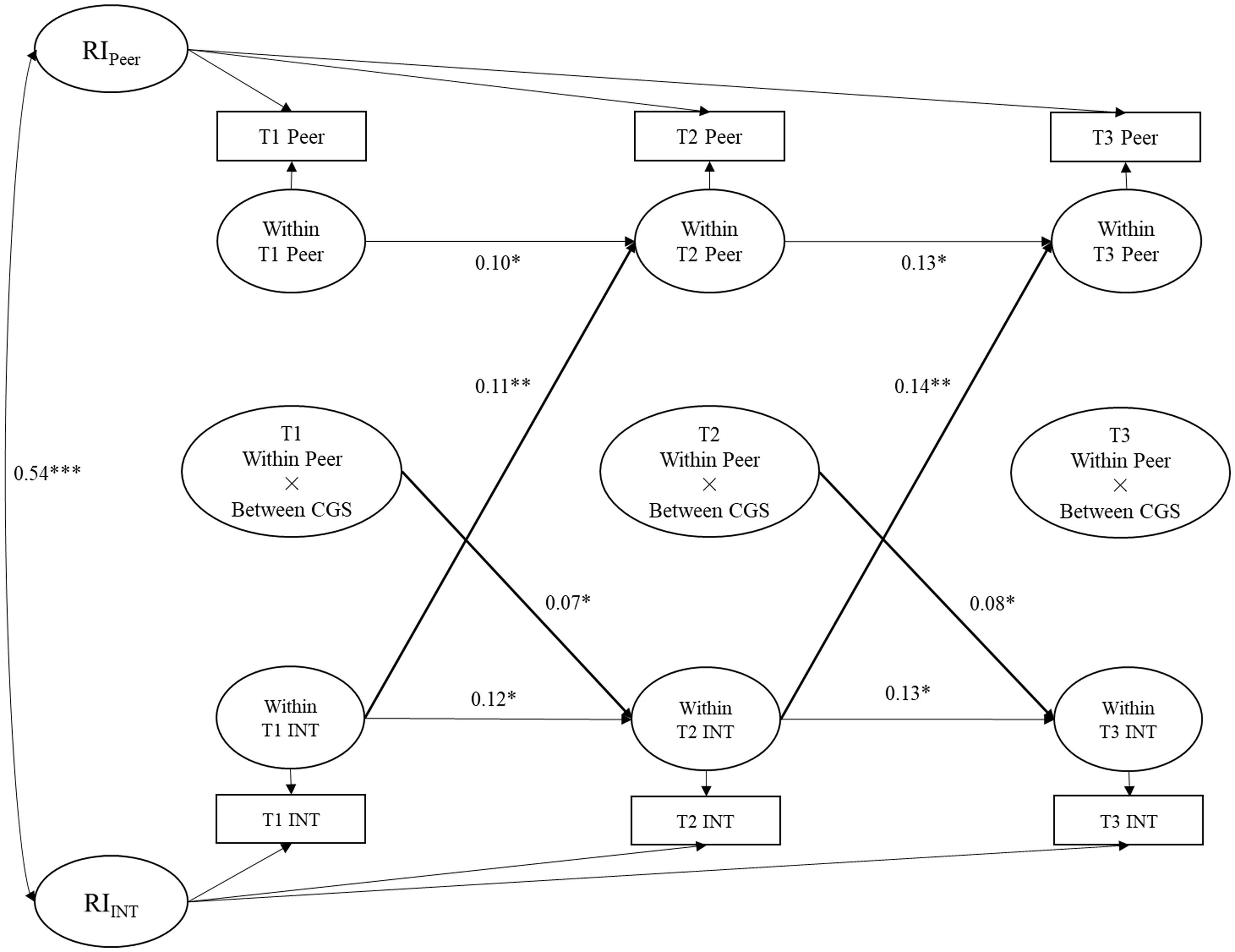
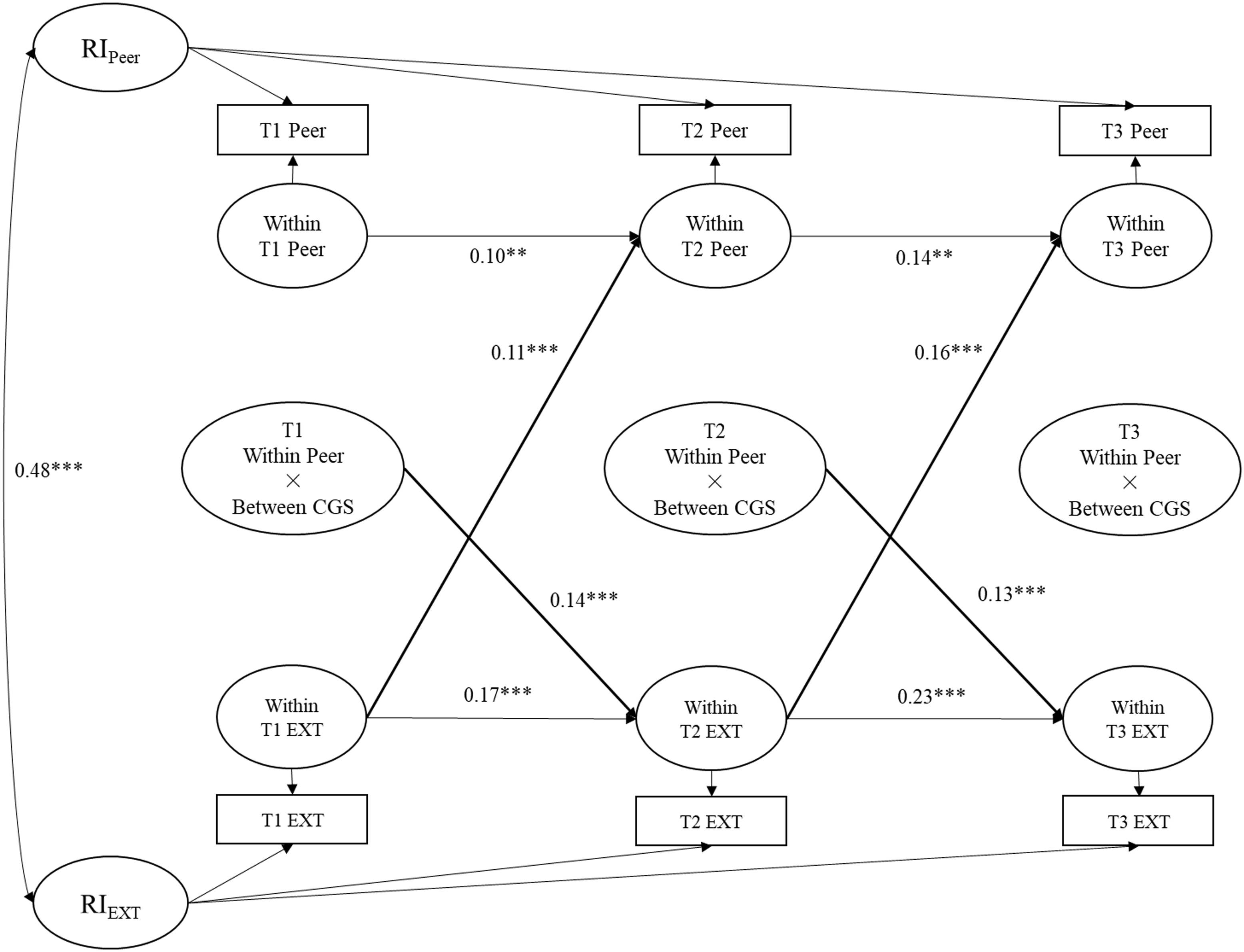
The results of the model investigating whether CGS moderated within-person developmental cascades from peer victimization to internalizing or externalizing problems (see Figure 1, Figure 2) indicated that CGS had a significant moderating effect on the within-person cross-lagged effect of peer victimization at time T to internalizing problems at time T + 1 (βs = 0.07 – 0.08, ps <0.05) (see Figure 1). Moreover, CGS had a significant moderating effect on the within-person cross-lagged effect of peer victimization at time T to externalizing problems at time T + 1 (βs = 0.13 – 0.14, ps <0.001) (see Figure 2).
RI-CLPM for peer victimization and internalizing problems using CGS as a time-invariant moderator. Only significant cross-lagged paths are presented as solid lines. Int = internalizing problems; Peer = peer victimization; CGS = cumulative genetic score of FKBP5. *p < 0.05; **p < 0.01; ***p < 0.001.

RI-CLPM for peer victimization and externalizing problems using CGS as a time-invariant moderator. Only significant cross-lagged paths are presented as solid lines. Ext = externalizing problems; Peer = peer victimization; CGS = cumulative genetic score of FKBP5. **p < 0.01; ***p < 0.001.

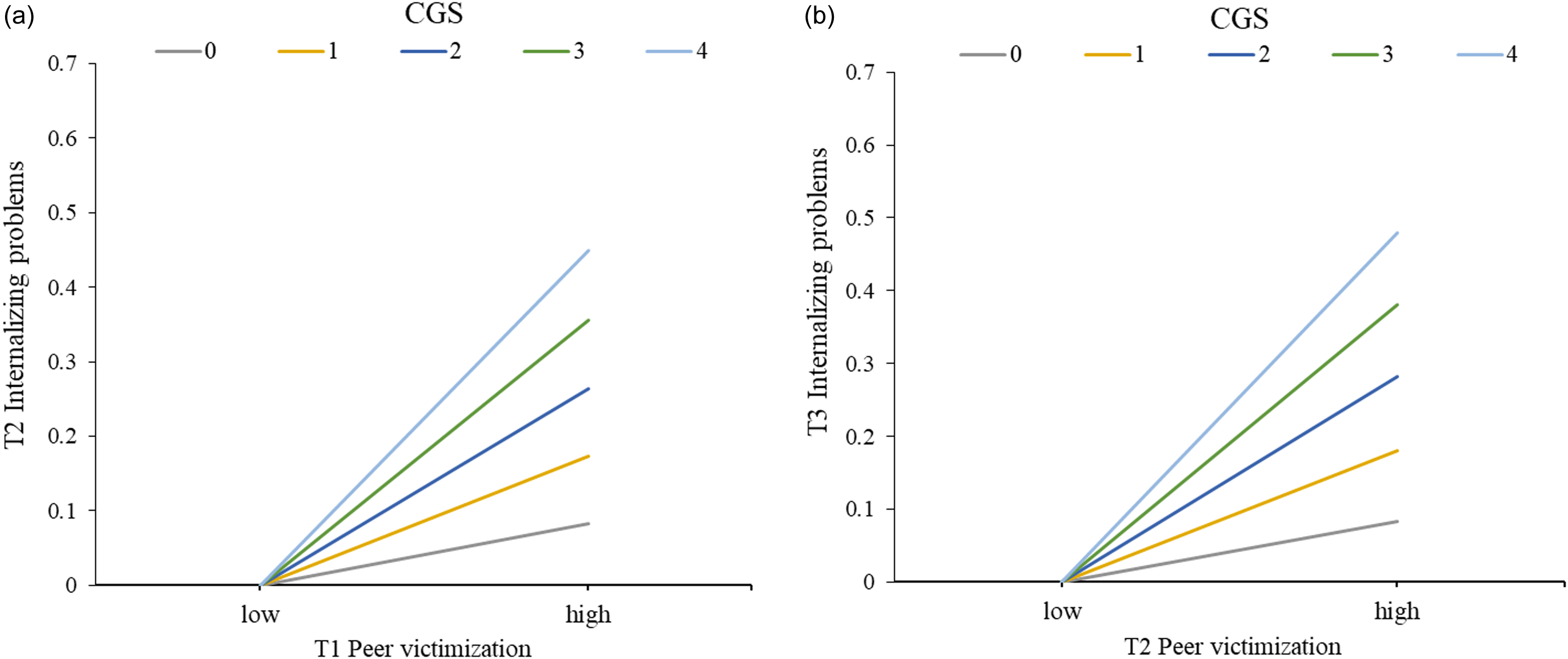
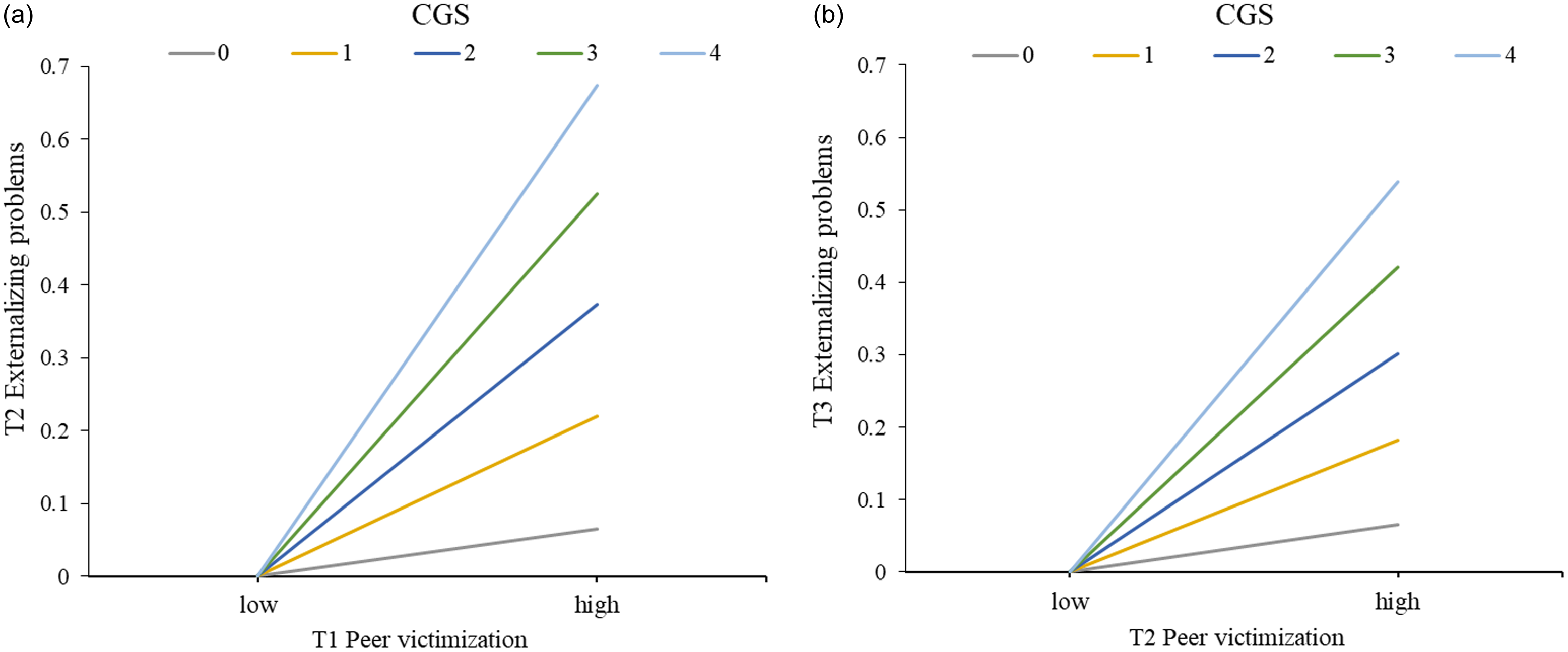
Figure 3 and Figure 4 illustrate post-hoc tests indicating that for higher CGS, youth who score high on peer victimization were more likely to demonstrate higher levels of internalizing and externalizing problems. Specifically, the slopes of peer victimization at T1 on adolescent internalizing symptoms at T2 for a cumulative genetic score of 0 were nonsignificant, cumulative genetic score = 0, b (SE) = 0.028 (0.02), p = 0.13. The slopes for a cumulative genetic score of 1 to 4 were all significant, ranging from b (SE) = 0.06 (0.02), p <0.01 for index value of 1 to b (SE) = 0.15 (0.05), p <0.01 for an index value of 4 (see Figure 3a). The slopes of peer victimization at T2 on adolescent internalizing problems at T3 for a cumulative genetic score of 0 were nonsignificant, cumulative genetic score = 0, b (SE) = 0.028 (0.02), p = 0.13. The slopes for a cumulative genetic score of 1 to 4 were all significant, ranging from b (SE) = 0.06 (0.02), p <0.01 for index value of 1 to b (SE) = 0.16 (0.04), p <0.01 for an index value of 4 (see Figure 3b). The slopes of peer victimization at T1 on adolescent externalizing problems at T2 for a cumulative genetic score of 0 were nonsignificant, cumulative genetic score = 0, b (SE) = 0.022 (0.02), p = 0.12. The slopes for a cumulative genetic score of 1 to 4 were all significant, ranging from b (SE) = 0.07 (0.02), p <0.01 for index value of 1 to b (SE) = 0.23 (0.05), p <0.001 for an index value of 4 (see Figure 4a). The slopes of peer victimization at T2 on adolescent externalizing problems at T3 for a cumulative genetic score of 0 were nonsignificant, cumulative genetic score = 0, b (SE) = 0.022 (0.02), p = 0.12. The slopes for a cumulative genetic score of 1 to 4 were all significant, ranging from b (SE) = 0.06 (0.02), p <0.001 for index value of 1 to b (SE) = 0.18 (0.03), p <0.001 for an index value of 4 (see Figure 4b).
Interaction of the cumulative genetic score of FKBP5 with peer victimization at T1(a) and T2 (b) on adolescent internalizing problems. CGS = cumulative genetic score of FKBP5.

Interaction of the cumulative genetic score of FKBP5 with peer victimization at T1(a) and T2 (b) on adolescent externalizing problems. CGS = cumulative genetic score of FKBP5.

Sensitivity analyses
To ensure the validity of using an additive CGS that combines multiple FKBP5 SNPs, we first tested the assumption that all selected variants exert similar effects. Specifically, we conducted a model comparison between an unconstrained regression model, in which the main effects of four individual SNPs and their interactions with peer victimization were freely estimated, and a constrained model, where these parameters were set equal across all SNPs (Stocker et al., Reference Stocker, Masarik, Widaman, Reeb, Boardman, Smolen, Neppl and Conger2017). The constrained model imposed ten equality constraints—four for the SNP main effects and six for their interactions with peer victimization. If the fit of the unconstrained model was significantly better, this would indicate heterogeneity in SNP effects and challenge the appropriateness of a CGS approach. However, the model comparison revealed no significant difference between the constrained and unconstrained models (Δχ2(6) = 7.20, p = 0.30), supporting the use of equal contribution across the four SNPs. This finding supports the use of a cumulative genetic score in the present study. Additionally, we tested for potential epistatic interactions between SNPs (e.g., SNP1 × SNP2, and SNP1 × SNP2 × peer victimization), none of which reached statistical significance, suggesting no interactive effects among the SNPs. These results collectively validate the additivity and independence assumptions underlying the CGS method. To further evaluate the relative utility of the CGS, we examined each SNP separately in interaction with peer victimization at T1. None of the four polymorphisms showed a significant interaction effect on internalizing symptoms at T2, suggesting that aggregating across loci provided stronger predictive power than analyzing SNPs individually. Lastly, we conducted a sensitivity analysis by recalculating the CGS while excluding each SNP sequentially. In each case, the interaction between the revised CGS and peer victimization remained statistically significant. This demonstrates that the observed effects were not driven by any single SNP, reinforcing the robustness and stability of the cumulative genetic score approach in this context.
Discussion
The results from the RI-CLPM provided strong support for the within-person pathways linking peer victimization to internalizing and externalizing problems. This finding aligns with our hypothesis, which was grounded in the interpersonal risk model (Kochel et al., Reference Kochel, Ladd and Rudolph2012). According to this model, children and adolescents who experience peer victimization are at an increased risk of developing internalizing and externalizing problems over time. This is consistent with previous studies demonstrating that peer victimization predicts heightened symptoms of anxiety and depression, as well as greater behavioral problems (Pan et al., Reference Pan, Yang, Liu, Chan, Liu and Zhang2020; Reijntjes et al., Reference Reijntjes, Kamphuis, Prinzie and Telch2010, Reference Reijntjes, Kamphuis, Prinzie, Boelen, van der Schoot and Telch2011).
The RI-CLPM results also supported a within-person pathway from internalizing and externalizing problems to peer victimization, providing empirical evidence for the symptom-driven model (Kochel et al., Reference Kochel, Ladd and Rudolph2012). This model posits that internalizing and externalizing problems may precede deteriorations in peer relationships, as individuals struggling with these symptoms often exhibit social withdrawal, reduced social competence, and heightened vulnerability (Casper & Card, Reference Casper and Card.2017; Holfeld & Mishna, Reference Holfeld and Mishna2019). Youth with heightened internalizing symptoms often report fewer friendships, diminished peer support, and lower acceptance, all of which may increase their risk of peer victimization (Christina et al., Reference Christina, Magson, Kakar and Rapee2021). These individuals may display withdrawn, anxious, or emotionally dysregulated behaviors, which can be perceived by peers as socially awkward or unapproachable, increasing their likelihood of being targeted by bullies (Reijntjes et al., Reference Reijntjes, Kamphuis, Prinzie and Telch2010). Similarly, adolescents exhibiting externalizing problems—such as aggressive, disruptive, or rule-breaking behaviors—are also at a heightened risk of peer victimization. Youth who display antisocial or aggressive behaviors may provoke negative peer responses, including hostility, rejection, or retaliatory bullying (Dishion & Patterson, Reference Dishion, Patterson, Cicchetti and Cohen2006). Studies have consistently shown that aggressive and oppositional behaviors can alienate peers, leading to reduced social acceptance and increased victimization risk (Van Lier & Koot, Reference Van Lier and Koot2010). Moreover, externalizing behaviors can destabilize peer group norms, prompting peers to react with exclusion or confrontation, thereby perpetuating a vicious cycle of victimization (D’Urso & Symonds, Reference D’Urso and Symonds2022).
While our study found a significant bidirectional relation between peer victimization and both internalizing and externalizing problems, Zhou et al., (Reference Zhou, Gong, Lu, Xu, Zhao and Yang2023, Reference Zhou, Li, Zou and Gong2024) and Gong et al. (Reference Gong, Zhou, Huebner and Tian2024) reported a significant within-person association only between peer victimization and internalizing problems, with no significant link to externalizing problems among Chinese youth. One potential explanation for these inconsistent findings may stem from the structural composition of the statistical models used across studies. In our study, we analyzed the associations between peer victimization and internalizing problems and peer victimization and externalizing problems separately, thereby allowing for the independent estimation of each effect. This approach enabled us to detect significant bidirectional associations for both symptom types. In contrast, Zhou et al., (Reference Zhou, Gong, Lu, Xu, Zhao and Yang2023, Reference Zhou, Li, Zou and Gong2024) and Gong et al. (Reference Gong, Zhou, Huebner and Tian2024) included both internalizing and externalizing problems within a single model, estimating their associations with peer victimization simultaneously. This may have led to suppressed or diluted effects, given the shared variance and interrelated nature of internalizing and externalizing symptoms. These constructs frequently co-occur and often share overlapping risk factors. Therefore, modeling them together may obscure the unique association between peer victimization and externalizing problems, and potentially mask effects that are otherwise statistically detectable when analyzed independently.
Importantly, our findings also advance biological sensitivity to context theory (Ellis & Boyce, Reference Ellis and Boyce2008) by demonstrating that individual differences in genetic susceptibility shape the psychological consequences of peer victimization. Specifically, this study demonstrated that the between-person FKBP5 genetic CGS significantly moderated the within-person pathway from peer victimization to internalizing and externalizing problems. This suggests that individuals with a higher CGS of the FKBP5 gene are more likely to develop internalizing and externalizing problems when experiencing higher-than-usual peer victimization. This may result from the higher the individual’s CGS of the FKBP5 gene, the more FKBP5 is secreted, and the GR binding to excess FKBP5 reduces its ability to bind cortisol, leading to elevated glucocorticoid concentrations. Youth experiencing high levels of peer victimization increase their glucocorticoid release in response to stress, in turn leading to high concentrations of glucocorticoids in individuals, resulting in a sustained hyperactivity of the HPA axis, impaired negative feedback mechanisms, and altered dendritic morphology of hippocampal pyramidal neurons (Matosin et al., Reference Matosin, Halldorsdottir and Binder2018; Tyrka et al., Reference Tyrka, Ridout, Parade, Paquette, Marsit and Seifer2015). These changes in biochemical processes may all lead to a decrease in individual adaptive stress coping strategies (Criado-Marrero et al., Reference Criado-Marrero, Rein, Binder, Porter, Koren and Blair2018; Matosin et al., Reference Matosin, Halldorsdottir and Binder2018), such as cognitive reappraisal and problem-solving (Aldao & Nolen-Hoeksema, Reference Aldao and Nolen-Hoeksema2012), and thereby lead to higher levels of internalizing and externalizing symptoms in youth.
Limitations and future direction
Despite the novelty of this study, it has some limitations. First, the data relied primarily on self-reported measures, which may compromise the internal validity of the findings. Self-report data may be influenced by shared method variance and social desirability biases, particularly in younger populations. To address this limitation, future studies should incorporate multiple informants and assessment methods, such as parent, teacher, or peer reports, and observational data to enhance data accuracy. Second, this study focused exclusively on polymorphisms of a single gene—FKBP5—within the HPA axis. While FKBP5 is an established genetic marker in stress reactivity research, future research should consider including additional HPA-axis-related genetic variants, or adopt a broader polygenic approach, to improve the statistical power and robustness of G × E interaction analyses. Third, although this study employed a longitudinal gene-environment interaction design, the sample size was relatively modest given the complexity of the RI-CLPM and G × E analyses. Limited sample size can reduce statistical power and raise the risk of false negatives or overestimated effects (Duncan & Keller, Reference Duncan and Keller2011). Future studies should aim to replicate these findings in larger and more representative samples to ensure the stability and generalizability of the results. Finally, the samples were all drawn from elementary schools in China; thus, caution is warranted when generalizing the results to other contexts. Future studies are required to replicate and extend these findings in different age groups (e.g., during adolescence) and in other countries.
Implication
This study’s findings provide valuable insights into the complex interplay between peer victimization, psychological outcomes, and genetic susceptibility, particularly related to FKBP5 polymorphisms. By demonstrating a significant G × E interaction, these results underscore that some adolescents are more biologically vulnerable to peer-related stressors, thus emphasizing the importance of identifying individuals at heightened genetic risk to provide targeted support (Caspi & Moffitt, Reference Caspi and Moffitt2006; Zannas & Binder, Reference Zannas and Binder2014). In principle, early screening for genetic susceptibility, such as FKBP5 polymorphisms, could facilitate individualized interventions for adolescents at the highest biological risk. However, direct genetic screening for FKBP5 variants is currently not feasible in routine school or clinical settings due to ethical concerns and high associated costs (Mills & Rahal, Reference Mills and Rahal2019). Given the impracticality of widespread genetic screening at present, the current focus of interventions must focus mainly on environmental and resilience-based strategies. Broadly effective school-based anti-bullying programs, such as KiVa (Salmivalli et al., Reference Salmivalli, Kärnä and Poskiparta2011) and the Olweus Bullying Prevention Program (Olweus, Reference Olweus1997), are essential for reducing peer victimization through the promotion of positive peer interactions, improved bystander responsiveness, and strengthened teacher support. Nonetheless, the present genetic findings highlight the importance of integrating more sensitive screening for early behavioral markers of vulnerability (e.g., heightened emotional distress, poor stress resilience), which might indirectly identify adolescents genetically predisposed to adverse psychological outcomes.
In addition, interventions designed to enhance adolescents’ stress resilience—such as Mindfulness-Based Stress Reduction (MBSR; Zoogman et al., Reference Zoogman, Goldberg, Hoyt and Miller2015) and cognitive reappraisal training (Aldao & Nolen-Hoeksema, Reference Aldao and Nolen-Hoeksema2012)—can help mitigate stress responses in high-risk youth. Although it is currently not feasible to directly tailor interventions based on genetic profiles, these resilience-focused programs provide valuable support to vulnerable populations by improving coping skills and mitigating heightened physiological stress reactions associated with FKBP5 risk alleles (Zannas & Binder, Reference Zannas and Binder2014). Similarly, biofeedback and neurofeedback approaches grounded in neuroscience (Melnikov, Reference Melnikov2021; Tosti et al., Reference Tosti, Corrado, Mancone, Di Libero, Rodio, Andrade and Diotaiuti2024) offer promising opportunities for future individualized interventions, potentially becoming more personalized as genetic testing technologies become increasingly accessible. Finally, interventions emphasizing parental and teacher involvement are essential for fostering emotionally supportive environments. Parental emotion coaching (Gottman et al., 2003) and trauma-informed teacher training (Craig, Reference Craig2016) can equip adults to better identify and support adolescents showing early signs of vulnerability, indirectly addressing genetic susceptibility through environmental means. In conclusion, although genetic screening for FKBP5 polymorphisms is currently impractical, this study highlights the theoretical and future practical importance of understanding genetic susceptibility. This underscores how future developments in affordable and ethical genetic screening methods could significantly enhance precision mental health approaches, ultimately enabling more tailored and effective prevention programs.
Conclusion
This study identified within-person effects between peer victimization and internalizing and externalizing problems, and that internalizing and externalizing problems also significantly predicted peer victimization at the within-person level. These findings will enhance understanding of the within-person relations between peer victimization and both internalizing and externalizing problems, as well as the G × E interactions of these within-person relations, thus offering a novel perspective for preventing and reducing peer victimization and both internalizing and externalizing problems in youth.
Supplementary material
The supplementary material for this article can be found at https://doi.org/10.1017/S0954579425100230.
Acknowledgements
We are grateful to the participants of this study for their participation.
Author contribution
Xue Gong conceived of the study, and participated in its design and coordination and performed the statistical analysis and drafted the manuscript; Jianhua Zhou participated in the design and coordination of the study and helped to draft the manuscript. All authors read and approved the final manuscript.
Funding statement
This research was supported by Funds for National Natural Science Youth Foundation of China (No. 32300898), Grants from the Ministry of Science and Technology of China (No. 2021ZD0203804), Funds for Humanities and Social Sciences Youth Foundation, Ministry of Education of the People’s Republic of China (No. 22YJC190031) and Funds for Youth Project of Social Science Planning of Shandong Province (No. 24DJYJ07).
Competing interests
The authors report no conflict of interests.
Ethical standards
The present study was approved by School of Psychology Research Ethics Committee, Northwest Normal University (PSYNWNU008). All procedures performed in this study involving human participants were in accordance with the ethical standards of the institutional and/or national research committees on human experimentation and with the Helsinki Declaration of 1975, as revised in 2008. All procedures involving human subjects were approved by School of Psychology Research Ethics Committee, Northwest Normal University, Lanzhou, China (PSYNWNU008).
Data sharing declaration
The datasets generated and/or analyzed during the current study are not publicly available but are available from the corresponding author on reasonable request.
Informed consent
Informed consent was obtained from all individual participants included in the study.