




No CrossRef data available.
Article contents
Modeling utility of second-eye cataract surgery
Published online by Cambridge University Press: 01 August 2004
Abstract
Objectives: To study the impact on public health in terms of utility of various proportions of first-eye and second-eye cataract surgery.
Methods: A model was used to study the impact on a population of a fixed cataract surgical rate (9,250 operations/1,000,000 people) with varying proportions of first-eye and second-eye cataract operations. The study population was the County of Blekinge with a known incidence of previous cataract surgery. The prevalence of cataract, the estimated need for cataract surgery, and the utility values were taken from the literature. The population was grouped by disability stage of cataract and previous cataract surgery in accordance with prevalence studies and data from a large national database on cataract surgery and patients' self-assessed visual function. The mortality rate was taken from real data for the study population.
Results: Given a fixed cataract surgical rate over a period of five years, a high percentage of second-eye cataract surgery (42 percent) resulted in a mean utility of 0.82239 in the population forty years of age and older and the corresponding number for a low percentage of second-eye cataract surgery (25 percent) was 0.82253. A high percentage of second-eye surgeries resulted in 421 more individuals who were well compared with a low percentage of second-eye surgeries. On the other hand, a low percentage of second-eye surgeries resulted in 152 fewer individuals with disability and 118 fewer individuals with dependence compared with a high percentage of second-eye surgeries.
Conclusions: A high frequency of first-eye cataract surgeries instead of second-eye surgeries affects more individuals and means an optimized improvement of utility in a population. This should be recommended if the cataract surgical rate is very insufficient. If the cataract surgical rate is high, more second-eye surgeries should be performed to optimize quality of life to as many as possible.
Information
- Type
- RESEARCH REPORTS
- Information
- International Journal of Technology Assessment in Health Care , Volume 20 , Issue 3 , August 2004 , pp. 361 - 367
- Copyright
- © 2004 Cambridge University Press
PUBLIC HEALTH ASPECTS OF CATARACT SURGERY
Cataract is the most common cause of avoidable blindness globally (32). Cataract is significantly related to age (10;11), and the prevalence of cataract with impaired vision is high in age groups over fifty-five years of age (10–12). Because of its high prevalence and risk for blindness if untreated, cataract has a significant impact on public health. Cataract can be treated successfully by cataract extraction and implantation of an intra-ocular lens. Cataract surgery is one of the most cost-effective public health interventions to prevent blindness (31). However, access to this high-tech surgery varies greatly between different countries. The global aim for cataract surgical rate (CSR) as defined by WHO for the year 2000 was 3,500 surgeries per 1,000,000 people (28). In some developed countries, the surgical rate far exceeds this goal (14;20;24;28). However, there are long waiting lists for cataract surgery (3;7;25;26) in these countries.
Estimated Need of Cataract Surgery
Several prevalence studies concerning cataract have been performed (9–11;15;23;27). Many of these studies focussed on the occurrence of lens opacities. The type and degree of lens opacities can be described by the use of different classification methods (4;12). In a prevalence study, cataract is defined as one or more types of lens opacities of a certain degree according to a grading system. It is well known that there is a poor correlation between the degree of lens opacities and visual acuity. In many studies, the frequency of lens opacities of a certain degree combined with a decrease in visual acuity is used as a complementary measure of prevalence (11). In the Beaver Dam Study, 3.9 percent of all examined men between fifty-five and sixty-four years of age had cataract and a visual impairment to 20/30 or worse in the worst-affected eye (11). In the Maryland Watermen Study (27) and the Framingham Eye Study (10) the corresponding numbers were 5.0 percent and 4.0 percent, respectively. In men between sixty-five and seventy-four years of age, the rate was 14.3 percent in the Beaver Dam Study compared with 25.0 percent in Maryland and 16.0 percent in Framingham. In men seventy-five years of age or older in Beaver Dam, the rate was 38.8 percent, whereas rates of 59.0 percent and 41.0 percent were found for men between seventy-five and eighty-five years in the Maryland and Framingham studies, respectively. Some studies have found a higher prevalence of cataract in women than men (10;11). It is generally accepted that there is not a good correlation between visual acuity and perceived difficulties in daily life for patients with cataract. In a recent study, more than half of the patients with cataract and a visual acuity of 6/12 at best were satisfied with their vision (22). Based on the literature (10;11;27), the prevalence of cataract and a visual acuity of 0.6 in the worst-affected eye can be estimated to 20 percent in age group sixty-five to seventy-four, 50 percent in age group seventy-five to eighty-four, and 80 percent in age group older than eighty-five. For age groups forty to fifty-four and fifty-five to sixty-four, the corresponding values are 0.6 percent and 5.0 percent, respectively.
The need for cataract surgery in terms of CSR is scarcely commented on in the literature. According to Hirvelä et al. (9), 30.3 percent of all eyes of persons seventy years of age or older can be considered for cataract surgery. Frost et al. (6) suggested that twenty-nine (95 percent CI 20–41) operations per 1,000 people over fifty-five years of age would be the most inclusive criterion for cataract surgery. McCarty et al. (22) estimated the need to be approximately 100 eyes per 1,000 population forty years old and over if the visual threshold is 6/7.5. Another approximately 100 eyes per 1,000 population forty years of age and over have the same visual acuity and cataract but the individuals are satisfied with their vision. According to Taylor (28), the need for surgery if the threshold of visual acuity was set to 6/9 would be 11,500 surgeries per 1,000,000 population per year.
Health-Related Quality of Life in Different Stages of Cataract
The Swedish National Cataract Register (NCR; 20) has collected data about cataract patients' self-assessed visual function before and after a cataract extraction annually since 1995 (18). A disease-specific questionnaire, Catquest (16;17), has been used. Catquest contains questions about perceived difficulties in performing seven different daily life activities. A disability score total of 7 or below means no difficulty in performing these activities, a disability score total of 28 or higher means extreme difficulty in performing these activities. The database contains 13,129 completed questionnaires.
Utility
In economic analyses, utility refers to the preference of individuals or the society for a particular health outcome. It is measured on a cardinal scale between 0 (dead) and 1 (perfect health). Utility can be measured directly by methods such as standard gamble or time trade-off (TTO; 29) or by questionnaires such as the EQ-5D or the Health Utility Index (30). Hawthorne et al. (8), using the EQ-5D in a general population, found that the thirty-six to fifty year age group had a mean utility of 0.88, the fifty-one to sixty-five year age group a mean utility of 0.84, and the older than sixty-six age group a mean utility of 0.79.
By using the EQ-5D, Kobelt et al. (13) compared utility values to disability scores obtained by the disease-specific questionnaire Catquest (16;17) for cataract patients. Cataract patients with no difficulties in daily life and a very low Catquest disability score had a utility of approximately 0.83. Cataract patients with great difficulty in daily life and a very high Catquest disability score had a utility value of approximately 0.67. For the majority of cataract patients with moderate disabilities, a mean utility value of 0.75 was estimated. Thus, the optimal gain in utility from cataract surgery was 0.16. The average patient in the study had a utility gain of 0.028 from a cataract extraction. Busbee et al. (2) estimated by the TTO technique that the improvement in visual acuity achieved by cataract surgery increased the utility from 0.71 to 0.858. The net utility gain for initial cataract surgery was thus 0.148 in this study.
If a cataract is untreated, the final stage may mean a visual acuity in the counting fingers to light perception range. According to Brown et al. (1), such a poor visual acuity in both eyes in age-related macular degeneration corresponds to a utility of 0.40. Drummond (5) estimated that an emotionally well-adjusted blind person would have a utility of 0.48.
Incident Cataract Surgery, One or Two Eyes, and Public Health
The CSR is defined as the number of cataract extractions per 1,000,000 population and year (28). In the literature, the number of cataract extractions per 1,000 population and year is also used as a measure of CSR. However, when the impact of cataract surgery on public health is discussed, one also must calculate the number of operated individuals. For example, if the CSR for one calendar year was 10,000 perhaps 6,000 operations were first-eye surgeries and the other 4,000 were second-eye surgeries. Of the 4,000 second-eye surgeries, 2,000 operations could have been on individuals previously operated on the first eye the same year. The other 2,000 second-eye surgeries could have been on individuals operated on their first eye during a previous year. So, during the actual year, 6,000 new individuals in the population had cataract surgery, 4,000 of them only in one eye and 2,000 in both eyes during the same year. Thus, the impact on public health by the CSR of 10,000 and 40 percent second-eye surgeries was 4,000 new individuals with surgery in one eye, 2,000 new individuals with surgery in both eyes, and 2,000 previously operated individuals who turned into the both-eye surgery group. Of course, the mortality rate will adjust these numbers.
From a public health perspective, it is important to decide which strategy should be used for cataract surgery as long as the need for surgery is unmet. In this study, we will model the impact on public health of different strategies for second-eye cataract surgery. Different stages of cataract, including previous surgery will be defined by using data from a large cataract database (NCR; 20). The stages will be turned into utility values and applied to a defined population with known incidence of previous cataract surgery (PCS).
METHODS
Stages of Cataract
In a population forty years and older, the majority will not have cataract and can be considered as “well” from this perspective. Several subjects will have cataract in at least one eye without any symptoms or perceived disabilities. Then there will be subjects with cataract in at least one eye, perceived disabilities in daily life and dissatisfaction with vision. There will also be people with previous cataract surgery in one or both eyes. Thus, the following stages of cataract in a population are easily defined: well (no cataract), cataract without disabilities, cataract with disabilities, PCS in one eye, and PCS in both eyes.
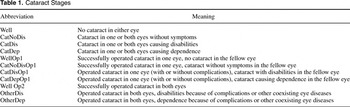
However, from a health perspective, subjects with cataract and perceived disabilities in daily life may differ greatly in severity of symptoms. A given number will be dependent because of poor vision and cataract (17). Therefore, cataract with disabilities could be separated into two groups: cataract with disabilities and cataract causing dependence. After first-eye surgery a subject may be “well” because there was only a unilateral cataract. There may be cataract in the fellow eye but no disabilities, cataract in the fellow eye with disabilities, or finally cataract in the fellow eye causing dependence. After surgery on both eyes, an individual may be “well,” but there may be other eye-diseases causing disabilities or dependence. Thus, we can identify 11 different stages of cataract depending on the severity of symptoms (disability stages) and PCS stages in one or both eyes (Table 1).

Utility is dependent on age (8). In the age group forty to forty-nine, the utility can be estimated to 0.87 in healthy individuals. Cataract without disabilities will correspond to 0.84, cataract with disabilities 0.79, and cataract causing dependence 0.71. For each increasing decade of age, these figures will be reduced with 0.03.
Application of Utility Values to Different Strategies for Cataract Surgery
The distribution of disability stages before first-eye surgery, after first-eye surgery, and after second-eye surgery were taken from the NCR database. Before first-eye surgery 84 percent had disabilities (CatDis) and 16 percent dependence (CatDep). After first-eye surgery 14 percent were well (WellOp1), 27.8 percent had cataract without disabilities (CatNoDisOp1), 54.5 percent had cataract in the fellow eye causing disabilities (CatDisOp1), and 3.7 percent had cataract in the fellow eye causing dependence (CatDepOp1). After second-eye surgery 52.4 percent were well (WellOp2), 44.4 percent had disabilities caused by other eye diseases (OtherDis), and 3.2 percent had dependence caused by other eye diseases (OtherDep). Each stage was given a utility value according to a previous study (13). The surgery volume in 2001 in Blekinge was used as a study population for the different strategies. The PCS and utility of the population in 2001 were compared with two different scenarios with the same surgery volume during the period of 1996 to 2000 as in 2001 but with two different rates of second-eye surgery, 42 percent and 25 percent. The actual history of cataract surgery in Blekinge was a slowly rising annual surgery volume from 768 in 1996 to 1387 in 2001 (21), and the percentage of second-eye surgery changed from 25 percent in 1996 to almost 40 percent in 2001. The situation in 1995 (PCS) in Blekinge was delineated in an earlier study (21) and used as a starting point. The actual mortality rates for cataract surgery patients in Blekinge each year (1995–2001) (21) were used also in the theoretical scenarios. The model used for the calculations is shown in Fig. 1. The same model was tested for part of the population, the age groups of seventy to seventy-nine years and eighty to eighty-nine years.

Schematic illustration of the model used for calculating the impact on a population of different proportions of first-eye and second-eye cataract surgery.
Material
The study population was the county of Blekinge. In 2002, the population was 150,017 and the age group of forty years and over consisted of 78,570 individuals. This age group was subgrouped in ten-year age groups, and the estimated prevalence of cataract (=cataract and VA[les ]0.6 in the worst-affected eye) was taken from literature. Thus, the age group seventy to seventy-nine years consisted of 13,029 individuals, the estimated prevalence of cataract was 32 percent resulting in 4,169 affected individuals.
RESULTS
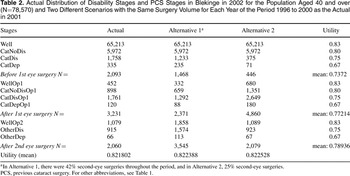
The actual distribution and two theoretical scenarios of disability stages and PCS stages in Blekinge in 2002 for the population older than forty are shown in Table 2. Actually 3,231 individuals were alive and had undergone a cataract extraction in one eye and 2,060 individuals were alive and had undergone a cataract extraction in both eyes. The estimated number of patients with a need for cataract surgery in the first eye was 2,093. In the case of a yearly surgery volume of 1,387 operations and 42 percent second-eye surgeries during 1996–2001, 2,371 individuals had undergone first-eye surgery and 3,545 individuals had undergone surgery on both eyes. In 25 percent, second-eye surgeries and the same total surgery volume, the corresponding numbers were 4,860 and 2,079, respectively. Using the low percentage of second-eye surgeries resulted in only 446 patients left with a need for first-eye cataract surgery in 2002, and using the high percentage of second-eye surgeries resulted in 1,468 patients left a with need for first-eye cataract surgery. The actual situation resulted in 66,744 individuals who were well, 4,434 individuals with disabilities, and 521 individuals with dependence. A high percentage of second-eye surgeries resulted in the highest number of individuals who were well (=67,403), while a low percentage of second-eye surgeries resulted in the lowest number of individuals with disabilities (=3,947) and dependence (=318; Table 2). The actual estimated mean utility of the population was 0.82180, and 0.82239 and 0.82253 with a high percentage and a low percentage of second-eye surgeries, respectively. This means that a low percentage of second-eye surgeries with the same CSR gave the highest mean utility in the population. The average improvement of utility was 0.03494 after first-eye surgery and 0.01722 after second-eye surgery.

The actual distribution and two theoretical scenarios of disability stages and PCS stages in Blekinge in 2002 for the population aged 70–79 were also calculated. The actual estimated mean utility was 0.76205. A high percentage of second-eye surgeries resulted in a mean utility of 0.76409, and a low percentage of second-eye surgeries resulted in a mean utility of 0.76468. The average improvement of utility was 0.03502 after first-eye surgery and 0.01738 after second-eye surgery. The distribution of individuals who were well, had disabilities, or dependence followed the same pattern as for the whole population (forty and older).
The actual distribution and two theoretical scenarios of disability stages and PCS stages in Blekinge in 2002 for the population eighty to eighty-nine were calculated as well. The actual estimated mean utility was 0.71170. A high percentage of second-eye surgeries resulted in a mean utility of 0.71241, and a low percentage of second-eye surgeries resulted in a mean utility of 0.71311. The average improvement of utility was 0.02969 after first-eye surgery and 0.01851 after second-eye surgery. The distribution of individuals who were well, had disabilities, or dependence followed the same pattern as for the whole population (forty and older).
The utility results for cataract surgery for all in both eyes versus surgery for no one with a need for surgery can also be calculated for various age groups. In the case of no surgery at all, two scenarios are specified: one with cataract patients with very poor vision and one with cataract patients with moderately reduced visual acuity. In case of moderately reduced visual acuity, 86 percent with need for surgery have a utility of 0.75 and 14 percent have 0.67; in case of very poor vision, 86 percent with need for surgery have a utility of 0.67 and 14 percent have 0.40 (counting fingers to light perception in both eyes).
For the forty and older population, the difference in mean utility between surgery to all (=0.8239) and surgery to no one (=0.8190; moderately reduced vision) was 0.0049. The total cohort was 78,570 individuals, which means that the difference corresponds to a gain in utility of 1.0×385. The corresponding numbers were 0.0113 for age group seventy to seventy-nine, corresponding to a gain in utility of 1.0×147, and 0.0227 for age group eighty to eighty-nine, corresponding to a gain in utility of 1.0×168. The difference in mean utility between surgery to all (=0.8239) and surgery to no one (=0.8086; very poor vision) was 0.0153 corresponding to a gain in utility of 1.0×1,202.
DISCUSSION
In this study, we have modeled two scenarios for second-eye cataract surgery given the same total surgery volume in a defined population. The most important findings were that a low percentage of second-eye surgeries gave a higher estimated mean utility in the population and fewer individuals with disability or dependence compared with a high percentage of second-eye surgeries. The latter scenario, on the other hand, gave a higher number of individuals who were well.
Why is there this impact on public health of first- and second-eye surgery? The well-known advantage of surgery on both eyes (18) is shown in our model by the fact that a higher percentage of patients are considered to be well after second-eye surgery than after first-eye surgery (52.4 percent and 14 percent, respectively). The actual numbers were based on findings accumulated over seven years in a large national database (20). The mean utility before surgery for patients with symptoms of cataract was 0.7372 according to our model. The mean utility was 0.77214 after first-eye surgery and 0.78936 after second-eye surgery. This finding means that the average utility improvement was 0.03494 after first-eye surgery and 0.05216 after surgery on both eyes. Of course, two first-eye surgeries will give a higher total sum of improvement than surgery on both eyes in one individual.
The same mortality rate was used for all patients irrespective of PCS in one or both eyes. However, a deceased subject with PCS in both eyes would reduce the impact of two surgeries instead of one surgery for a subject with PCS in one eye only.
The utility values for different disability stages in this study were obtained from an earlier study on cataract patients (13), whereas the differences in utility between different age groups were obtained from published population studies (8). This may introduce a source of error, as utility values from a population study may not be compatible with utility values for a chronic disease. However, patients with cataract in a certain age group do not differ from the general population regarding general health. Furthermore, small changes in utility values will not change the results of our study.
One important condition for our calculation is the occurrence of an ocular comorbidity in eyes undergoing a cataract extraction. On average, 40 percent of eyes being operated for cataract in Sweden also have a sight-threatening ocular comorbidity (20). This fact greatly influences the distribution of disability stages after both first- and second-eye surgery.
Cataract surgery includes the possibility of changing the refractive power of the eye. This means that the power of the lens to be implanted can be chosen to decrease or eliminate an existing myopia or hyperopia. However, if the new refractive power of the operated eye differs too much from the fellow eye, the patient will have problems with cooperation between the eyes. Therefore, if one deliberately operates only on one eye, the possibility of correcting high myopia or hyperopia will be lost.
In a population with good access to cataract surgery and without accumulated cases of unoperated cataract, most new cataract patients with cataract in both eyes should have surgery in both eyes. There should not be too much delay between surgery on the first and the second eye (19). This strategy will give the highest quality of life to the patients. If, however, there is a surgical “backlog” of cases with unoperated cataract and poor access to surgery, the society will have the greatest benefit from first-eye surgery in as many patients as possible rather than a high percentage of second-eye surgeries. This will prevent blindness and dependence in as many people as possible.
In this study, we have not made any economic calculation. If there is a large difference in cost between first-eye surgery and second-eye surgery, our conclusions may be modified.
This study was supported by grants from the Swedish National Board of Health and Welfare.
References
Brown GC,
Sharma S,
Brown MM,
Kistler J.
2000
Utility values and age-related macular degeneration.
Arch Ophthalmol.
118:
47–
51.Google Scholar
Busbee BG,
Brown MM,
Brown GC,
Sharma S.
2002
Incremental cost-effectiveness of initial cataract surgery.
Ophthalmology.
109:
606–
613.Google Scholar
Churchill AJ,
Vize CJ,
Stewart OG,
Backhouse O.
2000
What factors influence cataract waiting time?
Br J Ophthalmol.
84:
429–
431.Google Scholar
Chylack LT,
Wolfe JK,
Singer DM, et al.
1993
The lens opacities classification system III.
Arch Ophthalmol.
111:
831–
836.Google Scholar
Frost A,
Hopper C,
Frankel S, et al.
2001
The population requirement for cataract extraction: A cross-sectional study.
Eye.
15:
745–
752.Google Scholar
Hanning M,
Lundström M.
1998
Assessment of the maximum waiting time guarantee for cataract surgery: The case of a Swedish policy.
Int J Technol Assess Health Care.
14:
180–
193.Google Scholar
Hawthorne G,
Richardson J,
Day NA.
2001
A comparison of the assessment of quality of life (AqoL) with four other generic utility instruments.
Ann Med.
33:
358–
370.Google Scholar
Hirvelä H,
Luukinen H,
Laatikainen L.
1995
Prevalence and risk factors of lens opacities in the elderly in Finland. A population based study.
Ophthalmology.
102:
108–
117.Google Scholar
Kahn HA,
Liebowitz HM,
Ganley JP, et al.
1977
The Framingham Eye Study: Outline and major prevalence findings.
Am J Epidemiol.
106:
17–
32.Google Scholar
Klein B,
Klein R,
Linton KL.
1992
Prevalence of age-related lens opacities in a population. The Beaver Dam Eye Study.
Ophthalmology.
99:
546–
552.Google Scholar
Klein BEK,
Magli YL,
Neider MW,
Klein R.
1990
Wisconsin system for classification of cataracts from photographs (protocol).
Madison, WI:
University of Wisconsin-Madison:
1–
28.
Kobelt G,
Lundström M,
Stenevi U.
2002
Measuring utility and outcome in cataract surgery.
J Cataract Refract Surg.
28:
1742–
1749.Google Scholar
Kocur I,
Resnikoff S,
Foster A.
2002
Eye healthcare services in eastern Europe: I. Cataract surgery.
Br J Ophthalmol.
86:
847–
850.Google Scholar
Leske CM,
Connell AMS,
Wu SY.
1997
et al. Prevalence of lens opacities in the Barbados Eye Study.
Arch Ophthalmol.
115:
105–
111.Google Scholar
Lundström M,
Roos P,
Jensen S,
Fregell G.
1997
Catquest questionnaire for use in cataract surgery care: Description, validity and reliability.
J Cataract Refract Surg.
23:
1226–
1236.Google Scholar
Lundström M,
Stenevi U,
Thorburn W,
Roos P.
1998
Catquest questionnaire for use in cataract surgery care: Assessment of surgical outcomes.
J Cataract Refract Surg.
24:
688–
691.Google Scholar
Lundström M,
Stenevi U,
Thorburn W.
2001
Quality of life after first- and second-eye cataract surgery. Five-year data collected by the Swedish National Cataract Register.
J Cataract Refract Surg.
27:
1553–
1559.Google Scholar
Lundström M,
Brege KG,
Florén I,
Stenevi U,
Thorburn W.
2002
Strategy to reduce the number of patients perceiving impaired visual function after cataract surgery.
J Cataract Refract Surg.
28:
971–
976.Google Scholar
Lundström M,
Stenevi U,
Thorburn W.
2002
The Swedish National Cataract Register: A 9-year review.
Acta Ophthalmol Scand.
80:
248–
257.Google Scholar
Lundström M,
Albrecht S.
2003
Previous cataract surgery in a defined Swedish population.
J Cataract Refract Surg.
29:
50–
56.Google Scholar
McCarty CA,
Keeffe JE,
Taylor HR.
1999
The need for cataract surgery: Projections based on lens opacity, visual acuity, and personal concern.
Br J Ophthalmol.
83:
62–
65.Google Scholar
Mitchell P,
Cumming RG,
Attebo K, et al.
1997
Prevalence of cataract in Australia. The Blue Mountains Eye Study.
Ophthalmology.
104:
581–
588.Google Scholar
Nemeth J,
Molnar F,
Kocur I.
2002
Eye health care in Hungary.
Eur J Ophthalmol.
12:
228–
231.Google Scholar
Riley AF,
Grupcheva CN,
Malik TY,
Craig JP,
McGhee CN.
2001
The waiting game: Natural history of a cataract waiting list in New Zealand.
Clin Exp Ophthalmol.
29:
376–
380.Google Scholar
Stenevi U,
Lundström M,
Thorburn W.
2000
The cost of having cataract patients waiting for surgery.
Acta Ophthalmol Scand.
78:
703–
705.Google Scholar
Taylor HR.
1989
Ultraviolet radiation and the eye: An epidemiologic study.
Trans Am Ophthalmol Soc.
87:
802–
851.Google Scholar
Taylor HR.
2000
Cataract: How much surgery do we have to do?
Br J Ophthalmol.
84:
1–
2.Google Scholar
Torrance GW.
1986
Measurement of health state utilities for economic appraisal.
J Health Econ.
5:
1–
30.Google Scholar
Torrance GW,
Zhang Y,
Feeny DH, et al.
1992.
Multi-attribute value and utility functions for a comprehensive health status classification system.
Toronto:
McMaster University Research Report
World Health Organisation.
1997.
Fact Sheet No 145.
Blindness and visual disability. Socioeconomic aspect.
Geneva:
WHO
World Health Organisation.
2000.
Fact Sheet No 214.
Control of major blinding diseases and disorders (2).
Geneva:
WHO
Cataract Stages

Schematic illustration of the model used for calculating the impact on a population of different proportions of first-eye and second-eye cataract surgery.
Actual Distribution of Disability Stages and PCS Stages in Blekinge in 2002 for the Population Aged 40 and over (N=78,570) and Two Different Scenarios with the Same Surgery Volume for Each Year of the Period 1996 to 2000 as the Actual in 2001
 You have
Access
- 1
- Cited by