Introduction
Dementia is a major cause of impairment among the elderly. According to current statistics, there are more than 35.5 million dementia cases worldwide, with 3.1 million estimated in Latin America (Alzheimer´s Disease International, 2010). Increased investment to create detection tools has given rise to a discussion of how much it would be efficient and therefore whether or not to be worth doing.
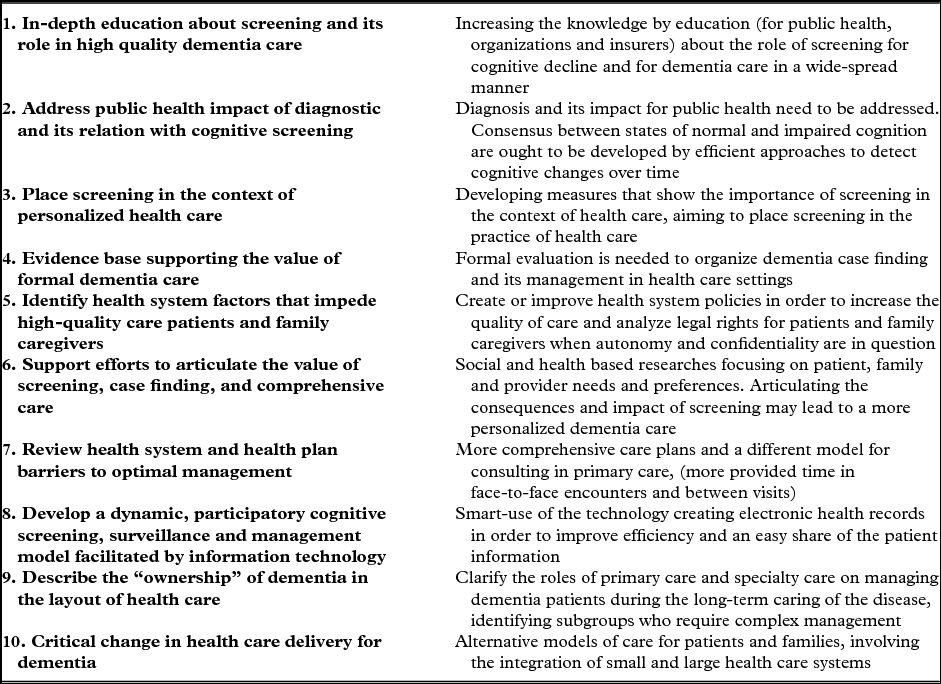
In 2013, a workgroup recruited by the Alzheimer´s Foundation of America and the Alzheimer´s Drug Discovery Foundation developed ten recommendations for improving the early detection and clinical care for dementia (Borson et al., Reference Borson2013), shown in Table 1.
Recommendations for policy goals of early detection developed by the Alzheimer´s Foundation of America and the Alzheimer´s Drug Discovery Foundation – USA
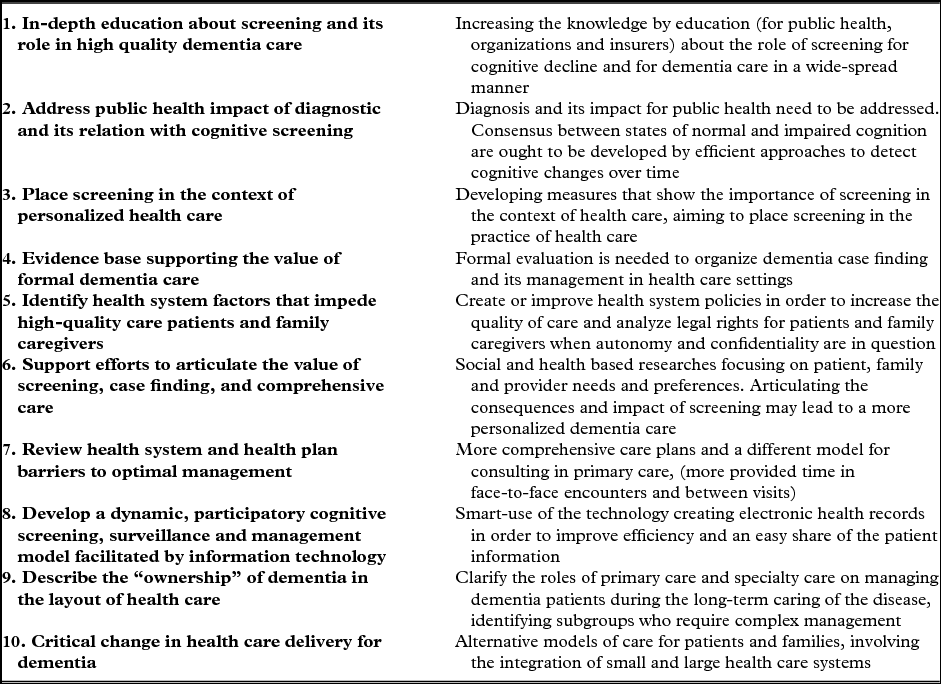
Although these recommendations are destined for the American health system, which includes the annual visit program, they may be feasible in other countries and, minimally, raise questions to consider. One recommendation involves the implementation of cognitive screening practice in personalized healthcare. The consensus considers cognitive screening as part of the dementia care, however some issues are ought to be addressed for an efficient practice. The 2003 report presented by the US Preventive Services Task Force – USPSTF did not endorse routine screening for Alzheimer disease due to the low prevalence of the disease, the lack of evidence regarding the efficacy of the instruments used, and biases as age and education, suggesting the need for further research that could improve the scenario. In the same way, the 2005 guidelines of the Alzheimer's Association had a similar position, assuming that early diagnosis is necessary, but with measures related to factors such as professional training and ensure referral for cases in which the result is positive (Solomon and Murphy, Reference Solomon and Murphy2005).
Despite the efforts, the misdiagnosis rate ranges from 50–80% in patients with moderate to severe dementia, reaching 91% in milder cases in primary care setting (Boustani et al., Reference Boustani2005). One reason of misdiagnosis may be the lack of knowledge about the disease by patients and relatives: differentiating “normal” deficits in aging versus impaired cognition is difficult; memory complaints are underappreciated; changes in behavior often call first the attention and often occur in moderate to severe stages of the disease (Valcour et al., Reference Valcour, Masaki, Curb and Blanchette2000; Baloch et al., Reference Baloch, Moss, Nair and Tingle2010).
Some factors related to the clinical procedure may contribute to the misdiagnosis, including situations when the clinician is not aware of the benefits of cholinesterase inhibitors medication, when there is not an adequate documentation of diagnosis conducted prior in a consultation clinic, and when the clinician is not comfortable to inform the diagnosis (Valcour et al., Reference Valcour, Masaki, Curb and Blanchette2000; Löppönen et al., Reference Löppönen, Räihä, Isoaho, Vahlberg and Kivela2003; Baloch et al., Reference Baloch, Moss, Nair and Tingle2010)
Also, the difficulty in detecting dementia may be due to the nature of the dementia diagnostic method itself, which is based on uncertain etiology and psychopathology with greatly variable signs and symptoms, lack of appropriate and validated instruments, and inadequate training for professionals who perform cognitive screenings (Milne et al., Reference Milne, Culverwell, Guss, Tuppen and Whelton2008).
These data show that dementia diagnosis in primary care is impaired by several aspects that may or may not be directly related to characteristics of the disease. However, other factors, such as providing general clinicians with access to information and using instruments that can be applied in primary care without significantly increasing the consultation time, may be important steps toward improving the early detection of dementia.
Regarding screening instruments, it is known that, despite there being a number of currently available tests, few of them have been adequately validated for the intended population (Cullen et al., Reference Cullen, O’Neill, Evans, Coen and Lawlor2007). Another aspect that influences whether or not to enter the practice of making an examination is the cost-effective factor. Numbers calculated in America suggest that the practice should be mandatory after 75 years, being held earlier when risk factors are present (Cullen et al., Reference Cullen, O’Neill, Evans, Coen and Lawlor2007; Ashford, Reference Ashford2008). A mathematical calculation that estimates the feasibility of cognitive screening involves: the incidence of the disease in a given population, the specificity and sensitivity of the instrument, the advantage (in financial terms) for individuals identified correctly on positive test (true-positive), the cost (in financial terms) for an individual misidentified (false-negative), and the cost (in financial terms) of the instrument, its administration and total time involved (Ashford, Reference Ashford2008).
In response to this demand, studies have been conducted in several countries to establish efficient tools for cognitive screening, considering the particularities of the populations to be evaluated. The development of new and more efficient methods might improve diagnosis and subsequent treatments, reducing its cost (Kansagara and Freeman, Reference Kansagara and Freeman2010).
At the same time, some recognized instruments have been used since the 1970s, such as the Mini-Mental State Examination – MMSE (Folstein et al., Reference Folstein, Folstein and McHugh1975) and the Abbreviated Mental Test – AMT (Hodkinson, Reference Hodkinson1972). One should question which of these instruments are still utilized and if they have advantages or limitations, compared to the newer instruments.
In this study, we aimed to provide a systematic review of cognitive screening instruments in the primary care setting.
Methods
Articles were collected in Scielo, Medical Literature Analysis and Retrieval System (Medline/Pubmed), and Excerpta Medica Database (Embase). The search was performed for the time interval from January 2000 to September 2013.
The following key terms were combined: “cognitive screening” and “dementia” and “primary care” and “review.”
The inclusion criteria were: 1) Studies should be reviews focusing on cognitive screening instruments best used in primary care setting; 2) Articles should be available in English, French, Spanish, or Portuguese.
For the instruments, self-administered tests and scales that assessed daily-living activities/functional status were not considered as cognitive tests.
Data were extracted by two authors (SSS and JEY). All the papers selected were submitted after reaching a consensus among all the authors.
Results
Initially, 74 review articles were found, but only 11 met the inclusion criteria (see Table 2). One review (not indexed) was included after reference mining (Kansagara and Freeman, Reference Kansagara and Freeman2010). Also, two studies (not reviews) were selected after reference mining because they presented relevant screening instruments not discussed in the reviews (Tariq et al., Reference Tariq, Tumosa, Chibnall, Perry and Morley2006; Clionsky and Clionsky, Reference Clionsky and Clionsky2010). In total, 13 studies were included in Table 2. Thirty-four screening instruments were found (37 if variations and reduced versions included), as described in Table 2.
Dementia screening tools for primary care: summary data

Abbreviations: 6CIT, 6 Item Cognitive Impairment Test; 7MS, Seven Minute Screen; ACE, Addenbrooke's Cognitive Examination; ADAS-cog, Alzheimer Disease Assessment Scale-Cognitive; AMT, Abbreviated Mental Test; BAS, Brief Alzheimer Screening; BLT/Ash, Bowles-Langley Technology / Ashford Memory Test; BOMC, 6-item Blessed Orientation-Memory-Concentration Test; BVRT, Benton's Visual Retention Test; CAMCI, Chinese Abbreviated Mild Cognitive Impairment Test; CAMCOG, Cambridge Cognitive Examination; CASI, Cognitive Abilities Screening Instrument; CCSE, Cognitive Capacity Screening Examination; CDT, Clock Drawing Test; CERAD, Consortium to Establish a Registry for Alzheimer's Disease Battery; DemTect; GPCOG, The General Practitioner Assessment of Cognition; HDS-R, Revised Hasegawa's Dementia Scale; IST, Isaacs Set Test; MAT, Mental Alternation Test; M@T, Memory Alteration Test; MIS, Memory Impairment Screening; MMSE, Mini-Mental State Examination; mMMSE, modified Mini-Mental Estate Examination; S-MMSE, Standardized Mini-Mental State Examination; Mini-Cog; MoCA, Montreal Cognitive Assessment; MOST, Memory Orientation Screening Test; Phototest; RUDAS, Rowland Universal Dementia Assessment Scale; SAS-SI, Short and Sweet Screening Instrument; SBT, Short Blessed Test; SIS, Six Item Screener; SLUMS, Saint Louis University Mental Status Exam; SPMSQ, Short Portable Mental Status Questionnaire; STMS, Short Test of Mental Status; T&C, Time and Change Test.
*Revised Version / ** Short Version
❖GP/ community/ primary care samples
For unspecified or absent data in reviews, the original articles of the instruments were searched. When original articles were not available, one trial was made to contact the first author; when this procedure was not successful, another referral article was searched in order to fulfill the characteristics of the instrument presented in the table.
The following tests were mentioned in three to five studies: 6CIT, 7MS, ACE/ACE-Revised, CAMCOG, MoCA, RUDAS, SAS-SI, SLUMS, SPMSQ, STMS, and T&C. The most cited instruments were mentioned in six or more of the presented studies: AMT, CDT, GPCOG, MIS, MMSE, and Mini-Cog.
Regarding the application time, half of the instruments seem to be adequate for primary care context, being applied within approximately 5 min: 6CIT, AMT, Brief Alzheimer Screening (BAS), Bowles–Langley Technology/Ashford Memory Test (BLT/Ash), Cognitive Abilities Screening Instrument (CASI), CDT, GPCOG, Isaacs Set Test (IST), Memory Alteration Test (M@T), Mental Alternation Test (MAT), MIS, MiniCog, Memory Orientation Screening Test (MOST), Phototest, Six-Item Screener (SIS), SPMSQ, STMS, and T&C.
More than half of the instruments were applied only via verbal instead of verbal and performance assessment. Performance assessment involved writing, drawing, and manipulating objects tasks. Not including performance assessment is justified on the interference of motor deficits, which are more common among the elderly (e.g., HDS-R). Still, the absence of a direct measure of visuospatial ability may be considered a limitation of the test.
Memory is the most commonly assessed function (91%). The only three tests that do not directly investigate memory (CDT, IST, MAT) are extremely quick administered and are integrated into other tests (for example, the clock drawing test was related to be part of the following instruments: 7MS, GPCOG, Mini-Cog, MoCA, MOST, SLUMS, and STMS; the MMSE is partially or fully included in five instruments).
Other assessed cognitive functions were attention/orientation (64%), visoconstrutive skills/praxis – including clock drawing (41%), and language (58%). Language is mostly assessed by fluency tasks, and only CAMCOG is reported to include vocabulary task. Only six (17%) instruments were reported to assess specific tasks of executive functions (for this study, we did not consider the fluency and the clock drawing test as specific executive function tasks) and the same number of tests included abstraction/reasoning tasks. Finally, three instruments (9%) included judgment tasks.
Although sensitivity and specificity data were more easily found, predictive values were missing in half of the studies and in 20 instruments. On the other hand, some tests, such as the MIS, presented larger ranges of PPV and NPV – these ranges vary according to characteristics of the studied sample, such as prevalence, and presence of data such as the considered confidence interval. However, these information were often not presented in the reviews.
At least 44% of the screening tests are mentioned to have influence of education or cultural factors.
Discussion
The MMSE is the most widely utilized cognitive screening test in the world, quoted in standard guides and as per the consensus of experts in the evaluation of dementia. However, the limitations of the MMSE, as the strong influence of education, and other sociodemographic and clinical scores on this test were discussed in several studies such as in China (Katzman et al., Reference Katzman1988), Finland (Ylikoski et al., Reference Ylikoski, Erkinjuntti, Sulkava, Juva, Tilvis and Valvanne1992), and Brazil (Bertolucci et al., Reference Bertolucci, Brucki, Campacci and Juliano1994; Brucki et al., Reference Brucki, Nitrini, Caramelli, Bertolucci and Okamoto2003; Scazufca et al., Reference Scazufca, Almeida, Vallada, Tasse and Menezes2008; Valle et al., Reference Valle, Castro-Costa, Firmo, Uchoa and Lima-Costa2009; Laks et al., Reference Laks2010; Moraes et al., Reference Moraes, Pinto, Lopes, Litvoc and Bottino2010).
Despite being the first choice of clinicians, MMSE has some limitations such as the fact that it is too long to be used in primary care, requiring caution in interpreting the scores. The test also shows cultural and educational biases, specially because of some of its tasks, such as the pentagons drawing task. Moreover, the widespread use of the test in follow up of patients might cause learning effect (Milne et al., Reference Milne, Culverwell, Guss, Tuppen and Whelton2008).
Recent reviews have highlighted tests such as the GPCOG, MIS, and Mini-Cog as equally or more efficient than the MMSE in the primary care setting. These tests seem to be brief, easily administered, well accepted by clinicians, efficient, and minimally affected by education, sex, and race (Milne et al., Reference Milne, Culverwell, Guss, Tuppen and Whelton2008).
Although the CDT has been one of the most mentioned instruments and being almost as utilized as the MMSE in some studies (Iracleous et al., Reference Iracleous2010), its psychometric properties such as sensitivity and specificity were unstable when it was applied solely. Perhaps the CDT should be applied with some other screening instrument, for example one that assesses memory and language. On the other hand, both 3MS and CASI evaluate a wide range of cognitive functions and are indicated for situations where there is more time available for assessment (Cullen et al., Reference Cullen, O’Neill, Evans, Coen and Lawlor2007).
On the other hand, some authors do not agree that a good cognitive screening test should necessarily assess a higher number of cognitive functions. Some types of tasks might end up increasing the complexity of the analysis of the results, without increasing diagnostic accuracy, thus making it unnecessary at this stage of the process. Some authors suggest that, in primary care setting, a brief screening, including guidance and learning, as an evocation of a name and address after 5 min, is as reliable as the full MMSE, and potentially less wearing for the patient and for the clinician (Milne et al., Reference Milne, Culverwell, Guss, Tuppen and Whelton2008).
Moreover, Cullen et al. (Reference Cullen, O’Neill, Evans, Coen and Lawlor2007) criticize the emphasis on assessment of memory in screening instruments, which ultimately undervalue other cognitive areas that could be most affected in other types of dementia, e.g., executive functions in frontotemporal lobe degeneration. Another topic pointed by the authors refers to the emphasis on quantitative aspects of a cognitive screening, leaving aside qualitative information that should also be considered when making a differential diagnosis – although there is no direct relationship between the number of cognitive domains assessed and the statistical validity.
The evaluator training should also involve the study of the qualitative analysis of the findings, since such observations are important from a clinical standpoint, contributing to the construction of diagnosis (Ladeira et al., Reference Ladeira, Diniz and Forlenza2009). Whereas cognitive screening itself has the characteristic of being an extremely brief examination, it is important that a well-done clinical analysis optimize this condition. Thus, sustaining attention, self-regulation, the characteristics of the errors, and how the patient deals with the tasks are some aspects to be observed to complement the interpretation of the findings.
In one review, the authors suggested 16 criteria for evaluating cognitive screening measures that were divided into four general concepts (Milne et al., Reference Milne, Culverwell, Guss, Tuppen and Whelton2008):
-
i. Practicality: 1 – time for clinicians to familiarize themselves with the measure; 2 – cost of the instrument; 3 – availability.
-
ii. Feasibility: 1 – acceptance by the patients; 2 – acceptance by the clinicians; 3 – ease of administering; 4 – ease of scoring; 5 – application duration; 6 – ease of interpreting the scores.
-
iii. Range of applicability: 1 – applicability to a wide age range; 2 – sensitivity to different educational levels; 3 – sensitivity to language and culture; 4 – applicability to different types of dementia.
-
iv. Psychometric properties: 1 – validity and reliability; 2 – specificity; 3 – sensitivity.
These criteria could be a guideline when developing or studying the efficacy of an instrument. All these topics need to be considered when designating an instrument that could be cost-effective in terms of time, financial resources, and comfort for the subject. Studies which applied questionnaires to family physicians or psychogeriatric clinicians also reinforced that some factors such as validity/accuracy/efficacy, ease of administration, and speed of administration were the most important characteristics for the clinicians when considering a cognitive screening to use (Iracleous et al., Reference Iracleous2010; Ismail et al., Reference Ismail, Rajji and Shulman2010)
Also, predictive values and the prevalence of dementia in each sample should be addressed. We did not find many of the positive and negative predictive values in the reviews (Only six reviews presented PPV or NPV, and sometimes they could not find these data collected from some of the original articles). We believe that these data should be ideally present, since prevalence of the disease directly influences these values – positive predictive value decreases as the rate of prevalence is lower, so it tends to be lower when calculated at lower prevalence values.
This results in discrepant predictive values according to the prevalence and context in which the study samples were collected. For example, the CDT positive predictive values ranged from 0.17 in community samples (Brodaty et al., Reference Brodaty, Low, Gibson and Burns2006) to 0.60 in clinical samples (Harvan and Cotter, Reference Harvan and Cotter2006; Milne et al., Reference Milne, Culverwell, Guss, Tuppen and Whelton2008).
The prevalence of cognitive disorders in the elderly in the community is around 15—20% (Graham et al., Reference Graham1997; Laks et al., Reference Laks2005), which is a considerable high value. In a dementia prevalence of 16% (> 65 years), cognitive screening might improve the positive predictive value from 36% to 78% with negative predictive value reduction from 94% to 92% (Mitchell et al., Reference Mitchell, Meader and Pentzek2011). Some authors argue that the practice of screening should be a first step in the detection of dementia, with further interventions addressed after this procedure is applied. Early identification could facilitate not only pharmacological and nonpharmacological intervention, but also neuropsychological rehabilitation and family psychoeducation. Brodaty and colleagues (Reference Brodaty, Low, Gibson and Burns2006) suggest that screening >75 years elderly could avoid a higher number of false-positive and false-negative cases. Also, false-negative cases could be further correctly diagnosed in a continued screening practice.
In addition, since primary care systems tend to be very different among the regions and countries, some points need to be highlighted. Sometimes, resources might be precarious. The lack of specialized professionals, such as psychiatrists, neurologists, and geriatricians, makes difficult the management of comorbidities, common in the elderly, and are factors to be considered in the diagnosis of dementia.
In developing countries, the elderly population that commonly utilizes the services of primary care is mostly characterized by being low-income, often from rural areas or who worked for much of their life in manual work. Most studies involve patients with mild AD, which might not be the main cases found in primary care, since more advanced cases are often underdiagnosed.
Another point of consideration for the future consists on the possibility to adapt the instruments for different types of dementia, from clinical examination. It is known that the initial manifestation of Frontotemporal Lobe Degeneration type is usually quite distinct from the manifestation of AD, such as behavioral changes, and must demand a different type of evaluation. For this, the ACE-R may be a good option.
In addition, combining a cognitive test with an informant report could enhance the detection of mild to moderate dementia in elderly patients with low education. A study conducted in a Brazilian outpatient population (Bottino et al., Reference Bottino2009) showed that combining a cognitive instrument such as the Fuld Object Memory Evaluation (FOME) (Fuld, Reference Fuld1980) and a functional/daily living assessment scale such as the Bayer Scale – Activities of Daily Living (B-ADL) (Hindmarch et al., Reference Hindmarch, Lehfeld, Jongh and Erzigkeit1998) might boost the sensitivity and the specificity (98.3% and 100, respectively) when compared to those instruments alone or the combination of MMSE and the Informant Questionnaire of Cognitive Decline (IQCODE – Jorm and Jacomb, Reference Jorm and Jacomb1989).
Thus, although it is not easy to include a combination of the two tests in clinical practice, considering the difficulties, such as the short consultation duration for performing the procedures, such as an interview, clinical examination, application, and screening instrument analysis, as well as the possibility of not having a reliable informant, the results appear to justify using this strategy in screening dementia. That is, early identification of these cases may enable more effective intervention, reducing suffering by the patient and their family, and it may have a long-term impact on reducing health system costs because dementia treatment measures are optimized. In this sense, tests such as the GPCOG, which includes a cognitive test and a questionnaire administered to an informant, appear to be promising instruments for screening dementia, especially in the primary care setting. Also, we have found that GPCOG presented the highest predictive values in community samples.
Recent recommendations presented by the Alzheimer´s Association for the Medicare Annual Wellness Visit include the informant interview as an important vehicle of information about the patient and his cognitive status. In addition, the recommendations classify the cognitive screening as an important tool not only to help diagnose dementia or cognitive decline, but also for a long time observation, and it is an appropriate moment to counsel and offer information of cognitive and functional changes for the family (Cordell et al., Reference Cordell2013).
Our study has several limitations. First, we did not investigate exclusively systematic reviews – our search included reviews that prior investigate cognitive instruments in primary care. On the other hand, all the studies showed a high quality of data, presenting a well-designed method for searching the information and discussing the findings. Some relevant information, such as total sample, the incoming and the profile of the sample in which each instrument was applied could and the prevalence of dementia was not often described in the reviews, although we believe that these data would be very important to better evaluate the tests. Another important information must be the most recommended functionality assessment scales in primary care, however it was out of our scope.
Despite these limitations, we believe that our study may contribute for the clinician to choose the cognitive screening instruments that best fit with his and his patients needs. We verified that there is a wide range of tests with different characteristics, therefore it is recommended that the professional gets some expertise in a few number of instruments in order to be able to choose which to use, or use in combination, depending on the setting and the profile of the patient.
Conclusion
Cognitive screening might help in early detection of dementia in primary care. Several factors can interfere with the effectiveness of screening, such as the characteristics of the disease, knowledge of symptoms to identify the framework for patients and families, and the existence of appropriate tools, with quick and easy application. Tests such as 6CIT, AMT, GPCOG, Mini-Cog, MIS, MoCA, and STMS seem to be good alternatives to the use of the Mini-Mental State Examination when considering factors such as application time, sensitivity, specificity, and number of studies. One should not assume that screening tests are equally effective in any population, context, and type of cognitive impairment.
Conflict of interest
None.
Description of authors’ roles
All authors contributed to the development of this review. JEY drafted the paper. JEY and SSS made the searches, extracted the data for Tables 1 and 2, and were the main contributors of the discussion. CMCB is the coordinator of the study and contributed to the overall design of the study. All authors read and approved the final version.
Acknowledgments
Sharon Sanz Simon is supported by a research fellowship from the Coordenação de Aperfeiçoamento de Pessoal de Nível Superior (CAPES). Dr. Cássio M. C. Bottino is a researcher of the “National Counsel of Technological and Scientific Development” (CNPq – Researcher Level 2).