Paleoparasitology sheds light on human behavior patterns and ecological transitions through time. Thus, it contributes valuable information about diet and health status of past populations, as well as knowledge on migration routes, cultural practices, and settlements used by these groups (Araújo et al. Reference Araújo, Reinhard, Ferreira, Pucu and Chieffi2013). Coprolites (desiccated/mineralized feces) and sediments are the main sources of paleoparasitological studies, which aim to detect and identify helminths and protozoa remains. Paleoparasitological findings can be linked to skeletal individuals (Fugassa and Barberena Reference Fugassa and Barberena2006; Fugassa and Dubois Reference Fugassa and Dubois2009; Jaeger, Taglioretti, Dias, et al. Reference Jaeger, Taglioretti, Dias and Iñiguez2013; Jaeger, Taglioretti, Fugassa, et al. Reference Jaeger, Taglioretti, Fugassa, Dias, Neto and Iñiguez2013; Ramirez, Vieira de Souza, et al. Reference Ramirez, Saka and Nores2021) or to common-use structures like cesspools and latrines, as well as occupational layers (Anastasiou and Mitchell Reference Anastasiou and Mitchell2013; Côté et al. Reference Côté, Daligault, Pruvost, Andrew Bennett, Gorgé, Guimaraes and Capelli2016; Hald et al. Reference Hald, Mosekilde, Magnussen, Søe, Hansen and Mortensen2018; Maicher et al. Reference Maicher, Hoffmann, Côté, Pérez, Segui and Le Bailly2017; Mitchell et al. Reference Mitchell, Anastasiou and Syon2011; Reinhard et al. Reference Reinhard, Araújo, Sianto, Costello and Swope2008; Seo et al. Reference Seo, Chai, Kim, Shim, Ki and Shin2016; Trigg et al. Reference Trigg, Jacobucci, Mrozowski and Steinberg2017; Yeh et al. Reference Yeh, Jeff Cheng, Huang, Zhan, Wong and Mitchell2019). In the Americas, paleoparasitological studies on samples from common-use structures in urban contexts are scarce, being restricted to the United States (Reinhard Reference Reinhard, Beaudry and Mrozowski1989; Reinhard et al. Reference Reinhard, Araújo, Sianto, Costello and Swope2008; Warnock and Reinhard Reference Warnock and Reinhard1992). In Argentina, paleoparasitology has focused instead on animal coprolites, regurgitated pellets, and sediments (Beltrame et al. Reference Beltrame, Fugassa and Sardella2010, Reference Beltrame, Pruzzo, Sanabria, Pérez and Mora2020; Fugassa Reference Fugassa2006; Fugassa and Dubois Reference Fugassa and Dubois2009; Petrigh et al. Reference Petrigh, Martínez, Mondini and Fugassa2019). In the central region of the country where this study is located, recent paleoparasitological research has reported the presence of parasite eggs in pelvic sediments from individuals dated from the Late Holocene (Ramirez, Vieira de Souza, et al. Reference Ramirez, de Souza, Iñiguez and Fabra2021).
The city of Córdoba, capital of the province of the same name, is located in the central region of Argentina, in the foothills of the Sierras Chicas on the Suquía River. Founded in 1573 by Jerónimo Luis de Cabrera, it is one of the earliest Spanish colonial cities of the region. The city has many historic buildings and monuments dating back to its colonial origins, the most important being the Jesuit block, which includes several buildings from the seventeenth century. Despite its important colonial legacy, few archaeological excavations have been carried out in the historic center, and most of them are related to rescue archaeology (Berberián et al. Reference Berberián, Rivero, Pastor, Salazar, Salvi, López, Heider, Berberián and García2008; Brizuela and Mignino Reference Brizuela and Mignino2020; Izeta et al. Reference Izeta, Pautassi, da Silva, Robledo and Bilinski2014, Reference Izeta, Pautassi, Roxana Cattáneo, Robledo, Caminoa, Mignino and Prado2017; Lindskoug et al. Reference Lindskoug, Pazarelli, Laguens, Izeta, Hierling, Ramos, Tapia, Bognanni, Fernández, Helfer, Landa and Lanza2011; Marschoff and Lindskoug Reference Marschoff and Lindskoug2020). The urban development of the city has increased markedly during the last several decades with the construction of residential and commercial buildings. The city is divided into three risk zones (low, medium, and high) with different levels of heritage protection based on the possibility of encountering archaeological remains during construction (Municipalidad de Córdoba 2011). The founding area in the city is a zone of 70 blocks, which were divided and distributed in 1577 to the first inhabitants of Córdoba (Luque Colombres Reference Luque Colombres1980): it is characterized as high risk because of the high possibility of uncovering vestiges from colonial times during construction works. Municipal ordinance 11935 requires mandatory archaeological excavations to document and preserve structures with historical value within this zone.
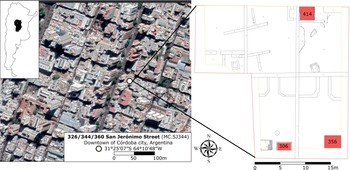
As mandated by this ordinance, an archaeological assessment with stratigraphic excavation was carried out during 2017–2018 in three plots located at 326/344/360 San Jerónimo Street, site code MC.SJ344 (Lindskoug, Marschoff, and Gabriel Reference Lindskoug, Marschoff, Gabriel, Laguens, Bonnin, Bernarda Marconetto and da Silva2019; Lindskoug, Vives, and D'Agostino Reference Lindskoug, Vives, D'Agostino, Laguens, Bonnin, Bernarda Marconetto and da Silva2019; Marschoff and Lindskoug Reference Marschoff and Lindskoug2020; Marschoff et al. Reference Marschoff, Lindskoug, Soledad Galimberti, Vives, D'Agostino, Gabriel and Aguirre2017; Marschoff, Lindskoug, Galimberti, et al. Reference Marschoff, Lindskoug, Soledad Galimberti, Vives, D'Agostino, Gabriel and Aguirre2018; Marschoff, Lindskoug, and Vives Reference Marschoff, Lindskoug and Vives2018), where a four-story parking garage, including a subterranean floor, was to be built (Figure 1). Historical documents of the city of Córdoba show that the plots were mainly used as residences, although this varied over time; their use alternated between commercial and residential purposes (Gabriel Reference Gabriel2020; Marschoff et al. Reference Marschoff, Lindskoug, Soledad Galimberti, Vives, D'Agostino, Gabriel and Aguirre2017). To record the contexts, a stratigraphic excavation was done, using single-context planning following the guidelines of the MOLAS site manual (Westman Reference Westman1994) with minor modifications to adapt to local conditions (Marschoff et al. Reference Marschoff, Lindskoug, Soledad Galimberti, Vives, D'Agostino, Gabriel and Aguirre2017). We also used the Harris Matrix (Harris Reference Harris1989) to register the stratigraphic sequence of the site in great detail. In total, we recorded 468 contexts at the site, including not only sediment deposits but also several structures with different functions and chronologies, such as walls, wall foundations, floors, drainage systems, trash pits, and cesspools. More than 30,000 artifacts were recovered during the excavation, mostly corresponding to animal bones associated to trash pits. Most of the trash pits were located in the southern part of the plots, an area that was interpreted as patios or backyards. The trash registered in several of the deposits (fillings) seems to correspond to secondary trash deposits. Before excavations started, we had identified historical sources indicating that the first constructions were built in the area in the beginning of the sixteenth century (Gabriel Reference Gabriel2020; Luque Colombres Reference Luque Colombres1980). However, most of the subterranean remains found could be dated to the nineteenth century. The buildings torn down by the construction company were built in the late nineteenth century, including the facade, which was preserved and integrated into the new parking garage (Marschoff et al. Reference Marschoff, Lindskoug, Soledad Galimberti, Vives, D'Agostino, Gabriel and Aguirre2017; Marschoff, Lindskoug, and Vives Reference Marschoff, Lindskoug, Soledad Galimberti, Vives, D'Agostino, Gabriel and Aguirre2018; Marschoff, Lindskoug, Galimberti, et al. Reference Marschoff, Lindskoug, Soledad Galimberti, Vives, D'Agostino, Gabriel and Aguirre2018).
Location of 326/344/360 San Jerónimo Street in the center of the city of Córdoba (white dot). Plan view of the archaeological site with the three contexts where the samples were taken (right) and map of the province of Córdoba in Argentina (left).

Given that little is known about the impact of parasitism in this past context, we conducted a paleoparasitological analysis of the sediments of two trash pits and a cesspool from nineteenth-century premises in the city of Córdoba: its objective was to assess the parasite diversity present and infer the cultural practices and sanitary conditions in this historical context.
Materials and Methods
The Site and Archaeological Context
The site studied has an area of 1,200 m2, from which 875 m2 were excavated during this archaeological assessment (Marschoff, Lindskoug, and Vives Reference Marschoff, Lindskoug and Vives2018). Sediment samples from three archaeological contexts (306, 356, and 414) were examined. Analysis of the stratigraphic information from the excavation helped us understand the archaeological context of the samples and to identify different activity areas in the three plots. The stratigraphic analysis indicates a chronology of the samples no older than the mid-nineteenth century and the beginning of the twentieth century. Complete associated information of the relevant contexts and their interpretation is presented in Supplemental Table 1.
The area associated with context 306 functioned as a patio or backyard since the first constructions on the plot (Luque Colombres Reference Luque Colombres1980; Marschoff and Lindskoug Reference Marschoff and Lindskoug2020). Structure 306 was interpreted as a cesspool and appears to have been associated with a kind of sewage drainage system constructed in the back of the central plot at 344 San Jerónimo Street; it also must have been associated with structure 304, which is possibly another cesspool and is located less than 1 m from structure 306. Structures 304 and 306 had similar construction techniques: both their northern and southern walls were constructed with bricks, and their western and eastern walls were made of a mixture of bricks and stone masonry. Several other features, such as floors and walls in the patio, were constructed with similar bricks (contexts 38, 198, 218, and 309), and were likely built simultaneously, associated with the erection of the last major construction on the plot in the beginning of the twentieth century. Both structures were completely sealed with a cement floor (context 8) during the twentieth century, but most likely these cesspools had already been out of use for some time. The only visible outlet from the two structures was a connection to a stoneware drainage tube (context 309).
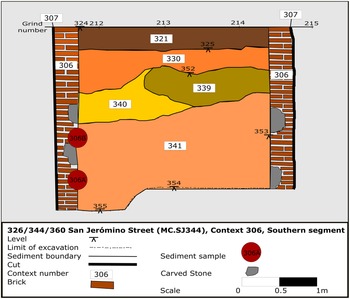
The filling of the cesspool (context 306) corresponds to at least five layers (Figure 2; contexts 321, 330, 339, 340, and 341) that were likely deposited in two major events; it seems to be associated with the construction of the last building on the plot in the beginning of the twentieth century. The first event includes contexts 339, 340, and 341, sealed and flattened by context 330, perhaps from the destruction of an old brick wall or something similar, as evidenced by the large amount of building material in the deposits. The second event of filling, context 321, contains building material, glass, metal and plastic elements, but no animal bones, covered by a cement floor (context 8). Because Structure 306 is large, we obtained two samples from different depths: 306a from 2.0 m and 306b from 1.4 m (Figure 2). It is important to consider that although the samples were taken from the brick joints because remnants of the original cesspool contents could be kept there, the parasite remains found could belong either to the cesspool itself or to its filling (context 341), which was in contact with the cesspool walls.
Stratigraphic section with the layers of fills identified in the southern segment of context 306. The position where samples 306a and 306b were obtained is indicated.

The area where context 356 was registered has also been identified as a patio or backyard, located in the southeastern corner of the plot at 360 San Jerónimo Street. The deposit was a sediment with a mid-blackish-brown color interpreted as a trash pit and included animal bones, charcoal fragments, broken glass, and ceramic material. This deposit was associated with other contexts (331, 357, 358, 359, 372, 373, 374, 376, 377, 391, 392, and 393) and was sealed sometime during the late nineteenth or the beginning of the twentieth century by a brick floor (context 40), which is similar to another brick floor (context 38) in the adjacent plot 344. During the twentieth century, more cement floors were added (contexts 18, 24, and 48). The trash pit (context 356) was created by digging (a cut, context 392) a subcircular hole (2 × 1 × 2 m) in another sediment deposit (context 331), interpreted as a sediment filling with a high content of trash. A stone structure (context 372) made with selected and carved rocks seems to be associated with the trash pit. It seems likely that this stone structure was constructed for another purpose but may have been reused for the disposal of trash.
This patio or backyard seems to have been associated with several events (contexts 391, 392, and 393) related to the digging of different trash pits: most of the deposits in the area have a high content of trash, including ashes, charcoal, glass fragments, animal bones, and ceramic material. A preliminary study of the trash in context 356 suggests that it originated in a domestic unit or commercial premises of the late nineteenth or early twentieth century, when it was sealed. It includes mostly secondary domestic trash: broken glass and crockery of industrial manufacture, ceramic material, charcoal fragments, and nonarticulated animal bones (Table 1).
Archaeological Materials from the Studied Contexts.

We interpreted context 414 as a trash pit. Stratigraphically, it was registered under a filling of a subfloor (context 413). Context 414 could be associated with context 418, which would have been part of a larger trash pit that was separated when digging the foundation of a brick wall (context 20) to divide plots 344 and 360 on San Jerónimo Street. The trash in context 414 corresponds mostly to animal bones and ceramic fragments and was interpreted as coming from a domestic unit, with a mid- to late nineteenth-century chronology.
The sediments were taken by scraping the profile or walls of each context, after removing a first film of sediment. We used disposable sterile tools and changed them between samples. Control samples were taken from the outside of each context to eliminate the possibility of environmental contamination.
Paleoparasitological Analyses
To obtain as much information as possible about the diversity of parasites in these sediments, two standard procedures were followed for paleoparasitological examination. In one method, we applied a rehydration of the samples (Callen and Cameron Reference Callen and Cameron1960), followed by a spontaneous sedimentation technique (Lutz Reference Lutz1919). Initially, 5 g of each sediment was rehydrated in 0.5% trisodium phosphate solution at 4°C for 72 hours with constant agitation. Then, they were strained through a double-folded gauze into a funnel and left to settle in a conic jar for 24 hours. After discarding the supernatant, 5 mL from the suspension at the bottom of the jar were recovered. The second procedure we followed involved disaggregation of 5 g of sediment in 10% hydrochloric acid, using the method of Reinhard and colleagues (Reference Reinhard, Araújo, Sianto, Costello and Swope2008). After several washing steps, the material was resuspended with ultrapure water in a final volume of 10 mL. Finally, slides were prepared and observed with an optical microscope (Labklass XSZ 107 CCD) with 100× (total magnification). The parasite remains were photographed with 400×, and all the eggs were measured with TCapture 4.3.0.605 software. A semiquantitative approach was applied to estimate the number of eggs per gram (epg) in each sample. Because we observed 200 μL of suspension with both techniques, epg was calculated by multiplying the total number counted by 5 for the spontaneous-sedimented samples and by 10 for the acid-treated samples. The identification of parasites was made based on their morphological and morphometric characteristics (Atías Reference Atías1998; Muller Reference Muller2002).
Paleogenetic Analysis
To identify the genus of the tapeworm eggs, we carried out paleogenetic analyses. Two hundred μl of rehydrated sediment were subjected to ancient DNA (aDNA) extraction. Initially, we employed a thermic shock treatment to break down the thick walls of parasite eggs, followed by incubation with an extraction buffer containing 50 mM Tris-HCl, 100 mM NaCl, 3% SDS, 50 mM EDTA pH 8.0, 2 mg/mL Proteinase K, and 40 mM DTT, for 48 hours at 56°C, with constant agitation. Then, two consecutive steps of purification were applied, phenol:chloroform:isoamyl alcohol (25:24:1) and the Wizard SV Gel and PCR Clean-Up System (Promega). PCR amplification was performed in a 20 μL final volume, containing 2–4 μL aDNA extracts, with specific primers for Taenia cyt b: Tae32F ATATGGCTCGTGCTTTGTATTATTC and Tae32R AGGTAATATATATCCWGTAAAAGCCTC (Côté et al. Reference Côté, Daligault, Pruvost, Andrew Bennett, Gorgé, Guimaraes and Capelli2016). PCR products were separated by 8% acrylamide:bisacrylamide (19:1) native gel electrophoresis and visualized in an UV transilluminator. Amplicons were sent to Macrogen (Seoul, Korea) for Sanger sequencing of both DNA chains. Electropherograms were analyzed with the Snapgene Viewer 5.1 software. Measures to avoid contamination with modern material and PCR products were taken following Ramirez, Saka, and Nores (Reference Ramirez, Saka and Nores2021).
Results
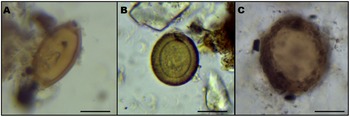
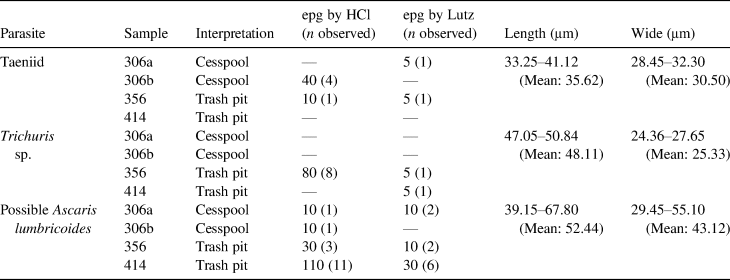
Paleoparasitological analysis by light microscopy allowed the identification of parasite eggs (Figure 3) and a larva. We found 10 lemon-shaped structures of brown color coincident with Trichuris sp. eggs, only one with polar plugs conserved, in the samples belonging to contexts 356 and 414 (Figure 3a). Seven taeniid eggs with thick-striated walls were identified in samples 306a, 306b, and 356 (Figure 3b). Sixteen structures suggestive of Ascaris lumbricoides eggs were found in all samples. They were ovoid shaped and yellow to brown colored, both with and without its characteristic mammillated coat (Figure 3c). The number of eggs observed, epg estimates, and measures are shown in Table 2. In addition, we observed a larva in sample 306b, similar to a free-living nematode larva. All external controls were negative, thus discarding the possibility of environmental contamination. The two methods used for the paleoparasitological examination yielded different results, with the hydrochloric acid technique generally enabling a higher egg recovery.
Paleoparasitological findings by light microscopy: (a) Trichuris sp. egg, (b) Taeniid egg, and (c) possible A. lumbricoides egg. Bar = 20 μm.

Paleoparasitological Findings by Light Microscopy, Reporting Observed Eggs (n) and Eggs per Gram (epg) Estimates Using Both Techniques.

Notes: HCl: hydrochloric acid disaggregation; Lutz: spontaneous sedimentation.
With regard to the paleogenetic analysis, successful PCR amplification of an expected 113 bp fragment with the specific cyt b primers for Taenia sp. was obtained from the 356 aDNA extract. However, we could not obtain the sequence of this fragment to confirm the genus determination. External samples, PCR negative controls, and extraction blanks were negative by PCR.
Discussion
We analyzed sediments from two trash pits and a cesspool collected during an archaeological assessment in the historic downtown of Córdoba. Using light microscopy, we recognized parasite eggs of whipworm (Trichuris sp.), possible roundworm (A. lumbricoides), and tapeworm with two concentration techniques. However, disaggregation with hydrochloric acid yielded more eggs than spontaneous sedimentation (Table 2), highlighting the usefulness of trying more than one method with certain kind of samples. This difference could be due to the presence of calcium carbonates, that bind parasite eggs to the soil matrix, which are subsequently released when hydrochloric acid dissolves this salt (Reinhard et al. Reference Reinhard, Confalonieri, Herrmann, Ferreira and Araújo1986, Reference Reinhard, Araújo, Sianto, Costello and Swope2008; Romera Barbera et al. Reference Romera Barbera, Hertzel and Reinhard2020; Warnock and Reinhard Reference Warnock and Reinhard1992).
Because Taenia and Echinococcus tapeworm eggs are indistinguishable by morphometric and morphological characteristics, we performed PCR with specific Taenia cyt b primers to determine the genus (Côté et al. Reference Côté, Daligault, Pruvost, Andrew Bennett, Gorgé, Guimaraes and Capelli2016). Although one fragment with the expected size was amplified, we failed to obtain a DNA sequence, so that we cannot, with certainty, assign the tapeworm eggs to a genus. In the site, animal bones of ungulates were found together with bird and fish remains during the excavation, but a full zooarchaeological analysis has not been done yet, and we can only ascertain that cow bones (Bos taurus) were present in these contexts (María Marschoff, personal communication 2020). However, the predominant consumption of beef during the nineteenth century in the city, as opposed to pork, sheep, and other animals (Izeta et al. Reference Izeta, Pautassi, da Silva, Robledo and Bilinski2014; Remedi Reference Remedi2004), allows us to suggest that the eggs belong to T. saginata (beef tapeworm). Yet, we cannot rule out the presence of other species of the genera Taenia or Echinococcus, as T. solium and E. granulosus. As for the possible roundworm eggs, A. lumbricoides and A. suum were traditionally differentiated for humans and pigs, respectively, although cross-infection cases with these helminths were occasionally reported. Advances in molecular techniques allow us to state that they are actually the same species, proposed to be named as A. lumbricoides (Leles et al. Reference Leles, Gardner, Reinhard, Iñiguez and Araújo2012). Concerning whipworm, species differentiation by morphometric means is usually possible, even between Trichuris trichiura, the human whipworm, and T. suis, the pig one, which have similar sizes. According to the dimensions of the observed whipworm eggs (Table 2), they fall within the expected range for T. trichiura (Confalonieri et al. Reference Confalonieri, Ribeiro-Filho, Ferreira and Araújo1985). Nevertheless, overlapping of the sizes can occur (Nejsum et al. Reference Nejsum, Betson, Bendall, Thamsborg and Stothard2012), so whipworm eggs could also belong to T. suis or both species could occur simultaneously (Maicher et al. Reference Maicher, Hoffmann, Côté, Pérez, Segui and Le Bailly2017).
Previous paleoparasitological studies in Argentina allowed the identification of a wide range of parasite species; most were conducted in Patagonia (Beltrame et al. Reference Beltrame, Fugassa and Sardella2010, Reference Beltrame, Tietze, Pérez, Bellusci and Sardella2017, Reference Beltrame, Pruzzo, Sanabria, Pérez and Mora2020; Fugassa Reference Fugassa, Ferreira, Reinhard and Araújo2014; Fugassa and Barberena Reference Fugassa and Barberena2006; Fugassa and Dubois Reference Fugassa and Dubois2009), with few studies carried out in other regions (Aranda and Araújo Reference Aranda, Araújo and Berón2018; Petrigh et al. Reference Petrigh, Martínez, Mondini and Fugassa2019), including Córdoba Province (Ramirez, Vieira de Souza, et al. Reference Ramirez, Saka and Nores2021). Most of these findings are dated from the Pleistocene–Holocene transition to the late Holocene, and only a few are from postcontact moments (Fugassa Reference Fugassa2006; Fugassa et al. Reference Fugassa, Araújo and Guichón2006). Studies related to these later contexts in South America are scarce and limited to the colonial period of the city of Rio de Janeiro (Guedes et al. Reference Guedes, Borba, Camacho, Neto, Dias and Iñiguez2020; Jaeger and Iñiguez Reference Jaeger and Iñiguez2014; Jaeger, Taglioretti, Dias, et al. Reference Jaeger, Taglioretti, Dias and Iñiguez2013; Jaeger, Taglioretti, Fugassa, et al. Reference Jaeger, Taglioretti, Fugassa, Dias, Neto and Iñiguez2013).
Ours is the first study to conduct paleoparasitological research in Argentina on urban-historical samples. Although parasite diversity in Argentinian prehispanic populations has been mainly characterized to determine the presence of animal parasites, including some with zoonotic importance, our results from nineteenth-century contexts account for the presence of human-specific parasites, which highlight the consequences that urbanization, industrialization, and other processes have on the sanitary conditions of human populations (Mitchell Reference Mitchell2015; Reinhard et al. Reference Reinhard, Ferreira, Bouchet, Sianto, Dutra, Iñiguez and Leles2013).
Whipworms and roundworms are considered geohelminths: parasites that must pass through the soil under specific temperature and humidity conditions to complete their biological cycle (Muller Reference Muller2002). Their cycles differ somewhat after the eggs are expulsed to the environment by the gravid female, but both have fecal–oral transmission, usually by eating food or drinking water polluted with fecal matter or by handling food with contaminated hands (Acha and Szyfres Reference Acha and Szyfres2003). Co-infection with these nematodes occurs frequently in current populations (Muller Reference Muller2002) and has been reported in archaeological and historical cases (Gonçalves et al. Reference Gonçalves, Araújo and Ferreira2003; Mitchell Reference Mitchell2015). Beef/pork tapeworms are not geohelminths and have humans as definitive hosts and cattle and pig as intermediate hosts. Humans become infected when eating raw or undercooked meat of infected animals (Muller Reference Muller2002). Some Echinococcus species have dog and cats, among other animals, as definitive hosts, and humans are accidental hosts when they have close contact with feces containing eggs (Atías Reference Atías1998). Beef/pork tapeworms have been reported in many works of the Old World paleoparasitological literature (Côté et al. Reference Côté, Daligault, Pruvost, Andrew Bennett, Gorgé, Guimaraes and Capelli2016; Gonçalves et al. Reference Gonçalves, Araújo and Ferreira2003; Mitchell Reference Mitchell2015), whereas there are few findings in the New World (Jaeger, Taglioretti, Fugassa, et al. Reference Jaeger, Taglioretti, Fugassa, Dias, Neto and Iñiguez2013). Echinococcus sp. findings have been reported in both the New and the Old World, but mainly as taeniids, except when molecular confirmation of the genera was achieved (Côté et al. Reference Côté, Daligault, Pruvost, Andrew Bennett, Gorgé, Guimaraes and Capelli2016; Gonçalves et al. Reference Gonçalves, Araújo and Ferreira2003; Paknezhad et al. Reference Paknezhad, Mazdarani, Hessari, Mobedi, Najafi, Bizhani and Makki2017; Reinhard Reference Reinhard1990; Wilke and Hall Reference Wilke and Hall1975). Oviposition of these helminths differs importantly. Trichuris females can lay up to 20,000 eggs per day, whereas A. lumbricoides can lay up to 200,000 eggs daily. T. saginata produces about 100,000 eggs daily by releasing mature proglotids, the segments that form the worm body, whereas T. solium lays about 40,000 per day (Acha and Szyfres Reference Acha and Szyfres2003). Echinococcus oviposition may vary among species, but between 500 and 1,500 eggs per day are usually laid by the gravid female (Atías Reference Atías1998). The low number of parasites recovered in each sample could be either suggestive of low parasite burdens or a result of postdepositional events.
In this sense, taphonomic processes affect both the amount and the structure of the parasite remains. The percolation caused by water flow and the presence in the soils of decomposer agents like fungi and bacteria might have hampered good preservation of the eggs (Camacho et al. Reference Camacho, Pessanha, Leles, Dutra, Silva, de Souza and Araújo2013, Reference Camacho, Leles, Santiago, Cabral Ramos, Uchôa, Pereira Bastos and Borba Nunes2016; Fugassa Reference Fugassa, Ferreira, Reinhard and Araújo2014; Jaeger, Taglioretti, Fugassa, et al. Reference Jaeger, Taglioretti, Fugassa, Dias, Neto and Iñiguez2013; Morrow et al. Reference Morrow, Newby, Piombino-Mascali and Reinhard2016). Furthermore, parasite species are affected in different ways by the action of taphonomic processes. Thus, for example, ascarid eggs have multiple thick layers that give them a more resistant structure than other nematodes, allowing them to be preserved over time (Rácz et al. Reference Rácz, De Araújo, Jensen, Mostek, Morrow, Van Hove and Bianucci2015; Romera Barbera et al. Reference Romera Barbera, Hertzel and Reinhard2020). However, this preservation depends not only on the inherent characteristics of each parasite species but also on the environmental conditions of the archaeological site (Morrow et al. Reference Morrow, Newby, Piombino-Mascali and Reinhard2016; Rácz et al. Reference Rácz, De Araújo, Jensen, Mostek, Morrow, Van Hove and Bianucci2015).
The effects of these parasites on human health depend mainly on the parasite burden, as well as on particular host conditions that make them more susceptible to disease. Usually, the infections of A. lumbricoides, T. trichiura, Taenia sp., and Echinoccocus sp. remain asymptomatic if the load is low. When the burden is heavier, abdominal discomfort, diarrhea, weight loss, and anemia occur, and children can suffer stunting and malnutrition in certain cases (Acha and Szyfres Reference Acha and Szyfres2003; Muller Reference Muller2002). Specific symptoms of each parasitosis appear in extreme cases (Acha and Szyfres Reference Acha and Szyfres2003; Muller Reference Muller2002; Satoskar et al. Reference Satoskar, Simon, Hotez and Tsuji2009).
Poor health and food hygiene conditions were documented in Córdoba in the period studied here. Toward the end of the nineteenth century and the beginning of the twentieth century, 40%–50% of deaths were due to infectious diseases (Carbonetti Reference Carbonetti2005; Carbonetti and Boixadós Reference Carbonetti and Boixadós2002). In 1926, for example, 176 out of 1,000 deaths in Córdoba Province were caused by digestive disorders, from which 142 were diarrhea-enteritis cases. In addition, 136 of these 142 deaths were of children between birth and two years old. More than one-third of the deaths in children under that age were due to gastrointestinal diseases, with poor hygiene as the main cause (Remedi Reference Remedi2004). Documents also show that the operation of slaughterhouses in the city was regulated toward the end of the nineteenth century, but hygienic conditions were still not optimal (Remedi Reference Remedi2004). For several decades, animals were slaughtered in establishments that were not properly sanitized. Meat was loaded into open carts, where they were exposed to the sun and dust until they reached the market and then offered for sale for approximately two days (Remedi Reference Remedi2004). In addition, because of the rudimentary technology of the time, families and commercial premises were not used to conserving meat in cold storage, which also posed a sanitation risk. Freezing meats is now known to be a reliable way to kill some taeniid cysticerci, the infective state of these parasites (Okello and Thomas Reference Okello and Thomas2017).
Considering this context, it would be expected that people who used the premises on San Jerónimo Street may have suffered health problems related to the sanitary conditions prevailing at that time. A. lumbricoides, Trichuris sp., and Taenia sp. eggs attest to the circulation of these parasites between those living or working there, because eggs of these species are exclusively released by infected humans with their fecal matter. However, the possible presence of taeniid eggs belonging to the genera Echinococcus could also be related to the dispersion of animal feces in the spaces that people inhabited or the disposal of animal excreta in the structures used as cesspool and trash pits. Handwashing has been shown to reduce the transmission of pathogens, including parasites; the washing of meats and vegetables and the consumption of clean water have been found to be critically important as well (Mitchell Reference Mitchell2015). The water supply in the city of Córdoba came from different sources—from ditches and water gutters to pools in the central square—following the population as it grew. By the end of the nineteenth century, water pollution, especially with fecal matter, was a major concern among authorities, who were aware of the presence of water-borne pathogens and its relationship with mortality rates in the city (Solveira Reference Solveira2009). Thus, it is possible that the washing of food and kitchenware with polluted water, the inefficient washing of hands, and a general lack of cleanliness were closely related with the incidence of roundworms and whipworms.
The presence of beef/pork tapeworms in contexts 306 and 356 would indicate the consumption of animals infected with these parasites. Given that proper cooking of these meals would have killed cysticerci present in the meat, insufficient cooking is suggested, as largely suggested in the paleoparasitological record (Hald et al. Reference Hald, Mosekilde, Magnussen, Søe, Hansen and Mortensen2018; Mitchell Reference Mitchell2015; Reinhard et al. Reference Reinhard, Ferreira, Bouchet, Sianto, Dutra, Iñiguez and Leles2013).
The creation of systems and structures for urine and fecal matter disposal, such as cesspools and latrines, is critically important to reducing infectious disease dispersion (Mitchell Reference Mitchell2015). Nevertheless, the inadequate management of night soils—the human excreta contained in these structures—and the pollution of water and food supplies continued to be a problem. Thus, it is not surprising that in a city like late nineteenth-century Córdoba, parasitosis was still a health risk in spite of having cesspools and sewage drainage systems. According to historical documents, the waters of local rivers were polluted, as were the water wells due to leaks from nearby latrines: thus citizens had to choose between two unhealthy options for their water supply (Remedi Reference Remedi2004; Solveira Reference Solveira2009). In 1909, the first national sanitation plan was drawn up, and in 1912, a state company called Obras de Salubridad de la Nación (Sanitary Works of the Nation) was established. Its aim was the study, construction, and administration of facilities to provide drinking water for domestic use in cities and towns of the country. Historical documents from Córdoba city indicate that these sanitary facilities were installed in the beginning of the twentieth century in all the buildings on San Jerónimo Street (Archivo Histórico Municipal 1909). It is highly likely that these facilities improved sanitary conditions for the residents of the city.
Conclusions
In this work, we found remains of whipworm, possible roundworm, and tapeworm, which provides evidence that people inhabiting and working in these premises were exposed to parasitic infections. These results suggest that the growth of urban populations, deficient food preparation, and poor hygiene practices were closely related to the occurrence of these food- and fecal-borne parasites. Previous paleoparasitological research in South America has focused mainly on samples from precontact archaeological sites; our study encourages new investigations related to parasitic incidence in local urban-historical contexts. We consider that new studies must be done to deepen our knowledge on the relation between cultural practices and parasite infections in urban contexts in the past, as well as to obtain a broader insight of which species circulated among the past populations of the central region of Argentina.
Acknowledgments
We would like to thank the archaeologists, students, and construction workers who executed the archaeological assessment at the San Jerónimo site—Soledad Galimberti, Virginia Gabriel, Oscar Vives, Lucas D'Agostino, and Mailén Aguirre, and especially María Marschoff (Instituto de Humanidades, CONICET—UNC), who directed the assessment—for generously providing the sediment samples and for a critical review of the manuscript. We also thank the reviewers whose comments helped improve this article. There are no conflicts of interest regarding the financing of this research or the writing of this article. No permits were required for the present work. The laboratory work was supported by the Ministerio de Ciencia y Tecnología de la Provincia de Córdoba (PID 2018-79). The archaeological assessment was supported by the Fideicomiso Fundación San Roque (Córdoba, Argentina). DAR is a doctoral fellow, and HBL and RN are Research Career members of the National Scientific and Technical Research Council (CONICET), Argentina.
Data Availability Statement
All data resulting from this research are within this article and in the supplemental materials.
Supplemental Material
For supplemental material accompanying this article, visit https://doi.org/10.1017/laq.2021.68.
Supplemental Table 1. Characteristics, Inclusions, and Interpretation of the Relevant Contexts Associated with the Three Contexts Sampled for Paleoparasitological Analyses.