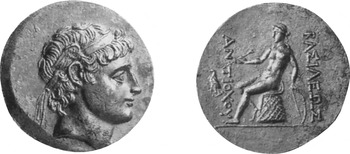
This paper proposes that living Seleucid kings were recognized as divine by the royal court before the reign of Antiochus III despite lacking an established centralized ruler cult like their fellow kings, the Ptolemies.Footnote 2 Owing to the nature of the surviving evidence, we are forced to rely heavily on numismatics to construct a view of Seleucid royal ideology.Footnote 3 Regrettably, it seems that up until now much of the numismatic evidence for the divinity of living Seleucid rulers has not been fully considered.Footnote 4 I argue that the evidence from silver coinage produced in the name of the Seleucid kings presents a version of the official image of the reigning king and that images which portray the king as divine reflect central acceptance of the king's divinity. This is clear from the epithets on the coinage of Antiochus IV and his successors, but I will argue that the same principle holds for all earlier Seleucid kings. Thus coinage with divine images of Seleucid kings provided one of the mechanisms through which the royal court transmitted the divine nature of the kings to the population. As we will see, in the case of Antiochus Hierax, local considerations also influenced the numismatic representation of the king. This blurring of boundaries between the local veneration of the king, which has long been accepted as normal civic practice in the Greek city-states and in non-Greek temples, and the royal images of the divine king calls into question the strict division between civic and centralized ruler cults.Footnote 5 The reflection of local cults within royal ideology can be seen as a manifestation of a negotiating model of Seleucid power that relied heavily on a dialogue with a wide range of interested groups.Footnote 6 This article argues that the inconsistencies in the development of an iconography of divine kingship before the reign of Antiochus IV is a manifestation of the same phenomenon.
Following Habicht's work on the divinity of the Hellenistic kings, scholars have tended to divide ruler cults into civic and royal categories.Footnote 7 The traditional view of Seleucid cult marks central imposition and control as the dividing line between civic and central cults.Footnote 8 Since for the Seleucid kings the epigraphic evidence for a royal cult is limited before the reign of Antiochus III, this has led to the argument that the Seleucids did not have a centralized cult until his reign,Footnote 9 well after a similar introduction in the Ptolemaic kingdom.Footnote 10 This view had been questioned already by E. Gruen in 1999, when he suggested that the Seleucid cult may have developed at the same time as the Ptolemaic cult.Footnote 11 This paper attempts to support Gruen's questioning of the traditional view of Seleucid ruler cult by arguing that the numismatic evidence does not support the claim that Antiochus III presented his own divinity on coinage in a way that was significantly different from that of his predecessors. Instead, it was not until the reign of Antiochus IV that the living king was unequivocally portrayed as divine through the legend on his coinage.Footnote 12 The major implication of this is that Antiochus III does not appear to be a distinctive marker in the numismatic representation of Seleucid divinity, and that both before and after his reign (and through the reign of his son, Seleucus IV) the representation of Seleucid kings as divine on coinage did not significantly alter. The recognition of living Seleucid kings as divine on royal coinage prior to the reign of Antiochus III, even if limited in scope, opens the door to a future discussion on the potential for royal cult arising earlier in the Seleucid empire.
While Seleucid coinage does not provide direct evidence of cult for the living king, some images of the kings strongly suggest their divinity and therefore may well reflect a royal cult. The reflection of cults within coinage is far from universal, but early in the Hellenistic period it is clear that particular claims to divinity by kings and queens who received cult were also reflected on their coinage. The two most prominent examples are that of Demetrius Poliorcetes and Arsinoë II of Egypt, both of whom were deified both in cults and on their coinage. Portraits of Demetrius invariably include bull horns. These horns have long been interpreted as a sign of his divinity, although the precise god to which they refer has never been established.Footnote 13 These horns have been assigned as aspects of both Dionysus and Poseidon, both of them gods whom the Athenians in the Ithyphallic hymn connect with Demetrius.Footnote 14
Demetrius’ deification, alongside that of Alexander by his successors,Footnote 15 appears to have formed a model of interaction for the other successors to further develop. The clearest example of this is in the sister-wife of Ptolemy Philadelphus, Arsinoë II. She was probably first deified as one of the Theoi Adelphoi with her brother/husband.Footnote 16 The creation of the cult for the Theoi Adelphoi was paralleled by the introduction of the famous Theoi/Adelphoi coinage which featured the deified Ptolemy I and Berenice with the legend Theoi on the obverse and Ptolemy II and Arsinoë II on the reverse with the legend Adelphoi. Given the simultaneous appearance ‘of priests of Alexander and the theoi adelphoi in official documents’,Footnote 17 it seems unnecessary to doubt the explicit connection between this coinage and the newly established cult for the royal family, even if some hesitancy is expressed in using the title theos.Footnote 18 Following Arsinoë’s deathFootnote 19 and the establishment of an individual cult for her, Ptolemy II issued a series of coinage in her name. This coinage also features divine attributes as was fitting for the newly established goddess, including a small horn behind her ear and a sceptre that may be connected with Isis.Footnote 20 Later Ptolemaic kings also continued to promote their divinity on their coinage, as may be seen, for example, in the gold octadrachms studied by Johnson for Ptolemy III.Footnote 21 Therefore, there is strong evidence that the presentation of the king or the queen as divine on coinage can be linked to the establishment of a cult.
In order to limit the scope to images that were produced by the court, this study is limited to mints that produced coinage for the Seleucid kings rather than exclusively civic mints. Furthermore, to limit the scope of the study to royal iconography rather than to potentially limited local iconography, silver coinage with its potential for larger patterns of circulation is preferred, although some bronze coinage is also considered.
Complicating any attempt to verify the existence of a cult for the Seleucid kings numismatically is the fact that Seleucid coinage does not depict images of temples or altars for the kings; indeed, it does not depict any buildings or monuments, nor like its Ptolemaic counterpart does it include divine titles in the legends.Footnote 22 While this contrasts greatly with the depictions of the Roman Imperial cult on Roman coinage or on Roman provincial coinage,Footnote 23 it appears that monuments and buildings were not an iconographic category that was employed by the Seleucids for use on royal coinage even after the establishment of a royal cult. The only evidence for royal promotion of a cult of the living king found on Seleucid coinage are images that presented the king as divine (or with attributes of divinity), as it is the case for the coinage of the Ptolemaic royal family.Footnote 24
There are two possible methods to present a king as divine on coinage: epithets which clearly mark the king as a god or divine iconography, such as horns or wings. As a point of methodology, this paper does not attempt to link a divine attribute with any particular deity, but rather follows Smith and sees these as features that associate the king with the divine.Footnote 25 Divine images of the kings, therefore, follow a similar pattern of conscious ambiguity that I have elsewhere argued typifies the Seleucid Apollo type.Footnote 26
Like the Ptolemies before the reign of Ptolemy V, the Seleucids before the reign of Antiochus IV eschewed the use of divine titles for the living king (and in fact for all kings with the exceptions of the Antiochus Sotēr coinage and the Theoi Adelphoi coinage).Footnote 27 This may reflect a reluctance to overtly advertise an unambiguous claim to divinity to the broader Greek world and all of their subjects, even when cults for the living ruler existed. Johnson proposes a clear rationale for this reluctance within the Ptolemaic context: ‘Participation in the royal cults and use of divine titulature were optional, and it was up to the individual subject to choose the terms in which he might interpret the king.’Footnote 28 The lack of divine titles in the Seleucid realm suggests that similar rationale appears to have operated perhaps as a concession to Greek sentiments within some of the Greek cities of Asia Minor. An interesting parallel may be adduced in that within Egypt we have cults, particularly for Ptolemaic queens, for whom we do not have coinage with divine attributes,Footnote 29 but we do not have coinage with divine attributes for an individual for whom we do not otherwise have evidence for a cult.
This raises the obvious question: what constitutes the divine image of a king? There are several features of Seleucid coinage that may point to an earlier divinity of the kings. However, the two following possible representations of the king as divine will not be considered, as they are too subjective to draw any firm conclusions. A significant, but often overlooked, change in Seleucid coinage is the placement of the portrait of the living king on the obverse, which occurs in the reign of Antiochus I.Footnote 30 This placement traditionally had been reserved only for gods, a convention followed even by Alexander. In fact, as Kroll shows, Antiochus I appears to be the first of the Hellenistic kings consistently to place his own portrait on coinage without other clear symbols of divinity.Footnote 31 It seems probable that this was done only when Antiochus I was already deified by some of the cities in Asia MinorFootnote 32 and thus did not break the convention as radically as it appears. As there are other, far clearer, representations of divine Seleucid monarchs than coin portraits, and since the practice of placing the king's portrait on coinage quickly becomes standard, it does not appear to be a suitable criterion for assessing the central acceptance of the divinity of the king. For the same reasons and for the subjectivity involved, it seems necessary to exclude any attempt to identify the king in the portraits of a god. While it is possible that this may have occurred, its value as an advertisement of the link between the king and the god is limited owing to the fact that few of the royal subjects would have personally seen the king closely enough to recognize a resemblance between him and the god on the coinage.Footnote 33 On the other hand, images of the king with horns do represent a deified version of the king.Footnote 34 The most important antecedent for this image was the image of Alexander. The addition of ram horns to his portrait associated him with Ammon but is also believed to have reaffirmed his divinity.Footnote 35 It was not only Alexander who gained horns which linked him to divine beings: a similar process explains the appearance of the ram's horn behind the ear of Arsinoë II which appears to be linked to her association with the ram god of Mendes,Footnote 36 while Demetrius Poliorcetes’ horns have often been associated with Poseidon and Dionysus.Footnote 37 A similar process seems to have taken place with the posthumous image of Seleucus. The images of horned Seleucid kings fall into three separate categories: first, images of a deceased king with bull horns sprouting from his head; second, images of the living king with bull horns sprouting from his head; and third, images of the living king with horn-like hair. There is one further set of images that is related but unique; these are the images of Seleucus in a horned helmet.Footnote 38
The first divinized images of Seleucus I appeared on coins issued at Sardis which featured his horned diademed portrait on the obverse. The reverse of these coins displays either the horned horse-head or Apollo-on-the-omphalos, and in both cases the legend reads ΒΑΣΙΛΕΩΣ ΑΝΤΙΟΧΟΥ. These types clearly depict Seleucus as divine, in the same way as the posthumous portraits of Alexander with the horns of Ammon represented his close relationship to that god and emphasized Alexander's divine status. According to the dating of Houghton and Lorber,Footnote 39 these two types were introduced during Antiochus I's stay at Sardis before the First Syrian War (276–274 b.c.). They may therefore shed some light on the existence of a centralized royal cult for Seleucus I. The horned portraits of Seleucus issued at Sardis clearly reflect royal acceptance of the deceased king as a god of the royal house. The production of these portraits should be related to Antiochus I's contemporary establishment of a cult for Seleucus at Seleucia-in-Pieria:
Philetaerus, the prince of Pergamus, bought the body of Seleucus from Ceraunus for a large sum of money, burned it and sent the ashes to his son, Antiochus. The latter deposited them at Seleucia-by-the-Sea, where he erected a temple to his father on consecrated ground, to which ground he gave the name of Nicatoreum.Footnote 40
This demonstrates that Antiochus actively deified Seleucus outside of, or in correlation with, the cult at Seleucia-in-Pieria.Footnote 41
Antiochus also produced bronze coinage with horned portraits of Seleucus in several cities outside Asia Minor. At Dura-Europus, a diademed horned portrait appears paired with a horned horse-headFootnote 42 and with an anchor.Footnote 43 At Houghton and Lorber's ‘Uncertain Mint 26’ in Bactria,Footnote 44 Seleucus is portrayed diademed with bull horns sprouting from his head on gold and silver coinage, and in all cases he is paired with a horned horse on the reverse. The evidence for horned images of Seleucus is not limited to numismatics. Libanius also places bull horns on a statue of Seleucus, this time at Antioch. According to him, Seleucus’ horns are associated with respect for the local cult of Io.Footnote 45 While Libanius may be incorrect in his reasoning behind the horns, we should not doubt that the statue existed in Antioch in the fourth century a.d. and that his version represented part of the broad array of potential interpretations for the bull horns. Additionally, a horned statue of Seleucus in the Antakya Museum likewise confirms that Seleucus’ horned representations were not confined to coins.Footnote 46 The broad chronological and geographic range does not suggest a regionally specific acceptance of Seleucus as divine. As the temple dedicated to Seleucus in Seleucia-in-Pieria is a royal foundation, it seems evident that Antiochus both established a cult of his father and promoted his divinity widely across the empire.
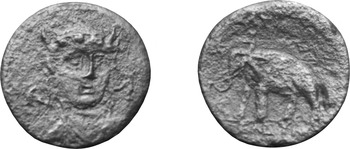
The first appearance of a living Seleucid with horns occurred during the reign of Seleucus II;Footnote 47 his son Antiochus III also produced horned portraits of himself. Bronzes were issued at Seleucia-on-the-Tigris, which featured a three-quarter facing bust of Seleucus II adorned with bull horns.Footnote 48 Additionally, on bronzes from Susa, Seleucus II was again depicted in three-quarter profile with bull horns sprouting from his head (see Image 1).Footnote 49 The reverse images of these coins clearly relate the image to martial victory and connect Seleucus II to his ancestor, Seleucus I, through the repetition of Seleucus I's coin types.Footnote 50 Seleucus II's assertion of his own divinity was limited by the choice of more locally circumscribed bronze issues for these images. As most of the cults established for the earlier Seleucids were the result of benefactions or military protection,Footnote 51 Seleucus may have seen it necessary to link his own divine claims with a victory, in this case his Parthian campaign. Seleucus II's claim to divinity may have also been linked to the dedications for the life of the king given by Anu-uballiţ (Kephalon), as they occurred in the same limited geographical region.Footnote 52 Furthermore, Seleucus II's horned image should be contrasted with the ‘horned lock’ of hair on his brother's coinage. Together these images suggest that this generation of Seleucid monarchs was willing to present themselves as divine.
Image 1a: Obverse of Houghton and Lober (2002), no. 800
Image 1b: Reverse of Houghton and Lober (2002), no. 800

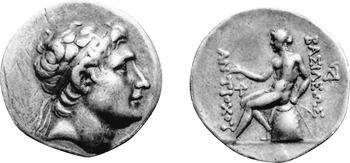
My third category of ‘divine’ images (images of the living king with horn-like locks of hair) appears nearly concurrently with the appearance of Seleucus II's horned portraits at Seleucia-on-the-Tigris and Susa. Under Hierax,Footnote 53 the mint at Ilion produced two types of coinage, both of them featuring what may be idealized portraits of Antiochus I. These feature small locks of hair that curl over the diadem in a manner reminiscent of horns (see Image 2).Footnote 54 This feature, combined with the idealized nature of the portraits on the coinage of Hierax, suggests a deification of Antiochus I and possibly of Antiochus II. This is, at most, a subtle hint towards divinity, although it is a striking feature given the care in which the diadem is normally depicted. The diadem is normally depicted on top of the hair, with no hair on top of the diadem. The only objects which cross over the diadem are the horns of Seleucus I and the wings from Antiochus Hierax's coinage, discussed below. Both of these images have a connection to divinity: the bull horns signify the divinity of the figure depicted and the wings tie the king into the tradition of his ancestor Perseus. There also appears to be a difference of iconography based on the metal in which the coin is minted. At Susa and Seleucia-on-the-Tigris the images of the living king with horns were produced on low-value bronze coinage. The images which feature the horn-like hair occur on higher-value silver coinage (as well as on the images of the deified Seleucus). This may be a symptom of the slow development of divine mortals in the Greek world, since Chaniotis argues that the kings were at least initially reluctant to propose their own divinity without the sanction of a Greek city or sanctuary.Footnote 55
Image 2a: Obverse of Houghton and Lober (2002), no. 867.2
Image 2b: Reverse of Houghton and Lober (2002), no. 867.2

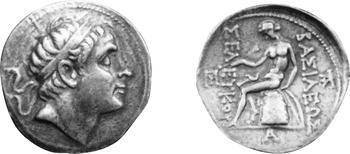
After this extremely timid introduction Seleucus III extended the use of this distinctive style. It was first utilized at a temporary subsidiary mint to Antioch-on-the-OrontesFootnote 56 and then moved eastward and was produced at Nisibis (see Image 3).Footnote 57 This trend continued under the first part of Antiochus III's reign, where he initially adopted features of divinity on his bronze coinage, at the same mints, only later adding horns to his silver portraits. Similarly, a lock of hair also extends over the diadem on Seleucus IV's principal silver coinage.Footnote 58 The use of this lock of hair over three generations of Seleucid rulers (and four kings) suggests that this became an important Seleucid iconographic feature.
Image 3a: Obverse of Houghton and Lober (2002), no. 942.1
Image 3b: Reverse of Houghton and Lober (2002), no. 942.1

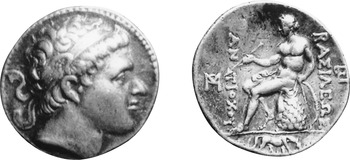
The final ‘divine’ type, the winged diadem, first appeared on the coinage of Antiochus II at Alexandria in Troas (see Image 4).Footnote 59 The type was a recutting of an original die from Abydus or Ilion so as to include the wing. The first suggestion for the origin of this type comes from the numismatist Babelon,Footnote 60 who concludes that the device was originally adopted by Antiochus II in order to advertise the Antigonid claims of his mother and therefore his descent from Perseus.Footnote 61 On the other hand, MacDonald concluded that the device was local and reflected the links between the Seleucid monarchs and some local deity who was worshipped with wings on his head.Footnote 62 The mint produced three types under Antiochus II: the first type portrayed a rejuvenated and idealized Antiochus I with a winged diadem; the second portrayed Antiochus II with a winged diadem; and the third portrayed an idealized young king with the winged diadem.Footnote 63 The final portrait may have been produced under Antiochus Hierax, as unidentifiable heads of young kings seem to be a distinctive feature of his reign.Footnote 64 We, therefore, have a series of coins that represent Antiochus I and Antiochus II as clearly linked to a divinity, either to a local god or to Perseus.
Image 4a: Obverse of Houghton and Lober (2002), no. 941.1
Image 4b: Reverse of Houghton and Lober (2002), no. 941.1

While the initial image of the winged-diademed king may have been related to a local cult, the image did spread on coinage produced under Hierax to other mints. These included Lampsacus (one type, from a recut die),Footnote 65 Ilion (two types, similar in type to those from Alexandria Troas),Footnote 66 Alexandria Troas (twelve types)Footnote 67 and one type that may have come from Abydus (see Image 5).Footnote 68
Image 5a: Obverse of Houghton and Lober (2002), no. 843
Image 5b: Reverse of Houghton and Lober (2002), no. 843

As all of these cities are in the same region, we should not exclude the possibility that the cult established at Alexandria Troas, with its own particular image of the king, expanded to the other cities. Although we have no evidence for such a cult beyond this coinage, the Ptolemaic parallels are suggestive of its existence. Additionally, the winged-diadem coinage is one of the major products of mints linked to Hierax, and as a consequence this divine image was also used by the court. This may have been the mechanism through which the supposed cult may have spread.
If this is evidence for a local cult, that identity of the kings becomes important. As Antiochus II appears with the winged diadem during his lifetime, he must have already been deified (this does not rule out the idea that Antiochus I was also deified during his lifetime, only that the evidence does not demonstrate this). Given the type's first appearance at Alexandria Troas, it seems suitable to locate the cult's genesis there. The adoption of the image by the local mint for coinage of the royal type suggests official acceptance of the image. This interaction between the local cult and the royal presentation of the king on his coinage is likely the result of the same types of influence which led the kings and the cities to use the same divine titles. As this shows official recognition of the kings as linked with a divinity, the inclusion of the young king on the coinage of Antiochus II raises the interesting question of whom it is meant to represent.
Given that portraits of Hierax are difficult to identify,Footnote 69 the young king who is portrayed on Hierax's coinage is normally taken to be Hierax himself. Additionally, the portrait of a young king very similar to the portrait that appears on Hierax's coinage also appears on the coinage of Antiochus II. It therefore stands to reason that Hierax is the young king on the coinage of Antiochus II. However, this is problematic for several reasons. This would require, for example, that the son of the living king should have been placed on the obverse of his father's coinage without also being co-ruler. This is unparalleled elsewhere in the kingdom. Furthermore, Antiochus Hierax did not seem to be considered the first option for succession. That prospect fell either to his older brother, the future Seleucus II, or less likely, except in Ptolemaic propaganda, to his younger half-brother, the son of Berenice.Footnote 70 The problem may be resolved by assigning the production of the young king portraits to Hierax's reign rather than to the reign of his father.
During the reign of Hierax only two kings are depicted wearing the diadem, Antiochus I and the young king. The young king may represent either Hierax or an idealized youth or a fully rejuvenated Antiochus I or Antiochus II. Nevertheless, Hierax is the most likely candidate. In the unlikely event that all of the portraits of the mint represent Antiochus I, then his increasingly youthful appearance may suggest a closer connection with the ever-youthful Apollo and a more extensive linkage between Antiochus and Apollo. However, from the perspective of Seleucid ideology, and according to the parallel of all other Seleucid practice, it makes the most sense to conclude that the portrait represents Hierax, since all other Seleucid monarchs (or later claimants to the throne) placed their portrait on the obverse of their coinage. Thus, when examining the winged-diadem coinage with portraits of the young king, we are looking at portraits of Hierax rather than at posthumous images of deified versions of either Antiochus I or Antiochus II.
Perhaps most interestingly, at Alexandria Troas during the reign of Antiochus Hierax, portraits of Antiochus II wearing the winged diadem were noticeably absent, although his non-winged portrait continued to appear at other mints during Hierax's reign. If there was indeed a cult of the kings who were depicted wearing the winged diadem at Alexandria Troas as is suggested by this coinage, does the lack of a portrait of Antiochus II suggest that he was removed from the cult, while Hierax and Antiochus I remained? This proposition seems difficult to accept, especially as, according to Appian (Syr. 65), Antiochus II was generally popular in Asia Minor and received cult elsewhere. Perhaps Hierax chose only to represent himself and his deified grandfather owing to his personal importance to Hierax, but the local cult continued to honour all the kings. The winged-diadem coinage suggests that Antiochus II and Antiochus Hierax adopted some of the iconography of a local cult and used it to present themselves as associated with a divinity. Another option would be to view this coinage as the expression of Hierax's own claims to divinity and connection to his grandfather, rather than as a continued representation of the local cult. Under this view the local cult would have been fully internalized by Hierax's court.
The final category of divine markers on coinage is the inclusion of divine epithets on coinage. Outside the posthumous Antiochus Sotēr coinage,Footnote 71 none of the Seleucid kings until Antiochus IV issues coinage with a divine epithet. Antiochus IV changes this practice when he expands the coin legends to include the epithets. After about 173–172 b.c. at Antioch, Antiochus IV issued a new series of tetradrachms that more clearly reflected his divine nature.Footnote 72 The obverse of this type featured the diademed portrait of Antiochus IV, with the diadem ends adorned with stars which may have associated the king with a solar deity, possibly Apollo-Helios. Elsewhere, as Iossif and Lorber have clearly shown,Footnote 73 he linked himself to a solar deity by the introduction of a radiate crown onto his portraits. The reverse type featured the reintroduction of Seleucus I's Zeus Nikēphoros type alongside a new legend. Rather than the normal ΒΑΣΙΛΕΩΣ ΑΝΤΙΟΧΟΥ, the legend reads ΒΑΣΙΛΕΩΣ ΑΝΤΙΟΧΟΥ ΘΕΟΥ ΕΠΙΦΑΝΟΥΣ. Antiochus IV introduced three different connected epithets on his coinage: ΘΕΟΣ; ΘΕΟΣ ΕΠΙΦΑΝΗΣ; and ΘΕΟΣ ΕΠΙΦΑΝΗΣ ΝΙΚΗΦΟΡΟΣ.Footnote 74 Following Antiochus IV's reign, the use of clearly divine epithets became on coinage issued by Seleucid kings and queens.Footnote 75 Therefore, from a numismatic perspective there is a clear break in the tradition during the reign of Antiochus IV.
As can be seen from the numismatic evidence, there was a significant amount of coinage issued from a range of royal mints across the empire that depicted the living king as either divine or partially divine. The pattern of Seleucid coinage suggests that the recognition of the Seleucid kings as divine varied both in location and in form. Contrary to what would be expected, if it was not until the reign of Antiochus III that a centralized cult of king and his family was established, there are portraits of divine kings with similar iconography both before and after his reign. Furthermore, it is not until the reign of his son, Antiochus IV, that unambiguous symbols of divinity (either in the legend or in the iconography) become common on Seleucid coinage. This suggests that Antiochus’ reforms had relatively little impact on the presentation of ruler cult across the empire.
This paper has argued that there was a significant amount of coinage issued from a series of royal mints across the empire that depicted the living king as divine or with divine attributes. Furthermore, the variation in the types of images fits with the pattern of royal engagement with local cults, as is particularly clear from the winged-diadem coinage. As such, the recognition of the Seleucid kings as divine varied both in location and in form, and could, if necessary, be ignored by a sceptical or hostile Greek audience in the same way as similar iconography could be viewed on Ptolemaic coinage. Therefore, we can draw a few conclusions with certainty and then proceed to reassess the nature of Seleucid ruler cult. Before the reign of Antiochus III it is clear that:
• The Seleucid kings certainly received civic cults from the cities of Asia Minor (as Habicht had already made clear).Footnote 76
• Seleucus I and Antiochus I were portrayed as divine on the coinage of their successors.
• The Seleucid kings beginning with Antiochus Hierax and Seleucus II portrayed themselves with divine attributes on their coinage.
Finally, it is also clear that the situation persists after the reign of Antiochus III and it is not until the reign of Antiochus IV that fundamental changes occur. This clearly does not provide evidence for a cult of the Seleucid kings, but it does demonstrate significant interest by the Seleucid kings for the divinity of the ruling kings from at the least the reigns of Antiochus Hierax and Seleucus II onwards. These cults may also have been linked to local circumstances, as the winged-diadem coinage suggests, but they were reflected in the royal prerogative of silver coinage. These conclusions open the door to further re-evaluations of the development of Seleucid ruler cult. Antiochus III was in fact participating in a more complex and gradual process of development rather than in radical reform.