The Serviceman’s Readjustment Act of 1944 (the “G.I. Bill”) provided a range of benefits—including unemployment assistance, favorable loans to start a business, and low-interest mortgages—to returning WWII veterans. The G.I. Bill, however, is perhaps best known for providing generous educational and training benefits. Veterans who pursued a college degree could receive up to $500 per year for tuition, fees, and books, along with a $50 monthly living expense allowance, for up to four years, with benefits varying depending on their length of service. For context, the average tuition was just over $400 at private universities in 1948, and from 1945 to 1950, the federal minimum wage was 40 cents per hour. Footnote 1 Given the generosity of benefits, it is not surprising that more than 2.2 million WWII veterans pursued a college education in the years following the war. Footnote 2
Studying the effect of the G.I. Bill, Bound and Turner (Reference Bound and Sarah2002) find a 16 percent increase in the number of years of college and a 23 percent increase in college completion when estimating the effect of cohort veteran share on cohort level educational attainment for men. Footnote 3 Stanley (Reference Stanley2003) finds that Korean War and WWII G.I. benefits increased years of college completed by between 15 and 20 percent for men in eligible birth year cohorts. Little is known, however, about the effect of the G.I. Bill for the 330,000 females who served in WWII, despite the fact that records show that 19.5 percent of veteran females elected to use their G.I. benefits to pursue a college education, compared to only 15 percent of male veterans. Footnote 4,Footnote 5
To determine whether greater educational attainment and earnings among female veterans can be attributed to the G.I. Bill, I examine differences in college attendance, completion, and annual earnings among veteran and non-veteran females. My estimates rely on data from the 1980 5 percent Census Public-use Microdata Sample (PUMS), which is the first year the long-form census asked females about military service. Among female high school graduates born between 1919 and 1925, descriptive estimates suggest that WWII veterans are 19 percentage points (56.7 percent) more likely to report attending college, 7.8 percentage points (57.8 percent) more likely to report having completed their degree, and complete about one semester more college (52.6 percent) relative to comparable non-veterans. Looking at earnings in 1980, I find that WWII veterans earn $1,887 more per year, a 19.8 percent boost relative to non-veteran females. My estimates focus on those born between 1919 and 1925 because, in addition to being a high school graduate, female enlistees generally had to be 21 or older, meaning that a female born in 1926 could not be a WWII veteran. Footnote 6 I exclude those born before 1919 to avoid bias from endogenous retirement decisions—those born in 1918 or earlier would be eligible for Social Security benefits in 1980. I examine the robustness of my findings to different sample restrictions in later sections.
While my findings are consistent with the idea that the G.I. Bill increased educational attainment and subsequent earnings for female veterans, there are at least three reasons why my estimates may not have a causal interpretation. The first is those female veterans who volunteered for service may have already had greater educational attainment at the time of enlistment. Focusing, however, on females who completed high school and were born between 1919 and 1925, summary statistics from my 1980 Census sample suggest that 33.5 percent of non-veterans and 53.8 percent of female WWII veterans attended at least some college, a 20.3 percentage point difference. As I mentioned earlier, administrative records suggest that 19.5 percent of female veterans used their G.I. benefits to attend college. It is possible, therefore, that the additional educational attainment of veteran females is entirely related to college attendance after their period of service. To provide direct evidence on this issue, I turn to the complete-count 1940 Census and Women’s Army Corps enlistment records to further illustrate that differences in education in 1980 are not related to differences in education at the time of enlistment.
A second threat to identification is that female veterans may have been especially likely to attend college after (or because of) their service, even if there were no G.I. benefits. However, the number of females who were high school graduates, aged 21 or older, who had not already attended college and were intending to later do so is likely to be negligible, particularly in the 1940s. Indeed, any individuals who were planning to soon attend college would likely have chosen not to enlist in the military, which would have delayed their intended path unless they suspected that service would lead to generous educational benefits. Footnote 7 The G.I. Bill’s benefits, however, could not have been easily anticipated—even as late as mid-1944—because the G.I. Bill passed the U.S. Senate by just a single vote. Footnote 8 Further, if many females enlisted only to obtain benefits, one would expect to see greater educational attainment among those veterans eligible to enlist only after the G.I. Bill was instituted. Instead, when I examine outcomes for females who were too young to enlist until after the G.I. Bill was passed, I find that they were slightly less likely to attend college compared to older veterans.
While I revisit issues of selection when discussing my findings, the enlistment requirements for females, the difference in educational attainment among those who enlisted at different times, along with the retroactive and unexpected nature of the G.I. Bill’s benefits suggest that relatively few female veterans would have subsequently attended college absent the G.I. Bill’s educational benefits. Together with the fact that enlistment records show enlistees had similar educational attainment to other female high school graduates in the same birth cohorts at the time of enlistment, and even though my data only allows me to identify female veteran status, this means that my estimates are consistent with the G.I. Bill being responsible for the additional educational attainment and associated higher earnings of female veterans. More generally, my estimates of the G.I. Bill’s effect on educational attainment for female veterans are causal under an identifying assumption that there were no idiosyncratic shocks to educational attainment that were also correlated with the decision to enlist during WWII.
When examining later-life earnings, leaving aside issues of selection, the third threat to identification is that service in the military may itself help to develop valuable skills that increase future earnings, absent any additional education. To separate the effect of G.I. Bill-related education from military service, I use age at the time of the G.I. Bill’s announcement as an instrument to provide a causal estimate of the effect of education on earnings for female veterans. My instrument is potentially valid because G.I. benefits varied by length of service, ensuring that those who could enlist earlier in the war effort would receive more post-service support, at least on average. When I instrument for educational attainment, my two-stage least squares estimates suggest that female veterans’ earnings are larger by $1,350 (11.6 percent) per year of additional education. Because age in 1944 is not likely to be correlated with unobserved ability, at least among female veterans born between 1919 and 1925, my instrumental variables (IV) estimates ease any concerns that veterans who attend college because of the G.I. Bill would have higher earnings even absent that additional education.
My findings make three contributions to the literature. First, while several studies examine the impact of WWII on educational attainment, labor market outcomes, and family formation for non-veteran females (Kossoudji and Dresser Reference Kossoudji1992; Acemoglu, Autor, and Lyle Reference Acemoglu, Autor and Lyle2004; Jaworski Reference Jaworski2014; Bellou and Cardia Reference Bellou and Emanuela2016; Rose Reference Rose2018), I document that WWII service and associated G.I. Bill benefits worked to improve educational attainment for female veterans, not only male veterans. Second, I show that the G.I. Bill led to significant later-life gains in earnings for female veterans, largely via increases in education rather than via the skills developed during service. Examining how the G.I. Bill increased earnings for females via additional educational attainment is important because American economic history features persistent gender-based differences in both labor market participation and outcomes (Altonji and Blank Reference Altonji, Blank, Ashenfelter and Card1999; Blau and Kahn Reference Blau2000; Mulligan and Rubinstein Reference Mulligan2008; Goldin Reference Goldin2014). Since the 1950s, however, female labor force participation has increased substantially (Acemoglu, Autor, and Lyle Reference Acemoglu, Autor and Lyle2004), and the gap in earnings for females, per dollar of male earnings, has decreased from about 40 cents per dollar to closer to 20 cents per dollar (Blau and Kahn Reference Blau2017). Female educational attainment has also increased over the same time period. For example, Blau and Kahn (Reference Blau2017) show that, by 2011, women had higher average levels of education (by 0.2 years, on average) and were 2.8 percentage points more likely to have an advanced degree than men. My findings suggest a causal relationship between increased education and earnings for females over this time period. Finally, my IV approach provides a new estimate of the long-term return to college for females during a uniquely interesting period in U.S. economic history.
G.I. Bill Background and Existing Work
Military records show that more than 330,000 females served in the U.S. military during WWII, often within dedicated female-only branches of service, including the Women’s Army Corps (WAC), the Women Airforce Service Pilots (WASP), and the Women Accepted for Volunteer Military Services (WAVES). Footnote 9 While 60,000 females served in the Army Nurse Corps, a majority of servicewomen held clerical positions: typists, clerks, mail sorters, and so on. Footnote 10 Such roles were essential to the war effort as having women fill these jobs freed up more men to engage in armed conflict. In June of 1944, to help veterans readjust to civilian life, Congress passed the first G.I. Bill (“Servicemen’s Readjustment Act”), providing generous educational benefits to “all individuals who had served in the U.S. armed forces during the World War II period […] for a minimum of one year of training plus one additional month for each month of active duty, up to a maximum of 48 months” (Stanley Reference Stanley2003, p. 674).
Despite the number of females who joined the war effort, the economics literature on the WWII G.I. Bill focuses entirely on males. For example, Bound and Turner (2002) use data from the 3 percent 1970 Census sample to examine the collegiate attainment of white male WWII veterans. Comparing veterans to non-veterans in the most affected birth cohorts, they find that serving in WWII was associated with more than a 100 percent difference in college completion rates along with similar effects on the number of years of college completed. Footnote 11 However, because many male veterans would have attended college had they not been conscripted, and because men who failed mental and physical fitness tests were excused from WWII service, Bound and Turner note that direct comparisons between veterans and non-veterans (what Bound and Turner refer to as a “within-cohort” approach) cannot be considered a valid estimate of the effect of WWII service and the G.I. Bill on educational attainment.
To get a better sense of the net effect of service and the G.I. Bill, Bound and Turner proceed to examine outcomes at the birth year-quarter level, regressing cohort educational attainment on the cohort veteran share, first using OLS and then using eligibility for service prior to V-J Day (“Victory over Japan”) as an instrument for the share of a cohort that are veterans (a “between-cohort” approach). The idea with this strategy is that a larger share of veterans in a cohort increases later educational attainment among that cohort via G.I. Bill-induced education. When focusing on cohorts born between 1923 and 1928, Bound and Turner’s between-cohort estimates imply a 16 percent increase in the number of years of college completed and a 23 percent increase in college completion rates if the share of veterans in a cohort were to increase from 0 percent to 100 percent. The effects are similar using either OLS or an IV approach.
On the other hand, because later-born cohorts (e.g., those born in 1927 or 1928) had relatively fewer WWII veterans, Bound and Turner suggest that their cohort level estimates might represent only a lower bound on the true effects. They argue that men who were too young to serve in WWII had a high probability of serving in the Korean War and Korean War veterans later obtained educational benefits from the Veterans’ Readjustment Assistance Act of 1952 (known as the “Korean War G.I. Bill”). Further complicating identification, those who served in WWII were generally exempt from Korean War-related conscription.
Instead of positioning the Korean War as an obstacle to identification, Stanley (Reference Stanley2003) directly studies the effect of the Korean War G.I. Bill on educational outcomes, relying on a sharp cutoff in Korean War G.I. benefit eligibility for identification. Although his focus is on Korean War veterans, Stanley then uses his estimates to bound similar effects for WWII veterans. Using data from the 1973 Survey of Occupational Change in a Generation, the identification provided by the sharp benefit eligibility cutoff allows Stanley to report that the Korean War and WWII G.I. Bills “probably increased total post-secondary attainment among all men born between 1921 and 1933 by about 15 to 20 percent” (p. 701).
Regardless of the approach taken, it is clear that estimating how WWII and the 1944 G.I. Bill affected educational outcomes for male veterans is challenging because the majority of men born between 1920 and 1935 served in either WWII or the Korean War, and sometimes both. Among those who served, many would have attended college shortly after turning 18 had the United States not been involved in WWII and young men who did not serve were generally deemed to be either physically or mentally unfit, ensuring that they are a poor comparison group. In contrast, to the extent that relatively few females served, that their service was voluntary, that they had to be 21 and a high school graduate, and that their choice to serve did not require them to be available for armed conflict, similarly, aged non-veteran females who were also high school graduates are likely to be a valid comparison group (meaning that a version of Bound and Turner’s “within-cohort” approach is more likely to produce reasonable estimates of the effects of interest). Because relatively few females served in the Korean War, those born just too late (1926 or later) to serve in WWII are potentially also a reasonable comparison group. Footnote 12
Because the challenges for identification are different when looking at the effect of the G.I. Bill on male versus female veterans, I focus mainly on providing evidence to show that female veterans were not positively selected in terms of pre-service (or intended future) educational attainment. Because of that focus, I present estimates looking at outcomes at the birth year-quarter cohort level only as an appendix item. While I discuss those cohort-level estimates in greater detail when discussing my findings (and again in the Online Appendix), it is worth noting here that cohort-level estimates may be confounded by other effects of the war effort on women’s labor force participation.
For example, Acemoglu, Autor, and Lyle (Reference Acemoglu, Autor and Lyle2004) show that between 1940 and 1945, the share of U.S. women over the age of 15 in the labor force increased by 21.5 percent. If some fraction of these new labor force participants would otherwise have attended college, then WWII could have reduced overall female educational attainment even while considerably increasing attainment among female veterans. Further, Jaworski (Reference Jaworski2014), using 1960 Census data, finds that greater military mobilization among males in an area resulted in lower educational attainment among high school-age females. Jaworski’s estimates imply a 0.163 reduction in years of school completed at the median level of WWII mobilization, providing further evidence that instead of completing high school and going to college, young women were entering the labor force. Footnote 13 These findings suggest that Bound and Turner’s between-cohort IV approach would fail the exclusion restriction when focusing on outcomes for females.
Notably, the war’s impact on females was not limited to one generation; Fernández, Fogli, and Olivetti (Reference Fernández, Fogli and Olivetti2004) show that men whose mothers worked because of WWII are themselves 24 to 32 percentage points more likely to have a spouse who works. Additionally, the war effort affected post-war labor force participation and labor supply decisions (Kossoudji and Dresser Reference Kossoudji1992; Rose Reference Rose2018), labor demand (Shatnawi and Fishback Reference Shatnawi and Price2018), marriage and fertility decisions (Larsen et al. Reference Larsen, McCarthy, Moulton, Page and Patel2015; Doepke, Hazan, and Maoz Reference Doepke, Hazan and Maoz2015), and later occupational choices (Bellou and Cardia Reference Bellou and Emanuela2016).
Other work on later-life outcomes for veterans, not limited to WWII veterans, also tends to focus on males. As examples, Angrist (Reference Angrist1993), Angrist and Krueger (Reference Angrist and Krueger1994), and Card and Lemieux (Reference Card and Thomas2001) consider the issue of male veterans’ earnings. Angrist (Reference Angrist1993, p. 649), using data on men from a 1987 survey of (mostly) Vietnam veterans, finds that a “post-service grade increment of one year translates to an increase in earnings of about 4.3 percent, so that use of veterans’ benefits raises annual earnings by around 6 percent (1.4 years times 4.3 percent).” Angrist (Reference Angrist1993, p. 637) notes that this premium “appears to accrue primarily to the 77 percent of benefit users who attended college or graduate school” but not other types of eligible training. Footnote 14 Angrist and Krueger (Reference Angrist and Krueger1994) focus on male WWII veterans and find that nonrandom selection into the military explains why male veterans earn more than similar non-veterans in their cohort. Their approach can leverage veterans’ quarter of birth as instruments because from 1942 men were drafted in chronological order of birth date. Note, however, that Angrist and Krueger (Reference Angrist and Krueger1994) do not examine whether the 1944 G.I. Bill had a unique and separate impact on male WWII veterans. Indeed, identifying the causal effect of just the G.I. Bill on male veterans’ earnings is likely infeasible because, as Stanley (Reference Stanley2003) explains, enlistment and conscription patterns ensured that “over 80 percent [of male veterans] qualified for the four years of support necessary to earn a bachelor’s degree” (p. 675). In contrast, females were not conscripted and were not required to serve for any particular period of time, almost surely generating greater variation in the quantity of G.I. benefits females could obtain. Footnote 15
Veterans in other countries also experienced increased earnings from readjustment benefits. Card and Lemieux (Reference Card and Thomas2001), for example, focus on Canadian veterans and analyze patterns of education and earnings for men from Ontario, using French-speaking men from Quebec, who were significantly less likely to enlist, as a comparison group. Card and Lemieux position their work as avoiding the challenges facing analyses using American veterans, noting that “the absence of a credible control group” ensures that “the education and earnings outcomes of later cohorts cannot be used to form simple inferences about the effect of the G.I. Bill on [American] WWII-eligible cohorts” (p. 314). Their estimates imply that veterans experienced a 7 to 15 percent return on their benefit-induced education. Further, several authors have studied how veteran status affects other long-term outcomes, including physical and mental health (Bedard and Deschênes Reference Bedard and Olivier2006; Grimard and Parent Reference Grimard and Daniel2007; Cesur, Sabia, and Tekin Reference Cesur, Sabia and Tekin2013). My work does not consider such outcomes but contributes by examining how the 1944 G.I. Bill affected female veterans’ educational attainment and labor market outcomes. My approach to examining how the G.I. Bill increased female veterans’ earnings is particularly informative because my estimates, relative to those that examine outcomes for male veterans, are in many ways less clouded by enlistment requirements, conscription patterns, and selection issues.
My work also helps to explain part of what Goldin (Reference Goldin2014) refers to as the “grand convergence” between male and female earnings. When examining how the gender earnings gap has evolved over the course of the twentieth century, Goldin highlights how the “explained” portion of that gap has declined because differences “in years of education, in the content of college, and in accumulated labor market experience narrowed” (p. 1093). Because differences in education and experience are now less pronounced, explanations for remaining unexplained differences such as differences in bargaining (Babcock and Laschever Reference Babcock and Sara2003) or tastes for competition (Niederle and Vesterlund Reference Niederle and Lise2007; Manning and Saidi Reference Manning and Farzad2010) have received more attention in the literature. Goldin (Reference Goldin2014, p. 1094) notes, however, that Waldfogel (Reference Waldfogel1998) finds a significant “child earnings penalty” and that these alternate explanations “do not explain why women without children generally have higher earnings than women with children and why the former’s earnings are almost equal to those of comparable men.” Moreover, such alternative explanations do not help us understand why the gender gap in earnings differs so much by age. Goldin then argues, convincingly, that the residual gap in earnings among men and women occurs because of idiosyncratic temporal demands across occupations, where (mostly male) workers are disproportionately rewarded for long hours or for working unusual hours. However, to get to the point where the remaining differences are so “idiosyncratic,” females had to begin accumulating more human capital, and that human capital had to pay dividends in the form of higher earnings. My work provides evidence that the G.I. Bill caused many veteran females to obtain more education and that the increase in education led to greater earnings.
Estimation Strategy and Data
To estimate the effect of the G.I. Bill on female labor market outcomes, I primarily examine differences between veteran females and comparable non-veterans. The general econometric specification is as follows.
 $${Y_i} = \alpha + \tau {D_i} + {X_i}\Pi + {\varepsilon _i}$$
In the estimating equation, Yi represents some educational or labor market outcome of interest for female i (in 1980). Following Stanley (Reference Stanley2003), I assume G.I. Bill eligibility is equal to WWII veteran status (although females are perhaps less likely to obtain the maximum amount of benefits). Therefore, the binary indicator D i equals one for those who report being a WWII veteran and zero otherwise. The ɛ i term is an idiosyncratic shock, while Xi represents demographic controls and fixed effects. In this framework, τ represents the treatment effect of the G.I. Bill (technically, WWII veteran status) on the outcome of interest under an identifying assumption that there are no idiosyncratic shocks to educational attainment or earnings that are correlated with the decision to enlist during WWII.
I estimate the G.I. Bill’s effect on female veterans using data from the 1980 5 percent Census sample. While any females who were eligible to serve in WWII were in their late fifties or older in 1980, I must rely on the 1980 5 percent sample because it is the first to ask about veteran status for females. My estimates leverage variation in WWII service eligibility across birth-year cohorts by restricting my main estimation sample to veterans and non-veterans who turned 21 between 1940 and 1946 (born between 1919 and 1925). Because females who were eligible for WWII service had to be at least a high school graduate, I also eliminate those who do not report having at least a high school diploma from my sample. Naturally, when examining earnings, I focus only on those who report that they are currently working (in 1980, the oldest individual in the main estimation sample would be 61). As an appendix item, however, I examine how differences in employment status affect my earnings estimates using a Heckman selection approach. Footnote 16 Note that in my summary statistics and estimates, all dollar figures are in 1980 dollars.
I do not include those who turn 21 before 1940 (meaning those born in 1918 or earlier) in my sample because these individuals would be at least 62 years old in 1980, and my census data shows that WWII veterans born between 1915 and 1918 had much lower labor force participation rates (in 1980) relative to those born between 1919 and 1925. Specifically, among WWII female veteran high school graduates, 68 percent of those born in 1915, 66 percent of those born in 1916, 57 percent of those born in 1917, and 51 percent of those born in 1918 were not in the labor force. Among those born in 1919 and 1920, 49.4 percent and 46 percent were not in the labor force. Of those born in 1925, only 35 percent were not in the labor force in 1980. These patterns suggest that I should exclude females closer to retirement from my main sample to avoid any bias. On the other hand, it is unclear exactly where to draw the line. I choose 1919 for three main reasons. The first is that those born in 1918 are the first cohort where a majority of female veterans were not in the labor force. Notably, the 1918 birth cohort would become eligible for early Social Security benefits in 1980. The second reason is that those born prior to 1918 may have been increasingly likely to already be married, have children, and so on, by the time the United States entered WWII, leading to another potential selection issue in my sample.
The third reason I limit the sample to those born after 1918 is so that I can examine differences in educational attainment and labor market outcomes for female veterans relative to females who were too young to enlist (those born after 1925). Footnote 17 The motivation for this approach is that serving in WWII delayed veterans’ entry into adult civilian life by a number of years. Moreover, as I discuss earlier, Jaworski (Reference Jaworski2014) suggests that many younger females in states and birth cohorts most affected by war mobilization joined the labor force rather than pursuing further education. For that reason, the appropriate comparison group might be those who were born just too late to serve in or to have their education disrupted by WWII. Including those born before 1919 could make the two groups increasingly dissimilar. That being said, I present estimates that also include earlier-born females (1915 to 1918) as an appendix item, and those estimates are reassuringly similar to the estimates when restricting the sample to females born between 1919 and 1925.
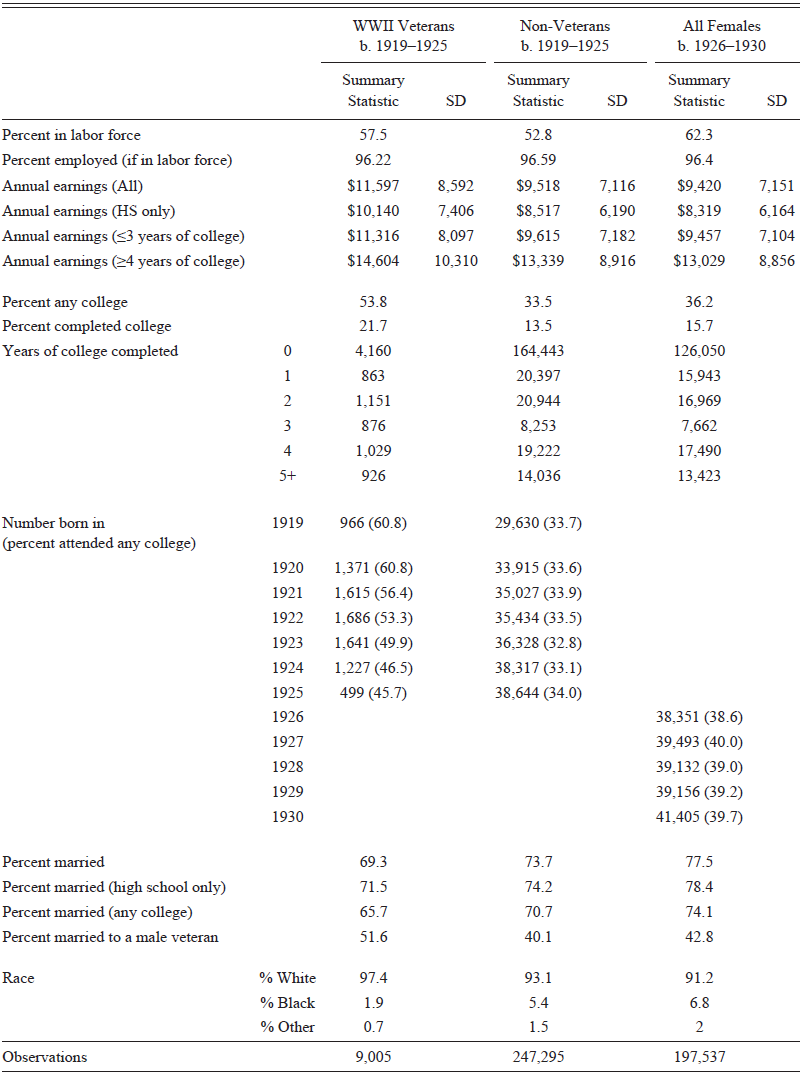
In Table 1, I present relevant summary statistics for female veterans and non-veterans born between 1919 and 1925 who were high school graduates. I also provide the same information for female high school graduates who turned 21 between 1947 and 1951 (females born between 1926 and 1930). The summary statistics demonstrate that, in 1980, WWII veterans had higher earnings, more education, were more likely to be white, and were less likely to be married. The marital status patterns are noteworthy, with veterans being less likely to be married, and particularly so if they had more than a high school education. I suspect this pattern emerges because married females were less likely to enlist and, conditional on marrying during their period of service, were then less likely to pursue further education after their service. Such selection effects would ensure that college-educated female veterans were less likely to be married. Footnote 18 Note that the summary statistics also demonstrate female patterns of enrollment in the military, with 3.26 percent (966 out of a total of 30,596) of females born in 1919 reporting that they were WWII veterans. That proportion rises to 4.54 percent of those born in 1922 before declining markedly for those eligible to enlist after 1944. Such a pattern helps to ease concerns that many females entered the army in response to the benefits provided by the G.I. Bill.
Summary Statistics—1980 Census 5 Percent Public use Micro Sample

Source: 1980 PUMS 5 Percent Census Sample restricted to females who completed high school.
Along with the information on cohort sizes by year of birth, I provide the percent of each cohort that attended any college. Notice that females who were born earlier, and therefore eligible to enlist in the war effort sooner, were significantly more likely to report having attended college when surveyed in 1980. The same pattern is not evident among non-veterans. The difference in female veterans’ educational attainment across birth cohorts suggests that the G.I. Bill might have affected females differently based upon age in 1944. I later exploit this variation to instrument for the G.I. Bill’s impact on educational achievement.
Main Findings
I present my findings in four related subsections. First, I provide descriptive estimates of the association between veteran status, labor market outcomes, and educational attainment in 1980. To help support a causal interpretation for those estimates, I then use the available information on the take-up of G.I. Bill benefits, differences in education in 1980, WAC enlistment records, and education levels in the 1940 complete-count Census to establish that the educational attainment of veteran females is related to education that occurs after, rather than before, their WWII service. Next, I show that veteran females would not likely have attended college after their service without the G.I. Bill by appealing to the variation provided by the G.I. Bill’s announcement. My final empirical exercise uses that same variation in an IV framework to show that the additional education of female veterans explains a large majority of the overall difference between female veterans’ and non-veterans’ earnings in 1980. In a fifth subsection, I contrast my approach with Bound and Turner (2002) and explain why their birth year-quarter cohort level strategy is less applicable in my setting.Footnote 19
Descriptive Estimates
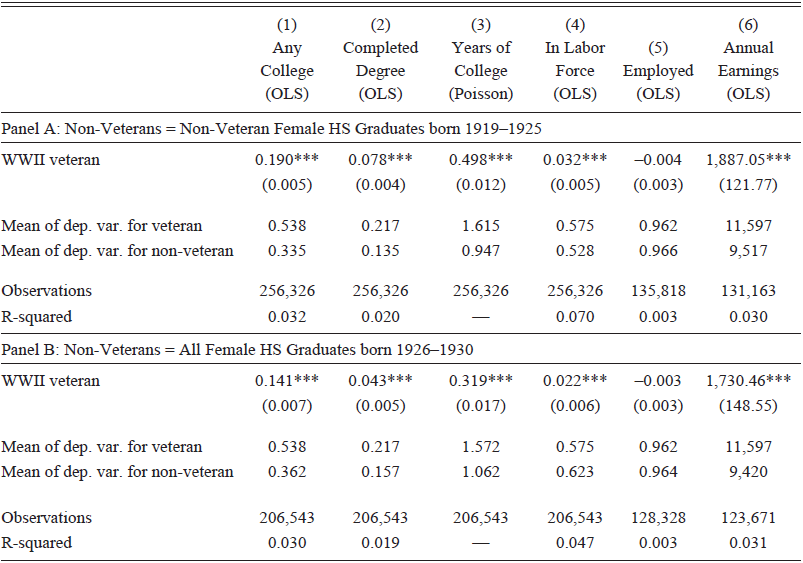
In this section, I examine the impact of WWII veteran status on indicators for any college, having completed four or more years of college, labor force status, and employment status (employed/unemployed, conditional on being in the labor force). I also consider years of college completed and annual earnings from employment. As I mentioned earlier, because females had to be high school graduates to be eligible for WWII service, both my treatment (WWII veterans) and comparison (non-veterans) groups include only those with a high school diploma. Specifically, in the estimates in Panel A of Table 2, non-veterans are female high school graduates born between 1919 and 1925 who do not enlist in the armed forces during the WWII period. I include state fixed effects and controls for marital status, age (measured in quarters), and race in each specification.
Estimates for WWII Veteran Status on Female Earnings and Education

Notes: Standard errors, corrected for heteroskedasticity, in parentheses. *** p<0.01, ** p<0.05, * p<0.1. Dollar values are $1980. In Panel A, I restrict the sample to female, high school graduates, who turned 21 between 1940 and 1946. Non-veterans are, therefore, female high school graduates born between 1919 and 1925 who do not enlist in the armed forces during the WWII period. In Panel B, I restrict the sample to female, high school graduates, who turned 21 between 1940 and 1951, but then exclude non-veterans born between 1919 and 1925. In those estimates, therefore, non-veterans are female high school graduates born between 1926 and 1930 who do not enlist in the armed forces during the WWII period. All specifications include state fixed effects and control for marital status and race. In Panel A, I also control for age using quarter of birth indicators. In Panel B, I cannot control similarly for age because veteran status does not vary for individuals born prior to 1926 due to the sample restriction. To capture the effect of age, I instead add a linear birth year-quarter trend. Estimates without including this linear trend are very similar.
Source: 1980 PUMS 5 Percent Census Sample.
Using an OLS-based Linear Probability Model, I find that female veterans (in 1980) were 19 percentage points more likely to have at least some college, 7.8 percentage points more likely to have completed four years of college, and were 3.2 percentage points more likely to be in the labor force relative to non-veteran female high school graduates. Female veterans, however, were not statistically more or less likely to be employed (conditional on being in the labor force). Further, using a Poisson model, I find that female veterans completed 49.8 percent more years of college than non-veteran females, conditional on having a high school diploma. Footnote 20
The educational attainment of veterans suggests that veterans and non-veterans differed in ways that could affect earnings from employment later in life. Confirming this suspicion, OLS estimates in Column (6) suggest that WWII veterans earned $1,887 more per year compared to non-veterans in 1980. Given annual earnings of $9,518 for non-veterans, my findings imply that being a veteran is associated with a 19.8 percent boost in earnings relative to similar non-veterans. As an Online Appendix item, I show that accounting for selection into the labor force (using a Heckman selection approach with “other household income” as the selection variable) leads to very similar estimates of the greater earnings of female veterans.
Note that I intentionally do not control for education when examining earnings because education is highly correlated with veteran status (see Table 1) and would bias estimates of veterans’ additional earnings downward. Put differently, I am interested in the gross effect of veteran status, whereas controlling for education would provide a net effect. I also purposely do not control for occupation when looking at earnings because veteran status may predict selection into occupations or industries with higher wages. However, I present estimates where I control for education and occupation as an appendix item. In those estimates, while the additional earnings of veterans are still large and statistically significant, including education and occupation controls attenuates the effect of veteran status on earnings. Such a pattern suggests that the additional earnings of veterans come, at least in part, from the subsequent occupational choices of veterans enabled by greater educational attainment. Note that I also provide estimates where I exclude nurses and doctors from my sample as an appendix item. Those estimates are reassuringly similar to the estimates in Table 2 and highlight that my main findings are not driven solely by the enlistment of medical professionals.
To the extent that military service delayed entry into civilian life (including career choices, marriage timing, fertility, and so on) for veteran females, females from the same age cohort (those born 1919 to 1925) are perhaps not the right comparison group. Also, and as I describe earlier, educational attainment among non-veteran was somewhat negatively affected by WWII. In Panel B of Table 2, therefore, I designate non-veterans to be female highschool graduates born between 1926 and 1930. These females were just too young to serve in WWII. The estimates in Panel B confirm that WWII veterans experience large and statistically significant increases in educational attainment and annual earnings, regardless of the comparison group.
 $$Edu{c_i} = \alpha + \tau Ag{e_{i,1944}} + {X_i}\Pi + {\varepsilon _i}$$
At issue is whether the additional earnings of veterans are causally related to the education benefits provided by the G.I. Bill. The problem is that being a veteran could have affected earnings in at least two other ways. First, female veterans selected into service and may have had greater (unobserved) productivity than non-veterans, whether due to innate differences or veterans becoming more productive because of their service (by acquiring skills and/or experience). Second, veterans, as a group, may have greater educational attainment than otherwise comparable females even before they enlist. The effect of WWII veteran status on annual earnings in the final column of Panel A of Table 2 simply estimates the size of the veterans’ earning premium and does not attempt to disentangle such competing explanations.
For my estimates to be causal, the additional educational attainment of veterans must be explained by the benefits provided by the G.I. Bill. Moreover, it must also be the case that such educational attainment causes at least some of the veterans’ earnings premium. In the next two subsections, to help establish a causal relationship, I show that the additional educational attainment of veterans is almost entirely explained by veterans attending college after their service that otherwise would not have attended college. I also show that there is no evidence that attending college affected veterans’ earnings differently relative to non-veterans. Then, I attempt to separate the effect of veterans’ experience and innate characteristics from the effect of education by using age at the time of the G.I. Bill’s announcement to instrument for veterans’ later educational attainment.
Selection on Pre-Service Educational Attainment
One threat to a causal interpretation for my findings is that female WWII enlistees might have been more likely to have attended college before their service relative to high school graduates who did not enlist. To see that this is not likely, first note that the Department of Veteran’s Affairs reports that 19.5 percent of eligible females used their benefits to attend college, and the estimates in Column (1) of Table 2 highlight that WWII veterans are 19 percentage points more likely to report having attended at least some college when responding to the 1980 long-form Census. Footnote 21 The alignment between these measures suggests veterans were not especially more likely to have attended college prior to their service relative to other female high school graduates. Footnote 22 If my 1980 census sample is representative, it, therefore, appears that differences in educational attainment between female veterans and non-veterans are explained by those veterans who attend college after serving in WWII.
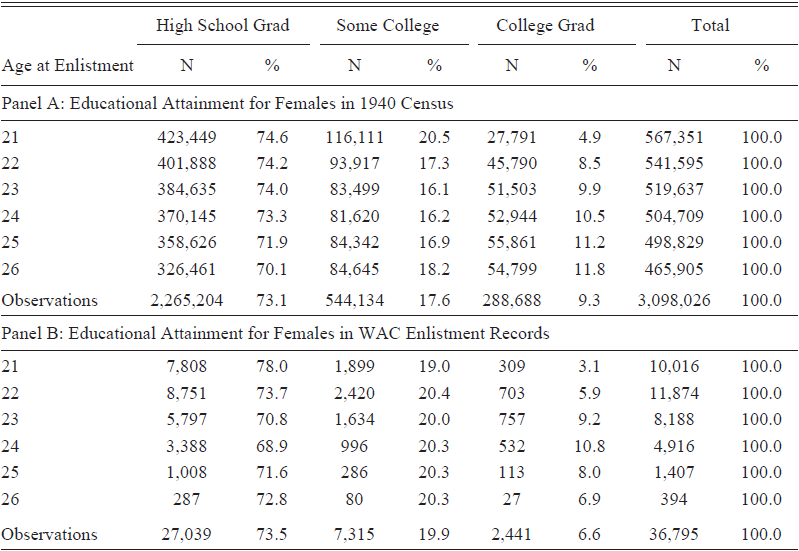
To further support such a claim, I turn to the publicly available Women’s Army Corps (WAC) Enlistment Records. Footnote 23 The enlistment records refer to females in just one particular branch of the military but provide educational attainment and other background information including age, race, marital status, birthplace, 1940 residence information, and army enlistment date for almost 37,000 female veterans aged between 21 and 26 at the time of enlistment. Footnote 24 Using the WAC enlistment records, I compare educational attainment (by age) at the time of enlistment to educational attainment for female high school graduates (at the same ages) in the 1940 complete count census (Ruggles et al. Reference Ruggles, Flood, Foster, Goeken, Pacas, Schouweiler and Sobek2020). Table 3 presents a summary of educational attainment for female WAC enlistees age 21 to 26 at the time of their enlistment compared to females age 21 to 26 in the 1940 census. The summary statistics in Table 3 illustrate that WAC enlistees were a little more likely to have some college but somewhat less likely to have completed college. This may represent enlistees interrupting their education to join the military, especially when we consider that enlistees were much more likely to be 21 or 22, relative to the age distribution in the 1940 Census. The key takeaway, however, is that enlistees, when I combine those who have some and those who have completed college—were not especially more likely to have a college education prior to service relative to high school graduates in the population.
Educational Attainment in 1940 Census and Enlistment Records

Sources: The data in Panel A refer to the 1940 Complete Census restricted to female high school graduates age 21 to 26 in 1940. Panel B contains data from Women’s Army Corps Enlistment Records.
Selection on Post-Service Educational Attainment
While it appears that females were not significantly more likely to have attended college before enlisting, it is possible that veterans would attend college after their service absent any G.I. Bill benefits. For example, those who enlist might also be those who were planning to attend college in the future. For this to be a significant source of bias, there would have to be a large number of female enlistees who were high school graduates and were planning to go to college, and yet (because females had to be 21 to enlist) did not attend college between the ages of 18 and 21. It is perhaps more likely that selection would work in the opposing direction. That is, the overall probability of attending college for females (or, indeed, males) age 21 or older, conditional on not attending college between age 18 and 21, is likely small. Furthermore, among those choosing to enlist (because few could have anticipated any educational benefits at the time they enlisted), the ex-ante probability of subsequent college attendance, absent G.I. benefits, could be lower relative to those who choose not to enlist.
The mid-1944 announcement of the G.I. Bill additionally limits the value of selecting into service primarily to obtain educational benefits. Given WWII G.I. benefits were awarded to those who served between September 1940 and July 1947 (see Stanley Reference Stanley2003, p. 674), only those who were already enlisted at the time of the announcement would have enough time to obtain the quantity of G.I. Bill benefits sufficient to complete a college degree (each month of active duty provided an additional month of G.I. Bill benefits). Footnote 25 It is possible that some delayed their exit from service to maximize their G.I. Bill benefits. Such behavior clouds identification only if there is a correlation between that delay (thereby increasing the quantity of G.I. benefits) and the individual’s pre-enlistment likelihood of attending college after their period of service. In such a case, the causation would be reversed, college attendance would, at least to some degree, “predict” G.I. Bill benefits. Given that the available evidence suggests few female veterans were likely to attend college without G.I. benefits and the fact that enlistment was concentrated prior to the announcement of G.I. benefits, it seems unlikely that such behavior could be a significant source of bias.
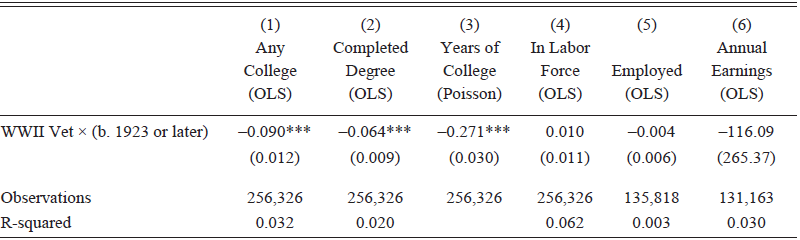
At the same time, because I do not observe the amount of benefits available nor individual army enlistment dates in my 1980 Census data, I cannot completely rule it out. Instead, to try to directly address this potential source of bias, I present estimates where I interact WWII veteran status with an indicator for those who turned 21 after June 1944 in Table 4. These later-born individuals could have been aware of the available G.I. benefits prior to being old enough to enlist and could be driving the increased educational attainment of veterans purely via selection effects once the benefits became known. On the other hand, summary statistics in Table 1 illustrate that those who were old enough to enlist in 1943 or earlier (rather than after 1943) were significantly more likely to attend college. The estimates in Table 4 reinforce that pattern. Looking at the interaction term only, female veterans who served in WWII but who were only eligible to serve after 1943 were somewhat less likely to attend college, complete their degree, and had fewer years of college compared to those who could enlist before the G.I. Bill was announced. They also had lower earnings, but the estimate is not statistically significant. The lack of precision perhaps arises because (1) the estimates are limited to only those who are employed, and (2) only a relatively small proportion of the estimation sample consists of female veterans born after 1923. In any case, these estimates suggest that females selecting into service upon learning of the G.I. Bill’s potential benefits are not driving my estimates.
Selection after G.I. Bill Announced

Note: In all specifications, non-veterans are female high school graduates born between 1919 and 1925 who do not enlist in the armed forces during the WWII period.
Source: 1980 PUMS 5 Percent Census Sample.
Note that the estimates in Table 4 also suggest that the experience of serving in the military is not driving my findings. That is, while the mechanism would be far from clear, the experience of being in the army could have caused veterans to attend college even absent any financial assistance to do so. If that were true, however, we would not expect differences in subsequent college attendance among those who were eligible to enlist earlier relative to those who could enlist later. The estimates in Table 4 also ease concerns that those who were planning to attend college in the future (for whatever reason) were significantly more likely to enlist across the WWII period. For example, if veterans were generally more likely to attend college after service, economic theory would suggest that the G.I. Bill’s announcement should further increase that proportion, at least at the margin. In turn, then those who turn 21 after 1943 should be especially likely to attend college relative to enlistees in prior years, but they are not.
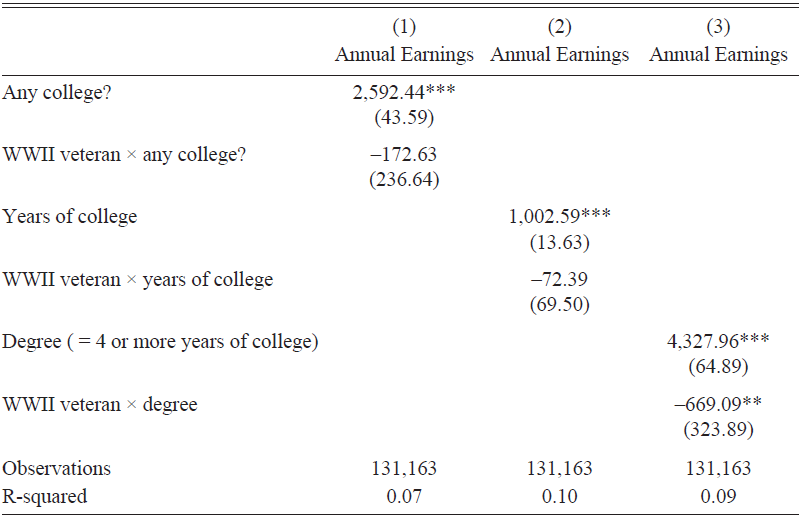
To further ease concerns that those who took up the offer of G.I. Bill benefits were positively selected, I present estimates that interact veteran status with indicators for educational attainment in Table 5. There I find suggestive evidence of mild negative selection, in the sense that veterans experienced a smaller boost in earnings from education relative to non-veterans. It is possible, therefore, that instrumental variable (IV) estimates will be larger than OLS estimates of the impact of education on earnings when focusing on veterans. Essentially, a valid IV may estimate a larger local average treatment effect because the instrument changes the behavior of veterans only for whom the positive effects of more education might be larger than average. Such a pattern would be consistent with the higher average earnings of veterans relative to non-veterans among those who did not attend any college (see Table 1).
Education Interaction Estimates

Notes: Standard errors, corrected for heteroskedasticity, in parentheses. *** p<0.01, ** p<0.05, * p<0.1. Dollar values are $1980. All estimates include controls for age, race, marital status, and state.
Source: 1980 PUMS 5 Percent Census Sample.
IV Estimates
Before turning to an IV approach, I briefly summarize my findings. In Table 2, I show that female WWII veterans’ educational attainment and annual earnings from employment were significantly greater than comparable non-veterans. Combining administrative data along with enlistment patterns and requirements, I then show that female veterans’ additional educational attainment must be due to veterans obtaining an education after their service, that veterans were not especially likely to attend college even if they did not obtain G.I. benefits (Table 4 and related discussion), and that veterans were not likely to benefit disproportionately from education (Table 5 and related discussion).
My final empirical exercise demonstrates that those induced to attend college by the G.I. Bill’s generous benefits are driving most of the overall earnings premium experienced by female veterans, further limiting concerns that service itself or innate differences in productivity are driving the earnings gap among veterans and non-veterans. Specifically, to try to isolate how increased education, caused by the G.I. Bill, affected veterans’ earnings, I use age at the time of the G.I. Bill’s announcement to instrument for increased educational attainment among veterans.
The idea with this approach is that army enlistment patterns, the 1944 announcement of the G.I. Bill, and the fact that longer periods of service granted more G.I. benefits, mean those female veterans born in 1919, and therefore old enough to enlist several years prior to the G.I. Bill’s announcement, could take greater advantage of the G.I. Bill’s unexpected benefits. My data are at least consistent with such a claim; in Table 1, I show that female veterans born earlier were much more likely to attend college compared to later-born veterans. Further validating my instrument, enlistment records (see Table 3) do not suggest that older enlistees were more likely to have a college education at the time of enlistment (relative to younger enlistees and relative to the general population). Using predicted education values, I then estimate how additional education affects veterans’ earnings.
 $$Annual\,Earning{s_i} = \theta + \phi \widehat {Edu{c_i}} + {X_i}\Pi + {\mu _i}$$
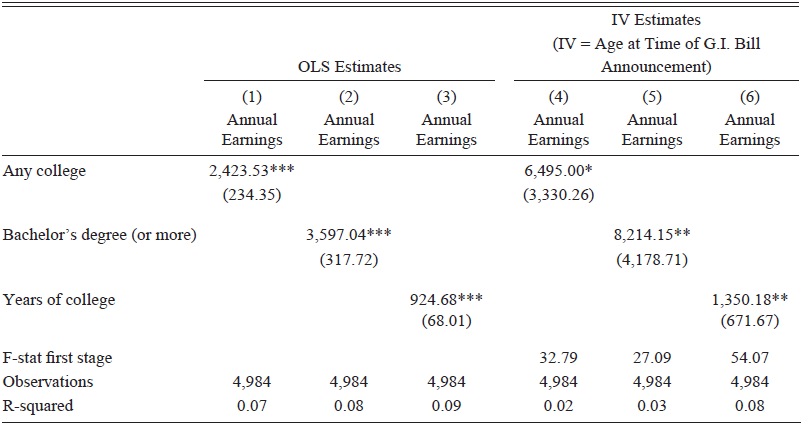
In practice, I use an indicator for being born after the second quarter of 1923 (identifying those turning 21 after the G.I. Bill was announced in June 1944) to instrument for three different measures of educational attainment for veterans: any college, four or more years of college (equivalent to a Bachelor’s degree or more), and total years of college. Footnote 26 I present two-stage least squares estimates, alongside OLS estimates, in Table 6. All specifications include state fixed effects while controlling for marital status and race. I do not control for year-quarter of birth in these estimates because I use age as an instrument. The OLS estimates show that attending any college increases veteran’s earnings by $2,424, completing at least four years of college increases earnings by $3,597 and that each additional year of college corresponds to a $925 increase in earnings relative to veterans with only a high school education. Footnote 27 Each estimate is significant at the 1 percent level. Because veterans obtained more education, and because more education appears to increase earnings, my OLS estimates suggest it is possible that the G.I. Bill (via increased education) explains most or all of the $1,887 earnings premium for female veterans in 1980.
Two-Stage Least Squares Estimates

Notes: Standard errors, corrected for heteroskedasticity, in parentheses. *** p<0.01, ** p<0.05, * p<0.1. Dollar values are $1980. All specifications include state fixed effects and control for marital status and race. I do not control for year-quarter of birth in the OLS or IV estimates because I use age as an instrument. “Age at time of G.I. Bill Announcement” refers to an indicator for being born before versus after the second quarter of 1923, making a female 21, and thus eligible to serve, before versus after the announcement of the G.I. Bill.
Source: 1980 PUMS 5 Percent Census Sample restricted to female veterans born 1919 to 1925.
On the other hand, the OLS estimates combine veterans who already attended college (or would have attended absent any G.I. benefits) with those who attended only because of the G.I. Bill. When using an IV approach, I find evidence that OLS likely underestimates the effect of G.I. Bill-induced education on earnings for female veterans. Specifically, the IV estimates suggest that female veterans induced to attend at least some college by the G.I. Bill have $6,495 greater annual earnings, those who complete four or more years of college experience $8,214 greater annual earnings, and that, each additional year of college corresponds to a $1,350 increase in annual earnings (an 11.6 percent annual return). The effects on earnings are significant at the 5 percent level for two of the three outcomes (falling just short of the 5 percent level when looking at “Any College”), and the first stage F-statistics indicate that the instrument is not weak.
Note again that using age in 1944 as an instrument is conceptually valid because age in 1944 is clearly correlated with educational attainment (see Table 1) and is unlikely to be directly correlated with differences in earnings in 1980, other than through its effect on education. Furthermore, the difference between the OLS and IV estimates is aligned with the literature on the returns to education described by Card (Reference Card2001). Footnote 28 While an 11.6 percent return to an additional year of education seems large, Card (Reference Card, Ashenfelter and Card1999) finds that IV estimates range between 6 percent (Angrist and Krueger Reference Angrist and Krueger1991) and 15.3 percent (Harmon and Walker Reference Harmon and Ian1995) in studies that use data from the 1970s, 1980s, and 1990s. Moreover, Dougherty (Reference Dougherty2005) highlights that females benefit more from a college education. Footnote 29 My two-stage least squares estimates suggest that 72.5 percent of the overall earnings boost for female veterans can be explained by the additional earnings of those who used their G.I. benefits to attend college. This back-of-the-envelope calculation relies on my earlier OLS estimates of the increase in any college (19 percentage points) and college completion (41 percent of those who complete any college) along with my IV estimates of the returns to education for those induced to attend ($6,495 per year) or complete college ($8,214 per year). Using those values, $6,495 × .19 × .59 + $8,214 × .19 × .41 = $1,368, which is 72.5 percent of the $1,887 overall difference between veteran and non-veteran females in 1980.
My IV estimates further limit concerns regarding positive selection into service by females with greater future earnings potential. Given the pattern of estimates, we would not expect veterans to be significantly more productive absent their additional education, as might be the case if IV estimates were smaller than OLS estimates. Moreover, because the estimates in Table 6 are restricted to veterans, they ease concerns that military service itself, by providing experience or on-the-job training, explain all of the veterans’ earnings premium.
Cohort Level Analyses
As I mentioned earlier, if we are concerned that comparisons between veterans and non-veterans are invalid, one alternative approach would be to perform a cohort-level analysis, following Bound and Turner (2002). Specifically, Bound and Turner use birth year-quarter cohort aggregates to develop estimates of the relationship between the share of veterans in a cohort and overall educational outcomes. Their OLS estimates suggest that the share of male veterans in a cohort is positively related to greater male educational attainment. They also present complementary IV estimates where they use an indicator variable for being born prior to the fourth quarter of 1927 (thus turning 18 prior to Victory over Japan Day (V-J Day), 15 August 1945) as an IV to predict the share of a cohort that are veterans. V-J Day is a valid IV because Japan’s surrender marked the end of the war. Bound and Turner show that the share of WWII veterans by cohort declines swiftly for cohorts born after early 1927. Highlighting that V-J Day was important, their IV estimates closely match their OLS estimates.
For Bound and Turner, the primary motivation for their cohort level analyses is that many veterans would have attended college (instead of serving), and non-veteran males in the same cohorts are those who failed physical and/or mental fitness, limiting their value as a comparison group. Put differently, when looking at male veterans, the main empirical issue is that the within-cohort non-veteran comparison group is small and severely negatively selected, requiring an alternative approach. As I explained when discussing Bound and Turner’s findings earlier, such concerns are less of an issue when focusing on females. When studying female veterans, the small share of female veterans in any given birth cohort (no more than 4.54 percent in my data) means that the within-cohort non-veteran comparison group is both large and unlikely to be severely negatively selected. For that reason, the primary concern when looking at the effect of the WWII G.I. Bill on female veterans is positive selection into service, either from having greater education prior to service or from innate ability/productivity differences that lead to greater future earnings even absent further educational attainment. To the extent that female WWII enlistees (1) did not have greater educational attainment than comparable non-veterans prior to enlisting and (2) were not likely to attend college after serving, as I demonstrated earlier, then comparisons between veteran and non-veteran females will provide reasonable estimates of the effects of interest.
That being said, I present estimates in Online Appendix C that mirror Bound and Turner’s cohort level analyses, using both OLS and the same “eligible for service prior to V-J Day” instrument. Footnote 30 However, regardless of my approach to estimation (OLS or IV), I find mostly null effects on cohort level labor force participation, employment, and earnings. Counter-intuitively, the share of a female birth year-quarter cohort that is a WWII veteran is associated with reduced educational attainment at the cohort level, even when focusing only on WWII-eligible cohorts. Specifically, the coefficients in Table C1 refer to the effect on the outcome of interest for a 1 percentage point increase in the female veteran share in the cohort. Looking at females born between 1919 to 1925, my between-cohort OLS estimates show that if around 3 percent of the sample are WWII veterans, then WWII was associated with a 1.5 percentage point reduction in college completion and about a 0.05 reduction in the number of years of college completed at the cohort level.
As I mentioned earlier, however, negative cohort-level effects on education would be consistent with Acemoglu, Autor, and Lyle (Reference Acemoglu, Autor and Lyle2004) and Jaworski (Reference Jaworski2014), who find that the war effort caused many non-veteran females to join the labor force rather than continuing their education. As a result, despite the boost provided by some veterans in eligible cohorts gaining additional education via the G.I. Bill, those cohorts obtained less education overall. In turn, cohort level IV estimates have the “wrong” sign because the correlation between the instrument (being born early enough to turn 21 before V-J Day, regardless of veteran status) and educational outcomes in relevant cohorts is negative.
Any war-related decline in educational attainment among non-veteran females means that comparisons between veterans and non-veterans in the same birth cohorts will tend to overestimate the effect of the G.I. Bill on female veterans’ outcomes. Helpfully, the effects on educational attainment are relatively small at the cohort level. Moreover, Table 1 shows that the effect of the war effort on college attendance for females seems to have mostly dissipated when we look at those born between 1926 and 1930. The estimates in Panel B of Table 2, because they compare outcomes for female WWII veterans to those of females born from 1926 to 1930, therefore help to bound the size of any overestimate. As one example, the difference between the estimates in Panel A and Panel B of Table 2, in terms of years of education, amounts to 0.169 years in 1980. Looking at years of education completed in 1960, Jaworski (Reference Jaworski2014) finds a war-related 0.163 decline in years of education for females at the median level of mobilization. If only non-veteran females experienced a decline in years of education because of WWII, then any comparison of veterans to non-veterans would likely overestimate the effect of veteran status on years of education by 0.163, right in line with the difference in estimates I report in Table 2. However, to the extent that the war effort also disrupted education among some females who served, it is perhaps best to view the estimates in Panel B of Table 2 as representing a lower bound on the true effect, with the estimates in Panel A representing an upper bound. Either way, it remains clear that female veterans experienced significant G.I. Bill-related increases in educational attainment and earnings.
Conclusion
By providing generous benefits to veterans, the 1944 Servicemen’s Readjustment Act (the “G.I. Bill”) improved access to higher education for millions of Americans. Several studies examine how the G.I. Bill affected male veterans, but little is known about how the G.I. Bill affected female veterans. While the vast majority of veterans were men, persistent differences in wages by gender mean that it is particularly important to study whether policies that provide greater access to education can lead to better outcomes for females. For that reason, I examine the long-term effects of the G.I. Bill on female WWII veterans who appear in the 1980 Census 5 percent PUMS, focusing on differences in educational attainment and labor market outcomes.
I find that, in 1980, female veterans are 19 percentage points more likely to report having attended at least some college and 7.8 percentage points more likely to report completing four years of college or more relative to non-veteran female high school graduates of similar age. Further, I find female veterans complete about one more semester of college relative to non-veteran females, conditional on having a high school diploma. Given differences in educational attainment, it is not surprising that I find female veterans earn $1,887 more per year compared to non-veterans. One caveat to my findings is that I rely on an indicator for WWII veteran status rather than G.I. benefit generosity specifically. Given, however, that some veterans may have obtained little or no G.I. benefits, my estimates therefore potentially understate the G.I. Bill’s true effects.
I support my findings by ruling out three plausible alternative explanations for the increase in educational attainment and subsequent earnings among female veterans. The first is selection on existing or planned educational attainment. The second is selection on ability or productivity. The third is that WWII service exerts its own impact, absent any G.I. benefits or selection effects. To limit such concerns, I rely on administrative reports, 1940 census data, and enlistment records to establish that attendance after service explains virtually all of the additional educational attainment among female veterans. I also show that female veterans who obtain a college education do not experience a larger overall “return” to education relative to non-veterans, which suggests that veterans are not especially likely to be those who would benefit from college. Mild differences in the overall returns to education also suggest that service itself does not exert an important independent impact on future labor market outcomes. Indeed, those estimates, combined with IV estimates that use age in 1944 as an instrument, suggest that veterans who used their G.I. benefits to attend college may have been somewhat negatively selected.
My IV estimates imply that 72.5 percent of the overall earnings boost for female veterans can be explained by the additional earnings of those who used their G.I. benefits to attend college. Further, my IV estimates suggest that those induced to attend college by the G.I. Bill experience a $6,495 increase in annual earnings, which amounts to 69.4 percent of the overall earnings gap among males and females at the time (the overall gender wage gap was $9,496 in 1980 among male and female high school graduates who work full-time and were born between 1919 and 1925). The fact that greater educational attainment does not close the entire gender gap in earnings is consistent with studies that examine the returns to higher education for females (see, e.g., Black et al. Reference Black, Haviland, Sanders and Taylor2008).
A final caveat is that WWII led to reductions in educational attainment among non-veteran females. For that reason, my empirical approach, comparing veterans to similar non-veterans, could overestimate the effects of interest. However, the available evidence suggests that any overestimate is likely to be small. Overall, it is clear that the G.I. Bill caused significant additional educational attainment and led to substantial increases in earnings among female veterans.