


INTRODUCTION
Collisionless explosion of a micro-plasma triggered by an intense short-pulse laser is known to be a mechanism of ion acceleration (Ditmire et al., Reference Ditmire, Zweiback, Yanovsky, Cowan, Hays and Wharton1999; Dorozhkina & Semenov, Reference Dorozhkina and Semenov1998; Last & Jortner, Reference Last and Jortner2001; Krainov & Smirnov, Reference Krainov and Smirnov2002; Kovalev & Bychenkov, Reference Kovalev and Bychenkov2003; Kaplan et al., Reference Kaplan, Dubetsky and Shkolnikov2003; Peano et al., Reference Peano, Peinetti, Mulas, Coppa and Silva2006; Nickles et al., Reference Nickles, Ter-Avetisyan, Schnurer, Sokollik, Sandner, Schreiber, Hilscher, Jahnke, Andreev and Tikhonchuk2007; Limpouch et al., Reference Limpouch, Psikal, Andreev, Platonov and Kawata2008). For targets that are smaller than the laser skin depth, instantaneous ionization and fast electron heating give rise to cluster explosion. For low energy (temperature) of electrons they cannot escape the cluster that expands as a quasi-neutral plasma bunch (Ditmire et al., Reference Ditmire, Springate, Tisch, Shao, Mason, Hay, Marangos and Hutchinson1998; Dorozhkina & Semenov, Reference Dorozhkina and Semenov1998; Esirkepov et al., Reference Esirkepov, Bingham, Bulanov, Honda, Nishihara and Pegoraro2000; Kovalev & Bychenkov, Reference Kovalev and Bychenkov2003). The quasi-neutral expansion occurs when the electron Debye length is much smaller than the radius of the cluster. When the electron energy in the laser field is well above the energy of Coulomb attraction by the ionic core, the cluster experiences Coulomb explosion (CE) (Zweiback et al., Reference Zweiback, Smith, Cowan, Hays, Wharton, Yanovsky and Ditmire2000; Nishihara et al., Reference Nishihara, Amitani, Murakami, Bulanov and Esirkepov2001; Kaplan et al., Reference Kaplan, Dubetsky and Shkolnikov2003). There also exists an intermediate regime of cluster expansion that is governed by a charge separation field proportional to electron temperature. The transition from quasi-neutral expansion to CE with electron energy increase has been clearly shown in simulations (Peano et al., Reference Peano, Peinetti, Mulas, Coppa and Silva2006). The intermediate regime of cluster expansion has also been studied by kinetic simulation including laser light absorption (Antonsen et al., Reference Antonsen, Taguchi, Gupta, Palastro and Milchberg2005).
Typically, the energy spectrum of accelerated ions is rather broad and terminates with an abrupt upper cut-off. However, studies of CE with an initially inhomogeneous density distribution have demonstrated monoenergetic ion components in the spectra of accelerated particles (Peano et al., Reference Peano, Fonseca and Silva2005; Kovalev et al., Reference Kovalev, Popov, Bychenkov and Rozmus2007b). Also, a group of monoenergetic light ions was reported for micro-plasmas composed of heavy and light ions (Last & Jortner, Reference Last and Jortner2001; Ter-Avetisyan et al., Reference Ter-Avetisyan, Schnürer, Nickles, Kalashnikov, Risse, Sokollik, Sandner, Andreev and Tikhonchuk2006, Reference Ter-Avetisyan, Schnürer, Nickles, Smirnov, Sandner, Andreev, Platonov, Psikal and Tikhonchuk2008; Murakami & Tanaka, Reference Murakami and Tanaka2008). Furthermore, the formation of a group of monoenergetic ions occurs from an initially homogeneous target that is different from a bilayered spherical cluster with heavy ion core and ultrathin light ion coating (Kovalev et al., Reference Kovalev, Bychenkov and Mima2007a). Naturally, substantial simplification of the nanotarget design without particle monochromaticity loss may enable significant advances in developing high-energy ion sources for different applications including laser-triggered nuclear reactions (Ledingham et al., Reference Ledingham, McKenna and Singhal2003).
Physically, in the multi-species cluster expansion case, more mobile light ions from an initially homogeneous cluster overtake heavy ions. The latter, acting as Coulomb piston, accelerate a shell of light ions moving ahead of the heavy ion front. Although this scenario is known (Last & Jortner, Reference Last and Jortner2001; Murakami & Tanaka, Reference Murakami and Tanaka2008), a description of the parameters of the light ion monochromatic shell (such as ion energy, the number of the monochromatic ions, and the spectrum width) versus plasma composition and electron temperature merits attention and is the main emphasis of this paper.
We consider in this article, large laser intensities (E l > E c, where E l is the laser field and E c is the Coulomb field of the cluster ion core) having high contrast ratio, short laser pulse length ( , where τl is the laser pulse length, and ωL1 is the plasma frequency of the heavy ion component, μ = M 1Z/MZ 1, M 1 and M are, correspondingly, masses of heavy and light components, Z 1 and Z are their charges), and small target sizes (much smaller than laser skin depth). The condition E l > E c corresponds to cluster radius R < E l/Z 1en 1, where n 1 is the density of the heavy component of the cluster. For this condition, an assumption on smallness of target size in comparison with relativistic laser skin depth is naturally met. The typical experimental laser-cluster parameters, cluster radius R ~ 20–50 nm, the laser intensity I≳1021 W/cm2, the electron density in cluster n e ~ 1023 cm−3, are of interest here. The pulse length for such interaction would be τ ~ 10 fs (Dunne, Reference Dunne2006). The laser contrast appears to be a most important parameter for the intensities in our case. Whereas the contrast ratio at ns-scale can be made as good as 1011 for high intensity lasers (Chvykov et al., Reference Chvykov, Rousseau, Reed, Kalinchenko and Yanovsky2006) or even better, there is uncertainty in this value for ps-scale. Namely, the ps-contrast-ratio is the crucial parameter that allows or suppresses laser-triggered ion acceleration from clusters. Our model assumes that intensity contrast ratio is so high that prepulse cannot significantly destroy a cluster; an approximate relation for this condition is c s τpp ≪ R, where c s is the ion acoustic velocity of prepulse-heated plasma and τpp is the prepulse duration. A simple estimation of c s based on an energy conservation argument, shows that for the laser intensity I ~ 1021 W/cm2 the ps-scale range contrast ratio should not be worse than ~107. Given the recent progress in improving laser contrast (Thaury et al., Reference Thaury, Quéré, Geindre, Levy, Ceccotti, Monot, Bougeard, Réau, d'Oliveira, Audebert, Marjoribanks and Martin2007; Kiriyama et al., Reference Kiriyama, Mori, Nakai, Shimomura, Tanoue, Akutsu, Okada, Motomura, Kondo, Kanazawa, Sagisaka, Ma, Daito, Kotaki, Daido, Bulanov, Kimura and Tajima2009), we believe that such experimental conditions will be feasible in the near future.
COLLISIONLESS EXPANSION OF A MULTI-SPECIES SPHERICAL TARGET
In the present model, the electrons of a spherical two ion species homogeneous cluster are assumed to be heated instantaneously by an ultrashort laser pulse. Their initial distribution is assumed to be Maxwellian, with the temperature T e. The dynamics of the symmetric cluster expansion is analyzed kinetically by using a one-dimensional-3V spherical gridless electrostatic particle simulation model that follows the motion of the electrons and ions in their self-consistent charge separation field E ≡ (r/r)E. It is equivalent to the following Cauchy problem for the Vlasov equations

for the distribution functions, f (α)(t, r, v) of the cluster species, where θ(x) is the unit step function and α stands for electrons and heavy and light ions, with the charges e α = −e, Z 1e, Ze, and masses m α = m e, M 1, M, correspondingly. In Eq. (1), for electrons, f 0(e) = [n 0(e)m e3/2/(2πT e)3/2] exp(−m ev 2/2T e) and for ions, f 0(α) = n 0(α)δ(v), where n 0(α) are the initial partial particle densities, n 0(e) = Z 1n 0(1) + Zn 0. Similar to (Peano et al., Reference Peano, Peinetti, Mulas, Coppa and Silva2006), we consider non-relativistic electrons although generalization to the relativistic case is straightforward.
We carried out multi-parameter simulations of cluster expansion for different target parameters such as relative electron thermal energy T = 2T e/M 1ωL12R 2, relative total light ion charge ρ0 = Zn 0/Z 1n 0(1), and kinematic parameter μ that defines the relative acceleration rate of the light ions with regard to heavy ion acceleration rate. The time, radial coordinate, electric field, light ion density (n), velocity (v), and energy (ε) are measured in ωL1−1, R, 4πZ 1en 1R, n 1, RωL1, and M 1ωL12R 2/2, respectively. To equalize the difference, for absolute comparisons, the total charge of the cluster is supposed to be constant for all the runs. This implies a weak dependence of R on ρ0 with R ∝ (1 + ρ0)−1/3.
In Figure 1a, the evolution of the density of light ions is shown. When the cluster is exploding, light ions, which are more mobile, overtake heavy ions, propagate ahead of them and finally gather into a thin shell. This is because the peripheral light ions that are initially accelerated by the strong radial linearly increasing electric field (∝r for high electron temperature T ~ 1) finally get into the decreasing electric field (∝r −2), where acceleration stops (see Fig. 1b). The details of this process are illustrated by the phase space plots given in Figure 1c. For certain set of parameters (typically, ρ0 less than few tens percent and T larger than several percent), the shell formation is accompanied by multi-flows near the expansion front (see insert in Fig. 1c). If light ions exhibit multi-flows, the density peak in the thin light ion shell comes to a singularity n ∝ (1 − r/r max)−1/2 similar to that for CE of a single ion species in inhomogeneous cluster (Kaplan et al., Reference Kaplan, Dubetsky and Shkolnikov2003; Kovalev & Bychenkov, Reference Kovalev and Bychenkov2003, Reference Kovalev and Bychenkov2005). The particles accumulated in the shell have radial velocities close to each other and the phase space curves, especially for Coulomb explosion regime (T ≫ 1), are flattening near the light ion front with time providing quasi-monoenergetic spectrum. A small fraction of quasi-monoenergetic particles from the vicinity dv/dr = 0 forms a peak fine structure of the light ions spectrum as shown in Figure 1d. There and below, the spectra are normalized to the total number of particles. The energy cut-off of the spectrum is singular, dN/dε ∝ (εmax − ε)−1/2. Formation of the density and spectrum singularities is reminiscent of a single species cluster with an inhomogeneous truncated density profile (Kovalev & Bychenkov, Reference Kovalev and Bychenkov2005), where overtaking of ions results into two flow regime with a singularity that arises at the edge of the cluster.
Dynamics of the light cluster component expansion for μ = 3 and ρ0 = 0.33: light ions charge density (a), electric field distribution (b), phase space plots (c), energy spectra (d). 1: t = 0, 2: t = 1, 3: t = 5. Thin curves correspond to Coulomb explosion regime (T → ∞) and thick curves correspond to T = 0.05.

The force of the Coulomb piston acting on the light ions depends on the number of evacuated electrons and thus on their initial temperature. With decreasing electron temperature, fewer electrons leave a cluster. The electrons trapped within a cluster suppress the electric field (c.f. thick and thin curves in Fig. 1b), which slows the cluster expansion and leads to the maximum energy of the light ions decreasing with decreasing of T. However, a remarkable feature of the two ion species cluster expansion is the maintenance of monochromaticity for the given number of ions for modest electron temperatures (c.f. thick and thin curves in Fig. 1d).
With electron temperature change, the spectrum of light ions experiences a dramatic transformation. For small temperatures (T → 0), the spectrum is monotonically decaying with negligible spike at its high-energy end, εmax. With increasing temperature, the spectrum becomes non-monotonic with a minimum (when T is on the order of 1–2%). With further temperature increase, the spectrum flattens in the main domain and finally becomes monotonic with a sharp increase near the energy cut-off (T ≲ 1). Thus, for dimensionless electron temperatures exceeding several percents, the light ion spectrum for a two ion species cluster expansion demonstrates a well-pronounced monochromatic feature. The energy and spectral width of the monoenergetic light ions depends on three controlling parameters, T, ρ0, and μ. Below, we present several illustrative examples of the dependencies on these parameters.
The energy spectrum of the expanding cluster is characterized by three main parameters: the energy cutoff, εmax, the relative width of the quasi-monoenergetic spectrum, Δε/εmax, and the relative number of monoenergetic particles, ΔN/N (in the energy interval Δε). For definiteness, we introduced a spectrum width that is Δε where the monoenergetic spectral contour line is twice as large as the average spectral level,  , where N is the total number of particles,
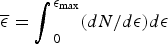 , and ΔN = ∫ε max−Δεε max (dN/dε)dε is the number of monoenergetic particles. The typical asymptotic light ion spectra of the expanding clusters, for different temperatures, are shown in Figure 2 by solid lines. It reveals the strong dependence of εmax and a spectrum shape on the electron temperature. For example, for T = 0.3 and CE regime, the spectra in Figure 2 have singularities at the energy cut-off, whereas for T = 0.05, the spectrum is finite because of absence of multi flows. Note that even for the single flow regime, the light ion spectrum can be quasi-monoenergetic if the electron temperature is at the level T≳0.1 − 0.2.
Light ions spectra for ρ0 = 0.33, μ = 3 at t → ∞: T = 0.05 (1), T = 0.3 (2), and T ≫ 1, CE regime (3). Solid lines show the spectra of a single cluster, dashed lines show spectra of clusters having ±3% radius dispersion, dotted lines – spectra of clusters having ±10% radius dispersion. The dash-dotted line shows the theoretical spectrum of Coulomb explosion with ρ → 0.

In a real experiment, there is always a natural spread of the cluster sizes. Let us suppose that cluster radii are distributed according to the Gaussian law: ∝exp[−((R − R 0)/ΔR)2], where R 0 is the clusters average radius and ΔR is the radius spread. Asymptotic light ion spectra for T = 0.05, T = 0.3, and CE regime for ΔR/R 0 = 3%, and 10% are given in Figure 2 by the, correspondingly, dashed and dotted lines. The spectrum-slightly broadens for the small temperature case and becomes much broader for the high temperature and especially CE cases.
To understand the resulting spectra, we present an analytical solution of expansion for an impurity of light ions (ρ ≪ 1) in the Coulomb explosion regime. In this case, the light ions move in the field (Kovalev et al., Reference Kovalev, Bychenkov and Mima2007a, Reference Kovalev, Popov, Bychenkov and Rozmus2007b):

where 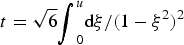 .
The distribution function of the radial velocity of the cold light ions can be calculated as (Kovalev et al., Reference Kovalev, Popov, Bychenkov and Rozmus2007b)

where the functions R = R(t, h) and U = U(t, h) are the solutions to the following equations:

w(t, r) = (Ze/M)r 2E(t, r). In Eq. (4), the field E is given by Eq. (2). The Eqs. (2) – (4) allow one to obtain all the light ion characteristics including the energy spectrum. The asymptotic spectrum of the light ions corresponding to this solution is shown in Figure 2 by the dash-dotted line. This spectrum is close to the one obtained in the numerical simulation until ρ is not too large. We conclude that the theory given above is applicable for ρ ≲ 20%. The dependence of the cut-off energy (in physical units) on the kinematic parameter following from Eqs. (2)–(4) is defined by a simple approximated formula

where Q 1 is the total charge of the heavy component. The numerical simulations give similar results for ρ ≲ 20%.
Eq. (5) can be generalized to the case of a finite temperature comparable to the Coulomb energy of the ion core in a qualitative manner. An estimation of the total charge of electrons inside the ion core is Q e ~ Q 1×(R/(R + λD))3. The negative electron charge partly compensates the charge Q 1 in (5), thus giving Q 1 − Q e as an effective accelerating charge. Therefore, for large finite temperatures, Eq. (5) may be written as

The effective charge concept corresponds to approximately the same shape of spectrum. Lines 2 and 3 in Figure 2 clearly demonstrate that this is the case for large enough temperatures. If the temperature decreases, one has to use the results of numerical calculations.
Let us now discuss the mechanism of narrow spectrum formation in more detail for the case of Coulomb explosion of a cluster with an impurity of light ions. If μ → ∞ (immobile heavy ions), the light ions spectrum is broad because of significant potential difference between center and boundary of the heavy core. The light ions from the boundary appear much slower than those from the center in this case. If the heavy ions can move (finite μ), the light ions from the boundary will still acquire approximately the same energy, whereas those from the center will accelerate in a smaller (time-decaying) field. This reduces the final energy of the central ions and, as a result, causes better monoenergeticity of the light ions. If μ is too low, (μ − 1≪1), only a small fraction of them is able to leave the core although being monoenergetic. When the light particles are accelerated inside the heavy core, their spectrum is broad,  . In this way, a modest μ ~ 5 leads to a considerable number of monoenergetic particles. This is illustrated by the case of μ = 3 shown in Figures 1,2 that can be addressed, for example, to a mixture of carbon and hydrogen, C+4 H+1. Such ionization states can be obtained from interaction of a carbohydrate cluster with a laser having intensity of 1018 W/cm2. The cluster radius in this case may be on the order of 20 nm to fall into temperature regimes discussed. The r 2 dependence of the number of particles per dr is another reason for high numbers of monoenergetic particles.
We discuss now the dependencies Δε/εmax and ΔN/N on the relative charge ratio ρ0 for different electron temperatures for a single cluster. As was pointed out above, for small ρ0, light particles experience multi-flows. The size of the multi-flow sheath is universal in this case and does not depend on ρ0 for ρ0 ≪ 1. With increasing light ion density, the self-field of the formed ion shell somewhat equalizes the total accelerating field and this leads to reduction of overtaking of the front particles by the back ones. Correspondingly, the multi-flow sheath decreases, leading to an improvement in the spectrum. At some ρ0, when the total light ion charge is comparable in magnitude to the heavy ion charge, the expansion becomes a single flow. At the same time, the spectrum loses monochromaticity with a decreasing of the number of monoenergetic particles. For CE, multi-flow does not arise for ρ0≳0.4 (cf. (Kovalev et al., Reference Kovalev, Bychenkov and Mima2007a) where the single-flow regime for a bi-layered cluster was restricted to the ρ0≳0.38) and for smaller ρ0 with finite temperature. This is illustrated in Figure 3. The number of particles participating in multi flows is shown in Figure 3b. The remarkable feature is that for a wide range of electron temperatures 0.04 < T < ∞, the spectra of light ions are (1) narrow and (2) contain a considerable fraction or majority of the particles. It is also noted that for a wide range of electron temperatures the cutoff energy weakly changes (within 10–20%) for 0 ≥ ρ0≳1.
(a) The asymptotic spectrum width versus ρ0; (b) the number of monoenergetic particles (solid lines) and the number of particles participating in multi flows (dash-dotted lines) versus ρ0. μ = 3, T = 0.05 (1), T = 0.3 (2), and T ≫ 1, CE regime (3).

CONCLUSION
In this article, we have performed a multi-parameter study of the expansion of a spherical micro-plasma consisting of mixed heavy and light species of cold ions and hot electrons. The expansion of such targets (clusters) can serve as a source of monoenergetic ions, with a monochromaticity holding within a wide range of electron temperatures, from few percents of the cluster Coulomb energy up to values much higher than the Coulomb energy. Monoenergetic ions participate in multi-flows that can not be studied within hydrodynamic approach and require kinetic description. Our study has demonstrated an optimum light ion concentration at levels of up to few tens of percent for the best spectrum monochromaticity. The number of monoenergetic ions can be as high as 70–80% of the total light ions. Changing of cluster radii, their radius distribution, light ions concentration, kinematic parameter and laser intensity allows one to control monoenergeticity and cut-off energy of the light ions. This could be a way for optimization of laser triggered nuclear reactions in a cluster gas.
ACKNOWLEDGEMENTS
The authors thank I. Andriyash for providing the cut-off energy fitting formula and M. Murakami for fruitful discussions. This work was supported in part by the Natural Sciences and Engineering Research Council of Canada, the Russian Foundation for Basic Research (Grant No. 06-02-16103), and the International Science and Technology Center (Project No. 2289).



