INTRODUCTION
When faced with cancer, individuals and their family members often turn to the internet for information and support. The number of cancer patients or caregivers who have reported using the internet to search for cancer information ranges from 29 to 60% (Basch et al., Reference Basch, Thaler and Shi2004; Fogel et al., Reference Fogel, Albert and Schnabel2002; Metz et al., Reference Metz, Devine and De Nittis2003; Monnier et al., Reference Monnier, Laken and Carter2002; Ranson et al., Reference Ranson, Morrow and Dakhil2003), while clinical oncologists have estimated that about 30% of their patients utilize the internet to search for cancer information (Helft et al., Reference Helft, Hlubocky and Daugherty2003). This internet use can potentially affect doctor–patient communication, as internet information has to some extent leveled the power imbalance in the doctor–patient relationship (Bylund et al., Reference Bylund, Sabee and Imes2007b; Makoul, Reference Makoul1998). When interacting with patients who have read and wish to discuss information from the internet, oncologists have various reactions. Some believe that internet information can lead to unnecessary discussions and conflict (Broom, Reference Broom2005), while others find that internet discussions prolong consultations (Helft et al., Reference Helft, Hlubocky and Daugherty2003). Some report positive outcomes, including learning about appropriate clinical trials and a strengthened doctor–patient relationship (Helft et al., Reference Helft, Hlubocky and Daugherty2003).
Patients report greater levels of satisfaction and reduced concern when a provider encourages their efforts in actively searching for information. (Bylund et al., Reference Bylund, Gueguen and Sabee2007a). Research on cancer patients shows that satisfaction is higher if the provider takes the information seriously (Bylund et al., Reference Bylund, Gueguen and D'Agostino2010); research on the general population shows this to be true even if the provider disagrees with the information (Bylund et al., Reference Bylund, Gueguen and Sabee2007a).
Given the prevalence of cancer patients' and caregivers' internet searches, it is possible that focused communication training about internet discussions with patients is warranted for oncology graduate trainees. The ability to successfully conduct these conversations is clearly tied to the Accreditation Council for Graduate Medical Education's definition of competency in interpersonal communication. Our communication skills training program for graduate medical trainees in oncology (Bylund et al., Reference Bylund, Brown and Bialer2011) currently does not teach how to discuss internet information explicitly. Thus, the purpose of this formative assessment was to evaluate oncology trainees' skills in talking about internet information with cancer patients.
METHOD
Participants
Thirty-nine trainees at Memorial Sloan–Kettering Cancer Center (MSKCC) participated in this formative assessment during the academic years 2008–2009 and 2009–2010 as part of their enrollment in the Comskil Training Program, a cancer communication skills curriculum at MSKCC (Bylund et al., Reference Bylund, Brown and Bialer2011). Some 28 of the trainees were male, and 11 were female. Thirty-one trainees were fellows from surgical specialties, four of the trainees were medical oncology fellows, three trainees were radiation oncology residents, and one trainee was a pediatric nurse practitioner. As part of the program, trainees completed pre- and post-training standardized patient assessments (SPAs). These are 12-minute interactions with standardized patients (SPs) designed to assess the trainee's use of the core communication skills taught in our curriculum.
Procedures
For the purposes of the formative assessment of communication about the internet, the SPs were instructed to make a statement relating to their use of the internet to look up information about their cancer. For this analysis, we only included SPAs wherein the SP followed these instructions.
Coding
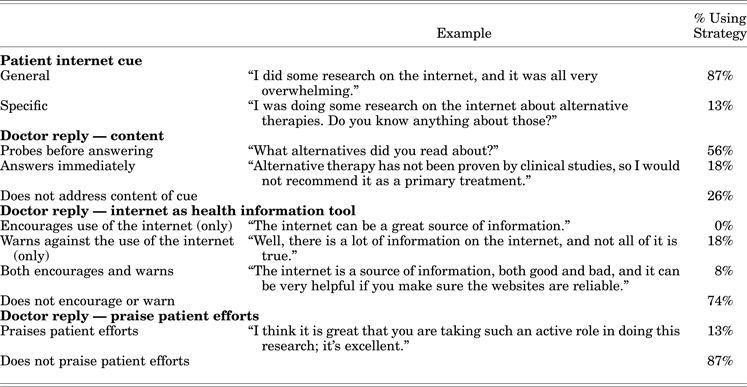
The second author transcribed the internet-related segments of the 39 video recordings of SPAs. The research team developed a brief coding manual to evaluate both the patient statements and the doctor responses. Each interaction about internet information was coded once for the patient statement and three times for the doctor statement. First, we coded for whether the patient's cue was general or specific. Then, the trainees' responses were coded (1) for content, (2) for how the trainee addressed the internet as a tool for patient research, and (3) for whether or not the trainee praised the patient. Each set of codes was mutually exclusive. The codes are listed with examples in Table 1. The SPAs were coded by two coders, with interrater reliabilities of kappa (κ) = 0.54 for the patient statement, 0.87 for content, 0.75 for the internet as a tool, and 1.00 for praise. Any discrepancies in coding were resolved by the research team.
Codes for patients' cues and doctors' replies

Data Analysis
We assessed for frequency of strategy use employing simple descriptive statistics. We also analyzed whether there were differences between male and female trainees on frequency usage.
RESULTS
Table 1 demonstrates the frequencies of skill use. The majority of SPs employed a general statement (87%) rather than a specific one (13%). Fifty-six percent used a probe to get more information before addressing the content of the internet search, 18% answered immediately without probing, and 26% never addressed the content of the internet cue. Some 18% of trainees warned the patient about the internet, while an additional 8% both warned about and encouraged use of the internet. The majority of trainees (74%) neither warned nor encouraged. Finally, 13% of trainees praised the patients for their use of the internet, while 87% of trainees did not. There were no significant differences in strategy use by trainee gender, although there was a trend for female trainees to be less likely to ignore the cue (p = 0.10).
DISCUSSION
The data from this formative study indicate that responses to patient statements about internet information have the potential to be multilayered: clinicians may respond to the content of what the patient was investigating on the internet; they may respond to the act of the patient seeking information; and/or they may respond to the tool that the patient utilized to seek information.
In this formative assessment, we found that the trainees generally seemed to be comfortable discussing the content of what the patient was investigating on the internet, with the majority probing for further information before addressing the internet information and others addressing it immediately. All of the trainees who did not address the content of the information had an SP who posed an indirect rather than a direct question. This may help explain the lack of a response, since research on doctor–patient communication has reported that doctors may not always reply to these kinds of indirect statements (Levinson et al., Reference Levinson, Gorawara-Bhat and Lamb2000).
Only about a quarter of the trainees gave the patient advice about the internet: 18% warned the patient, while 8% warned against but also advised them to use it. Research indicates that patients want guidance from their doctors on where to go for credible internet information (Diaz et al., Reference Diaz, Sciamanna and Evangelou2005). Trainees can be encouraged to endorse usage of the internet and to be open for any questions that patients may have.
Finally, just 13% of trainees praised the patient for seeking out information on the internet. Earlier work has shown that praising (or validating) patients for their internet use leads to greater patient satisfaction (Bylund et al., Reference Bylund, Gueguen and Sabee2007a). Teaching trainees to make a simple statement — such as “I'm glad to see you've been taking an active interest in seeking out health information” — before discussing the information has the potential of making a real difference for patients.
The literature indicates that there is room for improvement in healthcare internet discussions. The formative assessment reported on here demonstrates that this need also exists at the trainee level. We propose that it would be easy to integrate training on best practices about internet communication to graduate medical trainees through ongoing communication training and informal feedback. Although trainees may already be skilled at responding to the content of internet websites, they could be encouraged to praise patients' efforts and encourage interested patients to go to appropriate websites.
The limitations of this study include its small sample size and the variability of SP statements. Future work could examine educational interventions with trainees to improve their communication with patients about internet information, examining the effects of such on trainee behavior and patient perceptions.