


Introduction
During the Joseon Dynasty (1392–1897), many of Korea's most talented artists held positions in the royal court, where they made and preserved silk portraits of royalty, nobility, scholars, and public officials.Footnote 1 These were created and reproduced in great numbers for portrait halls and shrines throughout the country. Widespread destruction of the portraits and the documents regarding them took place during the Japanese invasions of Korea in the sixteenth century, as well as the Korean War in the twentieth century. This makes it impossible to meaningfully speculate as to how many were produced. However, surviving royal annals attest to the creation of as many as 26 portraits during only a 22-year period (1545–67). Furthermore, these records were only concerned with portraits made of a single subject: King Taejo.Footnote 2 Considering the wide variety of subjects in the surviving portraits and the long length of the Joseon Dynasty, it is likely that thousands of silk portraits were made. Unfortunately, only about 100 silk portraits have survived. Most of these are from the late Joseon period, and many of them are in poor condition, lacking half or more of the original image.Footnote 3
One of the most striking aspects of Korean silk portraits is the partial transparency of the canvas, which allows colouration from the back side of the canvas to be seen from the front.Footnote 4 The technique of painting the back of the canvas is generally referred to as baechae, although the words bokchae, bukchae, and bukseolchae are synonymous. This contrasts with the colouring of the front of the canvas, known as jeonchae.Footnote 5 In addition to allowing the creation of more vivid colours, this process helped to preserve the colours of the painting. Most of the pigments on the paintings were applied on the back of the canvas, while a significantly thinner layer of pigment was applied to the front. The back of the silk canvas was then pasted directly onto a paper backing, which sealed the thick baechae layer of pigment between the silk canvas and the paper. This significantly limited exposure of the pigments to the elements and helped to prevent them from peeling or flaking.Footnote 6
Silk canvases were difficult to produce and made in small quantities.Footnote 7 Therefore, court artists began each portrait by drawing the subject on paper. To emulate the transparent effect of a silk canvas, the artists applied oil to the paper, which made the paper translucent. Although these artworks are generally referred to as ‘oiled paper sketches’, they were very refined. They began with only charcoal lines, but those were usually traced over with ink, and both sides of the paper were coloured as tests for the final portrait.Footnote 8
These paper drafts were very important in establishing the look of the final portrait. In fact, the final portraits were traced directly from the oiled paper sketches. Thus, multiple sketches were made for each portrait to allow iteration and refinement.Footnote 9 This suggests that these paper sketches may have existed in even larger numbers than the silk portraits. However, there are now only about 70 extant paper sketches.Footnote 10
For this article, three oiled paper sketches of Portrait of Yi Bok Shin Footnote 11 (1698–1786) were examined. This is the only extant set of sketches depicting three iterations of the same basic image. It is unknown whether these sketches were used as the basis for a silk portrait but, based on the expense of the materials used and the quality of the techniques displayed, it is probable. If a silk portrait was made, it is no longer extant. Given the small number of surviving Joseon portraits, this is not surprising. In fact, there are only three extant portraits for which both the final silk portrait and the oiled paper sketch have survived: Portrait of Deok Ji Choe (1384–1455), Portrait of Je Gong Chae (1720–99), and Portrait of Kyoung Joo Hong (unknown–1521).Footnote 12
Extensive scientific analyses of oiled paper sketches are also rare. Prior to the publication of this article, only three sketches had been fully analysed. Microscopic and X-ray fluorescence (XRF) spectroscopic pigment analysis (on both jeonchae and baechae) were performed on Portrait of Geup Yun (1697–1770), Portrait of Bong Han Hong (1713–78), and Portrait of Jeong Im (1694–1750).Footnote 13 Portrait of Geup Yun and Portrait of Bong Han Hong are in Portrait Sketches of Renowned Officials—a collection of portraits that are believed to have been painted by court portrait makers.Footnote 14 Portrait of Jeong Im is part of Portrait Sketches by Hui Su Im—a bound collection of 17 oiled paper sketches drawn during 1749 and 1750 by Hui Su Im (1733–50), an amateur portrait maker.Footnote 15 Both collections are held by the National Museum of Korea. Images and further details for all three sketches are available in Supplementary Materials A.
This article presents a non-destructive scientific analysis of the materials used in making the Portrait of Yi Bok Shin oiled paper sketches and discusses the techniques used by the anonymous artist. Additionally, a reproduction of one of the oiled paper sketches was made, which sheds new light on certain aspects of the construction of the sketches.
Provenance
Unfortunately, the exact history and authorship of the sketches are unknown. The portrait depicts Yi Bok Shin, who was a scholar and advisor under King Yeongjo. He was born in 1698 and entered public service in 1729.Footnote 16 Surviving government documents related to Shin are largely mundane and include exam results (sigwon), a salary certificate (nokpae), and 25 royal letters of appointment (gosin), which bestowed a variety of government posts upon him throughout his life.Footnote 17 Additionally, there is a record of the king's gifting him an exceptional horse on 16 May 1731, which suggests that he was held in high regard.Footnote 18
The exact date on which the sketches were made is unclear. As is common with court portraiture, Yi Bok Shin was painted wearing a dal-lyeong round collar robe and a samo hat. On both sides of the samo hat are ornamental flaps, which are called yang-gak. The embossed pattern featured on the yang-gak in the sketches is of a style that was uncommon until the 1770s.Footnote 19 As the court portraits were often painted following government promotions, the sketches may have been painted shortly after 5 December 1772, when the 74-year-old Shin was promoted to jeong-3-pum, the fifth highest rank (out of a total of 18 ranks) that could be held by a government official during the Joseon Dynasty.Footnote 20 This was a major honour as, along with gaining the Joseon-era political title of dangsanggwan, he would have been given the right to attend cabinet meetings and shape government policy more directly.Footnote 21 The sketches could also have been made a few months later as, in February 1773, Shin rose yet another rank to jong-2-pum.Footnote 22 Based on Shin's appearance in the sketches, an age of 74 seems reasonable. However, as there exists no documentation about the making of the sketches, this is largely guesswork. Shin's final promotion to the third highest government rank of jeong-2-pum occurred in April 1786 when he was 88.Footnote 23 He died three months later on 12 July 1786 and was buried in Suwon (modern-day Hwaseong).Footnote 24 The sketches were unknown to present-day scholars until they were donated to the city of Hwaseong in 2011 by Shin's descendants.
Initial assessment
Examination of the sketches began with measurements of the paper, which were taken using a ruler and Bluetec BD547-321 digital micrometer. Additionally, their overall condition was assessed. Table 1 details the dimensions and visually shows the various types of damage. The sketches were all slightly damaged but were in much better condition than most extant oiled paper sketches. It is likely that they were stored in rolls, which led to horizontal creasing. A few small parts of the papers are torn, but this damage does not significantly affect the brushwork. Several parts of the paintings show signs of spillage of various types of contaminants. Additionally, some thick layers of baechae pigment have cracked or flaked off. Unlike silk portraits, oiled paper sketches were not mounted for display, so the pigment on the back of the paper was not well protected. Finally, the paper has lost nearly all of its transparency and darkened over time. All oiled paper sketches are susceptible to this kind of discolouration.Footnote 25
Measurements and damage assessments for Portrait of Yi Bok Shin sketches

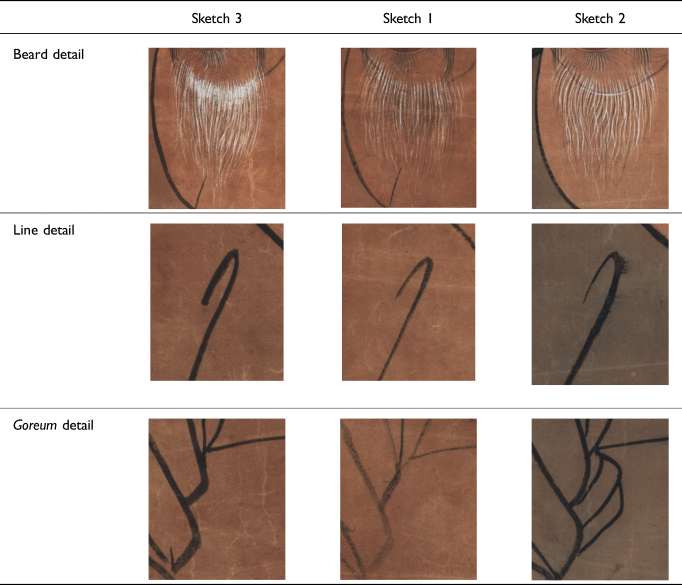
Based on details in the images, it is possible to make an informed judgment regarding the likely order in which they were produced. This can be seen in the quality of the lines and colouring, as well as by the details depicted (Table 2). Sketch 3 was likely the first image produced. The beard is depicted much more roughly, with many signs of correction. Its lines are also less nuanced and more uniform in thickness. Additionally, the goreum or breast tie of the robe is not depicted, and the colouration seems muted and unfinished. Sketch 1 shows more refined lines, but still lacks the goreum and also has muted colours. Sketch 2 has refined lines, the goreum, and stronger colours. Thus, the likely production order was Sketch 3 followed by Sketch 1 followed by Sketch 2. As Sketch 2 probably represented the final intent of the artist better than the others, it was the primary focus for the following analyses and reproduction work.
Details used to determine likely image production order
Material analysis
Although there are no historical documents related to the creation of these specific sketches, surviving royal protocol documents from the Joseon Dynasty detail the pigments used in the creation of several royal portraits. The dates of the documents range from 1688 to 1872. However, there is not much variation in the pigments used throughout this period. Every portrait for which documentation exists used cinnabar and yeonji (red pigments), azurite and indigo (blue pigments), orpiment and gamboge (yellow pigments), and malachite (a green pigment), along with lead white, gold leaf, and gold powder. For blacks, carbon black (always made from pine tree ash) was usually used for colouring large areas, while ink made from plant oil soot was used for line work. Massicot is listed as an additional pigment for all early paintings but is last attested to in 1748. From 1748 onwards, iron oxide red was also used in all paintings. Finally, two rarely used pigments, namely yellow ochre and shell white, are attested to for only two portraits each.Footnote 26
Using these records of traditional pigments, along with microscopic images and XRF spectroscopic data, the sketches were analysed to determine which pigments were used. These analyses were performed for all sketches. However, there were no significant differences between the sketches, so this article only gives a detailed analysis for Sketch 2.
Pigment analysis was conducted on both the front and the back of the paper in the same areas with the exception of the facial details that were only painted on the front. The first stage of analysis was XRF spectroscopy—a non-destructive method of chemical analysis. XRF spectroscopy was performed using a handheld Olympus Vanta VMW XRF Spectrometer that employs a silicon drift detector. The acquisition time was 70 seconds for all measurements, using 4 watts of power at 40 kilovolts. Detailed XRF data can be found in Supplementary Materials B. Through this XRF analysis, it is possible to detect the chemical elements making up the pigments on the paper. For instance, if XRF indicates a strong presence of mercury and sulphur in an area, the pigment can be tentatively identified as cinnabar.
XRF data is excellent for eliminating potential pigments. For example, if no lead is found in a certain area, then the pigment cannot possibly be lead white. Additionally, in situations in which different pigments are visually indistinct, XRF allows identification. For example, two white pigments used in Joseon portraiture were lead white and shell white. Even at the microscopic level, these are visually indistinguishable. However, if an XRF analysis detects lead in the pigment, then the pigment can be identified as lead white. If calcium is detected, then the pigment can be identified as shell white. This makes XRF a powerful tool for pigment analysis. Nevertheless, accurate identification of pigments also requires a visual examination via microscopy, as well as the categorical data provided by the royal protocol documents.
Used in isolation, XRF data cannot identify pigments with perfect accuracy, for several reasons. First, impurities in the sketches that existed at the time of creation or were accumulated later can impact results. Second, XRF analysis is only effective on inorganic pigments. Third, even at energy levels below what is needed to accurately identify pigments, X-rays have a penetration depth through oil of approximately 0.6 millimetres.Footnote 27 As the average thickness of the oiled papers is only 0.1 millimetres, the X-rays penetrate the entire paper. The papers are painted on both sides, which results in a significant amount of XRF bleed-through. Some jeonchae pigments can be detected when analysing pigments on the back of the paper and some baechae pigments can be detected when analysing pigments from the front of the paper. Additionally, the X-rays penetrate the surface of the table on which the paper is lying, which can cause additional elements to be detected.
To combat these problems, microscopic images of all XRF sampling sites were taken using a handheld I-Megascope 1080P microscope. All images can be found in Supplementary Materials B. A microscopic investigation of sketches reveals details about the pigments that cannot be observed with the naked eye or through XRF data. As an example, the XRF analysis of the jeonchae pigment for Shin's lips detected mercury and sulphur, which could suggest cinnabar. It also detected lead, which could suggest lead white. Additionally, it detected iron, which could suggest iron oxide red. All of these pigments are attested to in the royal protocol documents. However, the microscopic imagery clearly shows that these pigments were not used on the front side of the paper. First, inorganic pigments such as cinnabar tend to retain their shape and microscopic images can reveal the individual granules of pigment. On the other hand, organic pigments tend to decay and create homogeneous sections of colour.Footnote 28 In Figure 1, this difference can be clearly seen by comparing the microscopic image of the cinnabar used for the facial baechae to the red pigment used for the lip jeonchae. While the baechae clearly shows grains of cinnabar, the lips do not. Thus, cinnabar can be ruled out as a potential pigment for the lips. Additionally, the texture of the paper fibres is clearly visible underneath the pigment. These fibres would be entirely obscured with even a thin layer of lead white pigment (again, compare the images in Figure 1). This rules out the use of lead white. Iron oxide red can be ruled out based on the colour, which is the wrong hue and too saturated and bright to be caused by iron oxide red. Of course, the XRF data is accurately detecting the elements. However, the mercury, sulphur, and lead are being detected due to the baechae use of cinnabar and lead white on the opposite side of the paper. The presence of iron is less obvious but, as iron oxide red is used as the jeonchae pigment for the face, it is likely that the entire face was washed with a thin layer of iron oxide red before the lips were detailed with another pigment. Thus, having ruled out all inorganic pigments from the protocol documents that were detected via XRF, it can be deduced that the pigment used is an organic red pigment. There is only one such pigment in the royal protocol documents: yeonji. Unfortunately, the ingredients used in its creation varied considerably,Footnote 29 so its exact composition in this painting cannot be determined.
Microscopic comparison of pigments.
Source: author.

By knowing which pigments were likely used from royal protocol documents and combining both XRF and microscopic analysis, the composition of all pigments other than yeonji were identified to a high degree of certainty. Table 3 compares the pigments in the Portrait of Yi Bok Shin sketches to the other sketches that full pigment analyses exist for. There is not much variation in the pigments used among the sketches.
Pigment comparison between portrait sketches1
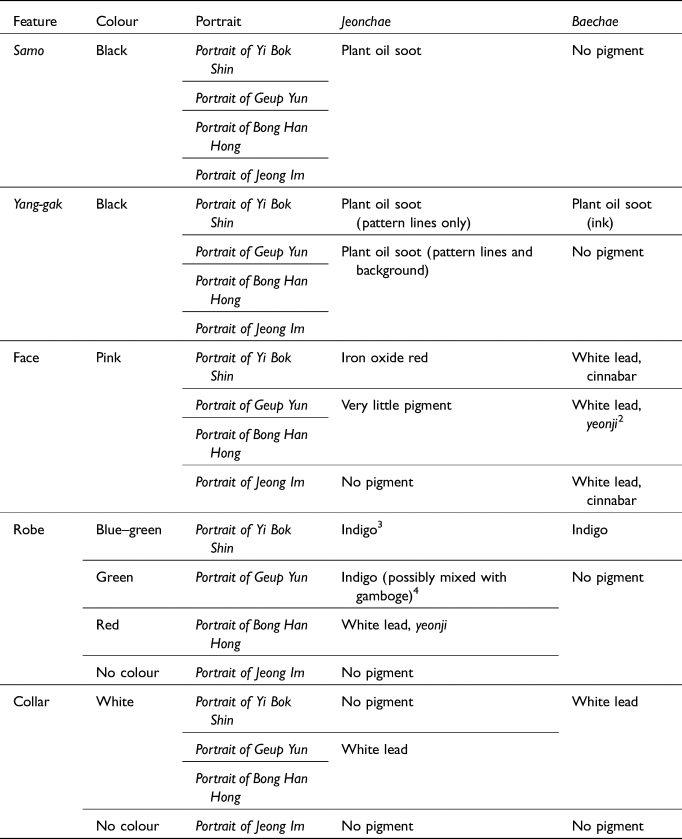
1 Data for Portrait of Geup Yun, Portrait of Bong Han Hong, and Portrait of Jeong Im from Yu, Chang, and Yun, ‘Pigments analysis’, pp. 265, 268, 271.
2 The source documentation does not speculate beyond the XRF data, which rules out inorganic red pigments. Some form of red pigment would be required to create this colour. Therefore, the organic pigment yeonji can be identified.
3 The XRF analysis rules out other potential blue pigments, which are all inorganic. This leaves organic indigo as the only likely pigment. The green tint in the final sketch is due to the naturally yellow colour of the oiled paper.
4 The pigment analysis table in the source lists white lead as a likely pigment. However, in the list of detected elements, lead—the primary element detected for white lead—is not mentioned. The microscopic images also show no trace of white lead or other inorganic pigments. Therefore, I assume that this is a typographical error. Since no significant amounts of inorganic elements were detected in this area, it must be an organic pigment. The exact hue is difficult to surmise based on the provided images, and the description merely lists the colour as ‘green’. It almost certainly uses indigo and, depending on how green the hue is, it may employ gamboge as well. This was a common combination.
However, one significant difference among the sketches is the red pigment used for the facial baechae. While Portrait of Geup Yun and Portrait of Bong Han Hong use much less expensive yeonji pigments, Portrait of Yi Bok Shin uses cinnabar. This is surprising, as cheaper organic pigments were usually used for this in oiled paper sketches.Footnote 30 However, it is attested to in all three Portrait of Yi Bok Shin sketches, not only by using XRF analysis (which showed mercury and sulphur), but also by microscopic images that clearly show the inorganic particles (Figure 2). Portrait of Jeong Im was painted during the same general period, also using cinnabar. However, unlike the other portraits, it was painted by an amateur artist, so it may not represent common practice for court painting. Unfortunately, with so few data points currently available, it is unclear whether this difference in pigment choice is significant. Silk portraits use either cinnabar or iron oxide red for this purpose—to my knowledge, all portraits of kings used cinnabar,Footnote 31 whereas portraits of lower officials could use either pigment.Footnote 32 The use of such a luxurious material in the sketches might suggest that the artist of the Portrait of Yi Bok Shin sketches was trying to more closely mimic the look of a final silk portrait.
Microscopic images of cinnabar pigment (mixed with white lead).
Source: author/Hwaseong City Museum of History.

All of the black pigment in the sketches appears to be made from plant oil soot. Although oil soot ink and powdered pine tree ash are both commonly used in silk portraits, all oiled paper sketches that have been analysed use only oil soot ink. This can be determined through using a microscopic examination, as pine tree ash creates a rough, leather-like texture, whereas oil soot ink is very smooth.
Royal protocol documents attest to traditional Korean paper (hanji) made from paper mulberry (Broussonetia papyrifera) being used for oiled paper sketches.Footnote 33 Although a thorough scientific analysis of the paper would require destructive techniques, the thickness of the paper and the long fibres seen in the microscopic images are consistent with this kind of paper. The paper was treated with oil. Sesame, perilla, tung, and soybean oil were often used for this purpose.Footnote 34 Unfortunately, without resorting to destructive methods, it is not possible to identify the specific oil used for these sketches.
Technique analysis and reproduction
A step-by-step analysis of the process and techniques used to make oiled paper sketches follows. This analysis is based not only on historical documents and previous research, but also on the practical experience gained from the creation of a reproduction of Sketch 2, using traditional materials and methods. This reproduction required both experimentation and an application of traditional processes, which gave new insights into the creation of oiled paper sketches. Images of the reproduction are used throughout this section to illustrate features of the sketch.
Preparing the paper
First, traditional mulberry paper was coated with oil. Although the exact oil used in these sketches is unclear, soybean oil was chosen for the reproduction, as the traditional methodology for creating and applying it is well documented in royal protocols from the time.Footnote 35 Soybeans were soaked in water, ground, and filtered. Then, the resulting mixture was applied onto the paper in thin layers. As the mixture dried, the water evaporated, leaving a smooth film of soybean oil.
For the reproduction, traditional Korean paper was made by Shin Hyun Se Traditional Hanji. Traditional hanji paper is unique to Korea, having a distinctive grain structure and pH level.Footnote 36 The paper for this project was specially made to the following specifications: 100 per cent paper mulberry bark, processed traditionally by boiling with plant ashes with fibre dispersal via liquid from the roots of aibika (Abelmoschus Manihot). The resulting fibres were formed into a single webal sheet and wood dried.
The oil coating was created using soybeans. White soybeans were used as they have a higher oil content than other varieties.Footnote 37 Following previous research, the soybeans were mixed with water in a 1:2 ratio by weight.Footnote 38 The liquid was then filtered several times through a tightly woven ramie fabric to remove soybean particles and create a smooth liquid. It was brushed onto the paper in thin layers and allowed to fully dry after each application (Figure 3). The primary purpose of the oil coating is to create transparency that allows the baechae colouring to show through to the front of the picture. To maximise transparency in the reproduction, experiments where performed using six, eight, and 10 layers of the soybean mixture. More oil will generally produce greater transparency and, in fact, eight layers of the mixture created more transparency than six. However, likely due to the greater accumulation of soybean particles, 10 layers were less transparent than eight. Therefore, eight layers were used. Due to slight variations in thickness caused by the paper manufacturing process, five different sheets were coated with eight layers of oil and evaluated. The final paper chosen for the reproduction measured 0.09 millimetres thick after coating—the same thickness as the original sketch.
Filtering and application of soybean liquid (reproduction).
Source: author/Hwaseong City Museum of History.

In addition to the added transparency, the oil coating also improves the uniformity of the ink lines. On untreated paper, the fibres of the paper are unevenly coated, whereas oiled paper produced lines with an unbroken texture. The smoother lines are more similar to the lines seen on silk portraits. This is especially evident when magnified (Figure 4).
Line comparison (reproduction).
Sources: (a) and (b) author/Hwaseong City Museum of History; (c) author.

Line work
After the paper was prepared, the court artist would have begun the sketch by drawing lines.Footnote 39 Lines were considered of utmost importance in traditional Korean portraiture. An axiom from neo-Confucianist Yi Cheng (1033–1107) held that, if a single hair was out of place, then the entire person was changed. This was of special concern as portraits were often used for ancestral worship. To make sure offerings went to the intended recipient, it was vital that the subject be accurately depicted.Footnote 40 Every hair, blemish, and wrinkle was painstakingly drawn as precisely as possible. Unlike facial details, clothing was not considered a part of the individual. Therefore, it did not need to represent reality to such a high degree of precision. As a result, oiled paper sketches did not focus overmuch on clothing details. They usually depicted the basic outlines and shape of the clothing but saved the more demanding line work for the silk portrait.Footnote 41
Lines were first drawn using traditional willow charcoal (Figure 5).Footnote 42 Charcoal lines could be easily erased from the oiled paper, which allowed artists to correct their mistakes when detailing the important features of the subject.
Charcoal lines (reproduction).
Source: author/Hwaseong City Museum of History.

The line work was finished using a fine brush and oil soot ink (Figure 6).Footnote 43 The lines depicting the face are uniform in thickness. These are Korean variations on Chinese tiě xiàn miáo and gāo gŭ yóu sī miáo techniques. Most of the lines depicting the dal-lyeong begin as thick and taper towards the end, similarly to Chinese dīng tóu shŭ wěi miáo lines. The use of these lines is typical of Joseon silk portraiture.Footnote 44 The use of nuanced tapered lines is indicative of more care being directed towards clothing line work than in most oiled paper sketches. As with the use of cinnabar mentioned earlier, this represents the artist's close adherence to silk painting techniques.
Ink lines (reproduction).
Source: author/Hwaseong City Museum of History.
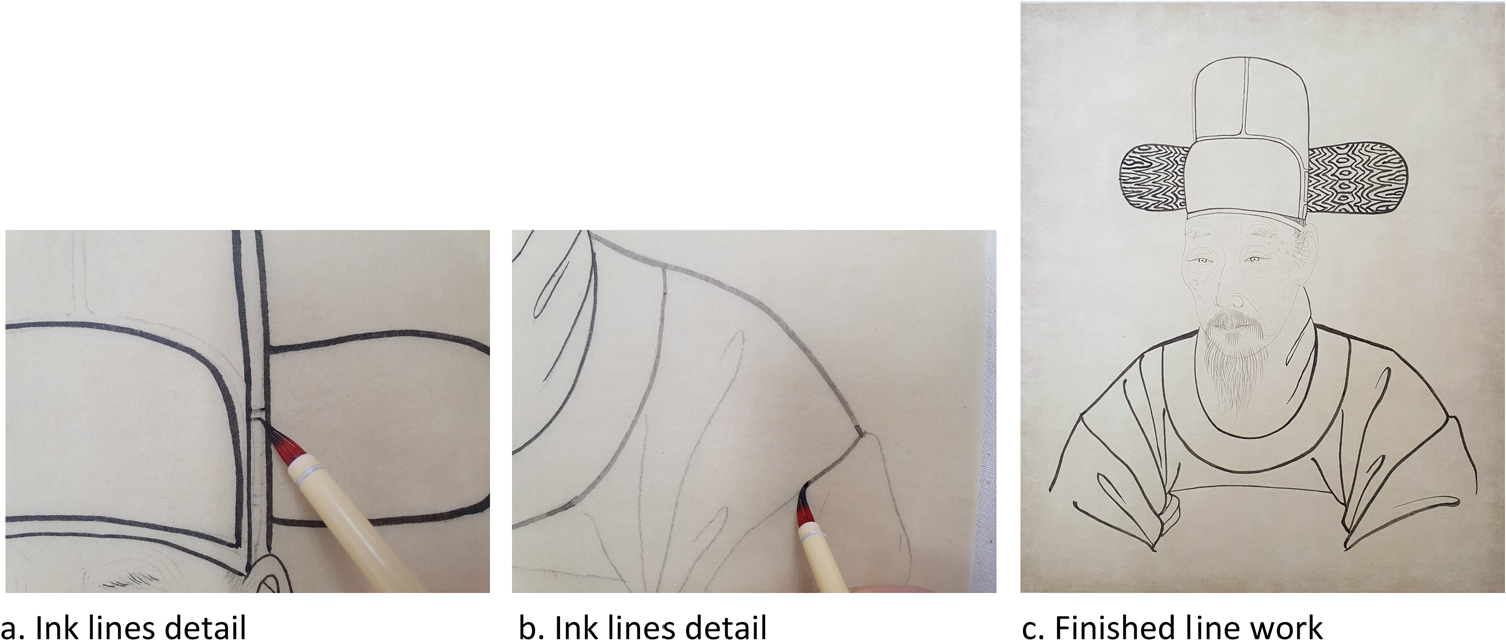
The fine point of a brush allows more control over line thickness than charcoal. However, the permanence of ink also shows the reason for the earlier charcoal work. The artist made a mistake with one of the ink lines outlining the samo hat. He drew a new line to correct it but, since ink cannot be erased, the original line is still visible. Of course, if the purpose of this sketch was to be traced onto a silk portrait, then the extra line would simply be ignored during the tracing process. In fact, Portrait of Je Gong Chae (one of the only extant sketches for which a final silk portrait exists) shows much more radical corrections to the entire robe (Figure 7).
Corrective ink line comparison (original sketches).
Sources: (a) Hwaseong City Museum of History; (b) Suwon Hwaseong Museum, with permission.

Several lines that depict folds in the dal-lyeong in Sketch 1 and Sketch 2 are atypical. These lines are on the right-hand side of the image and make a 180-degree change in direction at the top, resulting in a shape resembling a sharp hook (see ‘Line detail’ in Table 2). While the shape is not unusual, the thickness of the lines is. They show extreme tapering that begins immediately after the change in direction. To my knowledge, this is unique not only among oiled paper sketches, but also among final silk portraits. It is likely exclusive to this particular artist. Using it as a signature, it may be possible to identify other portraits made by the same artist. Unfortunately, due to the dark colouration often used on robes in silk portraits, the detail of these lines cannot be clearly seen in most published photographs. A close, in-person investigation of the surviving portraits from the time period would be required.
Colouring
After the line work was completed, colouring began with the baechae on the back of the paper (Figure 8).Footnote 45 The use of baechae colouring allowed rich colouration with only a thin layer of pigment on the front of the paper.Footnote 46 The baechae on the oiled paper sketch shows signs of experimentation. It is likely that the artist was testing pigment mixtures and dilution for both the skin and the yang-gak on the oiled paper (Figure 9). These tests were performed on the body of the samo hat, presumably because they would not have been visible after the black jeonchae pigment was applied to the front. This kind of testing is common in oiled paper sketches.Footnote 47 There are many examples, including both Portrait of Geup Yun and Portrait of Bong Han Hong included in Supplementary Materials A. On the other hand, final silk portraits typically have immaculate baechae work. Baechae details are usually not clearly visible due the back of the canvas being mounted to a paper scroll, so it is not possible for anyone to speak with authority regarding all of them. However, during remounting and restoration projects, I have seen the baechae for about 20 per cent of the surviving silk portraits, and none of them showed this kind of experimentation.
Baechae colouring detail (reproduction).
Source: author/Hwaseong City Museum of History.

Baechae pigment tests (original sketch).
Source: Hwaseong City Museum of History.
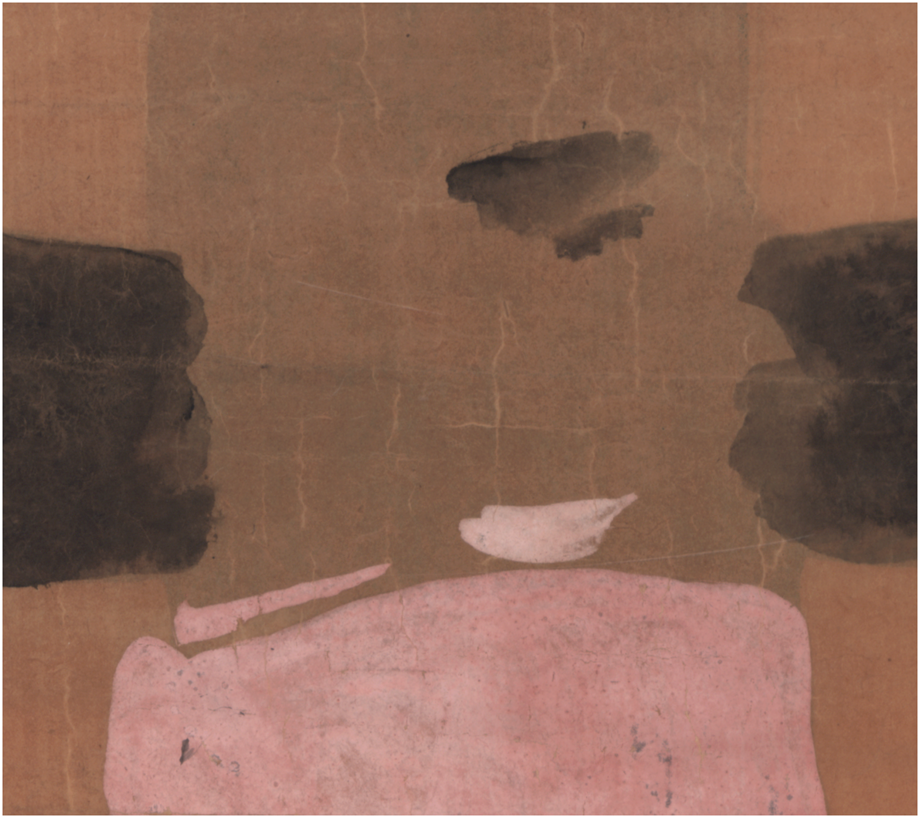
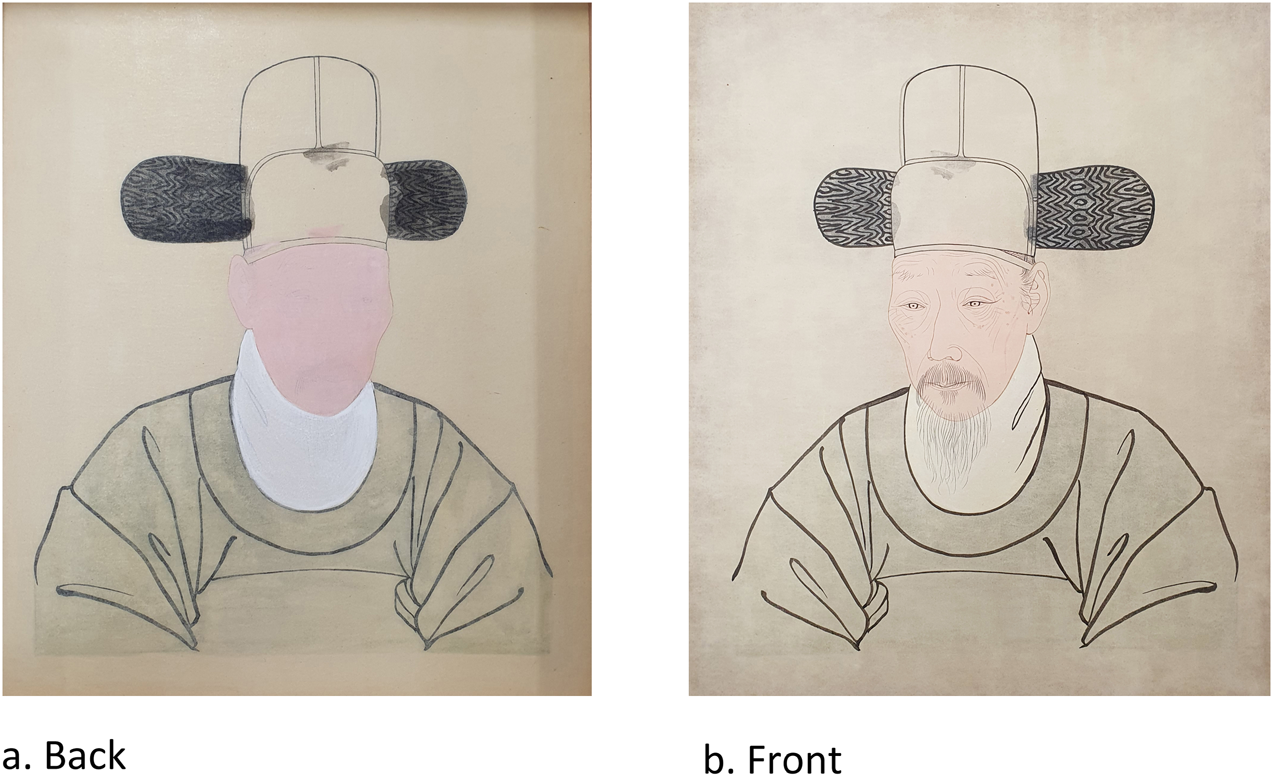
Additionally, the back sides of the yang-gak were painted with a thin layer of ink. The back of the face and the dal-lyeong also received baechae. As can be seen in Figure 10, the impact of the baechae was very significant before the paper browned and lost most of its transparency. The baechae shows through clearly so that, even from the front of the paper, the image appears coloured.
Completed baechae colouring (reproduction).
Source: author/Hwaseong City Museum of History.
Next, the jeonchae colouring on the front of the paper was done (Figure 11).Footnote 48 Except for the body of the samo, which only had baechae pigmentation tests, every feature in the sketch has baechae colouring. The jeonchae was therefore applied very thinly to allow the baechae to show through.Footnote 49 Facial details received special attention. Colours were added to facial blemishes and shading was added to wrinkles.Footnote 50 Changes to skin tone were made using barim—a traditional painting technique, which involves applying paint with one brush and using another to ‘wash’ the area with water. Barim is similar to the Chinese technique of xuàn rǎn. It creates a smooth gradation of colour without visible brushstrokes.Footnote 51
Jeonchae colouring (reproduction).
Source: author/Hwaseong City Museum of History.
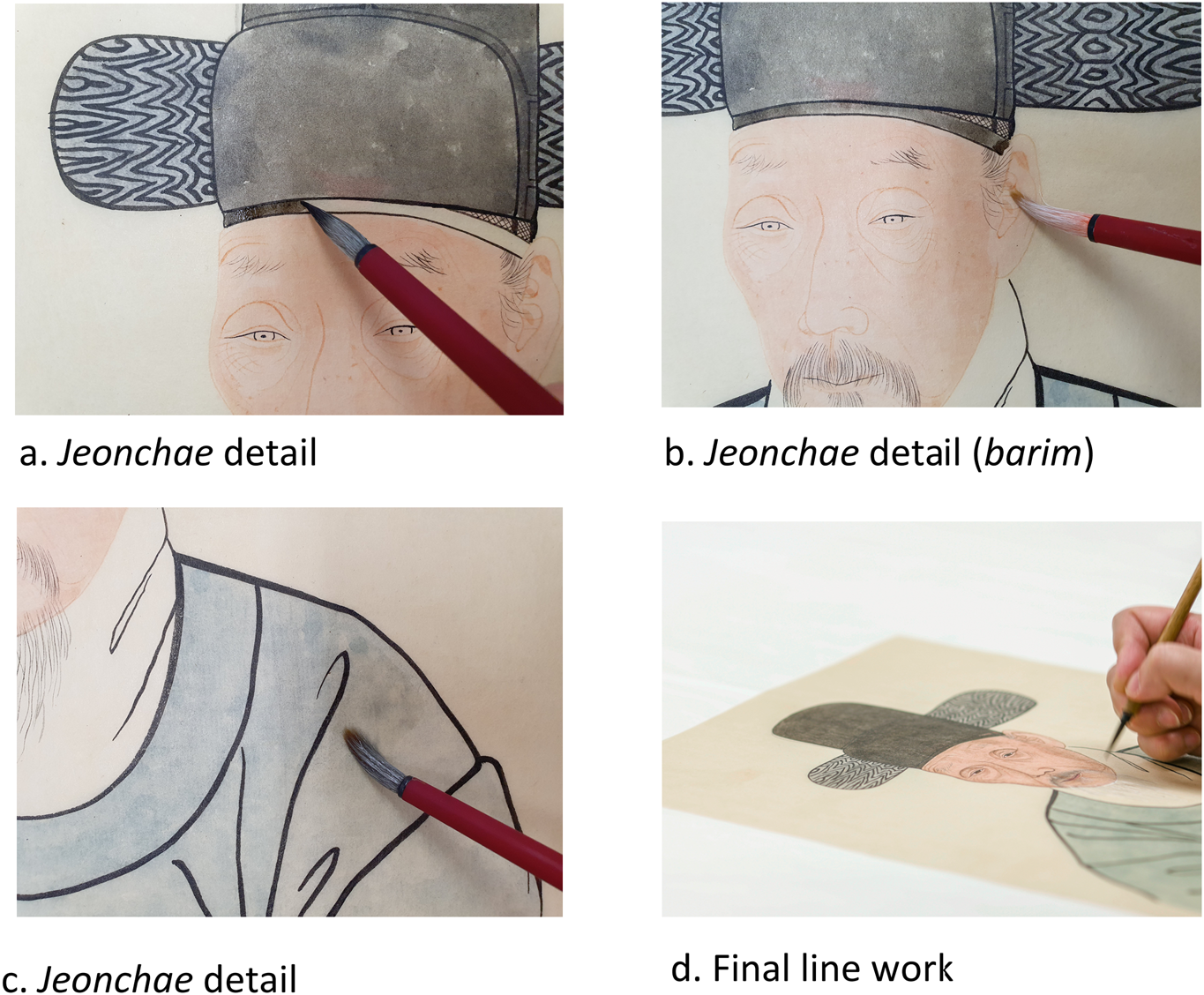
Finally, lines that were partly obscured by overlapping layers of pigment were redrawn (Figure 11d). This includes the facial detail lines, which were made using a combination of oil soot ink and iron oxide red to create a brownish colour.Footnote 52 The last lines made were the white hairs, which appear on the topmost layer in microscopic examinations.
There are some minor differences in technique between the Portrait of Yi Bok Shin sketches and the other three sketches in Supplementary Materials A. First, unlike all the other sketches, the yang-gak in Portrait of Yi Bok Shin have a layer of baechae ink. This provides a base black level, so the front of the paper only has ink lines depicting the yang-gak pattern. In the other portraits, all yang-gak colouration was done via jeonchae. The Portrait of Yi Bok Shin sketches were also unique among the group in their use of baechae colouring for the robes. All known silk portraits have baechae for clothing, so—as with the use of cinnabar and the careful line work discussed above—this shows a tendency for the artist of Portrait of Yi Bok Shin to hew more closely to final silk portrait methodology. One last difference between the other courtly sketches and Portrait of Yi Bok Shin is worth mentioning. While the other two professional sketches use both white baechae and white jeonchae for the collar of the robe, the Portrait of Yi Bok Shin sketches use only white baechae. Both methods of colouring collars can be found in silk portraits,Footnote 53 so this likely represents the artist's intent not to use white jeonchae for the collar on the final portrait.
Final reproduction and silk portrait reconstruction
After a final comparison to the original painting, where small corrections to hue, saturation, and brightness were made, the final reproduction gives an accurate view of what the sketch looked like when it was originally made (Figure 12b). The difference between the surviving sketch and the reproduction is dramatic, especially due to the transparency of the freshly oiled paper. At the time of writing, it has been approximately one year since the reproduction was completed. Already, the paper has begun to darken and turn brown, losing its transparency and revealing the ephemeral nature of oiled paper sketches.
Full comparison images.
Source: Hwaseong City Museum of History.

It is impossible to know whether Sketch 2 was considered satisfactory for transference to a more luxurious silk canvas. If it was, drafting would not have been done on the silk canvas, as the extreme transparency of silk makes erasure impossible. Instead, the lines on the oiled paper sketch would have been directly traced onto a silk canvas using ink and brush.Footnote 54 After the ink tracing was done, the portrait would have been coloured (as before) on both sides, likely using more expensive inorganic pigments. Additionally, as the focus of the sketch was primarily the line work details for the face, more elaborate shading and clothing details would also have been added. The painting would have then been mounted onto a paper scroll and decorated with tassels and silk.Footnote 55 The full process is beyond the scope of this article. However, a reconstruction was made and the image is included as Figure 12c.
Conclusion
The Portrait Yi Bok Shin sketches are unique among oiled paper sketches. They exist as a set, which gives an insight into the iterative process of traditional portrait drafting. The clear refinements and corrections made to the image through the three sketches give a deeper understanding of how traditional court artists developed their portraits. The nuanced line work and baechae colouring for the clothing are unusual, as is the use of cinnabar for the facial baechae. This makes these sketches more similar to silk portraits in terms of both techniques and materials. Finally, some of the lines used to depict folds in the clothing appear to be of a unique type. This could be used in future research to identify other artworks by the unknown artist.
Despite these differences, the sketches are still representative of a large tradition of oiled paper portraits from the late Joseon Dynasty. They all make use of similar pigments and paper. They all use similar techniques for oiling the paper and drawing lines. Like the silk portraits that are based on them, all oiled paper portraits exhibit a similar devotion to the idea of capturing the true image of their subject as accurately as possible, using accurate line work and colouring on both sides of the image using baechae and jeonchae techniques.
While most oiled paper sketches have been lost though Korea's turbulent history, those that remain may provide new understandings about important matters of history, culture, and art. Unfortunately, to date, few have been thoroughly studied. In fact, to my knowledge, this analysis of only three sketches has effectively doubled the number of sketches that have had full microscopic and XRF spectroscopic analyses performed for both the baechae and jeonchae sides of the paper. It is my hope that others will continue to see the value of analysing and preserving these cultural treasures.
Supplementary material
The supplementary material for this article can found at https://doi.org/10.1017/S1356186323000251
Acknowledgements
I am grateful to the Hwaseong City Museum of History for the opportunity to study these sketches.
Conflicts of interest
None.



