INTRODUCTION
Sitting in Chicago’s Central Bond Court, we are surrounded by family and friends waiting anxiously to see their loved ones and learn the outcome of their bond hearings. Courtroom One Hundred, the setting of Central Bond Court in Cook County, is an overwhelming setting, both physically and psychologically. It consists of harsh yellow lighting, rigid and uncomfortable wooden benches, and strict rules that stifle normal physical activity, such as a ban on eating/drinking, talking, reading, or closing your eyes for too long. Bond court is a place where information is limited and behavior that deviates from the strict set of rules is penalized. Typically, a person’s bond hearing occurs within seventy-two hours of an arrest and lasts a matter of seconds. In these seconds, a judge assesses a monetary amount that must be posted in order for a person charged with a crime to be released while awaiting trial. This monetary amount is often joined by conditions of release, such as regular check-ins from a county agency called Pretrial Services, electronic monitoring, and/or drug tests.
When a person is charged with a felony, their closest social ties typically attend bond court in order to hear their loved one’s bond amount/conditions and to provide moral support. In addition, many judges view supportive presence in court as an indicator that a person charged with a crime has ties to the community, which is often stated as important mitigating information for one’s bond outcome. While it is important for family and friends to be present in court, it often comes at a cost, whereby supporters are pulled into the punishment apparatus during their loved one’s very first court appearance.
In this article, we build on Megan Comfort’s (Reference Comfort2008) concept of legal bystander to describe the punishment associated with attending bond court for supporters of people charged with a crime. By utilizing courtroom ethnography of bond court and interviews with family and friends of people charged with a crime, we make two main contributions. First, we add to scholarship that documents the impact of the criminal legal system on the social ties of people with criminal legal contact. Here, we use “supporter” and “legal bystander” interchangeably to refer to family and friends of people charged with a crime that attend bond court. Scholars have considered the impact of incarceration pre-conviction, illustrating how short-term jail stays create instability and increased burdens of care for family members of criminalized people (Comfort Reference Comfort2016). This body of literature has shown how legal bystanders experience punishment in their homes and neighborhoods and in jails and prisons (Comfort Reference Comfort2003; Reference Comfort2007; Reference Comfort2008), but there is a lack of information about how they similarly experience punishment in courtrooms. Recently, scholars have called for the expansion of the analytical scope of punishment from that of solely imprisonment to a wider understanding of collateral consequences of criminal legal contact (Wakefield, Lee, and Wildeman Reference Wakefield, Hedwig and Christopher2016). We respond to this call by contributing information about the punishment that supporters experience by attending court months and sometimes years before incarceration (Comfort Reference Comfort2003; Braman Reference Braman2004; Aiello and McCorkel Reference Aiello and McCorkel2018; Miller Reference Miller2021).
Second, we contribute to the literature on procedural punishment, wherein scholars show the penalty associated with due process and pretrial hearings, such as the time spent attending status hearings or continuances for one’s case (Feeley Reference Feeley1979; Gonzalez Van Cleve Reference Gonzalez Van Cleve2016; Kohler-Hausmann Reference Kohler-Hausmann2018). We show that this punishment is also felt by supporters and, in doing so, we parse out different themes of punishment experienced during the process of attending court. Specifically, supporters experience punishment through extraction of resources, destabilization, and degradation. First, we define extraction as the seizing of resources from family and friends. Second, we describe destabilization as powerlessness or a loss of control for family and friends. Finally, we use degradation to illustrate how the state utilizes shame and fear to make family and friends feel humiliated.
By bridging the literatures between secondary prisonization and procedural punishment, we show that family and friends are pulled into the punishment apparatus simply by attending court hearings, even before a loved one is incarcerated and/or a loved one’s case is adjudicated. Because previous literature illustrates punishment experienced by a subset of this population (that is, legal bystanders of incarcerated people), our findings suggest that a larger proportion of people experience the punishment associated with being a legal bystander than previously accounted for (Comfort Reference Comfort2007; Reference Comfort2008). That is, there are more people that have a loved one charged with a crime than there are people that have a loved one incarcerated. This widens the analytical net of punishment-by-association to show that the penalties associated with being a legal bystander are more widespread than previously accounted for. Importantly, historic and current criminalization of Blackness and poverty ensures that those most likely to be impacted by attending court are disproportionately poor and Black or Latinx (Alexander Reference Alexander2010; Muhammad Reference Muhammad2010; Hinton Reference Hinton2016). They are also most likely to be poor, Black women (Page, Piehowski, and Soss Reference Page, Piehowski and Soss2019).
THE RIPPLE EFFECTS OF INCARCERATION
Many scholars have illustrated the ripple effects that incarceration has on the social network ties and communities of people who are detained in jails and prisons (Comfort Reference Comfort2003; Reference Comfort2008; Braman Reference Braman2004; Aiello and McCorkel Reference Aiello and McCorkel2018; Miller Reference Miller2021). These negative consequences have been theorized as “secondary prisonization,” wherein family and friends who visit their loved ones are also subjected to the surveillance and control associated with prisons and jails (Comfort 2003; Aiello and McCorkel Reference Aiello and McCorkel2018). This conceptual framework is central to the field and has helped elucidate the cost of incarceration for supporters. Importantly, scholars typically focus on individuals whose loved ones have already been convicted and are serving time in a state or federal prison. Recently, Reuben Miller (Reference Miller2021) has detailed how, what he calls the “afterlife of mass incarceration,” also impacts family members and loved ones of people with felony convictions. Still, even before a prison sentence is being served, these same supporters may play the role of “legal bystander,” whereby they are drawn into the “state’s punishment apparatus” (Comfort 2008, 271) because a family or friend has been charged or suspected of criminalized activity. Beyond secondary prisonization, legal bystanders can experience surveillance in their homes or neighborhoods or emotional burdens before they interact with a formal correctional institution (Comfort 2008; Miller Reference Miller2021). Specifically, legal bystanders experience an impact on their resources, family status, and mental health when a loved one is involved with the criminal legal system.
Legal Bystanders and Extraction
Previous research illustrates the extraction of financial resources that incarceration imposes on family and friends. When a loved one is incarcerated, family members are often charged with providing overpriced personal items from the commissary, paying for collect phone calls, and/or covering expensive monetary sanctions and subsequent legal debt (Braman Reference Braman2004; Hairston and Oliver Reference Hairston and Oliver2006; Harris, et al. Reference Harris, Heather and Katherine2010; Harris Reference Harris2016; Lara-Millan Reference Lara-Millan2021; Miller Reference Miller2021). On top of these costs directly associated with incarceration, the absence of the loved one’s income is often strongly felt, with nearly half of incarcerated individuals contributing at least 50 percent to the total household income of their family prior to incarceration (deVuono-Powell, et al. Reference deVuono-Powell, Chris, Alicia and Azadeh2015).
There are also specific costs associated with pretrial detention even before a loved one’s case is adjudicated, such as paying bond and/or paying for an attorney for the ongoing case. For instance, we know that families of people charged with a crime are financially strained, especially low-income families who are potentially losing a household wage earner and/or must choose between paying for basic necessities and posting bond for a loved one (Wiseman Reference Wiseman2014; Cochran Reference Cochan2019). Women of color are often the most likely to bear the brunt of this burden (Page, Piehowski, and Soss Reference Page, Piehowski and Soss2019). Additionally, when a loved one is incarcerated pretrial, family and friends are called on to collect evidence and build a defense case (Wiseman Reference Wiseman2014). This role becomes increasingly important because it is often difficult for the person charged with a crime to contact their attorney, leaving supporters to act as significant intermediaries between the person charged with a crime and the defense counsel (Wiseman Reference Wiseman2014). This illustrates that, in addition to money, supporters must invest their time when a loved one is detained pretrial. Still, we know less about the specific impact of attending court for family and friends of people charged with a crime.
Legal Bystanders and Instability
People with incarcerated loved ones are also more likely to face instability. Two instances of this instability include interventions on family relationships and disorientation during interactions with the criminal legal system. In terms of family relationships, convictions and incarceration can place strain on social ties resulting in changes to family structure (Western and McLanahan Reference Western and Sara2000; Braman Reference Braman2004; Lopoo and Western Reference Lopoo and Bruce2005). For instance, there is an increased likelihood of divorce when one member of a married couple is incarcerated (Apel, et al. 2009). Similarly, when a partner is incarcerated, some repartner as a way to create a new beginning and also to avoid association stigma (Nurse Reference Nurse2002). Children of incarcerated parents are also affected, in that they are more likely to have a change in living situation, have a change in custody or parent-relationship, and/or experience financial hardship (La Vigne, et al. Reference La Vigne, Elizabeth and Diana2008). This can also occur earlier on in instances where Child Protective Services is called upon the arrest of a parent, leading to a change in family structure long before the parent is convicted (Miller Reference Miller2021). Still, there is less information about how this instability occurs in the earliest stages of the criminal legal process.
In addition to instability to family structure, legal bystanders may also be subjected to more acute disorientation during visits to criminal legal institutions. This disorientation is largely a result of a power imbalance, wherein the state has total control over people with criminal legal contact and their legal bystanders (Girshick Reference Girshick1996). For instance, Comfort (2008) describes the lack of information and constant policy changes enforced for visitors at the San Quentin prison which denies any autonomy to visitors and thus, renders them powerless. Thus, while criminal legal contact may influence relationships in the long term, it is also destabilizing during immediate contact.
Legal Bystanders and Degradation
Supporters of people with criminal legal contact are often degraded by state actors through manipulations of emotions that can result in experiences of shame. Scholars have illustrated how family members are degraded when visiting incarcerated loved ones (Fishman 1988; Braman Reference Braman2004; Comfort 2008; Kita Reference Kita2018). This degradation happens at the hands of the state, where guards view wives with suspicion and violate their humanity through strip searches, for example (Fishman 1988). Family members also experience stigmatization in their communities, whereby spouses and other family members are seen as contaminated (Fishman 1988; Braman Reference Braman2004). In turn, this shame and stigmatization increases stress for family members (Fishman 1988; Braman Reference Braman2004; Kita Reference Kita2018).
In addition to an increase in stress, these highly emotional experiences can have other measurable impacts on the mental health of family and friends of people who are incarcerated. For instance, mothers of children with incarcerated fathers and the children themselves face risk of behavioral and emotional problems, such as major depressive episodes or dissatisfaction with life (La Vigne, et al. Reference La Vigne, Elizabeth and Diana2008; Hoffmann, et al. Reference Hoffmann, Byrd and Kightlinger2010; Wildeman, et al. Reference Wildeman, Jason and Kristin2012). This can have long term effects, as children with incarcerated parents are likely to face a negative impact on adult health outcomes (Kopak and Smith-Ruiz Reference Kopak. and Dorothy2016).
THE PUNISHMENT OF THE PROCESS
Today, a staggering 470,000 people in local jails are awaiting trial in the United States (Sawyer and Wagner Reference Sawyer and Peter2020). This is most strongly felt by people of color, largely Black and Latinx people, and/or people who are poor, because of the ways that the bond system works as a stratifying mechanism, wherein marginalized people experience harsher punishment by the hands of the state (Schlesinger 2007). Specifically, people with fewer economic resources remain in pretrial detention solely due to unaffordable bond assessments from the bond court judge. Because of structural racism, Black and Latinx people are more likely to be poor and thus this practice disproportionately impacts these populations (Schlesinger 2005; Reference Schlesinger2013). For instance, Schlesinger (Reference Schlesinger2005) shows that Latinx people (51 percent) and Black people (42 percent) are incarcerated pretrial at higher rates than white people (32 percent). While incarceration is harmful in and of itself, pretrial detention also has a profound negative impact on the case trajectory of the person charged with a crime. For example, those who are detained pretrial are more likely to both receive a conviction and more likely to serve longer sentences when compared to those who are released during the pretrial stage (Ares, et al. Reference Ares, Anne and Herbert1963; Philips Reference Phillips2012; Sacks and Ackerman Reference Sacks and Ackerman2012; Lowenkamp, et al. Reference Lowenkamp, Marie and Alexander2013; Oleson, et al. Reference Oleson, Lowenkamp, Cadigan, VanNostrand and Wooldredge2016).
Even when released on their own recognizance or given affordable bonds, people on pretrial release also face many burdens while awaiting their case outcome. For example, in Cook County people on pretrial release must attend pretrial hearings approximately once every three weeks, regardless of their work schedule, childcare responsibilities, or other obligations. Scholars have detailed some of the costs associated with attending court for people charged with a crime, such as transportation costs, license suspension, and childcare costs, to name a few (Feeley Reference Feeley1979; Kohler-Hausmann Reference Kohler-Hausmann2018). Often, people charged with a crime must spend hours waiting in court until their case is finally called, showing how the legal system works to control the time of people charged with a crime (Gonzalez Van Cleve Reference Gonzalez Van Cleve2016). In addition, the process of attending bond court often involves degradation and hyper-surveillance (Bogira Reference Bogira2005; Gonzalez Van Cleve Reference Gonzalez Van Cleve2016). Malcolm Feeley’s (Reference Feeley1979) landmark study on pretrial hearings goes so far as to say that “the [pretrial] process itself is the punishment” (244), citing the costs of obtaining an attorney, the conditions of release, and the time spent during status hearings or continuances for one’s case. Oftentimes, people charged with a crime are supported by family and friends at bond court and in other pretrial hearings. While the literature shows the immense burden of enduring an open case for a person charged with a crime, there is less information about the impact of attending court for family members. This article advances this line of inquiry by demonstrating an additional form of punishment experienced by legal bystanders who attend pretrial hearings.
CURRENT STUDY
This study considers how legal bystanders of people charged with a crime are drawn into the punishment apparatus simply by attending bond court. Family and friends typically attend bond court for two reasons: (1) to offer emotional support to their loved one; and (2) because having supporters in court shows one’s ties to the community, which is considered by judges to be a mitigating factor (Coalition to End Money Bond 2018). People attend bond court are likely to also experience the punishment associated with having a loved one incarcerated, but the impact of post-conviction incarceration has been more rigorously attended to than the tenuous and burdensome experience of attending bond court. Some scholars mention costs associated for family members’ attendance in court, such as embarrassment between spouses during hearings for domestic cases (Feeley Reference Feeley1979), the boredom of children (Bogira Reference Bogira2005), having to wait for hours for a loved one’s case to be called (Bogira Reference Bogira2005; Kohler-Hausmann Reference Kohler-Hausmann2018), the emotional burden of hearing the details of a loved one’s case (Bogira Reference Bogira2005; Gonzalez Van Cleve Reference Gonzalez Van Cleve2016; Miller Reference Miller2021), and degradation by state actors (Gonzalez Van Cleve Reference Gonzalez Van Cleve2016). While these details are important, they are often left unanalyzed because they are out of the scope of such projects.
We contribute to this literature by providing a more complete understanding of the punishment that family and friends experience when they attend bond court to support a loved one. Because bond court is the first court date in the often long and complicated legal process, this project allows us to isolate the punishment experienced by family members from attending court specifically before the punishment of secondary prisonization comes into play. To do so, we rely on both qualitative interviews conducted with family members of people charged with a crime and ethnographic observations of bond court in the Central Criminal Courthouse in Cook County, Illinois. Findings from the interviews and observations detail the punishment experienced by family members of attending bond court for their loved ones. In this article, we name and describe these punishments with three themes: extraction, destabilization, and degradation.
METHODS
Field site
The data presented in this article were collected from Cook County’s Central Bond Court, which is housed in the George N. Leighton Criminal Court Building at Twenty-Sixth Street and California Avenue in Chicago. Those who are processed in this courthouse are detained at Cook County Jail, which is one of the largest jails in the United States. More than 90 percent of people detained at the jail are people charged with a crime who are awaiting trial (Olson and Tahier Reference Olson and Tahier2012). This population is disproportionately low-income and Black or Latinx (Olson and Tahier Reference Olson and Tahier2012; Reference BellwareBellware 2017). Additionally, the impact of incarceration is highly concentrated, where 54 percent of previously incarcerated males return to just 9 percent of Chicago’s neighborhoods (Visher and Farrell Reference Visher and Jill2005). Thus, Cook County is a critical setting for understanding the role that court attendance plays on a concentrated group of family and friends, specifically, and in low-income communities of color, more generally.
Data Collection
The findings in this article are based on two sources of data: ethnographic observations during four months of bond court hearings in early 2016 and interviews conducted with fifteen family members and friends of people charged with a crime who attended bond court in 2016. Data were collected from February 2016 through May 2016. During these months, the brutal Chicago winter begins to subside. As such, it is likely that the burden of attending court is even harsher during the height of the winter season. Building on previous research that shows how family and friends provide similar support, we include data from a wide range of legal bystanders, including spouses, parents, children, and friends (Bales and Mears Reference Bales and Mears2008; Comfort 2008; Christian Reference Christian2019).
During observations, we took handwritten notes throughout each court call documenting information about the court cases and reactions by supporters to the bond hearings. We also recorded data about the interactions between court actors inside the courtroom and any interactions between people charged with a crime and their family members, though these were rare due to the rules of the court. These interactions included spoken conversations, facial expressions, changes in body language and other forms of reactions to actors’ behaviors or statements. These observations illustrate the on-the-ground process that family members’ experience during the court call, allowing us to provide “thick descriptions” (Geertz Reference Geertz1973) of bond court and the experience of attending for family and friends. In addition, these ethnographic observations provide “an essential grounding and resource for writing broader … accounts of others’ lives and concerns” (Emerson, et al. Reference Emerson, Fretz and Shaw1995, 11). By observing the reactions and behaviors of court officials and supporters, we can better understand the concerns they bring to the courtroom. We observed over fifty hours of bond court, equivalent to approximately 750 cases, in the Central Criminal Courthouse in Cook County, Illinois. Because electronic devices are not allowed in the courthouse, we took written fieldnotes during these observations, which were typed up immediately following.
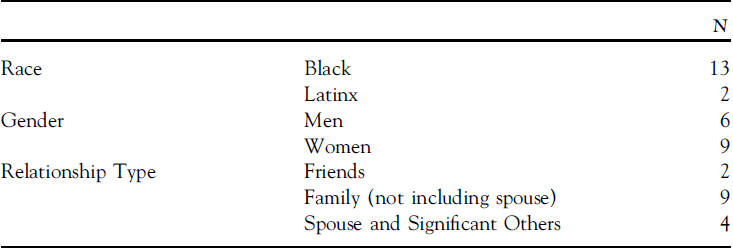
Our ethnographic observations are supported by interview data. We conducted interviews with supporters who attended bond court using a semi-structured interview guide with a total of fifteen respondents. The interview guide included questions about the relationship to the person that the respondent was supporting, experiences in bond court, recounting of bond court, reactions to the experience of bond court, and how attendance impacted their life. In Table 1, we present the demographics of the interview respondents. Because of the overcriminalization of people of color in Chicago, all respondents were people of color, with thirteen Black respondents and two Latinx respondents. Additionally, women (n=9) were overrepresented in our sample when compared to men (n=6). This supports previous research showing that women are most likely to support people with criminal legal contact (Girshick Reference Girshick1996; Richie Reference Richie2002; Comfort 2016; Miller Reference Miller2021) and particularly that women of color are the most likely to provide support to people who need to be bonded out (Page, Piehowski, and Soss Reference Page, Piehowski and Soss2019). Lastly, we included the breakdown of type of relationship. Specifically, four of the respondents were spouses or significant others, nine of the respondents were family members (including cousins, parents, and children and stepchildren of defendants), and two of the respondents were friends.
Demographics of Interview Respondents (N=15)

Recruitment
Interview respondents were recruited after their bond hearings in the courthouse’s atrium. Before the court call began, we distributed a handout to the family members who were waiting in Courtroom One Hundred, where bond court takes place. This handout explained the topic of the project and our institutional affiliation. Both authors conducted interviews. After a judge assigned bond conditions to a person charged with a crime, their loved one(s) would typically leave the courtroom. At this point, one author would follow them into the atrium, introduce themselves, and further explain the study. If recruitment was successful, one author conducted the interview on-the-spot outside of bond court within the confines of the courthouse, simultaneously taking notes. During this time, the other author simultaneously conducted observations and/or conducted an interview with a different respondent. This method of data collection allowed us to capture emotions and costs in real time with people who expressed raw and passionate concern about the process they were experiencing in that moment with the context of the bond hearing they were reacting to. Typically, these interviews were conducted while sitting on wooden benches in the atrium of the courthouse or while standing up due to the lack of seating outside of the courtroom.
Because of the restrictions on electronic devices in the courthouse, interviews were not audio recorded, but instead recorded through handwritten notes by the authors, including some verbatim quotes and other key phrases that documented a particular story. We took care to recap these phrases in our own words immediately following the interview. After each interview, we wrote-up case notes using both the ethnographic data collected during the loved one’s bond hearing and the interview with the respondent(s). While this mode of data collection provided robust data, the restrictions of the courthouse prevented us from documenting all answers verbatim. The direct quotes that we captured are presented verbatim here and offset by using quotation marks. Anything that was written in paraphrased notes after the interview is summarized in our own words.
On average, interviews lasted around thirty minutes. Eligibility criteria for the interviews required respondents to be eighteen years or older and have a family member or loved one who had just appeared in Cook County Bond Court. Once interviews were completed, participants were presented with a twenty-dollar gift card to Walgreens for participation.
Analysis
Our analysis consisted of two rounds of coding. During the first phase, we conducted initial coding or open coding (Saldaña Reference Saldaña2009) with the ethnographic fieldnotes and interview data. To do so, each author separately printed out the data and became familiar with them by reading through and looking for themes that emerged. Each author created a list of inconveniences and harms represented in the observations and interviews. We came together as a team to compare themes and subsequently created codes based on discussions that allowed us to reach a consensus. In our second round of analysis, we utilized codes such as “time,” “money,” “emotion,” “lack of information,” “relationship,” “punishment,” and “burden” and applied them to relevant segments of the data. Then, we put these data into conversation with the literature of legal bystanders and secondary prisonization reviewed earlier in this manuscript to develop our findings. Using this theoretical grounding and our collected data, we were able to distinguish three themes that we detail in the findings section. In what follows, we briefly introduce fundamental information about how bond court functions in Cook County, Illinois in order to contextualize the findings we present in the next section.
THE CONTEXT OF COOK COUNTY BOND COURT
In Cook County, there are three types of bonds that are most commonly used. A person charged with a crime will usually receive either an I-bond (release on one’s own recognizance, which requires no money posted), a D-bond (which stands for deposit bond, where ten percent of the monetary amount must be posted), or a No Bond (meaning that a judge deems the person charged with a crime too dangerous to be released pretrial and thus, must spend the entirety of their case incarcerated). Commercial bond is banned in Illinois, so bonds are paid directly to the county at Division Five in Cook County Jail. Often bond decisions are made by court actors using legalese, making it difficult for people without a law degree to follow along with the court call. Sensitive information about the case is shared publicly without regard for how persons charged with crimes or their supporters may feel about intimate details (such as residential addresses, relationships, work history, hospitalizations, criminal legal records, employment, or other personal information) being known to strangers sitting in the courtroom. Often times, supporters leave the court room upset about what they have heard and confused about what occurred during the brief but consequential bond hearing. Too often, bonds are set in amounts that are unaffordable for family members, meaning that their loved one will be incarcerated while legally innocent. Even after Cook County’s Chief Judge Evans passed Order 18.8A in 2017, which prohibited bond being set in amounts larger than what a defendant can afford, thousands in Cook County still remain behind bars simply because they cannot post bond (Chicago Community Bond Fund 2019).
FINDINGS
Our data show that there are several burdens associated with attending bond court for supporters of people charged with a crime in Cook County. These burdens are experienced by family and friends as punitive, and thus, we argue that legal bystanders are drawn into the punishment apparatus long before a loved one is convicted of a crime or serving a sentence. In what follows, we detail these experiences of punishment and present them in three themes: extraction, destabilization, and degradation.
First, extraction is used to describe the seizing of resources from family and friends. Second, destabilization describes a loss of control or powerlessness for legal bystanders. Finally, we use degradation to illustrate how the state employs shame and fear as a tactic to make family and friends feel humiliated. While we separate these themes as a matter of organization, they overlap often and thus, should not be thought of as mutually exclusive.
Extraction
By attending court, family and friends of bond court defendants experience an extraction of their resources. Here, extraction is used to describe the removal of resources. Previous scholars have suggested that commercial bail is the central form of resource extraction in the pretrial stage (Page, Piehowski, and Soss Reference Page, Piehowski and Soss2019). Because Illinois has eliminated commercial bail, family members in Cook County do not experience this form of private financial extraction. We use our data to show that there are other forms of extraction that occur during the pretrial stage absent of commercial bail and that this extraction is both financial and social in nature.
Our data show that family members who attend court experience extraction of financial resources and time. Financial resources were required for bond payments, but also for costs associated with attending court, such as gasoline, parking meters, and parking tickets. Family members experienced an extraction of time in how long transportation to court takes, and the length of time they waited in court, which often ensured that they missed a full day of work. Taken together, we illustrate how attending court consumes the scarcity of resources available to people most impacted by the criminal legal system.
Financial Extraction
Without exception, we found that financial costs are burdensome for family members who have a loved one appearing in Central Bond Court in Cook County. This was not surprising given that people who are detained pretrial tend to be mostly from low-income communities (Human Rights Watch 2017). Every respondent confirmed that (1) the money needed to bond their loved one out is very rarely accessible to supporters and (2) the costs associated with an arrest even if the person was released without a money bond were tremendously burdensome to family and friends.
If a person is assessed a money bond, this often meant that family or friends would need to post ten percent of the amount of the bond in Division Five of the Cook County Jail. Unlike commercial bail, this deposit is refunded once the case is adjudicated.Footnote 1 Still, cases can take years to close and during this time, the money deposited for bond is inaccessible. During one observation, a woman told her friends that the only money available to her to bail out her partner was her tax refund. She followed up by saying, “And I don’t get that money until next week, so he’ll have to wait until then.” This is just one example of how difficult it was for many family members to post bond, because the amounts were often unaffordable. Family members typically had to save up money over time, wait for certain funds to come in, or raise money through their community in order to bond a person out. Thus, even without commercial bail, financial extraction takes place.
While money bond, itself, poses a financial hardship, there are other significant associated costs with attending bond court. Additional financial costs include gasoline, bus fare, parking meters, and parking tickets. In terms of transportation, many respondents reported that paying for parking around the court building and/or gasoline to get to the courthouse made it more difficult for them to attend bond court. Street parking at Twenty-Sixth Street and California Avenue costs two dollars per hour and must be renewed every two hours in order to avoid an expensive Chicago parking ticket. Visitors to the courthouse can also park in a private parking lot for a daily fee of twenty dollars. Because the vast majority of the parking outside of the courthouse is paid street parking, one set of parents stated that in addition to the gas spent to drive, “We gotta spend even more on that!” This unexpected and urgent need is a heavy burden for family members to bear.
In addition to gasoline and parking meters, it is also likely that family members will receive parking tickets for an expired meter, which have a two-hour limit. During our observations, we often kept an eye on the clock so that we could repay a meter or leave the courtroom after two hours of observation. As researchers, we had the privilege of doing so but supporters of people charged with a crime did not. Critically, because cell phones are not permitted in the courthouse, Chicagoans cannot pay for metered parking via the mobile application on their phones. Parking tickets in Chicago start at fifty dollars and family members are likely to go over their metered time unless they leave in the middle of court and risk seeing their loved one’s bond hearing. One legal bystander told us that the best way for the court process to be improved was for the city to “stop charging for parking” near the courthouse. These data show that, in the day-to-day lives of family and friends of people charged with a crime, it is very unlikely that they have access to additional discretionary funds or disposable income. Very often, the people impacted by the financial costs of the criminal legal system are simply working to survive.
Previous scholars have noted forms of financial extraction utilized for people who are incarcerated (Lara-Millan Reference Lara-Millan2021) or for family members paying commercial bond (Page, Piehowski, and Soss Reference Page, Piehowski and Soss2019). For instance, family and friends face lost income and expenses associated with incarceration like collect phone calls, mailing packages, commissary purchases, and travelling to visit their loved ones in prison (Grinstead, et al. Reference Grinstead, Bonnie, Carrie and Barry2001; Comfort 2008; Miller Reference Miller2021). Our findings build on this literature by showing how financial extraction can also occur informally, whereby family members of bond court defendants do not directly fund state activities, but instead are punished by needing to dole out money to other sources in order to attend court. We suggest that just because this extraction is not formally conducted by the court does not mean that it is less harmful to family members. Further, our findings show that family and friends experience financial extraction even before a loved one is incarcerated. Supporters must spend a considerable amount of money to attend court to gain essential information about their loved one’s case before even knowing the bond amount and/or paying the bond. The financial cost to family and friends for simply attending one court date is a heavy burden for this marginalized group supporting loved ones in legal crisis. Thus, we argue that financial extraction for legal bystanders begins at their loved one’s first court appearance often within seventy-two hours of arrest, putting a burden on family members who are often low-income to begin with.
Extraction of Time
In addition to the extraction of financial resources, attending bond court also extracted time from family members who attended. It took time to travel to and from court, to wait for bond court to begin, and to wait until the support’s loved one is called in court. If the loved one is released on their own recognizance or given an affordable bond, typically the legal bystander will wait until 5:00 PM to post bond in Division Five of Cook County Jail and then wait for their release, which can take a few more hours. Thus, the time spent attending to a loved one’s arrest can take an entire day for some family and friends.
We conducted one interview with a couple identified as the mother and father of a person charged with a crime, who detailed the length of their trip. They stated that they “drove all the way from Riverdale,” a south suburb of Chicago, which is about forty minutes by car. While a forty-minute trip both ways is a large amount of time, most of the legal bystanders we interviewed took public transportation, which often took much longer. The courthouse itself is not close to a train stop, so legal bystanders often took a bus to arrive to bond court. The bus system in Chicago is infamous for running slower and being less reliable. One girlfriend of a bond court defendant expressed frustration with the forty minutes that the bus ride took, while another who arrived at bond court about an hour into the call told us the bus ride took forty-five minutes instead of the usual twenty minutes, putting her at risk of missing her loved one’s court appearance.
By being forced to wait in court, supporters also experienced financial extraction in terms of lost income, showing one way in which these forms of extraction overlap. One respondent who was an independent business owner, estimated that he would have been in the courthouse for fourteen hours by the end of the day. Thus, not only did he incur costs due to parking tickets, but he also lost potential business and earnings. He detailed this to us during an interview while pointing to the phone check-in station, where any non-county employee has to leave their phone before they enter the courthouse.Footnote 2 He explained that he could not answer calls or text messages because cell phones are forbidden in the court room. It was not rare for supporters to call off from work and lose wages in order to make their loved one’s court call.
This extraction of time is not unusual for people from low-income backgrounds, who are often made to wait in welfare offices, in medical offices, and on public transit (Auyero Reference Auyero2012). Previous research illustrates the frequency of waiting for people with criminal legal contact or their legal bystanders and argues that it is punitive (Bogira Reference Bogira2005; Comfort 2008; Auyero Reference Auyero2012; Gonzalez Van Cleve Reference Gonzalez Van Cleve2016; Kohler-Hausmann Reference Kohler-Hausmann2018; Eife and Kirk Reference Eife and Gabriela2021). We build on this literature by showing how time is also extracted from family members at the start of the criminal legal process, which serves as another way for them to be pulled into the punishment apparatus early on.
Destabilization
Another way that family members of bond court defendants were punished was through destabilization, defined here as loss of control at the hands of the state. Legal bystanders felt a loss of control during their time in the courthouse because of the unpredictability of the experience, as well as court intervention into their relationships. Previous scholars have suggested that a lack of information reinforces the power dynamics between the state and those being punished (Comfort 2008). Other literature illustrates the impact of incarceration on the family structure of those who come into contact with it (Western and McLanahan Reference Western and Sara2000; Lopoo and Western Reference Lopoo and Bruce2005; Apel, et al. 2009; Miller Reference Miller2021). We bring this literature together to show how the criminal legal system wields its power to destabilize the lives of legal bystanders, both in the short and long terms.
Unpredictability
The unpredictability of bond court is fueled by a lack of information. During our observations, there were almost always exchanges of information between legal bystanders. This inherently meant that some bystanders lacked information while others had information to share, mostly because of previous experiences attending court. We spoke to several family members who were unaware of how the proceedings unraveled, as well as family members who were told misinformation from court actors. Both of these instances led to family members having a lack of awareness of what to expect, and thus further subjugated them to a position of powerlessness.
In one interview, we spoke to two people who attended court to support their cousin. At the time of the interview, they told us that they had already received two parking tickets for that day. In addition to the time spent in bond court, these two respondents were told the wrong time for the court call. This happened often, which resulted in family members arriving to court at 9:00 AM, only to find out that bond court did not begin until 1:30 PM. This lack of information works hand-in-hand to fuel the extraction of time from legal bystanders. The commonness of misinformation is alarming, considering bond court meets at the same time each day.
In another observation, the court call was running twenty minutes late and many people were waiting outside of the courtroom in the hallway. Legal bystanders asked each other questions, as everybody tried to figure out what was going on. One woman asked a correctional officer (CO) a question (which the observer could not hear over the chatter). In response, the guard pointed at the call sheet and walked away. The woman who asked the question rolled her eyes and did not turn to look at the sheet, suggesting that the CO’s ill-attempt of an answer was not helpful in the least. During our observations, bond court rarely started on time and legal bystanders were made to wait until the previous court call had wrapped up and/or the bond court judge was ready to begin, showing the complete power that court actors have over both legal bystanders and people charged with a crime.
In addition to a lack of information, it is often very difficult to hear or understand the court proceedings. This is due to the quickness with which court appearances occur, the use of legalese, and the lack of reliable audio equipment, like microphones. We witnessed several legal bystanders strain to hear what court actors said during their loved ones’ appearances. Typically, family members stand during their loved one’s appearance to show their presence and support. Oftentimes, the same people standing would then lean forward in an attempt to better hear the judge. In another observation, a woman in the back row squinted and leaned forward, straining all of her senses to get a better idea of what was going on at the bench. There were several times that we followed people outside only to find that they were using any resources available to figure out what had just happened. Standing outside of the courtroom, several people approached EifeFootnote 3 to ask questions about the process and/or the details of the bail that was set. In another observation, there were a group of three men looking at the call sheet trying to figure out what each of their loved ones’ bonds were set at. They declined an interview, frustrated after the court call because they “[couldn’t] hear shit” in the courtroom.
This supports Comfort’s (Reference Comfort2008) analysis of abrupt policy changes for women visiting their incarcerated loved ones. In her observations of visitation lines and our observations of bond court, legal bystanders receive little information about proceedings and thus, cannot understand or remedy the conditions. Instead, the humanity of legal bystanders is undermined as they are forced to wait in stark conditions and become marked as “disgraced beings” (Comfort 2008, 50; Girshick Reference Girshick1996). We suggest that this destabilization is punitive in and of itself, but that it also further exacerbates punishment by extraction. By receiving misinformation or no information, family and friends increased the amount of time they had to set aside for attending court, leading to greater likelihood of financial extraction through parking tickets and/or parking fees, and greater extraction of time.
Relationship Change
In addition to the destabilization created through misinformation or a lack of information, legal bystanders who have a loved one charged with a crime also face the prospect of relationship instability. In this subsection, we offer data that describe how an arrest and/or court call can intervene in the relationships between a person charged with a crime and their supporters. Building on previous literature illustrating the impact of incarceration on family structure, we argue that legal bystanders need not have a loved one incarcerated in order to have their relationships destabilized by the criminal legal system (Lopoo and Western Reference Lopoo and Bruce2005; Apel, et al. 2009; Western and McLanahan Reference Western and Sara2000; Miller Reference Miller2021). While previous research shows that incarceration almost always impacts family structure, we suggest that court intervention was less commonly observed to have an immediate impact than the other punishment themes discussed within this article, which were ubiquitous in our data.
In one observation where family structure was directly impacted in court, we witnessed a father who was present to support his son. The son’s case was dropped from a felony to a misdemeanor, to which the judge stated, “It’s a lucky day.” The father, who stood in the last row of the courtroom benches, immediately responded “No, it’s not” to the judge. At this point, the judge paused the court call to give her evaluation of the father’s parenting: “This is a good dad. Young man,” she said, addressing the son, “you’re lucky to have him as your father.” The judge then made orders that the son, who previously resided with his mother, could only be released from jail to his father. In this instance, the judge used her power to change the living arrangements for the person charged with a crime based solely on his father’s behavior in court without questioning the original arrangement, nor asking the son for input in his own living arrangements. This interaction shows how the court has the unquestioned power to intervene in the lives and relationships of those entangled in the system based on a judge’s subjective interpretation of an isolated exchange. Further, this illustrates how court actors do not see people charged with crimes as capable of making good choices on their own, but instead act with paternalism to make the choice that looks “more correct” to the court actors. This finding corroborates previous literature showing how the relationship between lawyers and their clients is inherently paternalistic (Luban Reference Luban1981; Clair Reference Clair2020). In this example from our data, we show how judges also exhibit paternalism toward people charged with crimes and that, with the authority bestowed to judges, this paternalism has the ability to intervene in the lives of people charged with crimes and their supporters, destabilizing family structure and relationships.
While formal court intervention was infrequent, the indirect impact of the court system was much more common in the relationships between people charged with a crime and legal bystanders. A majority of our respondents expressed frustration with their loved ones. In an interview with a girlfriend, she told us that she felt “hurt” and when asked who she felt hurt by, she responded “my boyfriend.” While it is unclear if this hurt translated into an end or change to the relationship, it shows that the court proceedings can influence the relationships between people charged with a crime and their legal bystanders. Thus, simply being charged with a crime has the ability to destabilize both family and romantic relationships.
Scholars have shown how incarceration can influence family structure (Western and McLanahan Reference Western and Sara2000; Lopoo and Western Reference Lopoo and Bruce2005; La Vigne, et al. Reference La Vigne, Elizabeth and Diana2008) or cause a change in status in intimate relationships (Nurse Reference Nurse2002; Apel, et al. 2009). Our findings build on this literature, illustrating that legal bystanders’ relationships are impacted in bond court and not necessarily only once a loved one begins serving a sentence (Comfort 2003; Comfort 2008; Aiello and McCorkel Reference Aiello and McCorkel2018). Specifically, one’s first appearance in bond court can play a powerful role in relationships with their supporters, shifting how they interact and who they live with.
Degradation
The final theme we identified in our findings dealt with degradation of legal bystanders. Previous scholars have pointed to the shame associated with women who are romantically involved with incarcerated men (Fishman 1988; Comfort 2008; Kita Reference Kita2018). Others have illustrated the toll that having an incarcerated loved one can cause on the mental health of legal bystanders (La Vigne, et al. Reference La Vigne, Elizabeth and Diana2008; Hoffmann, et al. Reference Hoffmann, Byrd and Kightlinger2010; Wildeman, et al. Reference Wildeman, Jason and Kristin2012). We argue that the emotional nature of seeing a loved one in handcuffs being brought before a judge is manipulated by court actors and utilized as a tool of punishment.
Fear
Throughout our observations, a majority of supporters left bond court in distress, shaking their heads and cursing. Some hugged one another and cried. Others pounded the walls in the hallways. During interviews, when we asked legal bystanders how they were feeling, respondents expressed profound disappointment and emotional pain. They typically described being afraid of what had happened to their loved one during the arrest, fear that there might be some retaliation, and anxiety about their loved one’s future.
We observed evidence of emotional distress during each court call that we attended. It was common for family and friends to show observable emotions through audible and physical reactions to things that were said by judges, lawyers, or other court workers. In one case, the judge casually mentioned a person’s possibility of a life sentence. At this, a young woman gasped, folded over the gallery bench, and began crying. During the court call, we learned that this woman was engaged to the person charged with a crime. Without any reaction from the judge, the court call continued while the fiancée sobbed. The person charged with a crime was eventually assessed No Bail, meaning he would stay detained in Cook County Jail until his case’s adjudication, which could be for months or years. At the end of his time in front of the judge, the fiancée, clearly upset, yelled “I love you” to him across the courtroom. Her fiancé, the person charged with a crime, returned the sentiment as he was quickly ushered back to the jail.
In another observation, two women sat in the courtroom gallery quietly until their loved one was brought in front of the judge. When this happened, one of the women in the gallery stood up and gasped, then sat down and started to shake her head. The two women then comforted one another during their loved one’s bond hearing. These types of reactions happened often during our observations. We also heard about these emotions in our interviews. We asked one respondent how she felt after the bond hearing and she told us that “it hurts a lot” and began to cry, saying through her tears that her mom is “not a bad person, doesn’t have a bad background.” These findings illustrate that the process of attending bond court, itself, has a deep emotional impact on family members. Still, court officials issued statements without the appropriate sensitivities, which engendered understandably passionate responses from family members even before bond conditions were discussed or named. Thus, we argue that even before a loved one is convicted and/or incarcerated, family and friends experience emotional punishment at the hands of the state.
Shame
Previous scholars have also noted feelings of shame associated with having a loved one incarcerated (Fishman 1988; Comfort 2008; Kita Reference Kita2018). In our observations and interviews, we found that legal bystanders experienced shame by association during bond court, as well. In some cases, this was solely attached to having a loved one charged with a crime, but in other cases, it appeared as though court actors worked to yield shame explicitly as a tool of punishment for both the person charged with a crime and their family or friends who appeared in court.
In one case, we observed a person criminalized for pursuing a sexual relationship with a minor. As the prosecutor provided information from the arrest report, the person charged with the crime continued to shake his head. After hearing the details of the arrest report, the judge turned to the State’s Attorney and said, “You’ve said this twenty-three-year-old defendant has had sexual relations with the sixteen-year-old victim,” to which the defendant exclaimed “That’s not true!” After this exclamation, he glanced back at his girlfriend, who was in court and standing in support of him. At this, the judge remarked, “You have one girlfriend in court today, who certainly does not look like the sixteen-year-old,” working to shame the girlfriend for her partner’s alleged actions. As his time in front of the judge ended, the man charged with a crime was moved to go back to the jail and as his body was maneuvered by the guards, he yelled out “I love you!” to his girlfriend. Instead of returning the sentiment, she left the court quickly with her head down and no response. This shows how family members can be directly mentioned and intentionally humiliated in the court proceedings because of ties to a person charged with a crime.
These examples are representative of the many instances of shame we observed during each attendance in bond court. Here, shame is intended to punish the legal bystanders by degrading them and their relationships with people charged with a crime, much like the shame experienced by women whose husbands are convicted of sex offenses or women who visit their husbands in prison (Fishman 1988; Kita Reference Kita2018). Previous scholars show that guards view wives with suspicion and violate their humanity through strip searches during prison visits (Fishman 1988). In our observation, the judge shamed the defendant’s girlfriend in public for the actions of her allegedly unfaithful boyfriend, which included sexual exploitation of a minor. Here we show how shame can be cultivated and utilized as punishment even without the circumstances of incarceration. By intentionally offending family and friends in court, judges and other court actors punish supporters for attending bond court.
Literature on secondary prisonization details the feelings of powerlessness and fear among partners of incarcerated people during prison visits and the associated long-term mental health consequences (Comfort 2003; Braman Reference Braman2004). We build on this literature by illustrating how family members experience degradation by being marked as legal bystanders in bond court even before incarceration of a loved one. Previous research shows how agents of the state use manipulation of emotions and degradation as tactics for punishing people charged with a crime (Gonzalez Van Cleve Reference Gonzalez Van Cleve2016; Eife and Kirk 2020). Our data show that attending court as a supporter is similarly experienced as degrading and oppressive.
CONCLUSION
In this article, we have described three themes through which punishment is experienced by legal bystanders who attend bond court. First, we detail the theme of extraction, which entails the removal of resources from family and friends of bond court defendants. These resources include money and time. Second, we describe how family and friends experience destabilization, or a loss of control at the hands of the state, through a lack of knowledge about court proceedings and court intervention into relationships. Third, we illustrate how family and friends are degraded through the manipulation of both fear and shame associated with having a loved one charged with a crime. Further, we suggest that these themes are not mutually exclusive and, instead, that they operate in concert with one another. We use these findings to show how legal bystanders are drawn into the punishment apparatus early on in the criminal legal process.
With these findings, we make two important contributions to the literature. First, we bridge the literatures between procedural punishment and secondary prisonization. Some scholars have shown that there is punishment associated with due process and pretrial hearings for people charged with a crime and other scholars focus on the punitive impact that incarceration has on family members of people serving sentences. We contribute a qualitative analysis of the bond court experience from the perspective of family and friends of defendants, bringing together these two literatures. In doing so, we identify and describe how supporters experience punishment simply by attending a court date even before their loved one’s case is adjudicated.
Issa Kohler-Hausmann (2013; 2014; Reference Kohler-Hausmann2018) has illustrated how misdemeanor justice is used to manageFootnote 4 subjects of the court through procedural hassle, marking, and performance. In this article, we show that family members also experience procedural hassle, or burdens associated with complying with legal proceedings, through the themes of punishment described in this article. For instance, the financial extraction and the emotional tolls experienced while in court are both burdens associated with bond court proceedings. While procedural hassle is perhaps the most onerous and widespread operation of penal power exerted on family members, some family members also experience the stigma of “marking” (that is, official documentation of wrongdoing) (Kohler-Hausmann Reference Kohler-Hausmann2018), though informally through the shame experienced by being associated with bond court defendants, and “performance” (that is, self-management), by illustrating the ability to self-manage through rule following or repression of emotions during an often-time upsetting experience. Building on Kohler-Hausman’s misdemeanor justice, we expand the understanding of the state’s power to manage by revealing how it extends to the informal punishment of family and friends outside of prisons. That is, we illustrate a procedural punishment over non-defendants. Importantly, we show how this informal punishment operates even before the incarceration of loved ones begins, perhaps indoctrinating legal bystanders for further processes to come during a loved one’s incarceration. Because this widens the net of punishment-by-association, we show that the penalties associated with being a legal bystander are more widespread than previously accounted for and could be comparable to the punishment experienced by people charged with misdemeanors. In order words, by attending bond court legal bystanders are treated similarly to people charged with misdemeanors.
We also contribute novel information about the specific forms of punishment associated with attending bond court for legal bystanders. While previous literature addresses the impact of having a loved one incarcerated, there is less information that illustrates how attending even one court date can carry a large burden for family members (Comfort 2003; Comfort 2008). In this article, we parse out different themes of punishment that are experienced by family members of bond court defendants. We show that there are numerous forms of punishments associated with attending bond court, and by doing so we can more completely illustrate the weight that the criminal legal system puts on family and friends from the very start. These findings suggest that there are direct and multitudinous consequences for legal bystanders of people charged with a crime solely based on attending bond court.
While this study contributes valuable information, it also has limitations. First, because of the setting in which the interviews were conducted, we were unable to audio-record the interviews. While we wrote some direct quotes and paraphrased others, it is always preferable to use the exact wording of the respondents. Still, we believe that this methodology allowed us to capture a unique set of data. Second, our interviews were conducted immediately after loved ones left bond court and thus, we could only measure the instantaneous costs associated with attending court. Future research should consider the longitudinal impact of attending court dates, particularly if family members attend multiple court dates over the course of a loved one’s case. Third, while our findings suggest that women of color are the most likely to be drawn into the punishment apparatus, a gendered analysis of courtroom dynamics is outside of the scope of the project. Future research should focus specifically on the gendered dynamics of the courtroom, as both our findings and previous research (Girshick Reference Girshick1996; Comfort Reference Comfort2003; Reference Comfort2008; Reference Comfort2016; Page, Piehowski, and Soss Reference Page, Piehowski and Soss2019) have documented how these experiences overwhelmingly impact women. Lastly, interviews and observations were conducted at the central criminal courthouse in Chicago at Twenty-Sixth Street and California Avenue. While this is where Central Bond Court occurs, it is not where all pretrial status hearing court dates take place. This likely influences the experience of attending court as other locations may have free parking or more lenient rules around technology in the courtroom. Thus, findings may differ for status update hearings as compared to initial bond review hearings. Future research could consider experiences of family members attending other pretrial court dates besides bond court and/or consider the experiences of family members attending bond court in other jurisdictions, particularly in suburban or rural geographies where family members may be subject to different and/or more compassionate circumstances, and court actors may be more likely to know defendants and their families. This may influence the occurrence of extraction, destabilization, and degradation.
Just as Alexes Harris (Reference Harris2016) has reframed the conversation around court-ordered monetary sanctions, fines, and fees to show how they operate punitively for people with criminal convictions, we suggest that the experiences associated with attending court should also be understood as punitive, thereby exacerbating inequality for the majority of legal bystanders who already experience marginalization. By framing these experiences as punitive, we can better understand how family and friends become drawn into the punishment apparatus by association during their loved one’s court appearances (Comfort 2008). Our data clearly illustrate that these instances of punishment are not only invoked when a loved one is incarcerated, but rather that family members are brought into the punishment apparatus from the moment a loved one’s courtroom appearances begin. This article highlights how the criminal legal system marginalizes low-income communities of color in a subtler but more widespread way than convictions or incarceration.