Introduction
Offspring of mothers with psychotic disorders (high-risk (HR) offspring) have an almost two-fold higher risk of fetal death/stillbirth (Webb et al. Reference Webb, Abel, Pickles and Appleby2005). Elevated mortality risk continues at least until early adulthood. In a recent Danish study, the mortality risk in late adolescence and early adulthood (age 16–25 years) was 1.56 among offspring of mothers with non-affective psychosis (Webb et al. Reference Webb, Abel, Pickles, Appleby, King-Hele and Mortensen2006). The same group investigated causes of death among offspring of parents with a history of psychiatric in-patient admission, and found the highest relative risks for homicide in children, and for suicide in young adults (age 16–25 years) (Webb et al. Reference Webb, Pickles, Appleby, Mortensen and Abel2007). While the risk of death from unnatural causes was significantly increased in all age groups until young adulthood, the risk of death from natural causes was not increased (Webb et al. Reference Webb, Pickles, Appleby, Mortensen and Abel2007). Maternal diagnosis of non-affective psychotic disorder was not associated with higher mortality risk in offspring than other maternal diagnoses (Webb et al. Reference Webb, Pickles, Appleby, Mortensen and Abel2007).
Apart from the study by Webb et al. (Reference Webb, Abel, Pickles, Appleby, King-Hele and Mortensen2006), all other mortality studies among HR offspring beyond early childhood were conducted more than three decades ago, before diagnostic criteria for schizophrenia were established, and in an era when registration of deaths and causes of death in the general population may have been inaccurate (Erlenmeyer-Kimling, Reference Erlenmeyer-Kimling1968; Lindelius, Reference Lindelius1970; Webb et al. Reference Webb, Abel, Pickles and Appleby2005). There is still no information concerning either the effect on offspring's mortality of specific maternal diagnosis (schizophrenia versus other psychotic disorder) or maternal symptoms, nor of offspring's own psychiatric diagnosis. Neither is it known whether the mortality risk is increased beyond young adulthood.
We set out to study mortality from late adolescence until middle age in offspring of mothers with psychotic disorders. Within the HR group, we investigated the effect on mortality risk of maternal diagnosis, suicide attempts, and aggressive behaviour, and of offspring's sex and possible psychiatric diagnosis, examining mortality from all causes, natural causes, unnatural causes, and suicide separately. We also compared all-cause mortality with the general population.
Method
Identification of the cohort
In 1974, all women born between 1916 and 1948 who had been treated for schizophrenia, schizo-affective disorder or schizophreniform disorder in any of the mental hospitals in Helsinki, Finland, up till 1974, and who had given birth in Helsinki between 1960 and 1964, were identified from the central archives of mental hospital care in Helsinki (Wrede et al. Reference Wrede, Mednick, Huttunen and Nilsson1980; Niemi et al. Reference Niemi, Suvisaari, Haukka, Wrede and Lönnqvist2004b). The initial HR group consisted of 161 mothers having 179 offspring born between 1960 and 1964 and alive after the neonatal period (Niemi et al. Reference Niemi, Suvisaari, Haukka, Wrede and Lönnqvist2004b). We have since extended the study sample to cover all offspring (n=337) of these mothers. Social security numbers of the HR mothers, fathers and offspring were obtained from the Population Register Centre, and used for linkage to healthcare registers.
Diagnostic assessment and information on socio-economic status
Information on mental disorders was obtained from the Finnish Hospital Discharge Register, which provided data on hospital treatments from 1969 to 2001. Based on the register information, all case-records from hospital and out-patient treatments were collected. Diagnostic assessment was similar for HR and control mothers, fathers and offspring, and consisted of assigning a Diagnostic and Statistical Manual of Mental Disorder (DSM)-IV-TR diagnosis (APA, 2000) and completing the Operational Criteria Checklist for Psychotic Illness (McGuffin et al. Reference McGuffin, Farmer and Harvey1991), the Major Symptoms of Schizophrenia Scale (Kendler et al. Reference Kendler, McGuire, Gruenberg, O'Hare, Spellman and Walsh1993), the global ratings of anhedonia-asociality and of avolition-apathy on the Scale for Assessment of Negative Symptoms (Andreasen, Reference Andreasen1982) and the global rating of bizarre behaviour on the Scale for Assessment of Positive Symptoms (Andreasen, Reference Andreasen1984) (Niemi et al. Reference Niemi, Suvisaari, Haukka, Wrede and Lönnqvist2004b).
Using medical records we rated on a lifetime basis whether the person had attempted suicide and had behaved aggressively towards other people. Aggressive behaviour meant the person had been physically aggressive, or that the use of seclusion or restraint had been needed specifically to prevent physical aggression during in-patient treatment.
In the study, L.H. completed the whole assessment procedure for all case-notes. J.S. assigned DSM-IV-TR diagnoses for all case-notes but completed the whole procedure only for the first 20 cases and thereafter for every fifth case-note. In cases of diagnostic disagreement, the case-records were reassessed together and consensus ratings made (Niemi et al. Reference Niemi, Suvisaari, Haukka, Wrede and Lönnqvist2004b). In this article, we grouped mothers according to whether they had schizophrenia (n=92) or other psychotic disorder (n=69, of whom 46 had non-affective psychotic disorder and 23 affective disorder). Offspring's psychiatric diagnoses were grouped into psychotic (n=47) and non-psychotic (n=37) disorders, and no diagnosis (n=253). Diagnosis of four HR offspring had to be deferred because of inadequate information (Niemi et al. Reference Niemi, Suvisaari, Haukka, Wrede and Lönnqvist2004b). This occurred either because the case-notes lacked detailed information, or because they were missing. In the current study, all individuals having ‘diagnosis deferred’ as the consensus diagnosis were classified as having a non-psychotic disorder.
We used paternal occupation for the classification of socio-economic status, and if this was not available, maternal occupation. Information on social class was obtained from childhood health records. Since socio-economic status of the family could have changed over time and we lacked this longitudinal information, we used socio-economic status of the family when the proband (first child born from 1960 to 1964) was born as the socio-economic status for each family. The socio-economic classification was based on the City of Helsinki Social Group's seven-group classification (Central Statistical Office of Finland, 1989). These groups were collapsed into two: professional/clerical became the upper socio-economic status and skilled/unskilled workers the lower socio-economic status. In the statistical analyses, ‘socio-economic status unclassifiable’, consisting of families in which no occupation of mother or father appeared in the maternal or offspring's records, was used as a separate category, since it seemed that these HR families may have been the poorest functioning of all.
Information on causes of death
The Register of Causes of Death, kept by Statistics Finland, provided data on causes of death and death certificates from those who had died up till 2005. Statistics Finland has stored death certificates since 1936, but the data are available as a combined electronic file only from 1969 on. In our statistical analysis, the follow-up for mortality was started on 1 January 1970 or the 16th birthday, whichever came later. Children who had died before their 16th birthday or 1 January 1970 were excluded from the analysis. We did not investigate childhood mortality since we lacked this information on offspring born outside the 1960–1964 birth-year range and died before 1969. Offspring born between 1960 and 1964 had high rates of stillbirth and neonatal mortality, which has been reported previously (Wrede et al. Reference Wrede, Mednick, Huttunen and Nilsson1980).
Statistical analysis
Within the HR group, we investigated the effect of family (frailty term), mother's diagnosis (schizophrenia versus other psychotic disorder), maternal suicide attempts, maternal aggressive behaviour, childhood socio-economic status, offspring's sex, and offspring's psychiatric diagnosis (psychosis, non-psychotic mental disorder, no diagnosis) on mortality. This was done using a multivariate Cox model with frailty, using family as the clustering factor (frailty term). Frailty models are extensions of the conventional Cox model that include a random effect, frailty, which describes unexplained heterogeneity, i.e. the influence of unobserved risk factors in the model (Therneau et al. Reference Therneau, Grambsch and Pankratz2003). We used a multivariate frailty model in which the frailty was shared among siblings. This was done because we assumed that there were multiple factors unknown to us within the families that would have affected mortality risk, for example childhood living circumstances, nutrition, and genetic risk for cardiovascular disorders.
We compared overall mortality between the HR sample and the general population, using age- and sex-stratified mortality rates from 1970 to 2005 obtained from Statistics Finland as the reference. The expected cumulative hazard functions for the HR group and the general population were calculated using the exact method as described by Therneau & Offord (Reference Therneau and Offord1999). The mortality hazard rate ratio (HRR) between the HR offspring and the general population was calculated for the whole HR group, as well as separately for males and females. We also calculated the mortality HRR after excluding from the analysis those HR offspring who had developed psychotic disorders.
All analyses were conducted using statistical software R (R Development Core Team, 2005).
Results
The study sample consisted of 337 HR offspring born between 1940 and 1977; 181 males and 156 females. The mean follow-up time since their 16th birthday or 1 January 1970 was 27.9 years, totalling 9403 person-years at risk, and their mean age at the end of follow-up was 43.9 (s.d.=6.4) years. Of the HR offspring, 127 had upper and 176 lower childhood socio-economic status, while 34 had unclassifiable status. Of the mothers, 41.3% had attempted suicide, and 56.1% had behaved aggressively towards other people.
Mortality and its predictors within the HR group
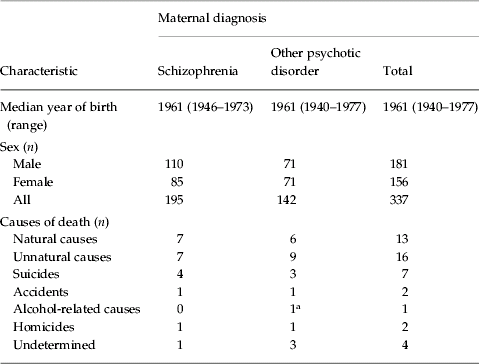
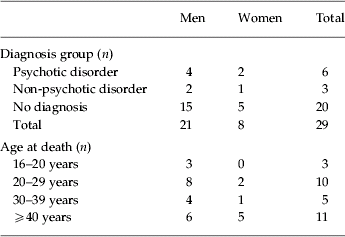
Twenty-nine offspring [21 (11.6%) men and eight (5.1%) women] had died. The cause of death was natural in 13 offspring, and unnatural in 16. Seven offspring had committed suicide, and two had been victims of homicide. In four offspring, the cause of death had remained undetermined. Of the HR offspring who had died, the mother had schizophrenia in 14 cases and other psychotic disorder in 15 (Table 1).
Demographic characteristics and numbers and causes of death among offspring in different high-risk groups
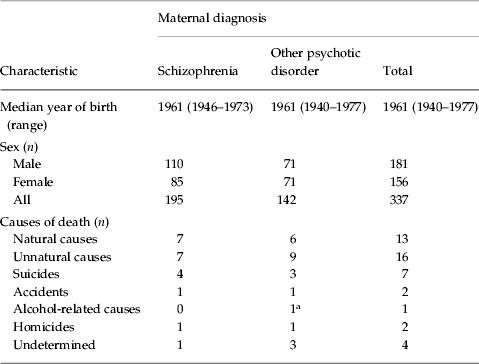
a Accidental death by poisoning.
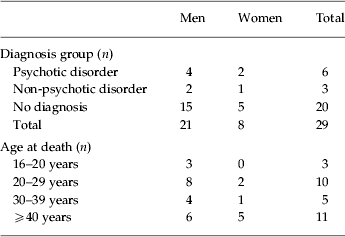
Among HR offspring, 12.8% (six of 47) of those with psychotic disorder had died, compared with 8.1% (three of 37) with non-psychotic disorder and 7.9% with no psychiatric diagnosis (Table 2). Eleven of the 13 deaths (84.6%) that occurred before 30 years of age, but only one of the 11 deaths (9.1%) after 40 years, were due to unnatural causes.
Information on high-risk offspring who had died
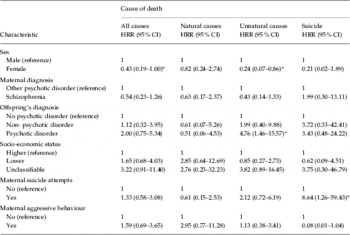
Within the HR group, females had lower all-cause mortality (HRR 0.43, 95% CI 0.19–1.00, p=0.05) than males. Having been diagnosed with a psychotic disorder was associated with higher mortality from unnatural causes (HRR 4.76, 95% CI 1.46–15.56, p=0.01), whereas females had lower mortality from unnatural causes than males (HRR 0.24, 95% CI 0.07–0.86, p=0.03). Maternal suicide attempts increased the offspring's risk of death from suicide (HRR 8.64, 95% CI 1.26–59.43, p=0.03). Family-related frailty, socio-economic status of the family, maternal diagnosis, offspring's non-psychotic disorder, and maternal aggressive behaviour were not significantly associated with mortality from any cause. None of the variables significantly predicted mortality from natural causes (Table 3).
Survival models of factors predicting mortality within the high-risk group, presenting HRRs and their 95% CIs

HRR, Hazard rate ratio; CI, confidence interval.
* p<0.05.
Mortality risk in the HR group compared with the general population
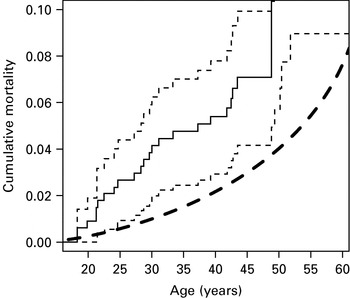
Compared with the general population, mortality in the HR group was over two-fold higher (HRR 2.44, 95% CI 1.69–3.51, p<0.0001) (Fig. 1). This was the case both among HR females (HRR 2.57, 95% CI 1.28–5.13, p=0.008) and males (HRR 2.39, 95% CI 1.56–3.67, p<0.0001). It remained significantly higher also when HR offspring who later developed psychotic disorders were excluded from the study sample (HRR 2.30, 95% CI 1.53–3.47, p<0.0001).
Cumulative mortality in high-risk offspring (–––) with 95% confidence intervals (- - -) compared with mortality in the general population ( ).

Discussion
Offspring of mothers with psychotic disorders had an over two-fold risk of dying compared with the Finnish general population during a follow-up which extended from late adolescence until middle age. The mortality risk was even higher than that found for early adulthood in the recent Danish register-based study (Webb et al. Reference Webb, Abel, Pickles, Appleby, King-Hele and Mortensen2006). Within the HR group, psychotic disorder in the offspring predicted higher mortality from unnatural causes, and female sex was associated with lower all-cause mortality and mortality from unnatural causes. While maternal diagnosis (schizophrenia versus other psychotic disorder) did not affect offspring's mortality risk, maternal suicide attempts were associated with substantially increased risk of death from suicide in offspring.
Factors associated with increased mortality within the HR group
Within the HR group, having a diagnosis of psychotic disorder was associated with higher mortality from unnatural causes. This is consistent with many previous reports (Brown, Reference Brown1997; Joukamaa et al. Reference Joukamaa, Heliövaara, Knekt, Aromaa, Raitasalo and Lehtinen2001; Ösby et al. Reference Ösby, Brandt, Correia, Ekbom and Sparén2001; Heilä et al. Reference Heilä, Haukka, Suvisaari and Lönnqvist2005; Dutta et al. Reference Dutta, Boydell, Kennedy, van Os, Fearon and Murray2007). Although HR subjects were also at increased risk of non-psychotic mental disorders (Niemi et al. Reference Niemi, Suvisaari, Haukka, Wrede and Lönnqvist2004b), these were not associated with significantly increased mortality risk within the HR group. However, the effect of mental disorders is an underestimate, because offspring with an emerging psychiatric disorder may have committed suicide prior to any treatment contact.
Webb et al. (Reference Webb, Pickles, Appleby, Mortensen and Abel2007), using register-based International Classification of Diseases (ICD) diagnoses, produced suggestive evidence that specific maternal diagnoses might affect offspring's mortality risk differently. However, the agreement between register-based ICD diagnoses and DSM-IV diagnoses based on all available clinical data is not perfect (Löffler et al. Reference Löffler, Häfner, Fätkenhauer, Maurer, Riecher-Rössler, Lützhøft, Skadhede, Munk-Jørgensen and Strömgren1994; Perälä et al. Reference Perälä, Suvisaari, Saarni, Kuoppasalmi, Isometsä, Pirkola, Partonen, Tuulio-Henriksson, Hintikka, Kieseppä, Härkänen, Koskinen and Lönnqvist2007). Thus, it was of interest to investigate whether maternal diagnosis, defined by DSM-IV criteria, had an effect on mortality. Our previous study showed that mothers with schizophrenia had the highest level of positive, negative, and disorganized symptoms, and also the most chronic course and poorest outcome compared with mothers with other psychotic disorders (Niemi et al. Reference Niemi, Suvisaari, Haukka and Lönnqvist2004a). We expected that because of this, maternal schizophrenia might have affected the offspring's life more than the other disorders, and mortality might also be higher in offspring of mothers with schizophrenia than in the remaining HR group. Contrary to our hypothesis, mortality risk in offspring of mothers with schizophrenia or with other psychotic disorders did not differ. However, neither did the outcome of offspring of mothers with schizophrenia or other non-affective psychotic disorders differ in terms of incidence of psychotic disorders (Niemi et al. Reference Niemi, Suvisaari, Haukka, Wrede and Lönnqvist2004b). We have also previously observed that maternal negative and disorganized symptoms did not predict offspring's morbidity from psychotic disorders, but maternal positive symptoms were inversely associated with offspring's risk of developing psychotic disorder (Niemi et al. Reference Niemi, Suvisaari, Haukka and Lönnqvist2004a). Thus, it may be that the severity of maternal psychotic illness does not have a strong impact on offspring's outcome in terms of psychiatric morbidity or mortality.
Offspring whose mothers had attempted suicide have considerably increased suicide risk. Previous studies have found substantially increased risk for suicide attempt in offspring of mothers who had attempted suicide (Brent et al. Reference Brent, Oquendo, Birmaher, Greenhill, Kolko, Stanley, Zelazny, Brodsky, Bridge, Ellis, Salazar and Mann2002; Lieb et al. Reference Lieb, Bronisch, Höfler, Schreier and Wittchen2005), and family history of suicidal acts is a risk factor for suicidal behaviour in psychiatric patients regardless of specific diagnosis (Mann et al. Reference Mann, Waternaux, Haas and Malone1999). Previous studies have mainly investigated offspring of mothers with mood disorders (Brent et al. Reference Brent, Oquendo, Birmaher, Greenhill, Kolko, Stanley, Zelazny, Brodsky, Bridge, Ellis, Salazar and Mann2002) or general population samples (Lieb et al. Reference Lieb, Bronisch, Höfler, Schreier and Wittchen2005), and have mostly examined offspring's suicide attempts rather than completed suicides. Our results suggest that among mothers with psychotic disorder, maternal suicide attempt is a strong predictor of offspring's suicide, whereas specific maternal diagnosis is not.
We hypothesized that maternal aggressive behaviour might be linked to offspring's mortality from unnatural causes. First, we assumed that aggressive behaviour might indicate an increased risk of offspring's physical abuse, and childhood physical abuse is a risk factor for suicide attempts (Molnar et al. Reference Molnar, Berkman and Buka2001). Second, maternal and offspring's aggressivity are correlated (Cadoret et al. Reference Cadoret, Yates, Troughton, Woodworth and Stewart1995), and lifetime aggression and impulsivity are related to suicide attempts (Mann et al. Reference Mann, Waternaux, Haas and Malone1999), accidents (Cobb et al. Reference Cobb, Cairns, Miles and Cairns1995) and higher total mortality risk (Räsänen et al. Reference Räsänen, Tiihonen, Isohanni, Moring and Koiranen1998). Contrary to our hypothesis, maternal aggressive behaviour toward other people was not significantly associated with offspring's mortality risk from any cause. Aggressive behaviour during treatment might not reflect aggressive behaviour in other situations.
There were no sex differences in mortality from natural causes within the HR group, but males had significantly higher mortality risk from unnatural causes, as in the general population (Statistics Finland, 2006). None of the variables predicted natural mortality significantly. The effect of socio-economic status on mortality within the HR group was not statistically significant for any cause of death, but this was probably due to lack of statistical power. The point estimates of mortality HRR were highest in the ‘unclassifiable’ group, consisting of families in which no occupation of the mother or the father appeared in the maternal or offspring's records.
Two HR offspring had been victims of homicide, neither filicides. We started the follow-up for mortality from 16 years, since we lacked information on offspring born outside 1960–1964 who had died before the use of social security numbers was established in Finland. However, of our original HR offspring group of 179 children born from 1960 to 1964, one child had been a victim of maternal filicide aged 4 years. As Webb et al. (Reference Webb, Pickles, Appleby, Mortensen and Abel2007) have suggested, risk factors for child homicide in offspring of parents with severe mental disorder should be investigated further.
Mortality compared with the general population
The mortality risk in early adulthood (from age 16–25 years) among offspring of mothers with psychotic disorders in the study by Webb et al. was 1.56 (Webb et al. Reference Webb, Abel, Pickles, Appleby, King-Hele and Mortensen2006). We found an over two-fold mortality risk that continued until middle age. Several factors may contribute to elevated mortality risk in adult HR offspring compared with the general population. One is that HR offspring have an increased risk of developing schizophrenia and other psychotic disorders (Erlenmeyer-Kimling et al. Reference Erlenmeyer-Kimling, Adamo, Rock, Roberts, Bassett, Squires-Wheeler, Cornblatt, Endicott, Pape and Gottesman1997; Niemi et al. Reference Niemi, Suvisaari, Haukka, Wrede and Lönnqvist2004b; Johnstone et al. Reference Johnstone, Ebmeier, Miller, Owens and Lawrie2005; Owens & Johnstone, Reference Owens and Johnstone2006), and schizophrenia and other severe mental disorders are associated with increased mortality both from natural and unnatural causes (Brown, Reference Brown1997; Joukamaa et al. Reference Joukamaa, Heliövaara, Knekt, Aromaa, Raitasalo and Lehtinen2001, Ösby et al. Reference Ösby, Brandt, Correia, Ekbom and Sparén2001; Heilä et al. Reference Heilä, Haukka, Suvisaari and Lönnqvist2005; Dutta et al. Reference Dutta, Boydell, Kennedy, van Os, Fearon and Murray2007). However, in our study the HRR remained over two-fold after offspring who had developed psychotic disorders were removed from the study sample. Another mediating factor may be that the socio-economic status of HR families is often low (Webb et al. Reference Webb, Abel, Pickles and Appleby2005), and childhood low socio-economic status is associated with higher age-adjusted mortality in adult life (Pensola & Martikainen, Reference Pensola and Martikainen2004; Power et al. Reference Power, Hyppönen and Smith2005; Lawlor et al. Reference Lawlor, Sterne, Tynelius, Davey Smith and Rasmussen2006). We lacked information on childhood socio-economic status in the general population, and could not therefore investigate its impact. The socio-economic status of HR families was somewhat lower than in control families from the same area: 40% of HR families versus 55% of control families belonged to the higher socio-economic status group (Niemi et al. Reference Niemi, Suvisaari, Haukka and Lönnqvist2005). Within the HR group the effect of lower childhood socio-economic status on mortality from natural causes approached significance (HRR 2.85, p=0.17). Thus, socio-economic differences might explain some of the disparities in mortality between HR offspring and the general population.
Children of mothers with psychotic disorders more often grow up in single-parent households (Niemi et al. Reference Niemi, Suvisaari, Haukka, Wrede and Lönnqvist2004b) and may also experience adverse events and neglect more often, and even maltreatment during childhood (Bågedahl-Strindlund et al. Reference Bågedahl-Strindlund, Tunell and Nilsson1988; Leverton, Reference Leverton2003), all factors that have been linked to elevated risk of dying prematurely (Brown & Davidson, Reference Brown and Davidson1978; Bågedahl-Strindlund et al. Reference Bågedahl-Strindlund, Tunell and Nilsson1988; Sauvola et al. Reference Sauvola, Räsänen, Joukamaa, Jokelainen, Järvelin and Isohanni2001). Unfortunately, our data on the general population were insufficient for investigating these variables further.
Limitations
Our study is to our knowledge the largest HR study of offspring of mothers with psychotic disorders, excluding register-based studies. Nevertheless, the number of subjects who had died was relatively small and the confidence intervals wide. In particular, the investigation of risk factors for suicide was inaccurate, since only seven subjects had committed suicide. However, compared with a register-based sample, our study benefited from detailed diagnostic assessment of both mothers and offspring. Another limitation was that we could not investigate in detail the causes of increased mortality risk in HR offspring compared with the general population.
Conclusions
Our study has important implications. Studies on offspring of mothers with psychotic disorders have often focused on their risk of developing psychotic disorders, while our study emphasizes that HR offspring are at increased risk of several adverse outcomes. Our current findings suggest that they have increased mortality risk from late adolescence until middle age, and that this is not limited to offspring who develop psychotic disorders. Offspring of mothers with severe suicidal behaviour are a special risk group for suicide.
It may be that the transition from adolescence to adulthood is particularly difficult for some HR offspring, who would need support that would extend beyond adolescence. Currently, adolescent children of parents with schizophrenia are often left alone to deal with parental mental illness and its effects on everyday life, which extend from having to assume adult responsibilities in the family to feelings of fear related to the parent's symptoms (Valiakalayil et al. Reference Valiakalayil, Paulsen and Tibbo2004). Developing support services for offspring of parents with psychotic disorder is an important challenge for mental health treatment systems.
Acknowledgements
The authors thank Gunnel Wrede, Ph.D., for identifying the original sample and for providing access to the data, and Ms Kirsi Niinistö for assisting with the follow-up data collection and recording. This study was supported by the Stanley Medical Research Institute and the Academy of Finland.
Declaration of Interest
None.