Introduction
Defined from a biological/behavioral perspective, employee helping behavior (i.e., altruism) is known to greatly benefit coworkers and organizations (e.g., Organ, Reference Organ1988). Assisting others at work is often indicative of organizational citizenship behavior (OCB), a confluence of voluntary acts initiated spontaneously by employees that can lead to many favorable individual and organizational outcomes (Organ, Reference Organ1988; Podsakoff, Ahearne, & MacKenzie, Reference Podsakoff, Ahearne and MacKenzie1997; Podsakoff, Whiting, Podsakoff, & Blume, Reference Podsakoff, Whiting, Podsakoff and Blume2009; Walz & Niehoff, Reference Walz and Niehoff1996). As noted by Katz and Kahn (Reference Katz and Kahn1966) in their description of acts (such as helpfulness) that are necessary for effective organizations, such citizenship behavior is important to companies. Research shows that OCBs are key components of job performance that lie outside the kinds of contributions linked to task-related performance. Such actions can contribute to organizational success ‘above and beyond’ behaviors that are typically expected of employees. In this regard, OCBs function as extra-role behaviors and contribute to a constellation of positive consequences (e.g., Podsakoff, Ahearne, & MacKenzie, Reference Podsakoff, Ahearne and MacKenzie1997; Podsakoff et al., Reference Podsakoff, Whiting, Podsakoff and Blume2009; Walz & Niehoff, Reference Walz and Niehoff1996). For instance, a recent meta-analytic study identified noteworthy correlations between OCBs and multiple organizational outcomes including productivity, efficiency, costs, and profitability (Podsakoff et al., Reference Podsakoff, Whiting, Podsakoff and Blume2009). In several other studies, OCBs (including helping behavior) accounted for significant variance in financial indicators and customer service, and they were significantly related to key work outcomes such as customer satisfaction (Podsakoff, Ahearne, & MacKenzie, Reference Podsakoff, Ahearne and MacKenzie1997; Walz & Niehoff, Reference Walz and Niehoff1996). Taken as a whole, these results show that OCBs and similar expressions of altruism in the workplace are important building blocks for enhanced well-being in companies.
However, the question of what motivates individuals to help others at work still persists. The individual and organizational benefits of citizenship behavior suggest that they are provided by caring employees, advancing the idea that altruism reflects a belief among individuals that helping and doing well for others is a moral action (e.g., Turnipseed, Reference Turnipseed2002). This notion implies that acts of altruism are motivated by employees' ethical preferences, but such behavior may also be precipitated by factors found within the immediate work environment. In this capacity, understanding the ethical origins of helping behavior, both individual and environmental, may facilitate the identification of key factors that precipitate altruistic tendencies.
Consequently, the purpose of this study is to determine the degree to which supervisor ethical character and behavior, facets of organizational leadership that can advance ethical cultures (e.g., Foote & Ruona, Reference Foote and Ruona2008; Kaptein, Reference Kaptein2008), prompt employee helping behavior. Investigating the ethical character and behavior of supervisors is particularly relevant because these tendencies are likely motivated by an underlying concern for ethics among leaders, reflected by their own altruism, due care, ethical traits/behavior, and other characteristics. While scholars have examined leader behavior relative to OCBs, few studies have focused on leader character, suggesting that such inquiry makes a valuable contribution to the literature. For instance, a meta-analysis covering over a decade and a half of research showed leader behavior, along with employee attitudes and task characteristics, were significant antecedents to OCBs (Podsakoff, MacKenzie, Paine, & Bachrach, Reference Podsakoff, MacKenzie, Paine and Bachrach2000); however, leader character was not among the variables reviewed. More recently, studies have determined that leaders' ethical character can impact OCBs (e.g., Kim & Kim, Reference Kim and Kim2013; Kottke & Pelletier, Reference Kottke and Pelletier2013; Zoghbi-Manrique-de-Lara & Suarez-Acosta, Reference Zoghbi-Manrique-de-Lara and Suarez-Acosta2014). While behaviors are clearly important predictors of citizenship, they involve specific actions assessed at one point in time in static circumstances. Alternatively, character is the reputation a person earns over time and is less situation-specific. An individual's character should therefore be more stable than behavior, as well as more reflective of individual ethics, especially given that an individual's actions may or may not be consistent with character and can vary based on the situation and context. However, character should encourage certain long-term behavioral tendencies in individuals, leading to the notion that ethical character and behavior function together synergistically. More research is clearly needed to clarify the role that leader character and behavior play in the advancement of employee citizenship and other prosocial/ethical behaviors.
Another purpose of this study is to answer Whetstone's (Reference Whetstone2001) call for research that develops a deep understanding of ethical language in organizations. Past research provides important insights by considering the effects of written documents such as mission statements, codes of conduct, and policies on ethics (Cressey & Moore, Reference Cressey and Moore1983; Dobson, Reference Dobson2003; McCraw, Moffeit, & O'Malley, Reference McCraw, Moffeit and O'Malley2009). Yet, much of this work fails to adequately address the complex embedded meaning of words and language in work settings (Whetstone, Reference Whetstone2001). This research uses an innovative methodology to distinguish the impact of supervisor ethical character versus supervisor behavior on likely employee helpfulness to a supervisor, relying on (1) computer simulations that generate predictions based on affect control theory (Heise, Reference Heise and Summers1970, Reference Heise2003, Reference Heise2007), and (2) the consideration of ‘thick ethical concepts’ as important components of moral language in work settings – or the way that words may be used to articulate universal principles and characteristics connected to individuals (Harcourt & Thomas, Reference Harcourt, Thomas and Kirchin2013). In this sense, a better understanding of ethical language may be obtained by exploring how words are understood and interrelated in a simulation setting.
Philosophers have considered thick ethical concepts in linguistic and moral issues (Jordan, Reference Jordan2013; Moore, Reference Moore2006). For example, Williams (Reference Williams1985: 129) posited that evaluative terms such as ‘brutality and courage…express a union of fact and value.’ Thorpe (Reference Thorpe and Anderst2014: 60) argued that thick ethical concepts offer fuller descriptions and ‘fleshed out concepts’ more effectively than do general prescriptive terms related to ethical language (i.e., ‘thin’ concepts) such as ‘good,’ ‘ought,’ ‘right,’ and ‘wrong.’ Considering these ideas, this paper utilizes a broad array of contextualized and language-based social interactions to gain insight on the likely effects of supervisor ethical character and behavior on employee helpfulnessFootnote 1.
The use of thick ethical concepts to study social interactions requires substantial quantities of complex information, which can be cost prohibitive and impractical in empirical research. However, social psychologists have developed and validated an effective methodology for simulating social interactions based on empirical definitions of identity and behavior concepts and guided by affect control theory (Heise, Reference Heise1991, Reference Heise2003). Prior research in business and managerial ethics has rarely considered simulation methodologies. Apart from two recent studies that used computer models (Chen, Reference Chen2010; Miller & Engemann, Reference Miller and Engemann2004), simulations in the field have used case studies (e.g., Hunt & Jennings, Reference Hunt and Jennings1997; White & Dooley, Reference White and Dooley1993) and the Iterative Prisoner's Dilemma game (e.g., Watkins & Hill, Reference Watkins and Hill2005). Thus, this study also seeks to contribute to the literature by utilizing an established social psychology/sociology simulation methodology uncommon in the fields of business, leadership, and ethics.
The following sections briefly explore supervisor behavior and character in management research, with particular emphasis on employee helping behavior and other kinds of OCBs. An overview of affect control theory is provided to explain the study's conceptual and methodological approach, followed by a discussion of the simulation methods and models used in this research. Finally, the results of the simulations are presented, and the managerial implications, limitations, and suggestions for future research are discussed.
Review of Relevant Research
Supervisor behavior/character and helping behavior/OCB
Given that an understanding of language is critical based on the methodology employed, it is important to clearly define relevant terminology. In this study, supervisor behavior refers to actions from a supervisor, operating as a social actor, that are directed at an employee, who represents the object person in a social interaction (Heise, Reference Heise, Berger and Zelditch2002). Character, often linked to an individual's reputation, is advanced from the macro-accumulation of behaviors in micro-instances that define personal status and power (MacKinnon, Reference MacKinnon1994). Management researchers have used similar terms to define leader behavior and character. For instance, Kaptein (Reference Kaptein2008: 932–933) developed an ethical culture measure that included items related to leader behavior (‘My supervisor sets a good example in terms of ethical behavior’) and leader character (‘My supervisor is honest and reliable’).
Previous research suggests that variations of these particular conceptions of leader/supervisor behavior and character are related to helping behaviors and other types of OCBs, with OCB being a common outcome of ethics-based leadership practices. For instance, a meta-analysis conducted by Podsakoff et al. (Reference Podsakoff, MacKenzie, Paine and Bachrach2000: 528–529) covering over a decade and a half of research on OCB showed that leader behavior and other work setting factors were significant antecedents of citizenship. Despite the fact that leader character was not among the variables reviewed, examples of leader behaviors that correlated with OCBs included ‘articulating a vision’ (r = 0.20, p < .05), ‘fostering the acceptance of group goals’ (r = .23, p < .05), and ‘supportive leader behaviors’ (r = .26, p < .05).
Alternatively, other studies indicate how leader morality may impact OCB. Kim and Kim (Reference Kim and Kim2013) defined leader moral competence, similar to leader character, to include qualities of honesty, fairness, integrity, and compassion, and determined that leader moral competence favorably influenced OCB (β = .43, p < .001). Other researchers defined ethical leadership to include supervisors as sources of moral guidance with a focus on fairness. In one investigation conducted by Zoghbi-Manrique-de-Lara and Suarez-Acosta (Reference Zoghbi-Manrique-de-Lara and Suarez-Acosta2014), ethical leadership fully mediated the relationship between justice at work and employee OCBs (β = .36, p < .001). Philipp and Lopez (Reference Philipp and Lopez2013) also found that ethical leadership, defined in terms of both behavior and character, positively influenced the relationship between relational contracts and OCB, with moderated regression results indicated acceptable findings (R 2 = .41, p < .05). Sosik (Reference Sosik2005) determined that a manager's performance moderated the relationship between manager values (a factor of character) and charismatic leadership, as well as employee OCBs. The t-value of differences in path coefficients was significant (t = −16.93, p < .001). Finally, Tang and Liu (Reference Tang and Liu2012) found employee perceptions of supervisor integrity and character were related to employees' propensity to engage in unethical behavior (r = −.20, p < .05), and Kottke and Pelletier (Reference Kottke and Pelletier2013) concluded that top leaders and supervisors' ethics can influence dimensions of employee OCB such as altruism and civic virtue. As a whole, these studies indicate that leader behavior and character influence employee OCBs. This research also provides evidence that helping behaviors and other OCBs have ethical origins and are tied to multiple indicators of organizational success.
Key principles of affect control theory
Affect control theory (Heise, Reference Heise1991) provides a platform to explore the linkages between supervisor character, supervisor behavior and employee helping behavior. Members of a society hold long-term, culturally defined impressions of identities and behaviors, referred to as fundamental sentiments (Heise, Reference Heise, Berger and Zelditch2002), which persist across decades and serve as social knowledge about an identity and his or her character (e.g., ‘a manager’). A fundamental sentiment about ‘a manager,’ for example, is ‘the cumulative product of micro situational events’ (MacKinnon, Reference MacKinnon1994: 175) and corresponds to the definition of a manager's character in this study. To verify the persistence of cultural definitions, we compared quantitative definitions of fundamental sentiments of concepts used in this study defined by male college students in two states 24 years apart: 2002 Indiana (Francis & Heise, Reference Francis and Heise2004) and 1978 North Carolina (Smith-Lovin & Heise, Reference Smith-Lovin and Heise1980). This comparison yielded a high correlation (r = 85, p < .05) between the two sets of sentiments as cultural meanings.
Individuals also develop temporary impressions in response to each encounter in the ongoing stream of social interactions. Transient impressions refer to momentary perceptions formed after a social encounter (Heise, Reference Heise, Berger and Zelditch2002). Employee perceptions of a supervisor's behavior in situations in this study correspond to transient impressions in affect control theory. The theory's main principle is that people intuitively compare fundamental sentiments with transient impressions and seek to minimize discrepancies between these two factors as social encounters unfold (Heise, Reference Heise, Berger and Zelditch2002). Affect control theory differs from cognitive dissonance theory, which focuses on conflicts within individuals over their attitudes and actions (Festinger, Reference Festinger1957).
Fundamental sentiments and transient impressions of concepts have been quantitatively defined on semantic differential scales ranging from −4.3 to +4.3 in empirical research (Smith-Lovin & Heise, Reference Smith-Lovin and Heise1980). The three dimensions of cultural meanings are evaluation (E), potency (P), and activity (A), and these factors refer to the EPA definition of a concept. The EPA dimensions represent universal meanings to persons within a culture (Osgood, May, & Miron, Reference Osgood, May and Miron1975). In a cross-cultural study of 27 countries, Osgood, May, and Miron (Reference Osgood, May and Miron1975) showed that the EPA profile represents universal dimensions across cultures, and the meaning of each concept varies by culture. Evaluation represents status and prestige with a morality component. It has been measured using ‘good-bad’ or ‘nice-awful’ as opposing anchors on the scale. For example, after seeing an actor help another person, observers tend to give the actor evaluation ‘credits’ for his/her noble act (Smith-Lovin, Reference Smith-Lovin1987). Potency represents power implied in property or relationships using ‘big-little’ or ‘powerful-powerless’ as opposing anchors. Activity refers to the liveliness of social expression or emotional energy defined as ‘…relating to arousal versus languor, and initiative versus passivity’ (Heise, Reference Heise, Berger and Zelditch2002: 36). Activity has been measured using ‘active-inactive’ or ‘noisy-quiet’ as opposing anchors (MacKinnon, Reference MacKinnon1994). EPA dimensions of cultural meanings quantitatively define fundamental sentiments and transient impressions of concepts for identity, behavior, emotion, and modifier concepts in the theory (Heise, Reference Heise2007).
Numerous studies contributed to the development of the principles of affect control theory, as well as the theory's formulas, which support simulations that predict likely outcomes from interpersonal interactions. Heise and Smith-Lovin (Reference Heise and Smith-Lovin1981) collected out-of-context EPA definitions of identity and behavior concepts such as ‘a judge,’ (EPA = 1.1, 1.8 and −.3) and ‘to contemplate’ (EPA = .9, 1.2, −.1) from 72 university students. They also collected EPA definitions of concepts in specific situations (in-context) such as ‘the judge contemplated the gambler.’ In this situation, ‘judge’ is the Actor (A), ‘contemplate’ is the Behavior (B) and ‘gambler’ (O) is the Object person in the ABO structure of events (Smith-Lovin, Reference Smith-Lovin1987). Through structural equation modeling with out-of-context EPA definitions (fundamental sentiments) as the independent variables, they found that the independent variables influenced EPA definitions for concepts in-context (transient impressions-dependent variables). Further, the most influential coefficient in terms of effect size (in the ABO structure) associated with the independent variables was Evaluation of Behavior (.68) (Heise & Smith-Lovin, Reference Heise and Smith-Lovin1981).
Smith-Lovin (Reference Smith-Lovin1987) conducted a similar but larger study with over 1,000 University of North Carolina students and compared results to studies done with university students from Wisconsin, Ireland, Egypt, and Lebanon. Again, among the highest, significant SEM coefficients for the independent variables from the North Carolina students was for an actor’s behavior (Be) to predict actor’s evaluation (Ae'), with a coefficient value of .49 (p < .05) associated with Be, which facilitates an overall regression result of .78 (p < .05) to predict Ae' by all interaction variables including Be (Smith-Lovin, 1987: 64, see Table IV). Regression results between other English-speaking students with results from US students ranged from .68 to .87 (p < .05), with substantial similarities in impression formation (transient impressions) of ABO elements in interactions. Results for Arabic speakers compared to North Carolina students were lower, due to varying patterns in a few factors, including Actor potency and Actor activity. Regression results varied from R 2 = .45 to .62 (p < .05) (Smith-Lovin, Reference Smith-Lovin1987).
Later studies validated affect control theory's ability to predict EPA profiles of transient impressions from EPA profiles of fundamental sentiments by comparing results of identical sets of behaviors and identities in simulations and in laboratory experiments. Based on formulae developed in prior empirical research, simulations predicted a ‘student’ (EPA = 1.49, .31, .35), evaluated to be ‘good’ is likely to be helpful to another ‘student.’Footnote 2 In an identical situation, simulations predicted a ‘student’ is likely to be neutral or unpleasant to a ‘delinquent’ (EPA = −1.81, −.78, .41) as a ‘bad’ interaction partner (e.g., Wiggins and Heise, Reference Wiggins and Heise1987). In the related experiment with 57 university students in situations identical to the simulations, the difference between subject helpfulness to a good ‘student’ (confederate) versus helpfulness to a (bad) ‘delinquent’ (confederate) was significant (t = 3.78, p < .001)Footnote 3. The less ethical character received neutral to unpleasant responses instead of helpfulness.
Schröder and Scholl (Reference Schröder and Scholl2009) also tested affect control theory by comparing theory simulation predictions to experimental results involving 60 university students and using a German language dictionary of EPA definitions of concepts including 40 emotion concepts. The experiment involved virtual agents assessing employee (subject) leadership skills. Experiment results supported theory predictions of subjects' felt emotions (e.g., happy, satisfied vs. angry, sad) in a 2 × 3 design of many interactions with a virtual agent who was supportive, antagonizing or withdrawn. Correlations for subjects' felt emotions between simulation results and experiment results were all significant except for one of the six design modes (.61, p < .001; −.40, p < .001 (×2); −.27, p < .05; −.23, p < .10; and −.18, p > .05 – deemed non-significant). Other research has also validated the theory by comparing simulation predictions to experiment results (e.g., Smith-Lovin & Douglass, Reference Smith-Lovin and Douglass1992).
Hypothesis development
The current study predicts outcomes of simulated supervisor behavior based on research in management and affect control theory. Prior research suggests employees are more likely to be more helpful to ethical supervisors than to unethical supervisors based on the stability principle and behavior-object consistency principle of affect control theory. Stability refers to fundamental sentiments of an actor that are transferred to transient impressions of the actor. Stability emerged in the analysis of transient impressions collected empirically across cultures in the United States, Ireland, Lebanon (Smith-Lovin, Reference Smith-Lovin1987), Canada (MacKinnon, Reference MacKinnon1985/1988/1998), and Japan (Smith, Matsuno, & Umino, Reference Smith, Matsuno and Umino1994). An actor fundamentally evaluated as ‘quite good’ seemed ‘good’ to some degree in an interaction whether the actor's behavior was deemed good or bad.
The behavior-object consistency principle is considered, ‘one of the most important [principles]’ (Wiggins & Heise, Reference Wiggins and Heise1987: 156). ‘Actors produce positive impressions [of oneself] by doing good acts to good people or bad acts to bad people’ (Wiggins & Heise, Reference Wiggins and Heise1987: 156). Stability and behavior-object consistency principles suggest employees are likely to act in morally positive ways such as helping a person perceived as a moral character enacting good behavior. The study discussed above by Wiggins and Heise (Reference Wiggins and Heise1987) supported this principle. This research, along with prior work in management (ethics), suggests the following relationships:
Hypothesis 1
A supervisor with an ethical character who behaves ethically is more likely to elicit helpful responses from employees than a supervisor with an unethical character that exhibits unethical behavior.
When supervisor character and behavior are inconsistent, how will employees respond? Will they be more or less helpful? The principles of stability and behavior-object consistency provide insight. When employees experience a supervisor of ethical character exhibiting unethical behavior, the behavior-object consistency principle suggests employees will likely be unhelpful to be morally consistent with immoral (unethical) behavior. However, the stability principle suggests that while employees are likely to form a reduced view of their leader's character based on recent bad behavior, the fundamental sentiment of a good character is likely to be transferred in part to the transient impressions of the supervisor. These principles suggest the following relationships:
Hypothesis 2
A supervisor with an ethical character who behaves unethically is less likely to elicit helpful responses from employees than a supervisor with ethical character who exhibits ethical behavior.
Similarly, the principles suggest employee helpfulness to a supervisor of unethical character behaving in an ethical manner should be slightly higher compared to employee behavior to an unethical supervisor behaving in an unethical manner. Consequently, the following hypothesis is offered:
Hypothesis 3
A supervisor with an unethical character who behaves ethically is more likely to elicit helpful responses from employees when compared to a supervisor of unethical character who exhibits unethical behavior.
Previous research demonstrated that leader behavior is related to OCBs (Podsakoff et al., Reference Podsakoff, MacKenzie, Paine and Bachrach2000). Separately, other studies have found that leaders' ethical character can impact OCBs (e.g., Kim & Kim, Reference Kim and Kim2013; Kottke & Pelletier, Reference Kottke and Pelletier2013; Zoghbi-Manrique-de-Lara & Suarez-Acosta, Reference Zoghbi-Manrique-de-Lara and Suarez-Acosta2014). However, the question of whether leader behavior or character is more influential on OCBs remains an open question. Leader character is generally viewed as being more stable than individual leader behaviors. However, leader behavior represents a leader's current perspective. Thus, the long-term character and recent behavior may each influence employee's altruistic response. The principle of stability from affect control theory suggests that the consistency observed in leader character will be more important than are passing behaviors in influencing OCBs. Therefore, we propose:
Hypothesis 4
Supervisor character will have a greater effect on likely employee helpfulness than will supervisor behavior.
Methods
Sample
Data on EPA definitions of concepts were previously collected from 1,027 university students at a large university in the United States (Francis and Heise, Reference Francis and Heise2004). In particular, the 2002–2004 dictionary was used in this study, which was considered appropriate for the factors considered in this investigation. While the accumulation of additional research is used to adjust the impression formation equations driving the simulation software so that new understandings of cultural relationships are better reflected, the changes made are generally not major and are not expected to dramatically affect simulation results. Prior research suggests that fundamental sentiments, affective meanings, and other culturally derived beliefs tend to be highly enduring over time, producing only small differences in results over many years (see Heise, Reference Heise, Berger and Zelditch2002, Reference Heise2007; MacKinnon & Luke, Reference MacKinnon and Luke2002). However, ongoing updates to the simulation can make the precise replication of specific research findings difficult.
Students rated identity, behavior, and modifier concepts on a survey instrument using semantic differential scales to measure cultural meanings of concepts for E, P, and A. Students rated each concept via the three scales, each ranging in values from −4.3 to +4.3. For example, the E dimension ranged from −4.3, extremely bad to +4.3 extremely good, zero represented neutral. The average of student ratings for each concept represents fundamental sentiments (Heise, Reference Heise and Summers1970; Osgood, May, & Miron, Reference Osgood, May and Miron1975) for simulations in this research.
Simulation procedures and the interact software
Prior research in leadership and managerial ethics has rarely considered simulation methodologies. Apart from two recent studies involving computer models (Chen, Reference Chen2010; Miller & Engemann, Reference Miller and Engemann2004), simulations tend to use case studies (e.g., Hunt & Jennings, Reference Hunt and Jennings1997) and strategic games, such as the Iterative Prisoner's Dilemma game (e.g., Watkins & Hill, Reference Watkins and Hill2005) to simulate social interactions. Burton and Obel (Reference Burton and Obel1980) argue that computer simulations offer both internal and statistical validity via tight control of experimental conditions. Despite abstractions from reality, simulations focus on variables of concern without the confounding effects from organizational culture, history, etc. (Burton & Obel, Reference Burton and Obel1980).
As summarized previously, affect control theory research provides evidence for the validity of the simulation model employed in this study. Researchers use fundamental sentiments defined by EPA profiles of language terms to create interactions in the simulation procedure – the sentiments serve as inputs, out-of-context meanings (Heise, Reference Heise1991). Thick ethical concepts are included in the EPA dictionary of fundamental sentiments in the simulation software, which are defined as specific instances of universal principles (Harcourt & Thomas, Reference Harcourt, Thomas and Kirchin2013). For example, being ‘just’ or ‘kind’ describes instances of ‘good’ and ‘right.’ Thick ethical concepts such as integrity and justice involve both evaluative and descriptive aspects, while thin ethical concepts (i.e., good/bad and right/wrong) represent core meanings without descriptions (Jordan, Reference Jordan2013).
The simulation generates predicted outcomes, including the likely behavior of an object person (e.g., employee) to an in-context actor in the simulation. In this study, inputs for supervisor character and behavior, and employee are fundamental sentiments, and among the output are transient sentiments in EPA terms of the likely helpfulness of employee to supervisor.
Based on theory principles, Heise (Reference Heise and Summers1970) and his colleagues created complex predictive formulae (e.g., Heise & Smith-Lovin, Reference Heise and Smith-Lovin1981; Smith-Lovin, Reference Smith-Lovin1987) to develop the software Interact. Based on the Interact dictionary selected by the researcher, the software utilizes mathematical models to convert verbal information to quantitative data, and then it transforms these numeric results back to a verbal format for interpretation (see Francis, Reference Francis, McClelland and Fararo2006). Operating the software involves selecting two English language identity terms, a social actor and an object individual (e.g., a ‘manager’ and an ‘employee’ could be selected), as well as a behavior term for the social actor (e.g., ‘manager praises employee’). The interaction that occurs between a social actor and an object individual may be adjusted by entering additional terms that highlight the characteristics of a setting and/or describe an actor's emotional state. After terms are selected, the software provides an output that summarizes the likely interactional findings, such as the likely behavior of the object individuals and likely emotions of a social actor and object individual (see Francis, Reference Francis, McClelland and Fararo2006).
An example algorithm for Interact shown below predicts transient impressions (DV: Ae’) of an object person's evaluation (e) of an Actor (Ae’) in an interaction based on fundamental sentiments. Fundament sentiment (IV) definitions on the right refer to actor Behavior (B), ‘O’ to the Object person of actor behavior, ‘p’ to potency, and ‘a’ refers to activity. Evaluation (e) terms tend to carry higher coefficients:

(Schneider, Reference Schneider2002a).
The use of simulated responses via Interact software is well-established in the social psychology literature. Fararo (Reference Fararo1989: 166) stated, ‘Undoubtedly this is the best developed empirically applicable cybernetic model in the history of theoretical sociology.’ Kemper (Reference Kemper and Strongman1991: 342–343) also noted ‘affect control theory is the most methodologically rigorous program… is more efficient than any other presently available in either sociology or psychology.’ The high predictive validity of affect control theory via software Interact contributes to this recognition.
Design
Basic characteristics of the study's design proceeded as follows. First, we defined variables of interest that could be manipulated in an Interact simulation. These were the ‘inputs’ or independent ‘variables’ that created the controlled variation in the study. Next, Actors were specified to include three types of supervisors: An ethical character (called ‘Honest Hank’), a somewhat bureaucratic type, yet marginally unethical character (identified as ‘Strict Sam’), and an unethical character (named ‘Rude Rick’). Then, objects were defined as two types of employees (male, female). Following that, we identified ‘behaviors’ of an ‘actor’ toward ‘objects’ that the authors determined as being consistent with the concepts of ethical character and behavior being considered in this study. The Appendix ‘EPA profiles of Behavior Concepts Modeled as Supervisor Behavior’ lists the ‘good’ (33) and ‘bad’ (29) behaviors utilized in the present study. The identification and selection of 33 ‘good’ and 29 ‘bad’ behaviors necessarily constrained the behaviors existing in the 2002–2004 dictionary (Francis & Heise, Reference Francis and Heise2004) previously identified, resulting in a thick/rich set of behaviors for analysis.
In the next step of the study, we ran a simulated interaction for each combination of actor type, employee type, and behavior (3 actor types × 2 employee types × 62 behaviors = 372 simulated interactions) and obtained 372 predicted E, P, and A responses. E, P, and A responses were used as dependent variables in analyses of variance. Additionally, we created another dependent variable, ‘ED’ (Euclidean distance to the concept ‘to help’) using the three dependent variables from the previous step. This was accomplished by calculating the three-dimensional Euclidean (straight line) distance from each of the 372 predicted E, P, and A values to the overall E, P, and A value indicated for ‘to help’ in the dataset. The ‘ED’ variable indicated the relative distance of each simulation result from helping behavior (e.g., OCB) and was used as a dependent variable in the analyses of variance.
The study proceeded by obtaining descriptive statistics for the four dependent variables (E, P, A, and Distance). Then ANOVA and MANOVA analyses were performed and comparisons of means were obtained in order to test hypotheses and gain further insight. Employee gender (2 levels), supervisor character (3 levels), and supervisor behavior (2 levels) were used as independent variables and E, P, A, and ED were used as dependent variables.
Measures
Dependent variables (E, P, A, and ED – helpfulness/OCB)
E, P, and A values were obtained using the values generated from 372 simulations which utilized the data described previously and the Interact software (also described previously). ED, the measure of distance to helpfulness/OCB was measured as noted previously. Additional detail follows: Comparisons were made between the 372 EPA indicated employee response (from EPA output values) to the EPA definition of the focal behavior, ‘to help’ (EPA = male, 2.90, 2.65, 1.58; female, 3.09, 2.52, 1.35). Specifically, the ED in three-dimensional space between each of the 372 predicted employee responses (E, P, A values) and the term ‘to help’ was calculated. For example, assume a specific supervisor type enacts a behavior to a specific employee type – such as ‘to oppose.’ Terms entered to the software for the interaction would be ‘supervisor opposes employee.’ Output in EPA terms in this study predicted employee responses to each of 372 supervisor-to-employee actions, resulting in 372 EDs. A low distance means close proximity to the term ‘to help,’ indicating a likely employee response closely approximating helpfulness or helping behavior, while a greater distance indicates a lower likelihood of helping behavior.
Independent variables (supervisor character and behavior) and control variables (gender)
Three supervisor characters are referred to as Honest Hank (an ethical character), Strict Sam (a somewhat bureaucratic type, yet marginally unethical character), and Rude Rick (an unethical character). Through simulations, each supervisor enacted identical behaviors to each employee. The behaviors are categorized as good and bad; see the Appendix for behaviors simulated and respective EPA profiles. Prior research indicates responses in social interactions differ by gender; thus, both genders are represented in the simulations (Heise & Smith-Lovin, Reference Heise and Smith-Lovin1981).
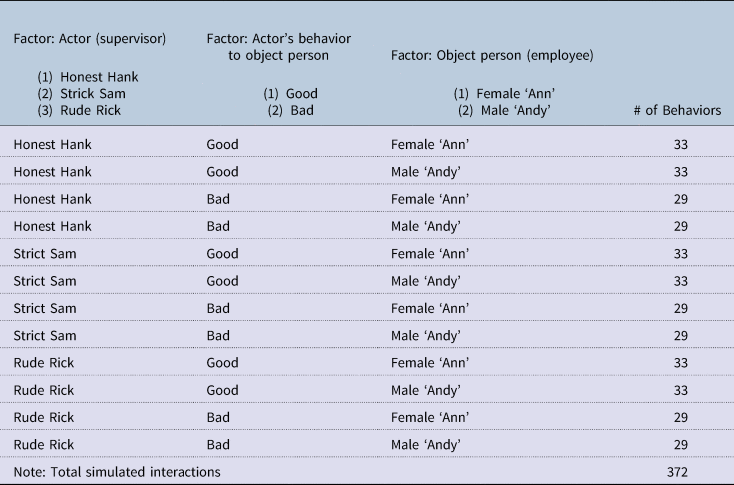
Table 1 displays a fully-crossed design which includes three supervisors (actors) of varying ethical character (identified as Honest Hank, Strict Sam, and Rude Rick), two categories of supervisor behavior (good, bad) toward two types (male, female) of competent employees. Thirty-three good supervisor behaviors and 29 bad behaviors by each supervisor toward each employee were simulated. A total of 372 unique simulated (predicted) likely employee emotional responses (E, P, A) were obtained, as described in Table 1. The E, P, A measures were used, as described in the ‘Measures’ section of this study, to calculate a measure of helpfulness (ED).
Experimental design: Supervisor–employee simulated interactions

Embedded formulae in the theory's software support identity modifications (Heise & Smith-Lovin, Reference Heise and Smith-Lovin1981). Two ‘employee’ identities, Ann and Andy, were modified via the software as ‘competent employees’ for this study. EPA profiles of ‘an employee’ (male: 1.16, .48, .66; female: 1.88, .05, .84) were each combined with the EPA of ‘competent’ (male: 2.74, 2.35, .88; female: 2.71, 2.62, 1.32) to result in a ‘competent male employee’ (1.61, 1.17, .80) and a ‘competent female employee’ (2.04, 1.10, 1.06). As expected, modifications increased the value of each EPA dimension for each employee identity.
A similar process was required to differentiate the EPA profiles of ‘supervisor’ for the three levels of supervisor ethical character. The unmodified ‘supervisor’ EPA profile (.88, 1.88, 1.09) was adjusted by a four-step process for each character. Honest Hank was modified to be considerate, competent, honest and generous with a final EPA profile of 3.26, 1.69, .67. This is similar to the EPA profile of ‘a best friend.’ The modifiers as thick ethical concepts are more descriptive than simply ‘good’ or ‘bad.’ Strict Sam was modified as cool, soft-spoken, strict and conscientious with a final EPA profile of −.42, .62, .02, similar to the EPA profile of ‘a bureaucrat.’ Rude Rick was modified to be inconsiderate, unambitious, unfair and rude with a final EPA profile of −1.91, −.93, −.36, similar to the EPA profile of ‘a delinquent.’ Honest Hank and Rude Rick as supervisors represent conceptually opposing ethical characters. Modified identities were added to the Interact EPA dictionary to conduct the simulations.
Results
Table 2, provides descriptive statistics for dependent variables (likely employee responses to supervisor behavior) including E, P, A, and ED. Evaluation exhibits the greatest variation of the four variables and ED has the least variation. Previous studies show E and P tend to be somewhat similar per interaction (Smith-Lovin, Reference Smith-Lovin1987). As expected, E and P for the dependent variables were strongly correlated in this study. E, P, and A are also significantly correlated with ED. The negative correlation between Evaluation and ED is also consistent with expectations since a low value for ED represents close proximity to helping behavior, which should be expected to be associated with high values for E.
Dependent variables: means, standard deviations, and correlations

N = 372.
**Correlation is significant at the .001 level (2-tailed).
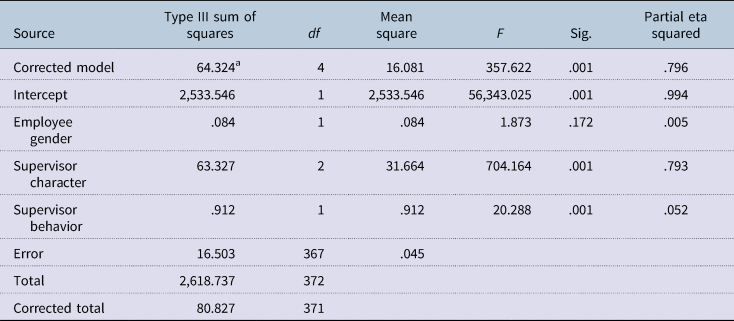
An analysis of variance (ANOVA) was performed using the ED from the simulated employee responses to the concept ‘to help’ (ED). Results are provided in Table 3. Employee gender was included as a control variable, while supervisor character and supervisor behavior were entered as main effects. The ANOVA model was statistically significant (p < .01) and exhibited a partial eta-squared value of .80 (R 2 = .80 and adjusted R 2 = .79).
ANOVA – tests of between-subjects effects dependent variable: Euclidean Distance (ED) from likely employee response to the concept ‘To Help’

a R Squared = .796 (Adjusted R Squared = .794).
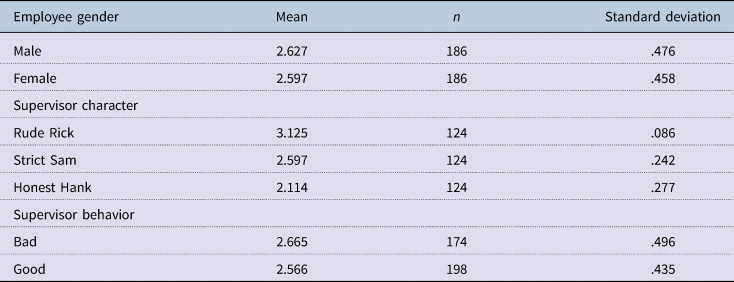
Table 4 displays means of the ED, for each factor (including the control variable of employee type/gender). The lower ED mean for Honest Hank indicates employee responses on average were closer to the EPA value for ‘to help’; the higher ED for Rude Rick indicate employee responses on average were further from the EPA value of ‘to help.’ These results are supportive of Hypothesis 1. A direct effect for gender was not observed (p = .17. partial eta squared = .01); however significant effects were observed for both supervisor character (p < .01, partial eta-squared = .79) and supervisor behavior (p < .01, partial eta-squared = .05). Pairwise comparisons of the ED of employee responses were analyzed. They revealed significant differences (p < .01) between all pairs of supervisor character (Honest Hank-Strict Sam, Honest Hank-Rude Rick, and Strict Sam-Rude Rick). Similarly, significant differences (p < .01) were observed between good and bad supervisor behavior indicating support for Hypothesis 2 and Hypothesis 3.
Means for Euclidean Distance for likely employee response to the concept ‘To Help’

Notes: EPA – Evaluation, potency, activity dimension to define verbal concepts, n = 33 good behaviors and 29 bad behaviors for each supervisor to each employee. Euclidean distance is the difference in three dimensional space between two concepts; the formula is: the square root of ((E-E’)2 + (P-P’)2 + (A-A’)2), where ‘to help’ is represented by E’, P’, and A’. E, P, and A terms represent the mean of employee likely/predicted behavior as shown above for Andy and Ann's likely responses to the supervisor.
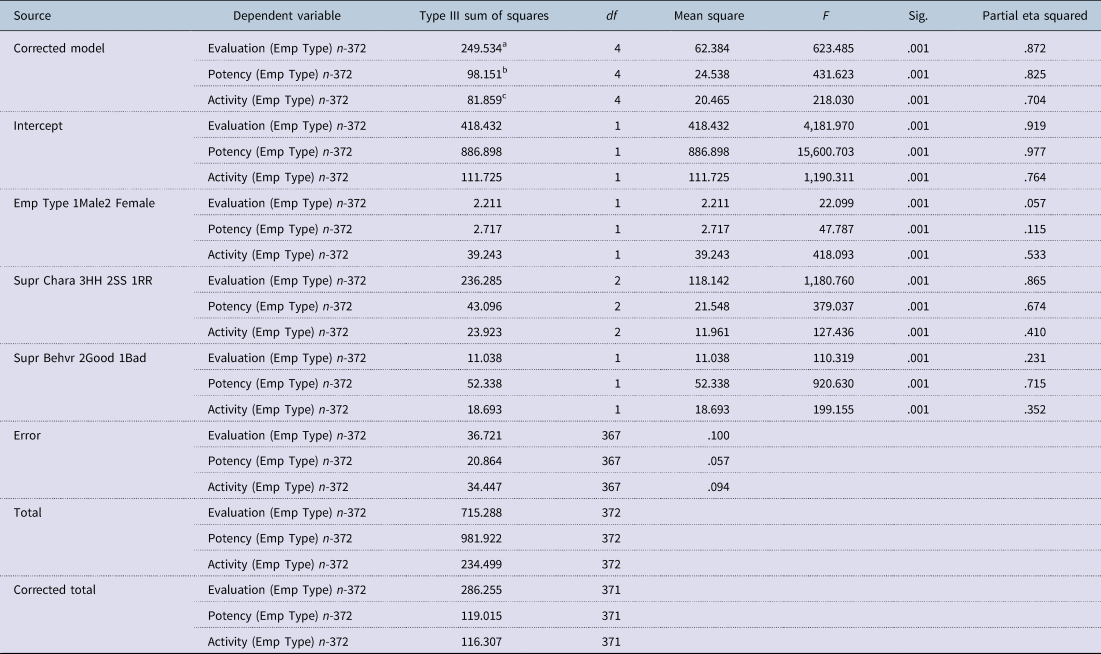
To gain further insight into the potentially different effects of supervisor character, supervisor behavior, and employee gender on E, P, and A distances to ‘to help’, we conducted a MANOVA analysis, where E, P, and A were included as the dependent variables and the same main effects (as in the preceding ANOVA) were used. Results of the between-subjects analyses are presented in Table 5. The F-tests for the E, P, and A models were all significant (p < .001). The models explained between 70 and 87% of the variance in the E, P, and A models.
MANOVA – tests of between-subjects effects dependent variables: Distance for likely employee response (E, P, A) to the concept ‘To Help’

a R Squared = .872 (Adjusted R Squared = .870).
b R Squared = .825 (Adjusted R Squared = .823).
c R Squared = .704 (Adjusted R Squared = .701).
Results for main effects were statistically significant (p < .001) for all variables (employee gender, supervisor character, and supervisor behavior) on the dependent variables (E, P, and A). From these results, it is apparent that employee gender, supervisor character, and supervisor behavior exhibit a differential pattern of effects upon E, P, and A, providing greater insight than the ANOVA analysis with the single overall measure of ED. While supervisor character is the dominant predictor of Evaluation, both supervisor character and supervisor behavior have a substantial impact on Potency. All three sources have a moderate impact upon Activity, yet, employee gender is the more dominant factor of the three. Thus, it appears that the pooling of E, P, and A data into ED in the prior (ANOVA) analysis may have obscured a more complex set of effects – including a gender effect – that appears when E, P, and A are examined separately.
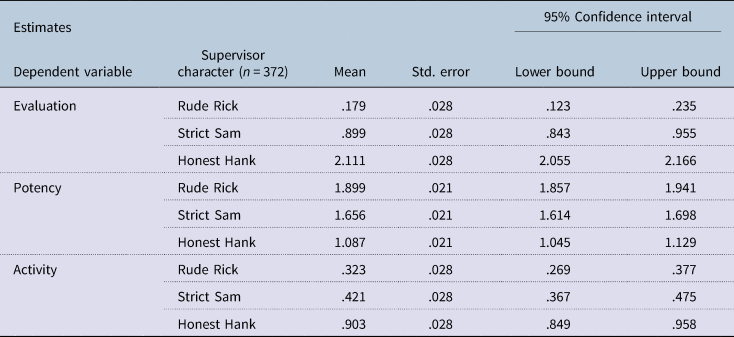
Next, we consider the effects of supervisor character on likely employee responses (in EPA terms) to supervisors. Estimated means for employee responses to supervisor character are provided in Table 6. Pairwise comparisons indicate highly significant differences (p < .01) between all pairs of supervisor characters for E, P, and A, with the exception of the comparison of Rude Rick and Strict Sam on the Activity dimension, which is significant at a lower level (p = .01). Effects of Supervisor Character on E, P, and A of likely employee responses produced partial eta-squared values of .87, .67, and .41 for E, P, and A, respectively (see Table 5), indicating support for Hypothesis 4 and fairly substantial and persistent effects of supervisor character on all three dimensions. Corresponding effects of supervisor behavior on likely employee responses were eta-squared values of .23 for E, .71 for P and .35 for A (see Table 5). Simulations for Rude Rick (the least ethical supervisor) predict the lowest definitions for the Evaluation and Activity dimensions of likely employee responses, indicating neutral to bad likely employee responses for Evaluation, the good versus bad dimension and less active versus lively responses for Activity; yet predict the highest potency for likely employee responses to Rude Rick. Overall, this suggests likely neutral to bad and passive employee responses with the most strength or emotional energy to Rick. These predictions contrast with likely employee responses predicted for Honest Hank, with highest definitions for Evaluation and Activity, that is quite good and lively likely responses and mild on the potency dimension.
EPA means of likely employee responses by supervisor character

N = 372.
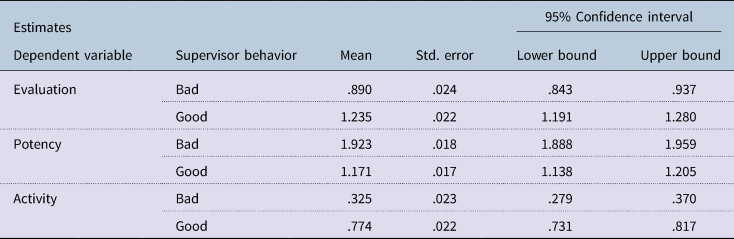
Finally, we consider the effects of different types of supervisor behavior on the E, P, and A estimates of likely employee responses – data are shown in Table 7. The means for good and bad behavior were significantly different (p < .01) for all three dependent variables. Partial eta-squared values .23, .71, and .35 for E, P, and A (see Table 5) indicate that all three variables were at least moderately related to supervisor behavior, with ‘potency’ of likely employee responses being most influenced by supervisor behavior. ‘Good’ supervisor behavior was associated with higher definitions on both evaluation and activity, but a lower definition for potency similar to the pattern of likely employee behavior to Honest Hank, the ethical character of interest in Table 6.
EPA means of likely employee responses by supervisor behavior

N = 372.
DISCUSSION
This study explores the ethical origins of employee helpfulness/OCB and responds to Whetstone's (Reference Whetstone2001) call for research to develop a deep understanding of ethical language in organizations. The study utilizes the idea of thick ethical concepts (Harcourt and Thomas, Reference Harcourt, Thomas and Kirchin2013) as applied via affect control theory's software, Interact (Heise, Reference Heise and Summers1970; Reference Heise2003; Reference Heise2007). This study evaluated likely (i.e., predicted) employee responses to supervisor ethical character and behavior with respect to likely employee helpfulness. It appears the ethical supervisor (Honest Hank) has a degree of license to behave badly, at least in the short-term, without unfavorable consequences from employees. Simulated (predicted) employee responses suggest that employees are likely to respond in a conciliatory manner to this supervisor's bad behavior. Favorable responses to an ethical supervisor's bad behavior suggest that employees seek to create an interaction to return the pair to an expected respectful encounter, consistent with affect control theory's main principle, ‘people seek to confirm fundamental sentiments’ (Heise, Reference Heise2007). Simulation results of employee likely behavior in response to an unethical supervisor (Rude Rick) were neutral at best. Predicted responses show resistance to the good behavior of an unethical supervisor and fairly potent neutral or negative responses to that supervisor's bad behavior. Employee responses to a slightly unethical bureaucratic character (Strict Sam) indicate this supervisor's good behavior likely generates less helpful responses versus responses to an ethical supervisor's good behavior. Yet, the potency dimension is higher, indicating more aggressive responses to a slightly unethical supervisor. Likely employee responses to Sam's bad behavior were similar to likely responses to the unethical supervisor's (Rick's) bad behavior, that is, punitive and assertive employee behavior, such as ‘to discipline’ and ‘to oppose.’
These results further demonstrate the theory's main principle, as noted previously. Thus, this study distinguished between the effects of supervisor character and behavior on employee helping behavior. Simulated results indicate supervisor character is the dominant factor. The study also distinguished the effects between unethical and minimally ethical supervisor character on employee helpfulness to supervisors. This apparent inflection point provides insight on the effects of leaders with a substantial ethical character versus those with limited ethical character. However, due to the limited number of characters that this study utilized, future research should identify where the inflection point occurs.
Simulated results are consistent with the principle of stability in affect control theory, which indicates that people (e.g., employees) transfer a portion of fundamental sentiments of an actor (e.g., a supervisor) to transient impressions of that leader in interactions. The simulated responses also indicated employees were likely to be more willing to assist their ethical supervisor and less likely to help an unethical supervisor. The simulated (predicted) response data also supported the behavior-object consistency principle, which states individuals preserve positive impressions of themselves by ‘doing good acts to good people and bad acts to bad people’ (Wiggins & Heise, Reference Wiggins and Heise1987: 156). This implies a person is likely to respond more in a morally positive manner to an ethical character versus an unethical character. Results from this study suggest that employees are likely to forgive an ethical supervisor's bad behaviors. Yet unfavorable results were predicted for employees' dealing with unethical supervisor's bad behavior. Consistent with prior research, this study indicates supervisors are well-positioned to influence employees' positive work behaviors (e.g., helping behavior) by paying close attention to their own ethics (e.g., Tang and Liu, Reference Tang and Liu2012). The results observed in this research also suggest that a limited demonstration of ethical character is unlikely to produce positive employee responses. It would then seem that clear demonstration of a leader's ethical character may be necessary to engender positive employee responses with respect to helpfulness.
Study limitations and future research
This study simulated interactions between supervisors and employees with a reasonably broad array of verbal concepts representing actions (behaviors) of supervisors with (researcher) defined characters. It was the intention of the researchers that the breadth of actions identified considered as ‘good’ or ‘bad’ would provide a sufficiently complex cross-section of human actions as to characterize a reasonably ‘thick’ and realistic representation of likely actions and responses. Despite this approach, other descriptors of character or behavior might yield different results. Substantial attempts were made to select a range of verbal concepts to rigorously apply theoretically relevant concepts to specify character and behavior. While the use of a conceptually similar set of verbal concepts could result in different substantially different findings, the authors believe that the steps taken here to richly define supervisor character and behaviors should minimize that possibility. Nevertheless, the use of a different set of verbal concepts representing another set of actions for supervisors may generate different findings. Thus, future studies might consider how the results of the current study might change (or not) under the use of different sets or subsets of ‘actions.’ Thus, potential limitations to generalizability do exist despite the use of thick ethical concepts.
The study defines three essentially discrete supervisor characters that might exist within a complex continuum of possible ethical characters. This approach was a necessity of research design and execution, as the incorporation of a broad range of supervisors along an ethical continuum was not practical from either a design or modeling standpoint. Thus, generalizations made from the present study should not be extended beyond the ethical character types utilized. Similarly, the study utilized a relatively simplistic representation of gender rather than incorporating the many possible conceptualizations of gender that are acknowledged today. Thus, generalizations beyond the boundaries of gender as characterized herein is not advisable.
The use of predicted employee responses as simulated behavior, while well established in other literatures, is relatively rare in the business/management literatures. It is essential to recognize that the ‘simulated’ interactions and responses obtained and analyzed herein represent mean or average responses that are ‘likely,’ but that are not guaranteed. Further, with a single point estimate of a likely response based on a specific supervisor character (as defined herein), a specific behavior, and a specific employee gender, all variability inherent in all individuals meeting those same criteria is not included in the simulation values. Thus, an unidentified amount of variation that would occur in interactions among real individuals (as opposed to simulated ones) is absent in the study. This should not be considered as a weakness of the methodology, as random variance in human populations would likely be categorized as ‘noise’ in statistical analyses. In this study, most ‘noise’ has been excluded through the use of mean (average) predicted values. The primary source of variation in the study comes from the 372 unique combinations of supervisor character, supervisor behavior, and employee gender. While this omits some of the ‘real’ variability of actual (and infinitely more complex) individuals interacting with one another, it captures the mean, or average, or expected behavior that is ‘likely’ for individuals with comparable characteristics in comparable situations. Thus, we would argue that highly relevant and useful variance has been captured via the interactive software and analyzed in this study – and the variance excluded, which reflects even greater ‘reality,’ is likely ‘noise’ or ‘error’ in most studies anyway, as every study has boundaries on what can and cannot be measured and analyzed.
Software predictions of likely behaviors are dependent on the most recent dictionary of US fundamental sentiments collected from university juniors and seniors in the United States in 2002–2003 (Francis & Heise, Reference Francis and Heise2004). These definitions likely differ for people in organizations with varying cultures. Yet, college juniors and seniors have good understandings of general cultural meanings of concepts (Schneider, Reference Schneider2002a) because they are mature enough to be socialized to general societal norms, yet they have not been heavily influenced by cultural norms in a single organization. Past research shows correlations of EPA definitions of general concept domains by college students across cultures can be somewhat high suggesting global norms for more generalized concept domains (Schneider, Reference Schneider2002b). However, correlations of concept domains with varying salience across cultures have not been significantly related (Schneider, Reference Schneider2002b). Caution is recommended before generalizing findings of this study to populations with cultures that differ from US values and beliefs.
Many types of OCBs exist and a number of factors influence citizenship in organizations. This study focused on the outcome of employee behavior ‘to help’ and a limited number of predictors. This approach represents a potential limitation because a trade-off can be made when applying thick ethical concepts in simulations. The inclusion of additional predictive concepts would likely have increased the research content beyond manageable levels. Yet, the strength and explanatory power of findings in this study suggest that the focus on a limited set of concepts was reasonable. Another limitation is that, unlike another study (i.e., Francis, Reference Francis2012), this current research does not compare software predictions with empirical findings; future research should validate the software's predictions with observational data, vignette studies, and/or other information.
Affect control theory suggests that repeated specific behaviors are likely necessary to change perceptions of character, and to modify behavior responses in interactions. The amount of repetition needed is theoretically unclear and is a challenging opportunity for future research. New work might investigate the impact of repetitive behaviors on perceptions of character. Results of this study provide some insights on a possible ‘tipping point’ between the ethical character (e.g., Honest Hank) and the bureaucratic character (Strict Sam). Likely employee responses to the minimally ethical and unethical supervisors were predicted to be quite similar. Moral intensity and the ethical decision-making process (Jones, Reference Jones1991) might be used to examine the influence of highly intense and impactful behaviors to change perceptions of supervisors.
In conclusion, this research gives new insight into the complexity of underlying factors in the ethical language in organizations. Specifically, affect control theory principles and cultural meanings of EPA profiles are important factors in supervisor/employee relations. Also, simulation predictions offer guidance to managers on likely employee outcomes as a consequence of supervisor ethical character and behavior.
Author ORCIDs
Sean Valentine, 0000-0002-3786-3833.
Conflicts of interest
None.
Appendix: EPA profiles of behavior concepts modeled as supervisor behavior