Introduction
Telmaturgus was established by Mik (Reference Mik1874) for the Palearctic species Sympycnus tumidulus Raddatz based largely on the nose-like projecting lower face of the female. Counting two species described here, eight species are now included in Telmaturgus from the Nearctic (3 spp.), Neotropical (1 sp.), Oriental (3 spp.), and Palearctic (1 sp.) Regions. However, the placement of the three Oriental species (Indonesia), known only from females, is tentative (Hollis Reference Hollis1964). A fourth Indonesian species attributed to Telmaturgus by Hollis (Reference Hollis1964) was transferred to Hercostomoides Meuffels and Grootaert upon discovery of the male (Meuffels and Grootaert Reference Meuffels and Grootaert1997). The remaining Indonesian Telmaturgus differ from Telmaturgus species from other regions by having five or six dorsocentral setae and metallic green thoraces (Hollis Reference Hollis1964) and may meet a similar fate once males are discovered.
The original purpose of this paper was to review and better characterize Telmaturgus in the Nearctic Region. In particular, I wanted to illustrate the male hypopygium of the genus for the first time, and describe a second Nearctic species from Pennsylvania with long, slender antennae. However, I was surprised to find that the female holotype of Telmaturgus parvus matched the Pennsylvania species and not the better-known species with short antennae previously thought to be T. parvus (e.g. sensu Robinson Reference Robinson1964). Here, the true male of T. parvus is described for the first time and the misidentified species is given a valid name. In addition, a second undescribed species of Telmaturgus found among material from the Canadian National Collection of Insects is described here. Finally, the taxonomic history of Telmaturgus in the Nearctic Region is reviewed and notes on the habits of this rarely collected genus are provided.
Materials and methods
Material examined during this study is housed in the following collections: the Academy of Natural Sciences in Philadelphia, Pennsylvania (ANSP); the Natural History Museum, London (BMNH); California Academy of Sciences, San Francisco (CAS); Canadian National Collection of Insects, Arachnids and Nematodes, Ottawa (CNC); Harold Robinson Collection, Washington, District of Columbia (HRC); Montana Entomology Collection, Montana State University, Bozeman (MTEC); National Museum of Natural History, Smithsonian Institution, Washington, District of Columbia (USNM).
Data for primary types are presented as they appear on labels. Labels are listed from top to bottom, each in quotation marks and separated by a semicolon; individual data lines are separated by a forward slash (/). Label data for other specimens are summarized using a standardized format.
Descriptions of structural terminology follow McAlpine (Reference McAlpine1981), except for genitalia which follow Cumming et al. (Reference Cumming, Sinclair and Wood1995) and Sinclair and Cumming (Reference Sinclair and Cumming2006). Illustrations of male genitalia are shown approximately as they appear on intact specimens (rotated approximately 180° and lateroflexed to the right), but in descriptions “dorsal” and “ventral” refer to the morphological positions before rotation and lateroflexion, with the top of the page ventral and the bottom of the page dorsal. Genitalia were cleared using 10% KOH and mounted in glycerin for examination and illustration. Body length was measured from the base of antenna to tip of the abdomen. Wing length was measured from the humeral crossvein to the wing apex.
The following abbreviations and terms are used: ad = anterodorsal(ly); av = anteroventral(ly); pd = posterodorsal(ly); pv = posteroventral(ly); ac = acrostichal seta(e); dc = pairs of dorsocentral seta(e); T1, T2, etc. = abdominal tergite one, abdominal tergite two, etc. Legs are designated by roman numerals, tarsomeres by bracketed Arabic numerals (e.g. Tarsus III(4) = 4th tarsomere of metathoracic leg).
Telmaturgus Mik
Telmaturgus Mik, Reference Mik1874: 349. Type species: S. tumidulus Raddatz, 1873 [Palearctic], by original designation.
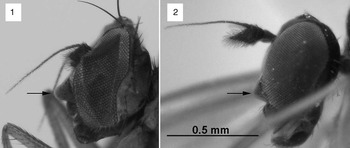
Diagnosis. Species of Nearctic Telmaturgus are small (body length 2.0 mm or less), nonmetallic sympycnines (but sometimes with metallic reflections) most readily recognized by the reduced number of dc setae (three pairs in Nearctic species versus four pairs in Neotropical and Palearctic species and five to six pairs in Oriental species) and the broad, projecting clypeus of females (Figs. 1–2). The combination of the following character states will distinguish Telmaturgus from other Dolichopodidae in the Nearctic. Vertex of head not excavate. Antennal scape without dorsal setae; pedicel without medioapical thumb-like projection. Wing with costa continuous to tip of unbranched vein M; veins R4+5 and M1 nearly parallel to slightly divergent beyond crossvein dm-cu; crossvein dm-cu shorter than last part of CuA1. Thorax with three large dc; ac in a single row; posterior scutum not distinctly flattened; scutum without velvety black area over wing base; notopleuron with two setae; proepisternum with only a few short hairs. Femurs II and III with preapical seta.
Heads of female Telmaturgus showing bulging face (arrow), lateral view. 1.Telmaturgus robinsoni sp. nov.2.Telmaturgus vockerothi sp. nov.

In the Nearctic Region, specimens of Telmaturgus are most likely to be confused with Lamprochromus Mik (which have four pairs of dc) or Syntormon Loew (females have a similar bulging face). However, Lamprochromus species are metallic green, have two rows of ac, a distinct blackened area on thorax above wing insertion, and females are without a bulging face. Syntormon species are also usually metallic green, have 5+ dc, an apical or subapical arista, and the pedicel has a thumb-like apical projection into first flagellomere.
Description
Male
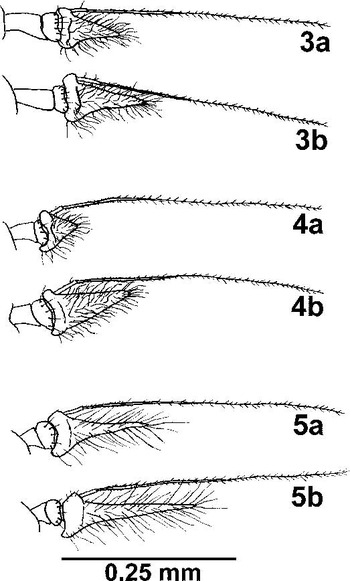
Head: Face pollinose with dorsal half triangular, ventral half very narrow (narrowest width less than or equal to width of two ommatidia), clypeus not projecting. Frons rather broad, shining with dark metallic reflections. Vertex with one pair of strong proclinate vertical setae; one pair strong divergent ocellar setae; one pair paravertical setae (slightly larger than uppermost postocular setae); postocular setae in a single row. Eyes with short hairs between facets (ommatidial hairs); ventral half to two-thirds of ommatidia enlarged, especially near face. Labellum with 12 geminately sclerotized pseudotracheae. Antennal scape without dorsal setae; pedicel small, with apical ring of setulae; first flagellomere brown to black, triangular, with basal arista (Figs. 3–5).
Antennae of Nearctic species of (a) female and (b) male Telmaturgus, lateral view. 3.Telmaturgus vockerothi sp. nov.4.Telmaturgus robinsoni sp. nov.5.Telmaturgus parvus (Van Duzee).

Thorax: Scutum with three pairs of large dc, sometimes with one to two small setae (less than one-third size of large dc) between two posteriormost dc that are inline to slightly offset medially from dc row; ac in single row; one presutural and one sutural intra-alar seta; one presutural and one postsutural supra-alar seta; one postalar seta; two notopleural setae. Postpronotum with one large seta and one to two very small hairs. Margin of scutellum with one pair large setae, one pair smaller lateral hairs, sometimes with additional marginal hairs medial to large setae. Upper proepisternum and proepimeron with several minute hairs. Pleuron in front of posterior spiracle with one or more yellowish small hairs.
Legs: Coxa I and II with small yellow hairs on anterior surface and larger black setae on apical margin. Coxa II with small black ad seta near 1/2. Coxa III with black dorsal seta at 1/2. Tibia I with comb-like row of ad setae on distal half (minute and essentially missing in T. parvus). Femur II with one ad and one to two pv preapical setae. Femur III with one ad preapical seta. Tarsus III(1) subequal to but slightly shorter than tarsus III(2).
Wing: Hyaline or brownish-tinged. R4+5 and M1 parallel or slightly diverging distally; crossvein dm-cu about half as long as distal section of CuA1. Calypter small, yellow, with dark brown to black apex, and with black setae.
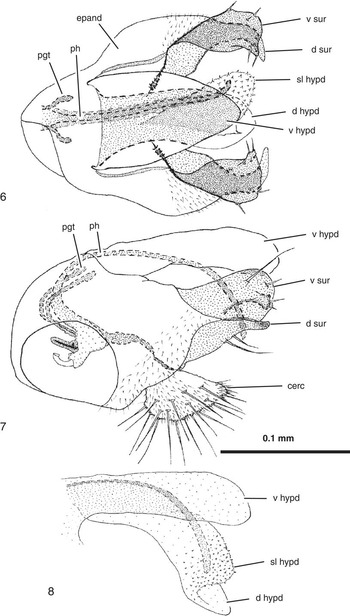
Abdomen: Conical, rather short and rather blunt apically, mostly dark brown with black hairs and setae. Hypopygium (Figs. 6–7) very small, mostly concealed, capping apex of preabdomen. Epandrium without distinct lobes or setae, with small hairs dorsoapically. Surstylus with two lobes; dorsal lobe rather narrow, tapering to rounded digitiform apex, which is directed medially, with one large and one smaller seta on dorsal surface near 1/2; ventral lobe broad, with one large ventral seta near 1/2, and several small setae near apex. Postgonite present as a pair of tubular sclerites extending around base of phallus and looping ventrally to end near base of hypandrium (Fig. 7). Cerci oval, pale brown with rather long yellow setae and short yellow hairs. Hypandrium (Figs. 6–8) composed of large, thick, rounded ventral lobe and tongue-like dorsal lobe that bears a large projection from ventral surface that is covered with minute spines apically (dorsal lobe and spiny projection are weakly sclerotized and easily missed if genitalia are over-macerated). Phallus arising between (or within) dorsal and ventral lobes of hypandrium with apex pointed slightly to the right (Fig. 6).
Telmaturgus male terminalia. 6.Telmaturgus robinsoni sp. nov. hypopygium, ventral view (Virginia). 7.Telmaturgus vockerothi sp. nov. hypopygium, left lateral view (dorsal lobe of hypandrium not shown) (New Brunswick). 8.T. vockerothi sp. nov. hypandrium, left lateral view (New Brunswick). Abbreviations: cerc = cercus; d hypd = dorsal lobe of hypandrium; d sur = dorsal lobe of surstylus; epand = epandrium; ph = phallus; pgt = postgonite; sl hypd = spiny lobe of hypandrium; v hypd = ventral lobe of hypandrium; v sur = ventral lobe of surstylus.

Female
Similar to male except for face very broad, nearly parallel-sided, concave with lower edge projecting beyond eyes (Figs. 1–2); first flagellomere shorter (Figs. 3–5); abdomen broader and usually somewhat flattened dorsoventrally. Abdominal terminalia with approximately eight slender acanthophorite spines.
Remarks. The form of the hypopygium, in particular the paired tubular postgonites (Fig. 7), supports the placement of Telmaturgus in Sympycninae. Interestingly, the male genitalia are very similar and show no characters useful for species identification. The essentially identical male genitalia and unusual structure of the hypandrium (Figs. 6–8) suggest that the Nearctic species of Telmaturgus form a closely related group. I have examined a male and female specimen of the Palearctic Telmaturgus tumidulus (from Stalmine, Poulton le Fylde, Lancashire, England), the type species of the genus. The male genitalia of T. tumidulus are very similar to the three Nearctic species: it has the same unusual hypandrium (except that the projection from the dorsal hypandrial lobe lacks spines), and is otherwise the same except the setae of the surstylus are much longer, and the cercus is more pointed apically.
The genitalia of only a few sympycnine genera have been examined in detail, but modification of dorsal lobe(s) (or arms) of the hypandrium may be common in the subfamily. For example, the unusual dorsal hypandrial lobe of Telmaturgus appears to be derived from the same structure as the hypandrial arms in Erebomyia, one of which is modified into a large hook (Hurley and Runyon Reference Hurley and Runyon2009). Detailed examination of additional Sympycninae genitalia, with particular attention to the hypandrium, may provide insights into relationships of the genera within this large subfamily.
Telmaturgus parvus (Van Duzee)
(Fig. 5)
Chrysotus parvus Van Duzee Reference Van Duzee1924: 45; transferred to Telmaturgus by Robinson (Reference Robinson1964).
Diagnosis. Males and females of this species are easily recognized by their long, slender first flagellomere with long hairs (Fig. 5) and the yellow ventral half of the pleura.
Description
Male: Body length 1.3–1.5 mm; wing length 1.4–1.6 mm.
Head: Face brown-gray pollinose, essentially obliterated by eyes (narrowest width less than width of ommatidium), slightly wider at ventral edge, narrowly triangular dorsally; frons large, wide, shining metallic dark violet with narrow median strip of very sparse brown-gray pollen. Postocular setae rather sparse, black. Palpus very small, dark brown, rounded apically, covered with minute hairs and two to three longer marginal brown hairs. Proboscis brown with a few slender brown hairs along margin. Antenna (Fig. 5b) entirely dark brown; first flagellomere long (length approximately 3 times width), slender, noticeably tapering near insertion of arista and drawn out to a narrowly acute point, covered with very long hairs (longest subequal to greatest width of first flagellomere).
Thorax: Scutum shining dark brown with very sparse brown-gray pollen and violet reflections; notopleuron covered with distinct patch of silver pollen (best viewed dorsolaterally); one to five ac anterior to transverse suture; three dc. Scutellum with very small lateral hair, no additional marginal hairs. Pleura with dorsal half dark brown, ventral half pale yellow, this color difference sharply demarcated.
Legs: Yellow, distal tarsomeres brownish. Coxa I with sparse yellow hairs on anterior surface, a few slender, black setae near apex. Tibia I without distinct setae. Tibia II with ad seta at 1/4 and 2/3, one dorsal seta near 1/4. Tibia III with one ad seta at 1/4, short series of two to four pd setae near 1/2, one av seta near 1/2, one small ventral seta near 1/3. Ratios of tibia:tarsomeres for leg I: 12-8-3-2-2-2; leg II: 20-9-4-3-2-2; leg III: 21-5-6-4-3-2.
Wing: Hyaline. R2+3, R4+5, and M slightly but distinctly diverging toward wing apex. A1 a very short, weak fold. Calypter yellow at base, broadly black at apex, with 4–5 short, black setae.
Abdomen: Similar in color to scutum, sternites frequently yellowish especially at base. Hypopygium very similar to Figs. 6–8 but: hypandrium in ventral view slightly narrower and more pointed apically, spiny lobe with smaller and perhaps fewer spines.
Female: Body length 1.3–1.7 mm; wing length 1.5–1.7 mm. Similar to male except for face wide, projecting ventrally but not greatly so (as in Fig. 2), with silver-brown pollen, dark violet ground color lending bluish color to pollen; first flagellomere a little shorter (Fig. 5a); tibia II with one av seta near 1/2.
Type material examined. HOLOTYPE ♀ labeled: “Protection / N.Y. 7.18 '15 / W. Wild Coll”; “Chrysotus / parvus / Holotype. Van Duzee”; “California Academy / of Sciences / Type / No. 03557”. PARATYPE: 1 ♀, PENNSYLVANIA, Delaware Co., Swarthmore, 13.vi.1909, Cresson (ANSP) [only photographs examined].
Additional material examined. CANADA: 1 ♀ ONTARIO, Simcoe, 13.vi.1939, G.E. Shewell (CNC). U.S.A: 1 ♂ MARYLAND, Somerset Co., Snow Hill, 16.vii.1968, swamp margin, W.W. Wirth (USNM); 1 ♀ PENNSYLVANIA, Centre Co., Black Moshannon State Park, Moss-Hanne Trail, Shirks Run, 40°53.40′N 78°02.58′W, 1900 ft, 26.vii.2005, J.B. Runyon (MTEC); 1 ♀ same data as previous, 24.vi.2007 (MTEC); 1 ♂, 9 ♀♀, same data as previous, 7.vii.2007 (MTEC, CNC, USNM); 3 ♂♂, 5 ♀♀ same data as previous, 26.vii.2007 (MTEC, CNC, CAS); 1 ♀ same data as previous, 12.viii.2007 (MTEC).
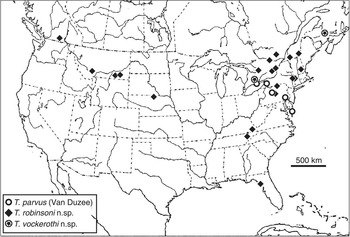
Distribution.Telmaturgus parvus is known from southern Ontario, New York, Pennsylvania, and Maryland (Fig. 10).
Remarks. The holotype is female (Robinson Reference Robinson1964), not male as described by Van Duzee (Reference Van Duzee1924). Although the holotype is in poor condition (missing antennae, most of wings, and part of abdomen), it has the following characters that clearly identify it as this species: ventral half of pleura yellow, bulge of face relatively small (as in Fig. 2), tibia I without comb-like row of setae. The specimens I collected in Pennsylvania were from deeply shaded sphagnum areas of a wooded swamp, the majority of which were obtained by inserting a sweep net into dark areas underneath a boardwalk.
Telmaturgus robinsoni Runyon, sp. nov.
Diagnosis. This species has entirely dark pleura and is similar to Telmaturgus vockerothi, but males lack very long setae on tarsus III(1) and females have a strongly projecting face (Fig. 1).
Description
Male: Body length 1.5–1.8 mm; wing length 1.5–1.7 mm.
Head: Face with silver-gray pollen and some yellowish pollen along eyes, nearly obliterated by eyes on ventral half (narrowest width less than or equal to width of ommatidium), a little wider at ventral edge, triangular dorsally; frons large, wide, shining metallic dark violet, uniformly dusted with very sparse brown pollen. Postocular setae brown to black. Palpus small, dark brown, rounded apically, covered with minute hairs and two to three longer black hairs near apex. Proboscis brown with a few slender black hairs along margin. Antenna (Fig. 4b) entirely dark brown; first flagellomere triangular, length approximately 2 times width, apex acute but rounded, covered with rather long hairs (longest approximately half greatest width of first flagellomere).
Thorax: Scutum dark brown with moderately dense brown-gray pollen and violet reflections; notopleuron with blue-gray pollen (best viewed laterally), same color as pleura; two to eight ac; three large dc with two to three small setae in front of anteriormost large dc, and with one to two small setae between second and third large dc. Scutellum with lateral hair and one to five marginal hairs medial to large setae. Pleura entirely brown in ground color which is mostly concealed by dense blue-silver pollen, sometimes metepimeron ventrally and area below posterior spiracle yellow.
Legs: Mostly yellow, distal tarsomeres brownish, coxa I, femora I and III sometimes brownish. Coxa I with sparse yellow hairs on anterior surface, a few black setae near apex. Femur II with several short ventral hairs or setae near base. Tibia I with comb-like row of setae on apical half (length subequal to width of tibia I). Tibia II with ad seta at 1/4 and 2/3, one dorsal seta near 1/4, one small av seta near 1/2. Tibia III a little widened distally, position and number of setae variable, but typically with zero to two ad setae (if present at 1/4 and 2/3), two to three pd setae near 1/2, one av seta at 1/2, one ventral seta at 1/4. Distal two-thirds of tibia through tarsus III(4) sometimes with ad setulae silvery-white. Ratios of tibia:tarsomeres for leg I: 12-8-3-2-2-2; leg II: 20-9-4-3-2-2; leg III: 22-4-5-4-2-2.
Wing: With brown tint, more hyaline on ventroapical one-quarter to one-fifth of wing in most specimens. R4+5 and M1 parallel beyond crossvein dm-cu. A1 present as short, weak fold. Calypter yellow at base, broadly black at apex, with three to five short, black setae.
Abdomen: Similar in color to scutum, T2 varies from entirely dark brown to some yellow laterally that in a few specimens extends dorsally to leave a narrow medial brown band; sternites frequently yellowish especially at base. Hypopygium illustrated in Fig. 6 and very similar to Figs. 7–8.
Female: Body length 1.7–2.0 mm; wing length 1.8–2.0 mm. Similar to male except for face wide, with ventral edge strongly projecting (Fig. 1), with silver-brown pollen, dark violet ground color lending bluish color to face; first flagellomere (Fig. 4a) short triangular with rounded apex (length less than or equal to width); short ventral setae at base of femur II very small to absent; tibia III not widened distally; tibia and tarsomeres of leg III never with silvery-white setulae.
Type material. HOLOTYPE ♂ labeled: “Lac Phillipe / Que. 2.IX.1968 / 45°37°N. 76°W / J.R. Vockeroth”; “HOLOTYPE / Telmaturgus / robinsoni / J.B. Runyon” [red label] (CNC). PARATYPES: CANADA: BRITISH COLUMBIA. 1 ♂, Penticton, 8.viii.1967, J.R. Vockeroth (CNC). ONTARIO. 1 ♀, Prince Edward Co., Outlet Beach, 14.viii.1968, J.R. Vockeroth (CNC); 1 ♀, Midland, 30.vii.1956, J.G. Chillcott (CNC); 2 ♀♀, Ottawa, 1.vi.1951, J.F. McAlpine (CNC); 1 ♀, Perth Road, 18.viii.1957, J.R. Vockeroth (CNC); 3 ♂♂, 8 ♀♀, same data as holotype (CNC). QUEBEC. 3 ♀♀, Farnham, 5.vi.1963, J.R. Vockeroth (CNC); 1 ♀, Megantic, 22.vi.1923, C.H. Curran (CNC). USA: FLORIDA. 1 ♀, Cedar Keys, 12.vii.1939, Oman (USNM). MASSACHUSETTS. 1 ♀, Berkshire Co., Pittsfield, Springside Park, 9.ix.2006, J.B. Runyon (MTEC); 1 ♀, Berkshire Co., Berry Pond, 2150 ft, 5 mi. NW of Pittsfield, 42°30.375′N 73°19.202′W, 9.ix.2006, J.B. Runyon (MTEC). MONTANA. 1 ♀, Rosebud Co., 6 mi. E of Lame Deer, 3800 ft, 14.viii.1993, R. Hurley (MTEC); 1 ♂, Powder River Co., Holiday Springs, 12 mi. NE of Ashland, 3850 ft, 24.viii.2002, J.B. Runyon (MTEC); 1 ♀, Jefferson Co., Milligan Creek at Milligan Canyon, 6 mi. W Three Forks, 4370 ft, 6.vii.2002, R. Hurley & J. Runyon (MTEC); 1 ♂, same data as previous, 14.vi.2003 (MTEC). NEBRASKA. 1 ♂, Keya Paha Co., Mills, 16.vi.1959, F.C. Harmston (MTEC). NEW HAMPSHIRE. 2 ♂♂, Belknap Co., 0.25 mi. NE of Tilton, 43°26.823′N 71°35.094′W, 16.vii.2007, J.B. Runyon (MTEC). PENNSYLVANIA. 1 ♂, Bradford Co., 2 mi. S Gillette, 4.vi.1983, R. Hurley (MTEC); 1 ♂, 1 ♀, Centre Co., Black Moshannon State Park, Moss-Hanne Trail, Shirks Run, 1900 ft, 40°53.40′N 78°02.58′W, 26.vii.2007, J.B. Runyon (MTEC). TENNESSEE. 1 ♂, Knox Co, 28.vi.1957, H. Robinson (HRC); 1 ♂, same data as previous, 18.vii.1957 (HRC). VIRGINIA. 4 ♂♂, 2 ♀♀, Dickenson Co., Cranesnest River, 3 mi. NE Clintwood, 1250 ft, 37°10.36′N 82°24.12′W, 11.vi.2008, J.B. Runyon (MTEC).
Distribution.Telmaturgus robinsoni is widely distributed in North America. Specimens are known from British Columbia, Ontario, and Quebec in Canada and Florida, Massachusetts, Montana, Nebraska, New Hampshire, Pennsylvania, Tennessee, and Virginia in the United States (Fig. 10).
Etymology. This species is named in honor of Dr. Harold Robinson who first recognized Telmaturgus in the Nearctic (Robinson Reference Robinson1960) and first described this species (Robinson Reference Robinson1964) (albeit mistakenly as T. parvus).
Remarks. This species shows considerable variability in a number of characters (even among specimens from the same locality on the same date) such as number of ac (from one to six), number of hairs on apical margin of scutellum (from one to five), and color of setulae on ad surface of tibia III and tarsus III (entirely black or entirely silvery-white). The presence and extent of yellow on the abdomen and the size of the small basoventral setae of femur II are also variable. Based on similarity of male genitalia and the lack of any geographic patterns in characters, the specimens listed here are considered to be conspecific. I have collected T. robinsoni from the shade of tall grasses (often with cattails) in rather open, marshy/springy areas (Montana, New Hampshire, Pennsylvania, Massachusetts) and from sweeping low vegetation bordering small, shaded creeks (Massachusetts, Virginia).
Telmaturgus vockerothi Runyon, sp. nov.
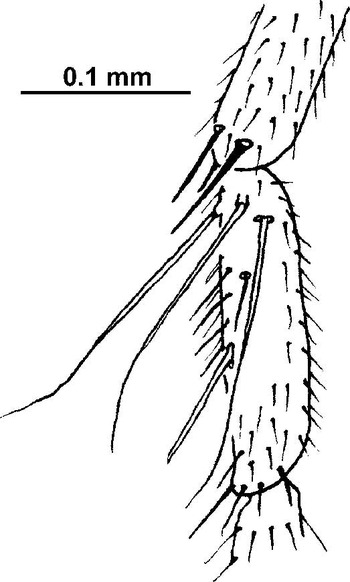
Diagnosis. This species has entirely dark pleura and is similar to T. robinsoni except that males have very long setae on tarsus III(1) (Fig. 9) and the lower face of females is only slightly projecting (Fig. 2).
Tarsus III(1) of male Telmaturgus vockerothi sp. nov., ventral view.

Description
Male: Body length 1.8–2.0 mm; wing length 1.5–1.6 mm.
Head: Face very narrow on ventral half (narrowest width equal to width of two ommatidia or less), a little wider at ventral edge, triangular dorsally, with light brown-gray pollen which is most dense along eyes; frons wide, shining metallic dark blue-violet, uniformly dusted with very sparse brown pollen. Postocular setae black, those on ventral half of head appearing light brown in certain lights. Palpus small, dark brown, rounded apically, covered with minute yellowish hairs and two to three longer yellowish hairs near apex. Proboscis brown with a few slender, yellowish hairs along margin. Antenna (Fig. 3b) similar to T. robinsoni, but scape slightly longer and first flagellomere usually narrower with slightly more pointed apex.
Thorax: Scutum dark brown with moderately dense to dense brown-gray pollen and violet reflections; notopleuron with sparse blue-gray pollen (best viewed laterally), same color as pleura; four to seven ac; three large dc, with two to three small setae in front of anteriormost large dc and with one to two small setae between second and third large dc. Scutellum with lateral hair and two marginal hairs medial to large setae. Pleura entirely brown in ground color, which is partly concealed by moderately dense blue-silver pollen.
Legs: Mostly yellow, but with coxa II often brownish, femur III brownish on distal half, tarsus I and II brownish distally, tarsus III mostly to entirely dark brown. Coxa I with sparse yellow hairs on anterior surface, a few black setae near apex. Tibia I with comb-like row of 4–5 setae on apical half (length subequal to width of tibia I). Tibia II with ad seta at 1/4 and 2/3, one dorsal seta near 1/4. Tibia III pale yellow, noticeably widened on distal two-thirds, with one to two pd setae near 1/2, and with noticeably longer setulae on ventral to av surface. Tarsus III(1) (Fig. 9) ventrally at base with three long, slender black setae (length of setae approximately equal to length of tarsomere), ventral surface surrounding insertion of these setae mostly bare.
Wing: Hyaline. Rather short (wing length less than body length). R4+5 and M1 nearly parallel beyond crossvein dm-cu. A1 present as short, weak fold. Calypter yellow at base, broadly black at apex, with four to seven short, black setae.
Abdomen: Similar in color to scutum, T2 yellowish laterally; sternites frequently yellowish especially at base. Hypopygium illustrated in Figs. 7–8, very similar to Fig. 6. Ratios of tibia:tarsomeres for leg I: 14-8-3-2-2-3; leg II: 22-9-4-3-2-2; leg III: 26-5-6-4-3-3.
Female: Body length 1.9–2.1 mm; wing length 1.7–1.8 mm. Similar to male except for face wide, with ventral edge slightly projecting (Fig. 2); with silver-brown pollen, dark violet ground color lending bluish color to face; first flagellomere (Fig. 3a) a little shorter (length greater than or equal to width); ventral setae at base of tarsus III(1) absent. Tibia II with av seta near 1/2. Tibia III not widened distally.
Type material. HOLOTYPE ♂ labeled: “Kouchibouguac N.P. / N.B. 5.VII.1977 / J.R. Vockeroth / Code- 5486Z”; “HOLOTYPE / Telmaturgus / vockerothi / J.B. Runyon” [red label] (CNC). PARATYPES: CANADA: NEW BRUNSWICK. 2 ♂♂, same data as holotype (CNC); 2 ♂♂, same data holotype, 30.vi.1977, with code “5453S” (CNC); 1 ♀, same data as previous, J.D. Lafontaine (CNC). ONTARIO. 1 ♂, 1 ♀, Oliver Bog, 3 km south of Galt, 27.v.-3.vi.1987, pitfall trap, sedge pond, D. Blades (CNC).
Distribution.Telmaturgus vockerothi is known only from southern Ontario and New Brunswick, Canada (Fig. 10).
Known distribution of Telmaturgus species in the Nearctic Region.

Etymology. Named in honor of Richard (Dick) Vockeroth who collected most of the known specimens of the species.

Discussion
Although short, the taxonomic history of Telmaturgus in the Nearctic is reviewed here in light of the newly interpreted identity of T. parvus. Robinson (Reference Robinson1960) first recognized Telmaturgus in the Nearctic Region (Telmaturgus brevicornis Robinson), recorded along with Diaphorus satrapa Wheeler and an undescribed dolichopodid species from Tennessee. Subsequently Robinson (Reference Robinson1964) transferred T. brevicornis and D. satrapa to Lamprochromus (the first record of that genus from the Nearctic) and synonymized T. brevicornis with L. canadensis (Van Duzee).
The undescribed species from eastern Tennessee in Robinson (Reference Robinson1960) turned out to be a “true” Telmaturgus. Following a suggestion by Fred C. Harmston that the Tennessee material might belong to Chysotus parvus Van Duzee, Robinson examined the types of C. parvus and then transferred the species (including his eastern Tennessee material) to Telmaturgus and redescribed it (Robinson Reference Robinson1964). Subsequently, my examination of the Van Duzee holotype and Robinson's Tennessee material revealed that the Tennessee material represents the new species T. robinsoni described here and that most literature records for T. parvus are based on misidentifications. For example, with the exception of New York and Pennsylvania, the localities listed for T. parvus in Pollet et al. (Reference Pollet, Brooks and Cumming2004) refer to the relatively more common and widespread T. robinsoni.
Telmaturgus are rarely collected and there are few specimens in collections. Assuming Hollis’ Indonesian species are true Telmaturgus (Hollis Reference Hollis1964), four of the eight known Telmaturgus species are known from a single specimen (Telmaturgus costaricensis Robinson, Telmaturgus pulchrithorax Hollis, Telmaturgus semarangensis Hollis, and Telmaturgus wonosoboensis Hollis). The Palearctic T. tumidulus is reported to be rare (Pollet Reference Pollet2000). Telmaturgus tumidulus inhabits humid heathland and peat bog areas (Pollet Reference Pollet2000) and Nearctic species appear to prefer similar habitats. For example, I found T. parvus only in moist deeply shaded sphagnum areas of a wooded swamp in central Pennsylvania and T. robinsoni primarily in shaded areas. Habitat preference of T. vockerothi is unknown, but two specimens were collected in a bog. Preference for deep shade is unusual for Dolichopodidae but is a hallmark of several Sympycninae including Sympycnus Loew, Calyxochaetus Bigot (Robinson Reference Robinson1964), and Erebomyia Runyon and Hurley (Runyon and Hurley Reference Runyon and Hurley2004; Hurley and Runyon Reference Hurley and Runyon2009). It seems noteworthy that species of Telmaturgus, and many of the other dolichopodid species occurring in dark habitats, have lost the metallic coloration found in most other Dolichopodidae.
Acknowledgments
Thanks to Scott Brooks (CNC), Norman Penny (CAS), Harold Robinson (USNM), Norman Woodley (USNM), and Erica McAlister (BMNH) for providing specimens used in this study. Max Barclay (BMNH) kindly carried and delivered specimens of T. tumidulus from London. Jon Gelhaus and Jason Weintraub (ANSP) examined and sent photos of the T. parvus paratype. Special thanks to Michael Ivie (MTEC) for reviewing the manuscript and use of his Syncroscopy AutoMontagePro® system to create digital images.