Introduction
The study reported in this paper coincided with the designation by the European Union Council and Parliament of 2007 as the ‘European Year of Equal Opportunities for All’ (Sidorenko and Walker Reference Sidorenko and Walker2004). The principal research question that has been addressed is, are the factors leading to self-perceived job satisfaction and organisational commitment different for older and younger workers? The analysis has examined the rarely considered predictors of skill discretion (i.e. the range of skills used on the job), organisational fairness, and perceived job insecurity in two contrasting labour markets, those of Belgium and Sweden. The study was inspired by the concern that the low rate of employment of older workers constitutes a loss of life opportunities for individuals, organisations and society at large (Carley Reference Carley2005; Organisation for Economic Co-operation and Development (OECD) 2006). Throughout this study ‘organisation’ refers to the employment site (i.e. factory, office, shop or school) for large multi-site employers and to the company or corporation for those with single employment sites.
In terms of the human resource principles that are applied to ageing in a labour force, we favour the conservation model rather than the depreciation model (Yeatts, Folts and Knapp Reference Yeatts, Folts and Knapp2000). This views all employees, regardless of their age, as long-term organisational assets that are worthy of investment (e.g. training). By contrast, the depreciation model sees an older worker's value to the employer as declining towards retirement, and consequently believes that investment in older workers gives a poor return. Recognising the positive contributions of older workers implies developing and implementing policies and practices for their retention in the workforce (Brewington and Nassar-McMillan Reference Brewington and Nassar-McMillan2000; Brooke and Taylor Reference Brooke and Taylor2005; Collins Reference Collins2003; Drury Reference Drury2001; Greller and Stroh Reference Greller and Stroh2004; Peterson and Spiker Reference Peterson and Spiker2005; Simon and Osipow Reference Simon and Osipow1996).
As part of a larger project, the current study makes a modest contribution to the understanding of successful ageing at the workplace by exploring the determinants of job satisfaction and organisational commitment. Job satisfaction refers to the extent to which an employee likes his or her job, or as Hodson (Reference Hodson2005: 46) put it, ‘to a summary indicator of a worker's mental calculus of how well a job meets his or her material, social and emotional needs’. We followed Cook and Wall (Reference Cook and Wall1980: 40) by defining organisational commitment as ‘feelings of attachment to goals and values of the organisation, one's role in relation to this, and attachment to the organisation for its own sake rather than for its strictly instrumental value’. These two criterion variables were selected because, apart from being important for workers' psychological and physical health, employers believe that job satisfaction and organisational commitment lead to better job performance (Judge et al. Reference Judge, Thoresen, Bono and Patton2001). Moreover, if there are more satisfied and committed older workers, this will counteract the forecasted labour shortages, help sustain social security systems, and be beneficial for society at large (Carley Reference Carley2005; OECD 2006).
The three studied predictors were ‘skill discretion’, ‘organisational fairness’ and ‘perceived job security’. Skill discretion is one of the control dimensions in Karasek's job-demand-control model of occupational health (Smith et al. Reference Smith, Tisak, Hahn and Schmieder1997; Van der Doef and Maes Reference Van der Doef and Maes1999). Karasek (Reference Karasek, Sauter, Hurrell and Cooper1989: 137) defined skill discretion as ‘the breath of skills used by the worker on the job’. Organisational fairness refers to the fairness of the material outcomes of work (distributive justice), of the procedures used to determine the distribution of outcomes (procedural justice), and of inter-personal treatment (interactional justice) (Colquitt Reference Colquitt2001; Colquitt et al. Reference Colquitt, Conlon, Wesson, Porter and Ng2001). We followed Mauno et al. (Reference Mauno, Kinnunen, Mäkikangas and Nätti2005: 210) by defining job insecurity as ‘a subjective estimate of one's chances of losing one's job, which in turn is based on the objective circumstance, e.g. downsizing, temporary employment, witnessed by the individual in organizations’. The predictors were selected for two reasons: first, they are consistent with good practice in the management of an ageing workforce, in that they combat age barriers and promote age diversity (Brooke and Taylor Reference Brooke and Taylor2005; Naegele and Walker Reference Naegele and Walker2006), and secondly, they address workers' perceptions of their interests (e.g. to prevent their de-skilling), of the organisation's responsibilities (e.g. to create a climate of fairness), and of the government's responsibilities (e.g. to promote active labour-market policies that reduce job insecurity).
To gain further insight into the factors that promote job satisfaction and organisational commitment among older workers, we also studied a comparison group of younger workers. This does not imply that we use an ‘extreme groups approach’ (as described by Preacher et al. Reference Preacher, Rucker, MacCallum and Nicewander2005) to infer results for the continuous variable ‘age’, but rather have taken older and younger workers as two target groups in the comparative management of an age-diverse workforce, as exemplified by Brooke and Taylor (Reference Brooke and Taylor2005) and urged by Roberts (Reference Roberts2006). The term ‘older workers’ is commonly used but there is no agreement on a particular chronological age threshold (Ashbaugh and Fay Reference Ashbaugh and Fay1987; Maurer Reference Maurer2001). Following Simpson, Greller and Stroh (Reference Simpson, Greller and Stroh2002), who considered that career development and work attitudes after 50 years of age are quite different from those at earlier ages, we defined ‘older workers’ as employed men and women aged 50 or more years. Such workers are in their late careers (Greller and Simpson Reference Greller and Simpson1999). OECD (2006) adopted 50 years as the age threshold for ‘older workers’ because in many countries it marks the beginning of a decline in age-participation rates. The term ‘younger workers’ is understood in theoretical research and various empirical studies as men and women aged less than 25 years (Loughlin and Barling Reference Loughlin and Barling2001; Neumark and Wascher Reference Neumark and Wascher2004; Salminen Reference Salminen2004). This definition is used in the labour statistics of the Statistical Office of the European Communities (Eurostat) and of OECD. Younger workers are primarily career starters. We agree with Frone (Reference Frone2000) that important developments in competencies take place in middle (16–18 years) and late (19–21 years) adolescence, and that little is known about the work attitudes of young workers or the extent to which they are carried into later career stages. We are particularly interested in the extent to which job satisfaction and organisational commitment project throughout careers in this way.
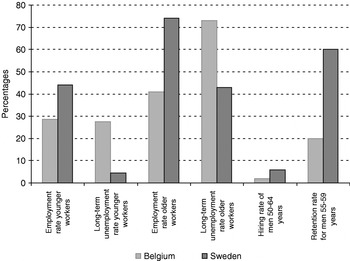
Work organisations and workers do not operate in a vacuum but in macro-social and economic contexts. Our study is of two European Union (EU) member states, Sweden and Belgium, which at the time of study had contrasting rates of labour market participation among older and younger workers. On the whole, opportunities in the Swedish labour market were more favourable for both age groups (see Figure 1). OECD (2006) found that Sweden reached the first EU Lisbon 2000 target (i.e. a 50 per cent employment rate for those aged 55–64 years by 2010) far in advance, and that it is well on the way to meeting the second target (i.e. an increase of five years in the average age of exit from the labour market by 2010). Belgium's progress towards the Lisbon targets is slow and remains uncertain. Far-reaching reform is still needed to promote the employment of older workers and to dismantle its early-retirement culture. It should be noted that more jobs for older workers do not mean fewer jobs for youth. Across the OECD countries, there was a positive correlation between changes in employment rates for younger and older people, as specifically in Belgium and Sweden (OECD 2006).
Labour markets for younger and older workers in Belgium and Sweden, circa 2001.

The research model
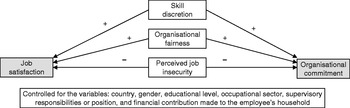
Based on a literature review, we generated hypotheses of the relationships between the three selected predictors and the two criterion variables that in combination constitute the research model, which is portrayed in Figure 2. The determinants of job satisfaction and organisational commitment, discussed below, are potentially powerful for workers of all ages, but where possible we specify their special relevance for older and younger workers. The key research question was whether the model held for both older and younger workers.
The theoretical research model.

Hansson et al. (Reference Hansson, DeKoekkoek, Neece and Patterson1997) nominated ‘maintaining important job skills’ and ‘learning new skills’ as factors in successful ageing at the workplace. Throughout their career, workers need to keep their skills up-to-date to remain competitive in the job market (Brewington and Nassar-McMillan Reference Brewington and Nassar-McMillan2000) and to remain self-confident (Maurer Reference Maurer2001). Society at large, and particularly employers, encourage lifelong learning and continuous vocational training. At the time of our study, however, these human capital investments were differentially available in Belgium and Sweden, with the latter in the lead (European Foundation for the Improvement of Living and Working Conditions 2004). Research has shown that human capital investments tend to favour younger over older workers (Maurer Reference Maurer2001; Simpson, Greller and Stroh Reference Simpson, Greller and Stroh2002; Taylor and Urwin Reference Taylor and Urwin2001). Appraising late-career employees' interest in training and facilitating their participation are major challenges for age-aware human resources managers. Another consideration is that, other things being equal, more skill discretion raises the job satisfaction of older workers (Warr et al. Reference Warr, Butcher, Robertson and Callinan2004). Mikkelsen, Øgaard and Landsbergis (Reference Mikkelsen, Øgaard and Landsbergis2005) found that skill discretion reduced the negative effects of high cognitive load and emotional job demands on job satisfaction. Hence, we hypothesised positive links between skill discretion and both job satisfaction and organisational commitment.
The meta-analytic review by Colquitt et al. (Reference Colquitt, Conlon, Wesson, Porter and Ng2001) and Liao and Rupp's (Reference Liao and Rupp2005) study pointed to the positive effect of organisational fairness on job satisfaction and organisational commitment. Hence, our research model hypothesises positive relationships between organisational fairness and both job satisfaction and organisational commitment. Job insecurity is highly dependent on the societal and organisational contexts (Kinnunen, Feldt and Mauno Reference Kinnunen, Feldt and Mauno2003; Sverke and Hellgren Reference Sverke and Hellgren2002). Factors such as a tight or slack labour market, the generosity of the social security system, and the rate of company restructuring may influence the probability of job loss and its consequences, especially for older workers (Armstrong-Stassen Reference Armstrong-Stassen2001). A longitudinal study in Belgium completed in 2003 found an increase over time of about 10 per cent in feelings of job insecurity among workers aged 40–64 years (Clays et al. Reference Clays, De Bacquer, Leynen, Kornitze, Kittel and De Backer2006). Based on 1997 data for 15 OECD countries (including Sweden), Anderson and Pontusson (Reference Anderson and Pontusson2007) revealed that societal measures (i.e. employment protection legislation, active labour-market programmes, and unemployment compensation) reduced employment insecurity, and that the overall level of welfare state generosity had no systematic effect on whether workers felt secure.
Reisel, Chia and Maloles III (Reference Reisel, Chia and Maloles2005) found that after controlling for age, job insecurity was negatively related to perceptions of esprit de corps (i.e. the extent to which employees were committed to common goals and to each other). This finding may be worrisome because workers who feel insecure (whether old or young) may come to perceive their co-workers (either old or young) as competitors for soon to be scarce jobs. Sverke, Hellgren and Näswall (Reference Sverke, Hellgren and Näswall2002) viewed the levels of job satisfaction and organisational commitment as consequences of perceived job insecurity. From a literature review and meta-analysis, they concluded that perceived job insecurity had a moderate negative correlation with organisational commitment and a strong negative correlation with job satisfaction. Böckerman (Reference Böckerman2004) and Mauno et al. (Reference Mauno, Kinnunen, Mäkikangas and Nätti2005) confirmed the latter finding. Hence the research model includes these negative relationships. Other factors may account for differences in job satisfaction, organisational commitment, skill discretion, organisational fairness, and perceived job insecurity. ‘Country’ was the primary control variable, and others that we examined were gender, educational level, occupational sector, job level, and the financial contribution that the employee made to his or her household.
Methods
The samples
The data were gathered during 2003–04 as part of a larger study (described in the Acknowledgements). A stratified sampling frame was employed in each country to represent three broad employment sectors (food and drink manufacturing, retailing and sales, and education). These three were chosen because of their ubiquity in each country, the accessibility of the employees, and the considerable diversity of employees, of employer organisations (referring to both employment sites and public and private sectors), of employment contracts (i.e. permanent versus non-permanent), and of the employees' levels of education and skills. The targets for the sample were: at least seven organisations in each country with a minimum of five respondents with non-permanent contracts (and any number with permanent contracts). Access to most organisations was through the Director of Human Resources. Questionnaires were distributed to employees and sealed boxes provided for the deposit of the completed forms. Unfortunately, the response rates could not be determined. As the data gathering relied on the voluntary participation of organisations and their employees, the resulting samples were neither completely random nor entirely representative. The survey measured age continuously in years, and the range of the respondents' ages was from 16 to 66 years. For the purpose of this article we selected respondents aged less than 25 years (17.1% of the all-age sample) and those aged 50 or more years (15.8%).
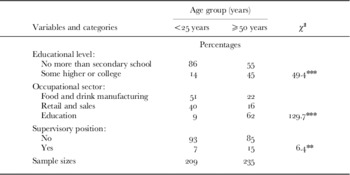
There were no significant differences between the older and younger samples by country, gender or financial contribution to their households, but the older workers were more highly educated and more likely to have supervisory positions than the younger workers, and there were age-group differences by the three employment sectors (Table 1). Older workers were over-represented in the educational sector, while younger workers were about evenly distributed across the food and drink manufacturing industry and the retail and sales sector. These sample differences raise two questions: whether age-related sector differences in job security explain the high number of older workers in education and the relatively high prevalence of younger workers in the more casualised other two sectors, and whether in turn these differences translate into job satisfaction and organisational commitment.
Comparisons of the older and younger age group samples

Note: The chi-squared comparisons for 2 by 2 tables use a continuity correction (Siegel and Castellan Jr. Reference Siegel and Castellan1988). The chi-squared test for occupational sector is a 3 by 2 comparison and has two degrees of freedom.
Significance levels: ** p=0.01; *** p⩽0.001.
Measures
The basic questionnaire was written in English and translated and back-translated into semantically equivalent Dutch and Swedish versions. Except for the socio-demographic measures, all items in the questionnaire were rated on five-point Likert scales. The respondents' frame of reference for answering the questionnaire was their current employment site (the organisation). The following explanation of the measures begins with the criterion variables.
Job satisfaction
The index used four items adapted from Brayfield and Rothe's (Reference Brayfield and Rothe1951) measure of overall job satisfaction, e.g. ‘I find enjoyment in my job’. It was described by Fields (Reference Fields2002) as reliable and valid, and seen by Cooper-Hakim and Viswesvaran (Reference Cooper-Hakim and Viswesvaran2005) as one of the most frequently used measures of job satisfaction. Cronbach's alpha index of reliability was satisfactory for the 225 older workers (0.79) and excellent for the 201 younger workers (0.89).
Organisational commitment
was measured with five items from Cook and Wall (Reference Cook and Wall1980), e.g. ‘I feel myself to be part of the organisation’. Fields (Reference Fields2002) evaluated this measure as reliable and valid, and Cooper-Hakim and Viswesvaran (Reference Cooper-Hakim and Viswesvaran2005) regarded it as one of the most frequently used measures of organisational commitment. Cronbach's alpha was 0.63 for the younger workers, below Nunnally's recommendation of 0.70, but 0.71 for the older workers, so just satisfactory. Given the available critiques of the alpha coefficient (Cortina Reference Cortina1993; Henson Reference Henson2001; Cronbach and Shavelson Reference Cronbach and Shavelson2004), the scale for the younger workers was retained.Footnote 1 We now define the predictor variables.
Skill discretion
For this measure, four items were adapted from the subscale ‘skill discretion’ from the Leiden Quality of Work Questionnaire (Van der Doef and Maes Reference Van der Doef and Maes1999), e.g. ‘I have an opportunity to develop my own special abilities’. Cronbach's alpha for the 226 older workers was 0.73 so satisfactory, and 0.77 for the 205 younger workers.
Organisational fairness
To measure organisational fairness, four items were adapted from Guest and Conway (Reference Guest and Conway1998), e.g. ‘Overall, do you feel you are rewarded fairly for the amount of effort you put into your job?’ The measure included distributive, procedural and interactional justice items. It adopts Liao and Rupp's (Reference Liao and Rupp2005) suggestion of using multiple foci in fairness research by including employee's differential perceptions of the fairness of supervisors, management and the organisation as a whole. Cronbach's alpha was excellent for 223 older workers (0.80) and for 197 younger workers (0.80).
Job insecurity
This measure adapted four items from De Witte et al. (Reference De Witte, Näswall, Chirumbolo, Goslinga, Hellgren and Sverke2002) to measure subjective or perceived job insecurity, e.g. ‘chances are, I will soon lose my job’. This is a global measure that captured emotional elements of probable job loss (Kinnunen, Feldt and Mauno Reference Kinnunen, Feldt and Mauno2003; Klandermans and van Vuuren Reference Klandermans and van Vuuren1999). Cronbach's alpha was excellent for 225 older workers (0.83) and for 200 younger workers (0.89).
Turning to the control variables, country was dummy coded with ‘0’ for Belgium and its unfavourable labour market, and ‘1’ for Sweden and its favourable labour market. Gender was a dichotomy (‘0’ female, ‘1’ male). Educational level was the dichotomy ‘0’ for lower education (i.e. completed no more than secondary school) and ‘1’ for higher education (i.e. completed college or beyond). The employment sectors were dummy coded with retail and sales as the reference category. Supervisory position was a dichotomy with ‘0’ for ‘no’ and ‘1’ for ‘yes’. Financial contribution to the household was also dichotomised as ‘0’ for less than 50 per cent (contributor or joint earner) and ‘1’ for 50 per cent or more (main or sole earner).
The analyses
To test the research model for each age group, hierarchical linear regressions were run of job satisfaction and organisational commitment, with two blocks of predictors. At Step 1, the control variables were entered (country, gender, educational level, sector, supervisory position, and financial contribution to the household). At Step 2, skill discretion, organisational fairness and perceived job insecurity were entered. To evaluate the effect of each block of predictors, we tested for the statistical significance of the change in the explained variance (ΔR 2). To evaluate the effect of each single predictor, we tested for the statistical significance of the standardised beta coefficient (β). These partial regression coefficients describe the average effect of one variable while partialing the effects of the other variables.
Results
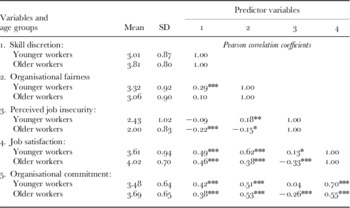
Table 2 presents the means, standard deviations and Pearson correlation coefficients for the predictor and the criterion variables. Job satisfaction and organisational commitment were above the midpoint of the scale for both age groups, but older workers rated both attitudes significantly more highly than younger workers.Footnote 2 Handbooks of organisational behaviour consider the relation of age with job satisfaction and with organisational commitment to be positive. Clark, Oswald and Warr (Reference Clark, Oswald and Warr1996) found that age had robust U-shaped effects on overall job satisfaction. According to Arrowsmith and McGoldrick (Reference Arrowsmith and McGoldrick1996), the positive relation between age and both job satisfaction and organisational commitment indicates the potential of older workers. Both older and young workers rated the skill discretion in their jobs higher than the midpoint of the scale, and older workers gave higher scores than younger workers, while the reverse was true for organisational fairness.Footnote 3 The higher skill discretion reported by the older workers may be related to their higher educational level and positions of greater responsibility (see Table 1) but other job and organisational factors that we have not studied may also be influential. The lower organisational fairness reported by the older workers may be related to their higher position in the hierarchy, to their own responsibility for fairness at their workplace, or to a more experienced (and critical?) view of organisational fairness.
Correlations between variables for the younger and older age groups

Notes: SD standard deviation. The sample sizes were 200 younger workers and 222 older workers.
Significance levels: * p⩽0.05; ** p⩽0.01; *** p⩽0.001.
Perceived job insecurity was on the whole quite low (and below the midpoint of the scale) and highest for younger workers (t (402)=4.92, p<0.001). Although not studied, it is plausible that amongst the younger workers there are many who start their career in temporary jobs, hence their higher perceived job insecurity. Moreover, Table 1 shows that younger workers were found dominantly in the more casualised sectors and not in the more secure education sector. There were enough significant correlations between independent and dependent variables to warrant hierarchical multiple regression analysis. Different patterns of correlation among the predictors were found for the older and the younger age groups, thereby reinforcing the need for separate regression analyses for each age group. It was also noted that job satisfaction and organisational commitment were strongly positively correlated, thus the respondents who were satisfied with their particular jobs were also committed to the organisation as a whole. Latham (Reference Latham2007) reviewed several meta-analyses and concluded that job satisfaction and organisational commitment, while positively related, are distinct concepts.
The regression analyses
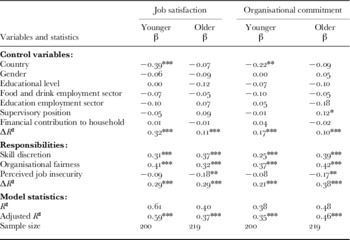
Table 3 reports the results of the hierarchical linear regression analyses. Beginning with the models of job satisfaction, the selected variables predicted significant percentages of the variance for both older and younger workers (adjusted R 2 respectively 0.37 and 0.59). In both age groups, job satisfaction was predicted by high skill discretion and high organisational fairness. For older workers only, job satisfaction was predicted by low perceived job insecurity. For younger workers only, the labour market (as indexed by the country dummy) had an effect. A negative beta coefficient for the country dummy variable can be interpreted as meaning that an unfavourable labour market predicts higher job satisfaction. Turning to the predictors of organisational commitment, again the selected variables explained significant percentages of the variance (adjusted R 2 respectively 0.46 for older workers and 0.35 for younger workers). For both age groups, high skill discretion and high organisational fairness were significant predictors. For older workers only, holding a supervisory position and low perceived job insecurity were also significant influences. For younger workers only, the labour market (as indexed by the country dummy) had an effect.
Regression models of job satisfaction and organisational commitment for the younger and older age groups

Note: ΔR 2 is the change in the explained variance contributed by the variable set.
Significance levels: * p⩽0.05; ** p⩽0.01; *** p⩽0.001.
Discussion
Limitations of the study
Several shortcomings of this study have characterised others in the field (i.e. the cross-sectional design, common method, self-reports, and the small number of countries), but others are specific. We tested only the direct or first-order associations in the research model. Although only a very limited number of predictors were used, satisfactory effect sizes were obtained.Footnote 4 Finally, only two age groups were compared. Given the relatively small samples, it was not feasible to disaggregate further by age. Future research should include workers aged between 25 and 49 years to provide a more complete understanding of both age relationships and the multi-generational workplace (Cordeniz Reference Cordeniz2002; Zemke, Raines and Filipczak Reference Zemke, Raines and Filipczak2000). More generally, new studies should use longitudinal designs, multiple methods, multiple sources and a wider range of countries.
The key findings
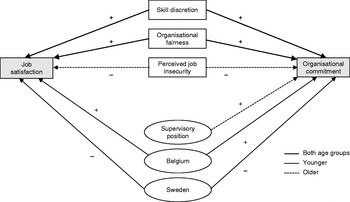
Figure 3 summarises the confirmed relations in the research model. We first review the cross-age findings, then address the cross-country findings for older workers, and finally comment upon the findings for younger workers. The most robust (i.e. across age) determinants of job satisfaction and organisational commitment were skill discretion and organisational fairness. Given the high positive correlation between job satisfaction and organisational commitment in both age groups, it is hardly surprising that these two employee attitudes were partly overlapping predictors. The positive effects of skill discretion and organisational fairness on the employees' attitudes go beyond confirmation of earlier research findings, because they were found among both older and younger workers.
The empirically substantiated model.

The findings for older workers included the negative impact of perceived job insecurity on both job satisfaction and organisational commitment, which confirms earlier research and the proposition of Farr and Ringseis (Reference Farr, Ringseis, Cooper and Robertson2002) that ageing may cause changes in what leads to satisfaction. Furthermore, the findings for older workers included a positive effect of holding a supervisory position on organisational commitment. It seems plausible that employees with some managerial responsibilities identify more with their organisation and its goals and will wish to maintain their affiliation. The results for older workers were similar in two countries with very different rates for older workers' labour market participation (see Figure 1). Apparently, the effects of societal policies and measures on older workers' perceptions of job insecurity were either non-existent (Anderson and Pontusson Reference Anderson and Pontusson2007), or suppressed by other relationships, or not captured by the cross-sectional design.
One finding for younger workers was quite surprising: the positive impact of the more constrained Belgian labour market on job satisfaction and organisational commitment. We can offer only a tentative explanation. Swedish young adults may now take for granted the well-established ‘Youth Guarantee Agreement’ that provides them with full-time activating and developmental employment (Berg Reference Berg2007). It is only very recently, however, that young adults in Belgium have seen the ‘First-Job Agreement’ that gets them into a job and vocational training as early as possible (Vandenbussche Reference Vandenbussche2007). Being lucky enough to be employed may render the Belgian young workers happy with their job and committed to their employer or employment site. To summarise, the findings of this study have expanded our theoretical understanding of the determinants of job satisfaction and organisational commitment. Some of the findings applied to both age groups and to two national labour markets with highly contrasted rates of age-group participation.
We now turn to the broader implications for society, employing organisations, and to workers themselves. The cross-age results support Brooke and Taylor's (Reference Brooke and Taylor2005) recommendation that ‘age aware’ policies and practices need to recognise the respective strengths and weaknesses of older and younger individuals rather than rely on ill-informed age stereotypes. With particular reference to Belgium, Martens et al. (Reference Martens, Lambrechts, Manshoven and Vandenberk2006) suggested that age-aware employment practice should adopt: (1) the opportunities offered by the government to encourage older workers to continue in work (e.g. split jobs); (2) formal assistance tools (e.g. competence management); (3) semi-formal assistance tools (e.g. learning through experience); and (4) informal, constructive working methods (e.g. specialised functions).
The positive effect of skill discretion might owe something to human resources (HR) management practices. Naegele and Walker (Reference Naegele and Walker2006) recently reported that the Swedish nuclear power company OKG began an organised, long-term programme for transferring competencies between older and younger employees through ‘parallel duties’ (i.e. older and younger staff working side-by-side) and through ‘role takeover’ (i.e. under supervision, the younger worker steps into the role of the older). In the same vein, Taylor (Reference Taylor2006) described for Belgium the case of Daikin Europe, which addressed the adaptability and capacities of older workers by creating the possibility of ‘skill-pooling’ (i.e. workers are given a fixed contract with a temporary agency and are employed at Daikin during the seasonal peaks and by other organisations at other times).
Despite restraining legislation in Belgium and Sweden, age discrimination in employment remains a significant problem in both countries (OECD 2006), which may influence perceptions of organisational fairness. About four per cent of the all-age labour force in Belgium and about five per cent in Sweden reported having directly experienced age discrimination or having witnessed age discrimination at their workplace during the previous 12 months (OECD 2006). Surprisingly, Parent-Thirion et al. (Reference Parent-Thirion, Fernandez Macias, Hurley and Vermeylen2007) found that in Belgium younger workers reported more age discrimination than older workers, while in Sweden there was no differentiation between younger and older workers in the prevalence of reported age discrimination. Naegele and Walker (Reference Naegele and Walker2006) proposed several HR practices that would promote organisational fairness including: waiving age limits in job advertisements; using selection processes that focus on skills, competencies, experiences and individual needs; removing age limits for access to learning and training opportunities; offering courses in retirement preparation; and developing flexible forms of retirement. Organisations can buffer the most negative impact of job insecurity through psychological contracting, e.g. by shifting from employment security to the more credible focus on life-long employability or employability security (Arocena, Núňez and Villanueva Reference Arocena, Núňez and Villanueva2007). To reduce perceived job insecurity, workers themselves could become ‘active crafters’ of their own jobs and engage in control-oriented coping (Wrzesniewski and Dutton Reference Wrzesniewski and Dutton2001). Control-oriented coping comprises actions and cognitive reappraisals that are pro-active and involve ‘taking-charge’, and include working harder, putting more effort into one's job, and making positive reappraisals of one's situation (Armstrong-Stassen Reference Armstrong-Stassen2004).
To conclude, we return to our starting question. Do different factors influence older workers' and younger workers' job satisfaction and organisational commitment? Are different models required? The answer is ‘partly no’, given the cross-age positive effects of skill discretion and organisational fairness, and ‘partly yes’, given both the negative effect of perceived job insecurity on older workers in both countries, and the inverse effect for younger workers in Belgium.
Acknowledgements
This research reported in this paper was part of the PSYCONES-project (PSYchological CONtracts across Employment Situations) that was supported by a grant from the European Union, Fifth Framework R&D Programme (HPSE-CT-2002-00121). The PSYCONES-project studied characteristics, antecedents, and consequences of psychological contracts. From the PSYCONES-antecedents we included skill discretion, organisational fairness, and perceived job insecurity. From the PSYCONES-consequences we included job satisfaction and organisational commitment. Further information about the project is available at www.uv.es/~psycon. The first author is the project's senior partner in Belgium and thanks Hans De Witte (Belgium) and Kerstin Isaksson (Sweden) for the use of the Belgian and Swedish data.