1. Introduction
Despite international and domestic efforts geared at strengthening Afghanistan’s legal system, state law remains completely absent in much of Afghan social life. Nearly two decades of research have documented the profound normative pluralism that marks society.Footnote 1 Alongside enacted laws, Islamic and customary norms remain widely in circulation—often fusing with one another, thereby assuming a hybrid form that mixes the two though staying true to neither.Footnote 2 In many ways, this arrangement has not only been viewed as desirable, but even as necessary for the functioning of the state, since unofficial normative practices help to provide a source of order and stability that cannot be achieved solely through the formal legal system.Footnote 3
Against this backdrop, this article looks at the creation, circulation, and regulation of informal trade credit in the Afghan economy. When goods are transferred between a seller and a purchaser, the latter may lack the requisite funds to complete the transaction but may nonetheless be in a position to repay any funds received once he has acquired the items and resold them. Such instances are very common in Afghanistan, particularly since individual wealth is low, but traders and merchants still import a significant quantity of goods from abroad involving the regular turnover of high volumes of funds. The economy has thus developed a practice known as “ograyi,” which allows businesses to access short-term credit for their transactions in the form of trade credit, usually from their suppliers, but also from third parties. Ograyi is pervasive throughout the country, as anyone involved in business activities will be familiar with its operation, despite remaining relatively unknown to lay individuals. One cannot properly understand the Afghan economy unless one appreciates the functioning of ograyi, as it plays such a crucial role in the way businesses transact with one another. This study focuses on the regulatory practices that facilitate the operation of ograyi. This study shows the combination of factors that businesses rely upon to regulate their credit relations: (1) investing in relationships, thereby allowing trust to accrue over time; (2) relying on clientelism; (3) acting according to widespread market norms and practices; and (4) renegotiating contract terms in the event of a breach. This study further explains the challenges that banks face in providing businesses with credit and the difficulty in relying on courts for contractual enforcement.
The second part of the paper provides a brief review of how communities in different settings globally have been able to provide informal credit to individuals and businesses. The third part details the research methodology employed. The fourth part provides a background on Afghanistan’s economy and its markets, which helps to explain the need for informal credit. The fifth part details the general practice of ograyi in Afghanistan. The sixth part is the heart of the paper and details the factors that facilitate the regulation of informal trade credit. The seventh part explains the shortcomings of the country’s banking system, which bolsters the widespread practice of ograyi. The eighth part details the challenges of seeking recourse through courts. The paper strives to show how informal credit in Afghanistan—an economy-wide practice—is regulated almost entirely through a combination of personal trust, non-legal practices, and community norms. These factors serve as a substitute for formal legal coercion, as the courts provide limited relief to aggrieved businesses.
2. Background on local-level credit
The availability of credit is an essential aspect of a functioning market system.Footnote 4 Credit facilitates macroeconomic growth by allowing businesses to expand their activities by gaining access to resources that would otherwise be unavailable.Footnote 5 While, in developed societies, banks are the primary mode through which people are able to acquire credit, individuals in many developing societies remain unable to access such channels. A significant portion of people across the world work in the informal economy—that is, in economic activities that lack registration and that are not directly regulated by the state.Footnote 6 Such societies have often created their own community-level mechanisms that provide individuals with credit so that they may meet their respective needs. In general, these lending practices may be termed “informal credit” and the markets they create may be referred to as “informal credit markets.”Footnote 7
Three common arrangements designed to provide informal credit include rotating savings and credit associations (ROSCAs), pawnbrokers, and trade credit.Footnote 8 In a ROSCA, a group of people agree to individually contribute money towards a communal savings fund over a fixed period of time.Footnote 9 The total funds are then made available to each member on a rotating basis until all of the members have once been able to use the full pot of collected funds, after which the funds are returned to their respective contributors. Pawnbrokering involves a broker who provides another party with credit after detaining some form of collateral from the latter, often gold, jewellery, or some other movable item of value, thereby mitigating the risk of non-payment.Footnote 10 Pawnbrokering is likewise widespread across the developing and developed world, largely owing to its simplicity.Footnote 11 ROSCAs and pawnbrokers allow parties to avoid both the bureaucracy associated with formal institutionsFootnote 12 and credit evaluations.Footnote 13
Afghan society hosts a number of practices that bear functional similarities to ROSCAs and pawnbrokering. The sharing of credit amongst a group of individuals is often accomplished through the qawm—a porous concept often used to describe a “community,” which demarcates social insiders and outsiders.Footnote 14 Afghanistan is a networked society in which people are held together by densely overlapping social ties between family members and close friends.Footnote 15 Wealth is often maintained within these communities, as members will support each other with loans if a member requires assistance.Footnote 16 Nonetheless, while a qawm may provide a minimum social safety net for its members, it often lacks the necessary wealth for businesses to be able to scale up their activities. Pawnbrokering in Afghanistan is accomplished through the practice of gerawi, which involves the pledge of property—usually land—to a creditor in exchange for financing.Footnote 17 The level of credit provided is usually much less than the value of the land detained, and the land is returned to the debtor once the loan is repaid. During this period, the creditor is able to benefit from the use of the land, whether for his own use or in leasing it out to a third party.Footnote 18 One of the limitations of gerawi is the limited size of loans provided. As will be explained in this paper, sizeable credit is often required by traders, who buy and sell high volumes of goods but who do not necessarily own significant collateralizable wealth.
An alternate way for a party to gain credit is directly from the supplier who provides the goods—a practice known as trade credit.Footnote 19 The purchaser takes possession of items on credit and repays the outstanding amount along with interest at a future date. The credit is usually provided by the supplier specifically for the acquisition of particular goods. One reason why this arrangement persists is that suppliers may be in a better position than banks to assess and monitor credit arrangements.Footnote 20 For example, within New York’s diamond industry, one finds an elaborate trade financing system between large diamond “sight holders” and smaller “dealers.”Footnote 21 While banks may be reluctant to finance a dealer because they lack the specialized knowledge required to value gems, they may have greater confidence in financing larger sight holders who have better credit ratings; subsequently, these sight holders can use this credit to finance dealers while also assuming the monitoring costs as an industry insider.
In developing countries, small and medium-sized enterprises often find trade credit crucial for their business.Footnote 22 Many enterprises operate in the informal economy, or alternately may be formally registered but still unable to receive a bank loan. These businesses thus turn to informal credit for acquiring goods. Suppliers in countries with weak legal systems must be particularly cautious in ensuring that a potential debtor business can be trusted to repay the loan. New businesses thus face particular challenges in gaining credit, since, in the absence of a strong state or functioning legal system, firms depend on trust and reputation, which new entrants are naturally lacking.Footnote 23 Relational contracting is one means by which suppliers and purchasers are able to build trust with one another.Footnote 24 The supplier can rely on repeated-game incentives, since the purchaser will want to maintain ties with the supplier for future opportunities.Footnote 25 In the event of an eventual breach of contract, a party may not always be able to rely on sanctions such as reputational damage within the community of businesspeople.Footnote 26 Suppliers will often go to great lengths to renegotiate the terms of the contract, even if it entails a loss, since they see no hope of legal recourse.Footnote 27
A series of studies by John MacMillan and Christopher Woodruff looks at the regulation of informal credit in Vietnam. Within the Vietnamese private sector, businesses provide informal credit without relying on courtsFootnote 28 ; instead, businesses ensure contractual fulfilment by scrutinizing potential partners, invoking community sanctions, using written contracts to avoid ambiguities, and taking partial payments in advance for goods supplied.Footnote 29 Spreading negative gossip across business networks can also provide a means of sanctioning recalcitrant parties. A comparison of Vietnam with Eastern European countries revealed that “[s]ocial networks and reputation appear … to serve as substitutes for functioning legal systems, while business networks function better when courts are effective.”Footnote 30 These seminal studies of the Vietnamese context demonstrate the importance of studying the local environments in order to understand how different legal and non-legal arrangements may help to sustain informal credit markets.
The existing literature on informal credit largely focuses on the economic and structural details of the arrangement: the barriers faced by young firms in accessing trade creditFootnote 31 ; the variations in the types of organizations that provide trade credit and under what conditionsFootnote 32 ; and whether trade credit complements or substitutes for credit from financial institutions.Footnote 33 This literature has been far less preoccupied with the governance mechanisms of informal trade credit. While the works of MacMillan and Woodruff make a significant contribution in addressing this gap, the limited scope of their studies—based on quantitative data and interviews—leaves the door open for more varied explorations of the various governance mechanisms that may be implicated.
The current study on informal credit practices in Afghanistan provides a granular account of the practices, social structures, and market forces that provide a regulatory framework. A sustained study of the markets of Kabul sheds light on the microdynamics of interactions between actors that animate business life. Supplanting interviews with prolonged participant observations of market activities helps to provide a thick description of the various factors impacting the regulation of credit without making a priori assumptions on dependent and independent variables—and their relative weighting—characteristic of qualitative studies.Footnote 34 This study shows how a combination of trust relationship, clientelism, market norms and practices, and contract renegotiation help to ensure that trade credit transactions are fulfilled by debtors.
Informal credit permeates virtually every aspect of the Afghan economy despite the limited attention it has received within existing scholarship. Informal credit practices have been recorded from at least the late nineteenth century when hawala transfers (i.e. informal money transfers) represented Bills of Exchange.Footnote 35 At present, the informal mobile vendors that inundate the streets of Kabul largely rely on informal trade credit.Footnote 36 These vendors acquire their goods on credit and then repay their suppliers in instalments. In rural areas, informal credit helps to play a consumption-smoothing role, since families, largely relying on agricultural income, may face income shortages.Footnote 37 In the illicit opium market, opium cultivation is one of the few available sources of credit for poor people through the practice of salaam in which advances are made by landowners or third parties for future crops.Footnote 38 The existing literature nonetheless fails to capture the extent to which informal trade credit pervades the overall economy, as it is integral for the operation of businesses throughout the country, particularly those acquiring goods from abroad. Furthermore, virtually no study focuses on the governance aspects of the circulation of informal credit, which seems particularly important given the risks inherent in credit, the weaknesses of the legal system, and the economy-wide shortage of resources. This article thus addresses a gap in the current literature by focusing on the governance of informal trade credit in Afghanistan, as the practice helps to mobilize large amounts of capital amongst businesses.
3. Research methods
Various methods were employed during the course of this study, particularly interviews and participant observation. The researcher conducted an ethnographic study of Afghan markets between August 2017 and July 2018 for a wider doctoral project, and the data for this paper are based on a subset of the interviews and observations. In total, 57 interviews inform this study and can be broken down as follows: 31 business persons; 12 bank officials; five government officials; five central-bank officials; two judges; two litigation lawyers.
3.1 Semi-structured interviews
Significant time was spent in the markets of Kabul speaking with businesses to understand how they conducted transactions. Businesses ranged in size from a single person to a business with over 100 employees. The size of the latter was a distant exception, as businesses with 5–20 employees was the norm.Footnote 39 All interviews were conducted in Kabul, and the majority took place in Mandawi, the central market for merchants and traders.
Business people were generally suspicious towards questions on their affairs. Academic research is still in its infancy in the country, particularly on economic matters. Thus, a continued issue that I faced was being viewed as a spy or—just as bad—an undercover tax collector. I thus relied on introductions by third parties.Footnote 40 Periodic visits also helped to build trust, as businessmen were happy to see my continued presence over a sustained period of time. Conversations with banking officials allowed me to understand how credit could be accessed through the banks.
3.2 Participant observation
I spent much of my time in the market-place alongside businessmen to understand the rhythm of their lives. Being in the market over the course of several months gave me exposure to some of the mundane practices that often go unnoticed. For example, shop owners would spend significant amounts of time talking with others in the market, whether over chai or in chance encounters. Such meetings helped to reaffirm social ties while also playing an information-sharing role. I also spent significant time in the offices of banking officials, observing their day-to-day activities and engaging in casual conversations to understand how they balanced between objectively upholding banking standards and maintaining social ties with those around them.
3.3 Judicial decisions
Unfortunately, written decisions were not particularly helpful, as the records were incomplete and, even when they existed, they often lacked many substantive details.Footnote 41 Thus, an alternate strategy was to collect the laws related to businesses, credit, and court procedures, and then gauge them against the experiences of those involved in court proceedings. For the latter, I gleaned information from judges, lawyers, and litigants, particularly businesses that decided to take their disputes to court.
4. Overview of Afghanistan’s economy
Trade is the economic bloodline of Afghanistan. Traders and merchants ensure that every possible good is imported into Afghanistan, including electronic goods, foodstuffs, medicines, and clothing items. The greatest volume of imports come from the neighbouring countries of Pakistan, Iran, and China, as well as other nearby countries, including Uzbekistan, India, Tajikistan, Russia, Turkey, and the United Arab Emirates (UAE).Footnote 42 Even during the Taliban government in the 1990sFootnote 43 as well as during the early parts of the twentieth century,Footnote 44 trade formed a central component of the Afghan economy. Because all the major routes to Kabul—and Afghanistan—are by land, virtually all these items arrive by transport truck.Footnote 45 The items arriving from abroad ensure that people are able to meet their daily needs. The cost of transporting goods along with the very low income of people throughout the country results in the items entering the country being of infamously poor quality.Footnote 46
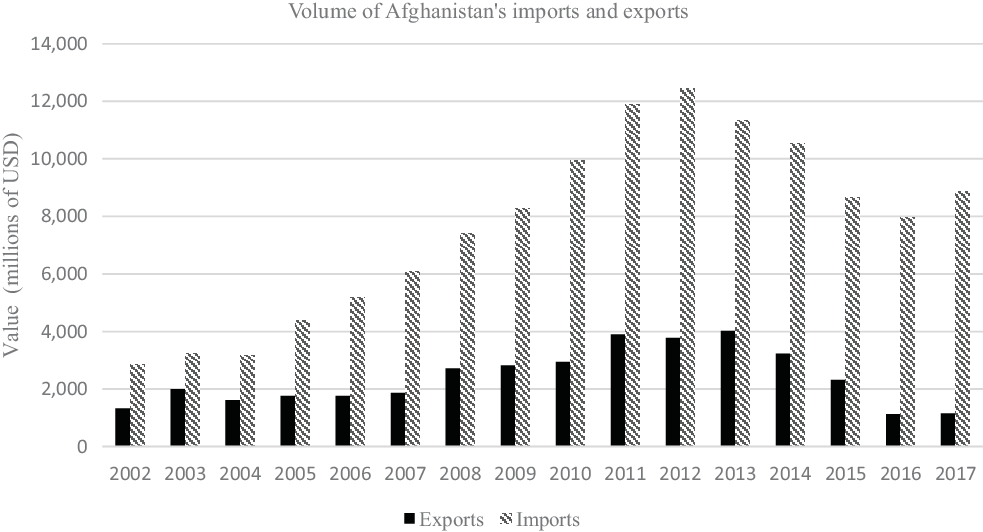
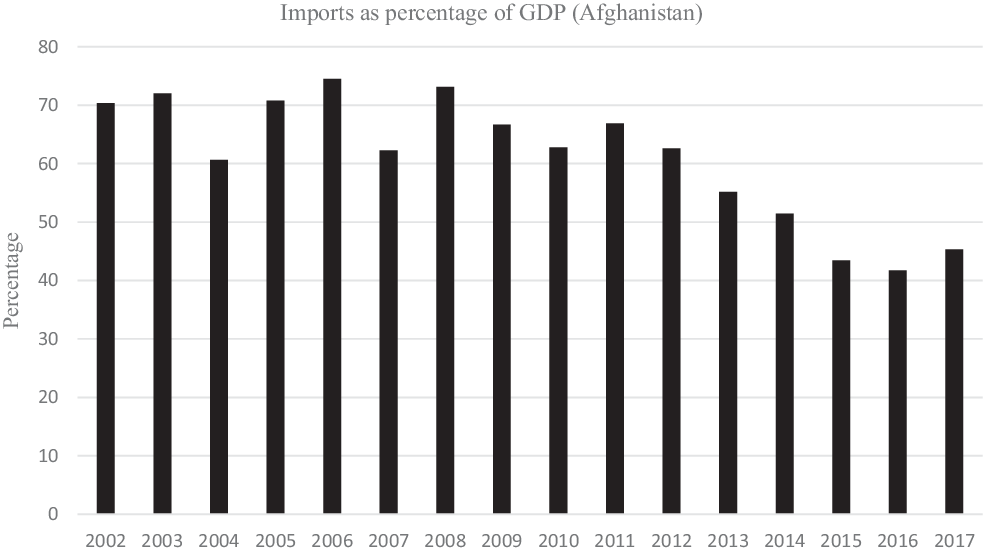
The data below from the World Bank provide an indication of the extent to which imports play a central role in the economy (Figure 1). Since the fall of the Taliban in 2001 and the reconstruction of the country, the value of imports have amounted to well over 50% of the gross domestic product (GDP) (except in the last three years; see Figure 2).Footnote 47 In 2018, the countries supplying the most goods to Afghanistan were Pakistan (USD $1.3 billion), Iran (USD $1.2 billion), China (USD $1.18 billion), and Kazakhstan (USD $0.87 billion), corresponding to those countries in closest geographic proximity.
The value of imports and exports for Afghanistan. Source: Based on data from the World Bank.

Imports as a percentage of the GDP. Source: Based on data from the World Bank.

Many of these imported goods eventually find their way to the area of Mandawi. The famous street of Mandawi in the heart of Kabul has become shorthand for the central merchant market, covering an area of just a few square kilometres.Footnote 48 Incongruous buildings occupy every nook and cranny, as businesses compete not only to sell their products, but also for a space in which to carry out their affairs. While, on the face of it, Mandawi may seem like any other sprawling bazaar in Afghanistan, its distinguishing feature is the role of its more innocuous traders and merchants. Those selling directly to the public occupy the storefronts facing the street, whereas traders normally have their offices in more discrete locations within building courtyards, away from the bustle of daily traffic.
Traders—in the thousands in Mandawi—serve as clearing houses for goods that arrive from abroad.Footnote 49 Traders operate as wholesalers who distribute their goods to stores, businesses clients, or individual customers. This distribution network emanating from Mandawi extends well beyond the market and city into various parts of the country.Footnote 50 Traders are continually on the move, monitoring the delivery and quality of items from abroad and subsequently distributing goods to clients. They often travel around the city to collect payments from their customers.
Afghan traders possess a vast regional network that facilitates the well-organized movement of goods.Footnote 51 Many spend significant amounts of time outside the country where they are able to facilitate the initial acquisition of goods from abroad, leaving the day-to-day grunt-work to employees, often family members. Some traders set up offices in foreign countries, spending part of the year abroad purchasing goods and the remainder of the year distributing those goods in Kabul. Some even relocate to the foreign country altogether, thereby becoming involved exclusively in the supply-side of goods to Afghanistan.Footnote 52 Afghan traders thus form elaborate networks that facilitate the movement of goods from neighbouring countries to various parts of Afghanistan.
While the interactions of these traders with local and foreign businesses form the human architecture for the movement of goods, underlying these transactions are economic relationships. The practice of ograyi allows buyers to access credit to acquire goods, with the loan being repaid at a later time.
5. General practice of ograyi
Often, businesses will not have the requisite funds to pay their suppliers on the purchase date. Gaining access to credit is particularly difficult in Afghanistan given that the economy is stretched for resources. Potential creditors legitimately fear that their funds may disappear given the fluctuations in the market or as a result of a bad business decision on the part of the debtor (even those that are well intentioned). Debtors may also abscond with funds to another country, leaving the creditor without any recourse. Furthermore, banks are very conservative in their lending practices, making them largely inaccessible to traders. For this reason, market participants have come to rely on informal trade credit or ograyi.
Wholesalers are aware that the businesses that purchase their goods will often have insufficient funds to purchase a large stock outright. Rather, the purchaser will slowly accrue funds over a period of time by selling these goods. Thus, the purchaser will ask his supplier for an ograyi arrangement in which the stock of goods is acquired with a supply-side line of credit, thereby allowing him to receive the goods and pay the outstanding debt through weekly instalments. The two parties agree in advance on the weekly amount to be repaid. Often, an employee of the supplier’s shop will make weekly visits to those businesses with which it has an ograyi arrangement to collect payments until their outstanding debts have been fully repaid. While different credit arrangements exist in Afghanistan, ograyi specifically relates to credit circulating amongst businesses to facilitate the purchase and sale of goods.Footnote 53 Unlike other forms of credit available to parties, ograyi is generally unsecured and thus exposes the creditor to significant risks. Ograyi is the most common mode of financing for traders and merchants who import goods from abroad. The local industrial and production sectors in Afghanistan are very limited and incapable of meeting the needs of the population,Footnote 54 thereby necessitating foreign goods.
The supply chain of particular goods may involve several ograyi arrangements. For example, an initial supplier—possibly in China—may provide ograyi to a wholesaler in Kabul, who then provides ograyi to another business in Kabul, who subsequently provides ograyi to a smaller shop in the neighbouring province of Parwan (and the lay customers of this shop may even acquire the goods for personal use on credit). Ograyi thus facilitates goods being distributed widely throughout society. At each level, buyers will repay their immediate suppliers through periodic payments. While this network of connections created by ograyi may entail greater potential for profits, it also carries greater risks, since delays in payment by any debtor will have a cascading effect upwards in the supply chain. This risk is partially counterbalanced by the fact that creditors at each stage are generally better capitalized than their debtors. Furthermore, providing credit entails possessing a level of financial capital, since, below a certain threshold, any credit provided to a buyer would start cutting into the operating expenses of the creditor’s business.
Ograyi may take two general forms: (1) supply-side credit; and (2) cash credit from a money currency exchanger for the purchase of specified goods. In both instances, the creditor reaps a profit from the transaction.Footnote 55 The first case of ograyi as supply-size credit is common when both businesses are located within Afghanistan and when the supplier possesses sufficient capital. When both businesses are within the country, the supplier is able to regularly interact and monitor the debtor, thereby exerting pressure to ensure repayment. The creditor sells the item at its regular price plus a markup, thereby profiting not just from the sale of the item, but additionally from the fee associated with the delay in payment.
The second form of ograyi becomes necessary when the supplier is unwilling or unable to provide credit, and thus a third party must be introduced to facilitate the transaction. Many businesses only accept full payment for the item being sought. Suppliers in neighbouring countries without a presence in Afghanistan may be particularly reluctant to provide goods on credit, as they are unable to continuously monitor debtors and would lack any recourse in the case of a recalcitrant party. In these instances, Afghan money currency exchangers play a crucial role in facilitating the transaction. Exchangers are able to provide funds to businesses in the form of credit tied to the acquisition of specified goods. In this way, the ograyi arrangement is between the exchanger and the business acquiring the goods, without the involvement of the supplier. The exchanger assumes the risk in the event of a default.Footnote 56 According to central-bank regulations, exchangers are not permitted to accept savings deposits or offer ograyi to their clientsFootnote 57 ; however, the challenges of strict financial oversight have allowed the practice to continue with minimal state interference.
Ograyi is an important transaction for exchangers, as it keeps their capital in circulation, thereby generating profits.Footnote 58 The debtor is able to acquire goods for his business while the exchanger benefits from the service charges associated with the credit transaction. Furthermore, when a money exchanger offers ograyi, it is often combined with other services. As the supplier of the goods is often located abroad, the exchanger facilitates the hawala transaction. The exchange rate for the money being sent abroad to purchase the foreign goods will be set by the exchanger and will include a profit margin.Footnote 59 The gains from these various services can quickly accumulate, especially if the business taking credit makes timely repayments to the exchanger and quickly requests new transactions. For an exchanger, if an excess of funds were to remain idle, it would potentially represent a lost opportunity.
Ograyi became particularly widespread in Afghanistan after 2002 when hundreds of millions of dollars in aid money starting flowing into the country.Footnote 60 In 2010, Obama announced his Afghanistan strategy, which entailed transforming the country into a functioning democracy with Western-style state institutionsFootnote 61 ; subsequently, imports drastically increased. Between 2009 and 2012, the level of imports increased by over 50%.Footnote 62 The circulation of credit in the market during this period can be likened to the US economy prior to the collapse of the market due to subprime mortgages. People had general confidence in the market (even if ill placed), with the belief that new opportunities would continue steadily.Footnote 63 The sheer volume of international aid kept the entire economy afloat, which in turn helped traders because of the greater demand for imported goods.
The country’s economy took a drastic turn after 2014 when US troops began phasing out of the country and foreign funding largely dried up. Between 2014 and 2016, the level of imports significantly shrunk by nearly 25%.Footnote 64 Less foreign money entering the country translated into a significant reduction in the demand for goods across the economy. Many exchangers saw their reserves of capital shrink, whether due to businesses unable to repay their debts or investors who had reclaimed their funds. As the economy slowed after 2014, people lost their general confidence in the market and exchangers became much more cautious when providing ograyi to businesses.
Before going into the details on the informal regulation of ograyi, it is helpful to situate the practice within the wider institutional landscape of the country. In many societies, banks and other financial intermediaries perform the function of providing credit to eligible individuals and businesses.Footnote 65 Credit bureaus perform the role of gathering information so that creditors can make decisions about the creditworthiness of potential debtors. Many developing countries lack functioning credit bureaus and, even when present, they often only cover formally registered businesses even if a significant number of businesses operate in the informal sector. In such cases, assessments of creditworthiness end up being assumed by the creditors. In Afghanistan, banks face formidable challenges in assessing creditworthiness and, for this reason, they are overcapitalized and also have high collateral requirements.Footnote 66 Within the economic-development literature, some argue that stronger property rights can provide greater access to credit by making land collateralizable.Footnote 67 However, some 80% of land in Afghanistan is unregistered,Footnote 68 making it difficult for banks to use land as collateral in many cases.Footnote 69 Furthermore, businesses seeking to enforce contracts, including collateral contracts, require a functioning legal system with fair and efficient courts. However, corruption and inefficiency plague Afghan courts, rendering them amongst the worst legal fora globally for contractual enforcement.Footnote 70 Ograyi thus operates within an institutional environment in which banks are overcapitalized, collateral is suspect, property rights are weak, and the legal system is plagued by various shortcomings.
6. Informal regulation of ograyi
Ograyi allows parties to capitalize on opportunities lying outside of their immediate web of personal ties, since such networks may possess limited wealth. Building informal credit relationships with those outside of one’s immediate social circle creates new opportunities, which, in Afghanistan, plays a central role in the running of the entire economy.
Thus far, the discussion over informal credit paints a picture of what happens within the economy. However, what crucially remains to be answered is how this system of informal credit works, as it entails significant risks for creditors. This section looks at the various mechanisms that informally regulate the circulation of informal trade credit. Credit vitally depends on the development of trust between parties. Clientelism helps to maintain stable relationships that can offset market unpredictability. Various norms and practices have also become widespread, thereby establishing a general routine of behaviour for market participants. Finally, in the event of contractual breach, parties make efforts to renegotiate the terms of the contract.
6.1 Developing trust between parties
At its very core, the issuance of credit requires trust between two parties. Credit will not be offered if the parties do not trust each another.Footnote 71 Unfortunately, rampant corruption has eroded trust in public institutions, as Afghanistan ranks as one of the most corrupt countries in the world (172 out of 180 countries in 2018 in terms of corruption)Footnote 72 with individuals harbouring suspicion towards the government. People have little faith in the ability of public institutions to hold individuals accountable and, as a consequence, generalized, impersonal trust between people is weak.Footnote 73 Businesses expend significant resources in developing channels of trust that can help to mobilize credit. The process of trust creation thus warrants attention.
6.1.1 Building a reputation
Reputation is crucial for any business in the market. A business’s reputation has a direct impact on their ability to seek out opportunities. Building a reputation allows a business to signal to others that it is willing to undertake transactions that require faith in its abilities.
One of the principle means of building a reputation is by repaying debts in a timely manner. A business builds its reputation for being creditworthy by showing prompt repayments in a string of transactions over time. Timely debt repayments signal to others that a business is true to their word and thus can serve as a reliable partner. Conversely, being unpredictable or unreliable in repayments will damage a business’s reputation and thus its ability to attract business partners with whom it can arrange an ograyi transaction. Parties are aware that their second-party interactions may bear on their future relationships with a wide range of businesses, as information travels quickly across the market.
Expanding operations is another means by which a business can bolster its reputation. When a business is able to increase the size of its operations, it signals that it is financially strong. Increasing the volume of its activities, number of employees, or number of branch offices can all play a role in indicating that a business is growing. When a business is performing well, information on its good standing circulates throughout the market.
Religion and morality also play an important role in bolstering the reputation of businesses. Good religious character is associated with economic success.Footnote 74 One customer attributed the success of his supplier to his religious character: “He’s a good Muslim, that’s why his business is doing so well.” A business person signals his morally upright character through acts of charity, daily religious prayers, and religious gatherings for important events such as the purchase of a new house or the birth of child. Conversely, if a person cheats another or absconds with money, he may be accused of “not being a Muslim,” which is not to be taken literally, but rather as an indication of the moral worth of the party.
The influence that religion has on one’s reputation is most evident with respect to interest-bearing activities. Islamic law generally prohibits the charging of interest when funds are loaned to another party.Footnote 75 This prohibition on interest (locally called sood) is widely understood in the market and often serves as a metric of religiosity. Businesses engaging in interest-bearing transactions would be labelled sood-khur (a pejorative title that literally means “eating interest”). Other businesses would also distance themselves from the impugned business to protect their own reputation. Nonetheless, many businesses will devise workarounds, such as carrying out interest-bearing transactions in private or employing legal devices to hide the interest in a more involved transaction. An example of the latter is when the debtor is asked to repay the loan in a foreign currency and the creditor sets a higher-than-normal exchange rate such that it covers the outstanding principle plus a markup, which effectively serves as interest.Footnote 76
6.1.2 Pre-screening clients
A potential creditor starts the screening process of a debtor by entering into discussions with the goal of understanding its general activities. The creditor will amass information on its relationship with past and present clients, thereby assessing its reputation and character. This allows the creditor to gauge how co-operative the business has been in past dealings and its record in making timely payments. A visual inspection—possibly unannounced—of the business’s office can help to reveal any potential irregularities, such as lack of any activity or maintenance.
It is not a requirement that a potential debtor should have a previous relationship with credit or be a family relation. The entire exercise of assessing a new debtor and building trust between the parties is meant to unlock untapped potential through new social and economic linkages. The parties will often be strangers, and thus the debtor will seek to prove that his business is successfully running and capable of turning a profit from the loan. Creditors are in fact particularly cautious about giving loans to close family members, as they often have difficulty in recuperating funds from such clients. One money exchanger mentioned:
We give small loans to our friends. Sometimes for family members, friends, and so on, the loans are up to $10,000. However, after three to four months, they have still not returned [the sum] back to us. And we have difficulty reclaiming the full amount.
When the transaction is between family members or close friends, the economic ties may become blended with non-economic links, such as kinship, ethnicity, and otherwise. The creditor thus risks becoming bogged down due to over-socialization.Footnote 77 While the difference between socialized and over-socialized ties is a matter of degree, one distinguishing feature is whether the relationship primarily rests on economic or non-economic times. With close family members, since the ties are often primarily non-economic, debtors have a greater preponderance to be lax in their repayments, relying on their social ties to make up for the deficiency in their economic obligations.
Generally, potential creditors are wary about businesses that exhibit sudden changes in behaviour. If a new business rapidly expands its activity, a potential creditor will be suspicious about its source of wealth and customer base, particularly if the business is relatively unknown by others in the market.Footnote 78 Reputation is built gradually over time, and thus greater esteem is afforded to businesses that have expanded their operations incrementally as it evidences their ability to weather the contingencies of the market. Similarly, if a business with a long-standing presence in the market suddenly alters its conduct, either by suddenly seeking larger amounts of credit or changing its core operations (such as replacing its main product of sale with another), it may be an indication that the business is facing financial difficulty and pursuing a new strategy to remain afloat.
6.1.3 Gradual accretion of social capital
Similar to physical capital, trust between parties is a form of social capital that gains value over time.Footnote 79 Trust is highly valued because, like the millions of dollars being transacted daily, it is a scarce resource that is not openly available to all. Instead, individuals must exert time and effort, which allow trust to accrue incrementally. Trust emerges from the “concrete personal relations” between parties.Footnote 80
The accretion of social capital commences before the two parties initially transact with one another. The pre-screening exercising helps to slot businesses into different categories depending on their reputation. When parties begin to deal with each other directly (not necessarily on credit), they will form opinions of each other, with positive interactions helping to close the “social distance” between them.Footnote 81
If the supplier remains wary about the potential buyer, then he may require a full payment for the first several transactions, as it will give him time to assess the buyer’s ability to make timely repayments, frequency of purchases, and general demeanour. When he eventually becomes satisfied with the performance of the purchaser, the supplier may begin to provide goods on credit through an ograyi arrangement. Through prompt repayments, the debtor will be able to increase his credit line as time progresses. Moreover, the time and effort invested by both parties into the relationship increase the level of social capital—sometimes called “goodwill”—between them. Parties may also supplement economic ties with social ties, such as by inviting business partners to dinners and special occasions. The combination of these economic and social factors helps to increase the stock of social capital between the two parties (though over-socialized ties also entail certain risks, as discussed in the previous section).
6.1.4 Third-party guarantees
Often, a debtor is introduced to a potential supplier-cum-creditor through a common third party. Third-party introductions can play an important role in placing the potential debtor and creditor in close social proximity to one another. Identifying a debtor through his association with a known third party helps the supplier to understand how the purchaser is embedded within a particular matrix of social relations. The purchaser thus indirectly benefits from the reputation of the third party.
The third party may play one of three roles. First, the third party may choose to become directly involved in the transactions with the other two parties. For example, he may agree to contribute funds or, conversely, assist in repaying the loan. Second, he may provide a financial guarantee for the debtor in the event of non-payment. Third, and most commonly, the third party often simply serves as a character reference for the debtor, and thus the supplier must still assess whether the latter can be trusted with credit. In the last case, if the debtor fails to repay the loan or disappears, the supplier will not direct recourse against the guarantor. Nonetheless, the guarantor’s reputation would still be adversely affected, as it would signal that he cannot be trusted. For this reason, parties are generally cautious in providing third-party introductions and will only do so if they feel comfortable in vouching for the party in question.
6.1.5 Balancing trust and risk
Finally, it bears mentioning that a creditor’s reliance on trust must be gauged against his eye for opportunity. If the level of trust between creditors and debtors is low, then the creditor assumes significant risks in providing a loan. However, a creditor may still be willing to go forward with the transaction if he feels the potential for profits is high. As one businessman noted: “With big risks come big gains.” Once a creditor has screened the potential business, he will weigh the potential risks and uncertainties against the potential for reaping profits. In deciding on a risky but potentially lucrative transaction, a creditor will consider his risk-taking preferences, his faith in the debtor’s ability to complete the specific transaction in question, and, importantly, the potential profits of the transaction.
6.2 Clientelism
Trust is formed within a social milieu in which parties are constantly trying to promote stability while minimizing the uncertainties associated with market conditions and co-contractors. For this reason, clientelism helps in sustaining a level of familiarity by matching parties together over a period of time. Clifford Geertz’s study of the Moroccan bazaar showed how “buyers and sellers, moving along the grooved channels clientelization lays down, find their way again and again to the same adversaries.”Footnote 82 In this way, clientelism helps to provide stability over time. For Geertz, the term “adversary” connotes “egalitarian and oppositional” parties,Footnote 83 since each possesses a level of independence such that the master–slave relationship implied by patronage relations would not aptly capture the power dynamics. Parties are bound together by their complementary roles, as each possesses something the other requires. Solidarity between parties based on difference (what sociologist Emile Durkheim calls “organic solidarity”) is arguably more valuable than solidarity based on similarity (or “mechanical solidarity”), since the former helps to capitalize on synergies.Footnote 84 Put otherwise, each party is able to focus on its own abilities, which, in turn, helps in the success of the partnership.
In Mandawi, co-operation between suppliers and their purchasers is value-enhancing, as it provides each of them with access to new opportunities, despite the oppositional nature of the contractual arrangement. In an ograyi transaction, both suppliers and purchasers are dependent on one another. Suppliers seek to distribute their goods as widely as possible while purchasers require an initial input of resources before they make goods available to their clients. Informal credit helps to slacken the stress between the parties and, while it places a debt on the purchaser, it does not turn the relationship into one of subordination. This is evidenced by the fact that a supplier expends significant effort in finding a reliable debtor and, once found, also invests in the relationship so that it continues. As one businessman remarked: “suppliers want to find reliable debtors. It helps their own reputation if their client is a prominent business.”
The repeated interaction between suppliers and purchasers is advantageous for both parties. First, it reduces the searching costs of both suppliers and purchasers. Once the two have become matched, their relationship stabilizes, allowing each to direct their attention to other aspects of their business. Second, as the parties continue to interact with one another, they continue to accrue social capital, which helps to make greater amounts of credit available, while also increasing switching costs.
This is not to say that parties are forever locked into clientelistic relationships. Over time, switching costs may become less than the cost of remaining in the relationship, at which point the parties may terminate their dealings and go elsewhere.Footnote 85 Furthermore, Kabul’s economic environment fluctuates rapidly, with businesses regularly closing their offices, merging with other businesses, moving locations, or changing their primary area of activity—all of which may extinguish credit relationships between suppliers and purchasers. Thus, while clientelism provides stability for a certain period of time, in the long run, these relationships may become undone, thereby allowing parties to adjust to new market conditions.
6.3 Norms and practices of the market
Ograyi transactions do not take place in a market devoid of meanings and symbols. Rather, the market is replete with practices that facilitate the formation of trust and the practicability of ograyi. Within the market-place, information flows quickly between different corners, allowing parties to make informed decisions. Parties behave with a level of reciprocity, thereby facilitating the long-term wellbeing of their business relationships. In certain instances, one party will have to exercise flexibility, as circumstances may arise that make it impossible for the other party to fulfil their obligations as anticipated.
6.3.1 Information sharing
Within the market, participants are regularly interacting with one another and exchanging information on ongoing activities and transactions. The multiple ties that any person has with others ensure that important information reaches every corner of the market in a short period of time. Businesses and individuals rely on information from others to assess the character of potential co-contractors.
Information travels across the market orally and is highly sought after by businesses. Clifford Geertz explained information in the Moroccan bazaar as being “poor, scarce, maldistributed, [and] inefficiently communicated.”Footnote 86 Mandawi bear many similarities, as information on transactions, behaviours, and prices is not collected by any central body, but rather moves unevenly through gossip, facilitated by the close physical and social proximity of businesses. Publicly available information pertains to the character and the type of transactions of different market actors, whereas information on volumes of wealth and profit margins usually remains undisclosed. The close proximity of the stores that regularly interact with one another means that information flows quickly across the market. When screening a potential debtor, a creditor will speak to past clients as well as stores located nearby the debtor’s office, keeping an ear out for any troubling rumours.
Breakfast and lunch in the bazaar serve as important times to collect information. Several businesspeople will meet in one store to break bread and exchange updates on business activities and other information that has caught their attention. Furthermore, the ritual of providing important clients or potential partners with chai allows information to be gleaned through casual conversations on business and non-business matters. If a supplier eventually provides a business with credit, then the weekly visits to the office of the debtor to collect payments serve as an opportunity to visually inspect the state of the business. Information quickly travels throughout the market, though also transforming with each transfer, impugning the quality of any single bit of information. Businesses thus verify information through a variety of sources to separate facts from fabrication.
6.3.2 Norms of reciprocity
As parties develop a personal relationship with each other, an expectation arises that each will be forthcoming. Thus, clientelism “is a reciprocal matter,” as both parties reap benefits by investing in the relationship.Footnote 87 Parties often exchange in-kind gifts to solidify their connection. One businessman remarked: “My uncle [the store owner] has one main client who he provides ograyi to. They have good relations, and my uncle even invites the owner to his house for dinner.”Footnote 88 Gifts and invitations are not merely philanthropic, but rather help to solidify the reciprocal partnership.Footnote 89
One instance in which reciprocity comes to the fore is when suppliers and purchasers have disagreements. At times, a shipment may arrive later than expected. At other times, the quality or nature of the item may be slightly different from what the purchaser anticipated. Alternately, the purchaser may be a few days behind schedule in making a payment. The parties may also disagree about a previously agreed-upon exchange rate. In the course of dealing with one another, such obstacles will inevitably arise. Parties operate on a give-and-take understanding, with one party sometimes foregoing the error and, other times, the other party acting similarly. To ensure a balance of interests, parties will keep a tab (often written) of each other’s actions to ensure that each side is reciprocating equitably. If either party were to stop being forthcoming, it would risk straining the relationship, possibly leading to an eventual breakdown.
6.3.3 Flexibility and empathy
Parties adopt a practice of remaining flexible with one another to account for contingencies that arise in the course of their dealings. Suppliers understand that debtors may periodically face difficulties in making payments, and thus will work with the debtor to find a solution. Strict adherence in all instances to the terms of repayment is not expected simply because it is not feasible. As in other settings, contractual breach is a market reality that needs to be worked around.Footnote 90 Parties are not interested in pursuing legal recourse for breach of contract. Thus, by observing a level of flexibility towards one another, parties can absorb contingencies that may otherwise put a strain on the relationship.
Flexibility is thus treated as a default understanding in their dealings. The level of flexibility depends on the particular circumstances and, importantly, the willingness of the debtor to work with the creditor towards a solution. Like trust, as the relationship grows, so too will the level of flexibility. Flexibility may extend to the repayment terms but will seldom involve the debt being fully written off. As the burden of the debt on the creditor increases, he will increase pressure for repayment and possibly convey threats, whether personal or legal.Footnote 91 Once this point has been reached, the social capital between the parties will also erode until the repayment is made.
6.4 Renegotiating the terms of the contract
In certain instances, a debtor will be unable to repay the outstanding loan due to one of several reasons. The debtor himself may be having difficulty in getting payments from his buyers, thus affecting his own ability to pay his creditors. For goods coming from foreign countries, delays in the shipment also cause delays in making repayments. In certain instances, the debtor may have simply made a bad business decision by acquiring goods on credit that are difficult to resell. In other instances, the market condition may have changed without any fault on the part of the debtor.
For a debtor who seeks to remain active in the market, it is important that he remains in contact with his creditor. Trust between the creditor and debtor will not immediately evaporate due to the non-payment, as creditors recognize that a variety of circumstances may have led to the breach. Nonetheless, a debtor must remain engaged with his creditor and show his willingness to try and resolve the problem. This does not imply that the creditor will dismiss the breach, as the debtor can expect to face social pressure to hasten the repayment. However, maintaining contact helps to preserve trust, particularly if the circumstances are truly extenuating, and can even strengthen the trust between them in the long run. Conversely, if a debtor fails to respond to telephone calls and meeting requests or moves the location of his store unannounced, such actions will adversely affect the relationship between the parties and the debtor’s ability to secure future credit. To avoid irreparable reputational damage, unprofitable businesses may even keep their stores in operation, since closing down would risk destroying the possibility of future business within the market.
At a certain point, the parties may take steps to renegotiate the terms of repayment, which may take one of two forms. First, the loan payment may remain the same but the repayment period may be extended. This arrangement is most likely if the creditor feels that, despite the delay in payment, the potential for future opportunity outweighs the need for charging additional fees. If the parties are family members or have built significant social capital between them, additional charges may strain their relationship beyond the immediate transaction. Second, the repayment period may be extended with additional fees. This arrangement is most common when the parties have an arms-length relationship with each another or when the prospect of future transactions is uncertain. The additional fees serve to offset the losses incurred by the creditor due to the late payment.Footnote 92
Besides renegotiating the terms of the contract, the creditor will also take the breach into consideration in providing future lines of credit. While the parties may continue to work with one another, the level of credit will likely change. The debtor will have to repay the outstanding amount before getting more credit. If the parties have prior dealings, the creditor may be able to decide on the appropriate level of credit based on those earlier transactions. The creditor will likely be stricter in requiring timely repayments in future transactions and may visually inspect the business location and activities of the debtor to determine whether to resume providing credit and at what level.
7. Bank ineffectiveness
The continued success of the informal economy is tied to the turbulent recent history of the Afghan banking sector, which was built at near lightning speed, with billions of dollars of military aid and development money streaming into the country from international sources. The sector took a significant hit in September 2010 with the near collapse of Kabul Bank, one of the country’s largest financial institutions at the time. The bank was found to be engaging in fraudulent activities, eventually leading to a bank run with nearly half of its USD $1.3 billion in deposits being withdrawn within a few days.Footnote 93 A number of regulatory lapses by Da Afghanistan Bank (DAB), the country’s central bank, allowed the fraudulent activities of Kabul Bank to fester unchecked.Footnote 94 Investigations revealed that the United States Agency for International Development (USAID), along with its implementing partners BearingPoint and Deloitte, did not follow up on early warning signs of poor oversight when providing technical assistance to DAB from 2003 until 2011.Footnote 95 Following an extensive evaluation on anti-money laundering (AML) and combatting the financing of terrorism (CFT) commissioned by the International Monetary Fund,Footnote 96 the Financial Action Task Force (FATF), an intergovernmental body that promotes the international financial system, placed Afghanistan on its grey list in 2012.Footnote 97 In June 2017, after improving its regulatory framework, which included passing AML/CFT laws, Afghanistan was removed from the grey list.Footnote 98
At present, banks remain largely conservative when issuing loans. As an indication of the conserving lending policies, the 2018 annual report by the DAB on the banking sector disclosed that the gross volume of deposits across was AFN 273.78 billion, whereas gross loans issued by banks stood at AFN 41.43 billion (i.e. only 15.1% of deposit holdings were loaned out).Footnote 99 In many developing settings, banks host an extreme surplus of liquidity because of the challenges in providing credit.Footnote 100 The stringent lending policies of banks are in part a response to stricter central-bank regulations following the Kabul Bank incident and in part a response to the difficulty more generally of ensuring that loans are adequately secured against default. These policies end up making bank loans largely inaccessible or, alternately, impractical for small and medium-sized enterprises, which make up the vast majority of shops in Mandawi and across Afghanistan.
Four principal factors dissuade traders from taking bank loans to pay for their transactions. First, the collateral requirements pose an exceedingly high barrier for businesses seeking credit. Central-bank regulations suggest that a loan should be secured for 100% of its value.Footnote 101 The actual practice of banks is to seek even great collateral, in the range of 150–200% of the loan value. This practice is conflated with the convention across banks of significantly undervaluing collateral—by up to 50%.Footnote 102 Traders make their profits from the turnover of goods, and thus may require credit that is several times the value of the property they own. Furthermore, traders also may live in unregistered areas of Kabul and banks are generally more reluctant in accepting unregistered land as collateral.Footnote 103 The combination of these factors makes it difficult for many traders to meet the collateral requirements set by banks.
Second, acquiring a bank loan is a time-consuming process. According to one banking official, an individual or business may need 7–25 days to get a loan, since the bank’s primary objective is hedging risks.Footnote 104 According to one banker:
A loan request first goes through the financial audit team, which will take a week. This is where the risk is assessed. Depending on the size of the loan, the property may need to be assessed by the business development team. The final step is the registration of the property deed as a guarantee in the bank’s name.
This timeline is incongruent with the schedules of businesses. Given the fluctuations in the market, a sudden need for goods may arise if the business is to capitalize on the opportunity to make a profit. Constantly waiting for bank loans to be approved would seriously affect the competitiveness of a business.Footnote 105 Furthermore, ograyi generally involves a repayment of the debt in a short period of time and, once repaid, the issuance of more credit; thus, in the course of a year, a business is able to undertake a significant number of ograyi transactions, which would be especially difficult to perform through a bank.
Third, bank loans do not provide the flexibility available through ograyi transactions. Businesses may sometimes need flexibility if they are unable to repay their loans in a timely manner. Suppliers can afford some level of flexibility to ograyi clients, whereas a bank is stricter in seeking repayments, since overdue loans may affect its credit rating.Footnote 106 Similarly, each time a bank loan is sought, a customer must complete the relevant paperwork, whereas, with an ograyi transaction, once the parties trust one another, a simple phone call by the debtor may be sufficient for funds to be released.Footnote 107
Fourth, some businesses avoid bank loans because they view interest fees as haram (i.e. unlawful according to Islamic law).Footnote 108 As mentioned previously, businesses dealing with interest transactions risk suffering damage to their reputation, as they would be viewed as engaging in morally unacceptable activities. Religious doctrine thus plays some role in the way businesses perceive banks. Nonetheless, religion was cited far less often than the other reasons for avoiding bank loans, implying that businessmen were driven more by pragmatism than piety.
It is finally worth noting that the claim made by some businesses that high interest rates dissuade them from taking bank loans seems inconsistent with actual market practices. Currently, the annual interest rate for bank loans is 15–21%, corresponding to a monthly rate of 1.25–1.75%. In an ograyi transaction, the supplier of credit may be either a business or a money currency exchanger. In the first case, the price of goods sold using ograyi usually includes a markup compared to goods bought in lump sum. Businesses indicated a markup in the order of 8–12% with the ograyi lasting between one week and one month.Footnote 109 In the second case in which ograyi involves a money exchanger, by comparing the market exchange rate with the exchange rate in an ograyi transaction in which the repayment is made in another currency,Footnote 110 one can deduce an interest rate in the order of 2–3.5% for a one-week to one-month loan. In both cases, the bank’s interest rate is less than the ograyi rate. Nonetheless, suppliers and exchangers emphasize that prices are decided using a “total-package” approach, which considers pre-existing trust between the parties, the likelihood of future dealings, the volume of goods purchased, and the amount paid up front. Ograyi is also often tied to other transactions such as the hawala transfer of the funds from the purchaser to the supplier. At a minimum, it cannot be clearly demonstrated that ograyi is financially more advantageous that a bank loan.
8. Perils of legal recourse
The court remains available to aggrieved parties seeking recourse through official state channels. The government and international community have invested significant funds in trying to improve the judiciary. Between 2005 and 2014, the US State Department provided some $241 million through the Justice Sector Support Program (JSSP), which targeted training officials, justices, prosecutors, and defence lawyers, as well as improving the case-management system and administrative capacity.Footnote 111 Nonetheless, such efforts have failed to bring about observable improvements to the legal system.Footnote 112 An audit of the JSSP revealed its utter failure, with no evidence that programmes brought about tangible benefits, since justice institutions did not subscribe to their efforts.Footnote 113
The judiciary has been criticized for being one of the country’s most corrupt institutions.Footnote 114 Courts in Afghanistan are widely viewed as being “firmly under the executive’s control; highly susceptible to outside influences; and widely … corrupt, predatory, and rent seeking.”Footnote 115 The copious amounts of red tape required for simple administrative tasks—vehicle registration requires as many as 27 signatures—have caused people to turn to bribes and informal arrangements to help to expedite their affairs. Nonetheless, the courts remain available to any party seeking their assistance.
The following passage presents the experiences of a businessman named Farhad who sought legal recourse for an ograyi agreement in which the co-contractor had failed to make payments. The passage is reported at length to provide a first-hand account of Farhad’s experience—and frustration—with the legal processFootnote 116 :
I used to own a shop in Mandawi that sold snacks [i.e. cookies, chips, etc.]. Nazar, another storeowner in his fifties, kept calling me asking for snacks. I did not know who he was, nor did others in the marketplace. He was persistent, and so I visited his house one day to understand his financial condition, and he seemed to be doing well financially. So I gave him USD $5500 worth of snacks. I agreed to an ograyi, where he would pay every 5000 AFN (approximately USD $75) every Tuesday. The first three times, he paid the 5000 AFN, but then he stopped. I called him many times, but he kept saying that the payment will be coming soon. But he never paid.
I decided to take legal action. I had to bribe a police officer for him to serve a summons on Nazar, and then again I had to pay the officer to transfer the file [from his office] to the court. On the first day, the court staff kept me waiting 3–4 hours and then told me to return the next day. They even told me to bring Nazar, though I had no power to force him to come. We finally came before the judge, and on several occasions, she [i.e. the judge] insisted that I give Nazar extra time. I agreed to this three times, but Nazar would not respond to my calls and even moved his shop without notice. I eventually found him, and again he told me that he would pay me, “Inshallah.” In the courtroom, he once event knelt to touch my feet to ask for more time. After 3 months of returning to the court every second day, I asked the judge for a final ruling.Footnote 117 Eventually, she issued her judgment [against Nazar] and told me to take it to the police for enforcement.
Outside of the judge’s room, I told Nazar that it would be over if he paid me. He became angry and claimed that I had threatened him. I knew this was a tactic to avoid paying me. I went to the Attorney General’s office to register my court judgement and to inform them that Nazar had made a false claim that I had threatened him. This way, I was protecting myself in case he later wanted to claim I threatened him.
It has been six months, and I have not yet seen a single dollar. Asking for help from the police will require paying them. Also, Nazar is the type of person who would cause more problems, which is not worth my time and safety.
While assessments of trust are normally integral when issuing credit, the ultimate weighing of risks versus opportunities is done at the individual level. Farhad explained why he decided to trust Nazar despite not having accrued sufficient social capital with him through prior transactions:
To make money in the market, one has to take risks. That’s the nature of the business. When I did the background check of Nazar, even though no one knew him, I did not get negative information about him. His economic condition seemed good. And he seemed very interested in selling. So I decided to take a risk.
Farhad decided to provide goods on credit without having a prior business relationship with the business partner or without being able to verify Nazar’s business profile through references in the market. Farhad attempted to offset this lack of information by visiting Nazar’s house and gauging his economic condition based on visual inspection. Trust often entails an element of risk, as it leaves one party vulnerable to the actions or inactions of another.Footnote 118 The perils of Farhad’s experience speak to the difficulties in balancing assessments of trust, risk, and opportunity.
Nazar’s engagement with the legal system reveals the general treatment of ograyi by the court. First, it is important to note the court’s willingness to receive the case. From the perspective of the commercial court, an ograyi dispute is principally an issue of breach of contract. The court’s task is thus to discern the facts surrounding the alleged breach. The ograyi transaction often has no written contract, either because the parties are accustomed to informality or because parties do not want to signal their scepticism about the relationship. Documents, if they even exist, often take the form of inconsistent ledgers and receipts, which are supplemented by the information of the parties and their witnesses. Through this bricolage of information, the judge will assess the nature and severity of the breach. Second, the court repeatedly insists that the parties seek to find a solution outside of the court. The judge asked Farhad on three separate occasions to try resolving the dispute outside of the court by giving Nazar more time (which Farhad entertained though to no avail). The official status of the court can serve as an added impetus to resolve the dispute informally as the parties feel the looming “shadow of the law.” In a different context, police and judges sometimes receive complaints from women of mistreatment by their husbands.Footnote 119 Rather than dealing with these cases through legal channels, these officials would encourage these women to approach their elder male relatives to mediate a solution.Footnote 120 Judges may sometimes remand the case to elders and religious leaders best suited to arbitrate a solution, thus preferring “court-supervised councils” over the heavy hand of the law.Footnote 121 In this way, judges (and police) may assume the role of mediator in trying to resolve a conflict through a variety of methods beyond their specific mandate.Footnote 122
In sum, Farhad’s case shows the difficulties in contractual enforcement through the courts. The court proceeding took a total of four months and ultimately provided Farhad only with a written judgment. However, he would still need it to be enforced by the police, which he decided not to pursue, as he would have to continue paying bribes though the final outcome remained uncertain. Thus, his case remains unresolved. On the Doing Business Index of the World Bank, Afghanistan ranked 181 out of 190 countries (190 being lowest) for contractual enforcement in 2019, with claims taking an average of 1,642 days from the date of the lawsuit until payment and enforcement expenses amounting to approximately 29% of the claim value.Footnote 123
Farhad’s case reveals the difficulty—though not impossibility—of having an ograyi transaction enforced by the court. The legal process is time-consuming and requires paying bribes at various stages if aggrieved parties hope for their case to move forward. Even a favourable decision may be foiled due to the difficulties in enforcement and the ability of recalcitrant debtors to prolong conflicts. Thus, the general sentiment amongst creditors is to carry out ograyi transactions with little confidence in the court’s ability to provide redress in the event of a contractual breach.
9. Conclusion
One of the challenges facing fragile and post-conflict settings is promoting economic development, since businesses face a shortage in the investment capital necessary for carrying out transactions. The circulation of credit eases market rigidities by facilitating the movement of goods and allowing businesses to scale up their activities. In Afghanistan, ograyi permeates every corner of the market, forming an elaborate network that connects foreign suppliers, urban wholesalers, small-scale urban and rural businesses, and money currency exchangers. Large businesses provide credit to smaller businesses, while money exchangers provide credit to businesses that import large shipments of goods into the country.
Decisions on whether or not to provide informal trade credit are made relationally between businesses. To ensure contractual fulfilment, creditors carefully assess potential debtors when deciding whether to provide credit and at what level. Creditors and debtors invest resources in building trust between each other, which involves assessing reputation, pre-screening clients, accumulating social capital, and co-opting third-party guarantors. Clientelism and widespread market practices and norms help to establish steady routines of behaviour. If a breach occurs, parties make efforts to renegotiate the terms of the contract. Through an imprecise science, creditors rely on a combination of these factors when deciding whether to issue credit to other parties. The surrounding environment also contributes to the prevalence of informal credit, as bank credit remains largely unavailable or unappealing to businesses and the legal system provides limited recourse in the case of contractual breach. The informal regulation of trade credit serves as a substitute for legal coercion.
The current study shows how economic opportunities are created in unstable environments, in which parties rely on non-legal practices to facilitate informal credit transactions. It also points to some of the limits of such market arrangements. Because of the high level of personal trust required between parties, significant resources must be spent on relationship building, slowing the ability of parties to scale up their activities. Furthermore, moving from a society largely characterized by small and medium-sized businesses to one that hosts large firms arguably requires a functioning state that can support corporate structures and shareholder protections. A more strongly functioning state may also provide access to larger volumes of credit through banks. Thus, while informal credit provides a viable means of assisting businesses when banks and state institutions are weak, this arrangement does not negate the potential importance of the latter for long-term economic growth.
Acknowledgements
David Nelken and Florian Grisel provided helpful reviews of this article. The Afghan Institute for Strategic Studies provided an institutional home during my fieldwork; I thank the Director General, Davood Moradian, for his continued support. I also thank Farhana Rahman, Zulfiqar Ali Khan, Ahmad Milad Assakzai, Mohammad Amin Amin, Abdul Musawer Ishan, Amir Khan Saleh, Naveed Saifi, and Wahidullah Haidari for assistance at various stages of the research. My fieldwork was supported by a Sociolegal Studies Association research grant. I presented portions of this paper at the Conference on Identities in Contemporary Afghanistan at Yale University and the Afghanistan in Academia Conference at the School of Oriental and African Studies, where the participants provided enriching feedback. The usual disclaimer applies.