Highlights
-
• A single session of VR-based optokinetic stimulation immediately altered postural control in people with MS.
-
• Responses differed by vestibular status: those with central dysfunction showed greater transient destabilization, while those without showed reduced sway.
-
• The well-tolerated intervention supports individualized VR-based OKS as a promising vestibular rehabilitation strategy in MS.
Introduction
Multiple sclerosis (MS) is a neuroinflammatory disease characterized by demyelination and neuronal damage in the central nervous system and is a leading cause of non-traumatic disability in young adults. Reference Jakimovski, Bittner and Zivadinov1 The literature indicates that central vestibular involvement is highly prevalent in people with multiple sclerosis (PwMS) and has a negative impact on their daily lives. In MS, brainstem plaques – especially in regions containing vestibular pathways – are associated with vestibular impairment and may lead to balance disorders. Reference Gür, Binkhamis and Kluk2 Postural stability, a fundamental component of balance control, relies on integrating multiple sensory inputs and the coordinated execution of motor responses, Reference Cameron and Lord3,Reference Pollock, Durward, Rowe and Paul4 with the visual, vestibular and somatosensory systems playing an important role in maintaining balance. Reference Warmerdam, Schumacher and Beyer5
Optokinetic stimulation (OKS) involves exposing individuals to moving visual stimuli that cover a wide visual field and can be used to enhance tolerance to imbalance experienced in dynamic environments. Reference Obrero-Gaitán, Sedeño-Vidal, Peinado-Rubia, Cortés-Pérez, Ibáñez-Vera and Lomas-Vega6 OKS elicits postural responses that typically diminish with repeated exposure. This reflects learning mediated by ocular and cervical proprioceptive inputs, as well as adaptive neuroplastic changes related to visual dependence. Cortical regions responsive to visual motion during OKS have been shown to activate both the oculomotor system and vestibular functions. Reference Pavlou7 OKS can be applied in various ways in neurological rehabilitation. The most commonly reported method in the literature involves screen-based applications (e.g., using a television or monitor). Reference Mandour, El-Gharib, Emara and Elmahallawy8,Reference Rossi-Izquierdo, Gayoso-Diz and Santos-Pérez9 In recent years, fully immersive approaches, such as virtual reality (VR) headsets, have gained increasing popularity. Reference Choi, Choi, Oh, Oh and Choi10
VR applications are becoming increasingly important in the management of MS, as VR-based interventions are suggested to modulate synaptic transmission and neuronal excitability by promoting neuroplasticity. Reference Georgiev, Georgieva, Gong, Nanjappan and Georgiev11 Due to its interactive and multisensory nature, VR can enhance patient motivation and adherence by providing immediate feedback. Individuals with MS have reported high levels of usability and acceptability of VR systems in neurorehabilitation. Reference Manuli, Maggio and Tripoli12 A pilot study has demonstrated that VR-based rehabilitation interventions significantly alleviate symptoms in participants with imbalance resulting from peripheral vestibular disorders. Reference Pavlou, Kanegaonkar, Swapp, Bamiou, Slater and Luxon13 Studies investigating the use of VR in MS have also reported improvements in both motor and cognitive functions. Reference Eftekharsadat, Babaei-Ghazani, Mohammadzadeh, Talebi, Eslamian and Azari14–Reference Zaragoza-Mezquita, Felix-Esbrí and Sebastián-Tirado17
To date, except for a few case reports, Reference Chitambira and McConaghy18 no studies have examined the effects of OKS delivered via VR in individuals with MS. Therefore, this study aimed to investigate the acute effects of VR-based OKS on postural sway in PwMS and, secondarily, to evaluate its oculomotor and orientation effects.
Methods
Participants
This study was conducted at Hacettepe University between August and November 2025, with ethical approval obtained from the Health Sciences Scientific Research Ethics Committee (2025/102). The study was registered at clinicaltrial.gov NCT07150520.
A total of 41 PwMS and 23 healthy controls participated in the study. Group 1 included 20 PwMS with central vestibular involvement, Group 2 included 21 PwMS without vestibular involvement and Group 3 comprised 23 healthy participants (Figure 1). The inclusion criteria for PwMS were as follows: a confirmed diagnosis of MS by a neurologist, age between 18 and 55 years, no relapse within the previous 3 months and an Expanded Disability Status Scale (EDSS) score of ≤ 4. Exclusion criteria for PwMS included cardiovascular conditions, orthopedic problems (assessed via medical history) or other medical conditions that could interfere with the assessments. Peripheral vestibular involvement was excluded. In cases where both peripheral and central vestibular impairments were present, participants were also excluded.
Flow chart of study. MS = multiple sclerosis.

Figure 1 Long description
The flowchart begins with the enrollment phase, where eighty-two individuals are assessed for eligibility, including fifty-six multiple sclerosis participants and twenty-six healthy individuals. Eleven participants are excluded due to not meeting inclusion criteria, having peripheral vestibular involvement, or other diseases, and seven declined to participate. Sixty-four individuals meet the inclusion criteria, consisting of forty-one multiple sclerosis participants and twenty-three healthy individuals. In the analysis phase, these individuals are divided into three groups: Group-1 with multiple sclerosis and central vestibular involvement, Group-2 with multiple sclerosis without vestibular involvement, and Group-3 with healthy individuals.
For healthy participants, inclusion criteria were age between 18 and 55 years; no history of neurological, systemic or vestibular disorders as reported by the participant and documented in medical records; and confirmation of the absence of neurological signs or peripheral vestibular impairment through screening by a neurologist and audiological examination, respectively. The study procedures and objectives were thoroughly explained to all participants, and written informed consent was obtained from all eligible participants.
Outcome measures
Vestibular system assessment
Vestibular system assessments were conducted by an audiologist (T.B.) to verify whether participants met the inclusion and exclusion criteria before allocation to the study groups. Positional tests were first administered to detect any peripheral vestibular involvement, and individuals with peripheral vestibular impairment were excluded from the study.
For participants who met the inclusion criteria, central vestibular function was subsequently evaluated by audiologist T.B. using VNG to determine the presence or absence of central vestibular involvement for appropriate group allocation.
The protocol was completed over two sessions on separate days. Vestibular assessment was performed on day one, and OKS application with pre- and post-postural measurements was conducted on the following day. Postural oscillations were measured using a force plate both before and after the OKS. Postural oscillations were reassessed following a standardized 5-minute seated recovery period after OKS to minimize transient disorientation immediately after headset removal while preserving the acute effects of stimulation. Additionally, the VR Sickness Questionnaire (VRSQ) was used to assess the effects of the VR experience on participants following OKS.
Positional tests: Positive findings in positional tests are indicative of peripheral vestibular dysfunction; Reference Bhattacharyya, Gubbels and Schwartz19 therefore, these assessments were employed as exclusion criteria in the current study. Two positional tests were administered, and two individuals who demonstrated nystagmus were excluded based on these results.
Dix–Hallpike test: The patient sits on the examination bed with their back against the headboard and legs extended. The head is turned 45° toward the side being tested, aligning the posterior semicircular canal parallel to the sagittal plane of the body. In this position, the head is tilted backward approximately 30° below the plane of the bed. This tilt allows assessment of the posterior canal on the tested side and the anterior canal on the opposite side. After a brief waiting period, the presence or absence of symptoms such as nystagmus and torsional vertigo is evaluated. Reference Bhattacharyya, Baugh and Orvidas20
Supine head roll test: This test evaluates the lateral semicircular canal. The patient is positioned supine, with the head elevated approximately 30° above the horizontal plane. The head is then rapidly turned 90° to one side, and the presence of vertigo or nystagmus is observed. The head is returned to the midline, and the procedure is repeated for the opposite side. Reference Kim, Kim, Shin, Yang and Im21
Videonystagmography: Videonystagmography (VNG) is a noninvasive test that employs magnifying goggles and a computerized monitor to record eye movements on video. VNG quantifies nystagmus – rhythmic, rapid eye movements – to provide objective information about vestibular system dysfunction. Nystagmus is classified based on the direction of its fast phase and may be rotational, vertical or horizontal. It can serve as an indicator of central vestibular dysfunction. Reference Noreikaite, Winters and Shermetaro22
Gaze test: The gaze test assesses nystagmus in the absence of vestibular stimulation. Eye movements are recorded while the participant maintains gaze straight ahead, upward, downward, to the right and to the left (approximately 30° in each direction). Each gaze position is held for at least 30 seconds. Persistence of nystagmus during any fixed gaze position is indicative of central vestibular involvement. Reference Baloh and Furman23
Pursuit test: The pursuit test evaluates the ability of the eyes to smoothly follow a slowly moving visual stimulus. Participants are instructed to track a target moving gradually to the right and left using only their eyes. When the pursuit system is impaired, the eyes make rapid corrective movements to catch up with the target, a phenomenon known as saccadic pursuit, which is commonly observed in cerebellar disorders. The gain should approach 1 at speeds up to 30°/s and 0.3 Hz, with a minimum acceptable value of 0.8. A low gain reflects an inability of the eyes to accurately track the target. Reference Baloh and Furman24
Saccade test: The saccade test assesses the eye’s ability to rapidly focus on a new target after a visual stimulus, positioned approximately 1 meter away, is shifted by 15°–20° while the head remains stationary. The latency, accuracy and velocity of these voluntary or involuntary eye movements – which facilitate image transmission to the fovea – are recorded. Reference Qian, Kang and Zhong25
Optokinetic: The optokinetic test evaluates reflexive eye movements in response to a moving visual field (OKN), characterized by a slow tracking movement followed by a rapid corrective saccade. During the test, a light rotating at 60°/s is presented, and both gain and nystagmus are assessed. OKN abnormalities often indicate central nervous system dysfunction. Reference Perepa26
Head-Shake test: Head-shake nystagmus is a transient nystagmus elicited by tilting the head forward approximately 30° and rapidly shaking it 10–20 times in the horizontal plane. It is considered pathological if nystagmus appears within 5 seconds and at least three beats are observed during this period. Reference Wu, Luo and Chen27
Postural sway evaluation
Postural sway measurements were performed using the FreeMed platform (Sensor Medica, Rome, Italy), which measures 60 cm × 50 cm and utilizes FreeStep software with a sampling frequency of 400 Hz. Participants were positioned barefoot on the platform with their feet shoulder-width apart. Each individual was tested under six conditions: bipodal stance with eyes open, bipodal stance with eyes closed, monopodal stance on the left and right with eyes open and monopodal stance on the left and right with eyes closed. The duration of each condition was set at 10 seconds, during which participants were instructed to remain as still as possible and refrain from speaking. Stabilometric analysis included evaluation of sway length, average speed, mediolateral sway (ΔX) and anteroposterior sway (ΔY). The data obtained were compared before and after the OKS application.
Virtual reality-induced sickness assessment
Following the OKS application, all participants were evaluated using the VRSQ. The questionnaire consists of two subscales: oculomotor disturbances and disorientation symptoms. It includes a total of nine items, such as fatigue, blurred vision and headache. Participants rated the severity of each symptom experienced after the VR session on a four-point scale: “none,” “mild,” “moderate” or “severe.” Reference Hain, Fetter and Zee28,Reference Kim, Park, Choi and Choe29
Virtual reality-based OKS implementation
Each participant received a 10-minute session of VR-based OKS. The intervention was conducted using the Oculus Quest 2 (Meta, USA) headset while participants were seated. The stimulation content was customized according to individual needs, with a stimulation speed set at 40°/s. In line with the protocol of Dai et al., stimulation direction was individualized according to rotational deviation on the Fukuda stepping test; when no objective rotational deviation was present, the direction was determined according to the participant’s perceived direction of oscillatory motion. Reference Çetin, Zengin and Kose30
Fukuda stepping test: The Fukuda test was administered to assess vestibular function. Participants were instructed to march in place for approximately 50 steps on a flat surface with their eyes closed and arms extended forward, while the degree of rotation and displacement was recorded. Reference Dai, Cohen, Smouha and Cho31
During the first 5 minutes of the OKS application, stimulation was delivered in the direction determined by the Fukuda Walking Test in a VR-compatible manner. In the subsequent 5 minutes, stimulation continued using content simulating daily walking in a store environment. Thus, each participant received a total of 10 minutes of VR-based OKS. Participant safety was maintained throughout the procedure, with a researcher present to provide immediate assistance if necessary. Following the application, postural control was reassessed under the same conditions.
Statistical analyses
Statistical analyses were performed using IBM SPSS Statistics version 25. Data normality was assessed using the Shapiro–Wilk test and homogeneity of variances using Levene’s test. The normality of continuous variables was assessed using the Shapiro–Wilk test, and homogeneity of variance was evaluated with Levene’s test. For variables that met parametric assumptions, a mixed-design Analysis of Variance (ANOVA) was conducted to examine the interaction between group (G1: MS with central vestibular involvement; G2: MS without vestibular involvement; G3: healthy controls) and time (pre-intervention vs. post-intervention). When parametric assumptions were not met, the Kruskal–Wallis or Mann–WhitneyU tests were applied. Bonferroni-corrected post hoc pairwise comparisons were performed for significant group × time interactions. Intra-group comparisons were conducted using paired-samples t-tests or Wilcoxon signed-rank tests, as appropriate. Categorical variables, such as gender and abnormal VNG findings, were analyzed using the chi-square test. Effect sizes were reported as partial eta-squared (ηp2) for ANOVA and Cohen’s d for pairwise comparisons. Descriptive statistics were presented as mean ± standard deviation for continuous variables and as frequency (%) for categorical variables. Statistical significance was set at p < 0.05. Post hoc power analysis indicated approximately 94% statistical power at α = 0.05 for a large effect size (f = 0.49) with a total sample of 64 participants.
Results
Participants
A total of 80 individuals were initially screened for participation (MS = 56; healthy controls = 24). After exclusions due to not meeting eligibility criteria and voluntary withdrawals, 64 participants completed the study, including 41 individuals with MS and 23 healthy controls. The MS participants were allocated into groups according to VNG findings: MS with central vestibular involvement (n = 20, Group 1) and MS without vestibular involvement (n = 21, Group 2), while healthy participants formed Group 3 (n = 23) (Figure 1).
The groups included in the study demonstrated comparable demographic characteristics, with no significant differences in age, gender or body mass index (p > 0.05). Disease duration and EDSS scores were comparable across the MS groups (p > 0.05) (Table 1).
Demographics and physical characteristics of individuals

Table 1 Long description
The table presents demographic and physical characteristics of individuals across three groups in a study. It includes variables such as age, body mass index, gender, disease duration, and EDSS scores. The table has five rows and six columns, including headers. The columns are labeled as Variable, Mean, Group 1, Group 2, Group 3, and p value. The rows provide data for each variable across the three groups and the corresponding p values indicating statistical significance. Age is measured in years, body mass index in kilograms per square meter, and disease duration in years. Gender is represented as a ratio of female to male. EDSS scores range from 1 to 4. The p values suggest no significant differences in age, gender, or body mass index among the groups. Disease duration and EDSS scores are also comparable across the groups.
Note: Group 1 = multiple sclerosis with central vestibular involvement; Group 2 = multiple sclerosis without vestibular involvement; Group 3 = healthy subjects.
BMI = body mass index; EDSS = Expanded Disability Status Scale.
Significant p-value, p < 0.05.
* Kruskal–Wallis test.
† Pearson chi-square test.
‡ Mann–Whitney U test.
Vestibular system assessment
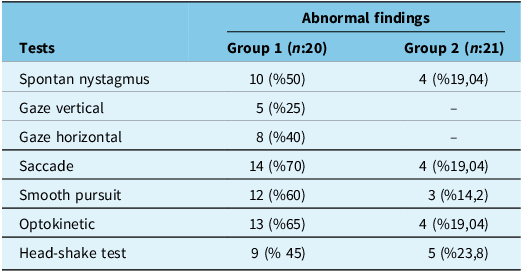
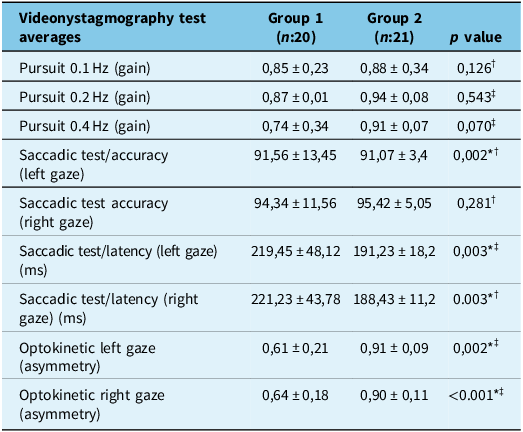
VNG findings showed that abnormalities in Group 1 were most frequently observed in the smooth pursuit and optokinetic tests, whereas in Group 2, the highest frequency of abnormalities was detected in the head-shake test (Table 2). Intergroup comparisons of VNG parameters demonstrated significant differences in saccade test accuracy and latency, as well as in optokinetic test measures (p < 0.05 for all comparisons) (Table 3).
Number of abnormal findings in parameters evaluated for videonystagmography testing

Table 2 Long description
The table presents data on abnormal findings in various parameters evaluated for videonystagmography testing across two groups. It consists of two columns labeled ‘Group 1 (n:20)’ and ‘Group 2 (n:21)’, and seven rows labeled with different tests: Spontaneous nystagmus, Gaze vertical, Gaze horizontal, Saccade, Smooth pursuit, Optokinetic, and Head-shake test. Each cell contains the number and percentage of abnormal findings for each test in the respective group. Notable trends include higher frequencies of abnormalities in Group 1 for Saccade, Smooth pursuit, and Optokinetic tests, while Group 2 shows the highest frequency in the Head-shake test.
Note: Group 1 = multiple sclerosis with central vestibular involvement; Group 2 = multiple sclerosis without vestibular involvement.
Comparison of videonystagmography test averages and vestibular function scores of the multiple sclerosis (MS) groups

Table 3 Long description
The table presents a comparison of videonystagmography test averages between two groups with multiple sclerosis. It includes six rows and eight columns, with the first column listing different test parameters such as pursuit gain at various frequencies, saccadic test accuracy and latency for left and right gaze, and optokinetic asymmetry for left and right gaze. The subsequent columns display the average values and standard deviations for Group 1 and Group 2, along with p-values indicating the statistical significance of the differences between the groups. Notable trends include significant differences in saccadic test accuracy and latency, as well as in optokinetic test measures, with p-values less than 0.05.
Note: Group 1 = MS with central vestibular involvement; Group 2= MS without vestibular involvement.
X ± SD: mean ± standard deviation.
* Significant p-value, p < 0.05.
† Student’s t test.
‡ Mann–Whitney U test.
Effects of OKS on postural sway across different test conditions
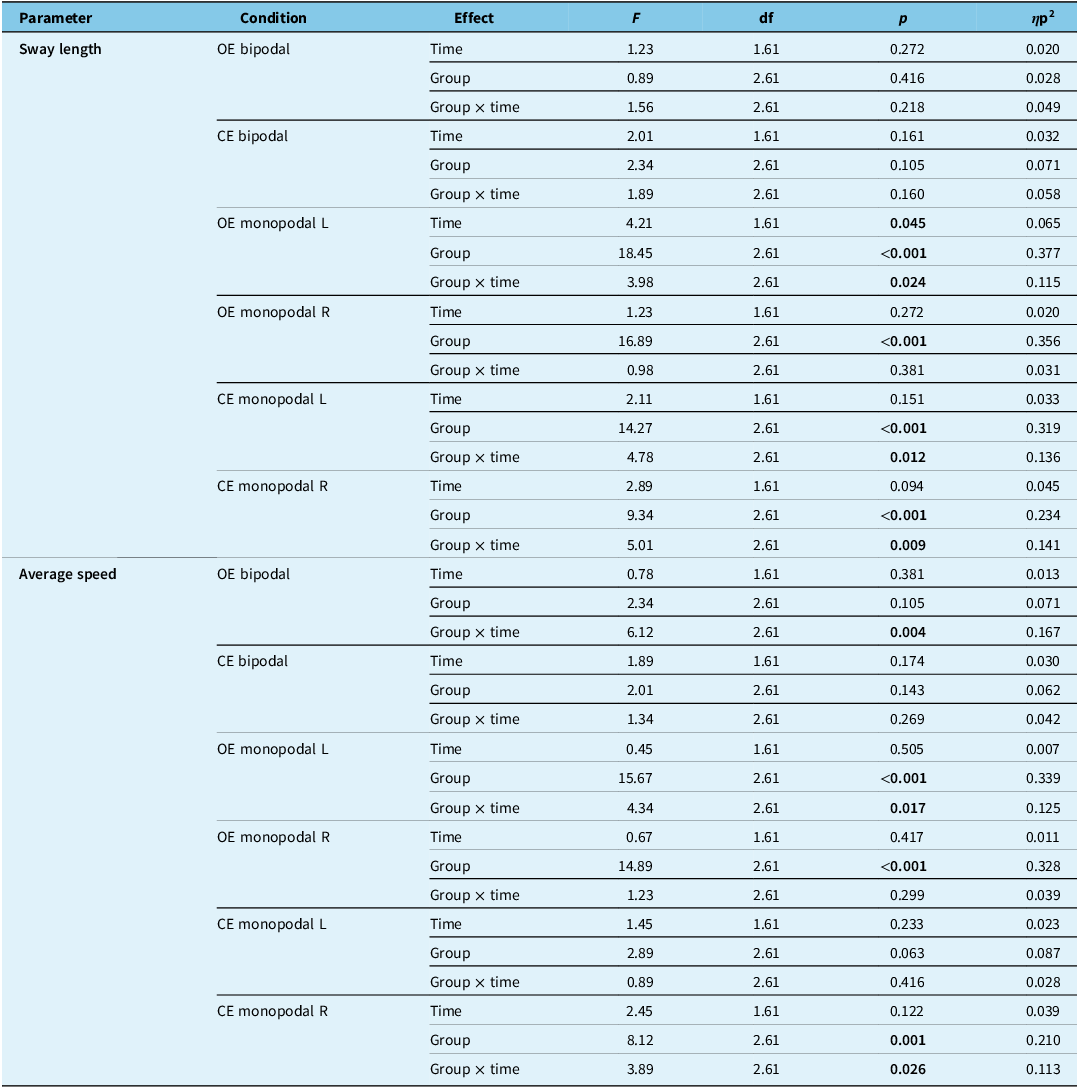
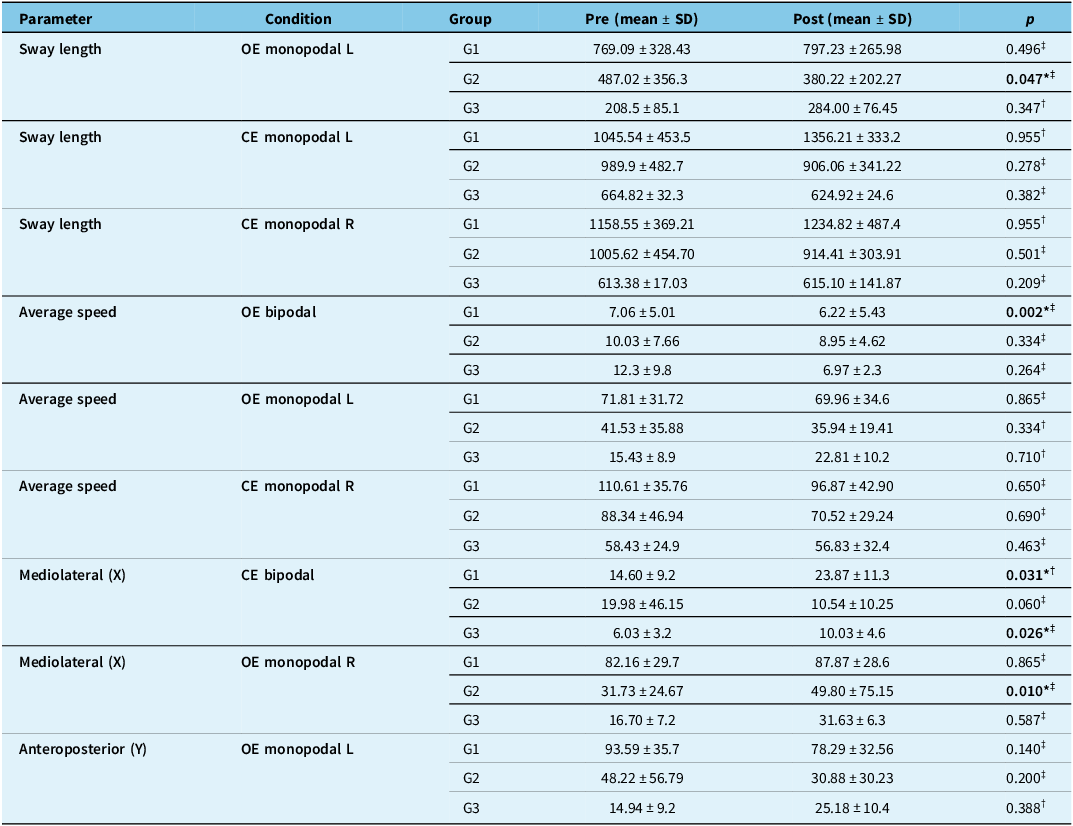
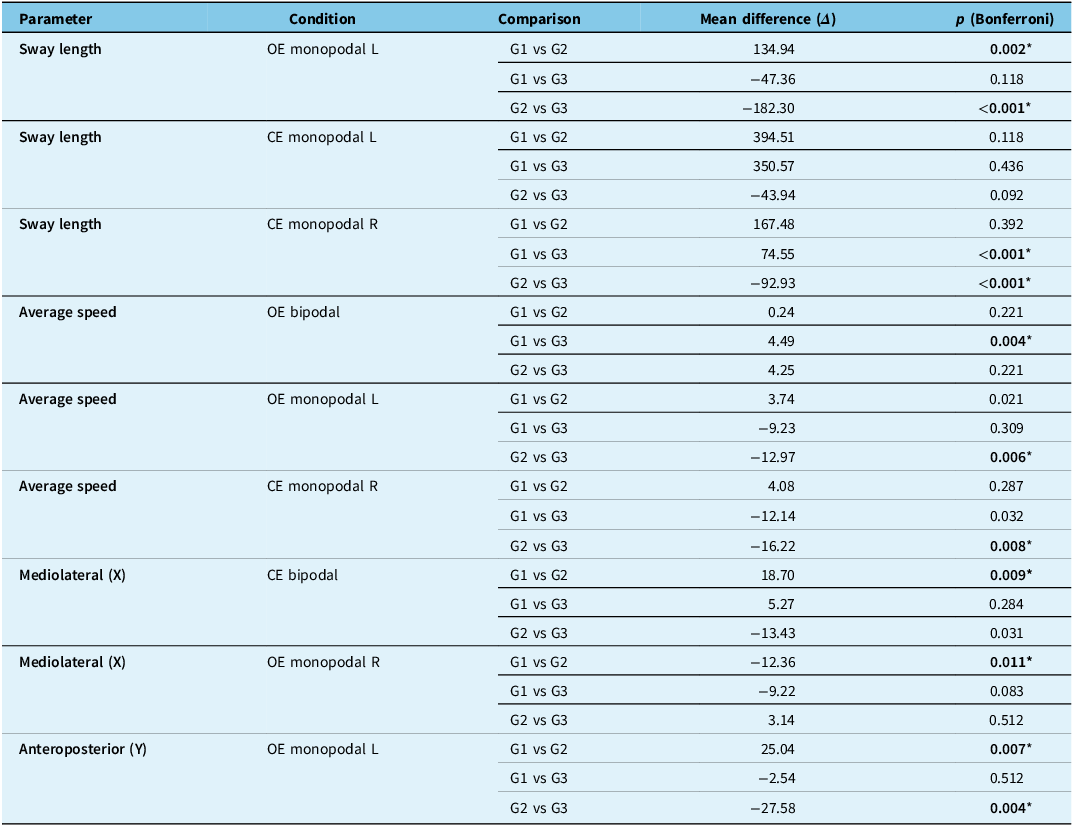
Sway length: Mixed-design ANOVA demonstrated significant group × time interactions in the open eyes (OE) monopodal left (F = 3.98, p = 0.024, ηp2 = 0.115), closed eyes (CE) monopodal left (F = 4.78, p = 0.012, ηp2 = 0.136) and CE monopodal right (F = 5.01, p = 0.009, ηp2 = 0.141) conditions (Table 4). In the OE monopodal left condition, sway length decreased significantly in G2 (487.02 ± 356.30 to 380.22 ± 202.27; p = 0.047), with greater reductions compared with G1 (p = 0.002) and G3 (p < 0.001) (Tables 5, 6, and 7). In the CE monopodal left condition, sway length increased in G1 (1045.54 ± 453.50 to 1356.21 ± 333.20), whereas it decreased in G2 (989.90 ± 482.70 to 906.06 ± 341.22) and G3 (664.82 ± 32.30 to 624.92 ± 24.60), although pairwise comparisons were not significant (Table 5). In the CE monopodal right condition, sway length increased in G1 (1158.55 ± 369.21 to 1234.82 ± 487.40), decreased in G2 (1005.62 ± 454.70 to 914.41 ± 303.91) and remained stable in G3 (613.38 ± 17.03 to 615.10 ± 141.87), with significant differences between G1 and G3 (p < 0.001) and between G2 and G3 (p < 0.001) (Tables 6 and 7).
Mixed ANOVA results for sway length and average speed

Table 4 Long description
The table presents the results of a mixed-design ANOVA for sway length and average speed under various conditions and groups. It includes data for open eyes (OE) and closed eyes (CE) in both bipodal and monopodal (left and right) conditions. The table is structured with parameters in the first column, followed by conditions, effects, F-values, degrees of freedom (df), p-values, and partial eta squared (p2) values. Notable interactions include significant group-time interactions in OE monopodal left, CE monopodal left, and CE monopodal right conditions. Specific changes in sway length are detailed for different groups, with significant reductions and increases noted in various conditions. The table provides a comprehensive overview of the statistical analysis, highlighting key trends and significant differences between groups.
Note: Mixed-design ANOVA was performed with time (pre-intervention [t0], post-intervention [t1]) as the within-subject factor and Group (G1, G2, G3) as the between-subject factor. Significant p-values (p < 0.05) are presented in bold. ηp2 indicates partial eta-squared.
OE = open eyes; CE = closed eyes; L = left; R = right; G1 = multiple sclerosis with central vestibular involvement; G2 = multiple sclerosis without vestibular involvement; G3 = healthy controls; ηp2 = partial eta-squared.
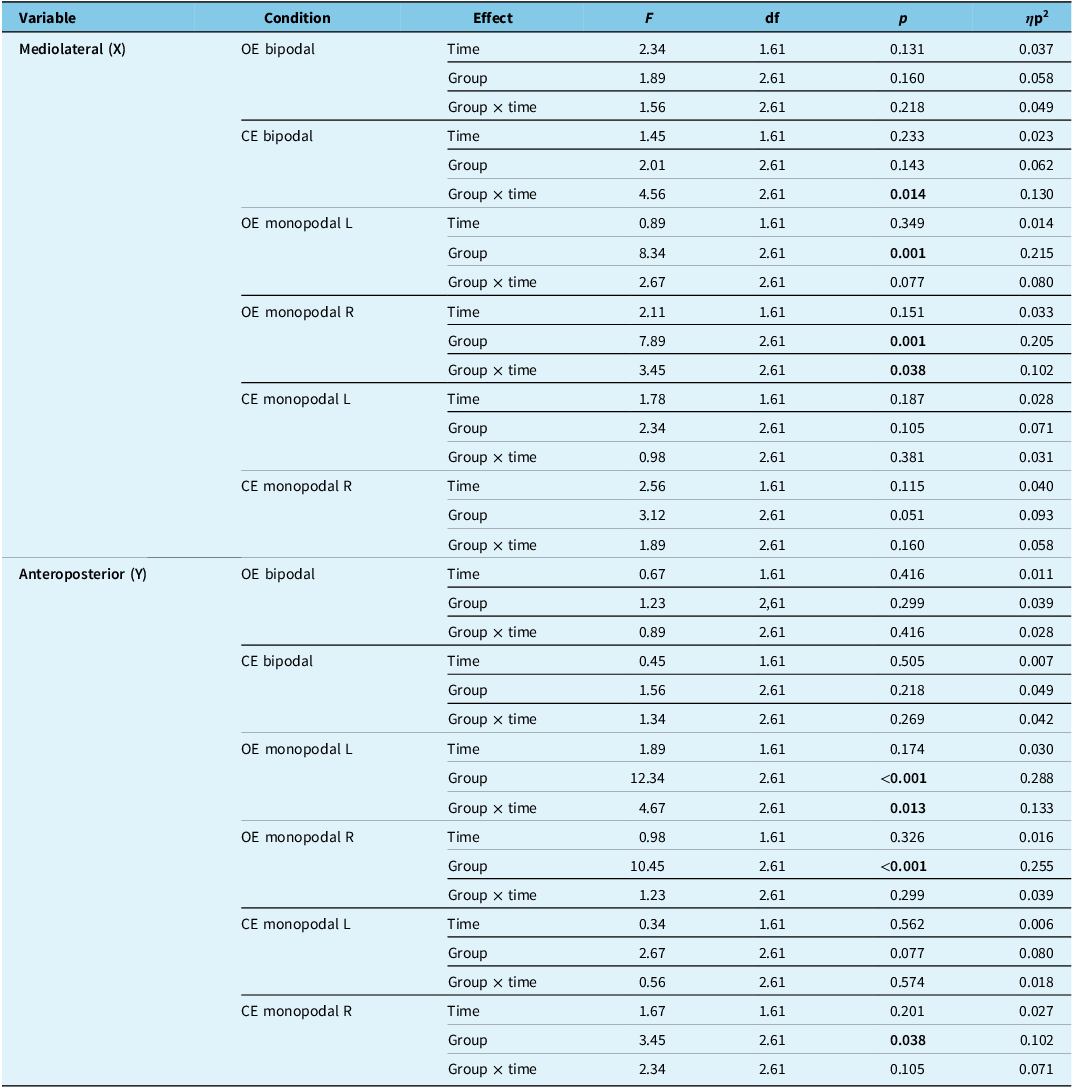
Mixed ANOVA results for mediolateral (X) and anteroposterior (Y) sway

Table 5 Long description
A table comparing mixed ANOVA results for mediolateral and anteroposterior sway across different conditions and effects. The table has 14 rows and 7 columns. The columns are labeled Variable, Condition, Effect, F, df, p, and eta squared. The rows list different conditions such as OE bipodal, CE bipodal, OE monopodal L, OE monopodal R, CE monopodal L, and CE monopodal R. Each condition is further divided into Time, Group, and Group x time effects. The table provides F values, degrees of freedom (df), p-values, and eta squared values for each effect. Notable trends include significant p-values for Group and Group x time effects in several conditions, indicating interactions between groups and time.
Note: Mixed-design ANOVA was conducted with time (pre-intervention [t0], post-intervention [t1]) as the within-subject factor and Group (G1, G2, G3) as the between-subject factor.
Only statistically significant pairwise comparisons (Bonferroni-adjusted) are presented in the post hoc column.
Significant p-values (p < 0.05) are shown in bold. ηp2 represents partial eta-squared.
OE = open eyes; CE = closed eyes; L = left; R = right; G1 = multiple sclerosis with central vestibular involvement; G2 = multiple sclerosis without vestibular involvement; G3 = healthy controls; ηp2 = partial eta-squared.
Within-group pre–post comparisons for significant group x time effects

Table 6 Long description
The table presents data on sway length and average speed under various conditions (open eyes monopodal left, closed eyes monopodal left, closed eyes monopodal right, open eyes bipodal, and closed eyes bipodal) for three groups (G1, G2, G3). It includes pre and post mean values with standard deviations and p-values. Notable trends include significant changes in sway length for G2 in the open eyes monopodal left condition and variations in sway length across groups in the closed eyes monopodal left and right conditions. Average speed shows significant changes in the open eyes bipodal condition for G1 and in the mediolateral closed eyes bipodal condition for G1 and G3.
Note: OE = open eyes; CE = closed eyes; L = left; R = right; G1 = multiple sclerosis with central vestibular involvement; G2 = multiple sclerosis without vestibular involvement; G3 = healthy controls.
* Values are presented as mean ± standard deviation. Normality was assessed using the Shapiro–Wilk test. Within-group comparisons (pre- vs post-intervention) were performed using a paired-samples t-test.
† For normally distributed data and the Wilcoxon signed-rank test.
‡ For non-normally distributed data. Only variables demonstrating significant group × time interactions in mixed ANOVA are presented. Statistically significant differences are indicated with an asterisk (p < 0.05).
Bonferroni-adjusted post hoc pairwise comparisons between groups following significant group x time interactions

Table 7 Long description
The table presents data on sway length and average speed under various conditions and group comparisons. It includes parameters such as sway length and average speed, with conditions like OE monopodal left, CE monopodal left, CE monopodal right, OE bipodal, and OE monopodal right. The table has 12 rows and 5 columns, with headers for Parameter, Condition, Comparison, Mean difference, and p (Bonferroni). Notable comparisons include significant differences in sway length and average speed between different groups, with specific p-values indicating statistical significance. The data highlights variations in sway length and average speed across the conditions and groups, providing insights into the interactions and differences observed.
Note: Post hoc analyses were conducted only for variables showing a significant group × time interaction in the mixed-design ANOVA (Tables 4–5). Between-group comparisons (G1 vs G2, G1 vs G3, G2 vs G3) were performed using independent samples t-tests. A Bonferroni correction was applied for each outcome variable to account for multiple comparisons (three tests per variable), resulting in an adjusted significance threshold of α = 0.0167. Adjusted p-values are reported in Table 7, with statistically significant differences indicated by an asterisk (*).
OE = open eyes; CE = closed eyes; L = left; R = right; G1 = multiple sclerosis with central vestibular involvement; G2 = multiple sclerosis without vestibular involvement; G3 = healthy controls.
Average speed: Significant group × time interactions were found in the OE bipodal (F = 6.12, p = 0.004, ηp2 = 0.167), OE monopodal left (F = 4.34, p = 0.017, ηp2 = 0.125) and CE monopodal right (F = 3.89, p = 0.026, ηp2 = 0.113) conditions (Table 4). In the OE bipodal condition, average speed decreased significantly in G1 (7.06 ± 5.01 to 6.22 ± 5.43; p = 0.002), and the reduction differed from G3 (p = 0.004) (Tables 6 and 7). In the OE monopodal left condition, average speed decreased in G1 (71.81 ± 31.72 to 69.96 ± 34.60) and G2 (41.53 ± 35.88 to 35.94 ± 19.41) but increased in G3 (15.43 ± 8.90 to 22.81 ± 10.20), with a greater reduction in G2 than G3 (p = 0.006) (Tables 6 and 7). In the CE monopodal right condition, average speed decreased in G1 (110.61 ± 35.76 to 96.87 ± 42.90), G2 (88.34 ± 46.94 to 70.52 ± 29.24) and G3 (58.43 ± 24.90 to 56.83 ± 32.40), with a larger reduction in G2 than G3 (p = 0.008) (Tables 6 and 7).
Mediolateral sway (X): Significant group × time interactions were observed in the CE bipodal (F = 4.56, p = 0.014, ηp2 = 0.130) and OE monopodal right (F = 3.45, p = 0.038, ηp2 = 0.102) conditions (Table 5). In the CE bipodal condition, mediolateral sway increased significantly in G1 (14.60 ± 9.20 to 23.87 ± 11.30; p = 0.031) and G3 (6.03 ± 3.20 to 10.03 ± 4.60; p = 0.026), whereas it decreased in G2 (19.98 ± 46.15 to 10.54 ± 10.25), with a greater increase in G1 than G2 (p = 0.009). In the OE monopodal right condition, mediolateral sway increased in G1 (82.16 ± 29.70 to 87.87 ± 28.60), G2 (31.73 ± 24.67 to 49.80 ± 75.15; p = 0.010) and G3 (16.70 ± 7.20 to 31.63 ± 6.30), with a greater increase in G2 than G1 (p = 0.011) (Tables 6 and 7).
Anteroposterior sway (Y): A significant group × time interaction was identified only in the OE monopodal left condition (F = 4.67, p = 0.013, ηp2 = 0.133) (Table 5). Anteroposterior sway decreased in G1 (93.59 ± 35.70 to 78.29 ± 32.56) and G2 (48.22 ± 56.79 to 30.88 ± 30.23) but increased in G3 (14.94 ± 9.20 to 25.18 ± 10.40). Change scores differed significantly between G1 and G2 (p = 0.007) and between G2 and G3 (p = 0.004) (Tables 6 and 7).
Virtual reality-induced sickness assessment
(VRSQ outcomes were low across all groups, indicating good tolerability of the VR-based OKS intervention. Mean total VRSQ scores were 10.17 in Group 1, 9.08 in Group 2 and 9.56 in Group 3, with no statistically significant between-group difference (p = 0.68). Similarly, no significant group differences were observed for the oculomotor subscale (12.08, 11.47 and 10.95, respectively; p = 0.52) or the disorientation subscale (11.30, 10.71 and 10.23, respectively; p = 0.72). These findings suggest that the intervention was well tolerated regardless of vestibular status.
Discussion
Our study demonstrates that short-term OKS induces selective, rather than generalized, changes in postural sway in PwMS with and without vestibular involvement. These effects, observed under specific stance conditions, suggest that the intervention transiently challenges balance while engaging adaptive sensory mechanisms. Importantly, participants reported minimal discomfort, indicating that the protocol is well-tolerated and feasible for short-term application.
When the overall pattern of results is considered, responses to acute VR-based OKS were heterogeneous and appeared to depend on vestibular status, sway parameter and postural task difficulty. Participants with MS without vestibular involvement generally showed reduced sway in several challenging monopodal conditions, which may suggest preserved adaptive capacity and more effective sensory reweighting. In contrast, those with central vestibular involvement demonstrated increases in selected sway parameters under visually or somatosensorily demanding conditions, consistent with greater transient destabilization in response to visual motion. Healthy controls also exhibited task-specific changes after stimulation, indicating that exposure to OKS may modify postural behavior even in individuals without known balance impairment. The differing responses between mediolateral and anteroposterior parameters may partly reflect the directional characteristics of the visual stimulus, which was delivered predominantly in the mediolateral plane.
The transient increase in postural sway observed after acute OKS should not necessarily be interpreted as a negative outcome. In balance rehabilitation, temporary destabilization is often used as a therapeutic strategy to stimulate adaptive postural responses and promote sensory reweighting. Similar short-term increases in sway can occur during tasks performed with eyes closed, on compliant surfaces or under externally applied perturbations, where the nervous system is challenged to reorganize the relative contribution of visual, vestibular and somatosensory inputs. Reference Fukuda32 Repeated exposure to such controlled balance challenges may subsequently reduce sway and improve postural efficiency over time. Reference Peterka33 From this perspective, the acute destabilization observed in our participants – particularly those with central vestibular dysfunction – may represent an initial adaptive response rather than a harmful effect. This interpretation is consistent with previous studies showing that perturbation-based and sensory-conflict training can enhance postural control through compensatory recalibration mechanisms.
Similar to our protocol, Fujitani et al. Reference Pavlou, Quinn, Murray, Spyridakou, Faldon and Bronstein34 investigated the effects of a single session of VR-based OKS in healthy individuals and reported reduced reliance on visual inputs for postural control after exposure. These findings support the idea that even one OKS session may rapidly modify balance strategies. In our study, acute responses were also observed after a single session; however, the direction of change varied according to vestibular status and task condition. While some participants demonstrated reduced sway, others showed transient increases, particularly those with central vestibular dysfunction. Together, these findings suggest that a single OKS exposure can induce immediate postural adaptation, although the specific response may depend on underlying sensory integration capacity.
Keersmaecker et al. conducted a meta-analysis investigating the effectiveness of VR applications in the rehabilitation of individuals with MS and reported that these interventions were effective in improving both balance and walking functions. Reference Fujitani, Noguchi and Jiroumaru35 However, the vast majority of the included studies (91%) employed non-immersive systems (e.g., TV screens), with only one study utilizing a fully immersive head-mounted display. Another systematic review similarly reported that VR-based interventions are effective in reducing fatigue and improving quality of life in PwMS. Reference De Keersmaecker, Guida and Denissen36 However, most of the studies included in this review (10 out of 12) also employed non-immersive VR devices. In contrast, fully immersive systems have the potential to enhance neuroplasticity by providing richer visual–vestibular stimulation and a stronger sense of presence. The originality of our study is reinforced by the fact that it is among the few to implement a fully immersive VR intervention in PwMS.
One of the few studies employing fully immersive VR was conducted by Ozkul et al., who administered game-based immersive VR to individuals with MS over an 8-week period and reported improvements in balance, mobility and fatigue. Reference Ozkul, Guclu-Gunduz, Yazici, Atalay Guzel and Irkec16 Another study investigated a 10-minute fully immersive VR application (rollercoaster simulation) and observed a transient increase in postural sway along with side effects such as blurred vision and nausea in the general MS population. Reference Cortés-Pérez, Sánchez-Alcalá, Nieto-Escámez, Castellote-Caballero, Obrero-Gaitán and Osuna-Pérez37 In our study, participants engaged in a VR application incorporating OKS within everyday life scenarios. This design allowed assessment of postural control in conditions more closely resembling real life while providing targeted vestibular stimulation and ecologically valid visual input. Importantly, participants did not report significant blurred vision or nausea, suggesting that the protocol is safe and well-tolerated even in individuals with central vestibular impairment. The absence of between-group differences in VRSQ scores despite measurable postural changes may indicate that objective balance responses and subjective symptom perception reflect partially distinct processes. It may also be related to the brief duration and controlled intensity of the stimulation, which was sufficient to elicit postural adaptation without provoking substantial discomfort. These findings underscore the importance of individualizing and optimizing VR-based rehabilitation strategies for specific subgroups.
In a pilot study, vestibular impairment in PwMS was assessed using the Dizziness Handicap Inventory, and participants were subsequently divided into two groups: one receiving VR-based vestibular rehabilitation and the other undergoing the traditional Cawthorne–Cooksey protocol. Reference Pau, Arippa and Leban38 The intervention consisted of 20 sessions, and the VR-based application was found to be safe and effective in improving balance and reducing vertigo. In our study, individuals with MS were classified as having or not having central vestibular involvement using VNG, and each participant underwent a single VR session. Notably, our OKS application differs from conventional vestibular rehabilitation protocols, potentially facilitating better adaptation to daily life. In another study, Gutierrez et al. administered 20-minute VR-based telerehabilitation sessions to the experimental group over 10 weeks, demonstrating that VR may be more effective than conventional physical therapy in improving balance and postural control in MS. Reference García-Muñoz, Casuso-Holgado, Hernández-Rodríguez, Pinero-Pinto, Palomo-Carrión and Cortés-Vega39 While longer-term interventions are generally associated with better outcomes, our findings suggest that VR is effective and safe even in the short term.
Very few studies have examined the use of OKS in individuals with MS. In one such study, Williams et al. exposed participants to OKS and assessed whether the induced visual motion was effective in suppressing nystagmus. Reference Gutiérrez, Galán Del Río, Cano de la Cuerda, Alguacil Diego, González and Page40 However, in this study, OKS was administered with the patient seated in a fixed position in front of an optokinetic screen, and no immersive intervention was implemented. A case of central vestibulopathy in an MS participant demonstrated rapid symptom improvement following a short-term intervention that combined OKS (three repetitions of 3-second upward stimulation) with gaze stabilization exercises. Reference Williams, Schofield, Khade and Abel41 Similarly, another case report described a non-ambulatory MS participant who underwent short-term optokinetic chart stimulation combined with balance exercises. Reference Chitambira and McConaghy18 The intervention led to significant improvements in muscle strength, functional independence, bladder control and fear of falling, becoming independently mobile. These findings highlight the potential benefits of OKS-based interventions in MS, particularly when combined with other rehabilitation strategies. VR-based OKS applications have been used in other populations to manage visual vertigo. Mandour et al. reported that incorporating VR-based OKS into rehabilitation programs was effective in this regard. Reference Mandour, El-Gharib, Emara and Elmahallawy8 In the study by Fujitani et al., 30 healthy individuals without balance impairments were exposed to an OKS consisting of black dots rotating clockwise at 60°/s for 2 minutes. The results indicated that this intervention improved postural control and reduced participants’ excessive reliance on visual cues for maintaining balance. Reference Pavlou, Quinn, Murray, Spyridakou, Faldon and Bronstein34
Our findings indicate that individuals with MS exhibiting central vestibular involvement showed transient increases in postural sway following VR-based OKS, suggesting that the intervention temporarily challenges balance by creating sensory conflict due to impaired visual–vestibular integration. This transient destabilization may, however, activate central adaptive mechanisms, highlighting the potential for vestibular system adaptation and improved postural control over time. In contrast, individuals with MS without vestibular involvement demonstrated smaller or even decreased sway in some conditions, likely reflecting more effective proprioceptive compensation through sensory reweighting. The relatively greater effects observed on lateral stability compared to anteroposterior stability further emphasize the vestibular system’s role in maintaining mediolateral control. To our knowledge, this study is the first to investigate VR-based OKS in people with MS, addressing an important gap in the literature. The results suggest that structured VR-based OKS interventions could be a promising tool for enhancing visual–vestibular integration and balance control in this population.
Although transient destabilization may be therapeutically useful in stable phases, caution may be warranted during acute vestibular exacerbations, when symptoms are more severe and tolerance to sensory conflict may be reduced. Therefore, the timing and progression of OKS-based interventions should be individualized according to clinical status.
Limitations of this study include the relatively small sample size, the brief duration of a single-session intervention and the weight of the VR headset, which caused some discomfort, particularly among older participants. Functional balance measures such as the Timed Up and Go or Berg Balance Scale were not included because the present study focused on immediate sensory-postural responses following a single-session intervention. Such outcomes may be more informative in future studies examining repeated applications and longer-term functional change. The absence of a sham-controlled condition is another limitation, as it precludes full differentiation of intervention-specific effects from potential expectation-related influences. However, the inclusion of three distinct groups, including a healthy control group, represents a methodological strength that enabled comparative interpretation of vestibular and postural responses across different participant profiles. Future studies with larger cohorts and repeated sessions are warranted to confirm these findings and examine long-term clinical benefits.
Conclusion
The observed changes in postural sway after VR-based OKS in MS participants with central vestibular impairment suggest a potential for adaptive vestibular responses. These preliminary results indicate that individuals with central vestibular involvement may benefit from structured OKS interventions, with the potential for long-term improvements in postural stability and balance rehabilitation.
Data availability statement
The datasets generated and/or analyzed during the current study are not publicly available due to privacy restrictions but are available from the corresponding author upon reasonable request.
Acknowledgments
None.
Author contributions
Ö.Ö. and Y.S.: Conceptualization. Ö.Ö., İ.T.B., Y.S., H.Ç.: Methodology. Ö.Ö. and Y.S.: Formal analysis and investigation. Ö.Ö. and Y.S.: Writing – original draft. P.A.Ö. and A.T.: Resources.
Funding statement
This research received no specific grant from any funding agency, commercial or not-for-profit sectors.
Competing interests
The authors declared no potential conflicts of interest with respect to the research, authorship and/or publication of this article.
Ethical standards
This study was conducted at Hacettepe University between August and November 2025, with ethical approval obtained from the Health Sciences Scientific Research Ethics Committee (approval number: 2025/102). The study was registered at ClinicalTrials.gov (registration number: NCT07150520).
Prior presentation
Portions of these data were previously presented as a poster at ECTRIMS 2025, Barcelona. This prior presentation does not constitute prior publication.
Consent to participate
Written informed consent to participate was obtained from all individual participants included in the study.
Consent for publication
Not applicable.