A social interaction learning (SIL) model for the development of antisocial behavior and delinquency has emerged over the past three decades (see Patterson, Reference Patterson1982, Reference Patterson, Dishion and Snyder2016; Patterson, Reid, & Dishion, Reference Patterson, Reid and Dishion1992; Reid, Patterson, & Snyder, Reference Reid, Patterson and Snyder2002). The model specifies two levels: contexts influence social environments and social environments shape repeating patterns of social interaction in reciprocal processes. Two social environments are considered primary for the delinquency model: the family and peer groups. In the family domain, adverse contexts are presumed to increase the likelihood of coercive parenting, which in turn erodes positive parenting; disrupted parenting practices serve as mechanisms for children's early and ongoing adjustment problems (see Forgatch, Beldavs, Patterson, & DeGarmo, Reference Forgatch, Beldavs, Patterson, DeGarmo, Kerr, Stattin and Engels2008; Patterson, Forgatch, & DeGarmo, Reference Patterson, Forgatch and DeGarmo2010). In youngsters' social environments outside the home, harsh contexts associated with social disadvantage, such as substandard schools and living in high-crime neighborhoods, can contribute to behavior problems by exposing youth to high densities of deviant peers (Dishion, Ha, & Véronneau, Reference Dishion, Ha and Véronneau2012). Antisocial and aggressive youngsters are at particular risk because they are likely to be rejected by normative peer groups and drift into deviant peer groups (Coie & Kupersmidt, Reference Coie and Kupersmidt1983; Dodge, Reference Dodge1983), who provide an important training ground for antisocial behavior (Dishion, Reference Dishion, Dishion and Snyder2016). Contexts affect these two mechanisms that contribute to delinquency: one mechanism is based on parenting practices and the other on deviant peer processes. These two mechanisms are at play from infancy into adulthood, producing a combination of antisocial behavior and a profound deficit in social skills.
This model can be described as a stage model, in which the reinforcers identified at a given stage predict the deviant behavior that will emerge at the next stage. Negative reinforcement and positive reinforcement are key mechanisms during early childhood, adolescence, and young adulthood. Stage 1 begins at home with the onset of conduct problems at ages 2, 3, or 4. The contingencies are provided by family members, with particular emphasis upon negative reinforcement for overt antisocial behavior. As their aggressive behavior generalizes outside the home, these children tend to be rejected by normative peers (Coie & Kupersmidt, Reference Coie and Kupersmidt1983; Dodge, Reference Dodge1983; Patterson, DeBaryshe, & Ramsey, Reference Patterson, DeBaryshe and Ramsey1989; Snyder, Horsch, & Childs, Reference Snyder, Horsch and Childs1997). In Stage 2, problems grow as deviant peers positively reinforce youngsters for talk about covert antisocial behavior, such as drug use, defiance of authority, truancy, stealing, and fire setting (Dishion, Eddy, Haas, Li, & Spracklen, Reference Dishion, Eddy, Haas, Li and Spracklen1997; Snyder et al., Reference Snyder, Schrepferman, McEachern, Barner, Johnson and Provines2008). In Stage 3, both the family and the deviant peer group provide high densities of negative and positive reinforcement for overt and covert antisocial behavior (Dishion, Reference Dishion, Dishion and Snyder2016). At each stage, the reinforcers define the content of development for the next stage. The long-term impact is to move the now adolescent youth further into the coercive process, with behavior becoming increasingly extreme, deviant, dangerous, and downright lethal (Dishion, Reference Dishion, Dishion and Snyder2016; Dishion & Van Ryzin, Reference Dishion and Van Ryzin2011; Van Ryzin & Dishion, Reference Van Ryzin and Dishion2012). We suspect that the process is bidirectional, making antisocial behavior a contagious process.
An overview of the contribution of family and peer contexts and processes to the development of antisocial behavior is shown in Figure 1. The development of antisocial behavior might be construed as involving a set of stages, each involving transactions among family and peer contexts and processes, and progression in the variety and severity of antisocial acts. Parenting processes are critical in the initiation and early progression of antisocial behavior. As children move into systematic peer contacts in school, their own level of antisocial behavior initiates selective peer affiliation and deviancy training processes, which exacerbate antisocial behavior and challenge effective parenting. Over time, progressions in antisocial behavior, deviant peer processes, and diminished parenting become increasingly powerful processes and comprise a pathway to more severe forms of violence, crime, and exploitive relationships.
The dual-process stage model for parenting and peer processes.

Patterson aptly used the metaphor of a chimera to describe the metamorphosis of antisocial behavior from mild to serious problems as boys transition from childhood to adolescence (Patterson, Reference Patterson1993). The chimera is a fire-breathing Greek mythological creature that was part goat, part lion, and part snake. A child raised in a coercive environment may undergo transformation analogous to that of the chimera. The goatlike antisocial behavior emerges early in a child's development and may be sustained throughout development. What makes the chimera particularly colorful are the additions (i.e., lion's head, snake's tail, and fire breathing) that map onto the increasingly extreme and varied antisocial behaviors that emerge in Stages 2 and 3 of the developmental model. Patterson tested developmental changes in antisocial behavior, its predictors, and the changing form of deviancy with data from the Oregon Youth Study, a sample of 206 families with boys living in high-crime neighborhoods. Patterson focused on the transition from childhood to adolescence when the boys were in Grades 4, 6, and 8 using latent growth curve modeling to illustrate changes in the form and predictors of deviancy.
Patterson found considerable stability (0.85) in a construct of antisocial behavior based on parent, teacher, and child report from Grades 4 to 8. Next he showed that the predictors of antisocial behavior changed over that period. Parenting practices assessed at Grade 4 predicted the intercept of antisocial behavior. Changes in wandering and deviant peer association from Grades 4 through 8 predicted the slope in antisocial behavior during that period. This suggests that one has to examine behavior in terms of developmental phases to detect the predictors of problem behavior in children, particularly in the phases of development as children become adolescents. The next step in deconstructing the developmental model was to examine the indicators of a deviancy construct during that time frame. Deviancy was defined with four indicators: antisocial behavior, poor academic skills, substance use, and arrests. The contribution of these indicators to the deviancy construct measured changes at Grades 4, 6, and 8, although the rank order of their loadings on the construct remained the same at each grade. The makeup of deviancy was shown to change over the course of development.
The Family Context
Massive changes in family contexts brought about by transitions such as divorce can impact effective parenting and in turn disrupt children's adjustment trajectories. Divorce is associated with a descent into poverty, parental depression, changes in residence and schools, and disturbances in social support systems for parents and children. The parental distress growing out of these adversities is associated with increased coercive parenting and decreased positive parenting, which places the children at increasing risk for behavior problems (Forgatch, Patterson, & Ray, Reference Forgatch, Patterson, Ray, Hetherington and Blechman1996). The youngsters' problems include aggression, poor peer relations, maladaptive behavior at home and school, and academic failure. Premature autonomy can exacerbate the situation by enabling youngsters to spend unsupervised time with deviant peers, who will shape deviant behavior through talk, wandering, and delinquent behavior (Dishion, Reference Dishion, Dishion and Snyder2016; Dishion & Patterson, Reference Dishion, Patterson, Cicchetti and Cohen2006; Snyder et al., Reference Snyder, Schrepferman, McEachern, Barner, Johnson and Provines2008). Divorce involves double jeopardy because socially disadvantaged parents are at risk for moving into environments rich in the availability of deviant peers for their children, and disrupted parenting invites youngsters' antisocial behavior.
The present study examines early steps in a stage model for understanding the descent into delinquency in a divorcing sample. We tested the disrupted parenting hypothesis experimentally by providing an effective parenting intervention to a sample of recently separated mothers with boys in Grades 1–3. We used a randomized controlled trial with 9-year follow-up data and repeated multiple method and agent assessment (see Forgatch & DeGarmo, Reference Forgatch and DeGarmo1999; Forgatch, Patterson, DeGarmo, & Beldavs, Reference Forgatch, Patterson, DeGarmo and Beldavs2009). Families were randomly assigned to intervention with Parent Management Training—Oregon Model (PMTO®) or a no-treatment control condition. Mothers assigned to the PMTO group learned effective parenting practices in a set of 14 parent group sessions. Intent to treat analyses were conducted using longitudinally sequenced models evaluating change in coercive parenting and growth in positive parenting and their mediational effects on 9 years of growth in teacher ratings of delinquency. We hypothesized that the PMTO intervention would reduce growth in coercion, promote positive parenting, and thereby prevent boys' development of delinquent behavior.
The findings are best described as a double-mediated model in which, relative to their controls, mothers assigned to the PMTO condition showed a reduction in coercive parenting from baseline to 12 months, which mediated intervention effects on growth in positive parenting at 12 to 30 months; growth in positive parenting was the most proximal mediator for the intervention's direct effect on decreases in teacher-rated delinquency, explaining 47% of the variance (Forgatch et al., Reference Forgatch, Beldavs, Patterson, DeGarmo, Kerr, Stattin and Engels2008). Thus, we found experimental support for the efficacy of the intervention and the theoretical model regarding parenting practices.
In the same study, we showed that the intervention had a significant effect on preventing growth in deviant peer association, accounting for six percent of the variance (Forgatch et al., Reference Forgatch, Patterson, DeGarmo and Beldavs2009). We had hypothesized that the effect on deviant peer association would be mediated by the benefit to parenting, which in turn would explain more variance in growth of deviant peer association. Although we tested this hypothesis, the model did not fit the data. We have been left with the question: how did a parenting program provided to mothers but with no direct intervention with the children produce this outcome? This study addresses that question.
The Peer Context
Studies of peer processes at multiple stages in youngsters' development indicate that deviant peer association occurs early and unfolds in stages and contributes to increasing severity and form of antisocial behavior (Dishion, Reference Dishion, Dishion and Snyder2016; Patterson, Reference Patterson, Dishion and Snyder2016). Parents' contribution to increasing deviant peer association is assumed to take place in two distinct steps: they fail to teach prosocial skills and they provide direct support for coercion, which together lead to the child's antisocial behavior and rejection by the normal peer group (Dishion, Patterson, Stoolmiller, & Skinner, Reference Dishion, Patterson, Stoolmiller and Skinner1991). Family socioeconomic status (SES) may be a crucial variable because it influences the density of deviant peers and neighborhood models, making effective parenting particularly important. SES has been found to predict peer rejection (Kupersmidt & Coie, Reference Kupersmidt and Coie1990), clustering in deviant peer groups (Dishion et al., Reference Dishion, Patterson, Stoolmiller and Skinner1991), and peer marginalization (Dishion et al., Reference Dishion, Ha and Véronneau2012). An intervention to bolster effective parenting and strengthen children's prosocial skills for families in the divorce process may benefit youngsters by preventing them from joining deviant peer groups, particularly in socially disadvantaged families.
Stage 1: Antisocial behavior early to middle childhood
The predominant mode for antisocial behavior during this stage is physical aggression appearing early and apparent in peer groups as well as at home. It is characterized by temper tantrums, defiance, and noncompliance as children reach about age 2 and can walk and talk. By age 5, more covert forms appear that involve being sneaky, although the behavior is hardly sophisticated. Aggressive behavior at school leads to rejection by the normative peer group. “Deviancy training” takes place as children receive positive reinforcement through social approval from nonnormative peers for deviant talk and rehearsal as early as kindergarten and first grade (Snyder et al., Reference Snyder, Schrepferman, Oeser, Patterson, Stoolmiller and Johnson2005, Reference Snyder, McEachern, Schrepferman, Just, Jenkins and Roberts2010). Deviant talk is also associated with deviant attitudes expressed by parents during parent–child interaction (Snyder, Schrepferman, Bullard, McEarchern, & Patterson, Reference Snyder, Schrepferman, Bullard, McEarchern and Patterson2012) and predicts trajectories of antisocial behavior during elementary school and into later childhood (Snyder et al., Reference Snyder, Schrepferman, Oeser, Patterson, Stoolmiller and Johnson2005, Reference Snyder, Schrepferman, McEachern, Barner, Johnson and Provines2008). The talk about overt antisocial behavior involves aggression, guns, and gangs; covert talk is about sex, drugs, and pretending to smoke or drink. The talk during this earlier childhood period is just talk because there are few opportunities to take commensurate actions given the behavioral immaturity of younger children; the lack of opportunity to engage in many of the behaviors described, or to access materials associated with antisocial behavior; as well as the higher levels of adult monitoring at this age.
Stage 2: Late childhood to early adolescence
Although deviancy training begins as early as kindergarten (Snyder et al., Reference Snyder, Schrepferman, McEachern, Barner, Johnson and Provines2008; Snyder & Stoolmiller, Reference Snyder and Stoolmiller2004), it becomes increasingly important as children become adolescents (Dishion, Reference Dishion, Dishion and Snyder2016; Dishion, Andrews, & Crosby, Reference Dishion, Andrews and Crosby1995; Patterson et al., Reference Patterson, DeBaryshe and Ramsey1989). Obdurate noncompliance, aggressive behavior, failure in school, and rejection by prosocial peers continues (Patterson et al., Reference Forgatch, Knutson and Mayne1992). Physical aggression declines normatively as children mature, but those who persist are more hurtful, with both intentional (e.g., bullying) and reactive (e.g., impulsivity and negative emotionality) forms (Tremblay, Mâsse, Vitaro, & Dobkin, Reference Tremblay, Mâsse, Vitaro and Dobkin1995). Covert or rule-breaking behavior becomes more sophisticated and varied, and lying and stealing take place outside the home. New behaviors are added to the antisocial repertoire, including truancy, curfew violations, initiation of drug use and sexual activity, and in extreme cases fire setting and cruelty to animals (Patterson et al., Reference Forgatch, Knutson and Mayne1992). The transition to middle school leads to access to a wider range of deviant peers, with selective affiliation, rejection by normative peers, and school failure accelerating deviancy training. Fueled by the biological changes accompanying the pubertal transition, increasing opportunity to engage in deviant behavior, greater practice of deviant talk, increasing autonomy and reduced monitoring, and opportunities for antisocial behavior increasingly present themselves with access to drugs and weapons (Dishion & Patterson, Reference Dishion, Patterson, Cicchetti and Cohen2006). Discourse with deviant peers is focused on talk about covert antisocial behavior, which is positively reinforced and leads to delinquent behavior, early drug use, and early sexual activity (Dishion, Reference Dishion, Dishion and Snyder2016). Family influence weakens and parents find it increasingly difficult to control their child's behavior. With time, more and more of the critical positive processes underlying constructive parenting give way (Patterson, Reference Patterson, Dishion and Snyder2016). Changes come about in rapid succession, and increasingly life can feel like it is out of control. As the behavior becomes more extreme, this youngster is now ready to begin the next stage in training for delinquency, Stage 3.
Stage 3: Late adolescence to early adulthood
This stage can be thought of as connecting all the mechanisms, including negative reinforcement provided by the family plus negative reinforcement by deviant peers as well as positive reinforcement for antisocial talk and behavior. Peers who contribute to Stage 3 represent the extremes in delinquent and antisocial behavior. They carry weapons, and they use the weapons. Observations of their verbal interactions demonstrate that the world they live in is a savage one, sounding much like the talk of hit men or soldiers in combat (Dishion, Reference Dishion, Dishion and Snyder2016; Dishion & Van Ryzin, Reference Dishion and Van Ryzin2011; Van Ryzin & Dishion, Reference Van Ryzin and Dishion2012). At the same time, coercion in the family persists and increases. Criminal activity becomes a way of life. The social environment cutting across family and peers becomes increasingly negative and hostile, as well as reinforcing. It all becomes one slate-colored vicious world.
Summary, Previous Findings, and Hypotheses
In summary, we have described research related to a dual-process (families and peers) stage model for the development of antisocial behavior in boys based on an SIL perspective. Reinforcing contingencies within the family and peer social domains are presumed to shape and sustain delinquent behavior in male youth. Conducting a preventive intervention with recently separated single mothers in a randomized controlled trial has enabled us to evaluate both the efficacy of the intervention and its theoretical basis. Earlier findings with the present sample supported several hypotheses. Random assignment to PMTO produced direct effects benefiting parenting practices and deviant peer association, and each of these explained significant variance in reduced growth in teachers' reports of the boys' delinquency over the course of 9 years. The SIL model performed as expected for the parenting dimension. Intervention effects on coercive parenting and positive parenting mediated the intervention's direct impact on the 9-year course of delinquency. The intervention also produced a reduction in deviant peer association, which also mediated direct effects on growth in delinquency. However, contrary to expectation, parenting practices did not mediate the intervention's effect on deviant peer association. In the present study, we extend analyses to uncover the mediators for the impact on deviant peer association. We do this by examining effects during Stages 1 and 2 in the model, when the boys are in elementary school and as they make the transition into puberty and middle school.
The families in our sample were in the early stages of divorce (3–24 months after separation) and experiencing high levels of financial stress. Their increasing social disadvantage led them to move into less desirable neighborhoods, often with substandard schools, increasing their sons' exposure to a higher density of deviant peers. In Stage 1, during the childhood/elementary school period, we expected the effects of improved parenting practices generated by PMTO on reducing children's deviant peer association would be most apparent for more socially disadvantaged families, given their children's increased exposure to deviant peers and models at school and in the neighborhood.
For the Stage 2 model, when boys were making the pubertal transition and entering middle school, we hypothesized that boys who were becoming more delinquent would spend more time with deviant peers. If the mothers in the intervention group improved their parenting practices and that in turn reduced growth in delinquency, then these boys' would spend less time with deviant peers. This suggests a double mediated model in which intervention effects on parenting would mediate a reduction in growth in delinquency, which in turn would lead to reduced deviant peer association.
Method
The Oregon Divorce Study spanned 9 years and comprised two distinct phases. Phase I took place between the years 1992 and 1997. Phase II was the long-term follow-up period between 1999 and 2005. The intervention for the experimental group took place between completion of the baseline assessment and the 6-month assessment.
Participants
Two hundred thirty-eight recently separated single mothers and their sons residing in a medium-sized city in the Pacific Northwest, recruited through media advertisements, community flyers, and divorce court records, participated in the Oregon Divorce Study. Mothers in eligible families (a) had been separated from their partner within the prior 3 to 24 months, (b) resided with a biological son in Grades 1 through 3, and (c) did not cohabit with a new partner. Mothers at baseline had separated from partners an average of 9.2 months prior to recruitment. Families had an average of 2.1 children. The average age of mothers at baseline was 34 years (SD = 5.4, range = 21.4–49.6) and 7.8 years for boys (SD = 0.93, range = 6.1–10.4). In the Phase II follow-up period, we prioritized older boys for early assessment to capture the transition to adolescence. Due to this assessment protocol, the age range of boys at each assessment period increased during Phase II.
The racial/ethnic composition of the boys was 86% White, 1% African American, 2% Latino, 2% Native American, and 9% from “other” racial/ethnic groups, including those belonging to more than one group. This distribution reflects the racial/ethnic makeup of the community in the study location. The mean annual family income at baseline (1992–1994) was $14,900; 76% of the families received public assistance.
At baseline, 76% of the mothers had some academic or vocational training beyond high school, 17% of whom had completed a 4-year college degree or higher. Approximately 20% completed their education with high school graduation, and 4% had not completed high school. Most mothers were classified within the lower and working-class ranges in terms of occupation (Hollingshead, Reference Hollingshead1975): 32% unskilled, 21% semiskilled, 23% clerical/skilled, 22% minor professional to medium business, and 3% major business/major professional.
The experimental and control groups differed significantly on only two variables of these baseline demographic variables: number of months since marital separation and age of boys. Mothers in the experimental group had been separated 2.6 months longer than control group mothers (M = 9.84 and 7.48, respectively, p < .01). Boys in the experimental group were 0.28 years younger than control group boys (M = 7.65 and 7.93, respectively, p < .05). These variables were included as covariates in all relevant analyses.
Design
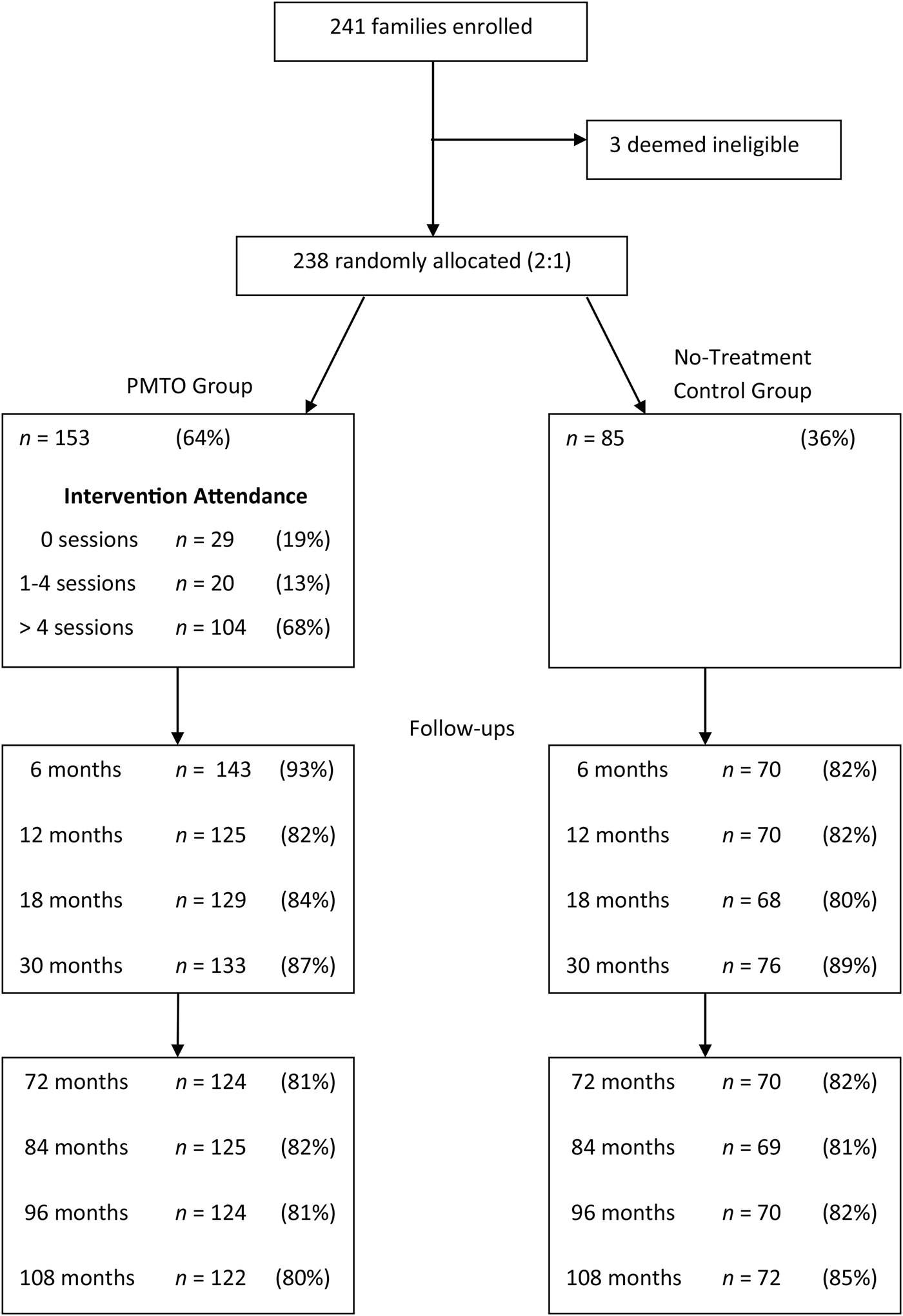
All families received a study description, agreed to random assignment for intervention, and completed informed consent. We randomly assigned families to the experimental and control group, with 153 in the PMTO experimental group and 85 in the no-intervention control group. Unequal group assignment was used to provide sufficient sample size within the experimental condition to examine potential full implementation intervention effects (Vinokur, Price, & Caplan, Reference Vinokur, Price and Caplan1991). PMTO and no-intervention control group families participated in the same assessment schedules during all phases. Figure 2 displays recruitment, group significance, and participation rates at each assessment. There was no differential attrition between groups at any of the assessments.
Consort table of participation rates.

The intervention consisted of a series of 14 sessions of parent group meetings held weekly in the early evening hours. There were 13 groups of parents, ranging in size from 6 to 16 (M = 9.5). Experimental group mothers participated in an average of 8.5 sessions (SD = 5.7). Forgatch and DeGarmo (Reference Forgatch and DeGarmo1999) summarized the intervention and described interventionist training and evaluation of program fidelity. The manual for the program, Parenting Through Change (Forgatch, Reference Forgatch1994), contains group leader information and parent materials. The manual incorporates detailed session descriptions for leaders, including agenda, objectives, rationales, procedures, exercises, role-plays, and group process suggestions. Parent materials include summaries of principles, home practice assignments, charts, and other necessary materials. A 30-min videotape, The Divorce Workout (Forgatch & Marquez, Reference Forgatch and Marquez1993), demonstrated families using program principles.
The five parenting practices comprising the foundation of the intervention and the core dimensions of PMTO interventions are skill encouragement, limit setting, monitoring, problem solving, and positive involvement. To meet the needs of the divorcing families focused on in this study, we added content to address issues related to divorce, including emotion identification and regulation, managing interparental conflict, and addressing children's divorce-related concerns. Sessions on emotion regulation emphasized recognizing specific negative emotions for parents and their children, as well as practicing techniques to regulate these emotions. Managing interparental conflict focused on communication, problem solving, and negotiation strategies. Talking with children about divorce combined active listening skills, problem solving, and emotion regulation. PMTO parenting components incorporate emotional regulation as an inherent part of the practice. For example, in the discipline component, mothers learned strategies to decrease coercive processes by using mild noncorporal discipline such as Time Out, extra work chores, and short privilege removal. Simultaneously, they learned ways to use contingent positive reinforcement, including praise, tokens, and incentive charts, to promote prosocial behavior. Topics were presented in an integrated step-by-step approach with new principles building on previously learned skills.
Measures
Multiple-method assessments included structured interviews, laboratory observations, and questionnaires completed by mothers, youth, and teachers. All those who collected data (e.g., interviewers, observers, and teachers) were blind to participant status (PMTO vs. no-intervention control group). In Phase I, teacher data were collected at baseline and 12, 24, and 36 months while parent–child data were collected at baseline and 6, 12, 18, and 30 months. Phase II began in Year 6 after baseline, during which we collected teacher and family questionnaire data annually and observational data twice on alternate years.
Youth outcomes
Delinquency was evaluated using the delinquency T score from the Teacher Report Form of the Child Behavior Checklist (Achenbach, Reference Achenbach1991). The T score consisted of nine items rated on a 3-point scale. Sample items include steals, lies, cheats, and destroys property. The Cronbach α values were 0.76, 0.71, 0.75, and 0.72 for respective assessments at baseline, and Years 1, 2, and 3. Teachers were blind to the fact that this was an intervention study and were different at each assessment. Parents identified which teachers would know their children well enough to make the ratings.
Deviant peer association was a summative index of five items scored true or false. The items were the boys' report of their friends' deviant behaviors (i.e., my friends: get into fights, clown around, get into trouble, do not like school, and find school too hard). The Cronbach α values were 0.60, 0.57, 0.60, 0.60, 0.46, and 0.55 for baseline, 6, 12, 18, 30, and 72 months, respectively. Each deviant peer association item loaded >0.39 on a common factor at each of the assessment points.
SES
SES was measured by educational and occupational attainment of the mother and per capita annual family income. Education was measured with categories ranging from 1 to 12 for number of school years completed. Occupation used categories ranging from 1 to 9 from the Hollingshead Four Factor Index of Social Status (Hollingshead, Reference Hollingshead1975). Per capita income was measured by dividing the annual income categories ranging from 1 (less than $5,000) to 9 (more than $50,001) by the number of persons dependent on the mother's income.
Effective parenting practices
We obtained laboratory observations during 45-min mother–child structured interaction tasks. The tasks were four problem-solving discussions about current conflicts, a teaching task, an unstructured activity, a forbidden toy situation, and a refreshment break. Microsocial data that detailed information on respondent, recipient, sequence, content, affect, context, and duration were scored in real time using the Interpersonal Process Code (Rusby, Estes, & Dishion, Reference Rusby, Estes and Dishion1991). Global ratings (Forgatch, Knutson, & Mayne, Reference Forgatch, Knutson and Mayne1992) were scored by coders following microsocial coding. Coders and interviewers were blind to intervention status and never assessed families more than once. With the exception of monitoring, all parenting practices were measured using coder data from the structured interaction tasks. Monitoring incorporated ratings from coders and interviewers. We randomly selected approximately 15% of the interactions at each wave for blind interrater reliability coding. We provide Cronbach α values and intraclass correlation coefficients (ICC) at baseline and 12 months, respectively, below.
Effective parenting was a factor score that demonstrated convergence measured by seven domains: positive involvement, skill encouragement, problem solving, monitoring, negative reinforcement, negative reciprocity, and aversive discipline (Forgatch & DeGarmo, Reference Forgatch, DeGarmo, Reid, Patterson and Snyder2002). Negative reinforcement and negative reciprocity are microsocial measures of coercion.
Positive involvement was measured by 10 global rating items (e.g., warm, empathetic, and affectionate) using Likert-scale items. The Cronbach α values were 0.96 and 0.97 and ICCs were 0.83 and 0.82.
Skill encouragement was measured using 11 Likert-scale global ratings of the promotion of skill development through contingent encouragement and scaffolding observed during the 10-min teaching task. Sample items included breaks task into manageable steps, reinforces success, and prompts appropriate behavior. The Cronbach α values were 0.69 and 0.81 and ICCs were 0.73 and 0.66.
Problem-solving outcome was based on 9 Likert-scale global ratings from the three mother–issue problem-solving tasks. Sample items included solution quality, extent of resolution, likelihood of follow through, and apparent satisfaction. Scale scores were averaged across tasks. The Cronbach α values were 0.92 and 0.91 and ICCs were 0.77 and 0.77.
Monitoring comprised five items rated by coders and parent interviewers. Coders rated parents' skill at supervising the child, tracking the youngster's behavior, and obtaining information from the child. Interviewers rated maternal knowledge of the boy's day-to-day behavior and antisocial behavior. The Cronbach α values were 0.72 and 0.71.
Negative reinforcement was defined as the frequency of conflict bouts initiated by the mother and terminated by the child. Bouts continued until at least 12 s passed without aversive behavior by either party. ICCs were 0.78 and 0.47.
Negative reciprocity was measured with the Haberman binomial z score (Gottman & Roy, Reference Gottman and Roy1990), reflecting the conditional likelihood that the mother reciprocated the child's aversive behavior with an aversive behavior of her own. ICCs were 0.65 and 0.54.
Inept discipline was measured as the mean of 13 Likert-scale global ratings. Sample items included overly strict, authoritarian, used nagging or nattering, expressed anger while engaged in, indecisive, and inappropriate discipline. The Cronbach α values were 0.91 and 0.92 and ICCs were 0.70 and 0.78.
Results
Data analysis strategy
Based on the premise that the effects of changes in parenting practices generated by PMTO intervention on deviant peer association are mediated by different intermediary processes during middle childhood and the later childhood/early adolescence periods, the analyses are conducted in two steps, one to account for changes in deviant peer association during childhood and one to account for changes in deviant peer association in late childhood/early adolescence. In each step, preliminary analyses checked for normality assumptions, and descriptive statistics and correlations for the variates were calculated. Our models used the period from baseline to 12 months to represent changes in parenting practices as we previously determined that the largest treatment effect was found during this period (DeGarmo & Forgatch, Reference DeGarmo and Forgatch2005; DeGarmo, Patterson, & Forgatch, Reference DeGarmo, Patterson and Forgatch2004). We measured deviant peer association at baseline, and at 6, 12, 18, 30, and 72 months, and teacher reports of child delinquency at baseline, and at 12, 24, and 36 months.
Next, separate growth models for deviant peer association were estimated for the childhood and for the late childhood/early adolescence periods, and a growth model for teacher ratings of delinquency was estimated for the childhood period. These growth models serve as components of each of the larger treatment effects causal models. Growth curve models provide several advantages, including more reliable estimates of change and intervention effects (Kraemer & Thiemann, Reference Kraemer and Thiemann1989), more accurate representation of the temporal spacing of assessments (Biesanz, Deeb-Sossa, Papadakis, Bollen, & Curran, Reference Biesanz, Deeb-Sossa, Papadakis, Bollen and Curran2004; DeGarmo & Forgatch, Reference DeGarmo and Forgatch2005), and capability to partial out measurement error for the time series data while simultaneously conducting tests of mediation, and direct and indirect effects (Cheong, MacKinnon, & Khoo, Reference Cheong, MacKinnon, Khoo, Collins and Sayer2001; Duncan et al., Reference Duncan, Duncan, Alpert, Hops, Stoolmiller and Muthén1997).
Finally, the full intervention-mediating/indirect effects causal models were tested using intention-to-treat analyses. For tests of the hypothesized mechanisms (i.e., parenting practices and family SES in the childhood model, and parenting practices and delinquency in the late childhood/adolescent model), mediation would be indicated if the path for the direct effect of intervention assignment on deviant peer association is rendered nonsignificant via the mediating mechanisms, and the indirect paths through parenting and delinquency are statistically significant. Thus, we examined the impact of the intervention on growth in deviant peer association and tested for mediation by examining whether intervention-initiated benefits to parenting practices and delinquency rendered the direct effect of the intervention on growth in deviant peer association to be nonsignificant. In the absence of a main effect for intervention, which precludes strong mediational effects, we tested for indirect effects consistent with the hypothesized models.
The component and hypothesized complete models were tested using structural equation modeling, applying AMOS 18 software (Arbuckle, Reference Arbuckle2009). At least partial data for each of the variates were available for 75% of the participating families at each of the assessment points after baseline. Previous analyses have indicated that the data were missing completely at random (Forgatch et al., Reference Forgatch, Patterson, DeGarmo and Beldavs2009). However, missing data were estimated using full information maximum likelihood estimation method. Full information maximum likelihood does not delete cases missing from one or more waves of data collection, nor does it delete cases that are missing one or more variables within a wave of data collection (Wothke, Reference Wothke, Little, Schnabel and Baumert2000). Child age and time since marital separation were tested as covariates in all of the models, but they were not reliably associated with any of the variates used in the models with one exception: child age was marginally associated with change in parenting (r = –.14, p = .096). Consequently, the results of all of the following models are presented without including those covariates.
Effective parenting practices
The childhood and the late childhood/early adolescence models for deviant peer association include a common aggregate construct for changes in effective parenting from baseline (before random assignment to PMTO or no-intervention control group) to 12 months after baseline, following delivery of the PMTO intervention.
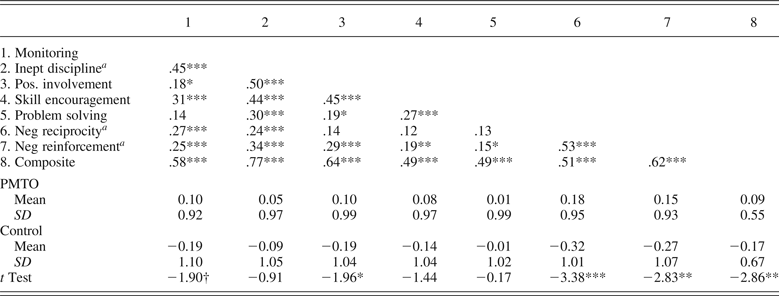
Effective Parenting Practices comprises seven indicators as described in the Method section. Data on all seven indicators were collected and coded at baseline and at 12 months following baseline. A composite index was derived as follows. The two microsocial indicators, negative reinforcement and negative reciprocity, and observer ratings of inept discipline were reverse scored so that low scores on these indicators reflected effective parenting. A separate score for each indicator at baseline and the 12-month follow-up was calculated, and then the score for the indicator at baseline was subtracted from the score for the same indicator at 12 months to create difference scores reflecting increases in effective parenting. The change score for each of the seven indicators was then standardized, and the mean of the standardized change scores for the seven components of parenting was calculated to create a composite change score for effective parenting from baseline to 12 months postbaseline (roughly 6 months after treatment termination). The correlations among the change scores for each of the seven indicators and for the composite for effective parenting are shown in Table 1. Table 1 also provides means and standard deviations for the component and composite parenting change scores for the PMTO and the control groups, accompanied by t test differences between the groups.
Descriptive statistics and correlations among changes in the components of effective parenting from baseline to 12-month follow-up

Note: PMTO, Parent Management Training—Oregon Model.
a Reverse scored.
†p < .10. *p < .05. **p < .01. ***p < .001.
In general, the various components of parenting skills were reliably intercorrelated and correlated with the composite parenting construct. The mean change scores indicate that PMTO maintains or improves effective parenting, whereas effective parenting for the control group decreased from baseline to 12 months on nearly all indicators (with the exception of problem solving) and on the parenting skills composite. The t tests for change scores indicated group differences in monitoring, positive involvement, negative reciprocity, and negative reinforcement, and the composite parenting skills construct favored the PMTO relative to the control group.
Earlier childhood deviant peer association models
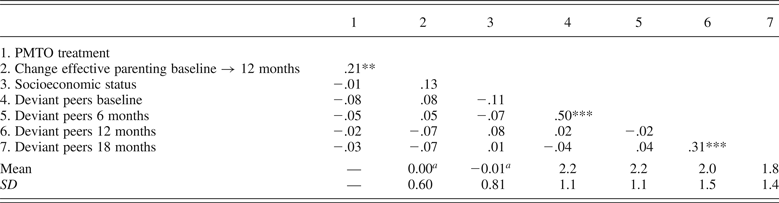
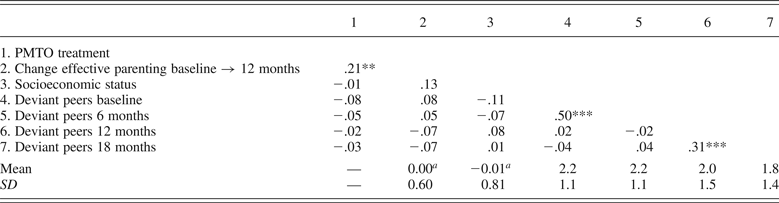
The first set of analyses focused on deviant peer association in earlier childhood. Correlations and descriptive statistics for variates in the model are shown in Table 2. Treatment assignment was correlated with change in effective parenting, but treatment assignment, change in parenting, and SES were not reliably associated with deviant peer association during earlier childhood. Deviant peer association at baseline was reliably associated with deviant peer association at 6 months, and deviant peer association at 12 months was reliably associated with deviant peer association at 18 months, but the relative lack of cross-time consistency in deviant peer association among the other assessment points suggests that there are interindividual variations in changes in deviant peer association over time.
Descriptive statistics and correlations among variates in the earlier child deviant peer model
Note: PMTO, Parent Management Training—Oregon Model.
a Standardized scores.
*p < .05. **p < .01. ***p < .001.
Preliminary to testing a model to ascertain the effects of PMTO on changes in deviant peer association during earlier childhood, a linear growth model was fit to the deviant peer association at baseline and 6, 12, and 18 months, with the intercept set at 12 months to permit estimates of the prospective association of changes in parenting with growth in deviant peer association. The growth model provided a marginal fit to the data for deviant peer association, χ2 (5) = 12.02, p = .035, comparative fit index (CFI) = 0.886, root mean square error of approximation (RMSEA) = 0.068, for this component of the full model. It is more important that both intercept and slope variances (0.278 and 0.091, respectively, both p < .001) were significant, indicating individual differences in the levels of deviant peer association at 12 months, and in change over time from baseline to 18 months.
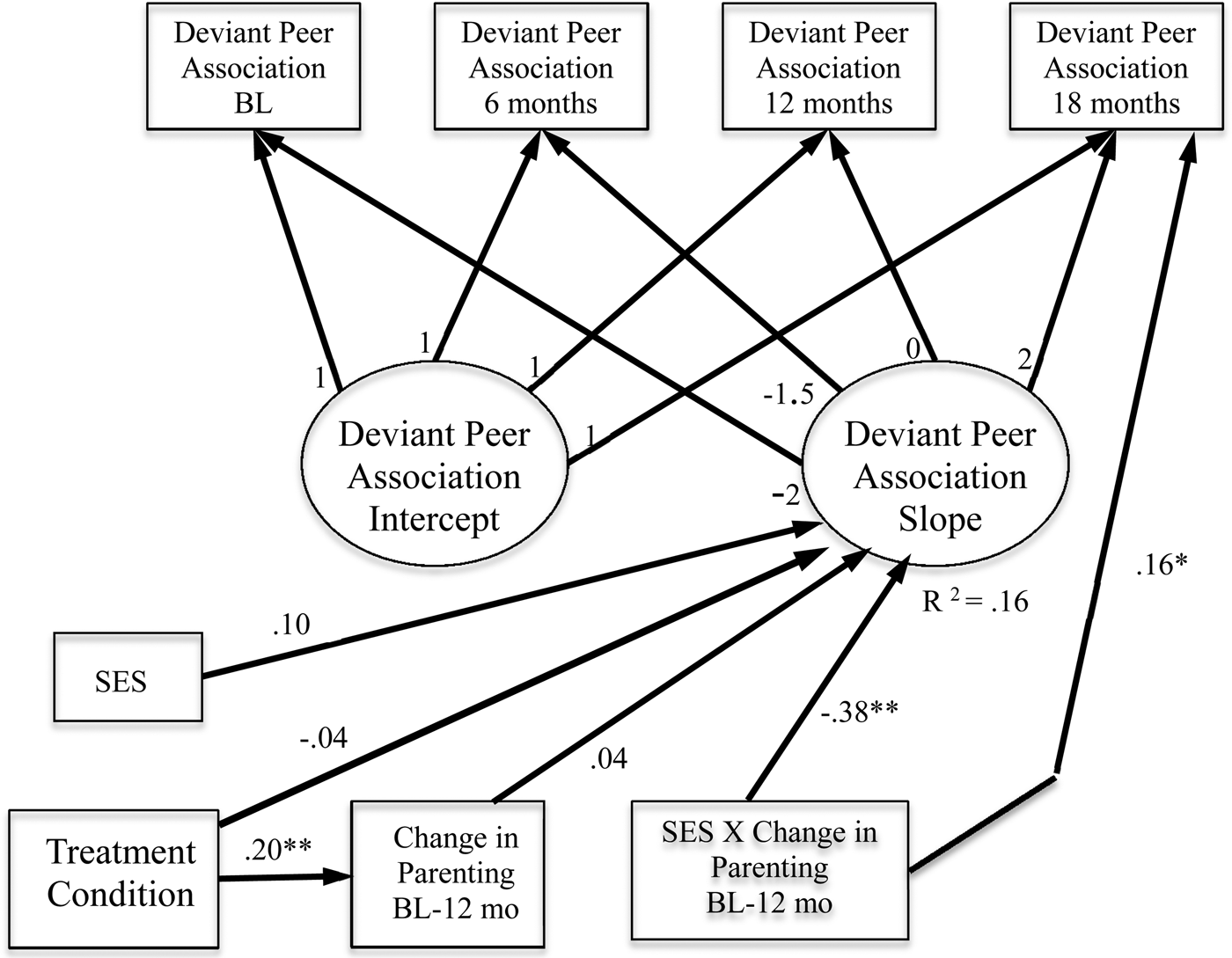
A full model of PMTO effects on deviant peer association during earlier childhood was then tested, incorporating treatment assignment, changes in parenting, family SES, and the interaction of changes in parenting and SES as predictors of changes in deviant peer association during childhood. This full model fit the data well, χ2 (46) = 50.46, p = .302, CFI = 0.979, RMSEA = 0.018, and is shown in Figure 3. Consistent with the bivariate correlations, PMTO was associated with improved parenting practices from baseline to 12 months. Treatment condition, changes in parenting, and SES were not reliable predictors of growth in deviant peer association. However, SES moderated the relationship of changes in parenting practices to growth (slope) in deviant peer association as well as having a direct effect on deviant peer association at 18 months. The interaction of changes in effective parenting and SES accounted for 16% of the variance in the growth of deviant peer association.
Parent Management Training—Oregon Model effects on deviant peer association during earlier childhood. *p < .05. **p < .01.

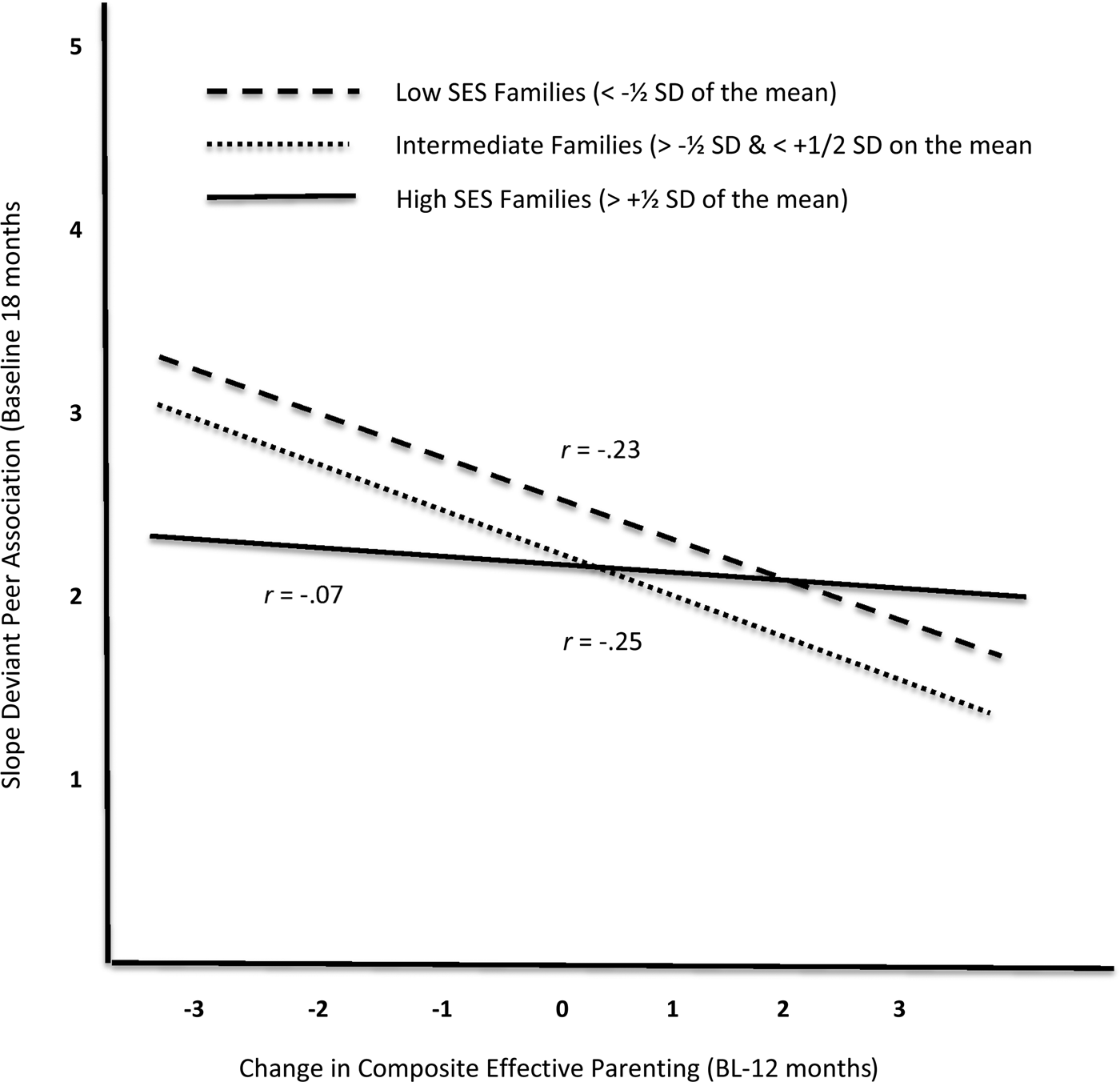
Focusing first on the PMTO group, the nature of the SES moderator effect was examined by calculating slopes relating changes in parenting to changes in deviant peer association for families at higher (above 0.5 SD of the sample mean), intermediate (between –0.5 and 0.5 SD), and lower levels (below –0.5 SD of the sample mean) of SES, and is shown in Figure 4. PMTO intervention had the strongest effect on diminishing growth in deviant peer association for low SES families (r = –.23 for relation of PMTO improvements in effective parenting with slope of deviant peer association) and intermediate SES families (r = –.25 for relation of PMTO improvements in effective parenting with slope of deviant peer association). PMTO had less beneficial effects for higher SES families (r = –.07 for relation of PMTO improvements in effective parenting with slope of deviant peer association). Combining the low and intermediate SES groups, the slope r was –.25, significantly different than 0 (p < .05). The slope for high SES families was not different than 0. The slope for the high SES group of families was significantly less than that of the combined intermediate and low SES families (p < .001).
Socioeconomic status moderator effects of the relation of changes in effective parenting to growth in deviant peer association for the Parent Management Training—Oregon Model group.

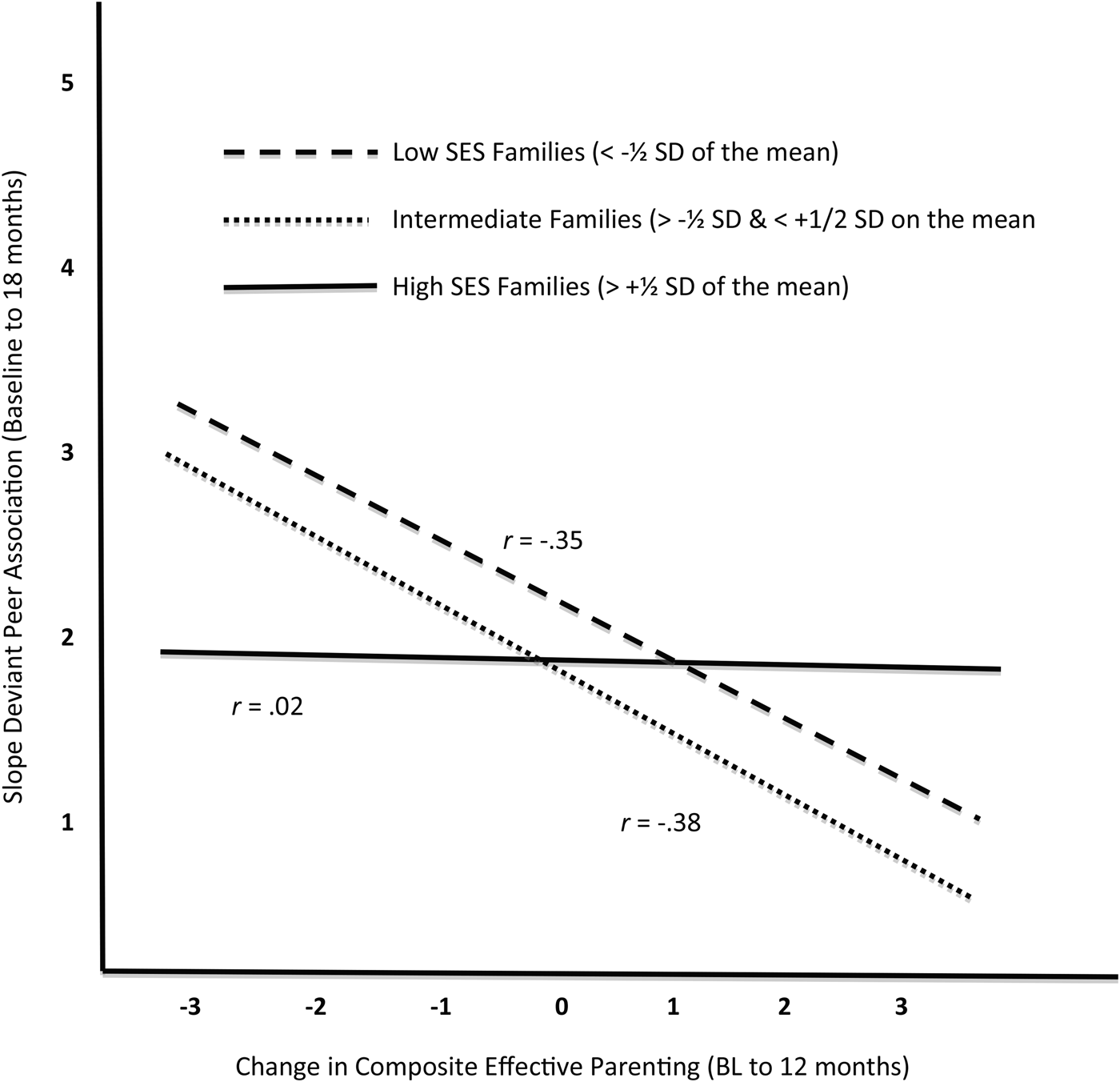
In a comparable fashion for the no-intervention control group, the nature of the SES moderator effect was examined by calculating slopes relating changes in parenting to changes in deviant peer association for families at higher (>0.5 SD of the sample mean), intermediate (between –0.5 and 0.5 SD), and lower levels (<–0.5 SD of the sample mean) of SES, and is shown in Figure 5. The strongest effect of naturally occurring improvements in parenting on diminishing growth in deviant peer association was for low SES families (r = –.35 for relation of improvements in effective parenting with slope of deviant peer association) and intermediate SES families (r = –.38 for relation of improvements in effective parenting with slope of deviant peer association). Naturally occurring improvements in effective parenting were not reliably related (r = .02) to growth in deviant peer association for high SES families in the control group. Combining the low and intermediate SES groups, the slope r was –.39, significantly different than 0 (p < .01). The slope for the high SES group of families was marginally less than that of the combined intermediate and low SES families (p = .078).
Socioeconomic status moderator effects of the relation of changes in effective parenting to growth in deviant peer association for the no-treatment control group.

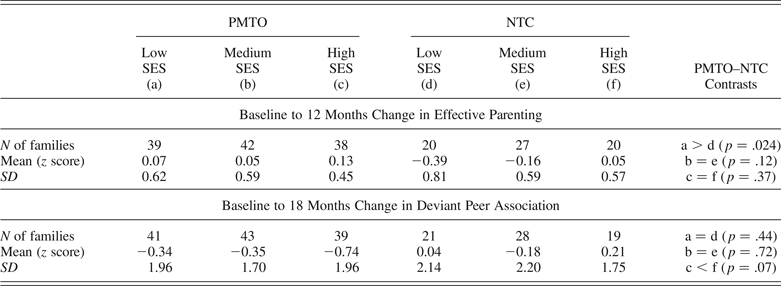
Comparing the slopes for PMTO families in Figure 4 to those for the no-treatment control group in Figure 5, the primary difference for the treatment group is for low and intermediate SES families, with considerably more growth in deviant peer association of children in low and intermediate SES families in which parenting skills diminished over time. There were few effects of changes in parenting on changes in deviant peer association for high SES families in the PMTO and control groups. Group × SES mean differences in changes in parenting and in deviant peer association are shown in Table 3. The between-treatment group differences in changes in parenting are most apparent for the low SES families, with a trend for intermediate SES families. In contrast, between-treatment group differences in changes in children's deviant peer association were not observed for children from high SES families.
Contrasts for changes in parenting and changes in deviant peer association by treatment group and SES
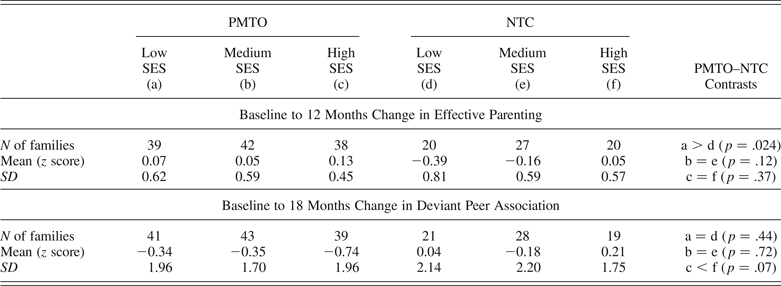
Note: Positive values for baseline to 12 months change scores indicate improved effective parenting, and negative scores indicate diminishing effective parenting. Positive values in baseline to 18 months deviant peer association indicate increasing deviant peer association, and negative scores indicate decreasing deviant peer association. PMTO, Parent Management Training—Oregon Model; NTC, no-intervention control group; SES, socioeconomic status.
Later childhood/early adolescence deviant peer association models
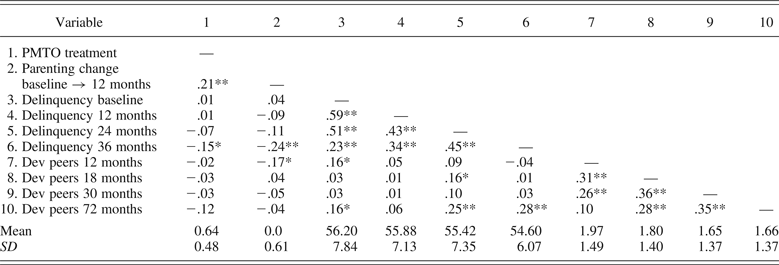
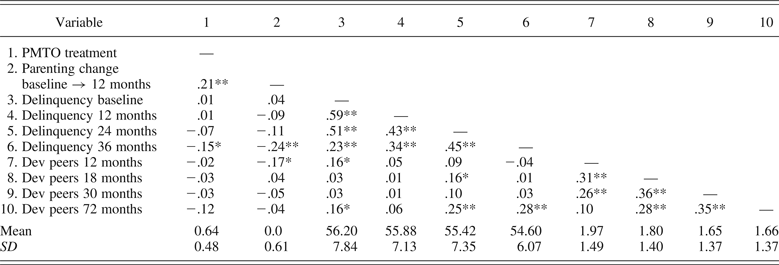
The second set of analyses focused on deviant peer association in later childhood/early adolescence. Correlations and descriptive statistics for variates in the model are shown in Table 4. PMTO treatment was correlated with improvements in effective parenting. Increases in effective parenting were associated with lower levels of teacher-reported delinquent behavior at 36 months and with lower levels of deviant peer association at 12 months. Teacher reports of youths' delinquent behavior across baseline and 12, 24, and 36 months were all reliably interrelated. Teacher reports of youths' delinquent behavior at baseline, 24 months, and 36 months were reliably associated with higher levels of deviant peer association at 72 months. Contiguous youth self-reports of deviant peer association at waves 12, 18, 30, and 72 months were reliably interrelated.
Descriptive statistics and correlations among variates in the late childhood/early adolescence deviant peer model
Note: PMTO, Parent Management Training—Oregon Model.
*p < .05. **p < .01.
Preliminary to testing a model to ascertain the effects of PMTO on changes in deviant peer association during later childhood/early adolescence, a linear growth model was fit to teacher reports of youths' delinquent behavior at baseline, 12 months, 24 months, and 36 months, with the intercept set at baseline. The growth model provided a good fit to the data, χ2 (5) = 3.47, p = .63, CFI > 0.999, RMSEA < 0.001, for this component of the full model. Both intercept (46.02, p < .001) and slope variances (5.00, p = .009) were significant, indicating individual differences in the levels of delinquent behavior at baseline and in the change in delinquent behavior over time from baseline to 36 months.
Again, preliminary to testing the full late childhood/early adolescence model, a linear growth model was fit to youths' self-report of deviant peer association at 12, 18, 30, and 72 months, with the intercept set at 12 months. The growth model provided a good fit to the data, χ2 (6) = 2.01, p = .91, CFI > 0.999, RMSEA < 0.001, for this component of the full model. Both intercept (0.474, p = .005) and slope variances (0.060, p = .046) were significant, indicating individual differences in the levels of children's self-report of deviant peer association at 12 months, and in change over time from 12 months to 72 months.
A full model of PMTO effects on deviant peer association during later childhood/early adolescence was then tested, assessing whether teacher reports of youths' delinquent behavior linked the effects of PMTO-generated improvements in effective parenting to diminished growth in deviant peer association. This full model fit the data well, χ2 (34) = 46.18, p = .079, CFI = 0.953, RMSEA = 0.034, and is shown in Figure 6. As in the previous full model, PMTO was associated with improved parenting practices from baseline to 12 months, which in turn were associated with less growth in teacher reports of youth delinquent behavior from baseline to 36 months. Changes in effective parenting accounted for 23% of the variance in the slope of teacher reports of youth delinquency. Less growth in teacher-reported youth delinquent behavior from baseline to 36 months was reliably and robustly associated with less growth in deviant peer association from 12 months to 72 months, accounting for 46% of the variance in the slope of deviant peer association during later childhood and early adolescence.
Parent Management Training—Oregon Model effects on deviant peer association during late childhood/early adolescence. *p < .05. **p < .01. ***p < .001.

A direct path from treatment condition to the slope of deviant peer association in the model just described was not significant (b = –0.15, p = .31). An alternate nonmediational model was tested in which the paths from treatment condition and changes in effective parenting to slope of youth delinquent behavior and from slope of youth delinquent behavior to slope of deviant peer association were constrained to 0, and the direct path from changes in treatment condition to slope in deviant peer association was freely estimated. The direct path from treatment condition to the slope of deviant peer association in this nonmediational model was marginally significant (b = –0.25, p = .12). However, the indirect model better fit the data than the direct path, nonmediational model, difference χ2 (1) = 4.96, p = .025. The indirect model suggests that intervention effects on reduced growth in teacher-rated delinquency from baseline to 36 months was linked by increments in effective parenting from baseline to 12 months, and reduced growth in teacher-rated delinquency from baseline to 36 months was predictive of less growth in deviant peer association from 12 months to 72 months.
Discussion
Child and adolescent emotional and behavioral development is shaped in two key social venues: the family and the peer group. The Oregon model for the development of antisocial behavior hypothesizes that ineffective parenting and association with deviant peers are primary risk factors for antisocial development in youth (Patterson, Reference Patterson1982; Patterson et al., Reference Forgatch, Knutson and Mayne1992; Reid et al., Reference Reid, Patterson and Snyder2002). The PMTO set of evidence-based interventions was designed to address antisocial behavior problems by strengthening parenting practices in a variety of cultures and contexts (Forgatch & Patterson, Reference Forgatch, Patterson, Weisz and Kazdin2010). The hypotheses related to the model specify that (a) the intervention will mitigate coercive parenting and strengthen effective parenting; (b) the intervention will operate effectively in adverse family contexts such as divorce and social disadvantage; (c) strengthening parenting in the context of adversity will alter trajectories of antisocial behavior by reducing the frequency of that behavior at home and school; and (d) strengthening parenting and preventing children's antisocial behavior will manage youngsters' exposure to and involvement with deviant peer groups and activities at school and in the neighborhood.
The models examined in this study support the Oregon model. They also address complexities of family context, parenting, and progressions in development while reflecting multilevel and cascading environmental and developmental processes. The present study extends earlier findings that supported hypotheses for a, b, and c (Forgatch et al., Reference Forgatch, Patterson, DeGarmo and Beldavs2009; Patterson et al., Reference Patterson, Forgatch and DeGarmo2010). The earlier findings also indicated a direct effect of the intervention on deviant peer association, but Hypothesis d was not supported: benefits to parenting practices were not associated with preventing increases in deviant peer association, and only 6% of the variance in growth in deviant peer association was explained.
In the present analyses, we tested mediational models to account for variance in growth in deviant peer association for two developmental phases: Stage 1, early childhood when the boys were in elementary school, and Stage 2, later childhood/early adolescence as they transitioned into puberty and middle school. The Stage 1 phase of the model suggests that the effects of PMTO benefits to parenting on early deviant peer association depend on a larger SES context; increases in effective parenting had their most powerful effects on mitigating deviant peer association in low SES contexts, accounting for 16% of the variance in growth, likely reflecting higher densities of deviant peers in the schools and in the neighborhood. This notion is not new (Wilson, Reference Wilson1980a, Reference Wilson1980b) but is supported in this report in a preventive intervention using an experimental design.
The Stage 2 model suggests that the effects of improved parenting generated by the PMTO intervention on later deviant peer association are linked in a cascading process through reductions in boys' delinquent behavior in school accounting for 46% of the variance. The decreases in antisocial behavior may reduce deviant peer association generated through niche finding (Dishion et al., Reference Dishion, Patterson, Stoolmiller and Skinner1991). From an ontological multilevel perspective, these models suggest that antisocial development involves multiple socioenvironmental contexts and processes that unfold in a transactional fashion. The form and sequencing of risk processes are neither simple nor developmentally isomorphic.
Patterson's chimera metaphor enabled us to conceptualize models needed to discover how the effects of the PMTO intervention were transmitted to reduced deviant peer association. Rather than examining predictors of deviant peer association over the full course of development available in our data set, we focused on Stages 1 and 2. Previous analyses indicated that the direct effect of the PMTO intervention accounted for 6% of the variance in 8-year growth in deviant peer association. In the present study, 16% of the variance in Stage 1 growth in deviant peer association was explained, and 46% for the Stage 2 model. These substantial increases are noteworthy given the lack of measurement overlap in the constructs in the models.
Our findings for the PMTO prevention program for newly divorced mothers of boys in early elementary school map onto those reported by Dishion, Bullock, and Granic (Reference Dishion, Bullock and Granic2002), who tested a preventive parenting program for families of middle school youth. In that study of a diverse sample of 671 boys and girls in a metropolitan community, they used a youth self-report measure of deviant peer association similar to that used in the current report. Findings indicated that parents who sought intervention developed parenting skills that protected at-risk youth from affiliating with deviant peers. The effect did not hold true for low-risk youth. In the Stage 1 phase of our study, the intervention effectively benefited parenting practices for mothers at all levels of SES, but the impact of those benefits on children's deviant peer association were most apparent in lower SES families whose children were likely exposed to high-risk peer environments. These findings support Dishion et al.'s statement that “the larger context in which the youth is embedded is a critical factor to consider when understanding developmental and change processes” (2002, pp. 978–979).
This paper contributes to the literature on deviant peer association because of its longitudinal, developmental, and experimental design and use of measures of adjacent constructs without method overlap. Deviant peer association was based on boys' self-report, parenting practices were based on direct observation of parent–child interaction, and delinquency was based on teacher reports. The models accounted for substantial amounts of variance in growth in delinquency and deviant peer association and were specified in a prospective manner in a longitudinal measurement framework. Experimentally induced changes in parenting practices made a dramatic contribution to the prediction in long-lasting change in delinquency, accounting for 16% of the variance in the 18-month growth of deviant peer association during the Stage 1 childhood period, and for 46% of the variance for 5-year growth in deviant peer association during the Stage 2 late childhood/early adolescence model.
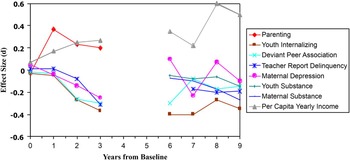
The increase over time in variance explained suggests that the effects of the parent-based intervention increased over time. Figure 7 illustrates these results. Although PMTO produced a rather modest effect size on effective parenting at 12 months, this outcome, in turn, produced several positive consequences for the boys and families. The effect size for teacher-rated delinquency was basically nonexistent at 1 year, barely noticeable at 2 years, and small to modest at 3 years. The effects traced similar trajectories for deviant peer association, youth internalizing, and maternal depression during Stage 1 of the model. Notice that an increase in per capita annual income accompanied the improvements in parenting practices. Looking into the later years when boys were adolescents, the largest effects were for boys' internalizing and families' per capita annual income. Teacher report of delinquency held but with a modest effect size. These findings indicate that an intervention that has modest but significant effects on the mechanism of adjustment (i.e., effective parenting) can produce long-lasting and cascading benefits for multiple outcomes.
(Color online) Expanding effect sizes. Adapted from “Cascading Effects Following Intervention,” by G. R. Patterson, M. S. Forgatch, and D. S. DeGarmo, Reference Patterson, Forgatch and DeGarmo2010, Development and Psychopathology, 22, 949–970. Copyright 2010 by Cambridge University Press. Adapted with permission.

Child antisocial behavior is not solely determined by family and peer environments. Research in behavioral (Rhee & Waldman, Reference Rhee and Waldman2002) and molecular (Gunter, Vaughn, & Philibert, Reference Gunter, Vaughn and Philibert2010) genetics indicates that the relation of coercive and unskilled parenting to child antisocial behavior, and even deviant peer association (Rowe & Osgood, Reference Rowe and Osgood1984), may reflect genetic effects that include gene–environment correlations and gene by environment interactions (Waldman & Lahey, Reference Waldman, Lahey, Beauchaine and Hinshaw2013). However, changes in the family environment may alter the phenotypic expression of genotypes in substantial ways, and additional research is needed to examine such effects in intervention-moderator designs. The importance of family environmental effects for children who are genetically at risk for antisocial development has recently been demonstrated experimentally by Wachlarowicz, Snyder, Low, Forgatch, and DeGarmo (Reference Wachlarowicz, Snyder, Low, Forgatch and DeGarmo2012), who found that the greatest benefits of PMTO on child antisocial behavior accrued for those children whose parents were most antisocial.
Limitations and future studies
All studies come with their limitations and ours is no exception. One shortcoming to note is the measure of deviant peer association. The extensive literature on child and adolescent peer association has benefited from more sophisticated measures, including direct observation of interactions during conversations in the laboratory and engaging in activities on playgrounds and in schools (see Dishion, Reference Dishion, Dishion and Snyder2016; Snyder et al., Reference Snyder, Reid, Stoolmiller, Howe, Brown and Dagne2006). Our measure consisted of five items based solely on the youngster's self-report. The measure was similar to one used with middle-school aged youth in the report by Dishion et al. (Reference Dishion, Bullock and Granic2002). Two of the items concerned the same kinds of behavior (i.e., gets into trouble or fights) in both studies, and the Cronbach alphas were acceptable for all years in each study. One problem with measures used in long-term longitudinal studies is that the measure must remain the same over the course of the study; however, that can be a problem given what we know about how outcomes and predictors change with development. An additional measure that assesses the density of deviant peers in the neighborhoods and schools in which the families lived throughout the course of the study would enrich our understanding.
Another limitation is that this sample consists strictly of boys; Patterson's long-term longitudinal sample on which he based his chimera paper is also all boys, and both samples are primarily White. Studies have tested outcomes for the PMTO program with mixed samples of boys and girls, showing that the core parenting practices mediated child internalizing and externalizing outcomes. The samples included Pakistani and Somali mothers who were immigrants to Norway, ethnically Norwegian families in Norway, and families of diverse race and ethnicity living in sheltered housing in the United States (Bjørknes, Kjøbli, Manger, & Jakobsen, Reference Bjørknes, Kjøbli, Manger and Jakobsen2012; Gewirtz, DeGarmo, Lee, Morrell, & August, Reference Gewirtz, DeGarmo, Lee, Morrell and August2015; Kjøbli, Hukkelberg, & Ogden, Reference Kjøbli, Hukkelberg and Ogden2013). Unfortunately, none of these studies examined deviant peer association as an outcome, calling for studies to replicate these findings for girls and youngsters from other contexts and cultures.
The Oregon model for antisocial behavior includes differentiation into overt (aggressive) and covert (lying or stealing) antisocial behaviors. A full account of the linkage between enhanced parenting resulting from the PMTO intervention, child antisocial development, and deviant peer association should also incorporate overt as well as covert antisocial behavior. We also know that SES for the families improved over time (Patterson et al., Reference Patterson, Forgatch and DeGarmo2010). It would be of some interest to examine how changing SES contributed to the model of deviant peer association at differing stages in the model. Future studies may address those issues in new analyses.
The findings from the present study and that of Dishion et al. (Reference Dishion, Bullock and Granic2002) indicate that strengthening parenting practices for socially disadvantaged families, especially those living in high-crime neighborhoods, may slow down escalating antisocial behavior problems by preventing youngsters from making friends with deviant peers. Replicated research has reported the danger of aggregating youth with problematic behavior in intervention programs (Dodge, Dishion, & Lansford, Reference Dodge, Dishion and Lansford2006). Evidence-based parenting programs may prove to be more effective than skills training or anger management work with groups of teens that have strong potential for producing iatrogenic effects. The findings from this study suggest that, treatment outcomes increase over time if certain changes are made for families. Perhaps outcomes could be maximized by predicting that the first thing that happens in a stage model is a reduction in coercive parenting, which then mediates intervention effects on growth in positive parenting, which in turn is followed by changes in child behavior and deviant peer association.
Each step in the stage model of family and peer processes makes a contribution to more extreme forms of antisocial behavior, as shown in Figure 1. There are multiple determinants in this dynamic process; the mechanisms that contribute for younger children differ from those that determine the behavior of older youth. The movement toward increasing intensity in antisocial behavior is a critical aspect of the model that leads one to ask if there is a fourth stage. Which youth find more violent peer groups? Is the shootist in contemporary society in Stage 4? We believe that this new challenge must be addressed in new research with a focus on violence itself. We are beginning to believe that Stage 4 may have to do with mental illness, which in turn leads to rejection even by the deviant peer group. Youth with a thought disorder may not be acceptable to delinquents in Stage 3, not even the violent ones. They are loners. Mass killings by loners used to be a low base rate event. With the current state of affairs in this country, we may soon be able to study this problem scientifically. We believe two variables are predictors: a thought disorder and preoccupation with weapons. Stage 4 may be the point at which the chimera begins breathing fire.