Binary polymer/polymer (all-polymer) blend solar cells,[Reference Earmme, Hwang, Subramaniyan and Jenekhe1–Reference Hwang, Earmme, Courtright, Eberle and Jenekhe5] in which electron-donating and electron-accepting semiconducting polymers are mixed to form the active layer, are currently of growing interest as alternatives to polymer/fullerene blend solar cells. Advantages of all-polymer solar cells include: (i) appreciable contribution to light absorption by the acceptor polymer, which can enhance the photocurrent of devices; (ii) the ready tunability of the energy levels of both bulk heterojunction (BHJ) components allows for energetically well-aligned blends to be rationally designed; and (iii) an all-polymer blend enjoys improved morphological stability over a blend containing a fullerene derivative, which tends to aggregate with time. Despite these potential advantages and recent progress, the power conversion efficiency (PCE) of all-polymer solar cells (5%–6%)[Reference Earmme, Hwang, Subramaniyan and Jenekhe1–Reference Hwang, Earmme, Courtright, Eberle and Jenekhe5] remains significantly below that of polymer/fullerene solar cells (9%–10%).[Reference He, Zhong, Su, Xu, Wu and Cao6–Reference Liao, Jhuo, Yeh, Cheng, Li, Lee, Sharma and Chen8] New approaches and innovations in materials, processing, and device engineering are thus needed to improve the performance of all-polymer solar cells.
An approach that has recently led to improvement in some polymer/fullerene devices is to add a third component to a binary blend to create ternary blend solar cells.[Reference Savoie, Dunaisky, Marks and Ratner9–Reference Lu, Xu, Chen, Landry and Yu14] Such a ternary blend solar cell operates by one of two mechanisms. In the first mechanism, referred to here as the “sensitizer” mechanism, a small amount (about 1%–20%)[Reference Savoie, Dunaisky, Marks and Ratner9, Reference Yang, Zhou, Price and You11] of the third component when added to the binary blend improves the light absorption but transfers energy to the majority donor or acceptor component. To be operative, the energy levels of the sensitizer component must fall between the energy levels of the majority components.[Reference Ameri, Khoram, Min and Brabec10] That is to say the electron affinity and ionization potential of the sensitizer must be lower lying than those of the donor component but higher lying than those of the acceptor component. The second mechanism, known as the “parallel-like bulk heterojunction” (PBHJ), relaxes the energy level restrictions of the sensitizer mechanism.[Reference Savoie, Dunaisky, Marks and Ratner9–Reference Yang, Zhou, Price and You11] Primary evidence of the PBHJ mechanism includes the following:[Reference Yang, Zhou, Price and You11] (1) the absorption width of the ternary blend is increased compared with the two binary blends considered separately; (2) a wide range of compositions produces a successful ternary blend solar cell as opposed to the sensitizer mechanism which is restricted to small amounts of the third component; and (3) the sum of the short-circuit currents [as well as external quantum efficiency (EQE) spectra] of the binary blends is equivalent to that of the ternary blend. Essentially, two unique donor/acceptor binary blends with independent percolating networks are combined into one active layer and the constituent materials with complementary absorption spectra can be chosen in order to maximize coverage of the solar spectrum.[Reference Savoie, Dunaisky, Marks and Ratner9] Although many examples of ternary blend solar cells containing at least a fullerene-derivative component are known in the literature,[Reference Savoie, Dunaisky, Marks and Ratner9–Reference Lu, Xu, Chen, Landry and Yu14] there are no reports of all-polymer ternary blend solar cells.
In this paper, we report studies of the composition dependence and mechanism of operation of ternary blend all-polymer solar cells and show that their performance is enhanced compared with the corresponding binary blend solar cells. The ternary blend BHJ system is composed of one donor polymer, poly[4,8-bis(5-(2-ethylhexyl)thiophen-2-yl)benzo[1,2-b;4,5-b′]dithiophene-2,6-diyl-alt-(4-(2-ethylhexanoyl)-thieno[3,4-b]thiophene-)-2–6-diyl)] (PBDTTT-CT),[Reference Huo, Zhang, Guo, Xu, Li and Hou15] and two electron-accepting polymers, naphthalene diimide-selenophene copolymer (PNDIS-HD)[Reference Earmme, Hwang, Subramaniyan and Jenekhe1, Reference Earmme, Hwang, Murari, Subramaniyan and Jenekhe16] and perylene diimide-selenophene copolymer (PPDIS). The molecular structures, highest occupied molecular orbital/lowest unoccupied molecular orbital (HOMO/LUMO) energy levels, and thin film absorption spectra of these polymers are shown in Fig. 1. The PBDTTT-CT:PNDIS-HD binary blend all-polymer solar cells were previously reported to have poor PCEs (1.2%–1.4%),[Reference Hwang, Earmme, Courtright, Eberle and Jenekhe5] whereas PBDTTT-CT:PPDIS binary blend devices have not previously been reported. Here, we investigated the composition-dependent photovoltaic properties of the PBDTTT-CT:PNDIS-HD:PPDIS ternary blends and their corresponding binary blends, including the short-circuit current density (J sc), open-circuit voltage (V oc), and EQE. The composition-dependent properties were used to establish the mechanism of operation of the ternary blend solar cells. We also investigated the surface morphology of the ternary blend films as a function of blend composition using atomic force microscopy (AFM) imaging. We found that the surface morphology of the active layers indeed changes with changing ternary blend composition and the surface morphology appears to be correlated with photovoltaic performance of the ternary blend solar cells.
(a) Molecular structures of donor polymer (PBDTTT-CT) and electron-accepting polymers (PNDIS-HD and PPDIS). (b) HOMO/LUMO energy levels of donor and acceptor polymers relative to vacuum. (c) Normalized thin-film absorption spectra of the ternary blend components.

The HOMO/LUMO energy levels of the ternary blend components shown in Fig. 1(b) suggest that the energetic offsets at each donor/acceptor interface can facilitate efficient charge transfer and transport.[Reference Rand, Burk and Forrest17, Reference Ren, Schlenker, Ahmed, Subramaniyan, Olthof, Kahn, Ginger and Jenekhe18] For example, the LUMO/LUMO offset is 0.65 and 0.70 eV at the PNDIS-HD:PBDTTT-CT and PPDIS:PBDTTT-CT interfaces, respectively, whereas the HOMO/HOMO offset at both interfaces is identical (0.75 eV). The similarity of the optical band gaps of PNDIS-HD (E g = 2.16 eV) and PPDIS (E g = 2.11 eV) and their nearly identical HOMO/LUMO energy levels suggest that sensitization mechanism is highly unlikely in the proposed ternary blend solar cells.[Reference Savoie, Dunaisky, Marks and Ratner9, Reference Ameri, Khoram, Min and Brabec10] Although both PNDIS-HD and PPDIS have similar optical absorption edges [Fig. 1(c)], PPDIS has a much broader absorption band and thus could absorb some higher-energy photons than PNDIS-HD. We used the results of prior studies[Reference Hwang, Earmme, Courtright, Eberle and Jenekhe5] of related binary blend all-polymer solar cells that showed that the optimum donor/acceptor composition was 1:1 by weight to narrow the composition space of the ternary blend system explored in devices: [PBDTTT-CT][PNDIS-HD]1−x[PPDIS]x, where x is the weight fraction of PPDIS in the binary acceptor components. The four ternary blend active layer compositions (x = 0.10, 0.30, 0.50, 0.75) investigated in devices are shown in the ternary diagram of Fig. 2 along with the corresponding binary blends (x = 0, 1).
Composition of the ternary [PBDTTT-CT][PNDIS-HD]1−x[PPDIS]x blend solar cells represented on a ternary diagram.
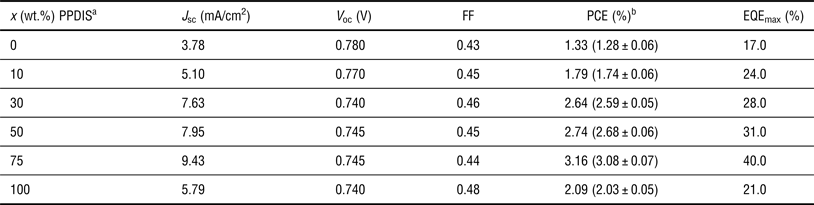
We fabricated and evaluated the ternary blend all-polymer solar cells using the inverted device structure, ITO/ZnO/PEI/active layer/MoO3/Ag, where the active layer is a PBDTTT-CT:PNDIS-HD:PPDIS ternary blend film, spin-coated from a chlorobenzene:diiodooctane (97:3 vol%) mixed solvent. The wet blend films were aged for 4 days at room temperature (~25 °C) in an argon-filled glovebox prior to the deposition of the MoO3/Ag anode. The solar cells were tested under AM 1.5 G solar illumination at 100 mW/cm2 in ambient air. The current density–voltage (J–V) curves of the ternary blend devices as well as those of the reference binary blend solar cells (PBDTTT-CT:PNDIS-HD, PBDTTT-CT:PPDIS) are shown in Fig. 3(a) and the photovoltaic parameters, J sc, V oc, fill factor (FF), PCE, and EQE, are summarized in Table I.
The J–V curves (a), V oc and J sc (b), PCE (c), and EQE spectra (d) as a function of composition (wt% PPDIS) of [PBDTTT-CT][PNDIS-HD]1−x[PPDIS]x ternary blend solar cells.
Photovoltaic properties of [PBDTTT-CT][PNDIS-HD]1−x[PPDIS]x ternary blend solar cells.
a Wt.% PPDIS relative to the acceptor components, overall donor:acceptor ratio is 1:1.
b Average of five devices.
The compositional dependences of the V oc and J sc of the ternary blend devices are shown in Fig. 3(b). The binary blend PBDTTT-CT:PNDIS-HD and PBDTTT-CT:PPDIS solar cells have open-circuit voltages of V oc1 = 0.780 V and V oc2 = 0.740 V, respectively. The larger V oc of the PNDIS-HD binary devices is consistent with its higher lying LUMO energy level compared to PPDIS. However, the expected linear dependence of V oc with composition,[Reference Savoie, Dunaisky, Marks and Ratner9]V oc = (1 − x)V oc1 + xV oc2, is not observed in this ternary blend system. The nonlinear compositional dependence of V oc of the ternary blend devices may be a consequence of the large difference in the light harvesting by the two acceptor polymers.[Reference Savoie, Dunaisky, Marks and Ratner9] Compared with the J sc values of the binary blend devices (J sc1, J sc2), the short-circuit current density is significantly enhanced in three of the four ternary blend solar cells. Indeed, a peak is observed in the J sc(x) at 75 wt% PPDIS where the ternary blend J sc = J sc1 + J sc2, demonstrating that the PBHJ mechanism is operative in these ternary all-polymer solar cells.[Reference Savoie, Dunaisky, Marks and Ratner9–Reference Yang, Zhou, Price and You11]
Figure 3(c) shows the compositional dependence of the PCE of the ternary blend devices. The PCE of the reference binary blend devices is 1.33% for PBDTTT-CT:PNDIS-HD and 2.09% for PBDTTT-CT:PPDIS devices. We note that the observed PCE for the PNDIS-HD binary device is comparable with the previously reported values of 1.2%–1.4% for this BHJ system.[Reference Hwang, Earmme, Courtright, Eberle and Jenekhe5] Compared with these reference PBDTTT-CT:PNDIS-HD devices, ternary blend solar cells with 10 wt% PPDIS (PBDTTT-CT:PNDIS-HD:PPDIS = 1:0.9:0.1) have an enhanced PCE of 1.79% and a slightly enhanced J sc of 5.10 mA/cm2 but a slightly decreased V oc of 0.770 V. Increasing the ternary blend composition to 30 and 50 wt% PPDIS produced devices with PCEs of 2.64% and 2.74%, respectively, due to the significantly increased J sc of 7.63 and 7.95 mA/cm2. Note that the performance of the ternary blend solar cells significantly exceeds the performance of both binary blend devices at the 30 wt% PPDIS composition. The best performance was achieved in the ternary blend devices that contained 75 wt% PPDIS (PBDTTT-CT:PNDIS-HD:PPDIS = 1:0.25:0.75), producing a PCE of 3.16% which is 51% higher than that of the PBDTTT-CT:PPDIS binary blend devices and 138% higher than that of the PBDTTT-CT:PNDIS-HD binary blend devices.
The EQE spectra of all the binary and ternary blend solar cells are shown in Fig. 3(d). Photocurrent generation turns on at 800 nm and extends to 300 nm in all the blend devices. EQE of all the ternary blend devices exceed those of the corresponding binary blend devices over the entire 300–800 nm spectral range, showing a monotonic increase with composition (x, wt% PPDIS). The observed 40% maximum EQE at 650 nm in the optimum ternary blend exceeds the 17% and 21% seen in the corresponding PNDIS-HD and PPDIS binary blend devices. Furthermore, the EQE spectrum of the optimum ternary blend solar cell is approximately equal to the sum of the spectra of the two binary blend solar cells in the range from 380 to 720 nm, which is also suggestive of the PBHJ mechanism. Note that the ratio of EQE values at 670–700 nm to that at 400 nm is about 2.0, which may indicate that the amount of the donor polymer (PBDTTT-CT) in the ternary blends is too large and not a global optimum. As mentioned earlier, we restricted the overall donor:acceptor ratio to 1:1 in order to narrow the number of possible compositions but further inspection and refinement of that ratio could lead to improved photovoltaic performance. The photocurrent values calculated from the EQE spectra were found to be slightly lower than the measured J sc values from J–V curves for all the devices, and mismatches between the two values were in the range of 1%–16%. The largest mismatch was found in the PPDIS binary blend, and this discrepancy could be due to spectral mismatch between the simulated light source and the AM 1.5 G solar spectrum and initial degradation of the performance under ambient conditions.
AFM imaging of the actual BHJ devices provided information on the surface morphology of the active layers in the binary blend and ternary blend all-polymer solar cells. AFM height images with a scan area of 5 × 5 μm2 are shown in Fig. 4. The surface morphology of the PBDTTT-CT:PNDIS-HD binary blend devices is characterized by prominent features that are approximately 200–300 nm in diameter with an average roughness of 8.27 nm [Fig. 4(a)]. In the 10 wt% PPDIS ternary blend active layer, slightly smaller and more numerous phase-separated domains with a slightly decreased surface roughness of 7.24 nm were observed, suggesting that incorporation of a small amount of PPDIS has altered the morphology of the BHJ active layer. This can be partially understood from the smaller crystallinity of PPDIS compared with PNDIS-HD as confirmed by x-ray diffraction (XRD) analysis (Figure S1 and Table S1). A gradual decrease in domain sizes is observed with increasing amount of the PPDIS (up to 75 wt%) in the ternary blend, whereas the surface roughness decreases down to 2.92 nm in the 75 wt% PPDIS ternary blend film. However, the PBDTTT-CT:PPDIS binary blend showed a surface roughness of 4.78 nm [Fig. 4(f)]. We note that the trend in AFM-derived surface roughness with blend composition is the inverse of the trend in device PCE, suggesting that the morphology of the devices plays a large role in overall device efficiency (Figure S2). The fact that the smallest roughness value and the highest PCE value both occur in the 75% PPDIS ternary blend device suggests that the morphology of the two acceptor phases within this device are somehow complementary and that this ideal, smooth-surfaced morphology is beneficial for PCE. The observed domain sizes in the AFM images are clearly not ideal for efficient photovoltaic devices, which require much smaller domain sizes (~10–20 nm),[Reference Hwang, Earmme, Courtright, Eberle and Jenekhe5, Reference Heeger19] suggesting that further optimization of the ternary blend film morphology could likely lead to higher efficiency.
AFM height images of ternary [PBDTTT-CT][PNDIS-HD]1−x[PPDIS]x blend solar cells: (a) x = 0 wt%; (b) x = 10 wt%; (c) x = 30 wt%; (d) x = 50 wt%; (e) x = 75 wt%; (f) x = 100 wt%.
In summary, we have demonstrated for the first time ternary blend all-polymer solar cells that outperform the corresponding binary blend devices. The performance, including J sc, V oc, EQE, and PCE, of the [PBDTTT-CT][PNDIS-HD]1−x[PPDIS]x ternary blend devices was found to vary substantially with the composition (x, wt% PPDIS). The 75 wt% ternary blend devices gave the optimum performance with a PCE of 3.16% compared with 1.33% for PBDTTT-CT:PNDIS-HD and 2.09% for PBDTTT-CT:PPDIS binary devices. AFM imaging of the surface morphology of the device active layers revealed phase-separated domain sizes that also varied with blend composition. However, the phase domain sizes even in the optimum ternary blends were in the range still too large for efficient charge photogeneration. The optical band gaps rule out the sensitization mechanism.[Reference Savoie, Dunaisky, Marks and Ratner9] Our findings that the short-circuit current density (as well as the EQE spectrum) of the optimal ternary blend solar cells is nearly equal to the sum of those of the two reference binary blend devices, and the fact that a wide range of compositions produced successful ternary blend solar cells with higher PCEs than the binary blend solar cells, suggest that the PBHJ mechanism is at work in the ternary blend devices reported here.
Supplementary materials
For supplementary material for this article, please visit http://dx.doi.org/10.1557/mrc.2015.36
Acknowledgments
We thank Dr. Micah Glaz for his assistance in obtaining AFM images. This work was supported by the NSF (DMR-1409687). B.A.E.C. is a Clean Energy Institute (CEI) fellow.