Implications
Attracting piglets to creep areas in loose farrowing pen systems may be a practical strategy to reduce piglet crushing, which is the main cause of pre-wean mortality. Piglets spent more time in creep areas which were brightly lit or had warmer mats than piglets with access to dark creeps or with lower mat temperature. Light may act as a cue for the warmth of creep areas, which led piglets away from pen areas shared with the sow. Further investigation of appropriate light characteristics and potential cues which can act as attractants to creep areas is warranted.
Introduction
The search for alternative farrowing systems without a crate is becoming particularly important as the world pork industry strives for opportunities to improve sow welfare. Piglets are at risk of being overlain and crushed by the sow in pens, natural or semi-natural farrowing and lactation systems, while fatal crushing of piglets by the sow may account for two-thirds of losses. Reports of pre-weaning mortality were as high as 32.0%, 27.0% and 22.0% in farrowing pen systems (McGlone and Morrow-tesch, Reference McGlone and Morrow-tesch1990; Blackshaw et al., Reference Blackshaw, Blackshaw, Thomas and Newman1994; Hales et al., Reference Hales, Moustsen, Nielsen and Hansen2015), 25.0% and 23.0% in pen systems with communal areas (Marchant et al., Reference Marchant, Broom and Corning2001; Li et al., Reference Li, Johnston and Hilbrands2009) and generally lower in farrowing crate systems (Lou and Hurnik, Reference Lou and Hurnik1994, 15.0% total pre-wean; Gu et al., Reference Gu, Gao, Lin, Zhong, Liu, Wang and Li2011, 10.8% crushing pre-wean; Kilbride et al., Reference Kilbride, Mendl, Statham, Held, Harris, Cooper and Green2012, 11.7% total pre-wean).
Attracting piglets to a protected creep area, in between nursing bouts, may be a solution for reducing piglet mortality, as increased time spent spread around the sow increases the risks of piglets being crushed (Marchant et al., Reference Marchant, Broom and Corning2001). The sow welfare and piglet protection (SWAP) farrowing pens (Jyden, Vemb, Denmark) have enclosed creeps exclusive for the piglets and have been studied as alternatives to provide greater freedom of movement for the sows, while allowing for competitive piglet survivability (Hales et al., Reference Hales, Moustsen, Nielsen and Hansen2015 and Reference Hales, Moustsen, Nielsen and Hansen2016). Yet, more investigation is needed to optimise piglet use of the creep in SWAP pens.
One strategy to attract piglets to the heated areas is to increase the temperature gradient between heated and pen areas (Xin and Zhang, Reference Xin and Zhang1999; Schormann and Hoy, Reference Schormann and Hoy2006; Burri et al., Reference Burri, Wechsler, Gygax and Weber2009), while considering the piglets’s age and type of heating (Xin and Zhang, Reference Xin and Zhang1999). However, increasing temperature gradient between the warm and pen areas in farms equipped with heat mats must be done with caution, as piglets tolerated a maximum contact temperature of 46.2°C (Zhang and Xin, Reference Zhang and Xin2000a) with heat mats. Yet, little is known regarding the ideal mat temperature to promote piglet use of the mat.
In addition, very little has been done to explore other environmental aspects, such as creep illumination, which may function as attractants to piglets. Furthermore, the design of creep areas varies substantially on commercial farms, from enclosed to fully opened, which affects light. The reported effects of light intensity on piglet behaviour are somewhat controversial, as some authors have reported piglet preference for darkness (Parfet and Gonyou, Reference Parfet and Gonyou1991; Larsen and Pedersen, Reference Larsen and Pedersen2015), while others reported fear of darkness (Tanida et al., Reference Tanida, Miura, Tanaka and Yoshimoto1996). However, most of the studies on light have been conducted with distinct light sources, within distinct contexts and light levels. Still, it is known that light affects the reproduction, welfare and behaviour of older pigs (Stevenson et al.,Reference Stevenson, Pollmann, Davis and Murphy1983; McGlone et al., Reference McGlone, Stansbury, Tribble and Morrow1988; Prunier et al., Reference Prunier, Dourmad and Etienne1994). Thus, light could be used to alter piglet behaviour, in an effort to enhance piglet survivability.
The present research, therefore, hypothesised that changes in the light intensity and mat temperature inside piglet creep areas alter piglet creep use and consequently their chances of survival. The current experiment aimed at evaluating the effects of two light intensities (300 v. 4 lx) without any source of radiant heat in the creep area on piglet behaviour and survivability in farrowing pens, considering the effects of the mat surface temperature as a covariate.
Material and methods
Facilities
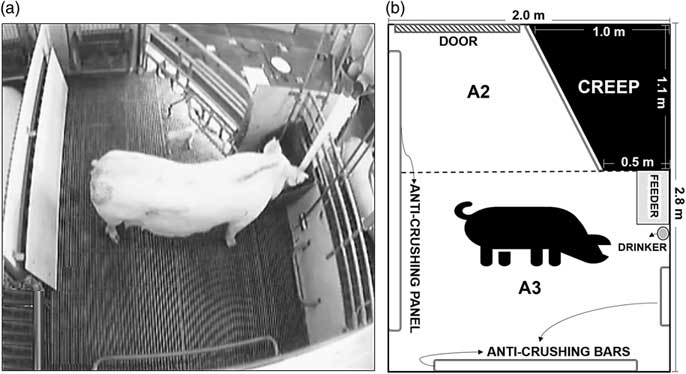
The study was conducted in two farrowing rooms on a commercial farm located in Central Queensland during September (replicate 1) and November (replicate 2), 2016. The environment in the farrowing rooms was automatically controlled using ventilation fans, attic inlets and evaporative cooling in warmer conditions (not operated during the present study). Artificial lighting of ~80±30 lx (ranging from 29 to 186 lx) was provided from 0800 to 1959 h, interrupted by a 12-h darkness phase (0 lx). The referred light levels were measured at the sow’s head level when in a standing posture, averaged for all pens in both farrowing rooms, and was not statistically different between rooms and replicates. Farrowing rooms were equipped with four rows of nine 2.0×2.8 m SWAP farrowing pens. Each SWAP pen had a trapezoidal creep area of 1.1 m (length)×1.0 m (wider width)×0.5 m (narrower width) with a trapezoidal metal heated mat (Lamapor S.A., Navarra, Spain) as the only supplemental heat source for the piglets. The pens had a slatted floor area for the sow, which the piglets could access. Creep areas had three sides fully closed, with the open side facing the pen. Creeps were covered with a black wooden lid, which could be lifted to check on the piglets (Figure 1). Sows were free to move and were never crated before or after farrowing.
(a) Top view of a sow welfare and piglet protection (SWAP) pen with bright creep. (b) Schematic plan view of a SWAP pen, depicting the trapezoidal covered creep, the areas immediately in front of (A2) and farthest from the creep (A3) distinguished by the dashed line.

A total of 108 multiparous (Large White×Landrace) sows (64 sows in replicate 1 and 44 in replicate 2) were randomly allocated into the 72 farrowing pens available across the two studied farrowing rooms, ~3 days before their farrowing due date. Farm practices were performed following their standard operation procedures, with minimal external interference from the research team, hence the unbalanced distribution of sows across the two replicates. As part of the farm’s routine, one or two employees were available covering 24-h per day to constantly assist with births when necessary, and care for the welfare of sows and their litters.
Experimental design
The experiment was performed in a generalised randomised block design, with two blocks or replicates (September and November) and a one-way arrangement of treatments (bright creep: 300 lx v. dark creep: 4 lx), with mat surface temperature treated as a covariate.
The bright creep treatment was achieved by illuminating the creep areas with cool white light-emitting diode (LED) light strips. Creeps assigned with the dark creep treatment did not have any source of artificial light inside them. Two of the four 15-pen rows inside each farrowing room were assigned with the bright creep treatment. The 15-pen rows with the bright creep treatment were staggered with the rows assigned with the dark creep treatment. Creep light levels were measured at floor level, before piglets were born, and did not add any extra heat to the creep environment.
Mat temperature was set for automatic control at room level for 30.0°C in farrowing room 1 v. 35.0°C in farrowing room 2 to promote temperature variation among mats of distinct rooms. Mat set-point was later swapped between rooms 1 and 2 for the second experiment replicate, in an effort to prevent the effects of the mat temperature to be biased towards possible existent unknown effects of the farrowing rooms. Although mat temperature was controlled automatically, mat temperature varied greatly among distinct pens and over the studied days, hence its consideration as a covariate for the statistical analysis.
Pregnant sows, due to farrow in 3 to 5 days, were randomly assigned to pens of distinct treatments and farrowing rooms after balancing for their parities (first v. multiparous sows), as they were brought from gestation pens into the farrowing rooms, following the farm’s schedule. Sow and piglet behaviour was studied for 72-h postpartum (pp), which is the period with the greatest risk for piglet crushing by the sow (Marchant et al., Reference Marchant, Broom and Corning2001; Baxter et al., Reference Baxter, Jarvis, Sherwood, Robson, Ormandy, Farish, Smurthwaite, Roehe, Lawrence and Edwards2009; Kilbride et al., Reference Kilbride, Mendl, Statham, Held, Harris, Cooper and Green2012).
Data collection
Behaviour
Six focal sows and their litters (three in replicate 1 and three in replicate 2) from each of the two possible treatments in each of the two farrowing rooms (total of 24 focal sows and litters) had their behaviour continuously recorded, with night view cameras (model QC-3694; SigNet Technologies Inc., Beltsville, MD, USA). The remaining 84 study sows and their litters (52 in replicate 1 and 32 in replicate 2) were scan sampled through live observation once every 15 min (from 0800 to 1700 h) for their location. Piglets’ use of the creep, as well as piglets’ and sows’ use of pen areas immediately in front of the creep (A2) and farthest from the creep (A3) were recorded (Figure 1). Sows were considered to be in a certain area if at least 70.0% of their body was in this area, otherwise sows were marked as being in the middle of the pen. Latency for piglets to enter the creep for the first time after birth, and latency for 30.0% and 75% of the litter to remain in the creep area for a continuous period of 10 min for the first time after birth (adapted from Burri et al., Reference Burri, Wechsler, Gygax and Weber2009), were coded from the recorded videos.
Light and temperature measurement
Light and temperature levels were automatically registered hourly inside creep areas of the 24 focal pens, with the use of light and temperature loggers (Hobo, U12; Onset Computer Corporation, Bourne, MA, USA). Ambient temperature and light levels were measured once daily at 1200 h, in the centre of each study pen, at the sow’s head level when in a standing position, using a heat stress meter (model 800036; Sper Scientific Ltd, Scottsdale, AZ, USA). Ambient light levels during darkness were measured in the centre of each study pen, once before each experiment replicate. Room temperature was also recorded from the rooms’ control systems at 0800, 1200 and 1700-h daily. Mat surface temperature was automatically registered using a temperature coin logger (model DS1922LThermocron; OnSolution Pty Ltd, NSW, Australia), attached directly to the mat, 0.5 m from the longest (1.1 m) edge of the mat and 0.3 m away from the second longest (1.0 m) edge. The coin logger placement allowed for it to be in contact with the actual heated area of the mat, while still close to the edges, to avoid attracting the piglets’ attention to it. The coin loggers were covered with 0.5 cm thick extruded polystyrene foam and insulation tape, except for the face in contact with the mat, to avoid measuring air instead of mat surface temperature. This method of measuring mat surface temperature was tested and validated before the study. Radiant temperature was measured inside the creep areas once before each replicate, to ensure that light treatment did not add extra heat to the creep’s thermal environment.
Piglet weight and mortality
Piglet mortality was assessed hourly during the 72-h pp period, for all pens in the rooms. Death cause was recorded and classified into death due to crush, weak and small piglets (without any signs of crushing), and other/unknown. Dead piglets were removed from the pen. Four piglets (the lightest- and the heaviest-born female and male) from each of the 24 focal litters were marked soon after birth and weighed both in the first and third days of life (72-h pp), to evaluate treatment effects on piglet weight gain. Average weaning weights for the focal litters were retrieved from the farm’s records.
Statistical analysis
The procedure GLMSELECT was performed on SAS (SAS Institute, Cary, NC, USA) through a stepwise method to find the best model explaining the pig behavioural parameters, after data were checked for normality and homoscedasticity. The response variables tested were the proportion of the 72-h pp spent by piglets inside the creep, A2 and A3. The parameters considered as possible independent variables were creep light treatments (bright and dark creep), farrowing room (room 1 or room 2), mat temperature, sow parity, time spent by the sow in A2 and A3, replicate (September or November), ambient temperature, ambient light, number of piglets in the litter and all possible interactions among these variables. The proportion of the 72-h spent by the sows in A2 and A3 was also considered as responsible variables as functions of the remaining referred independent variables. After the best models were selected, analyses of variance were performed through procedure GLM on SAS (SAS Institute) and least square means were compared. Individual sows and their litters within a pen were considered as experimental units. Means are presented along with their standard errors.
Results
Effects of the light treatment
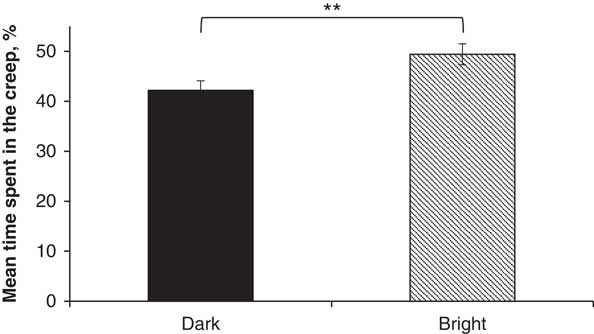
The interaction between creep light treatment and mat temperature was not significant (F 7,101=0.04, P=0.83), and therefore results are presented separately for light intensity and mat temperature. Light intensity significantly affected piglet use of the creep area (F 7,101=8.72, P<0.01). Piglets with access to the bright creep spent 7.2% more (P<0.01) time in the creep than piglets with access to dark creeps (Figure 2).
Mean time spent by the piglets inside the dark and bright creep areas, as a percentage of the 72-h postpartum period. **P<0.01.

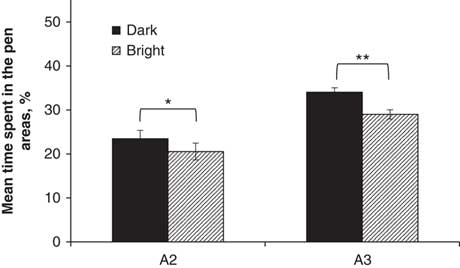
Piglets with bright creeps tended (F 5,19=3.90, P=0.06) to take longer (104±37 min) to enter the creep for the first time, compared to piglets with dark creeps (24±6 min). Conversely, the latency for 30.0% of the litter to be in the creep together and remain in the creep for a minimum period of 10 consecutive min for the first time tended to be shorter (P=0.08) for piglets of bright creeps, but no significant differences (P=0.49) were found for the latency of 75% of the litter to enter and remain in the creep for a minimum period of 10 consecutive min. Piglets in bright creeps spent 5.0% less time of the total 72-h pp period in A3 compared to piglets in dark creeps (P=0.01), and 2.9% less time in A2 (P=0.04, Figure 3).

Effects of mat temperature
There was a substantial variation in temperature measured at the surface of the mats among distinct pens and over time, even within the same farrowing room. Thus, mat temperature was not significantly different across the two desired set points (32.9±2.9°C v. 34.3±7.1°C, P=0.24). Mat temperature averaged 33.0±6.2°C (ranging from 20.3°C to 42.2°C) and 34.2±5.3°C (ranging from 34.2°C to 41.7°C) for bright and dark creeps, respectively, and did not statistically differ between light treatments (P=0.40).
Mat temperature was related to piglet use of the creep (F 7,101=31.0, P<0.01), as well as A2 and A3. For each increase of 1.0°C in mat temperature, there was an approximate 2.1% increase (P<0.01) in piglet use of the creep, and conversely a 0.7% decrease in piglet time spent in A2 (P=0.02) and a 1.6% decrease in A3 (P<0.01).
Effects of ambient temperature
Ambient temperature was significantly higher (P<0.01) in replicate 2 (27.3±0.1°C) compared to replicate 1 (23.8±0.1°C). Ambient temperature strongly affected the piglets’ use of the creep (F 7,101=28.8, P<0.01) and remaining pen areas. Generally, for each 1.0°C increase in ambient temperature, there was an approximate 4.8% reduction (P<0.01) in piglet use of the creep, and conversely a 1.2% increase in piglet time spent in A2 (P=0.02) and 3.4% increase in A3 (P<0.01).
Sow location
The proportion of time spent by sows in the areas A2 and A3 was not affected by light (A2: F 6,102=0.70, P=0.40; A3: F 6,102=0.33, P=0.57) or mat temperature (A2: F 6,102=0.05, P=0.83; A3: F 6,102=2.29, P=0.13). Sow location within the pen was related (P<0.01) to piglet location within A2 and A3. For each increase of 1.0% of time spent by the sow in A2 and A3, there was an approximate 20.0% increase of time spent by the piglets in the same area as the sow.
Light treatments and mat temperature did not affect sow posture (P>0.10). However, most of sow standing (76.0%) and sitting (74.5%) events were observed in A3, excluding the situations where sows had <70.0% of their bodies within a specific pen area (middle of the pen). Percentage of lying events (both lateral and sternal recumbence) were similar in A2 (52.9%) and A3 (47.1%).
Piglet weight, mortality and number of piglets in the pen
Average piglet weight at weaning was 7.3±0.2 kg, for an average birth to wean period of 27.8±0.8 days, not significantly different (F 4,15=1.11, P=0.39) between replicates, light treatments and not affected by mat temperature. Piglet weight gain within the first 72-h pp was also not affected (F 3,16=0.83, P=0.49) by light intensity or mat temperature.
Average piglet mortality for the 72-h pp was 8.7±9.2% and 8.8±15.7% for the bright and dark treatments, respectively. Piglet mortality was not affected by light treatment (F 1,108=1.20, P=0.28) or mat temperature (F 1,108=0.09, P=0.76). However, the risk of piglet death within 72-h pp tended to reduce with increased ambient temperature (F 1,106=3.50, P=0.06), and tended to be reduced with increased piglet birth weight (F 1,108=3.37, P=0.07).
The number of piglets in the pen had a small, but significant effect on piglet use of pen areas, as the increase of one piglet in the litter led to a 1.2% decrease in time piglets spent in the creep (P=0.03) and conversely a 0.7% increase in time piglets spent in A2 (P=0.01), but no effect of number of piglets in the pen was found for piglet use of A3 (P=0.25).
Discussion
Illuminating creep areas in farrowing pens led to higher use of the creep by piglets within 72-h pp on a commercial piggery. Consequentially, piglets with bright creeps spent less time in the pen areas shared with the sow, and the reduction was greater in the area furthest from the creep (A3) where sows spent most time standing. Piglet use of the creep area also increased with increased mat surface temperature and decreased ambient temperature, and a lower number of piglets per pen. Piglet weight gain, mortality and sow use of pen areas were not affected by light intensity or mat temperature.
Light treatment
The positive effect of bright creeps on piglet creep use contrasts with the findings of Larsen and Pedersen (Reference Larsen and Pedersen2015), in which piglets did not change their use of lit (130 lx) creep areas compared to piglets with access to dark creeps (lx not reported). Larsen and Pedersen (Reference Larsen and Pedersen2015) also reported a preference of piglets to sleep in the darkness, which was not seen in the present research.
The higher use of bright creep areas seen in the present study may not necessarily mean piglets preferred the lit (300 lx) over the dark environment (4 lx), especially because there was a trend that piglets took more time to enter bright creeps for the first time, compared to dark creeps. Instead, the light could have acted as an extra cue for the warmth of the creeps, helping piglets to associate the creep area with a warmer environment. This would explain why, although taking longer for individual piglets to enter bright creeps for the first time, once piglets began entering the creep, it tended to take less time for piglets to remain in the bright creeps with their litter mates (30.0% of litter together) for 10 consecutive min or more, as compared to dark creeps. The tendency for a greater latency for piglets to enter the bright creep for the first time could also be the result of neonates having to adjust from the intra-uterine (dark) environment to the extra bright environment of the bright creeps, thus not necessarily an aversion from piglets to the bright creeps.
Another possible explanation for the contrasting results between the present and Larsen and Pedersen’s (Reference Larsen and Pedersen2015) studies relates to the type of heat source in the creep. In Larsen and Pedersen’s study (2015), creep heat was delivered solely through radiation, whereas in the present study heat source was conductive, through heating mats. It is possible that type of heating affects how rapidly piglets perceive heat from distinct heat transfer mechanisms (i.e. radiation v. conduction), or how effectively piglets associate the creep areas with a warm zone. Piglets have been reported previously to spend more time under radiant heat for the first 2 days of life than on conductive heat mats (Zhang and Xin, Reference Zhang and Xin2001). It is possible that piglets perceive radiant heat more readily on their skin (head, neck, sensitive areas) compared to conductive heat (from the mats), where piglets need to lay down and be in direct contact to exchange heat with heat mats. Radiation may also help neonates to get dry, thus decrease heat loss soon after birth (Zhang and Xin, Reference Zhang and Xin2001), which is relevant for their survival in the very first few hours after birth (Vasdal et al., Reference Vasdal, Østensen, Melišová, Bozděchová, Illmann and Andersen2011). Thus, in Larsen and Pedersen’s study (2015), which used solely radiant heat, brightness may have been less important to attract piglets to the creep area, as compared to the current study, which used mats as the additional heat source for the piglets in the creeps. Therefore, in the latter case, brightness could have added an extra dimension to the cues of the warm and safe environment of creeps, hence the current results indicating a greater use of bright creeps by the piglets.
Moreover, creep light levels in the bright treatment were constantly above pen light levels (300 v. 80 lx, respectively) in the present study, thus there was a constant light gradient in which the higher light intensity was inside the creep. Conversely, in Larsen and Pedersen’s study (2015) creep light intensity was below the room light level during the day (130 v. 300 lx), which may be an indication that light gradient has a greater influence on neonatal behaviour than illumination per se.
There may be age-related changes in attractiveness of different light intensities. While Larsen and Pedersen (Reference Larsen and Pedersen2015) did not find an overall illuminance preference of pre-weaning piglets, a previous study by Taylor et al. (Reference Taylor, Prescott, Perry, Potter, Le Suerur and Wathes2006) demonstrated that 7 to 11 week old piglets preferred dimmer conditions (2.4 lx) over bright (400.0 lx) conditions. However, it is important to point out that in Taylor et al.’s study (2006), illumination was provided by incandescent bulbs, which are highly inefficient in converting energy into visible light; only 5.0% or less of the energy used by incandescent bulbs is converted to visible light, while the remaining 95.0% or more energy is converted into heat. Taylor et al. (Reference Taylor, Prescott, Perry, Potter, Le Suerur and Wathes2006) did control their experiment for ambient temperature, but there were no reports on the direct measurement of radiant heat, which has a direct impact on the piglet skin temperature, thus heat exchange with the surroundings. The authors mentioned keeping lights energised on the darkest treatment with a layer of black card between lights and chamber to maintain a radiant load on this treatment, but the magnitude of the achieved radiant load across treatments was not reported. It is possible that at higher illumination treatments, in which there were less gel filters between the lights and the pigs compared to dim treatments, there was also a greater radiant heat load perceived directly by pigs on their surface. Therefore, the preference found by older piglets for spending time in dimmer chamber in Taylor et al.’s study (2006) could be somewhat confounded with preference for less radiation, especially as older piglets require reduced heat load.
Based on the results of the present study, light can be potentially used as an additional cue in creeps to increase their use by newborn piglets. However, given the longer latency to enter bright as compared to dark creeps, the light configurations (cool white LED, 300 lx) used in this experiment may not be the ideal ones for increasing piglet use of the creep area. Lights of different intensity and frequencies, within the pigs’ visible spectrum, should be further studied as potential cues or attractants to creep areas. Furthermore, other sensory stimuli can be explored in creeps to increase piglet use of these areas, as piglets have been previously reported to be attracted to a variety of olfactory, auditory and tactile stimuli (Morrow-Tesch and McGlone, Reference Morrow-tesch and Mcglone1990; Parfet and Gonyou, Reference Parfet and Gonyou1991).
Mat temperature
The increased use of the creep area as mat temperature increased from 20.3°C to 42.2°C could be a result of the increased temperature gradient between the mat and the pen environment, as mat temperature increased. Generally, the greater the difference between the pen and heated areas, the more piglets will seek the heated areas (Xin and Zhang, Reference Xin and Zhang1999). Although 30.0°C to 35.0°C are common mat set points in farrowing facilities, mat temperatures above this range, measured at the mat’s surface, did not lead to reduced use of the creep area in this study. This result was in agreement with the one reported by Zhang and Xin (Reference Zhang and Xin2000a), in which piglets tolerated up to 46.2°C of contact temperature with the heated mat, without leaving the warm area. The variation observed among pens and over time in mat temperature, despite the central automatic control at room level, highlights the variation that is commonly observed on commercial farms, and demonstrates the importance of systematically and regularly checking mat temperatures, not just thermostat settings. In addition, part of the mat temperature variation found in this work could be a result of the extra heat load from the piglets on the mat’s surface as piglets used the mat. Zhang and Xin (Reference Zhang and Xin2000b) demonstrated that differences in temperature between the occupied and unoccupied mat areas by piglets could be as high as 7.0°C to 12.0°C. Thus, the substantial differences in temperature readings from mat surfaces in the present research could be a reflection of how piglets actually used heat mats, which could explain, at least partially, why piglets did not leave heat mats at high temperatures.
Ambient temperature
Ambient temperature was higher in replicate 2 compared to replicate 1 due to the seasonal variation between the two replicates (September, end of winter v. November, end of spring in Australia, respectively). The increase in creep use with the reduction in ambient temperature found in the present research may also have been a result of the increased temperature gradient between the heated creep and the pen area as ambient temperature decreased. Vasdal et al. (Reference Vasdal, Møgedal, Bøe, Kirkden and Andersen2010) reported that piglets showed clear thermal preferences when the thermal gradient between choices was 8.0°C to 16.0°C, whereas this disappeared when the gradient was 4.0°C to 8.0°C. The lower ambient temperature in replicate 1 led to an average temperature gradient of ~10.0°C between the mat surface and pen environment, whereas this gradient was about 5.0°C in replicate 2. Thus, the consequently decrease in temperature gradient with higher ambient temperatures could partly explain the lower creep use in such ambient temperatures, in agreement with Vasdal et al. (Reference Vasdal, Møgedal, Bøe, Kirkden and Andersen2010).
Sow location
Despite all the environmental effects found on piglet creep use, sow location was the main factor associated with piglet location within the pen, when outside the creep. Early access to colostrum is vital for piglet survivability (Hoy et al., Reference Hoy, Lutter, Puppe and Wähner1995) and piglets will tend to remain near the sow while nursing or seeking to nurse within the first few hours of life (Hrupka et al., Reference Hrupka, Leibbrandt, Crenshaw and Benevenga1998). It is also possible that in pen farrowing systems the sow herself tends to seek and remain near her piglets. Yet, the use of the creep as affected by the ambient and mat temperatures may be an indication of a shift in the piglets’ motivation from willing to stay near their mother to stay warm, in an enclosed area, depending on the thermal context.
Therefore, a possible strategic solution to reduce crushing in pen systems may be to manage the environment to attract piglets to protected creep areas, away from the sow between suckling episodes. Attracting piglets to the creeps should be done within the first 24-h to 72-h pp, which are the most critical for the risk of piglet crushing by the sow (Marchant et al., Reference Marchant, Broom and Corning2001; Andersen et al., Reference Andersen, Berg and Bøe2005).
Piglet weight, mortality and number of piglets in the pen
Piglet weight gain within 72-h pp and between birth to weaning was not affected by light and mat treatments, thus the higher use of bright and warmer creeps possibly did not affect piglet nursing behaviour, although further analysis would be needed to confirm this hypothesis. It is important that any strategy which promotes a greater use of the creep by the piglets, and consequently less time near the sow, allows for efficient milk intake during the nursing bouts. Missing milk ejection events can lead to a substantial decrease in milk intake, which can reduce piglet weight gain and vitality, while lighter piglets have more chance of dying due to starvation or crushing by the sow. Reduced milk intake can be even more aggravated with increasing litter size, where sibling competition can be higher and access to a teat more difficult (Andersen et al., Reference Andersen, Nævdal and Bøe2011; Bozděchová et al., Reference Bozděchová, Illmann, Andersen, Haman and Ehrlenbruch2014).
Although mortality was not affected by creep light and mat treatments, this study was not designed to detect mortality differences among sows, as this would require studying a substantially greater number of litters. Still, previous research has demonstrated that the risk of a piglet being crushed is significantly higher if piglets are spread around within 0.5 m from the sow as she lies down (Marchant et al., Reference Marchant, Broom and Corning2001), as opposed to piglets being safely clustered together.
The decrease in the use of the creep area with the increase in number of piglets in the pen may be partly due to the clustering dynamics among piglets of larger litters or due to increased heat generation among greater number of piglets. In support of the social dynamics hypothesis, increased incidence of crushing of at least three piglets by the same sow was found in litters of over 13 piglets, as compared with litters smaller than 10 piglets (Morello, Reference Morello2015). Hence, it is possible that in larger litters piglets are less likely to remain close together in one single cluster, which has been demonstrated to be safer for piglets as opposed to being spread around the sow (Marchant et al., Reference Marchant, Broom and Corning2001). In support of the heat generation hypothesis, 2-day-old piglets generate ~5 W/kg of heat (Zhang and Xin, Reference Zhang and Xin2000a; Brown-Brandl et al., Reference Brown-Brandl, Nienaber, Xin and Gates2004), which could be enough heat added up in larger litters to reduce the need of piglets to seek for warmer areas.
The present research demonstrated that provision of light and increased mat temperature in creep areas increased use of the creep by newborn piglets in a commercial setting. Whether the increase in creep use translates to lower piglet crushing and total reduction in pre-wean mortality should be evaluated on a larger sample size. Furthermore, other sensory stimuli can be explored as attractants to creep areas in an effort to improve piglet survivability, while providing better welfare to sows housed in pen systems.
Acknowledgements
The authors thank Bettapork Pty Ltd for their collaboration with the present study, the Australian Pork Cooperative Research Centre (project 1A-116) for funding and support of the present research, as well as David Murden, Igor Moreira Lopes and Seungyeol Ko for their help with data collection and analysis.
Declaration of interest
The authors declare that there are no conflicts of interest involved with this research.
Ethics statement
The present research was approved by the Animal Ethics Committee from the University of Melbourne, following the National Health and Medical Research Council’s Australian Code for the Care and Use of Animals for Scientific Purposes (eighth edition, 2013).
Software and data repository resources
None of the data were deposited in an official repository.