Pulmonary sequestration is a rare condition. Reference Gabelloni, Faggioni, Accogli, Aringhieri and Neri1,Reference Khen-Dunlop, Farmakis and Berteloot2 The lesion is mostly located on the left side. Pulmonary sequestration is defined as a segment of lung parenchyma separated from the tracheobronchial tree and receiving its blood supply from a systemic artery rather than a pulmonary arterial branch. The aberrant supplying artery usually originates from the thoracic descending aorta or the abdominal aorta. It mainly presents symptoms in young adults, including continuous cough, hemoptysis, recurrent bronchopulmonary infections, and chest pain, while growth retardation can be found in pediatric cases. However, with the development of fetal ultrasound and magnetic resonance imaging (MRI) scanning, some cases of pulmonary sequestration can be identified during the prenatal phase. Reference Khen-Dunlop, Farmakis and Berteloot2,Reference Baud, Windrim and Kachura3 A study report from Khen-Dunlop in 2018 demonstrated a cohort of pulmonary sequestration therapeutic alterations among 99 children, and 86 (87%) of all cases achieved prenatal diagnosis. Reference Khen-Dunlop, Farmakis and Berteloot2 Therefore, an increasing number of young patients have recently been scheduled to receive treatment after birth. Enhanced CT with three-dimensional reconstruction and MRI are commonly used in clinical diagnosis. However, selective arteriography is the gold standard for diagnosing pulmonary sequestration, as it helps to obtain the shapes, margins and numbers of feeding vessels, providing the essential criteria for choosing transcatheter embolization or surgical resection. Normally, if there is a solitary arterial branch, embolization is considered to be performed. Surgical removal should be performed if there are multiple arterial vessel.
Transcatheter embolization has been used to treat pulmonary sequestration for the past 20 years. Reference Park, Yoon and Sung4 Initially, coils were the most common types to be used for embolization. Amplatzer vascular plugs and duct occluders have also been introduced to pulmonary sequestration patients with solitary feeding arteries. Two issues were controversial. One issue was whether management should be provided for asymptomatic cases, and observation is usually proposed for such patients. However, risks for pulmonary infections still exist. The second issue was the indication for transcatheter embolization. Systemic vessel embolization has been proposed as an alternative to surgery because systemic vessel thrombosis leads to the regression of the bronchopulmonary malformation. However, current reports presented limited cases with pulmonary sequestration fed by a single small- or medium-sized artery (diameter < 5 mm) in which coils and small Amplatzer plugs were used. No study has paid enough attention to the changes in residual lesion masses, such as how their volume changes and their long-term risks. Herein, we report two rare cases of pulmonary sequestration that were fed by large systemic arteries, were embolized with a large Amplatzer duct occluder and were followed up for 3 years. In addition, we also summarize current published studies on children’s pulmonary sequestration treatment to define optimal indications for transcatheter embolization for pulmonary sequestration. This research study was approved by the ethics committee of our hospital (2014-034).
Case presentation
Case 1
A 9-year-old boy was first admitted to a local hospital with a main complaint of recurrent chest pain for 1 month, mainly at the root of the xiphoid process, with dull pain and no radiating pain in the shoulder and back. Chest CT scan revealed “a potential vascular malformation in the posterior segment of right lower lobe”. The patient was transferred to our hospital to receive an enhanced CT scan, which identified a right lower pulmonary sequestration with infection. The patient did not present any palpitation, shortness of breath, dyspnea, continuous cough, expectoration or other discomfort. Physical examinations demonstrated that the xiphoid process was concave in shape and oriented inward and that the thoracic cavity was funnel-shaped. Bilateral respiratory movements were symmetrical. The respiratory sounds of both lungs were thick, and no rales were heard. The diagnosis was right lower pulmonary sequestration (intralobar type, with multiple cystic shadows), accompanied by left heart enlargement, based on chest CTA. In addition, pulmonary function tests showed that the child suffered mild restrictive ventilation dysfunction.
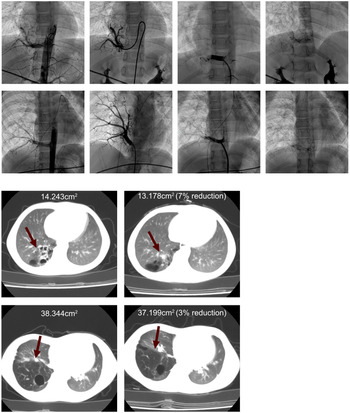
After admission, antibiotic treatment was administered for 1 week, and transcatheter embolization was planned for the occlusion of the sequestration. Hemodynamic evaluation revealed a left pulmonary pressure of 38/21 (29) mmHg, a main pulmonary artery pressure of 38/22 (31) mmHg, and a right ventricular pressure of 40/11 (25) mmHg. Aorta angiography showed a solitary artery arising from the descending aorta at the level of the diaphragm, and the narrowest size of the feeding artery was 8.54 mm (Fig 1a). A 16/14 mm size Amplatzer duct occluder was placed in the main feeding artery before its branches via a 9 Fr delivery sheath. The vessel was completely occluded, as post angiography showed no significant aorta-pulmonary flow to the lesioned lung segment (Fig 1a). The total procedure time was 65 minutes.
The angiography and implantation of Amplazter occluder for two patients of pulmonary sequestration with large aberrant systemic artery (a for patient 1, and b for patient 2). CT scanning demonstrated the lesions of lungs before and after occlusion (c for patient 1 before occlusion, d for patient 1 after 2-year-follow-up post occlusion; e for patient 1 before occlusion, f for patient 1 after 2-year-follow-up post occlusion). The follow-up results demonstrated the large residual lesions after Amplatzer occluder implantation for a large aberrant artery supplying pulmonary sequestration.

Thereafter, the patient received treatment with ceftriaxone to prevent infection and oral prednisone to prevent inflammation. However, the patient suffered transitory chest pain and a fever for 36 hours up to 38.7 °C. In the following 2 years of follow-up, the child did not have recurrent chest pain, cough or other related symptoms. The respiratory function test showed a slight dysfunction at 3 years post occlusion. However, the CT follow-up demonstrated that a residual mass was visible. The same chest scan revealed a slight reduction in the lung lesion from 38.344 cm2 (height, 142 cm; weight, 32 kg; body surface, 1.122 m2) to 37.119 cm2 (height, 160 cm; weight, 40 kg; body surface, 1.335 m2), and the lesion of pulmonary reduction is 3.19% and 18.64% normalized to body surface, which indicated a mild absorption of lesion (Fig 1c and d).
Case 2
A 6-year-old boy was first admitted to our hospital with the main complaint of continuous cough and expectoration for 3 months, as well as a long-term fever with the highest temperature above 39 °C. During that period, the child’s symptoms progressed, accompanied by dizziness and sweating at night. The patient was initially diagnosed with a pulmonary abscess and was provided antibiotics for 9 days. Then, he was transferred to our hospital, and chest CT revealed a right lower lobe pulmonary sequestration with infection. Physical examinations were remarkable only because the respiratory sounds of the right lower lung were decreased, though no rales were heard. ECG and cardiac ultrasound were generally negative and presented abnormally shaped cardiac chambers. CTA revealed multiple cystic shadows with consolidation and cord shadows in the right lower lobe and a feeding vessel arising from the thoracic aorta to supply the pulmonary sequestration segment.
After admission, transcatheter device occlusion was planned after essential antibiotic treatment. Hemodynamic evaluation revealed that the systemic and pulmonary pressures were normal. Aorta angiography showed a solitary artery arising from the descending aorta at the level of the diaphragm, and the narrowest size of the feeding artery was 7.32 mm (Fig 1b). A 12/10 mm size Amplatzer duct occluder was placed in the main feeding artery before its branches via a 7 Fr delivery sheath. The vessel was completely occluded, as post angiography showed no significant aorta-pulmonary flow to the lesioned lung segment (Fig 1b). The total procedure time was 110 minutes.
After embolization, the child suffered transitory chest pain for 3 days and a fever for 48 hours up to 39.0 °C. In the following 2 years of follow-up, the child did not have recurrent chest pain, cough or other related symptoms. The respiratory function test showed a slight dysfunction at 3 years post occlusion. However, the CT follow-up demonstrated that a residual mass was visible. The same chest scan revealed a slight reduction in the lung lesion from 14.243 cm2 (height, 114 cm; weight, 20 kg; body surface, 0.7985 m2) to 13.178 cm2 (height, 127 cm; weight, 27 kg; body surface, 0.9674 m2), the lesion of pulmonary reduction is 7.47% and 23.55% normalized to body surface, which indicated that the absorption of the lung lesion was not a promising result (Fig 1e and f).
Discussion
Pulmonary sequestration is a rare type of congenital malformation of the lung and its vessels, accounting for approximately 0.15–6.40% of malformations. Reference Zhang, Zeng, Chen, Yu and Zhang5 The cause is believed to be that a part of the lung bud tissue is separated from the bronchial tree, resulting in abnormal lung tissue, which is either connected or not connected with the normal trachea and bronchus during the development of the embryonic lung. As its blood supply comes from the systemic circulation, the oxygen content of the blood from the systemic circulation is completely different from that of the blood from the pulmonary artery. The clinical manifestations of pulmonary sequestration depend on the types of lesions and the volume of the abnormal lung lesion mass. Reference Polaczek, Baranska and Szolkowska6 Such patients have been divided into three main populations based on their clinical manifestations. The first population is asymptomatic patients, who usually have only a small proportion of lung malformations. The pulmonary sequestration in these patients is always discovered accidentally by imaging diagnostic methods. The second population is the group presenting respiratory symptoms, such as recurrent cough, pulmonary infection, and even hemoptysis, which is the most important and earliest clinical symptom of pulmonary sequestration. The last population of patients demonstrates cardiovascular onset symptoms, which are extremely rare and caused by abnormal blood shunts.
Intralobar pulmonary sequestration is often seen in young adults. Because it has normal or pathological channels with the bronchus, local infection of the lesion easily occurs repeatedly. Such cases are often misdiagnosed as pulmonary infections, pulmonary cysts complicated by infection or bronchiectasis. Extralobar pulmonary sequestration is usually asymptomatic without bronchial communication. Therefore, the treatment timing and approaches are mainly based on the manifestation and volume of lung malformation lesions. Adults are the patients who most often receive treatment, including surgical resection and transcatheter embolization. However, with the rapid development of imaging diagnostic methods, pulmonary sequestration can be found prenatally or at a young age. Reference Khen-Dunlop, Farmakis and Berteloot2,Reference Romberg, Tang, Chandra, Podberesky, Epelman and Iyer7–Reference Ng, Stanwell, Burge and Stanton9 Decades ago, pulmonary sequestration was mainly treated by the resection of the dysfunctional lung tissues via traditional thoracotomy. With continuous advances in video-assisted thoracoscopic surgery, video-assisted thoracoscopic surgery has become the main surgical technique in treating pulmonary sequestration. Reference Khen-Dunlop, Farmakis and Berteloot2 Moreover, a series of studies reported that endovascular embolization of systemic arterial abnormal vessels is a valid alternative therapeutic choice due to its advantages of minimal trauma, limited hospitalization and rapid activity. In these two cases, we used the Amplatzer duct occluder to achieve efficient embolization using a strategy which is based on the experiences and protocol for patent ductus arteriosus closure. Generally, the size of occluder is 1.5–2 times of the diameter of the artery. Under the consideration of absence of significant difference of blood pressure between the lateral sides of occluder, the selection criteria of occluder preferred to touch the lower border of the range as 1.5 times of artery dimeter.
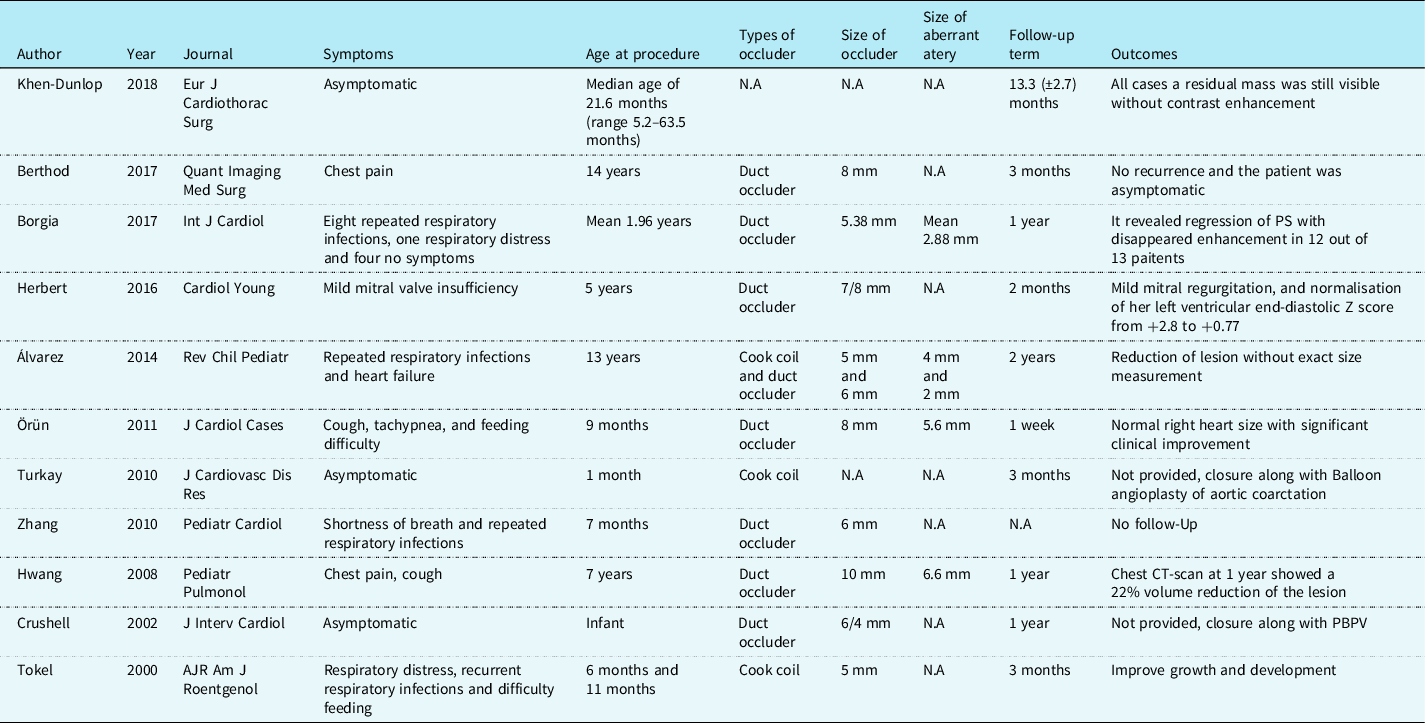
However, embolization is not efficient for all patients because its mechanism is to embolize the blood supply vessels to reduce the blood flow perfusion of the separated lung tissue. The isolated lung tissue first exhibits ischemic degeneration, then fibrosis and atrophy, and finally absorption. Therefore, if an isolated lung lesion is supplied by several vessels, the placement of several devices to achieve full embolization is not a good choice. Moreover, the clinical manifestations are usually based on the volume of pulmonary sequestration segments. Larger lesions are always supplied by larger aberrant arteries with a few surrounding vessels. We retrieved all the published reports of transcatheter embolization of pulmonary sequestration in children, Reference Khen-Dunlop, Farmakis and Berteloot2,Reference Borgia, Santamaria and Mollica10–Reference Tokel, Boyvat and Varan19 and the devices in the two cases presented here are the largest that have been placed. We noticed that the absorption of the lesion was very slow (3% and 7.5% for each patient, for 3 years), which may be due to the essential surrounding vessels supplying the embolized lung segment. In summary, transcatheter embolization of pulmonary sequestration has been performed in children ranging from infants to teenagers aged 14 years. Cook coils and Amplatzer occluders are the most common devices for embolization. Reference Álvarez, Cleveland, Green, Sanhueza and Silva13,Reference Turkay, Abdullah and Celal16,Reference Tokel, Boyvat and Varan19 A 10-mm Amplatzer occluder has been reported to close a 6.6-mm aberrant artery of the pulmonary sequestration. CT scans at the 1-year follow-up recorded only a 22% volume reduction in the pulmonary sequestration lesions. Reference Hwang, Tsai, Lin and Chen17 In addition, Khen-Dunlop Reference Khen-Dunlop, Farmakis and Berteloot2 and Álvarez Reference Álvarez, Cleveland, Green, Sanhueza and Silva13 also reported reductions in residual mass but failed to provide an exact measurement. Moreover, in the cohort reported by Cho et al, Reference Cho, Kim, Kim, Kim, Kim and Lee20 among the embolization group, complete regression was observed in only 3 patients, 4 showed no regression, and 35 (83.3%) had residual lesions, with four patients developing sepsis or other blood vessel complications. In all the reported cases, the occluder sizes ranged from 4 to 10 mm, and the follow-up times ranged from 1 week to 2 years. All of the cases demonstrated an improvement in clinical manifestations, and the patients suffered no severe complications. All the previously reported data are summarized in Table 1.
Summary of transcatheter embolization of PS in children patients

In our cases, both children had a good prognosis for clinical improvement. However, there was a slower reduction (around 20% reduction in 3 years) in their lesion masses than that observed in previous reports (which should reach at 20% reduction in 1 year). Compared to previous cases, our cases had the largest aberrant artery sizes of 8.54 and 7.32 mm, receiving 16- and 12-mm Amplatzer duct occluders. Although the main clinical concerns were relieved after closure, the imaging changes still remain controversial, with some debate regarding the indications for transcatheter embolization application. However, we still observed the growth developments on both children were delay, especially in height. No oblivious catch-up growth had been identified after occlusion. Due the poor absorption of such lesion, recurrent pulmonary infection is expected in long term results. Besides, the long-term residual mass complications, such as the revascularization of pulmonary sequestration lesions, inducing severe infection and requiring surgical resection, are still unknown. In addition, we do not know the relationship of the residual mass with the risk of lung tumors. For large pulmonary sequestration lesions, embolization does not lead to absorption in the short or mid term; therefore, an unknown risk remains for such patients in the long term.
Accordingly, we consider that transcatheter embolization should be avoided with an aberrant artery size greater than 6 mm that is planned to receive an occluder larger than 10 mm, even if a solitary feeding artery has been identified. Second, for small pulmonary sequestration lesions supplied by a small artery, Cook coils and an Amplatzer occluder are safe and practical approaches that are alternatives to surgical resection.
Conclusion
Our cases presented the clinical and imaging follow-up of the embolization of large aberrant systemic artery to pulmonary sequestration using Amplazter Duct Occluder. The two cases who received 16 mm and 12 mm are the largest ones reported among children patients. Although the clinical improvement has been achieved, but the reduction of lesion mass brought us to re-consider the indication for pulmonary sequestration using transcatheter embolization. As no follow-up data to demonstrated the long term clinical outcomes of the residual lesion. We would not recommend embolization to perform for large pulmonary sequestration lesion with an aberrant artery larger than 6 mm, which is planned to receive a device more than 10 mm as they showed a higher possibility to re-build a vascularization network to feeding pulmonary sequestration indicating a higher risk for long term complications.
Data availability statement
Further supporting data is available from the authors on request.
Author contributions
Zhang Y and Qiu Y contributed equally to this work. Li Y was the patient’s physicians. Zhang Y and Qiu Y reviewed the literature and contributed to manuscript drafting; Li Y conceptualized and designed the study, coordinated and supervised data collection, and critically reviewed the manuscript for important intellectual content. Zhang Y, Qiu Y and Li Y were responsible for the revision of the manuscript for important intellectual content; all authors issued final approval for the version to be submitted.
Financial support
This work was supported by grants from the National Natural Science Foundation of China (No. 81700360), Technology Project of Sichuan Province of China (2020YFS0102, 2020YFH0019).
Conflicts of interest
None.
Ethical standards
The guardians of both patients signed an informed consent statement to allow this case report to be published.
International review board approval
This research study was approved by the ethics committee of our hospital (2014-034).
Clinical trial registration
As this is not a clinical trail, such registration is not required.