Introduction
Dietary fermentable carbohydrates, such as non-starch polysaccharides (NSP) and resistant starch (RS), have been shown to reduce energy expenditure on physical activity in restrictively fed growing pigs, likely due to enhanced fermentation in the gastrointestinal tract (Schrama et al., Reference Schrama, Bosch, Verstegen, Vorselaars, Haaksma and Heetkamp1998; Schrama and Bakker, Reference Schrama and Bakker1999). This reduced activity partly compensates for the low NE value of fermentable carbohydrates (Schrama et al., Reference Schrama, Bosch, Verstegen, Vorselaars, Haaksma and Heetkamp1998). Reduced activity following NSP or RS intake has been suggested to reflect increased satiety, and therefore fermentable carbohydrates may improve welfare in restrictedly fed pigs (Gerrits et al., Reference Gerrits, Rijnen, Bolhuis and Schrama2003; De Leeuw et al., Reference De Leeuw, Jongbloed, Spoolder and Verstegen2005). It is unknown, however, which behavioural activities are affected by adding fermentable carbohydrates to the diet of growing pigs.
Behavioural effects of fermentable carbohydrates may be studied most easily under housing conditions that allow for the performance of a broad behavioural repertoire. Environmental enrichment by providing ‘rooting material’, such as straw bedding, strongly influences behaviour of pigs. Straw serves as an outlet for the motivation to perform foraging behaviours, such as chewing, rooting and digging, and in this way profoundly improves welfare (Fraser et al., Reference Fraser, Phillips, Thompson and Tennessen1991; Beattie et al., Reference Beattie, Walker and Sneddon1995; Tuyttens, Reference Tuyttens2005). The effects of straw bedding on energy partitioning in group-housed, growing pigs have not been studied so far. Straw bedding could affect energy partitioning in different ways. Besides the influence of straw intake on energy utilisation, straw bedding may increase energy expenditure on activity, because pigs supplied with rooting material are generally more active than barren-housed pigs (Fraser et al., Reference Fraser, Phillips, Thompson and Tennessen1991; Beattie et al., Reference Beattie, Walker and Sneddon1995; Bolhuis et al., Reference Bolhuis, Schouten, Schrama and Wiegant2006). It is unknown whether and how these effects of straw bedding on activity and energy partitioning of pigs interact with the effects of dietary fermentable carbohydrates.
The aim of this study was to investigate (1) the quantitative impact of straw bedding on energy partitioning in pigs; (2) the effects of fermentable carbohydrates (native potato starch (NS)) on behaviour in group-housed pigs; and (3) the interaction of both factors, straw bedding and fermentable carbohydrates, on energy partitioning and behaviour in pigs. The effects of provision of straw bedding and fermentable carbohydrates on energy metabolism are reported in the current paper. The effects on behaviour, straw intake and intestinal weight are reported elsewhere (Bolhuis et al., Reference Bolhuis, van den Brand, Staals and Gerrits2007; Staals et al., Reference Staals, Bolhuis, van den Brand and Gerrits2007; Bolhuis et al., in preparation).
Material and methods
Animals and housing
Effects of housing (enriched with straw bedding, S, or barren, B) and type of potato starch in the diet (pregelatinised (PS) or NS) on energy partitioning of growing pigs were assessed, using a 2 × 2 factorial arrangement. The experiment was carried out in eight successive batches. Each batch consisted of a 30-day adaptation period, of which the last 7 days were spent in climate respiration chambers, followed by a 7-day experimental period in these chambers. Two treatment combinations were tested per batch, resulting in four groups (of 12 pigs each) per treatment combination.
Per batch, 32 growing [Pietrain × (Yorkshire × Finnish Landrace)] gilts of 25 ± 2 kg were assigned to either B or S housing. During the first 23 days of the adaptation period, gilts were group-housed (n = 8 per group) in 10.6 m2 pens. B pens consisted of 5.8 m2 slatted and 4.8 m2 solid concrete floor. In S pens, 5.4 m2 of the floor was covered with rubber mats and a bedding of long wheat straw (approximately 8 kg per pen at the start), which was separated from the rest of the pen by a barrier (3.00 × 0.05 × 0.20 m) that could easily be crossed by the piglets. Pens had one nipple drinker and a feed trough (3.60 × 0.31 × 0.17 m), which could be closed. Room temperature was set at 20°C.
After the first 23 days of the adaptation period, six selected pigs (based on body weight) from each pen were transported to one of two identical climate respiration chambers (Verstegen et al., Reference Verstegen, Van der Hel, Brandsma, Henken and Bransen1987). Pigs were habituated to the climate respiration chambers and the smaller group sizes for 7 days before measurements started. Each chamber contained two 8.9 m2 pens, and two groups of six pigs, with the same treatment combination, were housed per chamber. B pens consisted of 1.5 m2 slatted and 7.4 m2 solid floor. In S pens, 5.3 m2 of the floor surface was covered with straw (9 kg at the start of each week); this part was separated from the rest of the floor by a barrier (3.00 × 0.05 × 0.20 m). Pens contained two drinking nipples and a feed trough, which could be closed. Temperature was kept constant at 20 °C. Relative humidity was maintained at 65%.
Throughout the experiment, all pens were cleaned in the morning. Soiled straw was removed from the S pens and replaced with fresh straw (2.3 and 3.0 kg per pen per day during the adaptation and climate respiration period, respectively). During the 7-day experimental period, soiled straw was stored until the end of this period. Animals were exposed to 12 h of light (0600 h to 1800 h) and 12 h of dimness. The Animal Use and Care Committee of Wageningen University approved the experimental protocols.
Diets and feeding
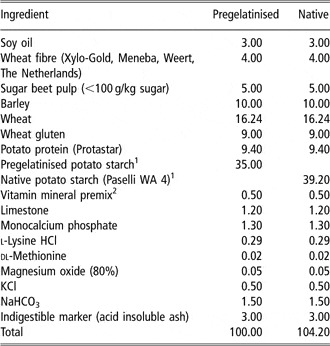
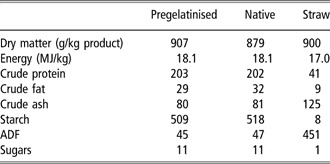
Pigs were gradually adapted, in 4 days, to the experimental diets and to restricted access to the feed troughs. They were fed a diet with either PS or NS. Except for the type of potato starch, raw materials of both diets were identical (Table 1). In the PS diet 35% potato starch was included, whereas in the NS diet 39.2% was included to compensate for a lower dry matter (DM) content of the NS. Consequently, the feeding level (in kg) of the NS-fed pigs was 4.2% higher than that of the PS-fed pigs. Diatomaceous shell powder (3%) was included in both diets, because acid-insoluble ash was used as an indigestible marker. The analysed nutrient composition of both diets and the wheat straw supplied is given in Table 2.
Composition of the experimental diets

1Except for potato starch type, raw materials of both diets were identical. To compensate for the lower dry matter (DM) content of the native potato starch, 35% potato starch was included in the PS diet and 39.2% in the NS diet. Consequently, the feeding level of the NS-fed pigs was 4.2% higher than that of the PS-fed pigs.
2Provided the following per kg of feed (of the P diet): vitamin A: 10 000 IU, vitamin B12: 20 μg; vitamin D3: 2000 IU; vitamin E: 30 mg; vitamin K3: 1.5 mg; d-panthothenic acid: 12 mg; niacin: 20 mg; folic acid: 0.2 mg; riboflavin: 4 mg; choline chloride: 150 mg; Fe: 100 mg (FeSO4.H2O); Cu: 20 mg (CuSO4.5H2O); Zn: 70 mg (ZnSO4.H2O); Mn: 30 mg (MnO); Co: 0.15 mg (CoSO4.7H2O); I: 0.75 mg (KI); Se: 0.20 mg (Na2SeO3).
Analysed nutrient composition of the experimental diets and straw (g/kg dry matter, unless indicated otherwise)

Pigs were fed at 2.5 times the energy for maintenance (MEm = 450 kJ/kg0.75 per day; ARC, 1981). The amount of feed was adjusted daily, based on animal weight and expected daily gain. Diets were fed twice a day in mash form (water: feed = 2.8:1) in the feed troughs, which were open until 30 min after feeding. During the adaptation period, pigs were fed at 0700 h and 1600 h. In the climate respiration chambers, pigs were fed at 0630 h and 1530 h. Water was available ad libitum.
Measurements
Body weights of individual pigs were determined weekly. Exchange of O2, CO2 and CH4 was measured in 9-min intervals as described by Verstegen et al. (Reference Verstegen, Van der Hel, Brandsma, Henken and Bransen1987). Physical activity was monitored continuously by two radar devices per chamber (Verstegen et al., Reference Verstegen, Van der Hel, Brandsma, Henken and Bransen1987). Changes in the frequency of the reflected radar waves due to movement of the animals (Doppler effect) were converted into electrical pulses and recorded in the same 9-min intervals.
Manure was collected quantitatively. In the S chambers, manure and soiled straw were collected as two separate fractions, homogenised and sampled. In order to increase homogeneity and to allow for representative sampling, visible faeces were removed from the soiled straw by washing. Faeces and washing water were added to the manure fraction. After weighing, the washed soiled straw was spread out over an area of approximately 8 m2 and sampled for energy and N analysis at six different spots. To evaluate this sampling procedure of the soiled straw fraction, in one batch the six different samples were analysed separately; coefficients of variation of air DM in soiled straw, DM in air dry samples, DM and N in fresh material were 2.6%, 0.6%, 2.4% and 2.8%, respectively.
Aerial NH3 was quantitatively trapped in 4.5 M sulphuric acid and in water that condensed on the heat exchanger (Verstegen et al., Reference Verstegen, Van der Hel, Brandsma, Henken and Bransen1987). Feed and fresh straw were sampled during each experimental period. DM content in feed, manure, and fresh and soiled straw was determined according to ISO 6496 (1998b). Kjeldahl N content was determined according to ISO 5983 (1997) in feed, manure, and fresh and soiled straw and in NH4+-containing sulphuric acid and water that condensed on the heat exchanger. Crude fat and crude ash content in feed and fresh straw were analysed according to ISO 6492 (1999) and ISO 5984 (2002), respectively. The starch and sugar content in feed and fresh straw was determined as described previously (Rijnen et al., Reference Rijnen, Verstegen, Heetkamp, Haaksma and Schrama2001). ADF was analysed according to ISO 13906 (2006). Gross energy (GE) content in feed, manure, and fresh and soiled straw was analysed using adiabatic bomb calorimetry (IKA-calorimeter C7000, Staufen, Germany) according to ISO 9831 (1998a).
To assess heat production and CH4 emission of manure and manure with straw, gaseous exchanges were measured during 1 day after departure of one batch of experimental pigs. Heat production of manure and manure with straw was estimated to be 7 (approximately 1% of H tot) and 20 kJ/kg0.75 per day (approximately 2.5% of H tot), respectively. CH4 emission of manure and manure with straw were estimated to be 0.04 kJ/kg0.75 per day (approximately 1.5% of total CH4 emission) and 0.02 kJ/kg0.75 per day (approximately 1.7% of total CH4 emission), respectively. H tot and CH4 data given in the results section are uncorrected for heat production and CH4 emission of manure.
Calculations
Energy and nitrogen (N) balances were assessed per chamber over the 7-day experimental period. Metabolisable energy (ME) intake was calculated by subtracting the energy content of manure, soiled straw and methane outputs from that of feed and fresh straw inputs. Total heat production (H tot) during the last 6 day of the experimental period was calculated from the gaseous exchanges according to Brouwer’s equation (Reference Brouwer1965). Estimated regression coefficients of H tot and activity counts were used to calculate the heat production related to activity (H act) as described by Heetkamp et al. (Reference Heetkamp, Schrama, De Jong, Swinkels, Schouten and Bosch1995). The heat production not related to physical activity (H cor) was calculated by subtracting H act from H tot.
Energy retention (ER) was calculated by subtracting H tot from ME intake. Retention of N was calculated from N in feed, fresh straw, soiled straw and manure. Aerial NH3 and NH4+ of water that condensed on the heat exchanger were included in the N excretion from manure. Crude protein content was calculated as 6.25 × N. ER as protein (ERp) was calculated as 23.8 × N retention, assuming 23.8 kJ/g of protein. ER as fat was calculated by subtraction of ERp from ER. The respiration quotient (RQ) was calculated from the ratio of CO2 production to O2 consumption. Means over the whole experimental period were calculated for all variables and hourly means were calculated for H tot, H act, H cor and RQ.
Statistical analyses
The experimental unit for all measurements was the group of 12 pigs, i.e. two pens of six pigs each, in a chamber. Effects of housing, starch type and their interaction on average daily gain (ADG) and energy partitioning were assessed by analysis of variance using the GLM procedure in SAS (v. 9.1, SAS Institute Inc., Cary, NC, USA). In addition, the hourly means of RQ, H tot, H act and H cor were analysed using the same model.
Results
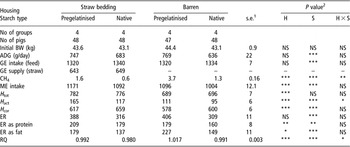
One pig on the PS diet in barren (B) housing was removed from the chamber before the start of the experimental period, because of an unhealthy appearance and lack of growth. None of the feed offered was refused during the experimental period. Effects of housing and starch type on growth rate and energy partitioning are given in Table 3. At the start of the experimental period, BWs were similar for the four treatment groups. ADG over the 7-day experimental period was higher (P < 0.001) in pigs fed the PS diet (758 g) than in pigs fed the NS diet (659 g, s.e. = 16), and was unaffected by housing.
Effect of housing (enriched with straw bedding v. barren) and type of starch (pregelatinised v. native) on growth rate and energy partitioning (in kJ.kg0.75/day, unless indicated otherwise) in group-housed growing pigs

ADG = average daily gain; GE = gross energy; ME = metabolisable energy; ER = energy retention; RQ = respiration quotient.
1Pooled standard error of the LSMeans.
2Statistical significance of effects of housing (H), starch type (S) and their interaction (H × S) is indicated: NS = non-significant; †P < 0.10; *P < 0.05; **P < 0.01; ***P < 0.001.
Energy partitioning
GE supply as straw was 646 kJ/kg0.75 per day in the pigs on straw bedding. ME intake was 81 kJ/kg0.75 per day higher (P < 0.001) in S-housed than in B-housed pigs. S-housed pigs also showed a higher heat production (H tot, +86 kJ/kg0.75 per day) than B-housed pigs (P < 0.001). Total ER was not affected by housing. S-housed pigs retained, however, more energy as protein (+24 kJ/kg0.75 per day; P < 0.01) and less as fat (−28 kJ/kg0.75 per day; P < 0.05) than B-housed pigs. Straw bedding reduced fat retention in pigs on the PS diet with −48 kJ/kg0.75 per day and in pigs on the NS diet with −12 kJ/kg0.75 per day, but the housing × starch type interaction was not significant (P = 0.13).
GE intake was slightly (+17 kJ/kg0.75 per day) higher in NS-fed pigs than in PS-fed pigs (P < 0.05), whereas ME intake was 85 kJ/kg0.75 per day lower in NS-fed pigs (P < 0.001). In B housing, metabolisability (ME/GE) was lower in the NS-fed pigs (75.3%) than in the PS-fed pigs (83.0%, P < 0.001). Metabolisability was not calculated for the S-housed pigs because of an unknown GE intake from straw. H tot was not affected by starch type. The lower total ER in NS-fed pigs (−84 kJ/kg0.75 per day; P < 0.01) was reflected both in a lower protein (−24 kJ/kg0.75 per day; P < 0.001) and in a lower fat retention (−60 kJ/kg0.75 per day; P < 0.001) as compared to PS-fed pigs.
The effect of starch type on CH4 production depended on housing (housing × starch type interaction, P < 0.01), with highest levels in the B-housed/PS-fed pigs (0.28% of GE) and lowest in the S-housed/NS-fed pigs (0.03% of GE).
When the differences in ME intake between treatments were considered and energy expenditure was expressed as a proportion of ME intake, ER/ME was lower in S-housed than in B-housed pigs (P < 0.01). Effects of housing and starch type on (ER as protein)/ME were not significant (P = 0.15 and P = 0.16, respectively), although when expressed as a proportion of total ER/ME they were (P < 0.001 and P < 0.01, respectively). Contrary to effects on absolute levels, H tot/ME was higher in NS-fed than in PS-fed pigs (P < 0.001). All other effects on H tot, ER, ER as protein and ER as fat, expressed as a proportion of ME intake were similar to the effects as presented in Table 3.
Heat production and RQ
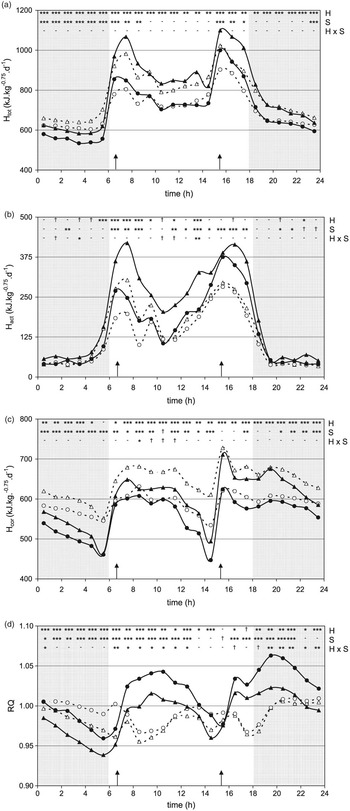
Circadian patterns in heat production and RQ are shown in Figure 1a–d. The higher H tot in S-housed pigs was partly due to a higher heat production corrected for activity (H cor, +49 kJ/kg0.75 per day, P < 0.001). Starch type did not affect H tot, but NS-fed pigs had a higher H cor (+46 kJ/kg0.75 per day) than PS-fed pigs (P < 0.001). Effects of starch type on H act depended on housing (housing × starch type interaction, P < 0.05): in B-housed pigs, H act was hardly affected by starch type (16.1% of H tot in B-housed/PS-fed pigs and 13.7% of H tot in B-housed/NS-fed pigs), whereas in S-housed pigs a profound difference between pigs on the P (21.1% of H tot) and N (15.0% of H tot) diets was found (Figure 1b). Both H tot and H act varied more over the 24-h cycle in PS-fed pigs than in NS-fed pigs (Figure 1a and b).
(a) Hourly means of total heat production (H tot, s.e.m. = 13), (b) activity-related heat production (H act, s.e.m. = 13), (c) heat production corrected for activity (H cor, s.e.m. = 7), and (d) respiration quotient (RQ, s.e.m. = 0.003) of pigs in barren housing (circles) or on straw bedding (triangles) fed a pregelatinised (solid lines, closed symbols) or native (dotted lines, open symbols) potato starch diet. Arrows indicate time of feeding. The dark period is indicated by a shaded background. Statistical significance of effects of housing (H), starch type (S) and their interaction (H × S) is indicated: †P < 0.10; *P < 0.05; **P < 0.01; ***P < 0.001.

When energy expenditure was expressed as a proportion of ME intake, the effect of housing on H cor/ME was not significant, whereas the effect of starch type remained (P < 0.001). Effects of housing and starch type on H act/ME (P < 0.001 and P < 0.01, respectively) were similar to effects on absolute levels as presented in Table 3.
Both RQ and fluctuations in RQ over the 24-h cycle were higher in PS-fed than in NS-fed pigs, but these effects of starch type were larger in B housing than in S housing (housing × starch type interaction, P < 0.05). During the postprandial periods, PS-fed pigs in B housing showed a rapid increase in RQ, whereas in the other groups, RQ increased less (PS-fed/S-housed pigs) or not at all (NS-fed pigs) after meals. In the hours before the first meal, RQ was lower in PS-fed pigs than in NS-fed pigs, and lower in B-housed pigs than in S-housed pigs (Figure 1d).
Discussion
In the present study, energy partitioning of pigs fed either PS or NS in the diet was studied in two different housing environments, barren (B) or enriched with straw bedding (S).
Effects of housing
By supplying pigs with straw bedding, not only a different housing condition was provided compared to the barren environment but also the possibility for unrestricted intake of straw. Based on two different methods, straw intake in this study was estimated to be between 143 and 234 g DM/day in the PS-fed pigs, and between 96 and 156 g DM/day in the NS-fed pigs (Staals et al., Reference Staals, Bolhuis, van den Brand and Gerrits2007), indicating that substantial amounts of the bedding were ingested. Several studies reported that the digestibility and/or metabolisability of straw, which contains high lignin and cellulose levels, are zero or even negative for growing pigs (Shi and Noblet, Reference Shi and Noblet1993; Schrama and Bakker, Reference Schrama and Bakker1999; Noblet and Le Goff, Reference Noblet and Le Goff2001; De Lange et al., Reference De Lange, Van Milgen, Dubois and Noblet2006). In contrast, in the present study, straw ingestion resulted in an increased ME intake. Pigs in our study were, however, habituated to the experimental conditions for 30 days prior to the assessment of energy partitioning, which is much longer than the adaptation period used in other studies (e.g. 12 days in Shi and Noblet, Reference Shi and Noblet1993; Schrama and Bakker, Reference Schrama and Bakker1999 and 10 days in De Lange et al., Reference De Lange, Van Milgen, Dubois and Noblet2006). As it has been found that volatile fatty acid (VFA) absorption increased up to 21 to 28 days following intake of a high-cellulose diet in growing pigs (Giusi-Perier et al., Reference Giusi-Perier, Fiszlewicz and Rérat1989), the difference in length of the adaptation period could partly explain the discrepancy between the current and other studies in ME resulting from straw intake. In addition, effects of straw intake on the utilisation of other dietary components cannot be excluded (see Staals et al., Reference Staals, Bolhuis, van den Brand and Gerrits2007). The manner and form in which the straw was provided may be important in this respect. In our study long, unchopped straw was provided as bedding material, whereas in other studies straw was mostly milled and included in the diet.
The increased ME intake related to straw ingestion compensated for the higher heat loss in straw-housed pigs. Consequently, total ER did not differ from that of pigs in barren housing.
Surprisingly, ER as protein was higher in pigs on straw bedding than in B-housed pigs, at the expense of a lower fat retention, suggesting that enrichment of pens with long, unchopped straw may result in leaner pigs. Apparent faecal nitrogen digestibility was, however, much lower in S-housed pigs than in B-housed pigs in the present study (Staals et al., Reference Staals, Bolhuis, van den Brand and Gerrits2007). This likely results from a shift from excretion of nitrogen from urine to faeces due to an increased amount of fermentable substrate in the colon (Heijnen and Beynen, Reference Heijnen and Beynen1997; Canh et al., Reference Canh, Sutton, Aarnink, Verstegen, Schrama and Bakker1998), and may therefore not be present at the ileal level.
It is unknown whether the effect of straw bedding on protein and fat retention should be attributed to an influence of straw as rooting material, increasing the activity levels of the animals, or to an influence of straw intake. Both activity patterns and straw ingestion potentially influence nutrient utilisation via effects on transit time (Filer et al., Reference Filer, Andersen and Cotton1986; Latymer et al., Reference Latymer, Low, Fadden, Sambrook, Woodley and Keal1990). Other studies (Schrama and Bakker, Reference Schrama and Bakker1999; De Lange et al., Reference De Lange, Van Milgen, Dubois and Noblet2006), however, reported no changes in protein or fat deposition in growing pigs that were offered milled or chopped wheat straw in the diet. It is therefore more likely that the lower fat deposition in S-housed pigs as compared to B-housed pigs, reflected in a lower postprandial increase in RQ on the PS diet, is related to the higher postprandial activity levels of pigs on long straw bedding. In humans, postprandial (light) exercise has been shown to blunt the postprandial plasma glucose increase and fat synthesis (Høstmark et al., Reference Høstmark, Ekeland, Beckstrøm and Meen2006) and to increase fat oxidation (Matsuo and Suzuki, Reference Matsuo and Suzuki1999). Further research will have to elucidate how the availability of straw, due to either its behavioural or its nutritional effects, alters fat and protein metabolism in growing pigs.
Straw provision also influenced fermentation processes of the two different diets, as indicated by the interactive effect of housing and starch type on methane emission. Several studies have reported a positive relationship between endogenous methane production and quantities of fermentable carbohydrates provided (Jensen and Jørgensen, Reference Jensen and Jørgensen1994; Jensen, Reference Jensen1996; Schrama et al., Reference Schrama, Bosch, Verstegen, Vorselaars, Haaksma and Heetkamp1998). In the present study, however, methane production was highest in the B-housed/PS-fed pigs and lowest in the S-housed/NS-fed pigs. This effect could not be attributed to methane emission from manure or manure with straw, which accounted for less than 2% of the total methane emission. Others (De Lange et al., Reference De Lange, Van Milgen, Dubois and Noblet2006) also reported a decrease in methane losses in pigs following ingestion of straw, and suggested either that straw reduces fermentation by methanogenic bacteria or that some of the methane produced might be adsorbed by faecal material of the pigs. NS consumption did not increase methane emission as compared to PS, possibly due to a high production of propionic acid relative to other fermentable carbohydrates (Awati et al., Reference Awati, Bosch, Tagliapietra, Williams and Verstegen2006).
Effects of starch type and its interaction with housing
ER was lower in NS-fed pigs than in PS-fed pigs, mainly due – at least in B-housed pigs – to a lower metabolisability of the NS diet. This low availability of energy from the NS diet is in line with studies reporting a low digestibility or metabolisability of raw potato (starch) (Hoffmann et al., Reference Hoffmann, Jentsch and Schiemann1990; Van der Meulen et al., Reference Van der Meulen, Bakker, Bakker, De Visser, Jongbloed and Everts1997; Martin et al., Reference Martin, Dumon and Champ1998). NS-fed pigs also showed a higher energy loss as heat corrected for activity as compared to pigs fed enzymatically degradable starch, likely reflecting a less efficient utilisation of fermentative end-products (Shi and Noblet, Reference Shi and Noblet1994; Jørgensen et al., Reference Jørgensen, Zhao and Eggum1996).
Part of the lower efficiency of the NS diet was, however, compensated for by a reduced energy expenditure on physical activity, in accordance with the results of Schrama and Bakker (Reference Schrama and Bakker1999). A similar reduction in activity-related heat production was observed in restrictedly fed growing pigs when sugar beet pulp was added to their diet (Schrama et al., Reference Schrama, Verstegen, Verboeket, Schutte and Haaksma1996 and Reference Schrama, Bosch, Verstegen, Vorselaars, Haaksma and Heetkamp1998; Rijnen et al., Reference Rijnen, van den Borne, Schrama and Gerrits2003). Notably, in the present study, the effect of starch type on activity-related heat production depended strongly on housing conditions. Activity-related heat production was remarkably high in S-housed, PS-fed pigs, much higher than in NS-fed pigs on straw bedding, whereas the effects of starch type were less obvious in barren housing. Effects of NSP and RS on activity-related energy expenditure have been attributed to fermentation processes (Schrama and Bakker, Reference Schrama and Bakker1999). In contrast with the rapid digestion of enzymatically degradable starch, fermentation of RS may continue for many hours after feeding, resulting in a more gradual supply of energy (Asp et al., Reference Asp, Van Amelsfoort and Hautvast1996; Van der Meulen et al., Reference Van der Meulen, Bakker, Bakker, De Visser, Jongbloed and Everts1997). In our study, this was reflected in the distinct circadian patterns in RQ and heat production of pigs on the two different diets. In PS-fed pigs, RQ increased rapidly after feeding, exceeded 1 for a substantial period and remained relatively high for at least 6 h, suggesting the enhanced oxidation of carbohydrates and de novo fatty acid synthesis, which is expected in the absorptive period of a highly digestible diet (Jakobsen and Thorbek, Reference Jakobsen and Thorbek1993; Achour et al., Reference Achour, Flourié, Briet, Franchisseur, Bornet, Champ, Ramboud and Messing1997; Wenk et al., 2001). Pigs on the NS diet showed, in contrast, relatively small fluctuations in heat production and RQ within the 24 h cycle. RQ was rather high in these pigs during the nightly hours before the first meal, likely reflecting the oxidation of absorbed VFAs, and, particularly in barren housing, de novo fatty acid synthesis from VFA. The gradual and prolonged supply of energy from fermentation of RS potentially increases periods of satiety (Heijnen et al., Reference Heijnen, Deurenberg, Van Amelsfoort and Beynen1995; Achour et al., Reference Achour, Flourié, Briet, Franchisseur, Bornet, Champ, Ramboud and Messing1997; Haralampu, Reference Haralampu2000). As feeding motivation seems to increase the physical activity of pigs (Jensen et al., Reference Jensen, Kyriazakis and Lawrence1993; De Leeuw et al., Reference De Leeuw, Jongbloed, Spoolder and Verstegen2005), fermentation processes could therefore be largely responsible for the reduced activity-related heat production in NS-fed pigs, apart from possible specific effects of fermentation products on activity patterns (Schrama and Bakker, Reference Schrama and Bakker1999).
Pigs housed on straw bedding dedicate most of their active time to straw-directed foraging behaviours such as nosing, rooting and chewing (Beattie et al., Reference Beattie, O’Connell, Kilpatrick and Moss2000; Bolhuis et al., Reference Bolhuis, Schouten, Schrama and Wiegant2005). The high activity level of straw-housed pigs on the PS diet may therefore have reflected an increase in foraging behaviour, possibly due to decreased interprandial satiety as compared with straw-housed/NS-fed pigs. This is supported by the higher DM intake from straw in PS-fed pigs as compared to NS-fed pigs observed in this study (Staals et al., Reference Staals, Bolhuis, van den Brand and Gerrits2007). Interprandial satiety in B-housed pigs may also have been lower for animals on the PS diet compared to those on the NS diet. However, barren-housed pigs on the PS diet did not have an outlet for their increased motivation to display foraging behaviour, because a suitable substrate was lacking in the B pens. This might explain why effects of starch type on activity-related heat production were lower in B-housed pigs than in pigs on straw bedding.
In conclusion, the present study shows that the availability of both straw bedding and dietary starch type, fermentable or digestible, affects energy utilisation and the physical activity of restrictedly fed pigs. The effects of housing condition on protein and fat deposition suggest that enrichment of pens with long straw may result in leaner pigs. Moreover, the relative impact of starch type on activity-related heat production depends on housing conditions of the pigs under study. The lower energy expenditure on the physical activity of pigs on the NS diet, which was most obvious in straw-housed pigs, likely reflects a decrease in foraging behaviour related to a more gradual supply of energy from fermentation processes.
Acknowledgements
The financial contribution of Cehave Landbouwbelang bv, Veghel, The Netherlands, and the assistance of Fleur Bartels, Yvonne van der Horst and the personnel of experimental farm ‘De Haar’ is gratefully acknowledged.