I. Introduction
THE vast increase in labor migration to Gulf Cooperation Council (gcc) states over the past half century is among the most notable trends in global migration.Footnote 1 A combination of oil wealth, rapid economic development, and small native populations initiated a major shift in labor movement toward these countries that has only accelerated in recent decades.Footnote 2 This trend is of massive significance: the six gcc countries today host nearly thirty-one million migrants, accounting for 11 percent of global totalsFootnote 3 and a similarly outsized proportion of remittances.Footnote 4 How do citizens in such states view this huge, and yet essential, flow of foreign workers?
Although researchers have established a sophisticated set of theories to explain individual-level preferences over migration, these theories were largely developed from a Western perspective with its attendant cultural outlook and policy framework. Yet South-South migration, a growing segment of global migration flows,Footnote 5 is distinct both in relative impact (foreign laborers serve as a critical component of the economic growth model in many such states) and in policy. Migrants in such states typically have fewer rights and legal protections, and, importantly, lack a viable path to citizenship—a sharp departure from the Western model, where migration is often viewed through the long-term lens of its impact on future demographics. These patterns are exemplified by the states of the Arabian Gulf, where the growth model is entirely dependent on the kafāla system of foreign labor (employer sponsorship that turns residency into a contractual feature and removes the prospect of naturalization), and migrant workers make up a substantial—even majority—percentage of the total population.
In this article, I demonstrate that a Western perspective obscures important global differences in attitudes regarding migration policy. The findings presented from Qatar diverge starkly from studies conducted in the US and Europe, validating predictions from the labor market competition hypothesisFootnote 6 and undercutting the consensus preference for skilled migrants. In other words, Gulf citizens do not share the same attitudes about these issues as their Western counterparts.
I develop an application of the labor market competition hypothesis to the Gulf context, with its small, primarily white-collar native workforce, as well as a set of expected sociotropic preference predictors in light of the distinct policies and practices regarding migration in gcc countries. I then test the predictions using individual-level survey data. I first exploit a survey experiment to obtain causal estimates of Qatari preferences regarding migrants of different skill levels. The survey design and experimental manipulation allow for a direct test of the labor market competition hypothesis, using the predicted moderating variables of skill level and employment status. They also facilitate the use of mediation analysis to decompose the overall treatment effect into the array of sociotropic cultural and economic factors that underlie policy preferences toward differing classes of migrant.
In Qatar, there is no broad consensus against blue-collar workers. In a notable departure from studies conducted in Europe and North America,Footnote 7 my results show that respondents express no preference for high- versus low-skilled migrants. And the often-maligned predictions of the labor market competition theory obtain in this context: for Qataris in the labor force, education is associated with a significant decrease in support for skilled foreign laborers as compared to unskilled foreign laborers.
I also present a novel application of mediation analysis to decompose the attitudinal factors generating the null treatment effect on migrant skill level. I find that Qataris’ impartiality is not driven by indifference, but rather by competing social, cultural, and economic considerations related to blue- and white-collar workers. I report causal evidence that different types of migrants evoke divergent sources of concern regarding their impact on the fabric of Qatari society and on local resources, public goods, and jobs. The mediation analysis suggests that many of these national-level apprehensions translate into policy preferences. Notably, the job competition threat posed by high-skilled migrants is substantial enough to nullify the other cultural and economic issues associated with low-skilled workers, resulting in net indifference regarding white- versus blue-collar foreigners. This analysis helps to clarify the surprising null finding on the high-skilled treatment condition, but also illustrates a methodological approach that can be used in other contexts to tease out how attitudinal measures map onto policy preferences.
To my knowledge, my research is the first test of the labor market competition model in the Gulf region and a rare example of its predictions obtaining across a nationally representative sample. To what should we attribute its relevance in this context? The Gulf states, and Qatar in particular, represent a global migration extreme.Footnote 8 Foreign workers have permeated all sectors of the labor force—public and private. The outsize foreign population means that natives are almost certain to have personally encountered non-natives in the workplace and in daily life.Footnote 9 This wide-ranging exposure to foreign workers across all sectors is distinct from most developed nations, in which foreign workers are typically concentrated in specific sectors and represent a small fraction of the overall workforce. We might interpret the findings here as evidence that due to the high ratio of migrants to natives in the workforce, labor market competition affects and is salient across the Qatari labor force as a whole.Footnote 10 The study thus complements other research uncovering evidence of a targeted effect of the labor market competition model in sectors of high exposure,Footnote 11 suggesting that gcc states serve as an example of foreign labor competition writ large.
These results reveal the value of adapting existing theories to address the diverse range of migration contexts today, as empirical trends in favor of primarily cultural explanations for migration preferences may be driven more by similarities in study settings than by homogeneity in global preferences. Migration in the Gulf is a major global phenomenon in its own right and is deserving of scholarly attention. And although labor movement and policies in the region differ substantially from patterns in oecd states, they are comparable to those of other small, developing contexts where the growth model depends on a large influx of foreign labor but where migration is temporary and devoid of citizenship rights. Contexts where such conditions apply include a number of East Asian recipient settings, such as Hong Kong, Singapore, and Malaysia.Footnote 12 Future research might replicate the analysis from this article in such contexts to see whether the findings travel. Taken collectively, the results demonstrate the increasing importance of broadening theoretical expectations and the empirical contexts in which they are tested to better reflect shifting trends in global migration.
II. Migration in the Gulf
The presence of foreign labor is of critical economic importance in gcc countries, which have seen a major transformation over the past century. After the discovery of oil and natural gas reserves in the region, the founding of opec and subsequent increases in oil prices set off a spate of rapid economic growth in these resource-rich nations. The expanding infrastructure required substantially more labor than could be supplied by countries’ small, native populations. As a result, the region saw a rising flood of foreign workers, first from other Middle Eastern states and, in recent years, increasingly from South and Southeast Asia.Footnote 13 As of 2021, the six gcc countries hosted approximately 30.8 million foreign workers—more than 50 percent of the total resident population.
These workers are an essential driver of economic development in the region, and yet the massive population influx has not been met with unfettered enthusiasm among locals. A UN survey found that citizens in four out of the six countries felt that immigration levels were too high.Footnote 14 All gcc states have significant foreign populations, but the phenomenon is most severe in Qatar, which has only around three hundred thousand citizens but hosts more than two million expatriates.Footnote 15
Foreign workers in Qatar come via two distinct pipelines. The majority are unskilled or semiskilled laborers working in blue-collar occupations (including factory workers and construction labor), while roughly one-quarter occupy white-collar, professional positions across all sectors of the economy, from foreign-operated oil and natural gas conglomerates to the Qatari civil service. The high ratio of foreigners to locals means that non-Qataris are a majority in both the public and private sectors.
The migrant population in the Gulf is also characterized by its temporary nature. In general, workers enter the country on contracts of a few years’ duration that may be extended or terminated with little notice. Migration is governed by the kafāla system of employer sponsorship noted above.Footnote 16 Many of the gcc countries have no legal framework for naturalization, and those that do have instituted highly restrictive laws that were registered only recently and that have conditions that the vast majority of migrants find impossible to satisfy. In Qatar, for example, a recent law specifies that non-nationals must have resided in the country for at least twenty-five consecutive years (with no more than two consecutive months spent elsewhere) before they become eligible for citizenship.Footnote 17 Even then, only fifty foreigners may naturalize each year. In this way, Gulf migration is distinct from that in the West, which often includes a path to permanent residence for workers and their families.
Migrant workers are primarily male; women make up only 17.5 percent of the non-Qatari population over the age of fifteen.Footnote 18 On average, migrant workers are less educated than the native population: 16 percent of non-Qataris have university degrees compared to 33 percent of Qataris. Precise statistics on migrants’ countries of origin are challenging to obtain, but estimates suggest that a large majority of workers, particularly in the blue-collar population, are from South Asia (including India, Bangladesh, and Nepal), with a smaller number emigrating from the Philippines.Footnote 19 An estimated 10 percent of migrants come from other Arab countries.Footnote 20 Finally, roughly 3 percent of the migrant population originates from Europe, North America, or Australia.Footnote 21 The Arab and Western migrants are primarily employed in white-collar jobs, although neither group dominates this category.
III. Attitudes toward Immigrants: Existing Explanations
A large literature explores predictors of immigration preferences and the extent to which they correspond with other attitudes toward trade. Theoretical explanations can be categorized as identifying the economic or sociocultural threat of migrants; they also differ in whether these threats manifest at the individual or societal level. In this section, I review these explanations and the empirical evidence supporting them.
Opposition Based on Economic Self-Interest
Migration flows are driven by economic incentives, and it follows that some theories explaining preferences over migration thus emphasize economic factors.Footnote 22 There are two primary explanations based on individual self-interest: a labor market competition hypothesis grounded in a factor proportions model (a model characterizing the macroeconomic implications of the relative abundance or scarcity of factors of production) and a fiscal burden explanation that emphasizes migrants’ demands on public goods. The first approach, based on an assumption that migrant workers are perfectly substitutable for locals, argues that labor conditions are a function of supply. An influx of foreign low-skilled workers thus increases labor market competition for native low-skilled workers, depressing wages in that sector and having the reverse effect in the alternative sector.Footnote 23 This theory predicts individual opposition to immigrants will vary with the skill level of respondents and that of prospective migrants: natives oppose the presence of foreigners with their same skill level, but support expanding the pool of immigrants with skill levels other than their own.
The second approach focuses on the impact of immigration on individual posttax income and transfers. The presence of low-skilled migrants may increase pressure on public spending, leading to an increase in taxes or a reduction in per capita public goods.Footnote 24 The empirical predictions depend on the expected policy response to migration, particularly of low-skilled workers. For example, in states with progressive tax rates, high-income individuals (those with the largest tax burden) should oppose increasing the number of low-skilled migrants.Footnote 25 Alternately, in scenarios where welfare funding is fixed, low-income individuals should oppose opening borders to low-skilled migrants who might compete for the state-supplied resources on which they rely.
The political economy approach has generated clear, testable predictions, but in general, these predictions have failed to produce empirical consensus. Although some studies have shown that high-skilled respondents, as measured through their education level, are more supportive of immigration in countries where most migrants are low-skilled,Footnote 26 analysis of survey data that experimentally differentiates between high- and low-skilled migrants using treatment frames or conjoint manipulation of migrant attributes has been less supportive of the labor market hypothesis: high-skilled natives are shown to be more supportive of all types of immigration,Footnote 27 and high-skilled migrants are almost universally preferred.Footnote 28 This ambiguity suggests that if the factor proportions model is correct, its influence is limited by countervailing sociotropic factors,Footnote 29 such as the broader impact of education,Footnote 30 which may alter individuals’ cultural values to reduce ethnocentrism or to increase their understanding of the potential benefits of migration to the economy writ large.Footnote 31 The fiscal burden explanation has also generated mixed results. Gordon Hanson, Kenneth Scheve, and Matthew Slaughter demonstrate that support for immigration is reduced in US states with high fiscal exposure;Footnote 32 Elias Naumann and Lukas Stoetzer find that information about the amount of immigration can lead high-income respondents to reduce their support for redistributive policies,Footnote 33 but other studies find no evidence that fears of fiscal threat at the individual level drive preferences.Footnote 34
National-Level Threats
A second set of theories argues that individuals consider the national effects of immigration rather than its implications for them personally. These sociotropic considerations include economic and cultural concerns. For example, studies have found that negative beliefs about the national economyFootnote 35 and perceived immigrant threats to the national languageFootnote 36 are each associated with support for reducing immigration.
Nationalist impulses and cultural biases are strong predictors of restrictionist attitudes, and there is consistent empirical evidence demonstrating their importance in observational studies. Negative opinions about groups are associated with opposition to immigration,Footnote 37 and the same relationship is observed for symbolic threats based on religion, language,Footnote 38 or simply group identity.Footnote 39 Similarly, the common finding that education predicts more support for immigration can be interpreted as consistent with the factor proportions hypothesis in some contexts, but it may also be an indicator of reduced xenophobia. As discussed above, education may be a bundled treatment with respect to migration preference.
Studies have also examined economic considerations. In one cross-temporal study, scholars found that opposition to immigration increases during economic downturns.Footnote 40 Other work has explored the impact of the welfare state, finding that more social programming is associated with reduced nativist sentiments.Footnote 41
One limitation of this evidence is that little of it is causally identified, and there are reasons to think that selection issues confound the distinction between economic and cultural fears.Footnote 42 One experimental study has shown that “culturally threatening cues” have a larger impact on attitudes than economic cues among Dutch respondents.Footnote 43 But cultural findings in particular may be highly contextual and reflect specific fears within the Western experience, where most migration research has been conducted.Footnote 44
Both the individual-level and sociotropic explanations described above were largely developed to fit the Western model of migration and have been primarily tested in oecd contexts. Although this has generated an impressive body of scholarship, the economic and cultural circumstances differ from those of recipient countries in the Global South in a number of important ways. For example, the fiscal burden predictions are premised on a citizen tax burden or the assumption that foreign workers (and their families) have access to the state-provided welfare net.Footnote 45 The total amount of migration and its permeation of the labor market may be a conditioning element for the factor proportions model. In oecd states, where migrants make up a relatively small proportion of the total workforce, individuals may feel less of a personal threat to their jobs. Indeed, scholars have found the labor market predictions hold in more localized tests in sectors or among worker populations that are particularly vulnerable to foreign competition.Footnote 46 In addition, negative attitudes toward low-skilled migrants or certain ethnic populations may be driven in large part by the long-term and chained nature of migration in these settings. Citizens may fear the demographic change wrought by offering not just one laborer, but possibly that laborer's extended family and any bad apples therein, a chance at permanent residency. Attitudes may be quite different in a context where migration is exclusive to the laborer only, predicated on continued employment and subject to immediate expulsion should the laborer violate any local regulations.
IV. Applying Existing Theories in the Gulf
With the understanding that migration within the Global South differs substantially from migration within oecd states in both economic significance and labor policy, it is important to carefully consider how the preceding theoretical constructs apply in such contexts. In this section, I discuss the relevance of individual-level and sociotropic explanations to the Gulf context, beginning with the labor market competition model. I do not evaluate the individual-level fiscal burden model because there is no personal income tax in Qatar and citizens do not compete with foreign workers for government assistance.Footnote 47
I first consider whether it is plausible that Gulf citizens view migration through the lens of their personal workplace exposure. Although Qatari citizens hold a privileged position within the local labor force, the sheer number of migrants means they experience a high degree of personal workplace exposure to foreigners. Qataris in the labor force are employed largely in white-collar positions (81 percent) and in the public sector,Footnote 48 which operates as a safety net for Qatari citizens.Footnote 49 The majority of migrants, by contrast, are low-skilled workers in private sector employment. Yet the population imbalance means that numerically, non-Qataris dominate every segment of the workforce—both in public and private employment.Footnote 50 Working Qataris are, as a result, nearly certain to encounter foreigners on a regular basis. In the survey data that follow, nearly 70 percent of respondents with part- or full-time jobs reported having non-Qatari coworkers.
Does this translate into increased labor market competition for Qataris? There are a number of reasons to expect it to. It is particularly difficult for Qataris to penetrate the private sector.Footnote 51 To do so, they must compete with a large influx of highly qualified foreign workers, which has the dual effect of limiting native access to prestige employment and depressing wages in this sector. On the first point, foreign workers dominate in elite jobs. In 2013, 80 percent of management positions were held by non-Qataris.Footnote 52 Qataris are in some cases personally subordinate to non-natives. In the survey described below, 11 percent of employed respondents reported having a non-Qatari direct supervisor. With respect to wage effects, although public sector wages are typically fixed by policy, private sector compensation is a function of market supply and demand. The outsize presence of foreign workers negatively affects private sector wages, reducing the appeal of such jobs for natives and increasing their dependence on the availability of public sector employment.Footnote 53 Additionally, public sector employment is an insufficient fail-safe in practice. Although Qataris can rely on preferential treatment in state hiring,Footnote 54 the low number of vacancies in an already bloated civil service creates a long wait time for government jobs and contributes to unemployment among natives.Footnote 55 As a result, Qatari nationals active in the labor force may well be concerned about the impact of migrants with respect to private sector access, job availability, and wage rates. And the extremely high level of personal exposure to foreign workers suggests that this issue should be a more broadly salient consideration there than in contexts in which foreigners make up a small fraction of the labor force.
I therefore expect predictions from the factor proportions model to obtain, subject to the specificity of the context. Personal vulnerability to wage competition requires an individual to be active in the labor force. Due to Qatar's wealth and cultural norms, a large percentage of Qataris (roughly half the adult native populationFootnote 56) are not active in the labor force.Footnote 57 It is therefore especially important in this case to condition on employment status. Conditional on employment, however, I expect that skill level will predict attitudes toward foreign workers. In particular, consistent with the labor market competition model predictions, high-skilled Qataris within the labor force should support decreasing the number of high-skilled (relative to low-skilled) migrants.
I next examine the role of national-level considerations in determining preferences. These may differ based on the type of migrant under consideration. White- and blue-collar migrants in Qatar are distinguished by more than just skill level. The former category is more diverse (and includes more Arab migrants) and makes up a minority of the overall pool of foreign workers. White-collar workers are also more likely to be integrated into society, to live in proximity to citizens, and to interact with them as coequals in the workplace. In reviewing potential sociotropic concerns, I thus characterize how they might apply to the two classes of migrant. I also consider that migrants have no viable path to citizenship and that, at the individual level, their migration is temporary.
In the collective, however, the sheer number of migrants has an important impact. Qatari citizens are a culturally homogeneous group of Arab Muslims, yet they comprise less than 15 percent of total residents. Temporary migrants may not change the demographics of what it means to be Qatari, but they exert an unavoidable influence on how it feels to be Qatari. A vast number of migrants live and work among the native population in service positions, public sector jobs, and other highly visible occupations. The increasingly non-Arab demographics mean that English is becoming the lingua franca of everyday life and used, for example, when ordering at restaurants, directing taxi drivers, and working in some offices.Footnote 58 And the shift to South Asia as a source of workers has resulted in an influx of non-Muslim laborers, a problematic reality in a nation with a strong religious identity.
I therefore expect the perceived cultural threat posed by migrants to be a predictor of migration preferences. Specifically, Qataris who view foreign workers as threatening cultural norms should be more opposed to allowing those workers entry. But this effect may be moderated by the cultural proximity of the migrants in question, following evidence in other contexts that such migrants are preferable to those from more culturally distinct settings.Footnote 59 As a result, I predict that Qataris will be more supportive of migration from other Arab states due to their shared language and, in many cases, religious traditions. Both white- and blue-collar workers may pose a threat to their identity, but because the latter are more numerous and more likely to be non-Arab, they may be seen as the greater cultural threat.
Sociotropic economic issues also have application to the Qatari context. As mentioned above, the public safety net in Qatar is robust and funded by resource wealth rather than by taxation. Personal vulnerability to welfare concerns is thus unlikely to determine preferences among citizens, but the broader concern that Qatar is spending its resource wealth on outsiders remains relevant. Although non-citizens are excluded from a number of the most generous state-provided services (including occasional stipends as well as substantial housing assistance/land grants), they still benefit from state spending in the form of subsidies, which include healthcare through public health servicesFootnote 60 as well as fuel and other commodities. And while social services like public education spending are primarily restricted to citizens,Footnote 61 Arabic-speaking migrants employed in the public sector are eligible to enroll their children in state schools.Footnote 62 In general, then, although Qatar's per capita spending on citizens is far greater than on noncitizens, that migrants outnumber citizens by a ratio of about seven to one means their impact on state resources is nontrivial. As with cultural concerns, then, I expect sociotropic considerations about the economic burden of migrants on the state to predict preferences toward migration. I predict that Qataris will assess migrant classes based on their perceived effect on state resources, and that more perceived strain will correspond with support for reducing migration. Again, a larger population of blue-collar workers may pose a greater burden on available resources.
Moreover, concerns about labor competition and job availability may also matter. I discussed the impact of migrants on individual job prospects above; I expect a similar set of considerations to apply in a sociotropic sense. On this metric, the distinction between migrant classes is clear. White-collar migrants’ skill levels put them in competition with locals in the native job market, and they thus pose the greater threat in this regard.
To summarize, because of the high level of citizen exposure to foreign workers, I expect the labor market competition hypothesis to obtain for Qataris active in the labor force. Specifically, Qataris with high levels of education should be more opposed to increased white-collar migration and more tolerant of blue-collar migration. I also expect sociotropic concerns to be relevant with respect to cultural and economic factors, as migrants represent an ethnolinguistic threat to Qatari daily life, a drain on social services and resources, and a point of pressure on the (white-collar) native job market. In addition, the nature of sociotropic threat may vary by class of migrant given the differing demographics; I elaborate more on these considerations in section VI below.
V. Data and Methodology
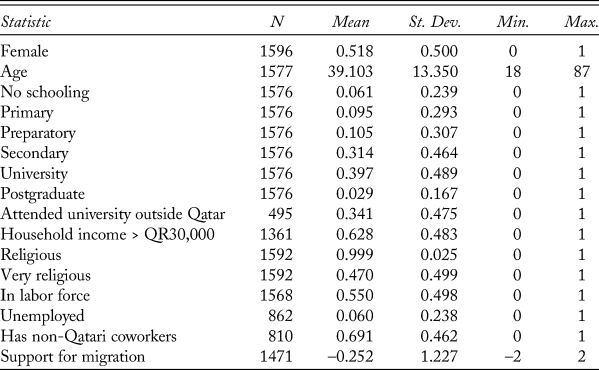
The data for these analyses are from an individual-level survey on attitudes toward foreign migrants conducted in Qatar in 2012 by the Social and Economic Survey Research Institute (sesri) at Qatar University.Footnote 63 The survey was administered to a total of 1,596 Qatari nationals comprising individuals who lived in residential housing units during the survey period.Footnote 64 The sampling procedure was designed to elicit a nationally representative sample, and there is no sign this was not successful. A review of respondents’ demographic characteristics reveals little evidence of systematic bias, and the question response rate among respondents is very high. Summary statistics from the survey are shown in Table 1, and I compare a subset of survey demographics to national indicators in section A1 of the supplementary material.Footnote 65
Summary Statisticsa

a Table presents summary statistics for key respondent characteristics. With the exception of age (numeric) and support for migration (on a five-point scale from –2 to 2), all variables are dummy indicators.
The survey questions were divided into two sections: a set of pretreatment covariates and demographic information followed by an experimental manipulation and series of attitudinal questions regarding migrants. This embedded experiment allows for causal estimation of the difference in native attitudes regarding high- and low-skilled migrants. The experimental design is closely related to that of Jens Hainmueller and Michael Hiscox.Footnote 66 In this iteration, respondents were randomly assigned to two different prompts preceding the primary outcome question regarding foreign migrants, distinguished as follows:
-
—Version 1. I would like to ask you a few questions about “blue-collar workers.” Blue-collar workers are non-Qatari workers who perform manual labor, such as manufacturing, construction, mechanical work, maintenance, etc.
-
—Version 2. I would like to ask you a few questions about “white-collar workers.” White-collar workers are non-Qataris who perform professional, managerial or administrative work from countries other than GCC.
In the analyses that follow, assigned treatment is coded as 0 for respondents who received the blue-collar frame and 1 for those who received the white-collar frame.Footnote 67 The prompt was followed by a question regarding policy toward migrants:
-
—Do you think the number of new [blue-collar/white-collar] workers allowed in Qatar each year should be increased a lot, increased a little, remain the same as it is, reduced a little, or reduced a lot?
This question is used as the main outcome variable in testing theories to follow. Responses are coded on a five-point scale ranging from –2 (reduced a lot) to 2 (increased a lot). Hence, positive values indicate support for increasing migration while negative values indicate respondents would like to decrease the number of migrants.Footnote 68
Random assignment ensured that the group of individuals receiving questions about blue-collar migrants was, in expectation, identical to the one receiving questions about white-collar migrants; in other words, no observable or unobservable characteristics should bias the difference in responses. I verify that these groups are equivalent using a balance check on a wide set of respondent characteristics and pretreatment attitudes (see Table A2 of the supplementary material). Overall, the results of the check suggest that randomization was successful in obtaining treatment groups that are balanced on a broad list of covariates: differences are small and, except in one case, insignificant at the 0.05 confidence level.
VI. Results
In this section, I present the results of regression analysis identifying predictors of support for increased migration. I first test the labor market hypothesis predictions. I then analyze the impact of sociotropic economic and cultural concerns regarding different classes of migrant. I use mediation analysis to identify the intervening factors through which the white- versus blue-collar frames may affect policy preferences.
Testing the Labor Market Hypothesis
I first explore the impact of the white-collar treatment relative to the blue-collar frame and test factor proportions model predictions in the distinctive Gulf labor environment. The model predicts opposition to high-skilled migrants will increase with a respondent's own skill level, and that this relationship is sensitive to individual employment status. I report direct effects of the treatment frame as well as interactions with the predicted moderating variables of skill level and participation in the labor market. As in many other studies,Footnote 69 skill level is approximated using a measure of respondent education.Footnote 70 Although some recent studies adopt alternative measures of skill based on respondent occupation,Footnote 71 that is not possible here because the data collected do not include this information.Footnote 72 Participation in the labor market is measured by responses to the question, “What is your current employment status?”, and is coded as 1 for respondents who indicated full or part-time employment or that they were seeking employment.Footnote 73 I also control for basic demographic characteristics (gender and age) in all except the first specification.
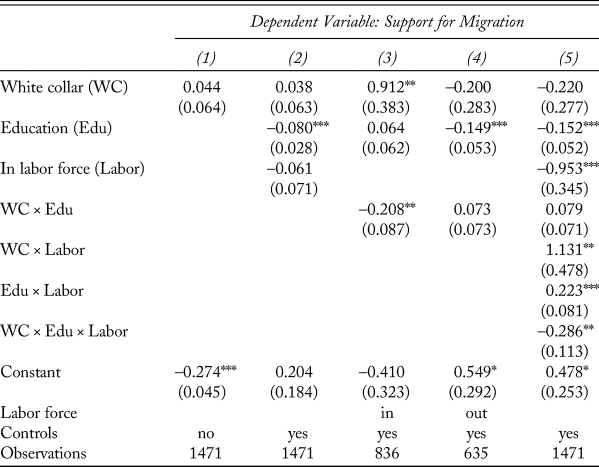
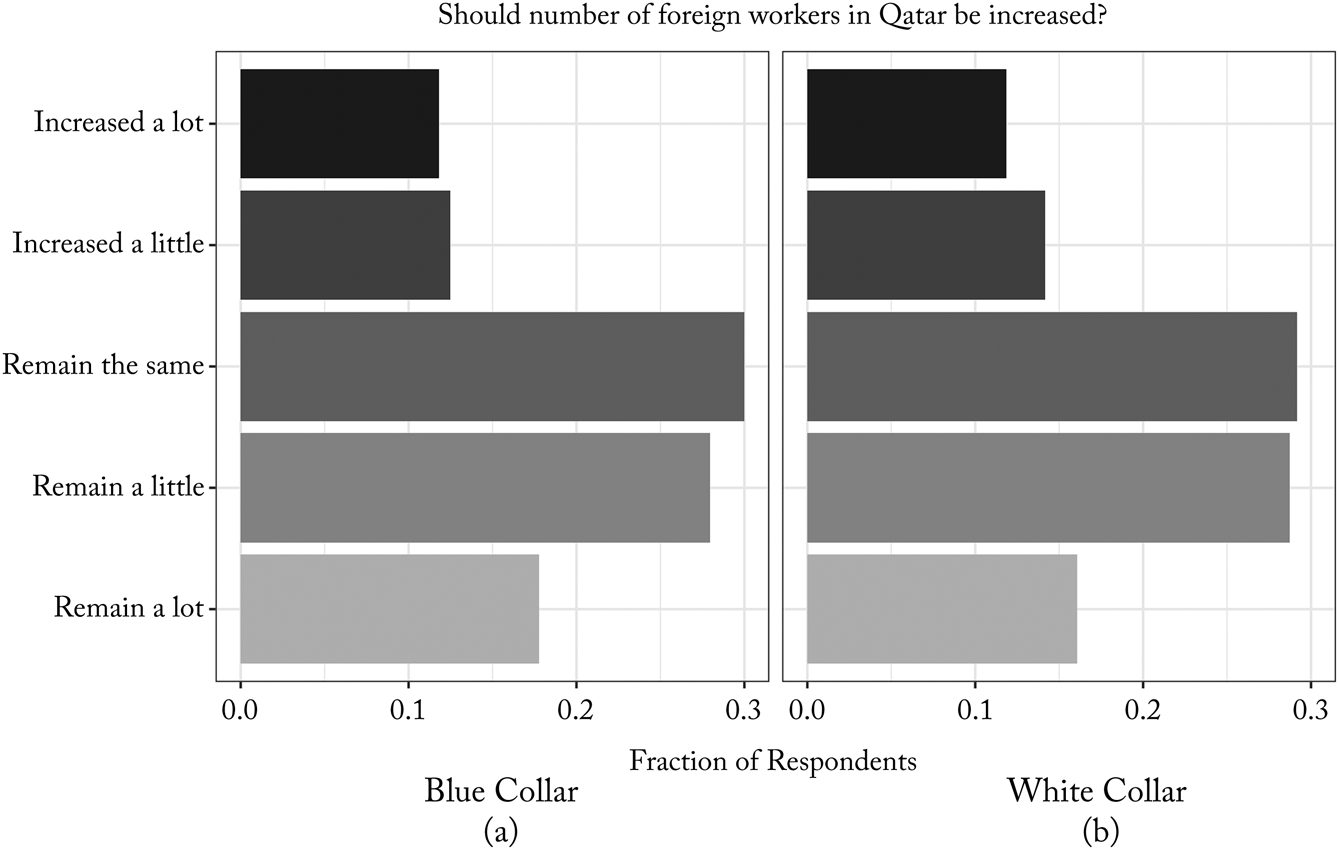
Results from ols regressions are reported in Table 2.Footnote 74 Models 1 and 2 present the direct effect of the white-collar frame, with and without controls for respondent background characteristics, on support for migration.Footnote 75 Of immediate interest is that unlike most Western respondents, Qatari nationals show no general preference for skilled workers: the white-collar treatment has an overall null effect on expressed migration preferences. For descriptive purposes, I also examine the distributions of responses to the two frames (see Figure 1). These are visually nearly identical, and a Kolmogorov-Smirnov test comparing the distributions reinforces this conclusion (p = 0.99). The coefficient on the white-collar frame is close to zero and does not approach significance even with controls. Additionally, where others have found that independent of treatment condition, education predicts increasing openness to immigration, for Qataris the opposite is true: educational attainment is associated with a decrease in support for migration in general (model 2).Footnote 76
Testing the Labor Market Hypothesisa

*p < 0.1; **p < 0.05; ***p < 0.01
a Coefficients represent estimates from OLS regression on the primary outcome variable; positive coefficients indicate increased support for migration. Standard errors are shown in parentheses. Where indicated, models include controls for respondents' gender and age. Models 3 and 4 are estimated on subsets including respondents active in and outside the labor force, respectively.
Support for White-Collar versus Blue-Collar Immigrationa
a Distribution of responses to the primary outcome variable; proportions are normalized within each treatment category.

I next conduct a split sample test to distinguish those Qataris who should be most directly affected by increased job competition with foreign workers,Footnote 77 examining the interaction between treatment frame and education first on respondents in the labor force (model 3) and then on those outside it (model 4). An important distinction emerges. For individuals who are not participants in the labor market, the interaction with education is positive and insignificant. But for those employed or seeking employment, the interaction term is negative and significant, consistent with localized factor proportions model expectations: as respondents’ skill level increases, their support for white-collar migration decreases, but only when they are themselves involved in the labor market. This suggests that as predicted, the prospect of job or wage competition posed by migrants is indeed a determinant of preferences for individuals who are personally exposed to such forces.
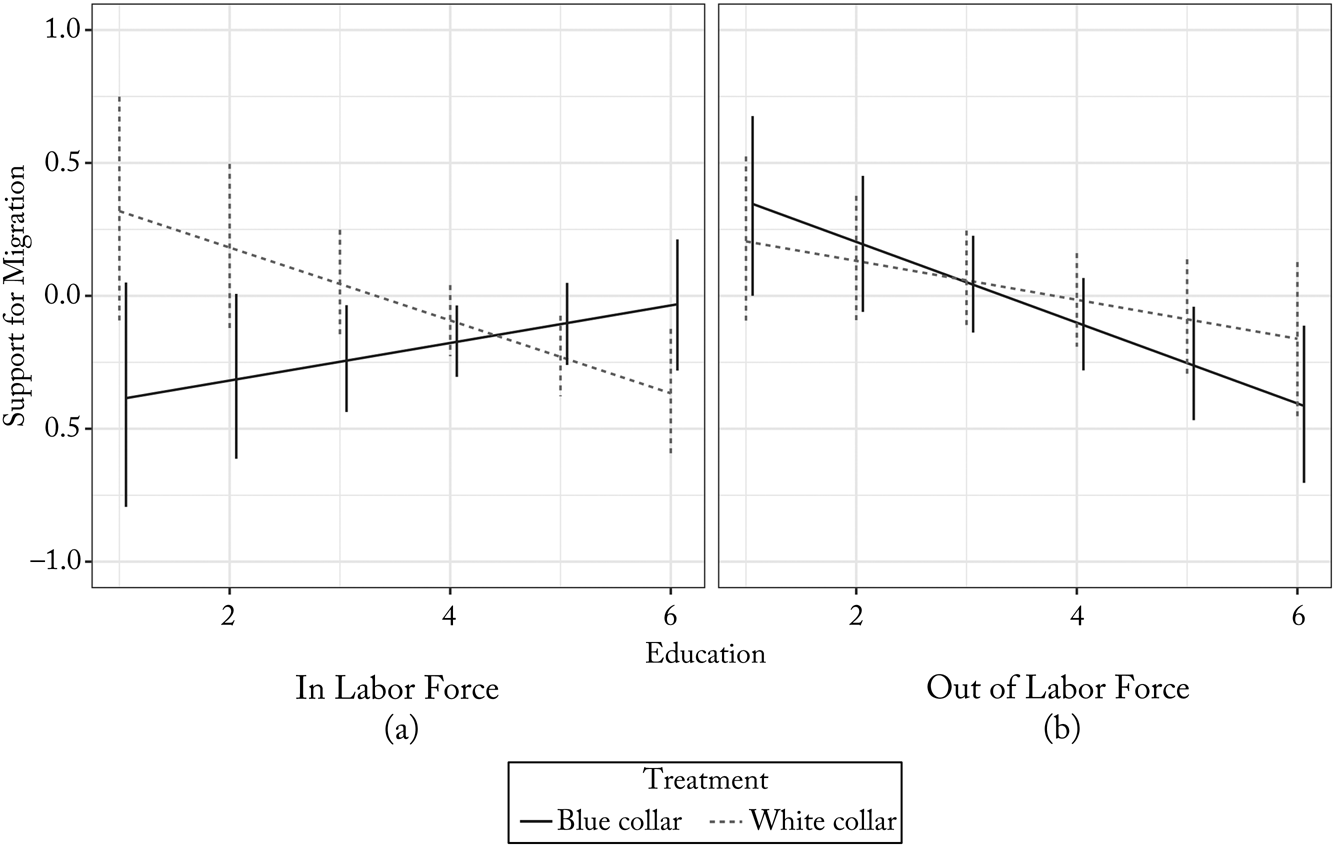
In model 5, I introduce a three-way interaction between the white-collar frame, education, and labor force variables. In it, the coefficient of interest is the triple interaction: essentially a comparison of the white-collar-by-education interaction terms across models 3 and 4. The triple interaction term is negative and significant, confirming that educated Qataris in the labor force are more opposed to white-collar migration than are uneducated Qataris or those outside the labor force. In Figure 2, I offer a visualization of this difference, plotting predicted levels of support for migration for a thirty-eight-year-old male respondent at differing levels of education and employment status using the specification in model 5.Footnote 78 Ninety-five percent confidence intervals are constructed using bootstrapped standard errors. The difference between panels (a) and (b) illustrates the specific nature of the treatment effect. For respondents outside the labor force, treatment effects are negligible and do not significantly vary across educational attainment. For respondents active in the labor force, the differential between treatment categories increases with education. Individuals with less than a secondary school degree significantly prefer white-collar migrants; individuals with postgraduate education significantly prefer blue-collar migrants. In fact, while overall support for migration declines with educational attainment, predicted support for blue-collar migrants increases with education for respondents in the labor force. The opposite is true for working respondents faced with the white-collar treatment frame.
Predicted Support for Migration for a Thirty-Eight-Year-Old Male Respondenta
a Predicted migration support as a function of treatment condition and education; panel (a) indicates point predictions for respondents in the labor force; panel (b) shows the same for respondents outside the labor force. Positive values indicate support for increased migration in the given category. Estimates are derived from OLS regression interacting the white-collar frame with education (on a six-point scale) and employment status, and error bars indicate 95 percent confidence intervals for each demographic category constructed through bootstrapping. OLS model includes controls for gender and age.

These findings are exactly as predicted by the factor proportions model: respondents whose employment status and skill level place them in competition with certain migrant categories are more opposed to those migrants. Note that a causal interpretation cannot be attached to these results. The experimental manipulation extends only to the treatment variable itself, not to respondents’ background characteristics. Yet this is a particularly interesting finding because it represents a clear departure from attitudes in oecd countries, where labor market competition predictions have found mixed evidence. Qatari preferences are sensitive to their individual employment circumstances, perhaps due to the wide-scale permeation of foreign labor across all economic sectors in this setting.
Competing Sociotropic Concerns
That Qataris do not, in the aggregate, prefer higher-skilled migrants is notable in light of findings from the Western context. In this section, I use mediation analysis to examine whether this reflects real indifference between categories of workers or competing concerns that result in a net null effect across the sample population. This approach facilitates an assessment of the intervening factors through which the treatment is operating on the primary outcome variable, and the objective is to decompose the total effect of the white-collar treatment frame on support for migration into its constituent attitudinal considerations. As I will show, Qataris are not indifferent between white- and blue-collar migrants. Rather, mediation analysis reveals a diverse set of concerns about each type of migrant that, taken together, contribute to an overall null effect on support for migration.
The extensive literature on immigration preferences covered above has identified a number of considerations that influence support for immigration. Migrants may threaten local culture, strain state resources, or crowd natives out of the job market, but the threat posed may differ by class of worker. I use a battery of posttreatment attitudinal measures to test for mediation of the white-collar treatment effect on support for migration. Each measure asks respondents to indicate their level of agreement on a four-point scale with a statement about white- or blue-collar workers, depending on treatment assignment.Footnote 79 I organize potential mediators into three categories: cultural, economic related to fiscal burden, and economic related to labor threat. In all cases, I look for sample-wide rather than heterogeneous effects on respondent background characteristics because the goal is to examine potential sociotropic considerations that influence respondents’ assessment of how each class of migrant affects Qatar as a whole.
Cultural mediators address concerns about the impact of immigration on existing society with its attendant norms and value systems. Respondents likely make differing assumptions about cultural backgrounds for the two classes of migrant; as discussed in section II, nearly all blue-collar laborers are non-Arab, and Arab workers are better represented (though still a minority) among white-collar workers. I therefore use the following two survey questions to measure the cultural impact of migrants in general and non-Arab migrants in particular:
-
—Threaten Customs. The growing number of [blue-collar/white-collar] workers threatens traditional Qatari customs and values.
-
—Threaten Customs (Non-Arab). The growing number of non-Arab [blue-collar/white-collar] workers threatens traditional Qatari customs and values.
The second set of mediators addresses the strain posed by migrants on state resources. Natives may see a large number of migrants as a drain on state-sponsored goods and welfare services, and different types of migrants may be seen as drawing more from the state than they contribute economically.Footnote 80 I include a set of questions addressing different areas of state assistance:
-
—Strain Health Services. The number of [blue-collar/white-collar] workers puts a strain on Qatar's health services.
-
—Use Resources. [Blue-collar/white-collar] workers weaken Qatar because they take our resources.
-
—Use Social Services. [Blue-collar/white-collar] workers receive more social benefits and services than they contribute to the Qatari economy.
Last, an important potential source of opposition to migration stems from the fear that migrants take jobs from natives and introduce distortions into the labor market. Although this fear may be based on personal conditions, as in the test of the labor market hypotheses presented above, it may also manifest as a concern for the Qatari economy in general. Here, the expectation is again that white-collar migrants are viewed as the greater threat to the native job market:
-
—Take Jobs from Qataris. [Blue-collar/white-collar] workers mostly take jobs away from Qatari citizens.
Each of these attitudinal questions asks respondents to make a value judgment about the impact of a class of worker on aspects of Qatari life, and I code responses such that higher values represent more positive assessments. I expect more positive assessments of migrants to correspond to more support for migration; hence, a positive treatment effect on potential mediators (that is, more positive evaluation of white-collar relative to blue-collar migrants) should transmit a positive indirect effect of the treatment on support for migration. I adopt a straightforward approach to mediation analysis, using the basic system of equations set out in work by Reuben Baron and David KennyFootnote 81 to identify these indirect effects. In the following equations, Mj refers to mediators indexed by j, vj are intercepts, Zi is respondent-level treatment status, Xi is a set of pretreatment covariates, and Yi is the primary outcome variable (support for migration).
 $$M_{\,ji} = v_j + a_jZ_i + \epsilon _{\,ji}.$$
 $$Y_i = v_0 + cZ_i + \mathop \sum\nolimits_i^j b_jM_{\,ji} + dX_i + \epsilon _i.$$
Indirect effects through a given mediator j are then estimated as the product of coefficients a j from equation 1 and b j from equation 2. A statistically significant basic treatment effect is not a requisite for mediation analysis: on the contrary, it may reflect competing direct and indirect effects through multiple mediators.Footnote 82 Following Kristopher Preacher and Andrew Hayes'sFootnote 83 recommendations for analysis with multiple mediators, I estimate equation 1 separately for each mediator j and equation 2 with all proposed mediators included. Doing so allows for simultaneous comparison of the impact of each mediating variable.
Although the direct effects of the treatment on mediating variables can be interpreted causally, we must use caution in interpreting the indirect, mediated effects estimated in the subsequent regressions. These variables are posttreatment and there may be underlying characteristics that predict responses to both mediating and outcome variables that could bias results. Causal claims with respect to mediated effects are contingent on the assumption of sequential ignorability: first, that treatment assignment is independent of potential outcomes, and second, that observed mediators are independent of potential outcomes, conditioning on treatment assignment and other pretreatment covariates. The first is addressed by the random assignment of treatment (see Table A2 in the supplementary material). The second requires the assumption that there are no unobserved confounders affecting mediators and outcome variables.Footnote 84 To make this assumption more plausible, I condition on a range of pretreatment covariates in equation 2.Footnote 85 Controls include respondent gender, age, education, employment status, self-reported religiosity, household income, and whether the respondent has non-Qatari (any other nationality) friends.
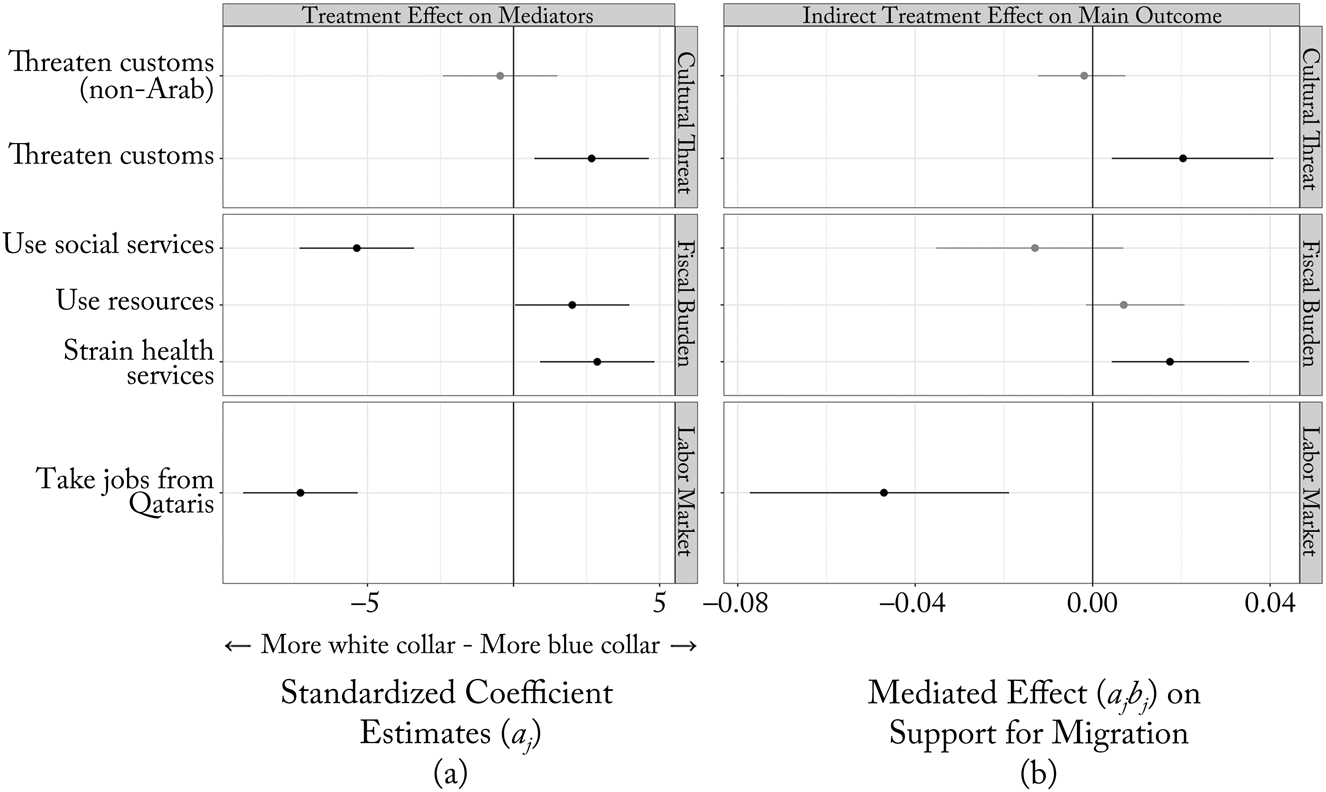
I estimate equations 1 and 2 for the battery of attitudinal variables described above using ols regressions. Standardized coefficients from estimating equation 1 with 95 percent confidence intervals are shown in panel (a) of Figure 3.Footnote 86 Using the coefficient estimates from the models, I subsequently estimate indirect effects a jb j for each mediator; these are reported in panel (b) of Figure 3. Point estimates represent the indirect effects of the white-collar treatment frame on migration preferences as transmitted through each mediator indicated; positive effects thus indicate more support for white-collar migration relative to blue-collar migration. To account for the non-normal distribution of a product, 95 percent confidence intervals are constructed through bootstrapping.Footnote 87
Mediation of Treatment Effect on Migration Supporta
a Panel (a) shows causal effects of white-collar treatment frame on potential mediators, estimated using OLS regression with 95 percent confidence intervals. Panel (b) depicts point estimates for mediated (indirect) effects from multiple mediator analysis; 95 percent confidence intervals are constructed through bootstrapping. Solid black estimates are significant at the α = 0.05 level.

First, as a matter of interest, I consider treatment effects on the proposed mediating variables to better understand Qataris’ varying perceptions of the two types of migrant. Again, because they follow directly from the experimental manipulation, these attitudinal differences can be interpreted as causal estimates of the difference in perceptions of white- versus blue-collar migrants. Recall that variable coding is such that higher values indicate more positive feelings toward a class of migrant (disagreement with the negative valuation in the question). A positive treatment effect thus indicates more favorable feelings toward white-collar migrants and more association of the negative attribute in question with blue-collar workers.
Panel (a) of Figure 3 demonstrates that Qataris have strong but mixed feelings regarding the two classes of migrant. With respect to cultural considerations, respondents feel that blue-collar workers represent a greater threat to Qatari customs by a significant margin. But this effect disappears when the question specifically references non-Arab migrants, suggesting that respondents are more likely to associate the white-collar label with Arab migrants.Footnote 88 This is consistent with the expectation that respondents prefer migrants they view as more culturally proximate. Without qualifiers, then, respondents may be more supportive of white-collar migration because they assume such workers come from Arab backgrounds and pose less of a threat to Qatari culture.
On fiscal measures, respondents find cause for concern with both types of migrant. Blue-collar migrants are seen as more likely to put a strain on Qatari health services and resources in general, and white-collar migrants are considered a greater concern with respect to social services. Again, these effects likely result from respondent assumptions about the two classes of migrant. The sheer numerical dominance of unskilled laborers in Qatar means that they create a greater burden on broadly accessible goods, such as subsidized fuel and state-sponsored health services. And yet, the circumstances of white-collar workers—more likely to bring their families and to be more integrated into Qatari society—mean that they make more use of other social services, such as public education.Footnote 89 Finally, with respect to the labor market, respondents demonstrate clear concerns about the impact of white-collar migration. The treatment effect of the white-collar frame on concerns that migrants take Qatari jobs was the substantively largest and most negative of all the attitudinal measures.
That respondents associate the two types of migrant with different issues is clear, but do these attitudes translate into policy preferences? The results in panel (b) of Figure 3 suggest that these attitudinal metrics are important drivers of migration support. In particular, the blue-collar frame negatively affects immigration preferences via respondents’ assumptions about the cultural threat posed by such workers, as well as concerns about the strain they put on state resources (the indirect effect through “strain health services” is positive and significant at the 0.05 level, while “take resources” is positive and significant at the 0.10 level). Both the non-Arab threat and the burden on social services produce insignificant estimates. But the mediated effect via “take jobs from Qataris” is large, negative, and significant. This is striking. Although Qataris perceive blue-collar workers as posing more of a cultural and fiscal burden to their country, the job threat posed by white-collar workers is large enough to nullify the influence of these other considerations on policy preferences.
That these effects operate in different directions is noteworthy and helps to clarify the absence of an overall treatment effect for the white-collar frame. Respondents are not entirely indifferent between high- and low-skilled workers. Attitudinal measures reveal that they are conflicted about the varying positive and negative aspects of each type of migration. Ultimately, then, the null effect in Table 2 likely reflects these competing concerns.
The significant indirect effects estimated suggest that the cultural threat posed by blue-collar workers, the burden they pose to social resources, and the impact of white-collar workers on the labor market are all important mediators of Qatari policy preferences. This conclusion comes with important caveats. In particular, it is possible that unexplained variation in the proposed mediators is correlated with variation in the outcome variable, biasing treatment estimates.Footnote 90 Nevertheless, the results suggest that sociotropic concerns are a powerful motivator for anti-migrant sentiment in Qatar, and that these concerns operate differently with respect to different types of workers. Most notably, national-level employment concerns about skilled workers entering Qatar are a major consideration for citizens, and this works to mitigate the other social and economic challenges posed by the high number of non-native low-skilled workers.
VII. Conclusion
In this article, I apply and test existing theories derived from the Western context in a novel migration setting. The findings prompt consideration of how we should approach the phenomenon of South-South migration, which occupies a growing segment of total migration flows but follows highly distinctive patterns from migration to the Global North.Footnote 91 The survey data from Qatar reveal that Gulf citizens share certain commonalities with citizen attitudes in oecd countries, despite these differences in context. Preferences about migration policy are driven largely by the perceived cultural and economic threat to society posed by even temporary foreign workers with restricted rights.
Yet there are also important differences in how respondents view migrants. In striking contrast to citizens in Europe and North America, Qataris do not exhibit a preference for high-skilled migrants. This ambivalence seems to result from competing social and economic considerations. Although low-skilled workers are associated with threats to local customs and public resources, an overriding preoccupation with the impact of skilled workers on the labor market nullifies these considerations in the aggregate. Unusually, the factor proportions model predictions hold up well in this empirical application: educated Qataris who are active in the labor force are the least supportive of white-collar migration. This is consistent with the idea that individuals should most oppose migrants who compete with them in the labor market, but stands in contrast to findings elsewhere. In addition, although higher education is typically associated with increasing cultural awareness in the Western context, in this study it predicts a reduction in support for migration.Footnote 92
Why does the factor proportions model successfully predict attitudes in Qatar, when it has failed in a number of other contexts? It may result from the extreme level of migration in the Gulf, relative to the size of the native population.Footnote 93 Because they are outnumbered, Qatari citizens have a high degree of exposure to migrants in the workplace as well as in everyday life. Research suggests that one reason the factor proportions model has failed to predict responses in nationally representative surveys is that migrant effects on the labor market are often localized to specific sectors.Footnote 94 In Qatar, because migrants dominate in both public and private sectors and a majority of working Qataris interact with foreigners, the impact of labor market competition is broadly visible rather than being confined to single sector.
Although Qatar is certainly at an extreme in terms of migrant population, it is not alone: per UN data, citizens are a minority in fifteen other states and territories.Footnote 95 And foreign workers make up more than 25 percent of the population (enough, perhaps, to penetrate a variety of sectors) in nearly 20 percent of the UN sample.Footnote 96 In other words, there are non-gcc economies with similar attributes (small local populations, explosive economic growth, and restrictions on political expression and migrant rights) where similar attitudes among natives might be expected. In section A8 of the supplementary material, I use a global sample to demonstrate that the relative size of the migrant population is correlated with increasing citizen concerns about its impact on the labor market. Although this analysis is descriptive, it suggests that respondent attitudes are sensitive to the percentage of foreign workers. Future research should more closely examine this relationship using additional case analysis or novel cross-national data.
Taken collectively, my findings prompt a reconsideration of migration preferences in light of the diverse variations in global migration patterns and policy today. Migration policy in the Gulf, while distinct from such policy in oecd states, echoes the situation in other smaller, wealthy contexts with a large foreign workforce, an authoritarian government, and a sharply conscribed migrant path to citizenship. The novel empirical findings in this article offer a strong argument for expanding the frame of migration research into new contexts across the Global South—a reflection of shifting trends in labor migration. In such future applications, it is important to consider the circumstances of migration and attendant restrictions when weighing different theoretical predictions and developing new questions. The norms and policies of non-oecd states, particularly with respect to migrant rights and prospects for attaining citizenship, are not universal. Future research should take these factors into account and consider more nuanced questions, such as how citizens view migrants when the duration and circumstances of their stay or their level of access to public goods is varied.
Supplementary Material
Supplementary material for this article can be found at https://doi.org/10.1017/S0043887121000253.
Data
Replication files for this article can be found at https://doi.org/10.7910/DVN/GNSPU8.
Acknowledgments
I thank Yotam Margalit, Erik Lin-Greenberg, Jack Snyder, Johannes Urpelainen, Nikhar Gaikwad, fellows at the Niehaus Center for Globalization and Governance, participants at the MPSA annual conference, and three anonymous reviewers of World Politics for their helpful comments on earlier drafts of this manuscript. Special thanks to the Social and Economic Survey Research Institute (SESRI) at Qatar University and its funders for making their data available.
Funding
I am grateful for support from the NSF Graduate Research Fellowship, no. DGE-11-44155, while writing this manuscript.