1. The Enigma of Kantian Gesinnung: Leading Questions
Immanuel Kant’s theory of religion, especially as elaborated in Religion within the Bounds of Bare Reason, has often been criticized for generating a nest of unresolved problems, especially troublesome for those who take seriously both the claims of real historical religious traditions and the bounds of knowledge established in Critique of Pure Reason. At the heart of such criticisms is the impression that Kant’s defence of rational/moral religion illegitimately appeals to various metaphysical (or ‘noumenal’) features of human nature to ground the theological knowledge-claims that practical reason impels us to affirm as rational beliefs. Whether or not one accepts this traditional metaphysical interpretation, Kant’s questionable account of human nature is integrally bound up with his enigmatic use of Gesinnung. For Kant obviously does associate human Gesinnung with an inscrutable, ‘timeless deed’, whereby we choose to order the incentives of morality and happiness in a manner that makes us evil at the outset of our moral development, thus giving rise to the problem religion tries to solve. The same Gesinnung then takes centre stage again, in Kant’s theory of religious conversion, and remains a central feature of his account of authentic religious belief and practice.
In opposition to the prevailing assumption that Gesinnung is merely a (poorly justified) component of a religious metaphysics, I shall argue that it fulfils a non-metaphysical role in Kant’s theory of volition, directly parallel to the status of Kantian Überzeugung (normally translated as ‘conviction’) in his theory of knowledge − a role that could be used to justify any metaphysical application the term might retain. Pasternack’s analysis of Kant’s theory of propositional attitudes persuasively demonstrates that Kant has two quite distinct applications for Überzeugung: theoretical and moral.Footnote 1 I shall claim that, although Gesinnung is not a direct synonym of Überzeugung, it designates its moral manifestation. That is, Kantian Gesinnung is a special state of being convinced to live by a specific moral principle. In this special, moral sense the term ‘conviction’ refers to a heartfelt dedication to a particular belief (or set of beliefs) that will form the basis of one’s ‘lifestyle’ (Lebenswandels). In other words, belief p constitutes my Gesinnung if I am so convinced of p that I dedicate my life to p.Footnote 2 Kantian Gesinnung therefore refers to a one-off decision to dedicate one’s life in one direction or another − e.g. towards kindness and good or towards self-interest and evil. An overview of past translations confirms that this definition of Gesinnung is controversial: Kant-scholars almost universally refer to Kantian Gesinnung as ‘the disposition’ (thus implying it is a single, fixed component of human nature), the exception being Pluhar’s preference for ‘attitude’.Footnote 3 The Appendix offers general observations regarding the standard same-language definitions of four key terms relevant to this study (i.e. the German definition of Gesinnung and the English definitions of ‘disposition’, ‘attitude’ and ‘conviction’), assessing whether each word takes on any special meaning when used in religious contexts.
In what follows, the discussion is oriented around the following hermeneutical questions, designed to address the inevitable controversial nature of this new approach:Footnote 4
1. To what extent does Kant’s use of the word Gesinnung in Religion explicitly require or even imply psychological or feeling-based notions that readers normally associate with attitude?
2. Is there any evidence that Kant regards human Gesinnung as a propositional attitude?
3. What evidence is there that Kant sees Gesinnung as a metaphysical constituent of human nature, rather than as a reference to some choice(s) we make?
Using these questions as interpretive guides, sections 2–3 analyse Kant’s various uses of the word Gesinnung throughout Religion: section 2 examines Kant’s moral applications of Gesinnung, while section 3 focuses on its specific religious meaning in certain passages of Religion.Footnote 5 Offering a detailed account of Kantian Gesinnung, these two sections provide compelling evidence that ‘conviction’ expresses Kant’s meaning more accurately than either ‘disposition’ or ‘attitude’. Finally, section 4 summarizes and clarifies the chief conclusion of this study, that Kantian Gesinnung, understood as a moral species of conviction, functions not as a problematic metaphysical assumption, nor as a psychological tool, but as a volitional principle that fills a heretofore neglected gap in Kant’s theory of propositional attitudes.
2. Kant’s General Portrayal of Gesinnung as Principled Moral Conviction
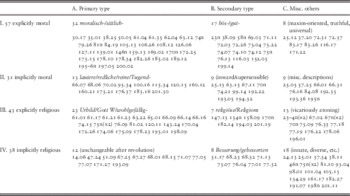
In this and the following section I analyse, respectively, Kant’s various types of moral and religious uses of the word Gesinnung in Religion. While this article’s main goal is to understand Kantian Gesinnung as such, an inevitable secondary concern is of course to consider which English word best reflects Kant’s intended meaning. The closest Kant ever comes to defining the word Gesinnung is in the first of the seventeen passages where the term is directly modified by bös- (‘evil’) and/or gut- (‘good’), as specified in Table 1, I.B. (See Appendix for further explanation of Table 1.) He writes (6: 23.10n): ‘between an evil and a good Gesinnung (inward principle of maxims) − by which the morality of the action must also be judged − there is no mean’. This highlights three key features of Kantian Gesinnung: (1) it is a specific kind of principle, one that is (a) ‘inward’Footnote 6 and (b) maxim-oriented;Footnote 7 (2) it can be either good or evil, with no intermediate position between these options; and (3) it is the proper basis for judging any action’s moral worth. While ‘disposition’, ‘attitude’ and ‘conviction’ all refer to features of a person’s inner life (1a), neither ‘disposition’ nor ‘attitude’ typically refers to a consciously chosen, maxim-oriented principle (1b). By contrast, ‘conviction’ normally does refer to just such a self-chosen, underlying principle determining one’s beliefs and/or actions. This supports my hypothesis that Kantian Gesinnung is a moral type of Überzeugung,Footnote 8 a maxim-oriented principle that establishes either good or evil (not both) at the foundation of one’s moral nature,Footnote 9 and explains why Kant usually modifies Gesinnung with explicitly moral terms.
Contextual Aalysis of Kant’s 169 Uses of ‘G/gesinn-’ in Religion

Neglecting the fact that Kant defines Gesinnung as a principle of moral decision-making, not as a metaphysical constituent of human nature, I previously treated the term as virtually synonymous with ‘heart’ (see e.g. Palmquist Reference Palmquist2000: §VII.2) − a term Kant often uses in close association with Gesinnung (see e.g. 6: 37.20). While both terms refer to aspects of human nature, the heart is not a subjective inward principle of maxim-formation; it is the disposition (the Sinnesart) that forms within us on the basis of our Gesinnung(en). Although the heart does fulfil a dispositional function for Kant, one should not infer that ‘heart’ is functionally equivalent to the term Gesinnung. The only viable option that obviously refers to a rational principle determining the character of one’s disposition (or to the process whereby one’s disposition is so determined by a rational principle) is ‘conviction’. The remainder of this section therefore conducts an experiment, testing the hypothesis that translating Kant’s term as ‘conviction’ is viable: examining all thirty-two occurrences of Gesinnung that are modified by ‘moral’ (i.e. moralischen/er or sittlichen/er) should determine whether Kant’s text can be cogently read as referring to moral conviction.
Kant’s most common way of using the word Gesinnung throughout Religion, comprising nearly 20 per cent of all occurrences, is to modify it with ‘moral’. Scanning the context of each of Kant’s twenty-eight references to moralischen/er Gesinnung reveals that in the first half of the book Kant calls it a way of thinking (6: 30.17) that can be corrupted by evil maxims: it is the ‘power’ (Kraft) (61.35) to manifest virtue (35.01), but tends to be weakened by falsity (38.25); it is not completely hidden from us, for we can be conscious of it (62.04). Because a person is always ‘a being of the world’ (Weltwesen), our moral conviction will always be in the process of ‘becoming’, no matter how pure it may be (74–5n). Unfortunately, religious traditions often introduce external rituals and ceremonies that downplay ‘the inwardness (das Innere) of moral conviction’ (79.26); such ‘ceremonial faith’ tends to ‘displace all moral conviction’ (81.37n), even though the latter is the very basis for the ‘spirit’ and ‘truth’ of all religion (84.19) − a point examined further in section 3. These passages never link Gesinnung to any feeling or other psychological feature characteristic of human attitudes; at most, they only hint that Kant might think of it as a metaphysical component of the mind.Footnote 10 By contrast, the explicit references to the role of thinking, maxim-choosing, conscious awareness, and the process of conforming external actions to an internal ideal all indicate that the principle he calls our Gesinnung is a rational, judgement-like power, akin to discernment (see n. 10) − features that all resonate well with ‘conviction’.
In the second half of Religion Kant states that ‘the matter’ of venerating God (namely, observing ‘all duties as his commands’ − this being Kant’s ‘subjective’ definition of religion) occurs ‘in a moral conviction’ (6: 105.13). The force of this ‘in’ is not one of metaphysical containment, otherwise Gesinnung would be called the form of venerating God; rather, we venerate God by virtue of directing our conviction to obeying the call of duty. It should come as no surprise, therefore, to find that Kant thinks the true purpose of a church is ‘admonition and animation in moral convictions’ (106.26); for ‘religion is hidden inwardly and comes down to moral convictions’ (108.12). However we translate Kant’s use of the word Gesinnung, it must refer (at least in such moral contexts) to something hidden within a person; its externalization is the task of historical religious traditions, such as churches.
Kant’s distinction between Judaism and Christianity is bound to be misunderstood unless we recognize that he views each as an ideal type, where the latter (properly understood) focuses on empowering a person’s Gesinnung, while the former puts primary emphasis on external manifestations, as when the Ten Commandments (of whose truth reason itself already convinces us) are enforced without making any ‘demand on one’s moral conviction in obeying them’ (126.06). Overemphasizing the importance of this distinction for Kant would be difficult. For he goes on to insist (127.11) that ‘a God who wants obedience merely to such commandments for which no amended moral conviction is required is not actually that moral being whose concept we need for a religion’.
In the General Comment to the Third Piece Kant further explains that ‘the pure moral conviction’ (139.01) is ‘inseparably linked’ with ‘the idea … of the highest good’, and that our inability to realize the latter draws us ‘toward the faith in the cooperation or arrangement, by a moral ruler of the world, through which alone this purpose is possible’. Again, Kant here treats Gesinnung not as a feeling or fixed component of human nature, like our predisposition to good or propensity to evil, but as an idea-driven power that generates the human need to have faith. Kant is directly associating Gesinnung with his framework of propositional attitudes, as a moral way of being convinced. Indeed, in a footnote near the end of that General Comment, he openly states that we can assess religious ‘merit’ (146.10n) by observing which persons exhibit ‘a superiority of morality not in reference to the law … but in comparison with other human beings in regard to their moral conviction’.
In the Fourth Piece Kant claims that one of the main principles of Jesus’ teachings is that ‘only the pure moral conviction’ can render a person ‘satisfactory to God’ (6: 159.13) − an explicitly religious claim, examined further in section 3. The alternative, believing that a set of religious statutes defines specific actions that God requires, inevitably amounts to ‘mak[ing] a God for [ourselves]’, in hopes of being ‘exempted from the burdensome uninterrupted effort of acting upon the most inward [aspect] of our moral conviction’ (169.02). Such a religious believer may sacrifice greatly, ‘tender[ing] everything to God, except for his moral conviction’ (172.25); yet without the latter, a moral God cannot be satisfied. For any such ‘sensible means of furthering the intellectual [element] (of the pure moral conviction)’ must be regarded as influencing God only indirectly, not directly (170.23n). ‘What matters here’ − i.e. in comparing the efficacy of different religious rituals and doctrines − ‘is not so much the difference in external form; rather, everything hinges on the acceptance or abandonment of the sole principle, to become satisfactory to God either only through moral conviction … or through pious play-acting’ (173.15, my emphasis). Religious ‘formalities’ and ‘observances’ aimed directly at pleasing God can make a person ‘receptive to the achievement of [moral goodness]’; as such, they ‘have no immediate worth but do serve as means to the furtherance of that moral conviction’ which directly satisfies God’s requirements (178.10). The problem Kant calls ‘pseudoservice’ arises when a person views such observances ‘not merely as a means to moral conviction but as the objective condition for thereby becoming satisfactory to God immediately’ (178.34).
In what might first appear to be a confirmation of Pluhar’s psychological reading of Gesinnung (see Appendix), Kant points out near the end of the Fourth Piece that ‘godliness’ tends to characterize ‘moral conviction in relation to God’ (6: 182.26) in two ways that could be called attitudes: ‘fear of God’ and ‘love of God’. However, he goes on to warn that, for this very reason, godliness must be considered as secondary, ‘serv[ing] only as a means to strengthen that which in itself constitutes a better human being, virtuous conviction’ (183.16).Footnote 11 What is properly regarded as primary (i.e. ‘virtue’) is a pure concept ‘taken from the soul of the human being’ and serves to awaken a ‘consciousness to a capacity’ whereby we can ‘become masters over the greatest obstacles within us’ (183.19–20). Here Kant’s description of Gesinnung designates a reasoned conviction, rather than a psychological attitude or metaphysical disposition. He reiterates this a few pages later, writing, ‘In what concerns moral conviction, everything hinges on the supreme concept to which one subordinates one’s duties’ (185.02, emphasis added). That is, putting godliness before virtue amounts to idolatry, whereas the proper order is to allow virtue (the rational element) to come first and be ‘crowned’ with the hope provided by godliness (the feeling-oriented element). As we shall see, a person’s ‘moral conviction in a good lifestyle’ has a ‘redeeming capacity’ that is beneficial, provided ‘I do not perhaps make myself unworthy of it’ (189.12). This, surely, is why only a prayer ‘which is made in a moral conviction’ (195n) ‘can alone be made in faith’ and why Kant advises those who pray, ‘through continued purification and elevation of the moral conviction’ (197.05), to ‘work toward the point where the prayer’s spirit alone may be animated sufficiently within us and where … its letter may eventually drop out’.
Kant’s four references to sittlicher Gesinnung(en) exhibit similar themes. Thus ‘moral convictions’ are sublime (6: 50.05): Kant recommends repeatedly arousing a person’s feeling for such sublimity, as this can effectively deter a good-hearted person from lapsing into evil. But Kant does not here assign Gesinnungen the status of feelings; rather their sublimity can arouse morally empowering feelings within us, if we cultivate it. The ‘ideal of moral perfection’ that Kant calls the ‘archetype’ (Urbild) − a term closely related to Gesinnung in its specifically religious application (see section 3) − is the highest and purest expression of ‘moral conviction in all its integrity’ (61.04); thus, Kant admits it is debatable whether ‘an outer experience’ can provide ‘attestations (Beweistümer)’ of ‘the inward moral conviction’ at all (63.12). For as noted above, we humans cannot perfectly achieve that ideal. However, in the real human moral communities that religious groups should aspire to become, this ‘moral conviction’ can nevertheless manifest itself as ‘brotherly love’ (200.02). Although the latter could be read as referring to an attitude, those familiar with the debate over whether love is a feeling or a choiceFootnote 12 will recognize that the kind of love Kant refers to here functions more like a rationally chosen conviction as to how one ought to live.
The smooth coherence of the foregoing quotations highlights the status of Kantian Gesinnung as a species of moral conviction, thus confirming the hypothesis introduced at the beginning of this section. Since we have so far located no direct (and only a few indirect) references to Gesinnung as an attitude, yet have found numerous passages where Gesinnung directly entails rational/conceptual aspects of volition, the evidence so far overwhelmingly favours ‘conviction’ over ‘attitude’. Whether it also improves upon ‘disposition’ might depend on how one understands this term (see Appendix); but to the extent that ‘disposition’ implies a metaphysical constituent of our nature (perhaps something unconscious or subconscious), the passages considered so far also offer virtually no support for that option. In any case, whereas ‘disposition’ is not a term people use much nowadays, especially in religious contexts, the way religious people tend to use ‘conviction(s)’ is virtually identical to Kant’s usage of the word Gesinnung in Religion. This parallel will become even clearer as we see (by examining the passages listed in row III of Table 1)Footnote 13 how Kant modifies Gesinnung with various explicitly religious words.
3. Kant’s Specifically Religious Application of Gesinnung
Because Kant’s Religion focuses mainly on the nature of religion, rather than on the nature of morality as such, and because my method of classifying the various uses of Gesinnung relies on the word’s immediate context, many uses examined in section 2 touched on themes that were obviously religious, even though moral terms actually modified Gesinnung. The examples to be considered in this section, by contrast, consist of passages where the terms primarily modifying Gesinnung are explicitly religious.
The first of Kant’s seven uses of ‘religious conviction’ (Religionsgesinnung or religiöse[r] Gesinnung; cf. Table 1, III.B) is significantly placed at the very end of the Third Piece. The final sentence of the General Comment on the holy mysteries (6: 147.13) warns that when interpreting scripture a merely ‘literalist faith more readily corrupts rather than reforms true religious conviction’. These words transition from the Third Piece, where Kant’s focus (as related to his first ‘experiment’Footnote 14) is on the need for individual good-hearted persons to band together to form a church, to the Fourth Piece, where his (first-experiment) focus is on determining the difference between true and false service of God. This is highly significant, because the Fourth Piece is where Kant finally explains what a well-functioning, rational religion should look like; so only here are we fully informed of how religious conviction supplements bare moral conviction.
In the Fourth Piece, Kant first describes religious Gesinnung as ‘the guilty awe’ we feel towards God that manifests itself ‘in all our dutiful actions generally’ even though ‘this awe is not a special action of religion’, nor a special duty to God (6: 154n.). This is one of the few instances in Religion where the word Gesinnung seems to refer to a psychological attitude rather than to a component of human nature (a disposition) or a reasoned commitment (a conviction). Yet Kant’s intention here is not to identify religious conviction with guilty awe, but to explain that the former typically gives rise to the latter for religious believers because their type of moral conviction makes them more vividly aware of the perfection demanded by the moral law. Perhaps because enlightened philosophers typically have a strong distaste for such guilty awe, Kant goes on to explain that ‘illumined persons’ who believe in bare natural religion, grounded on the postulates of God and immortality, never think they need, to support their ‘religious convictions, the fellow comradeship of others in such a religion’ (158.09). Surprisingly, the next sentence adds that a visible church is nevertheless a necessary supplement for the realization of true religion. Thus, in a later footnote Kant cites ‘pure religious conviction’ as his only example of ‘the supersensible (the subjective principle of morality in us, which lies locked up in the ungraspable property of freedom)’ (170.30–1n), reminding us that ‘we have no insight’ into how religious conviction operates − i.e. into the problem of how ‘actions as events in the world of sense’ can arise ‘from the moral make-up of the human being’ − except to appeal to the moral law itself. So here Kant confirms that, properly understood, religious Gesinnung is just as principle-based, just as grounded in our supersensible moral nature, as is bare moral Gesinnung, considered apart from its visible representation in concrete religious traditions. Although historical religious traditions can include elements that actually distract us from the moral core of all true religion, he explains in the next section that, if we give first priority to ‘pure religious faith’, then with this fundamental ignorance in mind, ‘the moral-faithful person is yet also open to the historical faith insofar as he finds it conducive to the animation of his pure religious conviction’ (182.14).
The last two occurrences of ‘religious Gesinnung’ come in the General Comment to the Fourth Piece, where Kant examines four ‘means of grace’ from Christian tradition. In a parenthetical side-comment, Kant opines that, among Islam’s ‘five great commands’, ‘almsgiving alone’ could be properly regarded as a means of grace, ‘if it were done from a truly virtuous and also religious conviction for human duty’ (6: 194.03). On the last page of Religion, Kant then reminds us that ‘only virtue, linked with piety, can constitute the idea that one understands by the word godliness (true religious conviction)’. A religious Gesinnung, therefore, supplements a person’s moral nature with religious ideas or beliefs, clothing bare moral religion with historical traditions that should enliven, enrich and deepen the firmness of one’s commitment. Again, calling this inward, intellectual function a ‘conviction’ rings truer to the modern ear than does the rather old-fashioned term, ‘disposition’, or the relatively newer, more psychological term ‘attitude’.
Of all evidence suggesting that Kant is referring to what we nowadays call convictions, probably the strongest comes in the passages that are undoubtedly the heart of Kant’s defence of explicitly religious Gesinnung: his references to the Gesinnung made available by the ‘archetype’ of perfect humanity and to this Gesinnung as the sole path to becoming ‘satisfactory to God’ (cf. Table 1, III.A). All eleven occurrences of the former type occur before the twelve occurrences of the latter, thus suggesting that for Kant the possibility of our Gesinnung actually satisfying God depends on the precondition that an archetypal Gesinnung achieves this status. Let us therefore look first at the passages where Kant talks about the archetype’s Gesinnung, then at the passages where he describes Gesinnung as being satisfactory/unsatisfactory to God.
Shortly after introducing the archetype as ‘the personified idea of the good principle’ near the beginning of the Second Piece (6: 60), Kant claims that ‘only in him and by adopting his Gesinnungen can we hope “to become children of God”’ (61.01, quoting Heb. 1: 3). What are these (plural!) features of the archetype that we are supposed to detect, then take up into ourselves so we might be adopted, as it were, into God’s family? Are they psychological feelings (i.e. attitudes), metaphysical components of human nature (i.e. dispositions), or intellectually based principles that guide our actions (i.e. convictions)? Important clues are found in a lengthy sentence that includes the next three occurrences (61.17, 61.21, 61.23) and is worth quoting in full:
This unification [of the archetype] with us may therefore be regarded as a status of abasement of the Son of God, if we envision to ourselves that divinely minded (göttlich gesinnten) human being − an archetype for us − in the way in which he, although himself holy and as such not bound to endure sufferings, nonetheless takes these upon himself to the greatest extent in order to further the world’s greatest good; the human being, by contrast, who is never free of guilt even when he has taken on the same conviction, can still regard the sufferings that befall him, no matter by what path, as something that he has brought upon himself, and hence must regard himself as unworthy of the unification of his conviction with such an idea, even though the idea serves him as archetype.
Three salient points emerge from this passage. First, rendering Kant’s use of the words göttlich gesinnten Footnote 15 as ‘divinely minded’ highlights that Kantian Gesinnung is a mental orientation. Second, the specific example Kant gives of what it means for the archetype to be divinely minded (or convicted) is that, if we hope to be empowered by our union with the archetype, then we must be willing to abase ourselves, to ‘endure sufferings’ in order ‘to further the world’s greatest good’ − even though, unlike the holy archetype, we always remain guilty and therefore responsible for the sufferings we endure. Third, being essentially an inward idea,Footnote 16 the archetype’s function is to empower an aspect of our intellectual decision-making capacity. Whereas requiring conviction(s) to conform to a personified idea of perfection makes good sense (i.e. requiring us to become inwardly convinced that the idea is worthy of emulation), how we could conform our attitude(s) or disposition(s) to an ‘idea’ is unclear.
Kant’s initial description of the archetype in terms of the willingness to suffer is not merely one of several features he might have highlighted, but the core characteristic we are to emulate, in order to reorient our Gesinnung and effect a ‘change of heart’ − Kant’s term for religious conversion. Indeed, the concluding paragraph of subsection B refers explicitly to this feature three times in close succession. First he says ‘such a conviction, with all the sufferings taken upon oneself for the sake of the world’s greatest good’ is ‘thought in the ideal of humanity’ (6: 66.09, emphasis added) − thus again highlighting the rational nature of Gesinnung − and that it ‘is completely valid, for all human beings at all times and in all worlds, before the supreme righteousness, if the human being makes, as he ought to do, his [conviction] similar to it’. He then adds that this would ‘remain a righteousness that is not ours insofar as the latter [righteousness] would have to exist in a lifestyle completely and unfailingly in accordance with that conviction’ (66.14) − which ours does not. Subsection B then concludes with the assurance that if our conviction ‘is unified with the conviction of the archetype’ (66.16), ‘an appropriation of this [conviction] for the sake of ours’ ‘must be possible’ − provided we can make the idea ‘graspable’ by solving the three ‘great difficulties’ discussed in subsection C. In discussing the third difficulty, Kant highlights this same point, that a religious conversion just is the act of adjusting the guiding principle of one’s heart (i.e. one’s Gesinnung), so that one begins to interpret suffering in a new way (74.12 and 74.15):
The exit from the corrupted into the good conviction (as ‘the dying of the old human being,’ ‘crucifying of the flesh’) is in itself already a sacrifice and an entrance upon a long series of life’s ills that the new human being takes upon himself in the conviction of the Son of God − in other words, merely for the sake of the good − but that yet were actually deserved by a different human being, namely the old one, as punishment (for, the old one is morally a different human being).
Once again, Kant describes the archetype’s Gesinnung, which alone is capable of satisfying God, as the conscious determination to accept suffering ‘merely for the sake of the good’ − a decision that (when done in the context of belief in God, as Kant assumes here) can aptly be described as a religious conviction.
In a long footnote that transitions from Kant’s references to the archetype’s Gesinnung to his explicit references to our Gesinnung as determining whether or not we satisfy God (6: 75.15n), Kant argues that, ‘because this [archetypal] conviction contains the basis for continual progress in complementing this deficiency’ − that basis being the heartfelt commitment to adopt ‘the good principle’ to guide our decision-making − this conviction ‘stands in the place of the deed in its [the archetype’s] perfection’. Kant then asks whether (given his proposed solution to the third difficulty) a converted person can be innocent (by virtue of having adopted a good Gesinnung), yet also consider suffering ‘as punishing, and hence confesses thereby a punishability, and thus also a conviction dissatisfactory to God’. He answers affirmatively, arguing that the converted person accepts punishment vicariously, on behalf of ‘the old human being’. Kant goes on to call this explanation of how ‘a human being who is indeed guilty … has nonetheless passed into a conviction satisfactory to God’ (76.09) ‘a deduction’ of the theological concept of ‘justification’.Footnote 17
In the second half of Religion Kant argues that ‘one must with all one’s powers strive after the holy conviction of a lifestyle satisfactory to God’ (120.11), in the hope that this ‘will complement the lack of the deed, onto whichever kind of lack it may be added, in consideration of honest conviction’.Footnote 18 This ‘conviction satisfactory to God’ (143.24) is ‘a determination of the will to the good’ (i.e. a rational function of volition, not a psychological attitude or a metaphysical disposition). But it is one that a human being ‘cannot bring forth on his own’, due to ‘the natural corruption within him’; so in order to realize its purpose, we must appeal beyond moral Gesinnung, to religious beliefs (such as practical faith in the archetype) and practices.
Although German does not allow reference to a Gesinnung daß’, in the way English allows reference to a ‘conviction that’,Footnote 19 Kant does identify false Gesinnung with ‘a heartfelt wish that’ God will receive one’s offerings in lieu of a good lifestyle: ‘when he says that he brings even his heart to God’, the deluded believer ‘understands by this not the conviction of a lifestyle satisfactory to God, but a heartfelt wish that those offerings may be taken up in payment for that [conviction]’ (172.26). Likewise, in discussing the means of grace, Kant first notes that prayer is important, as an inward confirmation of our Gesinnung, then adds that churchgoing also helps promote ‘[t]he outward proliferation of it through public assembly … in order to let religious teachings and wishes (and with them convictions of this sort) be heard and thus to communicate them pervasively’ (193.09). Here Kant explicitly refers to ‘religious teachings and wishes’ as examples of our religious Gesinnungen in externally communicable forms. Religious Gesinnungen, in other words, are propositional: precisely in this way they raise our moral Gesinnung to a new level.Footnote 20 Would it be accurate to describe teachings or wishes as ‘dispositions’ or ‘attitudes’? Whereas these words would seem odd in such a context, ‘convictions’ is obviously appropriate.
Completing this initial study by examining Kant’s various other ways of modifying Gesinnung with religious termsFootnote 21 would provide further evidence that he is referring to what are typically called convictions. The passages listed in Table 1, III.C, for example, interpret the Christian doctrine of vicarious atonement in terms of a converted person’s conviction to follow the good principle: this good conviction offers us a new way to understand (and experience the effects of) the deeds we performed while still convinced that the evil principle should have dominion. Those listed in Table 1, IV.A, show that Kant saw the good conviction as being unchangeable, at least insofar as it is rooted in the archetype’s conviction. And those listed in Table 1, IV.B, relate to Kant’s claim that our conviction must undergo a radical, one-off ‘reformation’ (Besserung), not just a gradual increase in the percentage of deeds that comply with the moral law, if human goodness is to satisfy God.
4. Gesinnung as a Propositional Attitude of Principled, Convinced Faith
The foregoing analysis of Kantian Gesinnung provides ample evidence that the fundamental change from evil-heartedness to good-heartedness that is a central theme in Religion is best understood as being prompted by a change in a person’s deeply held, rationally grounded convictions; changes in our psychological attitudes or at a metaphysical level are hardly addressed, if at all. This conclusion has implications for how we understand the deepest core of Kant’s ‘message’ regarding the nature of religion. Referring again to Pasternack’s analysis of propositional attitudes, we can express the point as follows: religion is properly based on a form of faith (Glaube) that arises out of moral Überzeugung, just as science is properly based on a form of knowledge that arises out of logical Überzeugung. This way of expressing the conclusion of the foregoing study brings us to a potential objection to translating Gesinnung as ‘conviction’: translations normally avoid using the same term for two different words in the original language, and ‘conviction’ is already the standard translation of Überzeugung.
If ‘conviction’ reflects what Kant means by the word Gesinnung more appropriately than either ‘attitude’ or ‘disposition’, then how can we translate Überzeugung accurately, yet without creating confusion regarding Kant’s use of these terms? The key is to remember that ‘convince’ is not an exact cognate of ‘conviction’: they have slightly different etymological roots (see n. 37). Yet recent translators normally render Überzeugung as ‘conviction’ and its verbal form, überzeugen, as ‘convince’.Footnote 22 By translating two forms of the same word as two different English words, this convention fails to reflect accurately the cognate relationship between the corresponding German terms. To correct this (minor but significant) inconsistency, it seems reasonable to translate Überzeugung as either ‘convincing’ or (occasionally) ‘convincement’Footnote 23 (i.e. the state of being convinced). The cognate relation between the English translations (‘convincing’/‘convincement’ and ‘convince’) then exactly mirrors the cognate relation between the German equivalents (Überzeugung and überzeugen).
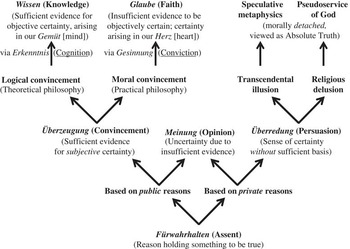
Translating the word Gesinnung as ‘conviction’ in any case fills a lacuna that has gone virtually unnoticed in the literature: the need to identify the status of the assent that arises out of Gesinnung-based reasoning, so that Gesinnung can find its place in Kant’s theory of propositional attitudes.Footnote 24 Translating Gesinnung as ‘conviction’ is a perfect synthesis of the potentially metaphysical ‘disposition’ and the potentially psychological ‘attitude’, for it reminds us that we must be convinced of something, and convinced of it on the basis of moral concepts and principles that can be expressed as maxims, in order to claim we have genuine moral/religious conviction. Figure 1 incorporates this interpretation of Gesinnung into Kant’s broader taxonomy of propositional attitudes − most aspects of which have been thoroughly examined in the literature (e.g. see n. 1).
Gesinnung’s Role in the Kantian Scheme of Propositional Attitudes

(Figure 1 is a thoroughly revised and extended version of the diagram in Pasternack Reference Pasternack2011: 204, as updated in Pasternack Reference Pasternack2014: 82; see also the diagram in Chignell Reference Chignell2007: 333.)
A crucial difference between Überzeugung (in either its moral or logical applications) and Gesinnung, for Kant, is that the former must be intersubjectively communicable, whereas the foregoing study provides only minimal evidence that this requirement applies to the latter. Kant does say in the third Critique that ‘if cognitions are to be able to be communicated, then the mental state, i.e. the Gesinnung of the cognitive powers for a cognition in general … must also be capable of being universally communicated’ (§21, 5: 238). This use of the word Gesinnung, however, is non-standard, referring to the subjective mental state that accompanies a cognitive process that has objective validity. As such, Kant’s point seems to be that, even though an ordinary (moral or religious) Gesinnung may not be universally communicable,Footnote 25 due to its inherently subjective character, the correlate of this mental state that accompanies an objective judgement is intersubjectively communicable.
Kantian Überzeugung is a form of assent that has a ‘subjective sufficiency’ that is intersubjectively valid: what is morally (or practically) convincing produces belief/faith on this basis; what is logically (or theoretically) convincing produces knowledge by also incorporating objective sufficiency. The foregoing study demonstrates that Gesinnung is equivalent to a moral and/or religious type of Überzeugung: whereas being logically convinced is the mental state associated with cognition (Erkenntnis) and leading to knowledge (Wissen), being morally convinced is the mental state associated with conviction (Gesinnung) and leading to faith (Glaube). Confirming the consistency of this suggestion with Kant’s broader use of these terms would be a worthwhile undertaking, but is beyond the scope of this study.
We can, however, test this new way of understanding how Gesinnung fits into Kant’s taxonomy of propositional attitudes by examining a passage where the words Überzeugung and Gesinnung appear in close association (6: 51.09, 51.12):
Now, because this merely leads to a progress, advancing ad infinitum, from the bad to the better, it follows that the transformation of the evil human being’s Gesinnung into that of a good human being must be posited in the change, in accordance with the law of morals, of the supreme inward basis for the acceptance of all his maxims, insofar as this new basis (the new heart) is now itself unchangeable. Überzeugung concerning this, however, the human being can indeed not reach naturally, neither through immediate consciousness nor through the proof of the lifestyle he has led thus far; for the depth of the heart (the subjective first basis of his maxims) is inscrutable to himself.
This passage might appear to present counterevidence to my claim that Gesinnung is a specific type of Überzeugung: Kant seems to say it is impossible to be convinced regarding the nature of our conviction. However, what he actually says is that, in the case of conviction (Gesinnung), convincing (Überzeugung) cannot occur naturally; that is, to be convinced about the character of one’s (moral/religious) convictions, one must appeal to evidence that goes beyond what is merely natural (i.e. empirical). As such, this passage confirms my suggested taxonomy, by pointing out that Gesinnung is a type of Überzeugung that appeals to something that transcends natural causality, occurring whenever one engages in moral or (genuine) religious reasoning. To affirm a conviction (Gesinnung), our reasoning must be convincing (Überzeugung), but not by appealing to natural (i.e. objective) evidence that aims at knowledge; we must instead appeal to moral (i.e. subjective) evidence that aims at faith.
We have seen that interpreting Kantian Gesinnung as a form of principled conviction lends a significant degree of clarity to Kant’s difficult theory: it transforms the problem of noumenal choice from a metaphysical appeal to a quasi-magical ‘event’ that somehow ‘occurs’ in a hidden, transcendent realm (the realm where ‘the disposition’ supposedly exists) into a perspectival appeal to our everyday experience of the ordinary rational thinking and willing that we normally call ‘convictions’. Although this realization on its own does not solve all of the conundrums that have plagued readers of Religion, it does render Kant’s apparent appeal to a mysterious ‘noumenal’ realm far less troublesome. At the very least, it shows that Kant’s appeal to Gesinnung in religious situations is no more troubling than a recognition – if such be required – of the ‘noumenal’ character of any aspect of human existence. For in such passages, Kant is claiming no more than this: our inner convictions constitute a standpoint that is not subject to the determinations of the theoretical standpoint (i.e. empirical causality), because the essential nature of this standpoint is a self-chosen, rational commitment.Footnote 40
Appendix: Statistics on Kant’s Use of G/gesinn- Terms in Religion
A simple statistical comparison suggests that the word Gesinnung plays a far more significant role in Religion than in Kant’s main Critical writings. Together with its variants, this term occurs nearly ten times more frequently in Religion (an average of once every 1.2 Akademie Ausgabe pages) than in the three Critiques and Groundwork (where it occurs on average once every 11.4 pages). Gesinnung and its variants occur: fifteen times in the first Critique (552 pages); sixty times in the second Critique (163 pages); seventeen times in the third Critique (321 pages); and six times in Groundwork (79 pages). These four works therefore have ninety-eight occurrences of Gesinnung in 1,115 Akademie Ausgabe pages, while Religion has 169 occurrences in 202 pages. Thus Religion has nearly twice (1.7 times) as many occurrences as all four previous works combined. These statistics suggest that, whereas Kant’s elusive Gesinnung plays no crucial role in the main arguments of the first and third Critiques, and its role in his moral theory is optional (since it occurs only rarely in Groundwork but quite often in the second Critique), its role in Religion is essential. Explaining the main features of Kantian ethics without reference to Gesinnung would be fairly easy, but one would be at a loss to explain the key positions defended in Religion without focusing on this central term.
Table 1 classifies Kant’s 169 uses of G/gesinn- words in Religion into twelve types, according to the dominant modifier (or descriptor) in each context. The ‘primary’ type in each class (i.e. in each row of the table) refers to the type with the most number of occurrences, while the third (‘Misc.’) type bunches together several similar occurrences, each having only one (or a few) occurrence(s). Because the term sometimes occurs in a context that relates to several different classifications, these statistics are somewhat subjective: to avoid having more than 169 references appear in the table, I list each such occurrence only once, in the class that seems dominant in that context. A careful analysis of the context of each occurrence suggests that Kant’s usage can be classified as (1) either generally moral or specifically religious, with each side of this classification being determined (2) either explicitly, by adjectives that directly qualify the term itself as either moral or religious, or implicitly, by other contextual cues. When the four resulting classes of occurrences (i.e. the rows) are each subdivided according to the three aforementioned types (i.e. columns), a twelvefold classification results. My analysis of Kant’s usage in sections 2–3, above, follows this classification as a guide for clarifying Kant’s various uses of the word Gesinnung. Table 1 lists each occurrence of G/gesinn- by the page and line number where it appears in Akademie Ausgabe, volume 6, except that occurrences appearing in footnotes show the page number followed by ‘n’. Headings using a description or English word rather than Kant’s German word appear in parentheses.
Another informative way of analysing the 169 occurrences of the word Gesinnung (and its cognates) in Religion is to classify each according to its grammatical form. Over three-quarters (128) consist of the simple singular noun, Gesinnung, standing alone, with an additional 10 per cent (17) being the plural noun, Gesinnungen. Of the remaining 24 occurrences, 14 are compound nouns (10 singular, 4 plural), attaching the prefixes Herzens- (3), Religions- (6), or Tugend- (5) to -gesinnung, while 10 are various forms of the verbal root, gesinn- (6 of these being compound, attaching Gleich-, gut-, or W/wohl- to -gesinnten). Few interpreters acknowledge that Kant’s use of the plural is so frequent − over 12 per cent of the total! − yet this is a major drawback for the alternative translations: a plurality of metaphysical dispositions or psychological attitudes is quite perplexing, while people frequently refer to plural convictions without any sense of awkwardness (cf. n. 38).
A Brief History of English Translations of Kant’s Use of the Word Gesinnung
The standard practice of translating the word Gesinnung as ‘disposition’ was first introduced by T. K. Abbott in his Reference Abbott1873 translation of Religion. It served as a single, consistent rendering for a term that had plagued previous translators: both John Richardson (Reference Richardson1799) and J. W. Semple (Reference Semple1838) had translated Gesinnung with a variety of words and phrases.Footnote 26 ‘Disposition’ established itself as the standard English term for Gesinnung when T. M. Greene and H. H. Hudson followed Abbott in their Reference Greene and Hudson1934 translation; and it promises to survive for generations to come, given George di Giovanni’s acceptance of this tradition in his Reference Di Giovanni1996 Cambridge edition translation. To accept ‘disposition’ without considering other options, therefore, is to assume that a word that might have been suitable over 140 years ago is still appropriate today.
This use of ‘disposition’, and the metaphysical interpretation it encourages, has been called into question by the only scholar who has translated all three of Kant’s Critiques into English: Werner Pluhar proposes a new alternative by consistently translating the word Gesinnung as ‘attitude’. This new translation of Gesinnung went virtually unnoticed in his editions of the three Critiques, but is inevitably highlighted in his 2009 translation of Kant’s Religion. For as demonstrated in the previous section of this Appendix, only in Religion does Kant’s use of Gesinnung come to the fore as an unmistakably technical term, playing a crucial role in his argument. As a result, Pluhar’s use of ‘attitude’ for Gesinnung gives Kant’s theory of religion a markedly different, more psychological ‘feel’ than when the same passages are translated as references to a ‘disposition’. For ‘attitude’ typically refers to a readily changeable feature of a person’s empirical character, whereas ‘disposition’ is typically taken to refer to a deeply rooted feature of one’s transcendental nature that would be difficult (if not impossible) to change.
This stark contrast, between the metaphysical/transcendental implications of ‘disposition’ and the psychological/empirical implications of ‘attitude’ gave me great pause for thought in 2007, when I was invited to write the Introduction to Pluhar’s translation. Of the many issues Pluhar and I debated over the following year, we laboured over this one most extensively; yet, unlike most other issues, we were unable to agree on this point. Instead, we reached an amicable compromise: I (reluctantly) used the conventional ‘disposition’ in the Introduction, while he remained consistent with his past usage by preserving ‘attitude’ throughout his translation of Religion. We each added a footnote, defending our preferred usage, and agreed to disagree.Footnote 27 My footnote proposed ‘conviction’ as the best English equivalent of Gesinnung;Footnote 28 but, admitting that such an option faces difficulties that would need to be resolved before actually employing this translation, I opted for the relative security of the time-honoured ‘disposition’ for the purposes of that Introduction.
Evidence from Standard Definitions of Key Terms
Pluhar grounds his defence of ‘attitude’ on the definition of Gesinnung in Duden, the standard German–German dictionary, which cites [Grund]haltung (‘[basic] attitude’) as a synonym of Gesinnung.Footnote 29 The full definition in Duden Online reads: ‘An attitude that someone basically (or in principle) assumes toward another person or thing; the basic spiritual/intellectual and ethical position (or attitude) [characteristic] of a human.’Footnote 30 Since Haltung is the main German word for ‘attitude’, Pluhar’s choice has prima facie plausibility, especially for native speakers of modern German. However, Duden actually cites twenty-three synonyms, including words sometimes translated as ‘disposition’ (i.e. Sinnesart) and ‘conviction’ (i.e. Überzeugung), as well as several terms closely related to the general notion of a perspective.Footnote 31 Those familiar with my earlier work on Kant might be relieved to know that, despite my love of perspectival terminology, and notwithstanding my past attempts to demonstrate that Kant’s philosophy is best interpreted as a system of perspectives, I have resisted the temptation to take Duden as evidence for translating Gesinnung as ‘perspective’!Footnote 32 Clearly, the German word has such a varied meaning that we cannot base a reliable translation on the current German meaning alone. Rather, we must examine how Kant actually uses the term and judge, from the context of that usage, which alternative best expresses Kant’s meaning in English.
Pluhar’s preference for ‘attitude’ appeals to a richness of meaning that goes well beyond a mere psychological feeling: the Merriam-Webster Dictionary cites seven definitions, three relating to the position of a body and one (Pluhar’s favourite) denoting the angle that sets a trajectory: ‘the position of an aircraft or spacecraft determined by the relationship between its axes and a reference datum’. If the latter were the only or even the main meaning of ‘attitude’, this option would be more compelling. For Kant, Gesinnung is intimately bound up with the trajectory of development, the overall ‘aim’, of a person’s ‘lifestyle’. However, the other three definitions are all more common: (1) ‘a mental position with regard to a fact or state’ or ‘a feeling or emotion toward a fact or state’; (2) ‘an organismic state of readiness to respond in a characteristic way to a stimulus’; and (3) ‘a negative or hostile state of mind’, such as ‘a cool, cocky, defiant, or arrogant manner’. Whereas Kantian Gesinnung never means (3), (1) and (2) are not incompatible with his use of the term. However, none of the seven definitions has any special connection with religion. While not conclusive in themselves, these observations suggest that, to assess the suitability of Pluhar’s choice of ‘attitude’, we should ask: to what extent does Kant’s use of the word Gesinnung in Religion explicitly require or even imply psychological or feeling-based notions that readers normally associate with an attitude? The foregoing study found little, if any evidence of such usage.
Pluhar’s appeal to Duden has a major flaw: the use of Grund as a prefix to -haltung in his preferred synonym is significant (as is the suffix -einstellung (‘positioning’) in the second part of the full definition), for what grounds an attitude (or an act of positioning) cannot be another attitude (or positioning).Footnote 33 Perhaps for this reason, the Oxford-Duden German–English Dictionary includes neither ‘attitude’ nor ‘disposition’ as possible translations for Gesinnung. Rather, its only two options are: ‘[basic] convictions’ and ‘[fundamental] beliefs’.Footnote 34 This obviously supports the proposal that ‘conviction’ is the best translation for Kant’s Gesinnung. For Oxford-Duden presents us with a choice: either use a word that (along with ‘faith’) is one of two standard translations of Glaube, or else settle for ‘conviction’. Given the leading role Glaube plays throughout Kant’s philosophy, few if any Kant-scholars − whatever their view of Kant’s theory of religion may be − would opt for ‘belief’ over ‘conviction’ if forced to choose between these two options. However, these options do support my claim that Gesinnung is to Glaube what Erkenntnis is to Wissen (see section 4, especially Figure 1): Kantians who follow what is arguably the most authoritative modern source for German–English translation should regard Gesinnung as conviction leading to faith.
The Oxford-Duden translation for Gesinnung weakens the significance of the major objection to my proposal: if Gesinnung and Überzeugung were not closely related terms, then using ‘conviction’ for the former would cause hopeless confusion, since Kant clearly defines the latter as a technical term.Footnote 35 Hiding this similarity by changing the translation of Überzeugung to a synonym, such as ‘persuasion’, would have an undesirable ripple effect, because another of Kant’s technical terms, Überredung, is normally translated as ‘persuasion’.Footnote 36 These two terms both have distinct and explicit roles to play in Kant’s theory of propositional attitudes (see Figure 1) − an interesting turn of phrase, given that ‘attitude’ is one of the main alternatives for translating Gesinnung! That Pluhar’s preferred translation is a word used to describe the general class that my preferred translation belongs to is more than a mere coincidence. For my claim that Kantian Gesinnung is a species of Überzeugung implies that it is a kind of attitude. This possibility gives rise to a second question that can be answered only by thoroughly examining Kant’s actual use of the word Gesinnung: is there any evidence that Kant regards human Gesinnung as a propositional attitude? By answering this question affirmatively, the foregoing study firmly supports using ‘conviction’; likewise, using similar English terms to translate Kant’s use of the words Gesinnung and Überzeugung is rendered unproblematic.
Unlike ‘attitude’, ‘conviction’ sometimes takes on a specifically religious meaning that could end up being relevant to Kant’s usage. Merriam-Webster lists three definitions for ‘conviction’: whereas the first, legal meaning (‘the act or process of finding a person guilty of a crime’) may seem irrelevant to Kant’s usage, the other two, each expressed in two versions, are clearly relevant: (2a) ‘the act of convincingFootnote 37 a person of error or of compelling the admission of a truth’; (2b) ‘the state of being convinced of error or compelled to admit the truth’; (3a) ‘a strong persuasion or belief’; and (3b) ‘the state of being convinced’. The two versions of (2) correspond closely to the function of Kantian Gesinnung: we all start out our moral life finding ourselves in a state of being guilty (cf. definition 1), implying that we have chosen wrong; the only way to change this situation is to be convinced of our error in the second sense of ‘conviction’, and in so doing to be compelled (e.g. by a set of religious symbols or articles of faith) to choose a new path (definition 2a); and as new persons we live in the state of having a good conviction, in the sense of being dedicated to correcting the error of our former ways and compelled to admit the truth of another way (definition 2b), thereby dedicating the remainder of our life to live out the implications of this new truth (definitions 3a and 3b). They all fit Kant’s usage! Moreover, the phrase ‘religious convictions’ makes good sense in English, whereas the phrase ‘religious attitudes’, being comparatively vague and imprecise, is less common.Footnote 38 In general, references to a person’s moral or religious ‘attitude(s)’ tend to be made when a person is commenting on something that can easily (and probably should) change, whereas references to a person’s moral or religious ‘conviction(s)’ tend to refer to deep-seated beliefs that are unlikely to change, or change very rarely.Footnote 39 That Kantian Gesinnung is a propositional attitude, one that is difficult to change (or perhaps even unchangeable, under certain conditions), clearly favours ‘conviction’ over ‘attitude’.
But what about ‘disposition’? This term, surely, refers to something as unchangeable, if not more unchangeable, than a person’s convictions. Can we not avoid all the above problems simply by sticking with the safety of tradition and assuming Kant has in mind precisely the sort of entity that tends to be implied by ‘disposition’? Before we assess the standard definitions of ‘disposition’, note that ‘disposition’ has the disadvantage of being easily confused with ‘predisposition’, the typical translation for Kant’s use of the word Anlage. The latter undoubtedly does refer to a metaphysical aspect of human nature, as Kant repeatedly refers to the human predisposition(s) as ‘innate’. Indeed, the similarity between these terms is a common source of confusion for beginning students of Kant, and occasionally even trips up seasoned scholars, especially those who are less familiar with Kant’s German.
Merriam-Webster lists two main definitions for ‘disposition’, the first being a legal meaning, irrelevant to Kantian Gesinnung. The second definition has three variations: (a) ‘prevailing tendency, mood, or inclination’; (b) ‘temperamental makeup’; and (c) ‘the tendency of something to act in a certain manner under given circumstances’. Undeniably, (c) fits well with Kant’s use of the word Gesinnung, because he definitely portrays Gesinnung as something that gives rise to actions of a certain type, even though it is not itself an (empirical) act. Interestingly, definitions (a) and (b) imply, like ‘attitude’, a psychological element, so ‘disposition’ could also give the impression that Gesinnung relates to a person’s habitual mood or temperament. Interpreters (including my own previous work on Kant) have tended to overlook this common connotation of ‘disposition’, treating it as a metaphysical component of human nature by emphasizing its status as a prevailing noumenal possession, as opposed to being something a person empirically chooses, as a principled, moral conviction. The third question to be kept in mind in any attempt to understand Kantian Gesinnung therefore is: what evidence is there that Kant sees Gesinnung as a metaphysical constituent of human nature, rather than as a reference to some choice(s) we make? The foregoing study has demonstrated that, at least in Religion, little if any such evidence exists.