INTRODUCTION
White yam (Dioscorea rotundata) is a major root crop grown throughout West Africa (Coursey Reference Coursey1967; Lagemann Reference Lagemann1977; Onwueme Reference Onwueme1978; Okoli & Onwueme Reference Okoli and Onwueme1980; Gbedolo Reference Gbedolo, Terry, Akoroda and Arene1987; Hahn et al. Reference Hahn, Osiru, Akoroda and Otoo1987). The tubers provide excellent nutrition (Asumugha & Chinaka Reference Asumugha, Chinaka, Igbokwe, Eluagu, Asumugha and Mbanason1992; Asiabaka Reference Asiabaka and Akorode1992; Orkwor Reference Orkwor, Orkwor, Asiedu and Ekanayake1998), can be sold as a cash crop (Asuming-Brempong Reference Asuming-Brempong, Ofori and Hahn1994; IITA 1998) and the crop has cultural importance in a number of societies (Hahn et al. Reference Hahn, Osiru, Akoroda and Otoo1987). Its disadvantages include the need for good soil fertility (Orkwor & Adeniji Reference Orkwor, Adeniji, Berthaud, Bricas and Marchand1998; Oyetunji & Osonubi Reference Oyetunji and Osonubi2008), a high labour demand for cultivation as the crop has to be grown in heaps or large ridges (Agbede Reference Agbede2006) with staking for the best yields (Otoo et al. Reference Otoo, Anchirinah, Ennin and Asiedu2008). In addition, attacks from a range of pests and diseases, including nematodes (Bridge Reference Bridge, Miege and Lyonga1982; Jatala & Bridge Reference Jatala, Bridge, Luc, Sikora and Bridge1990; Adegbite et al. Reference Adegbite, Saka, Agbaje, Owolade, Olaifa, Lawal and Ojo2006), continue throughout the cultivation, storage and marketing cycle. Indeed, losses during storage can exceed 0·4 (Acholo et al. Reference Acholo, Morse, McNamara, Flegg and Oliver1997; Morse et al. Reference Morse, Acholo, McNamara and Oliver2000).
There have been attempts to produce improved varieties of white yam both by scientists and farmers (Scarcelli et al. Reference Scarcelli, Tostain, Vigouroux, Agbangla, Dainou and Pham2006b) and recent years have seen the emergence of various biotechnological strategies as an aid to this endeavour (Zoundjihekpon et al. Reference Zoundjihekpon, Dansi, Kouakou, Sanou, Hamon, Bocoon-Gibod and Tio-Toure1998), including the production of linkage maps (Mignouna et al. Reference Mignouna, Abang, Asiedu, Moore and Ming2008). One of the key targets of this activity has been the breaking of tuber dormancy (Craufurd et al. Reference Craufurd, Summerfield, Asiedu and Prasad2001; Ile et al. Reference Ile, Craufurd, Battey and Asiedu2006). Given that white yam is thought to have its centre of origin in West Africa, there are closely related species growing wild and to some extent domestication is still taking place (Vernier et al. Reference Vernier, Orkwor and Dossou2003; Scarcelli et al. Reference Scarcelli, Tostain, Mariac, Agbangle, Dainou, Berthaud and Pham2006a). Varietal variation within D. rotundata provides farmers with flexibility (Baco et al. Reference Baco, Biaou, Pham and Lescure2008) although there is some evidence that diversity is declining (Zannou et al. Reference Zannou, Ahanchede, Struik, Richards, Zoundjihekpon, Tossou and Vodouhe2004).
There have been many efforts to enhance the soil fertility of smallholder farms without the use of expensive artificial fertilizer. De Costa & Sangakkara (Reference De Costa and Sangakkara2006), for example, provide a range of examples discussed within a sustainable livelihood context in Asia. There have also been attempts to achieve this with yam (Okonofua et al. Reference Okonofua, Ogboghodo, Chokor and Agbi2008), especially given the reduction in fallow periods that have been seen in many parts of West Africa. The pest and disease problems have proven to be far more difficult to address, partly because of the wide range of organisms involved and also because of their persistence through the cultivation, storage and marketing periods (Aboagye-Nuamah et al. Reference Aboagye-Nuamah, Offei, Cornelius and Bancroft2005; Coyne et al. Reference Coyne, Tchabi, Baimey, Labuschagne and Rotifa2006). The tubers, where much damage takes place, are consumed by humans so great care has to be taken with insecticides, even if they are available and affordable. Indeed, expensive products such as carbofuran may be of only limited benefit for controlling pests such as nematodes (Marinho De Moura et al. Reference Marinho De Moura, Albuquerque, De Oliveira and De Castro Torres2005). As a result of the high cost of commercial insecticides, some research has looked at the possibility of employing leaf extracts as a more sustainable technology (Nwauzor Reference Nwauzor2001; Okigbo & Nmeka Reference Okigbo and Nmeka2005; Coimbra et al. Reference Coimbra, Soares, Garrido, Sousa and Ribeiro2006). A third issue revolves around the need for adequate storage of yam tubers, given their vulnerability to pest and disease attack and also their tendency to premature sprouting, which can significantly reduce both quality and quantity of tuber material (Girardin et al. Reference Girardin, Nindjin, Farah, Escher, Stamp and Otokoré1998).
Besides soil fertility, pest and disease attack and storage, a further key issue that has been identified with yam is the need for farmers to use clean planting material (Okonmah Reference Okonmah1980; Diehl Reference Diehl1982; Djokoto & Kporfeame Reference Djokoto, Kporfeame and Howeler1990; Okoli & Akoroda Reference Okoli and Akoroda1995; Doumbia Reference Doumbia1999). However, the availability of good quality planting material can be a major constraint to yam production (Gbedolo Reference Gbedolo, Terry, Akoroda and Arene1987; Akoroda & Okonmah Reference Akoroda and Okonmah1982; Asiabaka Reference Asiabaka and Akorode1992). As a result, farmers often plant poor quality material infected with pests and diseases, which not only influences the yield obtained by the farmer but also can result in a further build-up of damage within the field and indeed a spread of these organisms to other, uninfected, tubers (Kenyon et al. Reference Kenyon, Nwankiti, Ekefan and Peters1998). If farmers could be encouraged to use clean planting material, then this cycle could be limited or even broken. Allied to this problem of pest and disease persistence, yam-planting material is very expensive, with price often linked to quality (Nwosu Reference Nwosu1975; Iwueke et al. Reference Iwueke, Okereke and Iloka1985; Igwilo & Okoli Reference Igwilo and Okoli1988; Ezeh Reference Ezeh, Ofori and Hahn1991). Multiplication ratios for yam are relatively low, ranging from 1:4 to 1:8 (Alvarez & Hahn Reference Alvarez, Hahn, Terry, Doku, Arene and Mahungu1984), and shoot emergence tends to be uneven (Otoo et al. Reference Otoo, Osiru, Ng and Hahn1987). Thus, other researchers have explored the possibility of cutting a tuber into pieces of various sizes (thus referred to as ‘mini’ or ‘micro’ setts, depending on size), treating the cut surfaces to limit infection and using them as planting material. In general, the smaller the weight of the planting material, the smaller are the tubers that result (Oyolu Reference Oyolu, Miege and Lyonga1982). This is the so-called ‘yam minisett technology’ (YMT; Iwueke et al. Reference Iwueke, Mbata and Okereke1983; Orkwor & Asiedu Reference Orkwor, Asiedu, Orkwor, Asiedu and Ekanayake1998). YMT uses ‘mother’ yams of 500–1000 g to generate the minisetts by careful cutting. Minisett size can vary from 10 to 80 g, but the recommended weight in Nigeria was 25 g (Kalu et al. Reference Kalu, Norman, Pal and Adedzwa1989). One 500–1000 g mother yam should yield c. 20–40 minisetts of 25 g and thus in theory YMT could increase the multiplication ratio in yam tuber production from 1:8 to 1:30 and reduce the cost of production. Minisetts planted at a density of 40 000 stands/ha could yield about 13·6 tonnes/ha of yam planting material for every tonne of minisett material (Okoli Reference Okoli and Cock1986).
YMT has been heavily promoted in Nigeria since the mid-1980s (Chikwendu et al. Reference Chikwendu, Chinaka and Omotayo1995; Asumugha & Chinaka Reference Asumugha, Chinaka, Igbokwe, Eluagu, Asumugha and Mbanason1992) and early reports suggested that farmers had a positive attitude towards the technique (Kalu et al. Reference Kalu, Norman, Pal and Adedzwa1989; Djokoto & Kporfeame Reference Djokoto, Kporfeame and Howeler1990; Asiabaka Reference Asiabaka and Akorode1992). However, later reports indicate that adoption by farmers has been patchy. For example, a recent study by Agbaje & Oyegbami (Reference Agbaje and Oyegbami2005) suggested that only 0·35 of those farmers sampled in an agricultural development project in Nigeria had adopted the technology to any extent. Given the potential of YMT to generate affordable and good quality planting material, this failure of widespread adoption has been explored by several authors. Some have suggested that the degree of contact with extension services is critical (Asiabaka Reference Asiabaka and Akorode1992). Chikwendu et al. (Reference Chikwendu, Chinaka and Omotayo1995) point to the age of farmers (young farmers are more likely to adopt new ideas), household size (larger households imply that more labour is available and thus are more likely to adopt), membership of co-operative/extension contact (members/higher contact more likely to adopt) and status of tenure as important factors. Onyenweaku & Mbubah (Reference Onyenweaku and Mbubah1991) confirmed the importance of age and extension contact, but also point out the significance of farm size as those having smaller farms were more likely to adopt YMT. Clearly there is an element of risk, as much depends upon how well the cut surfaces of the setts are allowed to cure and the treatment they receive (Okoli Reference Okoli and Cock1986; Igwilo & Okoli Reference Igwilo and Okoli1988; Kalu et al. Reference Kalu, Norman, Pal and Adedzwa1989). If not done properly, the setts could rot and thus waste all of the investment. The recommendation is for farmers to use a cocktail of insecticide and fungicide, but woodash is also claimed to be effective (Otoo Reference Otoo, Akoroda and Arene1992).
Interestingly, the economic performance of YMT rarely appears as a factor in adoption surveys, largely because researchers are comparing characteristics of adopters and non-adopters and looking for patterns. Indeed thorough cost:benefit analyses (CBA) for YMT are surprisingly rare. Ezeh (Reference Ezeh, Ofori and Hahn1991) has provided perhaps the most widely quoted and best known CBA for YMT. The work was conducted ‘on station’ under highly controlled conditions, but even so his results suggest that it may be uneconomic with a −50% return on investment. Planting material made up 0·45 and labour 0·21 of total cost. However, the Ezeh (Reference Ezeh, Ofori and Hahn1991) work was conducted nearly 20 years ago and the ‘on station’ nature of the experiments can be regarded as an artificial environment. There are no such published studies of CBA for YMT under ‘on farm’ conditions, with the experiments entirely managed by farmers. While government help for yam farmers has often revolved around the provision of cheap credit and subsidized fertilizer, pesticides and labour-saving inputs such as herbicide (Agbaje et al. Reference Agbaje, Ogunsumi, Oluokun and Akinlosotu2005), this may not be sustainable as availability is often poor or non-existent (Oladeji & Oyesola Reference Oladeji and Oyesola2006). To be sustainable, a YMT technique generating clean planting material for personal use or re-sale must be economically viable. Can YMT provide an economically viable and thus sustainable avenue for provision of clean yam planting material? In order to help address this question, the results reported in the present paper are from a series of farmer-managed, on-farm trials with the YMT in Kogi State, Nigeria.
MATERIALS AND METHODS
Research sites
Two sites were selected for the on-farm trials, with four farmers at each site having a trial. The villages selected were Ekwuloko and Edeke, both in the Igalaland region (between c. 6°30′ and 8°40′N and 6°30′ and 7°40′E and covering an area of about 13 665 km2 with an altitude varying from 40 to 420 m asl) of Kogi State, Nigeria. The two villages represent the two main yam growing areas of Igalaland and some of the farmers at these villages had long been working with a Catholic Church-based development agency based in Idah; the Diocesan Development Services (DDS). DDS has been in Igalaland since the early 1970s and has long experience of on-farm research as well as a deep familiarity of the local language and culture. DDS staff helped select the two villages and the eight farmer households. In Igalaland, yams are normally planted at the onset of the rainy season (usually April) and harvested some 9–10 months later during the dry season. Given their relatively high economic value, great care is normally taken during harvest and storage.
Ekwuloko is inland from the two main rivers (Niger and Benue) and rests on a plateau. Conditions here are not as ideal for yam production as the river banks but still good. Ekwuloko is close to the Igbo border and therefore hosts farmers, traders and others in search of land and opportunities scarce in their own state (Enugu State). As a result, the population of the village is a mix of Igala and Igbo, with Igbos in the majority. Almost all would speak Igbo but there is also a dialect of Igala. Farmers in Ekwuloko are more generalists than those in Edeke, growing a very wide range of crops. Almost all their yam planting material is produced locally, with some farmers illegally growing yams in a nearby conservation area where soil fertility is relatively high. Encouraging some specialist producers of ‘seed’ yams would thus provide a service to the village as a whole and reduce pressure on the conservation area. Soils in Ekwuloko are of the Ferric Acrisol classification (Ach/ACf-1 series; FAO 1998, IUSS/FAO).
Edeke, by way of contrast, is on the banks of the river Niger and provides ideal conditions for yam production. While there is some marked spatial variability in characteristics (Ameyan Reference Ameyan1986), the Fluvial soil (Fle-VRgd-1; IUSS/FAO) is rich and heavy and experiences an annual flooding that helps replenish soil fertility and reduces pest density. Farmers in this village specialize in yam production, along with rice and other vegetables, and indeed the conditions allow for a virtual monoculture of yam. The population of Edeke is approximately 40 000 people and there are many migrants from outside Edeke that now live in the village; a good number of them come from the wider Igala area. Edeke farmers purchase their yam tubers for planting from specialist producers further south along the banks of the river Niger. Such ‘seed’ yams are expensive, not least because once purchased they have to be transported by speedboat up the Niger back to Edeke.
Trials at Ekwuloko and Edeke provide some insights as to the economics of production of clean yam planting material under quite different environments conducive to the growing of yam.
Treatments and design
The design at each site was a 2×2 factorial with one replication and plot sizes of approximately 10×10 m. Treatments were two varieties and two dressings (local treatment of woodash and a ‘chemical’ dressing of insecticide/nematicide and fungicide).
Two varieties were included to test whether there was any varietal effect in seed yam production with YMT. By far the most popular yam variety in Ekwuloko is Opoko, whereas in Edeke it is Ekpe-Igbo. The other varieties included were Imola, a popular variety grown throughout the plateau area of Igaland, at Ekwuloko, and Akpaji at Edeke. At each location the majority of the setts planted (2400) were of the locally popular variety, largely because that was what the farmers wanted to grow. The introduced varieties (Imola and Akpaji) occupied less land, with 800 setts of each variety being planted at the sites.
Two-tuber dressing treatments were employed; woodash slurry and a ‘chemical’ dressing that comprised a mixture of mancozeb (fungicide) and diazinon (an insecticide with some nematicidal properties). Tubers were cut into pieces of c. 80–100 g; significantly larger than the typical YMT recommendation of 25 g and at the high end of the sett size normally employed in YMT. For the chemical treatment, the pieces were placed in a sack or small basket then dipped freely into a chemical solution containing 100 g mancozeb 80 WP (800 g/kg mancozeb) and 70 ml Basudin 600 EC (600 g/l diazinon) in 10 litres of water (equates to a final concentration of 8 g/l mancozeb and 4·2 g/l diazinon). The setts were dipped for 5–10 min and left to drain and dry for 2 h or overnight. The other treatment involved the use of woodash slurry. Woodash was supplied by the farmers. The a priori assumption was that the chemical treatment would provide an improvement over the woodash both in terms of yield and quality (market value) of seed yam tubers.
The Ekwuloko trials took place in 2004 (harvested in early 2005) and the Edeke trials took place in 2005 (harvested in early 2006). Farmers provided the bulk of the labour requirements, either through their household or via hired labour, and made the key decisions regarding what needed to be done and when. All activities took place by hand. The Ekwuloko sites were planted on land fresh from fallow, as traditional practice in the village (and indeed in many parts of Igalaland) demands for yam. In Edeke, the land is subject to annual flooding and cropping intensity is such that there is little fallow land. Plant spacing was 0·5×1 m using heaps, the method commonly employed at both villages, and the yams were staked after germination. At the farmers’ request, DDS provided each of them with some herbicide (Primextra 500FW; formulation of 170 g/l atrazine and 330 g/l metolachlor), which was typically applied 7–10 days after planting (at 5 litres/ha). In addition, all the experiments were weeded by hand three times during crop growth. Harvest of the trials took place between December 2004 and January 2005 for Ekwuloko and December 2005 and January 2006 for Edeke. The weight and number of tubers were recorded for each of the four treatments. Following harvesting, transportation of the yams to the barns took effect immediately for security reasons. Tying of the produce in the yam barns commenced 1–2 days after transportation. All the produce belonged to the farmers and they were free to sell or to keep the ‘seed’ yams as they wished.
Data collection and analysis
DDS staff collected all of the data from the experiments and visited the sites on a regular basis throughout the growing season. Three sets of data were collected; agronomic (number of setts planted, shoot emergence, yield, number of tubers harvested, etc.), social (primarily the dates of activities, how many people were involved and for how long) and economic (expenditures on inputs, including labour and revenues). Three measures of yield have been employed; number of tubers/stand, weight of tubers (kg)/stand and total weight of tubers (kg)/plot. All of these measures are important for seed yam production. Farmers want as many seed yams as possible but they need to be of the correct size. It was the compromise between these two concerns that resulted in a sett size of 80–100 g.
Data analysis was via an analysis of variance, after appropriate transformation and linear regression. The number of tubers/stand, weight of tubers (kg)/stand and total weight of tubers (kg)/plot were all transformed as z=log (x+1). The proportion of emerged stands was transformed as z=arcsine (square root (x)). When making comparisons between sites, treatments and varieties partial gross margins were also transformed by taking logarithms. Means and standard deviations presented in results tables have been back-transformed.
RESULTS
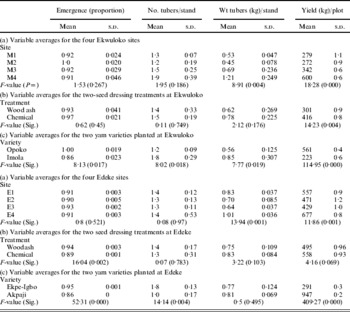
The results of an analysis of variance applied to the number of proportion of sprouted setts, harvested tubers/stand, weight of tubers/stand and yield/plot are shown in Table 1. Interaction terms were not significant and have been left out of the analysis. At both Ekwuloko and Edeke there was no significant difference in shoot emergence or number of tubers/stand between the sites. However, at both villages there was a highly significant difference in weight of tuber/stand and tuber weight/plot between sites, perhaps reflecting different local environments and management regimes. In terms of sett treatment, the pattern across villages was complex. The proportion of shoot emergence was the same for the ‘chemical’ and woodash treatments at Ekwuloko, but significantly higher for the woodash treatment at Edeke. Differences in the number and weight of tubers/stand were not significant in either village. However, the ‘chemical’ treatment resulted in a significantly higher tuber weight/plot in Ekwuloko. The ‘chemical’ treatments were not significantly different in tuber weight/plot in Edeke (P=0·069). However, the back-transformed means showed an increase in tuber weight/plot for the ‘chemical’ compared with woodash treatment was 38% in Ekwuloko and 13% in Edeke. This significantly higher yield for the chemical treatment relative to woodash was noted by the farmers who took part in the experiments. The smaller response to ‘chemical’ at Edeke probably arises in part from a ‘sterilization’ effect of the annual flood.
Results from the four-seed yam experiments at Ekwuloko and Edeke. Figures are back-transformed means and standard deviations

What was perhaps the most surprising result was that at both villages the variety that was least preferred by the farmers did well in terms of a number of the variables. At Ekwuloko, the Imola variety had greater numbers of tubers/stand and tuber weight/stand than the locally preferred Opoko, although shoot emergence was not as good. This was noted by the farmers at both villages and was clearly a matter of some surprise. Indeed, at the beginning of the experiments in Ekwuloko, one farmer (M1) noted how the Imola variety was so poor that it looked like ‘groundnut’ (a derogatory term implying small and shrivelled tubers) and went on to make further unflattering remarks. Later, the same farmer was astounded at how well Imola had done on his farm. At Edeke, the Akpaji variety had a lower emergence and number of tubers/stand relative to the preferred Ekpe-Igbo and weight of tubers/stand was the same for both. However, in terms of weight of tuber/plot, arguably the key variable as far as farmers are concerned, Imola did not do as well as Opoko in Ekwuloko although Akpaji did significantly outperform Ekpe-Igbo in Edeke.
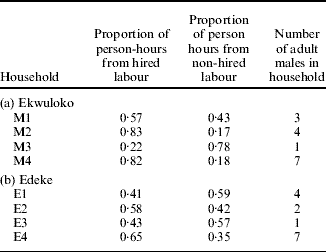
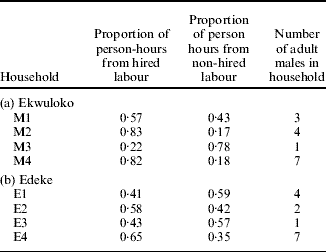
While yield/stand expressed in terms of tuber numbers and weights is important, Igala farmers are also interested in overall production and the inputs, particularly labour, required to generate such results. Labour is often a significant constraint in Igala agriculture. At Ekwuloko, it was possible to sub-divide some of the labour on a per sett treatment basis (woodash v. chemical), given that the work took place over 2 separate days. At Edeke, such separation between sett treatments was not possible as planting of all heaps took place on the same day. At Ekwuloko, hired labour is typically priced in terms of an hourly rate (c. N700 per 8 h), although there is some variation around this figure depending upon activity and urgency. Thus, at Ekwuloko it was possible to estimate reasonably well an imputed cost for household labour. At Edeke, this is far more complex as the rate is negotiated on a ‘per job’ basis rather than time and thus fluctuates significantly from task to task, field to field and depending upon urgency. Indeed, the proportion of labour from household members and from hired labour varied between the sites (Table 2). It is difficult to discern a pattern here, although it is notable that two of the Ekwuloko farmers (M2 and M4) employed a very high proportion (>0·8) of household labour while one (M3) employed the opposite strategy. In Edeke, there was a more even divide between household and hired labour inputs. Even though, the expenditure on labour across both villages and all sites is high, with figures of between N36000 (E1) and N117000 (E4).
Summary of labour inputs for the seed yam trials
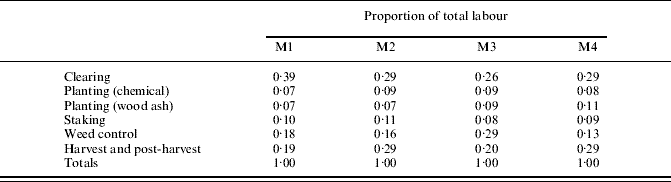
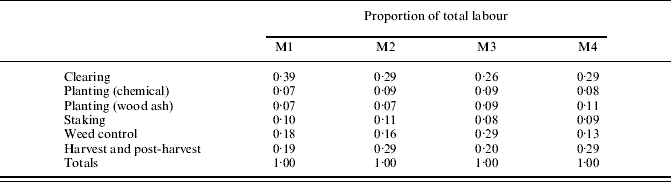
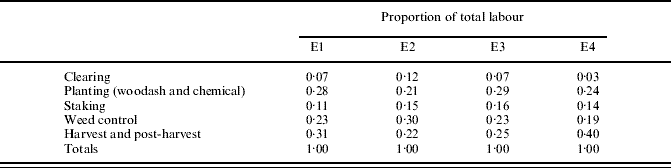
A summary of proportional labour input into activity headings is shown as Table 3. Most of the labour at Ekwuloko went into clearing the land (0·26–0·39) and harvesting (0·19–0·29). This is not surprising, given that yam in Ekwuloko tends to be planted into virgin land, or land that has long been in fallow. Thus, all four sites required substantial effort in terms of clearing. Harvesting yam is also labour-intensive, especially as it has to be brought to a place where the tubers can be stored safely without fear of theft. Harvesting includes the labour required for transporting the tubers and placing them into storage. Other notable labour demands are for weeding and staking (each 0·08–0·11 of total). At Edeke, clearing did not require much labour and this reflected the fact that the sites receive an annual flood that both replenish the soil and limit bush growth. At Edeke, the major labour inputs went into harvesting (0·22–0·4 of total), weeding (0·19–0·3 of total) and planting (0·21–0·29 of total). As for Ekwuloko, harvesting yam included the labour for transportation and storage. Farmers in Edeke tend to use larger heaps than Ekwuloko and also the land tends to be heavier and thus harder to cultivate. This would explain a higher proportion of labour going into planting at Edeke (0·21–0·29) than Ekwuloko (0·03–0·12).
Labour (person-hours) divided into activity groups of land clearing (includes packing of material), planting (includes construction of heaps), staking, weed control (includes application of herbicide) and harvesting and post-harvest. Figures are proportions of total person-hours
(a) Ekwuloko
(b) Edeke
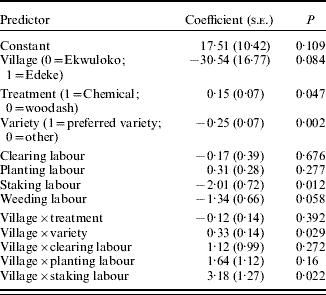
At this point, it is worthwhile investigating the main factors that influence yam production. Given there are only four sites at each of the two villages, this limits what can be achieved with statistical analysis, but even so a basic production function (Cobb–Douglas) does generate some interesting insights (Table 4). The four labour groups included in the analysis (clearing, planting, staking and weeding) are those that one would expect to have an influence on yield (kg/stand). ‘Harvest and post-harvest’ was not included as it was assumed these would be a function of production. Dummy variables have been included for village, treatment and variety. In the latter case, the analysis was simplified by allocating ‘1’ to the preferred variety (Opoko and Ekpe-Igbo) of each village and ‘0’ to the non-local variety (Imola and Akpaji). Some interaction terms for ‘village’ have also been included. The logarithm of all independent variables was taken to allow for a non-linear (diminishing return) form in the relationship between production and the various inputs. The model explains nearly 0·7 of total variation in yield. Both treatment and variety were important contributors. The results point towards a positive effect on yield coming from the use of ‘chemical’ dressing as opposed to woodash, and, surprisingly, the introduced varieties relative to the local preference. The important labour inputs were staking and weeding. Indeed the interaction term for village×staking was significant (P<0·05) and reflects the skill that the Edeke farmers put into this activity, using a specialized technique of bamboo stakes and rope trellis.
Results of a production function multiple regression applied to the yield per stand data from the Ekwuloko and Edeke seed yam plots
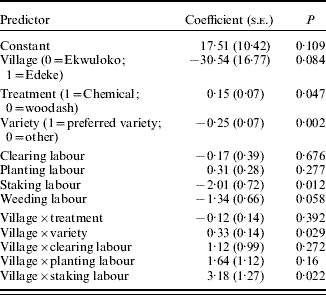
Adjusted R 2=0·69, F=6·69 (P<0·001), d.f.=12, 31.
Log production=function of log (village, treatment, variety, clearing, planting, staking, weeding).
- Production
kg/stand for plot.
- Treatment
1 (chemical) and 0 (wood ash).
- Variety
1 (locally preferred variety) and 0 (other variety).
- Clearing
labour (person hours) spent on clearing/parking of the site.
- Planting
labour (person hours) spent on construction of heaps, sett preparation, seed dressing and planting.
- Weeding
labour (person hours) spent on weeding (including application of herbicide) of the site.
- Staking
labour (person hours) spent on staking of the site.
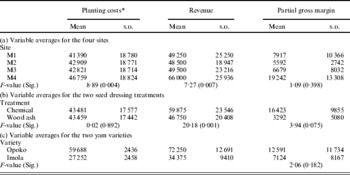
All of the seed yams produced at the Ekwuloko sites were sold in local markets, whereas at Edeke they were kept by the farmers. Thus, it was only possible to produce ‘real’ (as distinct from imputed) gross margins for the Ekwuloko sites. It also was possible to obtain revenues for the tubers produced from setts receiving the chemical and woodash treatment and the two varieties as these were sold separately at the request of the researchers. The mean revenues (back-transformed) are shown in Table 5 along with the cost of planting material, seed dressing (woodash was assumed to have a zero cost) and planting labour pooled together as ‘planting cost’. Also shown are mean ‘partial’ gross margins (revenue−planting cost) for sites, sett treatments and varieties. It is notable that revenue from the setts that had been treated with chemicals was significantly greater than that derived from woodash treated setts. The farmers claim that this was due to a combination of a higher yield and better quality. However, this increased revenue was not translated into a significantly higher partial gross margin for the chemical treatment, although the P value was 0·075. There was no significant difference in partial gross margin between the varieties although the Opoko variety did have a higher partial gross margin than Imola. Given the local popularity of Opoko and its greater market value this would be expected.
Partial gross margin for the four sites at Ekwuloko. Data are back-transformed means and standard deviations (s.d.)

* Includes cost of planting material, seed dressing (woodash assumed to have no cost) and planting labour (based upon an assumed hired labour rate in Ekwuloko of N700 for 8 h). The numbers of setts planted were 1200 for Opoko and 400 for Imola.
While the woodash/chemical treatment comparison is interesting, what matters from the farmers’ perspective is the gross margin of each site (Table 6). There are two components to this table. The first (a) shows the gross margin of each of the four sites based solely on recorded expenditure for hired labour. Household labour has been assumed to have a zero cost, and thus in effect this is what the farmers ‘saw’ in terms of financial gain or loss. All four sites showed a profit of between N9166 and N41366. However, one must consider the opportunity cost to the households of growing seed yam. If household labour is included and costed at N700/8 h (the typical rate for hired labour in Ekwuloko) only one of the sites (M4) returns a profit. The other three had losses of between N52347 and N14109. This is not a very encouraging finding. Yam is an expensive crop to grow and while the market price is high this clearly did not compensate for the cost.
Gross margins of the four Ekwuloko seed yam experiments based on actual and imputed labour costs
(a) Gross margin based on actual expenditure on labour (household labour assumed to be free)

(b) Gross margin based on estimated expenditure on labour (imputed household labour cost)

Wood ash and staking have been assumed to have zero cost.
Seed dressing is a mix of diazinon (Basudin) and mancozeb.
In (a) labour cost is the amount actually spent by the farmers on the site. Some of the labour was provided by the households and this has not been costed.
In (b) the imputed labour cost for household labour has been calculated from the person hours spent on each site with an assumption that the daily rate in Ekwuloko (N700) applies equally for all tasks.
Gross margin=revenue−total cost.
All costs are in Naira.
DISCUSSION
The results from the trial sites in Ekwuloko and Edeke provide cause for both optimism and pessimism. On the one hand, the experiments provide further confirmation that YMT does work (Iwueke et al. Reference Iwueke, Mbata and Okereke1983; Orkwor & Asiedu Reference Orkwor, Asiedu, Orkwor, Asiedu and Ekanayake1998) and the chemical treatment does improve yields compared with the traditional method of using woodash (Okoli Reference Okoli and Cock1986; Igwilo & Okoli Reference Igwilo and Okoli1988; Kalu et al. Reference Kalu, Norman, Pal and Adedzwa1989). There is evidence from Ekwuloko that this did translate into a better economic performance of the chemical treatment relative to woodash. It should be stressed that all the sites were entirely managed by the farmers under their local environmental and socio-economic conditions so the relative benefit of using chemical as a sett dressing should be durable. Unlike on-station trials, in the present experiments the farmers made the key decisions over site selection, labour inputs and marketing. The only artificial component was the use of herbicide, which was supplied by DDS and not costed in any of the budgets presented in the paper, and the purchase of yam planting material for all participating farmers by DDS. How effective the herbicide was at each of the sites was not recorded and it can be assumed that the effect was not significant, given that each of the sites had to be weeded by hand on three occasions. There is no evidence to suggest that the price paid by DDS for the planting material was overly high or low, and while the farmers may have done better or worse it can be reasonably assumed that the price paid by DDS was realistic.
It was also interesting to note the good performance of the ‘non-local’ varieties at the villages and this was a surprise to the farmers. Imola is a popular variety in many parts of Igalaland and it was somewhat surprising that the Ekwuloko farmers were not aware of it. At the time of writing the present paper, Imola has become more widespread in Ekwuloko, adding to varietal diversity. In Edeke, the Akpaji variety did well in terms of tuber weight/stand and tuber weight/plot relative to Ekpe-Igbo, but unlike Imola in Ekwuloko, Akpaji is a variety well-known to the Edeke farmers. Akpaji is a ‘non-local’ variety in the sense that it is not the preferred local variety and indeed at the time of writing Ekpe-Igbo retains its preferred status.
Less positive was the economic performance of the seed yam sites taken as a whole. If household labour is not costed, then all four sites at Ekwuloko did indeed make a profit. The size of that profit varied substantially between the sites, with the worst being M2, largely because of a relatively high cost of hired labour compared with revenue, and the best being M4. The latter was largely a function of excellent revenue. However, discounting household labour is problematic as it does ignore opportunity cost. Households can put their labour into a number of farm and off-farm activities and there may well be alternatives to using YMT for growing clean seed yams that have less risk or are less arduous. Indeed, yam itself is but one option open to these generalists. When household labour is fully costed, three of the sites made a net loss and only one made a profit, although the returns on investment are better than the −50% reported by Ezeh (Reference Ezeh, Ofori and Hahn1991) for his YMT on-station trials. In Ekwuloko, the returns on investment varied from 5 (best) to −21% (worst). Even so, it has to be said that the results are in broad alignment with those of Ezeh (Reference Ezeh, Ofori and Hahn1991) and suggest that this technique hardly seems a solid basis for an economically sustainable clean seed yam production system. Indeed interviews with the Ekwuloko farmers suggest that while they are continuing to use the minisett technique it is on a much smaller scale than that of these experiments and unfortunately some farmers are still growing seed yams in the conservation area (an illegal activity).
While an economic analysis comparable to that of Ekwuloko was not possible in Edeke, given that the farmers kept all of their seed yams for planting, it should be noted that the YMT was not unfamiliar to them. Indeed these yam specialists are well aware of the technique as YMT is simply a recent evolution of a traditional technique in Southern Nigeria. All of the farmers taking part in the trials expressed delight at the yields they had achieved, and all of them have continued using the technique. It was almost as if the trials provided a reminder of what could be achieved. These findings therefore support the somewhat ‘patchy’ nature of the reported uptake of YMT in Nigeria (Agbaje & Oyegbami Reference Agbaje and Oyegbami2005). Broad-based surveys will include farmers who are yam specialists, such as those in Edeke, and others who are less so, such as the farmers in Ekwuloko.
CONCLUSION
The encouragement of clean seed yam production does have an undeniable logic as it would help break the cycle of pests and pathogens being reintroduced to land. In theory, YMT could be a way to help achieve this end, given that yam tubers are expensive. However, the results from the farmer-managed trials in Ekwuloko and Edeke suggest that this is not straightforward. For non-specialist yam producers, the YMT approach does not appear to be economically viable once household labour is costed. For those farmers that do specialize in yam, the YMT technique allied with the use of chemical sett dressing does have benefits. Perhaps the problem is with the assumption at the heart of extension programmes and follow-up surveys that all farmers should adopt YMT rather than allowing for diversity and the reality that some farmers are yam specialists while others are not.
The authors would like to begin by acknowledging the support of the late Bishop of Idah Diocese, Dr E. S. Obot. Within DDS, there are many who deserve mention including Remigius Ikkah, Gerard Obaje, Raphael Akubo, Clement Agada, Sunday Onakpa, Stephen Okanebu and Sr Felicitas Ogbodo. Dr A. Claudius Cole, Dr Danny Coyne and their colleagues at the International Institute of Tropical Agriculture have been of immense help and Dr Lawrence Kenyon also deserves a special thank you. This work was partly funded by the Department for International Development (DFID) of the UK (ZA0566). The views expressed in this paper are the views of the authors and not necessarily the views of DFID.